


 Скачать презентацию The Case for a Light Footprint The international
8e8001210b6f329ee43a6c607e31a64a.ppt
- Количество слайдов: 27
 The Case for a Light Footprint. The international project in Afghanistan Astri Suhrke, SOAS 17 March 2010
 Structure of involvement • • Towards 130 000 NATO and allied forces 8 -10 bill USD in aid a year 60 donors and 37 troop contributing countries parallel structures – international advisors ubiqtuous – external budget (2/3 of funds) • COIN: military and civilian ’surge’ to defeat ’the enemy’ and provide ’government in a box’ (General Mc. Chrystal)
 Status • 8 years of investment in money and lives have brought expanding armed conflict and risk of ’losing the war’ (Mc. Chrystal August 09) • some positive development indicators (health/education/NSP/ roads)’ but growing insurgency, corruption, poor governance, aid bubble • comparisons with other ill-fated interventions increasingly common (Vietnam, Soviet in Afghanistan) • need a ’surge’ to exit
 Key questions • How did we get to where we are today – given that we started from a ’light footprint’? – ’disjointed incrementalism (quagmire) – ’march of folly’ (Tuchman) – deliberate policy design/ rational actor • What does the result tell us about the limitations/contradictions of a ’liberal internationalism • Alternative policy options at this point?
 The first, light footprint • October-November 2001: disinterest/caution/ – US: military engagement • don’t follow Soviet path, use Afghans’ • ’let the UN handle the rest’ (Bush/Powell 2001) – UN: fears of another Somalia, but narrative of collective responsibility in Afghanistan – Brahimi: self-determination on principle and in practice -Afghanistan unruly/unfriendly territory -Soviet experience -Afghan transitional administration prerequisite for aid -Afghan, not international, security force in Kabul
 The aid regime moves in • • • The pledging conferences – Tokyo 2002 (8. 2 bill), Berlin 2004 (8. 2 bill), London 2006 (10. 4 billion), Paris 2008(20 bill/ANDS) Aid agencies, INGOs and NGOs emphasize direct execution – lack of local capacity – massive needs – massive donor money on the horizon Afghan Ministry of Finance fighting to establish control – dilemma of funds inflow vs building capacity – 2004: capitulates w/external budget
 Momentum towards a heavier aid footprint • Under-estimating task of reconstruction and ’state-building’ • Problem-solving: ’more of same’ – increase international resources rather than adjusting course. Why? – Ideology of liberal internationalism • Lingering optimism of Bonn – Huge needs vs limited local capacity – Organizational vested interests – Control imperative – Political scrutiny at home – Military lobby for ’comprehensive approach’ (2005/6) – Limited imagination?
 Military escalation • ISAF expansion from Kabul to provinces – aid actors support to provide security for programs – UN Mission supports; buoyed by welcome of ISAF in Kabul – allies support as least difficult option (PRTs) • ISAF/PRTs expand in size and function, merging command structure with other forces into unified NATO command • OEF force expansion to fight ’AQT’ • Merging ISAF/OEF command – 130 000 (over Soviet)
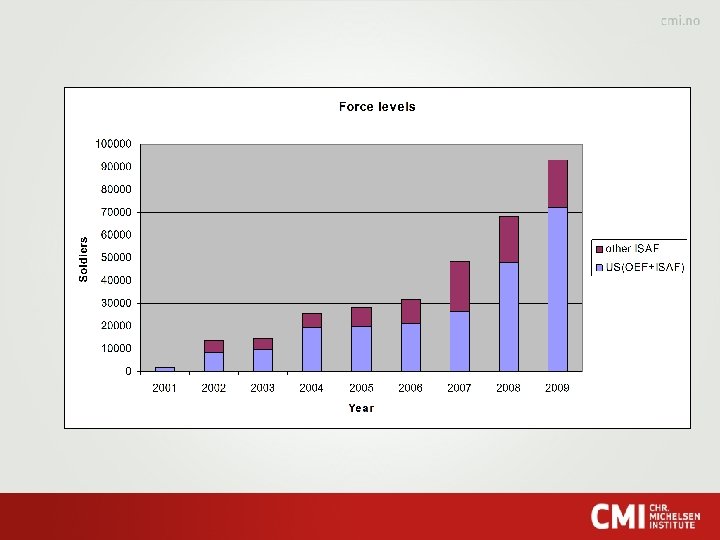
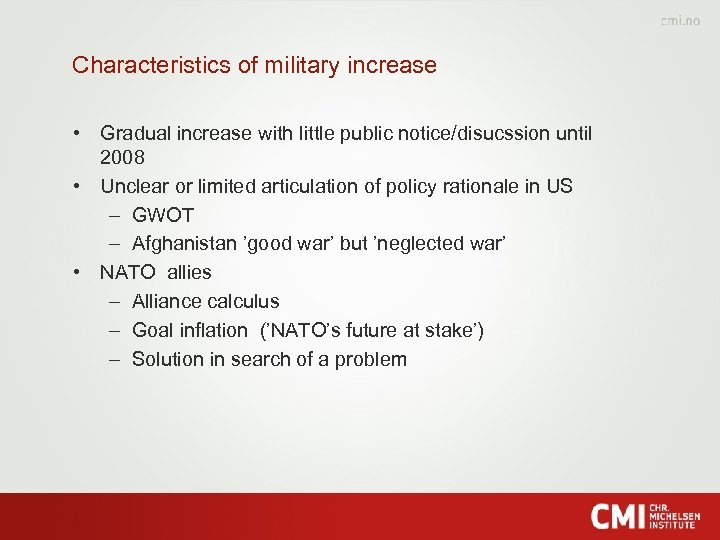 Characteristics of military increase • Gradual increase with little public notice/disucssion until 2008 • Unclear or limited articulation of policy rationale in US – GWOT – Afghanistan ’good war’ but ’neglected war’ • NATO allies – Alliance calculus – Goal inflation (’NATO’s future at stake’) – Solution in search of a problem
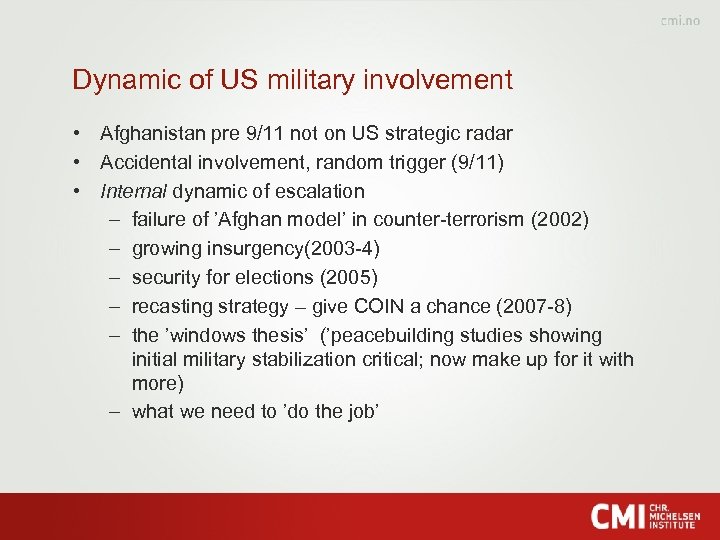 Dynamic of US military involvement • Afghanistan pre 9/11 not on US strategic radar • Accidental involvement, random trigger (9/11) • Internal dynamic of escalation – failure of ’Afghan model’ in counter-terrorism (2002) – growing insurgency(2003 -4) – security for elections (2005) – recasting strategy – give COIN a chance (2007 -8) – the ’windows thesis’ (’peacebuilding studies showing initial military stabilization critical; now make up for it with more) – what we need to ’do the job’
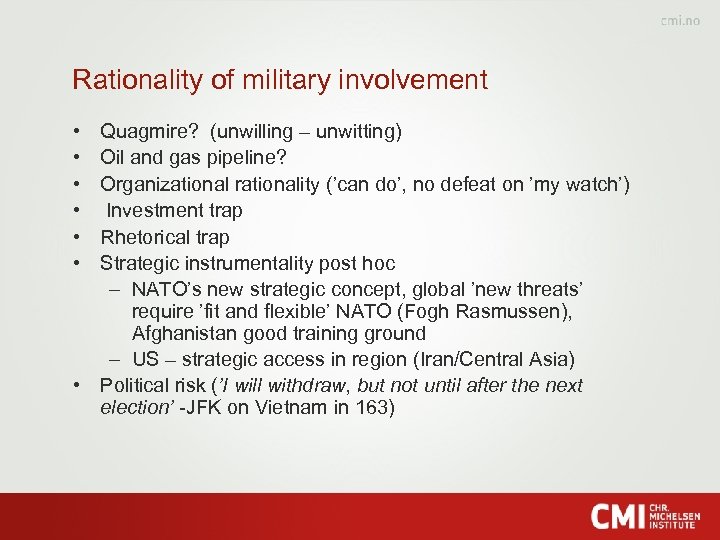 Rationality of military involvement • • • Quagmire? (unwilling – unwitting) Oil and gas pipeline? Organizational rationality (’can do’, no defeat on ’my watch’) Investment trap Rhetorical trap Strategic instrumentality post hoc – NATO’s new strategic concept, global ’new threats’ require ’fit and flexible’ NATO (Fogh Rasmussen), Afghanistan good training ground – US – strategic access in region (Iran/Central Asia) • Political risk (’I will withdraw, but not until after the next election’ -JFK on Vietnam in 163)
 The surge decision • • March 2009 – Obama opens for AQ vs Taliban distinction; debate on COIN versus counter-terrorism goes public December 2009 surge decision, clarity of March speech gone. Unclear rationale – who is the main enemy and why? – additional forces more likely to suceed than previous increases? – if main enemy AQ now in Pakistan, why fight Taliban rather than split them off? – if train Afghan forces, who is their enemy? Part of a ’bargaining from strength’ strategy – if so, why undercut by saying withdrawal by mid-2011?
 The political anatomy of the surge • Surge only makes sense as a political not strategic decision – – – second-term president defend against the conservatives at home protect legislation in Congress do what is minimally necessary low risk ’on my watch’
 Meta-logic of US involvement • George Kennan’s prehistoric beast • Miltarization of foreign/national security policy (Bacevich) – Culture, professional military ’caste’, milindustrial complex, Wilsonian idealism – [structure of U. S. capitalism] – Afghan engagement totally irrationality in terms of US ’national interests’
 Levels of rationality • Partial/fragmented rationality (political, organizational) • Internal dynamic of intervention towards goal expansion and deepening involvement • Limits policy options and increases risk: – deepening involvement limits future choices at each juncture – investment trap (defend what have done/investment) – rhetoric trap (increased the stakes to justify involvement) • Increasing political costs of eventual defeat/compromise
 Will ’it’ work? • Unclear/multiple objectives (statebuilding, democracy, WHAM, reconstruction, rights-based development) • ’State-building’ – reasonably effective and legitimate state – key to other objectives • International project of statebuilding weakened by five contradictions
 # 1 Control vs ownership • Strong external demand for control over policy • ambitious policy objectives • limited or ”irrelevant” local capacity • high stakes (NATO’s future) • time constraint (political will at home uncertain) • bureaucratic/political demands for result • Strong Afghan demands for ’ownership’ • ideological framework • material-political benefits • Contradictions play out on all levels • Project, subnational admin/appointment, national policy)
 #2 Dependenc vs sustainability • external aid – overwhelming national legal resources • 90 -95% of all state and development expenditures • 70 percent of recurrent expenditures in state -controlled budget – present ’rentier state’ unprecedented in Afghan history • incl Daoud and Soviet period • rentier states tend to collapse with loss of aid
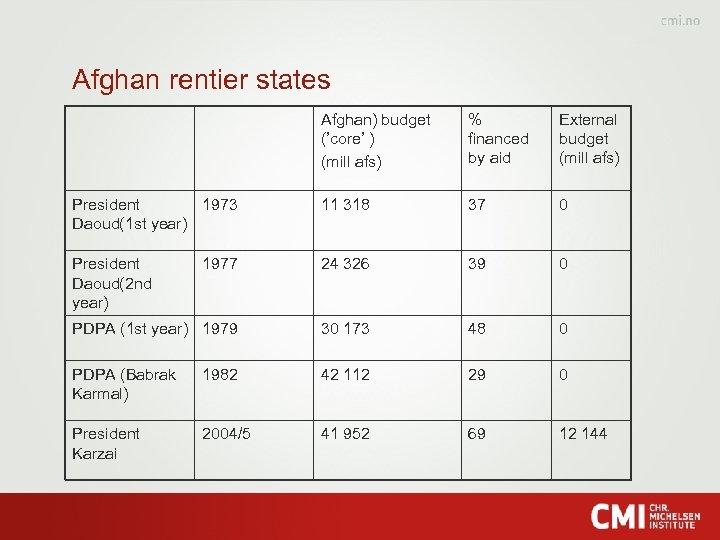 Afghan rentier states Afghan) budget (’core’ ) (mill afs) % financed by aid External budget (mill afs) President 1973 Daoud(1 st year) 11 318 37 0 President Daoud(2 nd year) 1977 24 326 39 0 PDPA (1 st year) 1979 30 173 48 0 PDPA (Babrak Karmal) 1982 42 112 29 0 President Karzai 2004/5 41 952 69 12 144
 #3 Dependence vs legitimate state The rentier state • weakens local political accountability and representation – lowers incentives for local accountability – marginalizes elected/parliamentary structures – patron-client relations structured towards donors – donor priorities take precedence – salutary effects of domestic taxation reduced
 # 4 Effective vs legitimate state • heavy external hand may increase state efficiency • but – weakens traditional and historically important sources of legitimacy (nationalism/Islam) – generates opposition on nationalist, religious, conservative ground – feeds into the insurgency • legitimacy of external aid limited - utilitarian (’social contract) • elections as secondary source of legitimacy for state – external and manipulated by all
 Cross-cutting contradiction: Building the ANA • Armed forces central to historical process/projects of statebuilding • Increase of ANA now ’dramatic’ relative to earlier plans and periods: 130 00/300 000 by 2013 (or before) • Problems: – nationally unsustainable (WB: 70 00 goal ’unsustainable) – extreme dependence on foreign funds undercuts national legitimacy in country and region (whose army? what purpose? ) – unlikely to foster a democratic/legitimate state when civilian institutions weak (Afghan army in two previous coups, ’ 73+’ 78)
 The multiplier effect The ongoing war intensifies the contradictions in the statebuilding project – pressure for more and faster result – pressure for more external control/direction/presence – military objectives/institutions favored – collateral damage and foreign troop presence used by adversaries to undermine legitimacy of Afghan government and state
 What to do? • More-is-more: counsel of reinvestment – more foreign funds, consultants, troops • Strengthen contradictions in short run – Possibly overcome in the long run if sufficient • funds&consultants to reform the state, drive out the black economy, • foreign troop to work with ANA on training and COIN – Practically feasible? (to date, more-strategy produced modest results) – Politically feasible? To succeed will require such foreign presence as to be de facto trusteeship? (’shared sovereignty’)
 Alternative: • Pull back to reduce contradictions and conflictual consequences of heavy presence – military strategy • reduced NATO presence in provinces, cease offensive operations • give space for Afghan political dynamic/pragmatism – political strategy • reduce our interference in ’the political marketplace’ – counter narrative/chance of ’renewed civil war’ • military: international stabilization of capital • political: devolution of power to provinces - insurgency: - National framework for some power-sharing and local-level deals or change of power structure
 Ideals and interests • • Ideally: transition needs regional buy-in In practice: partial , continuous process Long-term: more important to accommodate interests of regional states than Western powers Long-term Western interests in Afghanistan? – Humanitarian and development assistance – Moral/political obligations to facilitate transition to lower levels of violence and framework for Afghan autonomous development – More cost-effective and focused counter-terrorist policies – Taliban can be our allies, not enemy