


 Скачать презентацию The Care and Feeding of Linear Amplifiers Marc
4df2a66701b0a34c78efb10eb5c36ca8.ppt
- Количество слайдов: 19
 The Care and Feeding of Linear Amplifiers Marc C. Tarplee, Ph. D. N 4 UFP ARRL Technical Coordinator South Carolina Section
 What Is A Linear Amplifier? • In amateur radio parlance, a linear amplifier (also known as a linear or a brick) is an RF amplifier designed to amplify the output of a transmitter to a higher power level without introducing distortion. • Linear amplifiers are available for frequencies from 1. 8 MHz to above 1 GHz. • Linear amplifiers may have an output power of 20 to 1500 W PEP
 Why use a linear amplifier? • Working DX on the lower HF bands and 160 m may require high transmitter power to get through the high level on noise on these bands. • Certain modes, such as EME, have very high path losses (> 200 d. B) and high power is required to make a contact.
 Types of Linear Amplifiers • Solid State – Active device is a power BJT or MOSFET – Available in powers of 20 – 1000 W – Commercially available for any amateur band (1. 8 – 1296 MHz and higher) • Vacuum Tube – Active device is a triode or tetrode vacuum tube – Available in powers of 300 – 1500 W – Commercially available for amateur frequencies between 1. 8 MHz and 144 MHz
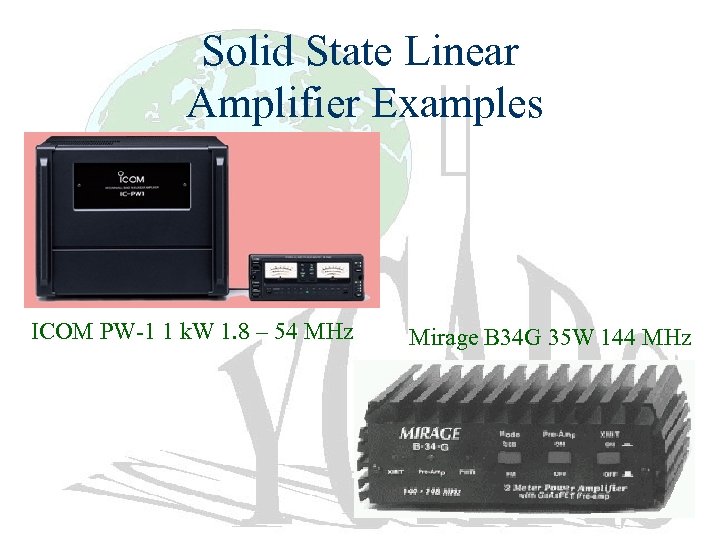 Solid State Linear Amplifier Examples ICOM PW-1 1 k. W 1. 8 – 54 MHz Mirage B 34 G 35 W 144 MHz
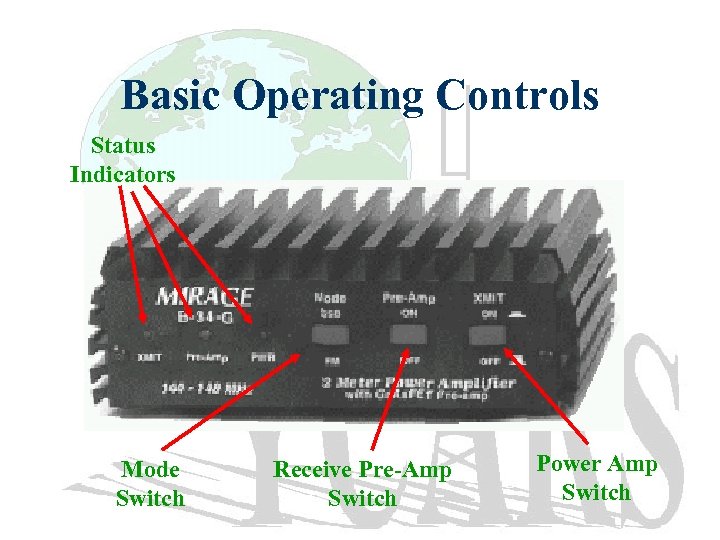 Basic Operating Controls Status Indicators Mode Switch Receive Pre-Amp Switch Power Amp Switch
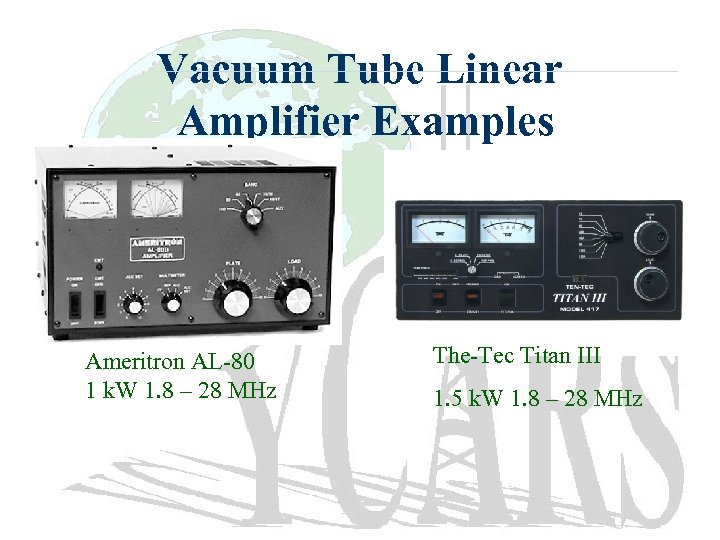 Vacuum Tube Linear Amplifier Examples Ameritron AL-80 1 k. W 1. 8 – 28 MHz The-Tec Titan III 1. 5 k. W 1. 8 – 28 MHz
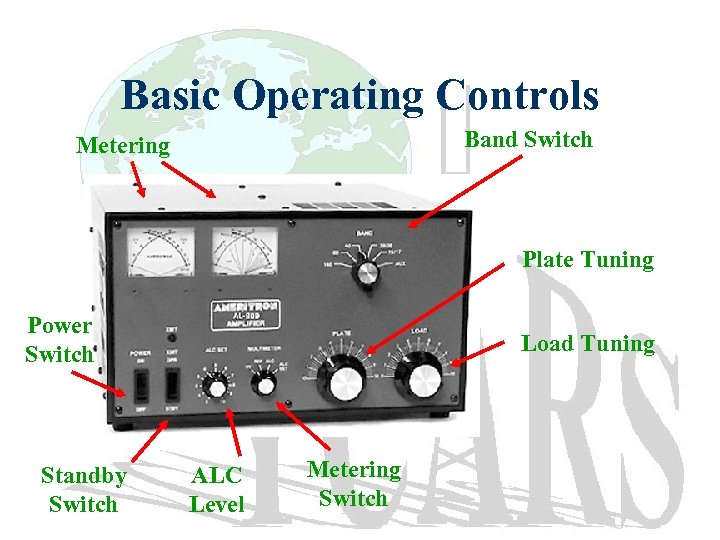 Basic Operating Controls Band Switch Metering Plate Tuning Power Switch Standby Switch Load Tuning ALC Level Metering Switch
 Solid State Linear Amplifier (Brick) • Advantages – Requires no adjustments when changing frequencies within the amplifier’s design range – Generally RF switched – Generally include a receive pre-amp • Disadvantages – Requires high current (20 – 140 A) LV DC power supply – Designed to operate into a 50 ohm load – Relatively expensive ($1 - $4 per W )
 Vacuum Tube Linear Amplifier • Advantages – Requires no external power supply – Can operate into a wide range of loads (30 – 150 ohms) – Relatively inexpensive ($1 - $2 per W) • Disadvantages – Requires adjustments when operating frequency is changed, even within a band. – May some sort of external TR switching relay – Difficult to find for frequencies above 28 MHz
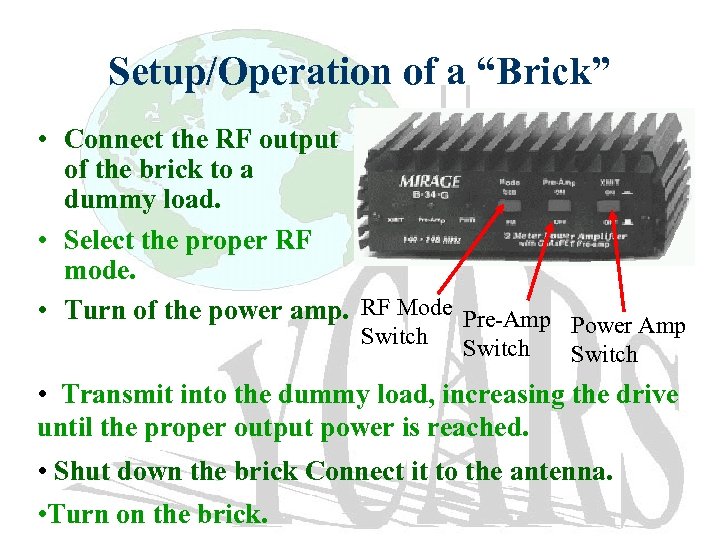 Setup/Operation of a “Brick” • Connect the RF output of the brick to a dummy load. • Select the proper RF mode. • Turn of the power amp. RF Mode Pre-Amp Power Amp Switch • Transmit into the dummy load, increasing the drive until the proper output power is reached. • Shut down the brick Connect it to the antenna. • Turn on the brick.
 But it’s not working…. . • Is the DC power supply connected? ? • Check to make sure that the SWR at the RF output of the brick is below the maximum allowable value (typically 1. 5 to 2. 0) • Check to make sure that the proper mode is selected. Trying to operate SSB in the FM mode can create problems.
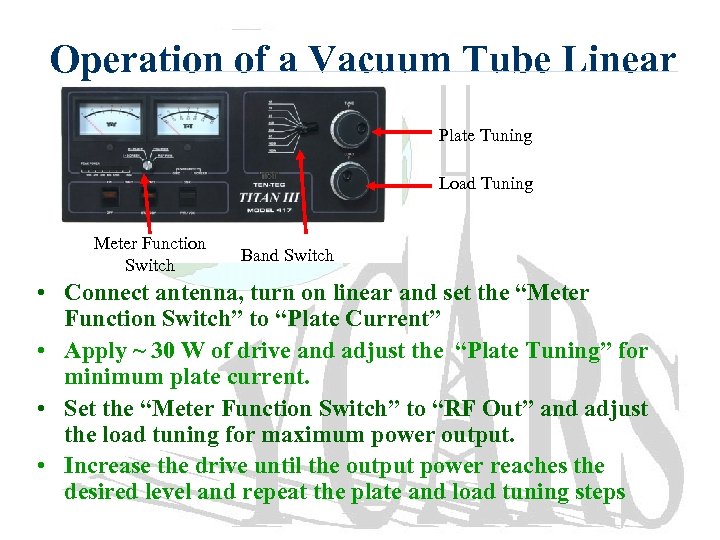 Operation of a Vacuum Tube Linear Plate Tuning Load Tuning Meter Function Switch Band Switch • Connect antenna, turn on linear and set the “Meter Function Switch” to “Plate Current” • Apply ~ 30 W of drive and adjust the “Plate Tuning” for minimum plate current. • Set the “Meter Function Switch” to “RF Out” and adjust the load tuning for maximum power output. • Increase the drive until the output power reaches the desired level and repeat the plate and load tuning steps
 I tried all that and it didn’t work…. • Check to make sure the antenna is connected. • If the plate current does not show a dip and the antenna is OK, one of the amplifier tubes may be bad. • Use the amplifier’s metering to check the output of the HV supply. No HV = no RF output! • Check the antenna impedance. A vacuum tube linear cannot generally match impedances less than 30 or greater than 150 ohms. • Make sure that the amp is in the right mode (CW/SSB)
 Which Amplifier Should I buy? • If money is no object, it is hard to beat a good solid state linear amplifier for HF/VHF work. • If money is a concern, vacuum tube linear amplifiers are widely available on the used market at prices as low as $0. 75 per W.
 Selecting A “Brick” • Decide whether or not a receive pre-amp is important – this can add significantly to the cost of the brick. • Make sure that the brick’s output will not exceed the rating of the antenna or any mast-mounted pre-amps • Remember that a DC power supply will also need to be purchased. The power supply can be sized according to the following equation: • I = Pout/6. 3 • Good bargains – Mirage units and rf. Concepts units for VHF/UHF, Ameritron ALS-600 (w/pwr supply)
 Selecting A Vacuum Tube Amp • Triode Amplifiers – – Generally grounded grid design Do not require neutralization (unconditionally stable) Gain limited to 10 - 12 d. B Triode transmitting tubes are very robust (and relatively inexpensive) • Tetrode Amplifiers – May require neutralization – Gain can reach 20 d. B – Tetrodes may be destroyed by excessive grid current • Sweep Tube amplifiers – Gain limited to ~ 6 – 8 d. B – Sweep tubes can be destroyed by full duty cycle operation (FM, RTTY, PSK 31, even CW) • Best bang for the buck – grounded grid triode linear such as an SB-200, SB-220, TL-922 A
 For More Information • Linear Amplifier Design – http: //www. cpii. com/eimac/PDF/C&F 2 Web. pdf • HF Linear Amp Construction – http: //users. knoware. nl/users/veldman/frans/english/hflinear. htm – http: //i 5 uxj-2. cln. it/amp/hfamp. html • VHF/UHF Linear Amp Construction – http: //www. qsl. net/dl 4 mea/2 g 35. htm – http: //www. svetlana. com/docs/Tech. Bulletins/technote. No 42. html
 Demo Time! • We will get some hands-on experience tuning the club’s Kenwood TL-922 A linear amplifier. • Letting the smoke out of any of the components is not an acceptable outcome!