 Скачать презентацию The Cambridge Phenomenon The Power of Networking in
bde636be9af352ffa49e6326fa2dd142.ppt
- Количество слайдов: 70



“The Cambridge Phenomenon” “The Power of Networking in Regional Economic Development” 28 th Conference on Entrepreneurship and Innovation – Maribor March 27 2008 Professor Alan Barrell Slide 1
Agenda and Context • • • In the Beginning ( or close to it ! ) Chronology of Discovery - Greatness remembered 1960 – The seeds of CHANGE…. The Columbus Spirit Inspired by Heroes – The Spirit of Enterprise and the Evolution of Networking Another Chronology – Another Culture Diversity and Convergence – NOT a paradox…. Liberated Minds and “Worldthink” Coherence and Support Structures – A World of Networks Sustaining Economic and Social Development – Beyond Bureaucracy Empowering the Next generation – Looking ahead Slide 2
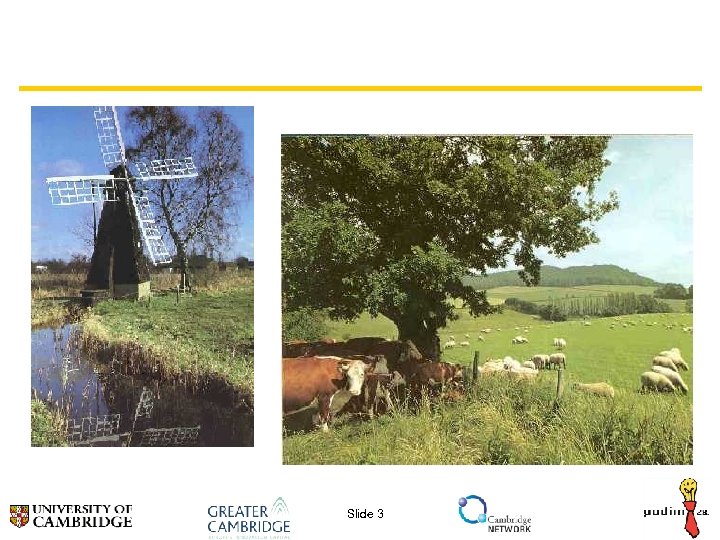
Slide 3
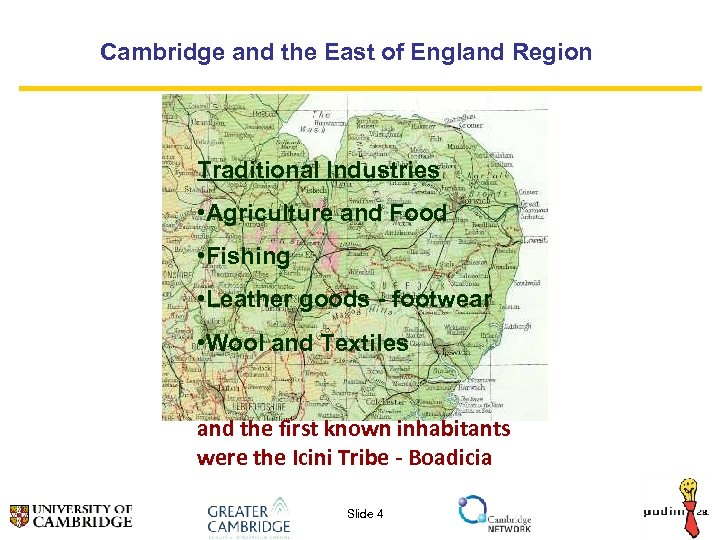
Cambridge and the East of England Region Traditional Industries • Agriculture and Food • Fishing • Leather goods - footwear • Wool and Textiles and the first known inhabitants were the Icini Tribe - Boadicia Slide 4
Slide 5
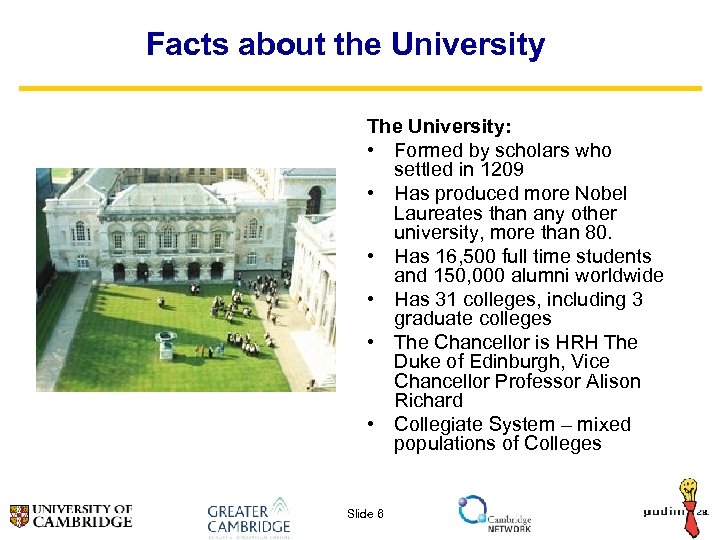
Facts about the University The University: • Formed by scholars who settled in 1209 • Has produced more Nobel Laureates than any other university, more than 80. • Has 16, 500 full time students and 150, 000 alumni worldwide • Has 31 colleges, including 3 graduate colleges • The Chancellor is HRH The Duke of Edinburgh, Vice Chancellor Professor Alison Richard • Collegiate System – mixed populations of Colleges Slide 6
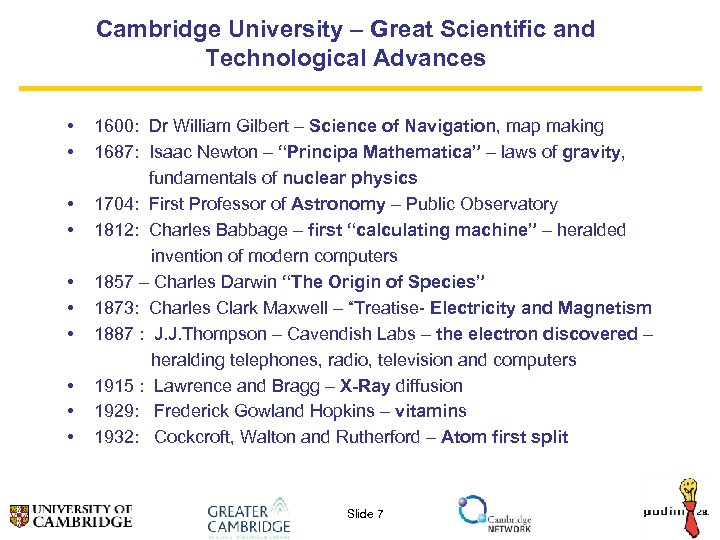
Cambridge University – Great Scientific and Technological Advances • • • 1600: Dr William Gilbert – Science of Navigation, map making 1687: Isaac Newton – “Principa Mathematica” – laws of gravity, fundamentals of nuclear physics 1704: First Professor of Astronomy – Public Observatory 1812: Charles Babbage – first “calculating machine” – heralded invention of modern computers 1857 – Charles Darwin “The Origin of Species” 1873: Charles Clark Maxwell – “Treatise- Electricity and Magnetism 1887 : J. J. Thompson – Cavendish Labs – the electron discovered – heralding telephones, radio, television and computers 1915 : Lawrence and Bragg – X-Ray diffusion 1929: Frederick Gowland Hopkins – vitamins 1932: Cockcroft, Walton and Rutherford – Atom first split Slide 7
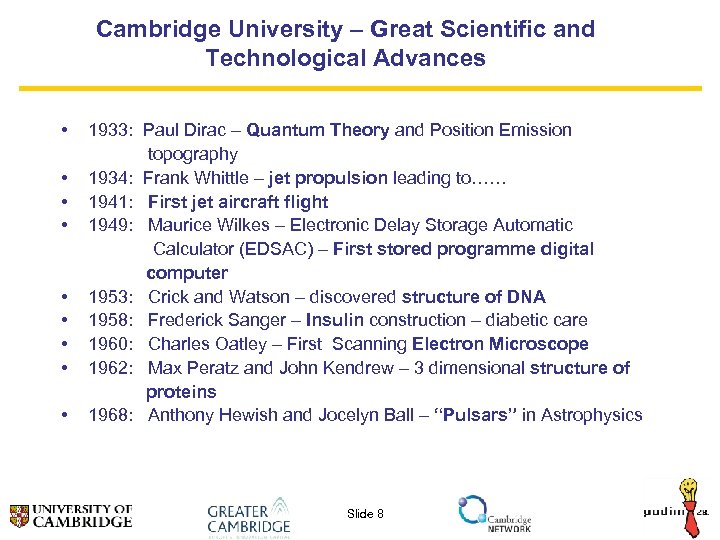
Cambridge University – Great Scientific and Technological Advances • • • 1933: Paul Dirac – Quantum Theory and Position Emission topography 1934: Frank Whittle – jet propulsion leading to…… 1941: First jet aircraft flight 1949: Maurice Wilkes – Electronic Delay Storage Automatic Calculator (EDSAC) – First stored programme digital computer 1953: Crick and Watson – discovered structure of DNA 1958: Frederick Sanger – Insulin construction – diabetic care 1960: Charles Oatley – First Scanning Electron Microscope 1962: Max Peratz and John Kendrew – 3 dimensional structure of proteins 1968: Anthony Hewish and Jocelyn Ball – “Pulsars” in Astrophysics Slide 8
Cambridge University – And Discoveries and initiatives in more recent years • • 1974: 1982: 1985: 1992: Immuno-suppression in transplantation surgery–Roy Calne Aaron Klug – molecular biology, viruses and RNA Cesar Milstein – monoclonal antibodies Richard Friend and team – Cavendish labs – light emitting and conductive polymers – “Plastronics” • 1996: Human Genome Project at Sanger Centre – results of decades of international research • 2006: Population Health Genetics Foundation ( PHG ) founded • 2007: Joint Venture – Cambridge University – China Pharmaceutics Research Centre –) Traditional Chinese Medicine (TCM Slide 9
BUT…. Cambridge in 1960 • • Medieval City Great University and Seat of Learning Farmers Not much Industry Lots of Bicycles Entrepreneurs …. . ? Who wants CHANGE ? ? Slide 10
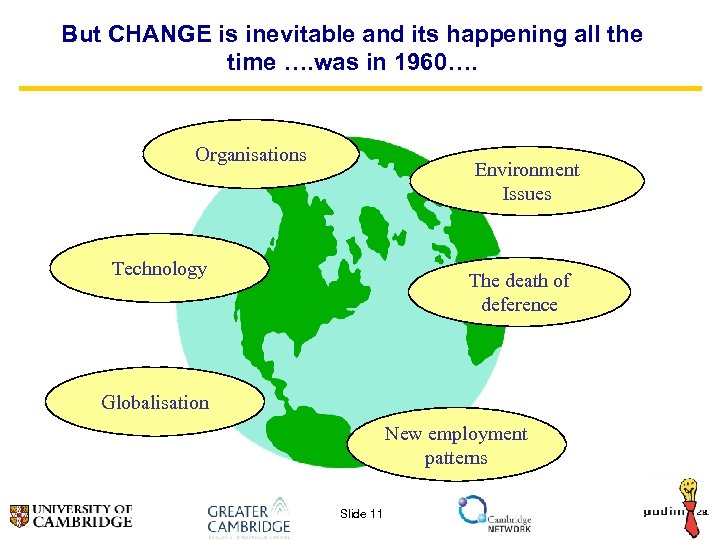
But CHANGE is inevitable and its happening all the time …. was in 1960…. Organisations Environment Issues Technology The death of deference Globalisation New employment patterns Slide 11
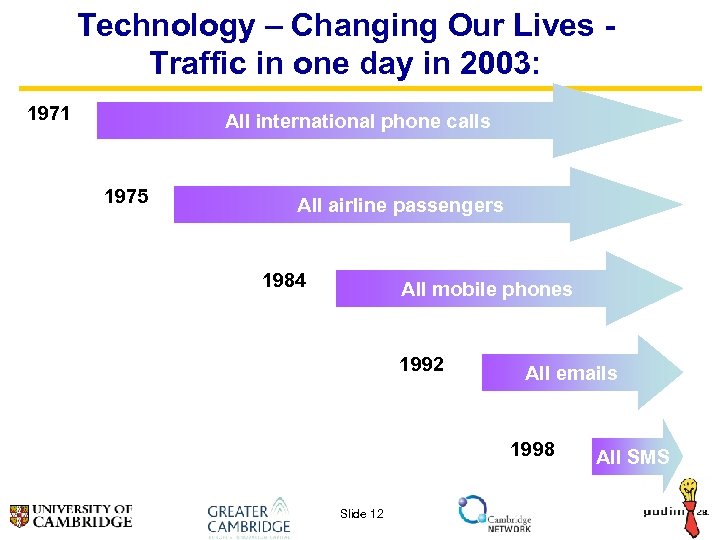
Technology – Changing Our Lives Traffic in one day in 2003: 1971 All international phone calls 1975 All airline passengers 1984 All mobile phones 1992 All emails 1998 Slide 12 All SMS
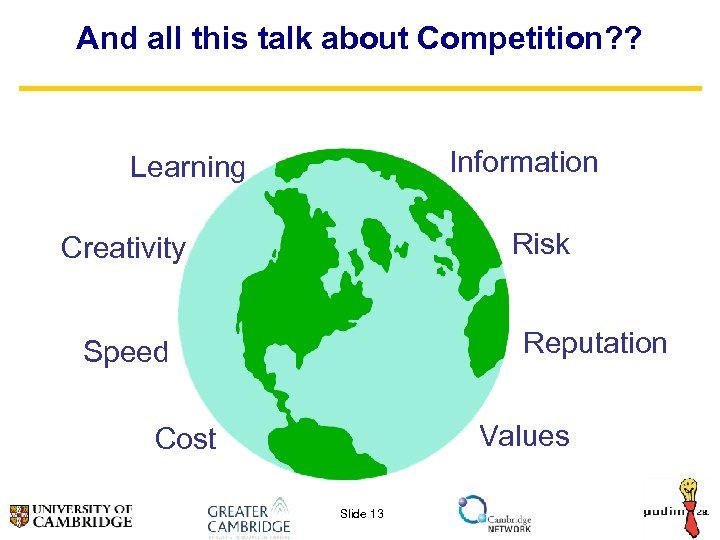
And all this talk about Competition? ? Information Learning Risk Creativity Reputation Speed Values Cost Slide 13
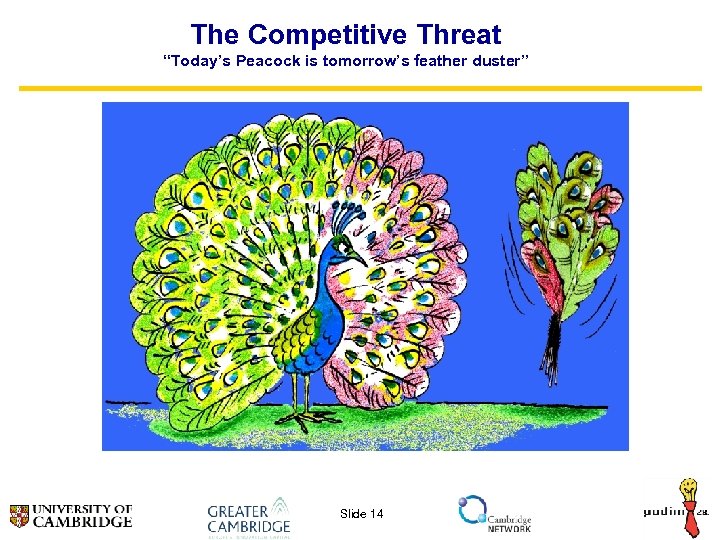
The Competitive Threat “Today’s Peacock is tomorrow’s feather duster” Slide 14
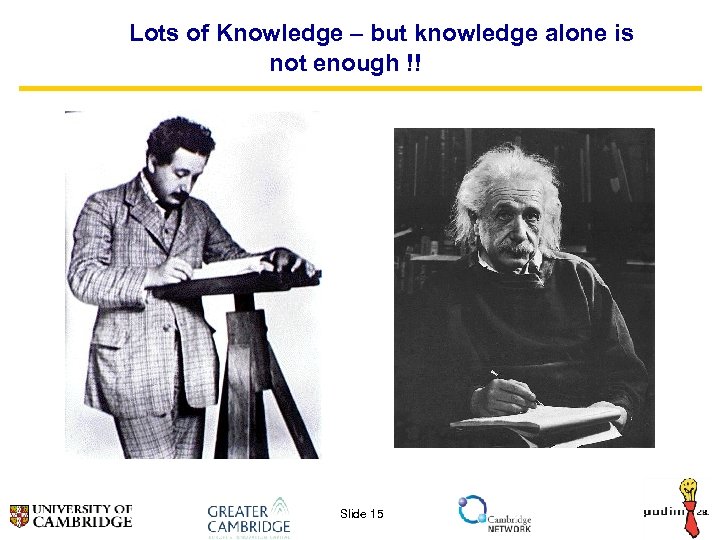
Lots of Knowledge – but knowledge alone is not enough !! Slide 15
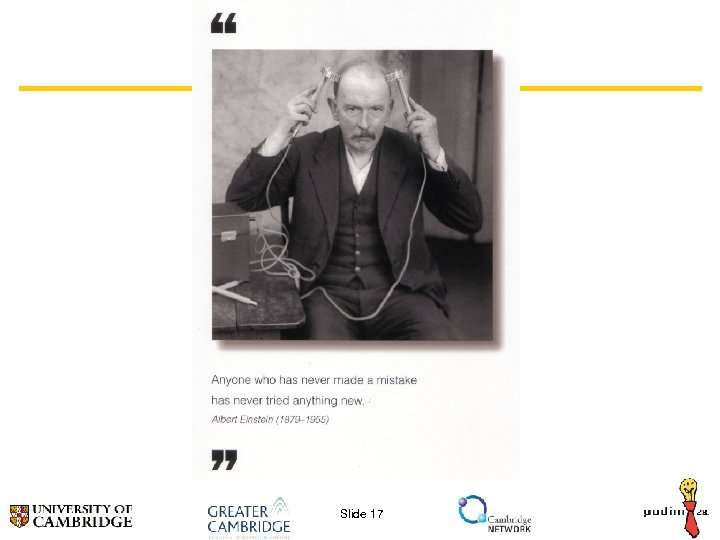
Why is Knowledge not enough ? . . “Imagination is more important than knowledge. Knowledge is limited. Imagination encircles the world” Albert Einstein 1879 - 1955 Slide 16
Slide 17
Slide 18
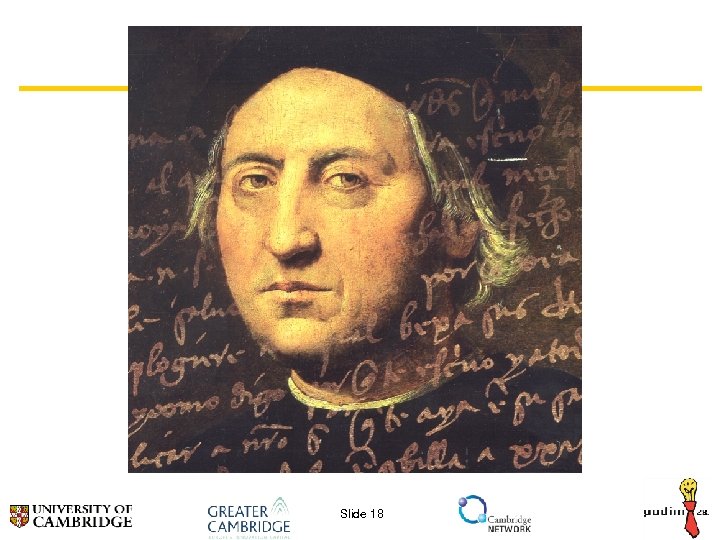
The “Columbus Spirit” – Exploration, Risk and Adventure…. Not Forgetting…. • Wisdom – “acknowledging what we don’t know – and exercising judgement” • Having Vision • Innovation – Vision into Reality • Research put to USE – for mankind’s benefit • Exploiting and Protecting • Sharing, Synergy and Symbiosis • Liberating minds • Exploiting Cultures and Diversity • Power of People and “Worldthink” Slide 19
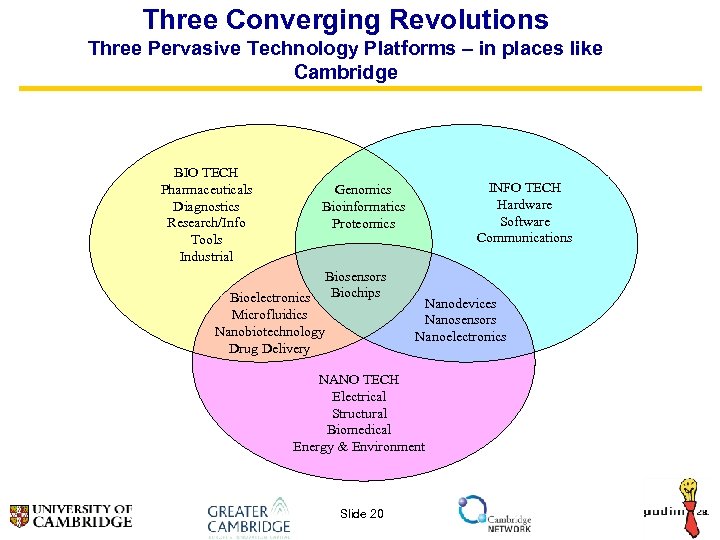
Three Converging Revolutions Three Pervasive Technology Platforms – in places like Cambridge BIO TECH Pharmaceuticals Diagnostics Research/Info Tools Industrial INFO TECH Hardware Software Communications Genomics Bioinformatics Proteomics Bioelectronics Microfluidics Nanobiotechnology Drug Delivery Biosensors Biochips Nanodevices Nanosensors Nanoelectronics NANO TECH Electrical Structural Biomedical Energy & Environment Slide 20
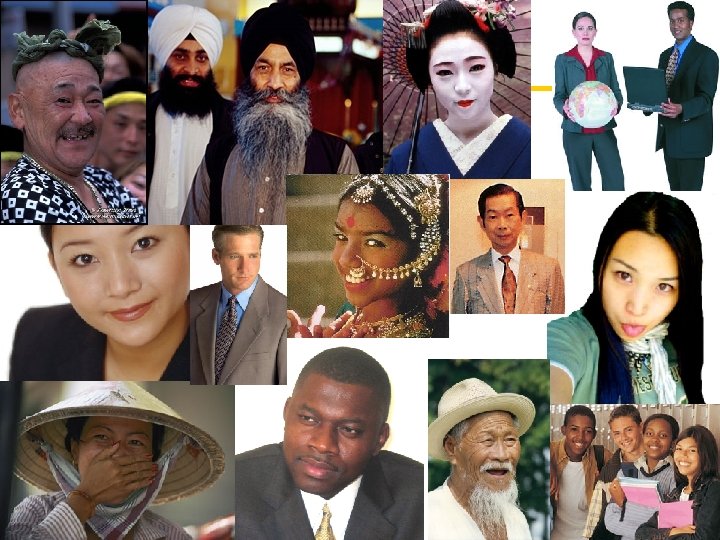
Slide 21
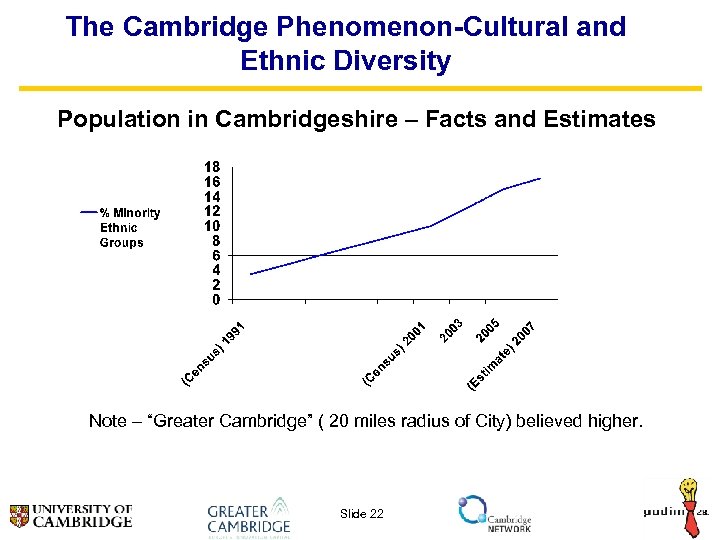
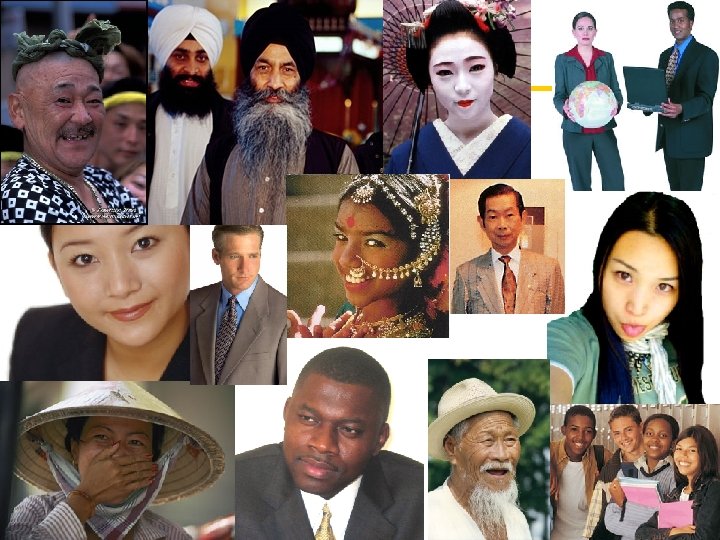
The Cambridge Phenomenon-Cultural and Ethnic Diversity Population in Cambridgeshire – Facts and Estimates Note – “Greater Cambridge” ( 20 miles radius of City) believed higher. Slide 22
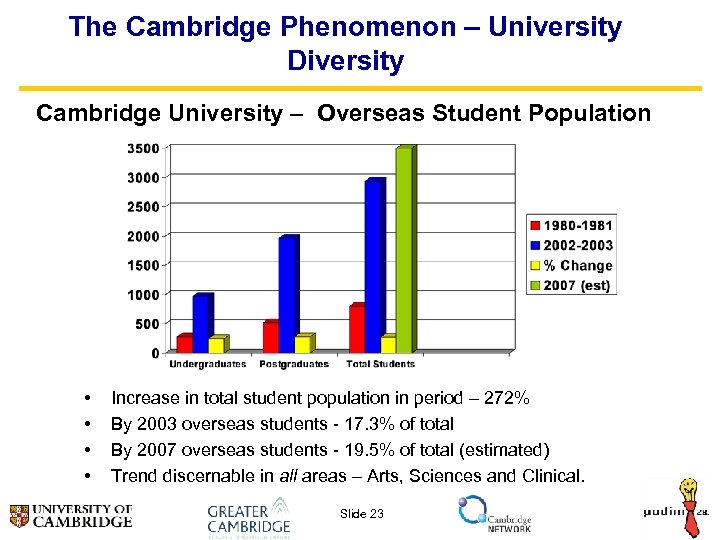
The Cambridge Phenomenon – University Diversity Cambridge University – Overseas Student Population • • Increase in total student population in period – 272% By 2003 overseas students - 17. 3% of total By 2007 overseas students - 19. 5% of total (estimated) Trend discernable in all areas – Arts, Sciences and Clinical. Slide 23
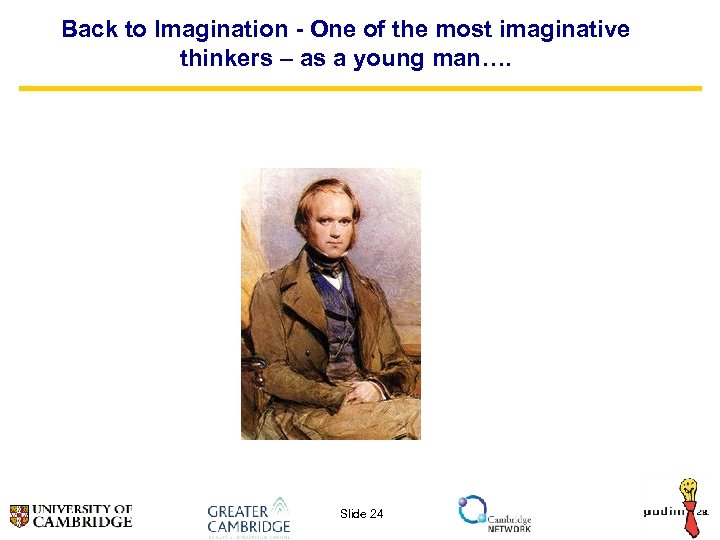
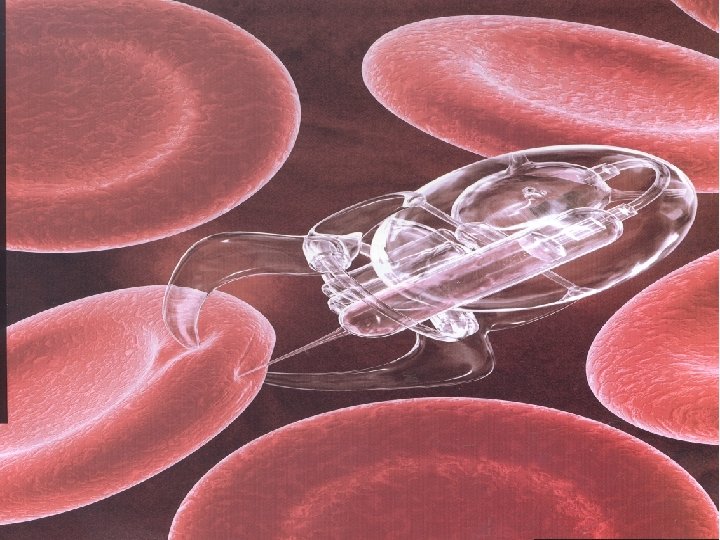
Back to Imagination - One of the most imaginative thinkers – as a young man…. Slide 24
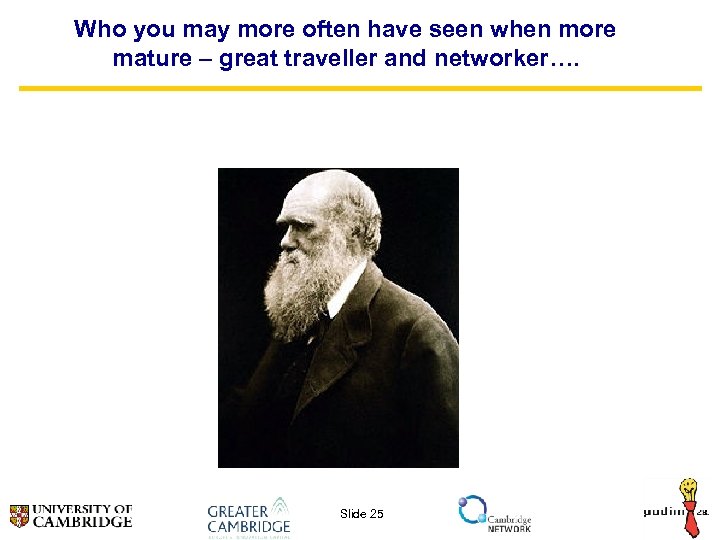
Who you may more often have seen when more mature – great traveller and networker…. Slide 25
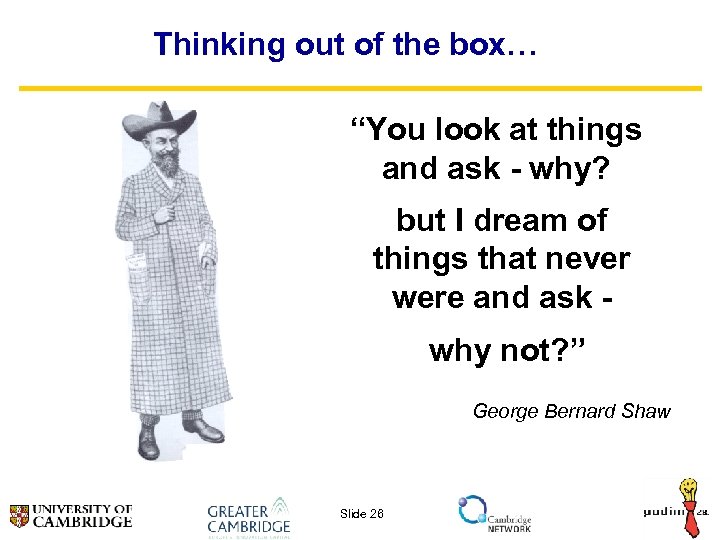
Thinking out of the box… “You look at things and ask - why? but I dream of things that never were and ask why not? ” George Bernard Shaw Slide 26
Who ever heard of Albert-Szent-Gyorgyi ? He, a Nobel Laureate said……… “Creativity is no more than looking at the same thing as everyone else and thinking something different. ” Slide 28
Extending Creativity and Innovation – exploiting convergence and diversity…. realisation dawning…. • CREATIVITY – The ability to develop new ideas and discover new ways of looking at problems and opportunities • INNOVATION – The ability to apply creative solutions to problems and opportunities to enhance or enrich peoples lives • Creativity is THINKING – Innovation is DOING • Both are enhanced by new encounters and connections – knowledge exchange, diversity and convergence can impact through NETWORKING ! Slide 29
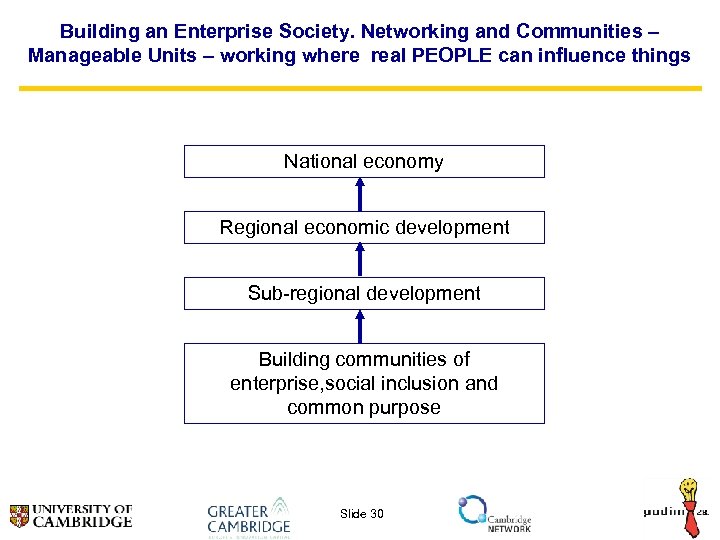
Building an Enterprise Society. Networking and Communities – Manageable Units – working where real PEOPLE can influence things National economy Regional economic development Sub-regional development Building communities of enterprise, social inclusion and common purpose Slide 30
And then there is Entrepreneurship… “Entrepreneurs blow gales of creative destruction. ” Role of the entrepreneur in transforming economies by developing: · New products · New methods of production · New ways of organizing · Untapped raw materials · Enhanced competitive performance Joseph Schumpeter - 1911 Slide 31
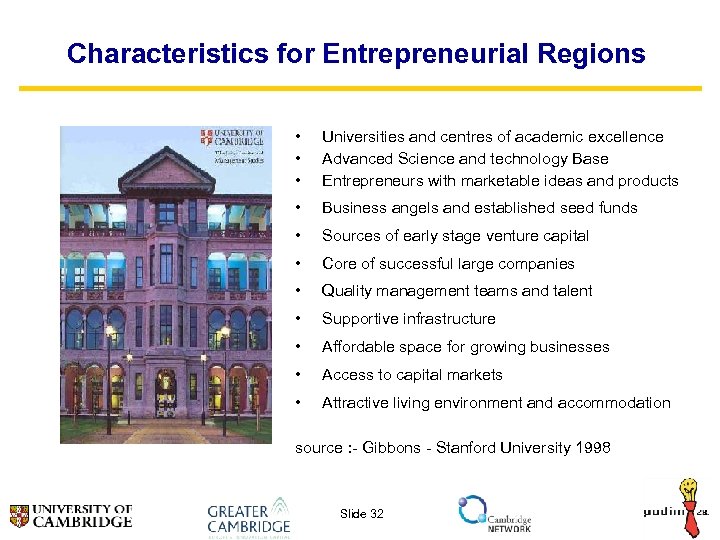
Characteristics for Entrepreneurial Regions • • • Universities and centres of academic excellence Advanced Science and technology Base Entrepreneurs with marketable ideas and products • Business angels and established seed funds • Sources of early stage venture capital • Core of successful large companies • Quality management teams and talent • Supportive infrastructure • Affordable space for growing businesses • Access to capital markets • Attractive living environment and accommodation source : - Gibbons - Stanford University 1998 Slide 32
Cambridge in 1960 • • • Medieval City Great University and Seat of Learning Farmers Not much Industry Lots of Bicycles Entrepreneurs …. . ? Traditions resisting change Enter “The Columbus Spirit” Ready for Culture Change Slide 33
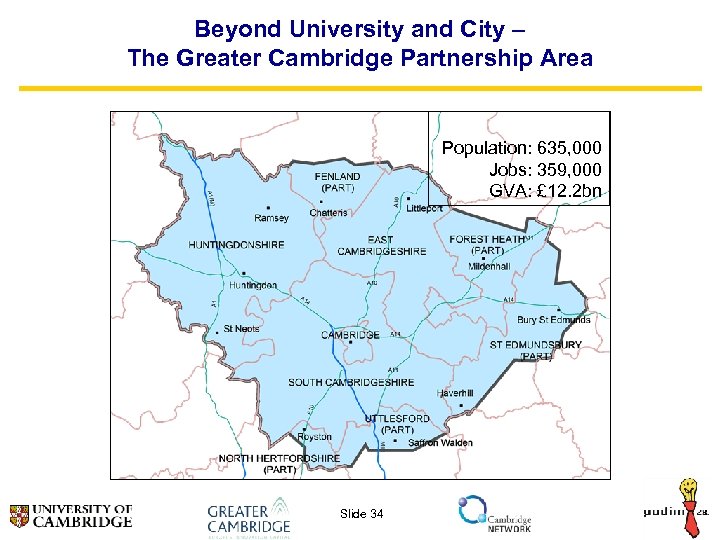
Beyond University and City – The Greater Cambridge Partnership Area Population: 635, 000 Jobs: 359, 000 GVA: £ 12. 2 bn Slide 34
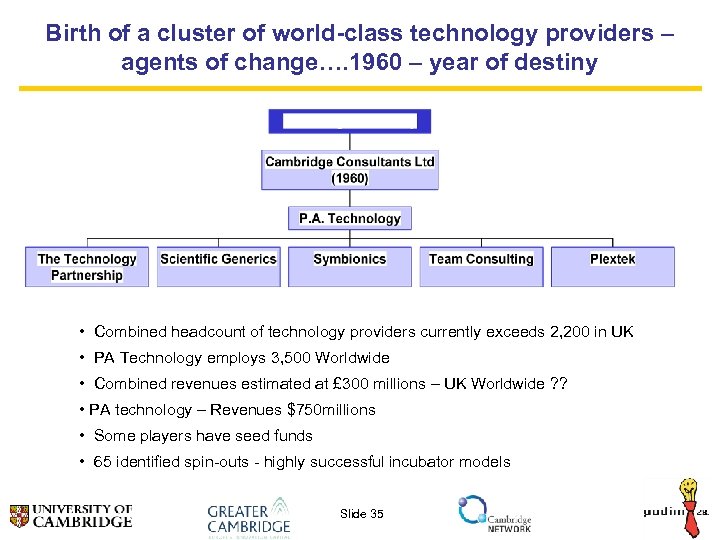
Birth of a cluster of world-class technology providers – agents of change…. 1960 – year of destiny • Combined headcount of technology providers currently exceeds 2, 200 in UK • PA Technology employs 3, 500 Worldwide • Combined revenues estimated at £ 300 millions – UK Worldwide ? ? • PA technology – Revenues $750 millions • Some players have seed funds • 65 identified spin-outs - highly successful incubator models Slide 35
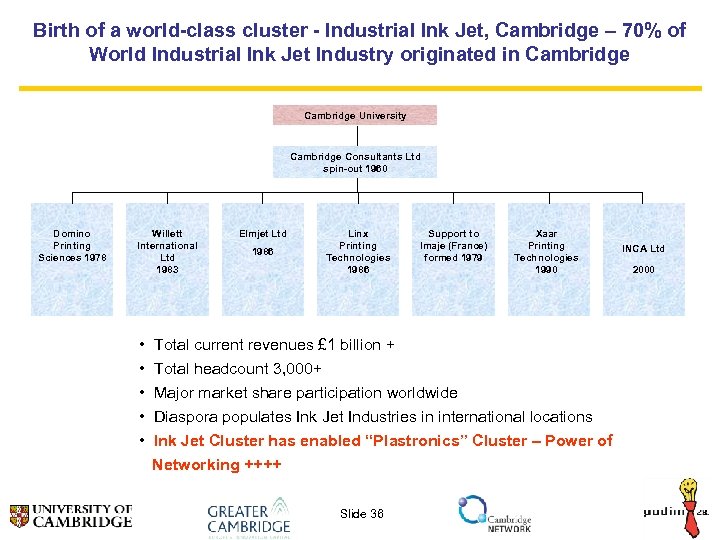
Birth of a world-class cluster - Industrial Ink Jet, Cambridge – 70% of World Industrial Ink Jet Industry originated in Cambridge University Cambridge Consultants Ltd spin-out 1960 Domino Printing Sciences 1978 Willett International Ltd 1983 • • • Elmjet Ltd 1986 Linx Printing Technologies 1986 Support to Imaje (France) formed 1979 Xaar Printing Technologies 1990 Total current revenues £ 1 billion + Total headcount 3, 000+ Major market share participation worldwide Diaspora populates Ink Jet Industries in international locations Ink Jet Cluster has enabled “Plastronics” Cluster – Power of Networking ++++ Slide 36 INCA Ltd 2000
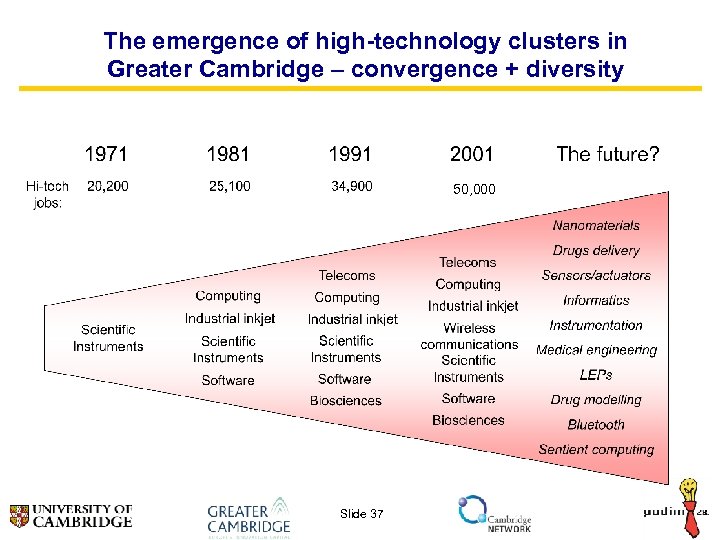
The emergence of high-technology clusters in Greater Cambridge – convergence + diversity 50, 000 Slide 37
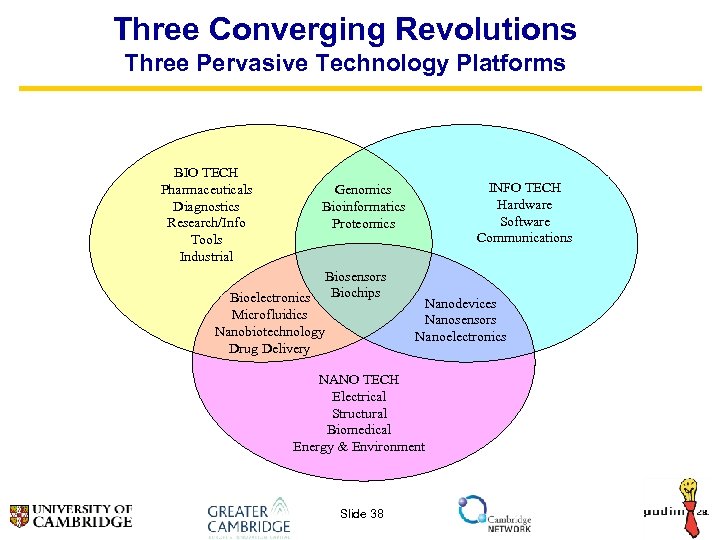
Three Converging Revolutions Three Pervasive Technology Platforms BIO TECH Pharmaceuticals Diagnostics Research/Info Tools Industrial INFO TECH Hardware Software Communications Genomics Bioinformatics Proteomics Bioelectronics Microfluidics Nanobiotechnology Drug Delivery Biosensors Biochips Nanodevices Nanosensors Nanoelectronics NANO TECH Electrical Structural Biomedical Energy & Environment Slide 38
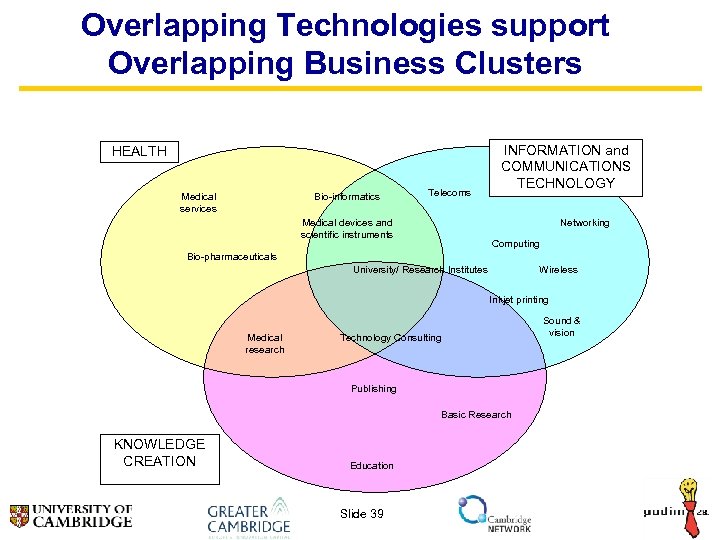
Overlapping Technologies support Overlapping Business Clusters HEALTH Medical services Bio-informatics Telecoms Medical devices and scientific instruments INFORMATION and COMMUNICATIONS TECHNOLOGY Networking Computing Bio-pharmaceuticals University/ Research Institutes Wireless Inkjet printing Medical research Technology Consulting Publishing Basic Research KNOWLEDGE CREATION Education Slide 39 Sound & vision
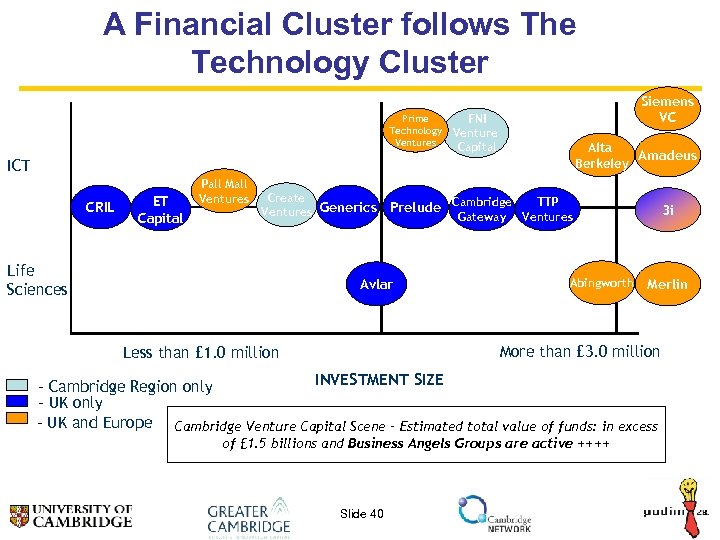
A Financial Cluster follows The Technology Cluster Prime Technology Ventures Siemens VC FNI Venture Capital Alta Amadeus Berkeley ICT CRIL ET Capital Pall Mall Ventures Create Ventures Generics Life Sciences Prelude Cambridge Avlar Gateway TTP Ventures Abingworth 3 i Merlin More than £ 3. 0 million Less than £ 1. 0 million INVESTMENT SIZE - Cambridge Region only - UK and Europe Cambridge Venture Capital Scene – Estimated total value of funds: in excess of £ 1. 5 billions and Business Angels Groups are active ++++ Slide 40
Another Chronology – Another Culture – “Reaching out and…. Networking” • 1584: Cambridge University Press – first “spin-out. ” Alive and well 2008 • 1818: Horace Darwin – Scientific Instruments Co- evolution of Pye Company Group (now Phillips owned) • 1960: Cambridge Consultants – birth of a “Technology Family • 1970: Cambridge Science Park ( Trinity College) • 1978: Barclays Bank initiative – promoting and financing Hi-Tech Companies: + Sinclair Electronics + Acorn Computers • 1980: “Clusters” emerge – Electronics / Instrumentation • 1985: First “Cambridge Phenomenon Report” – 350 Hi-Tech companies Slide 41
Reaching out and Networking – it goes on…. • 1987: St John’s College Innovation Centre ( since then 200 companies – 150 survived, 30 University spin outs) • 1989: First Organised Business Angels Network • 1990: And ongoing – proliferation of Science Parks • 1994: Judge Business School opened – MBA etc • 1995: Emergence of Venture Capital Cluster – including Cambridge University Challenge Fund • 1998: Cambridge Network Ltd formed – still thriving • 1999: CU won bid for $5 m of Govt. funding – to start Entrepreneurship Centre • 1999: Developing Technology Transfer Unit Slide 42
And on…. . the momentum and power of Networking • • 1999: “Cambridge Massachussett’s Institute” (CMI) “The two Cambridges” – JV with MIT - $150 m funding. 2001: Cambridge Centre for Entrepreneurial Learning ( Cf. EL ) – major advances in Entrepreneur Education and support – Entrepreneur Summer school. 2001: “CUE” – Cambridge University Entrepreneurs Student Business Plan and Business Creation activities – a number of companies successfully formed some became international 2002: Cambridge Angels and Cambridge Capital Group High net worth Angel investor groups 2002: Library House Ltd – Innovation Research and linking investors and companies – ongoing activity 2002: 2 nd and 3 rd Cambridge Phenomenon Reports 2007: Vibrant technology and Biotech Clusters – 2, 000 Innovative Tech companies – 3, 500 “All Tech” – 50, 000 jobs Slide 43
Greater Cambridge - More science parks than in any other UK location – and they Network ! • • • Babraham Bio-Incubator Cambridge Research Park Cambridge Science Park Granta Park Great Chesterford Research Park Melbourn Science Park St John’s Innovation Centre Peterhouse Science Park South Fenlands Innovation Centre • Biopark Welwyn Slide 44 Tenants include: Kodak European Research Toshiba Research Europe Epson (UK) Ltd Hitachi Pfizer Napp Pharmaceuticals Genzyme Therapeutics Ltd Astra Zeneca Glaxo. Smith. Kline Takeda…
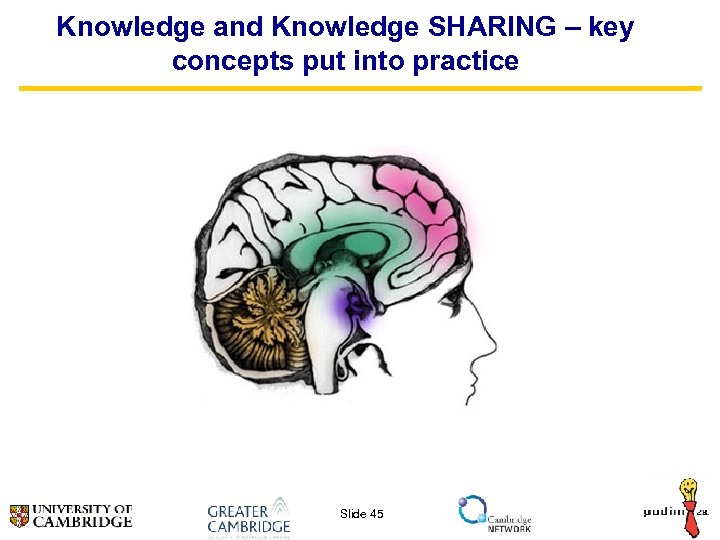
Knowledge and Knowledge SHARING – key concepts put into practice Slide 45
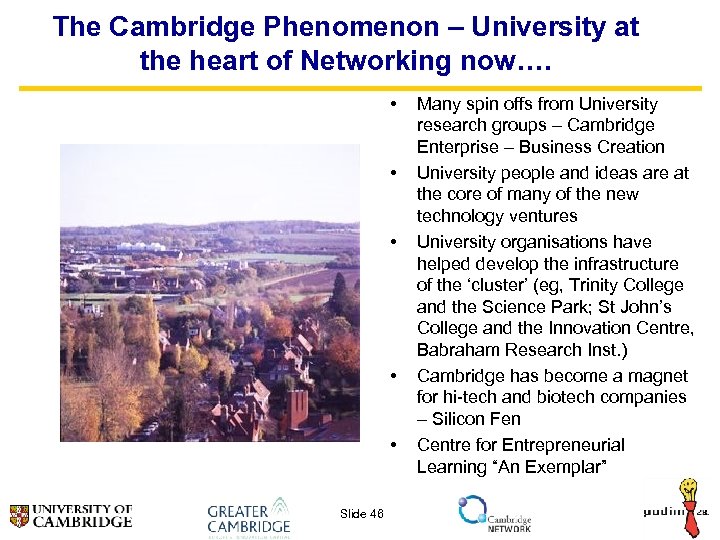
The Cambridge Phenomenon – University at the heart of Networking now…. • • • Slide 46 Many spin offs from University research groups – Cambridge Enterprise – Business Creation University people and ideas are at the core of many of the new technology ventures University organisations have helped develop the infrastructure of the ‘cluster’ (eg, Trinity College and the Science Park; St John’s College and the Innovation Centre, Babraham Research Inst. ) Cambridge has become a magnet for hi-tech and biotech companies – Silicon Fen Centre for Entrepreneurial Learning “An Exemplar”
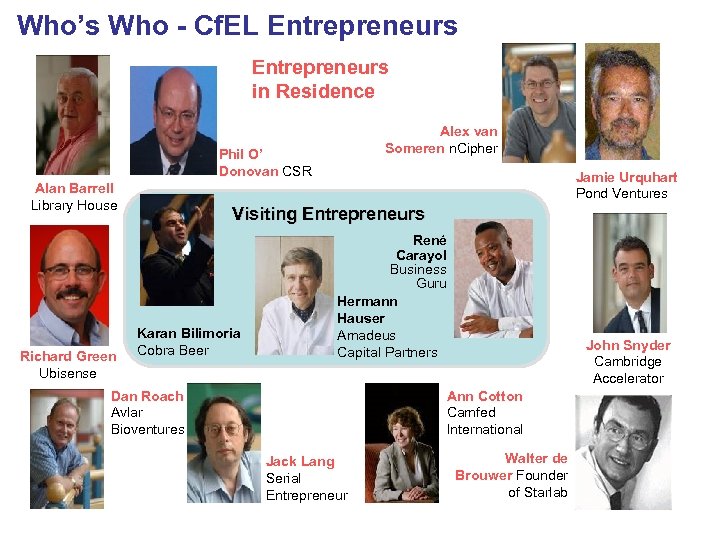
Who’s Who - Cf. EL Entrepreneurs in Residence Alex van Someren n. Cipher Phil O’ Donovan CSR Alan Barrell Library House Richard Green Ubisense Jamie Urquhart Pond Ventures Visiting Entrepreneurs Karan Bilimoria Cobra Beer René Carayol Business Guru Hermann Hauser Amadeus Capital Partners Dan Roach Avlar Bioventures John Snyder Cambridge Accelerator Ann Cotton Camfed International Jack Lang Serial Entrepreneur Walter de Brouwer Founder of Starlab
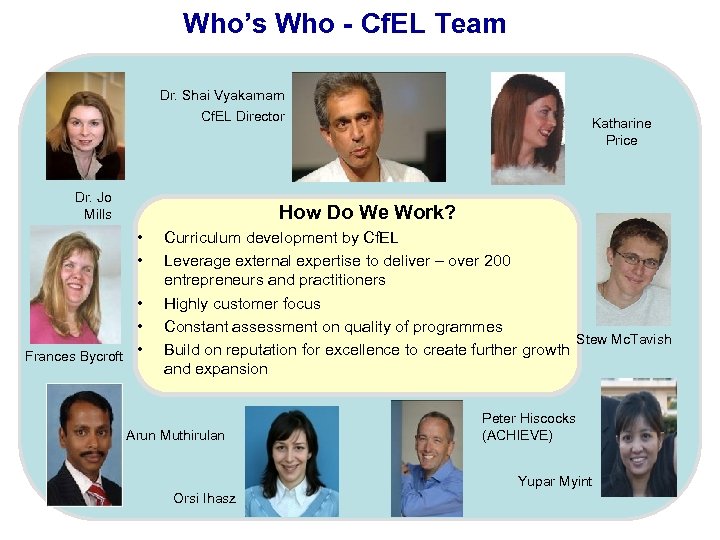
Who’s Who - Cf. EL Team Dr. Shai Vyakarnam Cf. EL Director Dr. Jo Mills Katharine Price How Do We Work? • • Frances Bycroft • Curriculum development by Cf. EL Leverage external expertise to deliver – over 200 entrepreneurs and practitioners Highly customer focus Constant assessment on quality of programmes Stew Mc. Tavish Build on reputation for excellence to create further growth and expansion Arun Muthirulan Peter Hiscocks (ACHIEVE) Yupar Myint Orsi Ihasz
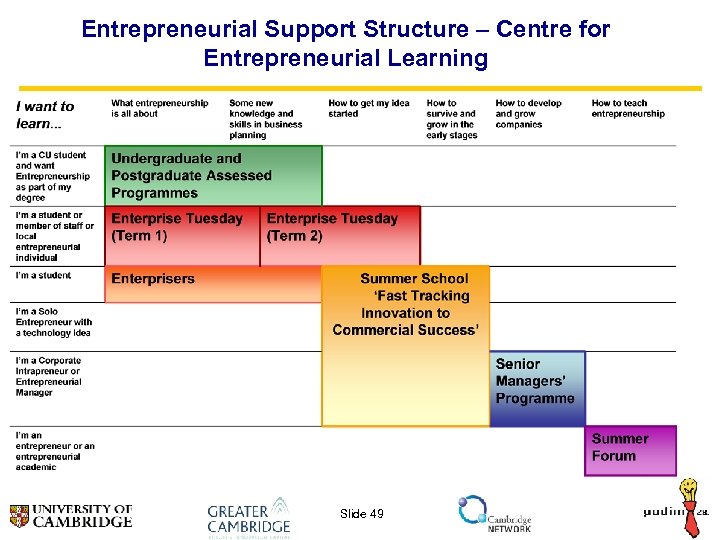
Entrepreneurial Support Structure – Centre for Entrepreneurial Learning Slide 49
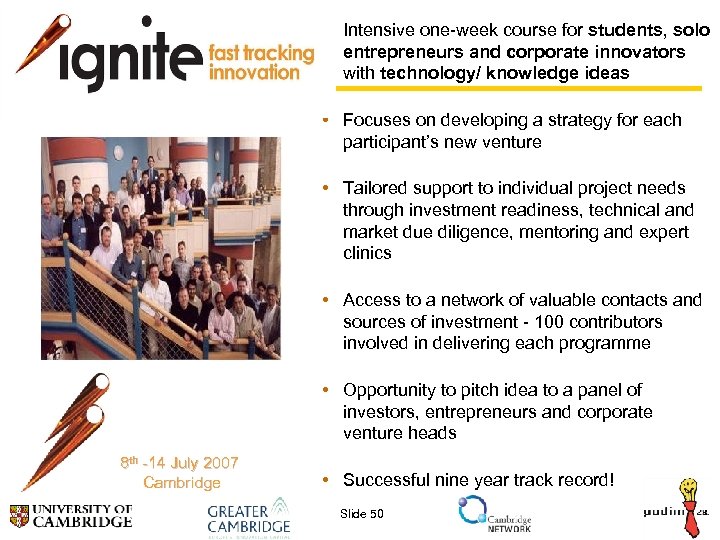
• Intensive one-week course for students, solo entrepreneurs and corporate innovators with technology/ knowledge ideas • Focuses on developing a strategy for each participant’s new venture • Tailored support to individual project needs through investment readiness, technical and market due diligence, mentoring and expert clinics • Access to a network of valuable contacts and sources of investment - 100 contributors involved in delivering each programme • Opportunity to pitch idea to a panel of investors, entrepreneurs and corporate venture heads 8 th -14 July 2007 Cambridge • Successful nine year track record! Slide 50
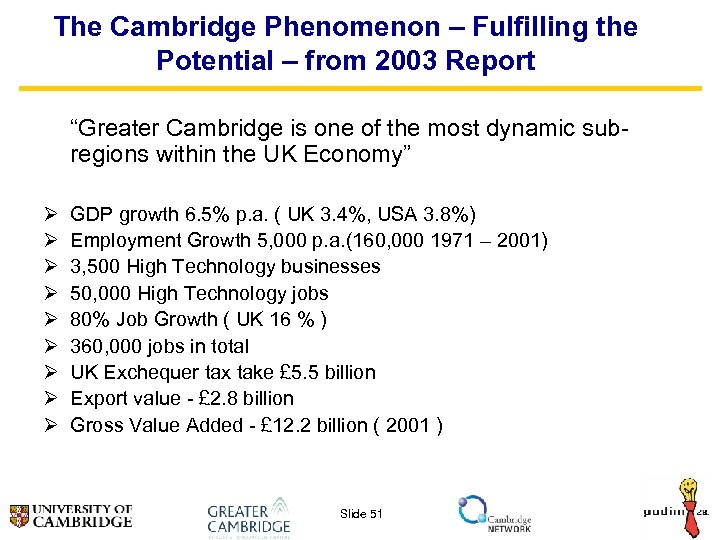
The Cambridge Phenomenon – Fulfilling the Potential – from 2003 Report “Greater Cambridge is one of the most dynamic subregions within the UK Economy” Ø Ø Ø Ø Ø GDP growth 6. 5% p. a. ( UK 3. 4%, USA 3. 8%) Employment Growth 5, 000 p. a. (160, 000 1971 – 2001) 3, 500 High Technology businesses 50, 000 High Technology jobs 80% Job Growth ( UK 16 % ) 360, 000 jobs in total UK Exchequer tax take £ 5. 5 billion Export value - £ 2. 8 billion Gross Value Added - £ 12. 2 billion ( 2001 ) Slide 51
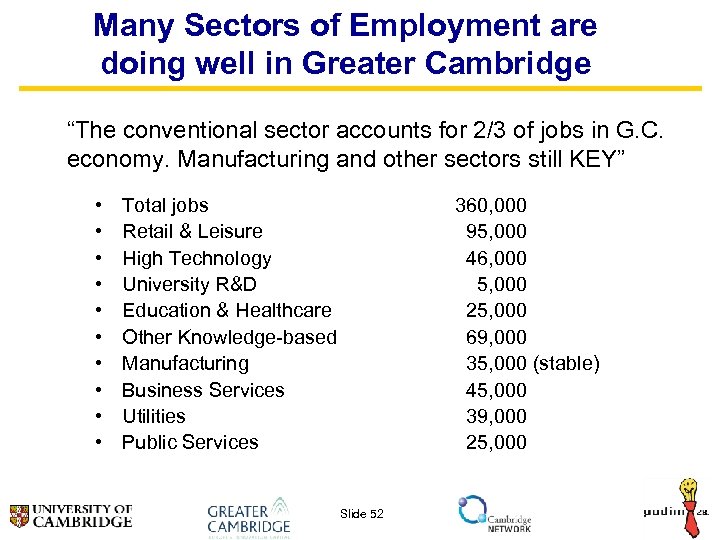
Many Sectors of Employment are doing well in Greater Cambridge “The conventional sector accounts for 2/3 of jobs in G. C. economy. Manufacturing and other sectors still KEY” • • • Total jobs Retail & Leisure High Technology University R&D Education & Healthcare Other Knowledge-based Manufacturing Business Services Utilities Public Services 360, 000 95, 000 46, 000 5, 000 25, 000 69, 000 35, 000 (stable) 45, 000 39, 000 25, 000 Slide 52
Slide 53
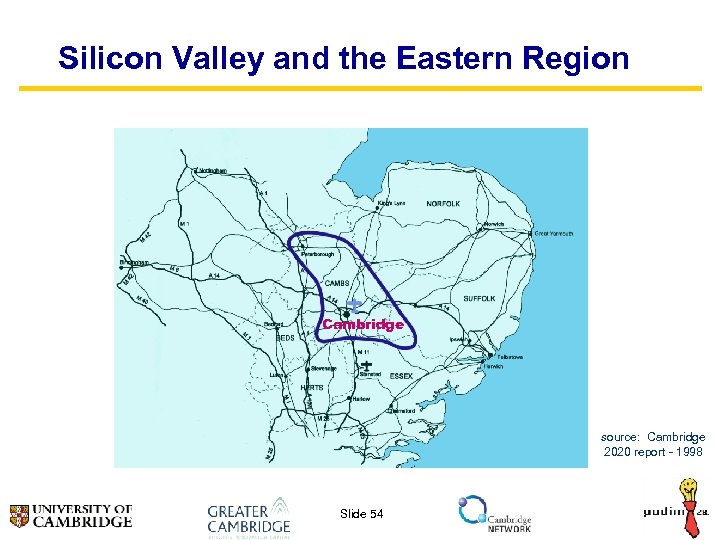
Silicon Valley and the Eastern Region Cambridge source: Cambridge 2020 report - 1998 Slide 54
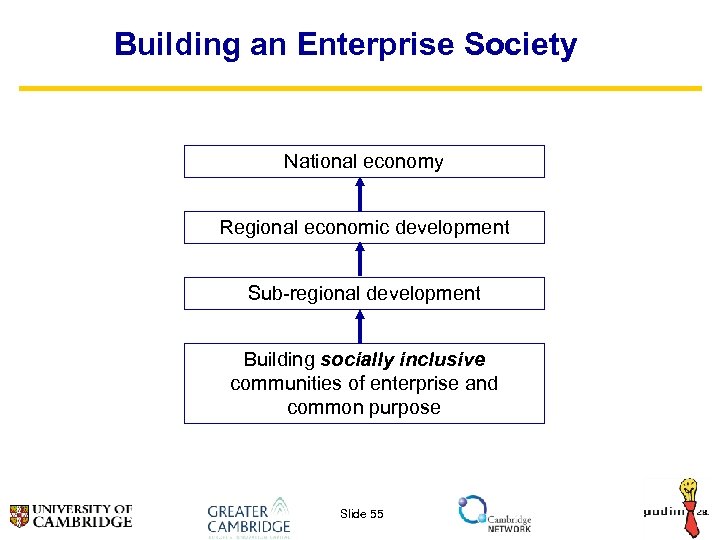
Building an Enterprise Society National economy Regional economic development Sub-regional development Building socially inclusive communities of enterprise and common purpose Slide 55
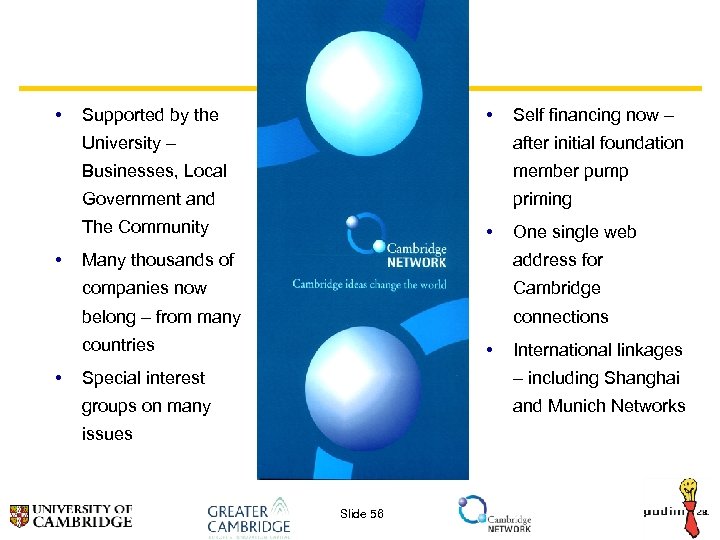
• • Supported by the Self financing now – University – after initial foundation Businesses, Local member pump Government and priming The Community • • One single web Many thousands of address for companies now Cambridge belong – from many connections countries • • International linkages Special interest – including Shanghai groups on many and Munich Networks issues Slide 56
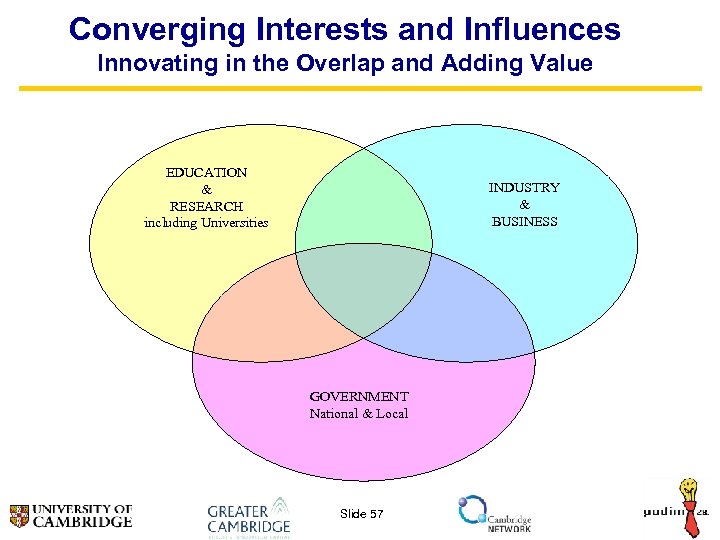
Converging Interests and Influences Innovating in the Overlap and Adding Value EDUCATION & RESEARCH including Universities INDUSTRY & BUSINESS GOVERNMENT National & Local Slide 57
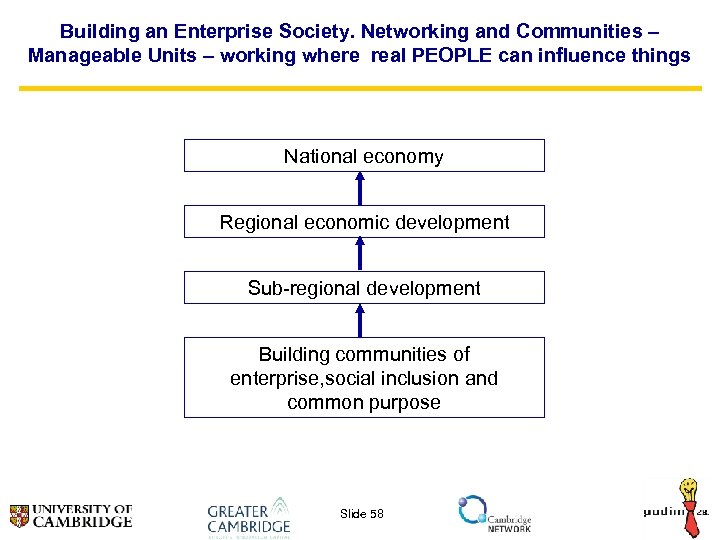
Building an Enterprise Society. Networking and Communities – Manageable Units – working where real PEOPLE can influence things National economy Regional economic development Sub-regional development Building communities of enterprise, social inclusion and common purpose Slide 58
Slide 59
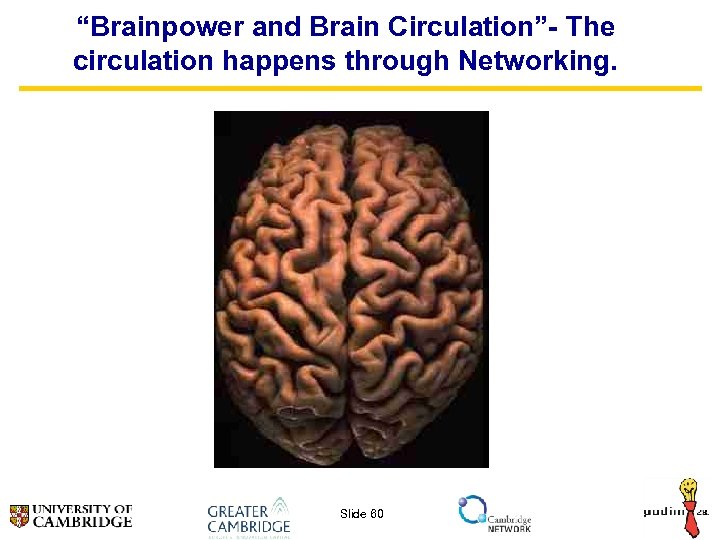
“Brainpower and Brain Circulation”- The circulation happens through Networking. Slide 60
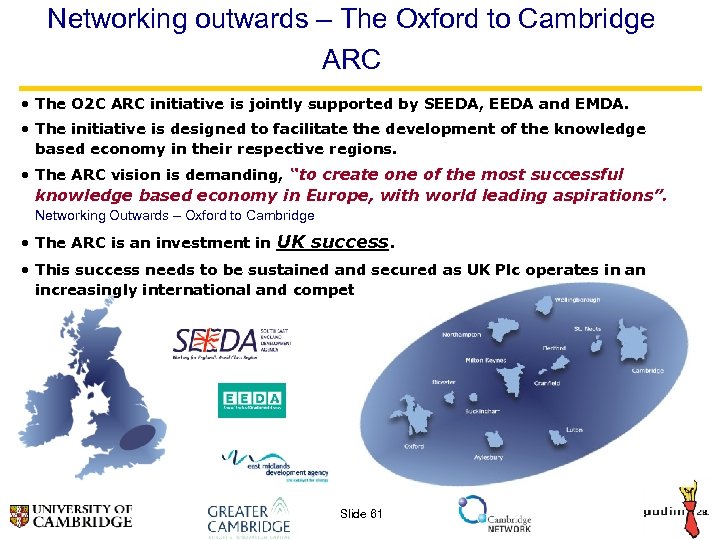
Networking outwards – The Oxford to Cambridge ARC • The O 2 C ARC initiative is jointly supported by SEEDA, EEDA and EMDA. • The initiative is designed to facilitate the development of the knowledge based economy in their respective regions. • The ARC vision is demanding, “to create one of the most successful knowledge based economy in Europe, with world leading aspirations”. Networking Outwards – Oxford to Cambridge • The ARC is an investment in UK success. • This success needs to be sustained and secured as UK Plc operates in an increasingly international and competitive economic environment. Slide 61
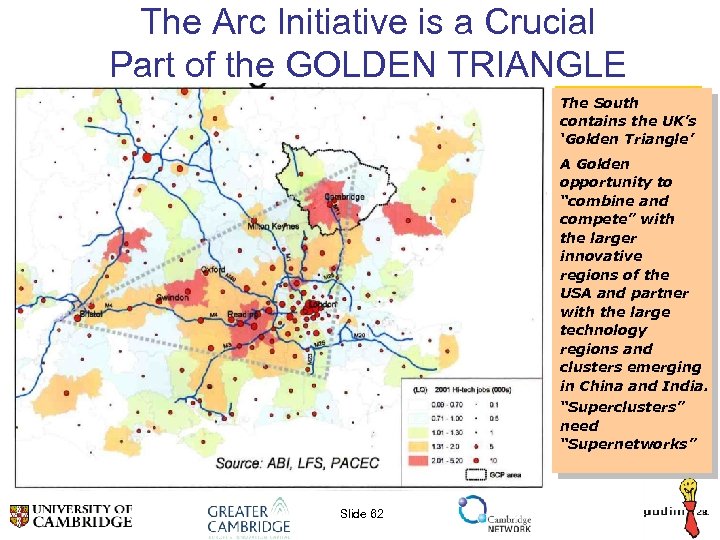
The Arc Initiative is a Crucial Part of the GOLDEN TRIANGLE The South contains the UK’s ‘Golden Triangle’ A Golden opportunity to “combine and compete” with the larger innovative regions of the USA and partner with the large technology regions and clusters emerging in China and India. “Superclusters” need “Supernetworks” Slide 62
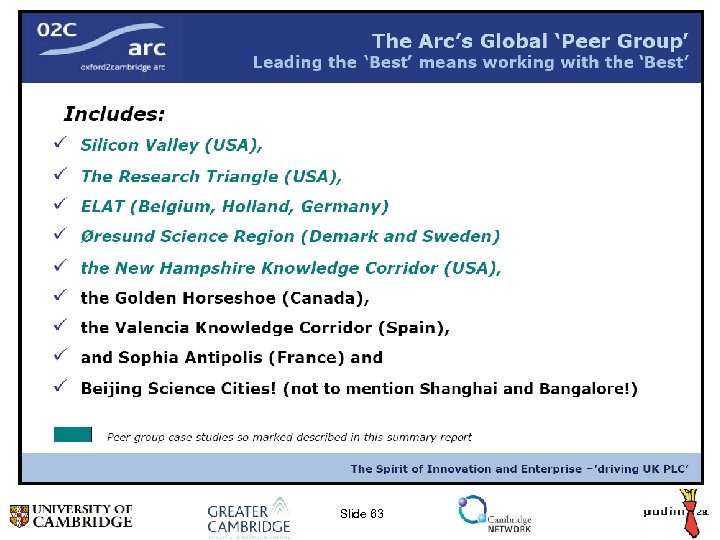
Slide 63
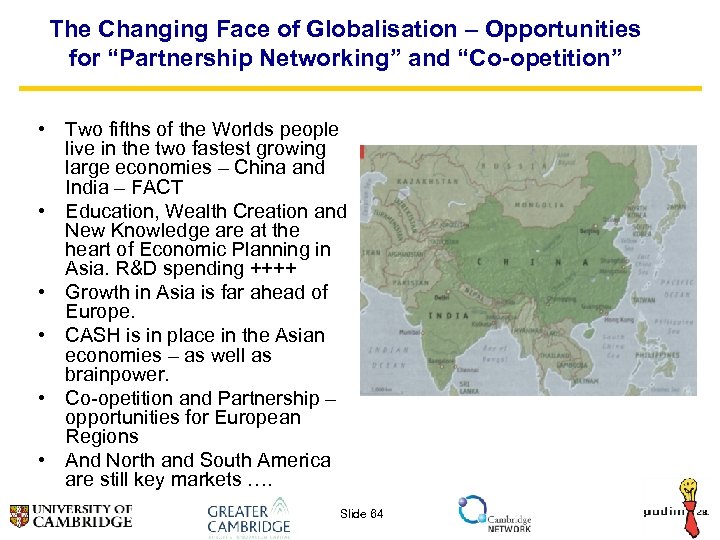
The Changing Face of Globalisation – Opportunities for “Partnership Networking” and “Co-opetition” • Two fifths of the Worlds people live in the two fastest growing large economies – China and India – FACT • Education, Wealth Creation and New Knowledge are at the heart of Economic Planning in Asia. R&D spending ++++ • Growth in Asia is far ahead of Europe. • CASH is in place in the Asian economies – as well as brainpower. • Co-opetition and Partnership – opportunities for European Regions • And North and South America are still key markets …. Slide 64
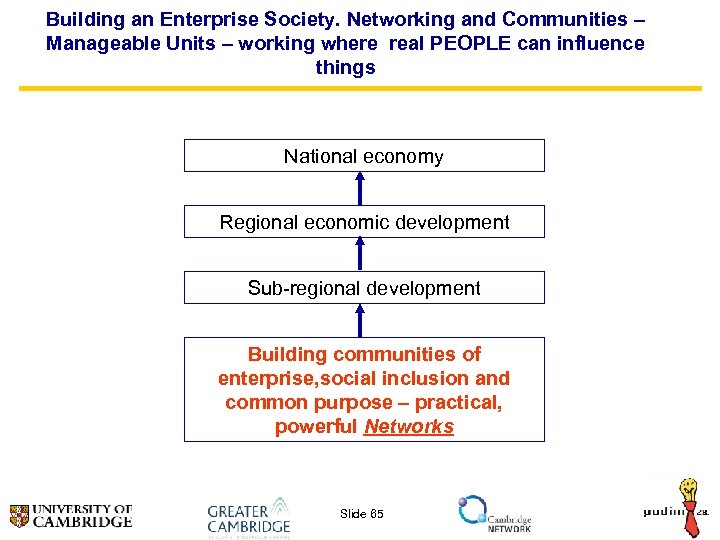
Building an Enterprise Society. Networking and Communities – Manageable Units – working where real PEOPLE can influence things National economy Regional economic development Sub-regional development Building communities of enterprise, social inclusion and common purpose – practical, powerful Networks Slide 65
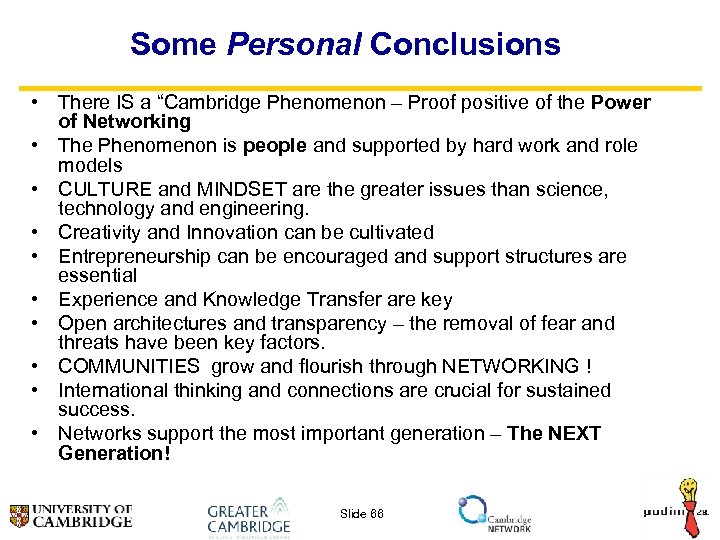
Some Personal Conclusions • There IS a “Cambridge Phenomenon – Proof positive of the Power of Networking • The Phenomenon is people and supported by hard work and role models • CULTURE and MINDSET are the greater issues than science, technology and engineering. • Creativity and Innovation can be cultivated • Entrepreneurship can be encouraged and support structures are essential • Experience and Knowledge Transfer are key • Open architectures and transparency – the removal of fear and threats have been key factors. • COMMUNITIES grow and flourish through NETWORKING ! • International thinking and connections are crucial for sustained success. • Networks support the most important generation – The NEXT Generation! Slide 66
Slide 67
Slide 68
In Pursuit of Excellence ! “Excellence can be achieved, if we: Care more than others think is wise, Risk more than others think is safe, Dream more than others think is practical, Expect more than others think is possible. ” Deborah Johnson-Ross Slide 69
Let’s build more Powerful Networks! For more information…… www. alanbarrell. com alan@alanbarrell. com Slide 70
Скачать презентацию The Cambridge Phenomenon The Power of Networking in
bde636be9af352ffa49e6326fa2dd142.ppt