


 Скачать презентацию The Cali Meteorite Mateo Naranjo Florida Institute of
bf584ab2770a22ae6b8b523b869f7d87.ppt
- Количество слайдов: 1
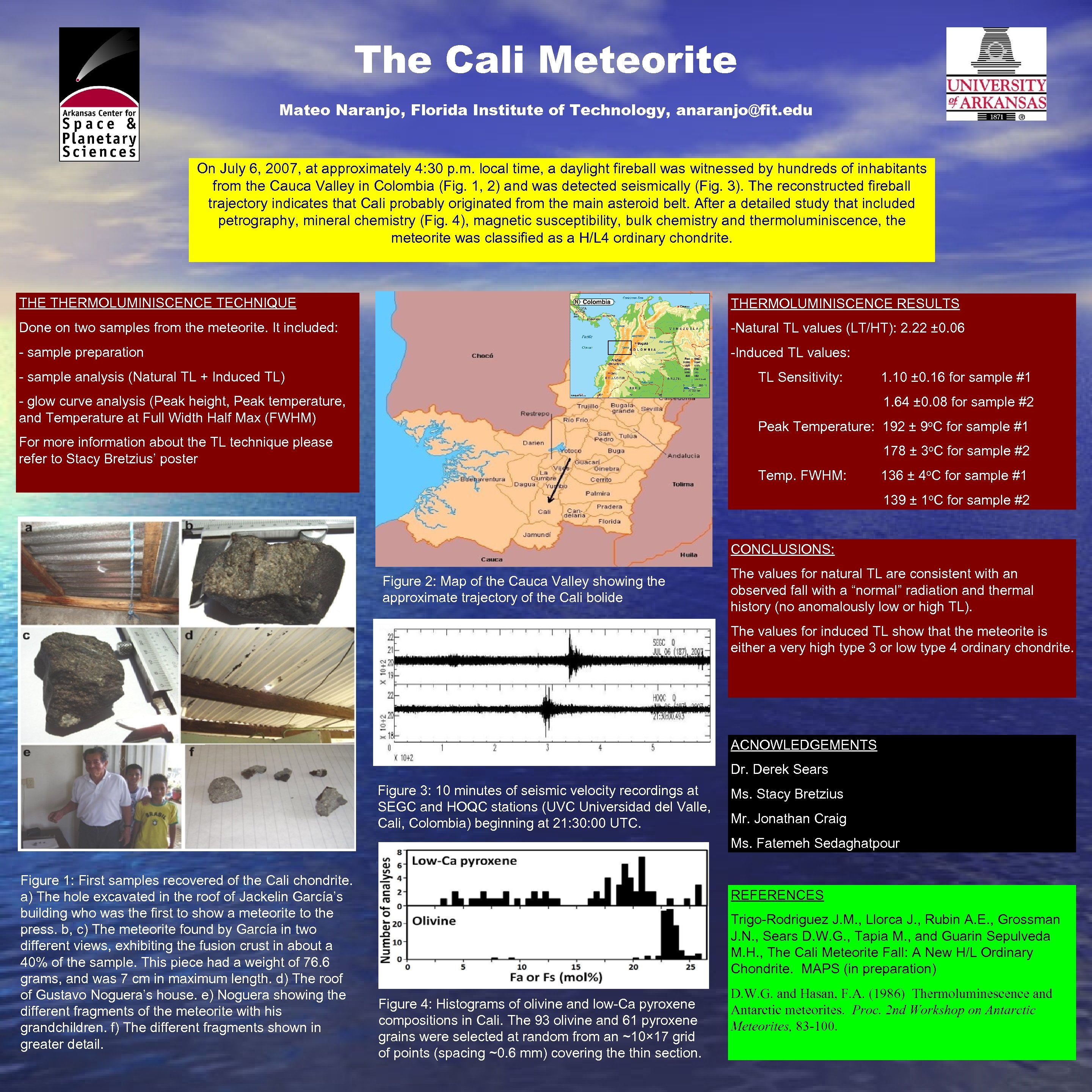 The Cali Meteorite Mateo Naranjo, Florida Institute of Technology, anaranjo@fit. edu On July 6, 2007, at approximately 4: 30 p. m. local time, a daylight fireball was witnessed by hundreds of inhabitants from the Cauca Valley in Colombia (Fig. 1, 2) and was detected seismically (Fig. 3). The reconstructed fireball trajectory indicates that Cali probably originated from the main asteroid belt. After a detailed study that included petrography, mineral chemistry (Fig. 4), magnetic susceptibility, bulk chemistry and thermoluminiscence, the meteorite was classified as a H/L 4 ordinary chondrite. THERMOLUMINISCENCE TECHNIQUE THERMOLUMINISCENCE RESULTS Done on two samples from the meteorite. It included: -Natural TL values (LT/HT): 2. 22 ± 0. 06 - sample preparation -Induced TL values: - sample analysis (Natural TL + Induced TL) TL Sensitivity: 1. 10 ± 0. 16 for sample #1 - glow curve analysis (Peak height, Peak temperature, and Temperature at Full Width Half Max (FWHM) 1. 64 ± 0. 08 for sample #2 Peak Temperature: 192 ± 9 o. C for sample #1 For more information about the TL technique please refer to Stacy Bretzius’ poster 178 ± 3 o. C for sample #2 Temp. FWHM: 136 ± 4 o. C for sample #1 139 ± 1 o. C for sample #2 CONCLUSIONS: Figure 2: Map of the Cauca Valley showing the approximate trajectory of the Cali bolide The values for natural TL are consistent with an observed fall with a “normal” radiation and thermal history (no anomalously low or high TL). The values for induced TL show that the meteorite is either a very high type 3 or low type 4 ordinary chondrite. ACNOWLEDGEMENTS Dr. Derek Sears Figure 3: 10 minutes of seismic velocity recordings at SEGC and HOQC stations (UVC Universidad del Valle, Cali, Colombia) beginning at 21: 30: 00 UTC. Ms. Stacy Bretzius Mr. Jonathan Craig Ms. Fatemeh Sedaghatpour Figure 1: First samples recovered of the Cali chondrite. a) The hole excavated in the roof of Jackelin García’s building who was the first to show a meteorite to the press. b, c) The meteorite found by García in two different views, exhibiting the fusion crust in about a 40% of the sample. This piece had a weight of 76. 6 grams, and was 7 cm in maximum length. d) The roof of Gustavo Noguera’s house. e) Noguera showing the different fragments of the meteorite with his grandchildren. f) The different fragments shown in greater detail. REFERENCES Trigo-Rodriguez J. M. , Llorca J. , Rubin A. E. , Grossman J. N. , Sears D. W. G. , Tapia M. , and Guarin Sepulveda M. H. , The Cali Meteorite Fall: A New H/L Ordinary Chondrite. MAPS (in preparation) Figure 4: Histograms of olivine and low-Ca pyroxene compositions in Cali. The 93 olivine and 61 pyroxene grains were selected at random from an ~10× 17 grid of points (spacing ~0. 6 mm) covering the thin section. D. W. G. and Hasan, F. A. (1986) Thermoluminescence and Antarctic meteorites. Proc. 2 nd Workshop on Antarctic Meteorites, 83 -100.