


 Скачать презентацию The Caledonian System The challenges of trying to
16e114e023b6498c62a582a3ddc1dcd3.ppt
- Количество слайдов: 31
 The Caledonian System The challenges of trying to get a whole system approach for re-integration – working with domestic abuse offenders and their families
 Presentation • • • The challenges we faced in developing the Caledonian System Other challenges we faced Where we are in the roll-out process
 The Caledonian System An integrated approach to address men's domestic abuse and to improve the lives of women, children and men. Developed for the Effective Practice & Equality Units of the Scottish Government Accredited in February 2009 by the Scottish Accreditation Panel for Offender Programmes
 Partners in the Caledonian • Change (Men learning to end their violence to women) Limited • Domestic Violence Probation Project, Edinburgh • Sacro group-work services, Falkirk
 What research tells us Keeping women and children safe and helping men to change is proven to be more effective if it takes a systems approach where changes in organisational and institutional responses to men’s abuse of women are simultaneously happening alongside work undertaken with men, their partners and children.
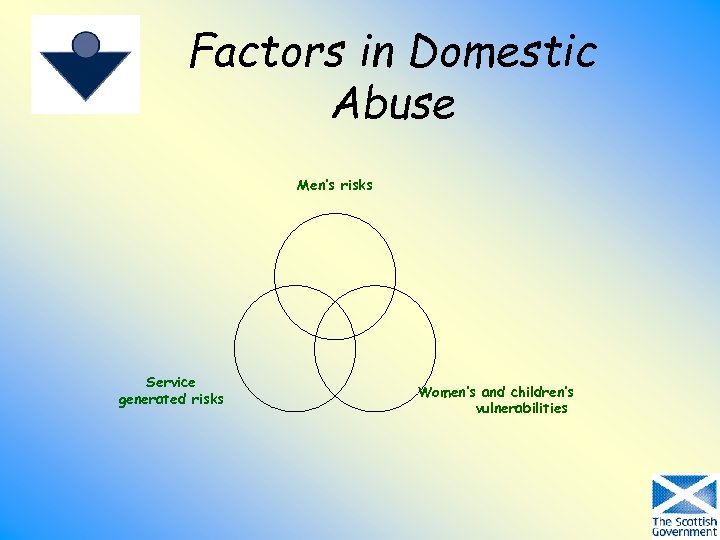 Factors in Domestic Abuse Men’s risks Service generated risks Women’s and children’s vulnerabilities
 Factors • • • Risks – Risk of harm, factors which increase the likelihood of men continuing to abuse, and other factors which contribute to abusive behaviour. Vulnerabilities – vulnerability factors can make a women more susceptible to men who abuse, can be caused by the abuse she is experiencing, can be exacerbated by the abuse she is experiencing or can be used by the man to increase his control over her. Service Generated Risks - the ways in which wider societal structures, organisations, services and the individuals within them can increase the man’s risk to the woman.
 Risk factors - man • • • • Criminal history Psychosocial adjustment Childhood trauma and attachment issues Domestic violence history Drug/alcohol misuse Current offence Emotional abuse Stalking and harassing behaviour Dishonesty, denial, blame and minimisation Isolating and controlling behaviour Using the children Making rules and expectations Financial control Threats, huffs and demands Intimidation and fear • • • • Sexual jealousy History of torturing/disfiguring partners History of cruelty to animals Victim or witness of political persecution, torture or violence Sexual sadism Suicidal ideation or intent Easy access to firearms Recent loss of social support network Member/ex-member armed forces History of going AWOL Homeless/temporary accommodation Living with mother/grandmother/ vulnerable adult History or current offence fireraising Aggressive driving Diagnosis of OCD
 Vulnerabilities - woman • • • • Age - Under 25 Age - Over 50 Experience of sexual abuse in childhood Witness of domestic abuse as a child Prior victimisation Disability Pregnancy / post partum Caring responsibilities Step children Drug/alcohol misuse Mental health issues Homicidal ideation or intent Suicidal ideation or intent • • • Ethnic minority Women seeking asylum and immigration issues Worker in sex industry Repeated separations and reconcilliations Attachment issues Risky, incomplete or inaccurate safety plans Home location Homelessness Social isolation, loss and loneliness Financial issues Other power imbalances
 Vulnerabilities- children • • • Direct physical/sexual abuse Harm through protecting mother Divided loyalties Abusing by proxy Isolation Physical/emotional harm due to domestic abuse Neglect Dispute over child contact Changes in child contact arrangements which will result in less or no contact with the father Other factors related to children’s well being which impact on risk
 Service generated risks • • • • Professionals’ beliefs and opinions Accessing service Incident based approach Confidentiality Lack of funding and resources Lack of knowledge and skills Failure to recognise service generated risks Poor communication between the men’s and women's service The man 'using' the programme to further abuse The focus on women's failure to protect The focus on ending the relationship Varying perspectives and systems Ignoring the perpetrator/his strengths/ability to change
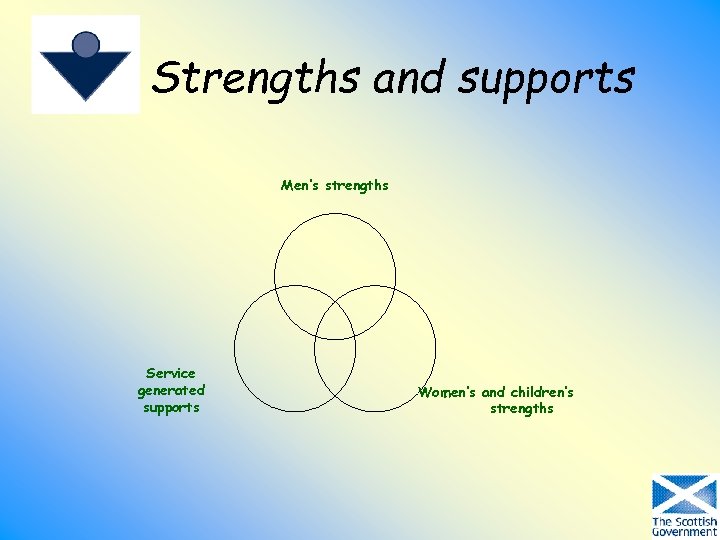 Strengths and supports Men’s strengths Service generated supports Women’s and children’s strengths
 Strengths - man • • • • Wants to change - dissonance Wants to be a good partner/father Positive family background Supportive wider family Pro-social friends Good employment record Demonstrated previous change process Has ‘good lives’ goals Accepts responsibility/accountable Good compliance with programme Practices men’s programme exercises Good compliance with access arrangements Attends child protection meetings Prepared to address other criminogenic needs, such as substance misuse/ gambling/childhood trauma Prepared to address mental health issues Open and trusting relationship with workers
 Strengths - woman • • • Honest, trusting relationship with staff Able/willing to call police Has a safety plan Is addressing dynamic vulnerabilities - mental health, drugs, unemployment Is self nurturing Has resilience Has positive coping strategies Feels self confident and in control of her life Has good understanding of domestic abuse and its effects Able to continue living in a supportive and familiar environment
 Strengths - children • • • Respects the authority of their mother Has safety plan Not afraid to contact the police Has resilience and self esteem Has an adult confidante (teacher, aunt etc) Realises domestic abuse is not their fault Has positive/safe relationship with accountable father Understands the child protection processes they’re engaged in Is able to state what they want Feels included and involved in decisions which affect them
 Service generated supports • • • Share Caledonian values and understanding of domestic abuse Share understanding of confidentiality and safe information sharing Hold men accountable Expectations of men to change Consistent criminal justice response Bail conditions are reinforced and policed Fathers are expected to be involved in child protection processes Safe separate arrangements for the attendance and participation of parents at child protection meetings Staff feel confident and safe when confronting/making expectations of abusing men Workers reinforce the authority of the protective parent Civil court takes into account information from man’s criminal court proceedings
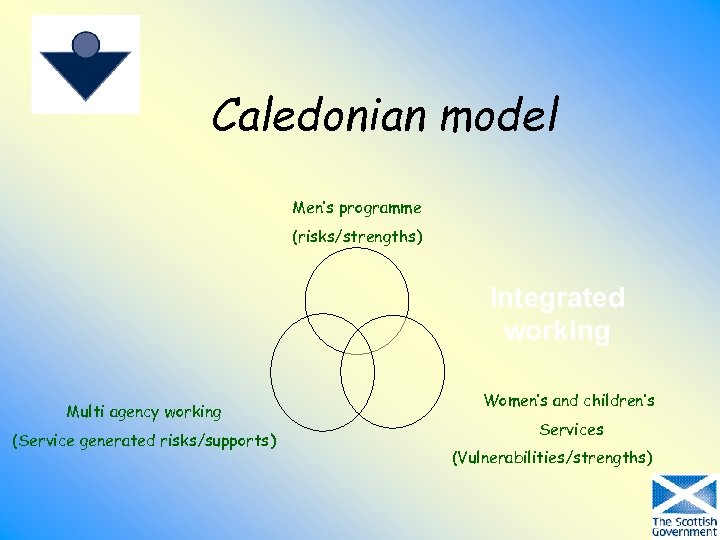 Caledonian model Men’s programme (risks/strengths) Integrated working Multi agency working (Service generated risks/supports) Women’s and children’s Services (Vulnerabilities/strengths)
 The Caledonian System • • • A two year programme of intervention work with men Services to women partners and children Inter and intra-agency protocols to maximise safety A training programme for all staff (managers, case managers & men’s group workers, women’s & children’s workers) Multi-agency training in implementing protocols
 Targeting - men’s programme • Aimed at adult men defined as over 16 years of age whose abuse of partners has taken place within a heterosexual relationship • Men will be referred if they have been convicted of offences involving domestic abuse • Men will be accepted if assessed as moderate to high risk using SARA, and are able and suitable • Referrals will be men on probation or post release licenses
 Men’s Programme A two year programme comprising: • Fourteen or more pre-group sessions • Minimum of twenty six group-work sessions • Maintenance work for remainder of order or licence
 Pre-group • • • Quick pick-up – start within 7 days Engagement (forming a working alliance) Enhancing motivation Getting to know the man (and him to know himself) Introduction to the tools needed for the group First ‘personal plan’
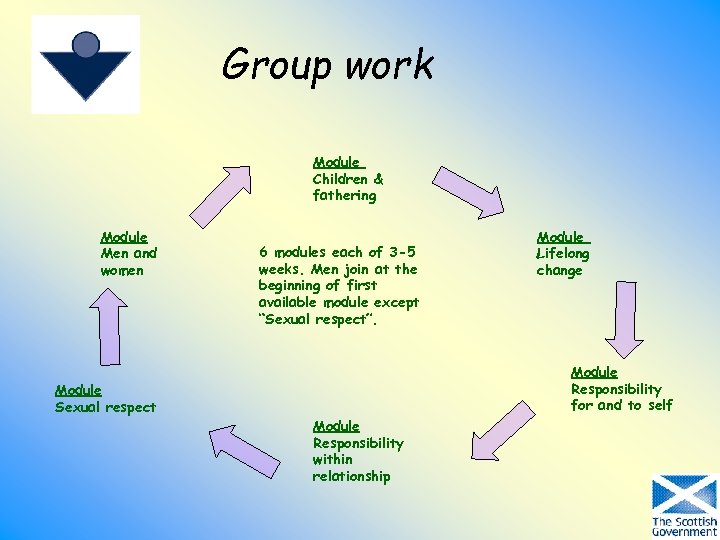 Group work Module Children & fathering Module Men and women Module Sexual respect 6 modules each of 3 -5 weeks. Men join at the beginning of first available module except “Sexual respect”. Module Lifelong change Module Responsibility for and to self Module Responsibility within relationship
 Maintenance • • • Further encourage his responsibility for change Address any unmet needs Long term Toolbox of skills Productive use of the residue of the Order of licence Reinforcement of positive change by other men
 Women’s Service - - - Liaison with the men’s and children’s services throughout – assessment, client liaison meetings, joint risk assessment, joint visits to women, probation reviews Multi-agency working – risk management, liaison with other workers, attending joint meetings, child and adult protection, referrals to other services Safety planning Crisis planning Programme of activities Dealing with assault, separation, legal issues, making sense of domestic abuse, healing after domestic abuse
 Children’s Service • To ensure the rights of children are upheld and their needs are met • Using the Getting it Right for Every Child (Girfec) approach - Gathering and sharing information - Assessment of the child’s needs - Risk assessment - domestic abuse, contact issues - Ensuring a child’s plan is in place - Convening planning meetings • Some direct work with children in relation to safety planning and advocacy, particularly during periods of transition
 Integrated working Governed by the principle of keeping women and children safe: Intra-agency protocol for sharing information among the Caledonian men’s, women’s and children’s services Inter-agency protocols for sharing information between the Caledonian men’s, women’s and children’s services and other agencies
 Challenges we expected to face, but have not • • Effective Practice and Equality Units joint working Buy-in by CJAs and criminal justice social work managers and staff
 Challenges we still face • • • Sustaining the training and support from EPU and EQU beyond the current roll-out Extending the availability of Caledonian Resubmission to SAPOP in 2004
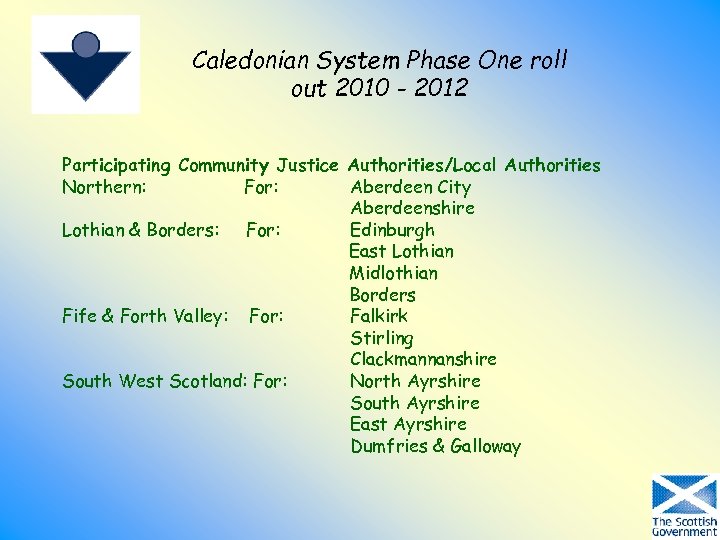 Caledonian System Phase One roll out 2010 - 2012 Participating Community Justice Authorities/Local Authorities Northern: For: Aberdeen City Aberdeenshire Lothian & Borders: For: Edinburgh East Lothian Midlothian Borders Fife & Forth Valley: For: Falkirk Stirling Clackmannanshire South West Scotland: For: North Ayrshire South Ayrshire East Ayrshire Dumfries & Galloway
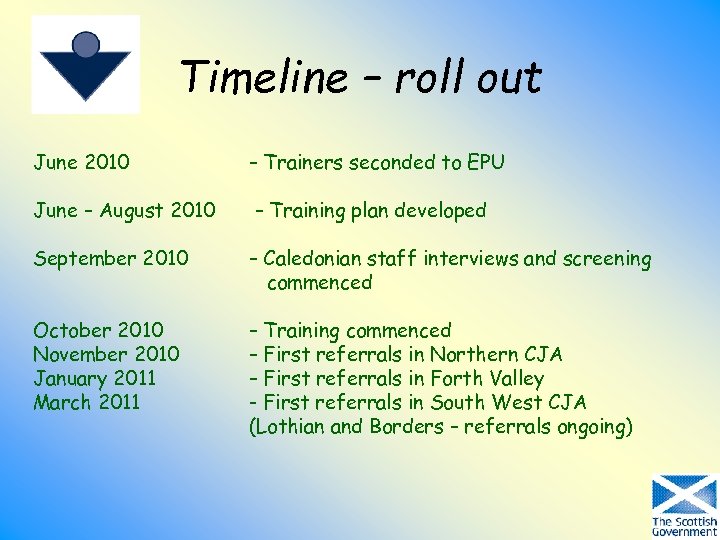 Timeline – roll out June 2010 – Trainers seconded to EPU June – August 2010 – Training plan developed September 2010 – Caledonian staff interviews and screening commenced October 2010 November 2010 January 2011 March 2011 – Training commenced – First referrals in Northern CJA – First referrals in Forth Valley - First referrals in South West CJA (Lothian and Borders – referrals ongoing)
 Monica Wilson Caledonian Professional Advisor Effective Practice Unit Monica. wilson@scotland. gsi. gov. uk