 Скачать презентацию The Cabinet Directive on Streamlining Regulation Regulatory Affairs
87a89f8481e44480976443994b156ba5.ppt
- Количество слайдов: 19



The Cabinet Directive on Streamlining Regulation Regulatory Affairs Sector Treasury Board of Canada Secretariat Environmental Evaluators Network September 30, 2010 Ottawa Conference Centre
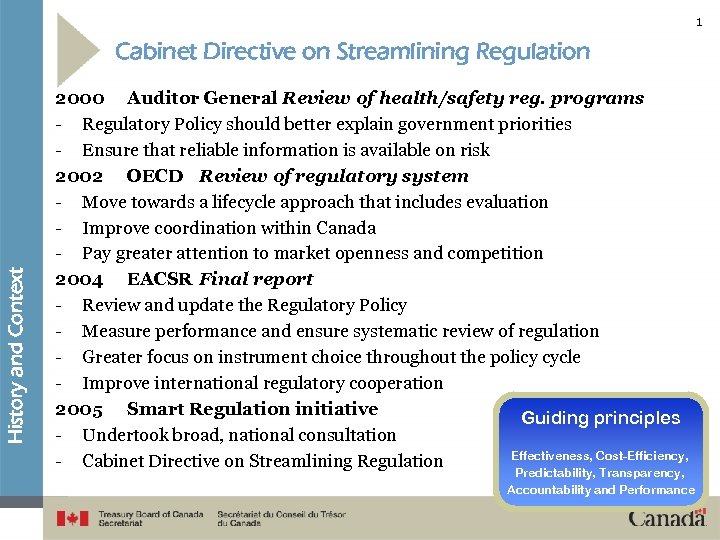
1 History and Context Cabinet Directive on Streamlining Regulation 2000 Auditor General Review of health/safety reg. programs - Regulatory Policy should better explain government priorities - Ensure that reliable information is available on risk 2002 OECD Review of regulatory system - Move towards a lifecycle approach that includes evaluation - Improve coordination within Canada - Pay greater attention to market openness and competition 2004 EACSR Final report - Review and update the Regulatory Policy - Measure performance and ensure systematic review of regulation - Greater focus on instrument choice throughout the policy cycle - Improve international regulatory cooperation 2005 Smart Regulation initiative Guiding principles - Undertook broad, national consultation Effectiveness, Cost-Efficiency, - Cabinet Directive on Streamlining Regulation Predictability, Transparency, Accountability and Performance
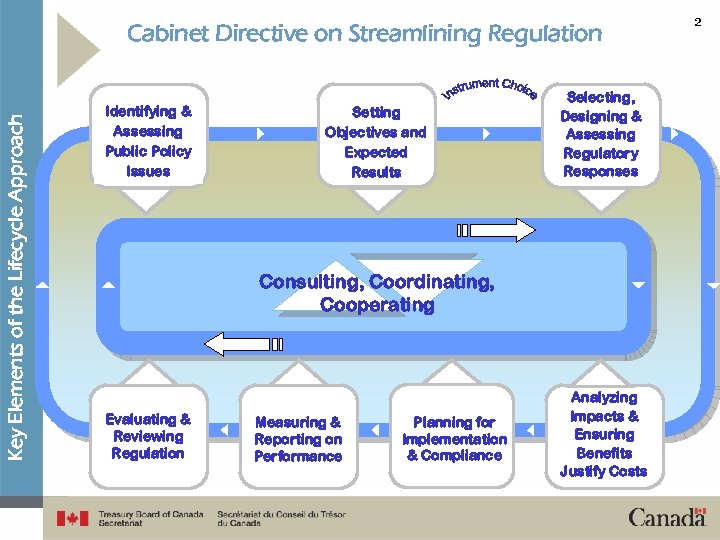
Key Elements of the Lifecycle Approach Cabinet Directive on Streamlining Regulation Identifying & Assessing Public Policy Issues Setting Objectives and Expected Results Selecting, Designing & Assessing Regulatory Responses Consulting, Coordinating, Cooperating Evaluating & Reviewing Regulation Measuring & Reporting on Performance Planning for Implementation & Compliance Analyzing Impacts & Ensuring Benefits Justify Costs 2
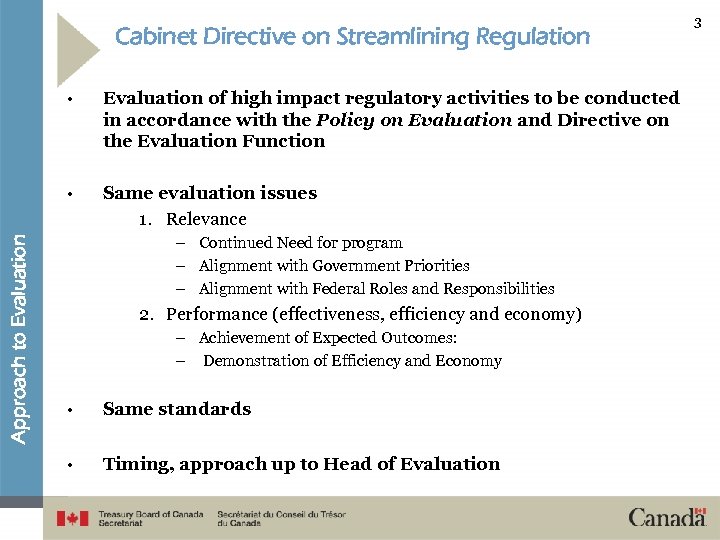
Cabinet Directive on Streamlining Regulation Evaluation of high impact regulatory activities to be conducted in accordance with the Policy on Evaluation and Directive on the Evaluation Function • Approach to Evaluation • Same evaluation issues 1. Relevance – Continued Need for program – Alignment with Government Priorities – Alignment with Federal Roles and Responsibilities 2. Performance (effectiveness, efficiency and economy) – Achievement of Expected Outcomes: – Demonstration of Efficiency and Economy • Same standards • Timing, approach up to Head of Evaluation 3
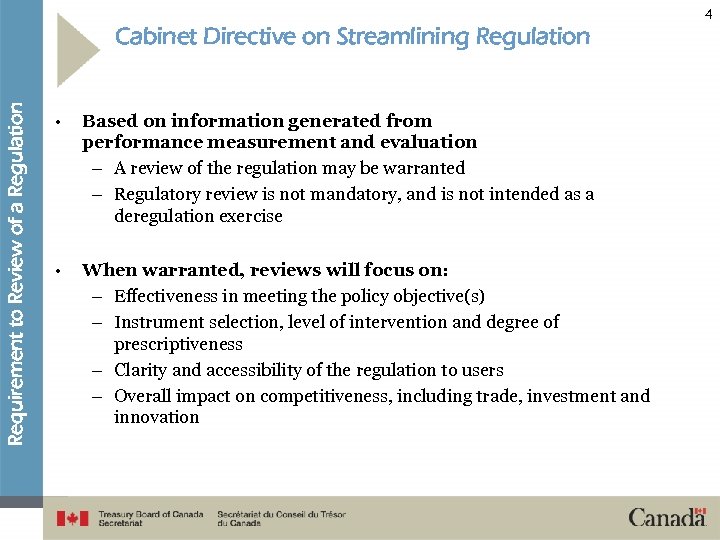
4 Requirement to Review of a Regulation Cabinet Directive on Streamlining Regulation • Based on information generated from performance measurement and evaluation – A review of the regulation may be warranted – Regulatory review is not mandatory, and is not intended as a deregulation exercise • When warranted, reviews will focus on: – Effectiveness in meeting the policy objective(s) – Instrument selection, level of intervention and degree of prescriptiveness – Clarity and accessibility of the regulation to users – Overall impact on competitiveness, including trade, investment and innovation
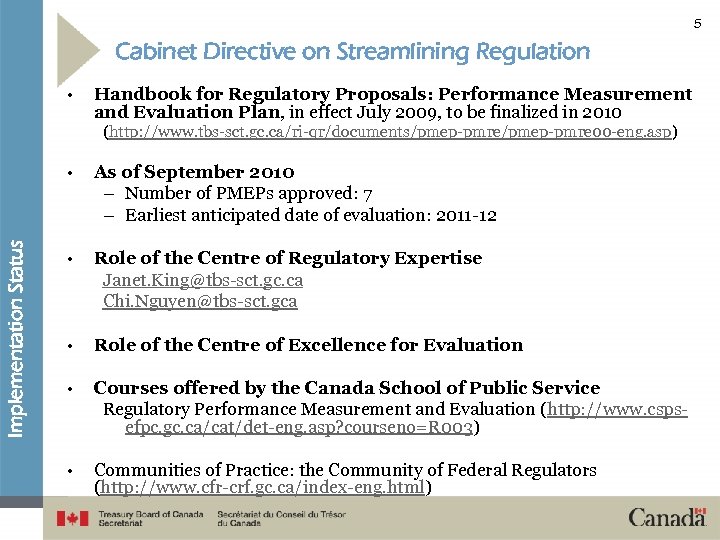
5 Cabinet Directive on Streamlining Regulation • Handbook for Regulatory Proposals: Performance Measurement and Evaluation Plan, in effect July 2009, to be finalized in 2010 (http: //www. tbs-sct. gc. ca/ri-qr/documents/pmep-pmre 00 -eng. asp) Implementation Status • As of September 2010 – Number of PMEPs approved: 7 – Earliest anticipated date of evaluation: 2011 -12 • Role of the Centre of Regulatory Expertise Janet. King@tbs-sct. gc. ca Chi. Nguyen@tbs-sct. gca • Role of the Centre of Excellence for Evaluation • Courses offered by the Canada School of Public Service Regulatory Performance Measurement and Evaluation (http: //www. cspsefpc. gc. ca/cat/det-eng. asp? courseno=R 003) • Communities of Practice: the Community of Federal Regulators (http: //www. cfr-crf. gc. ca/index-eng. html)
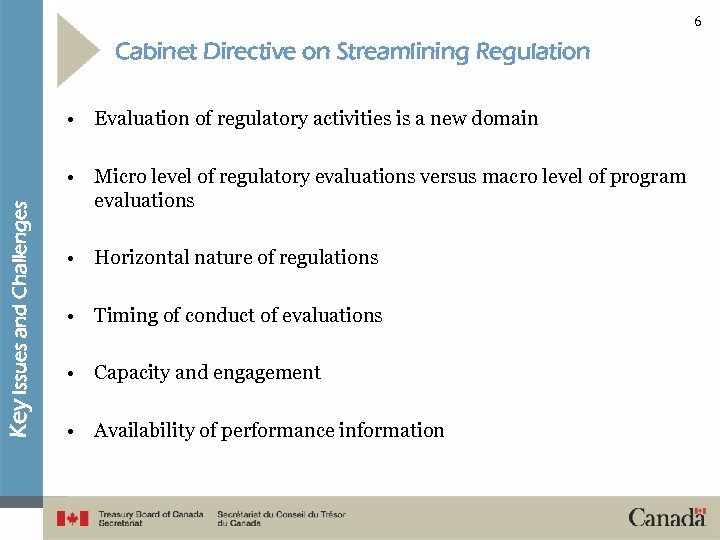
6 Cabinet Directive on Streamlining Regulation Evaluation of regulatory activities is a new domain • Key Issues and Challenges • Micro level of regulatory evaluations versus macro level of program evaluations • Horizontal nature of regulations • Timing of conduct of evaluations • Capacity and engagement • Availability of performance information
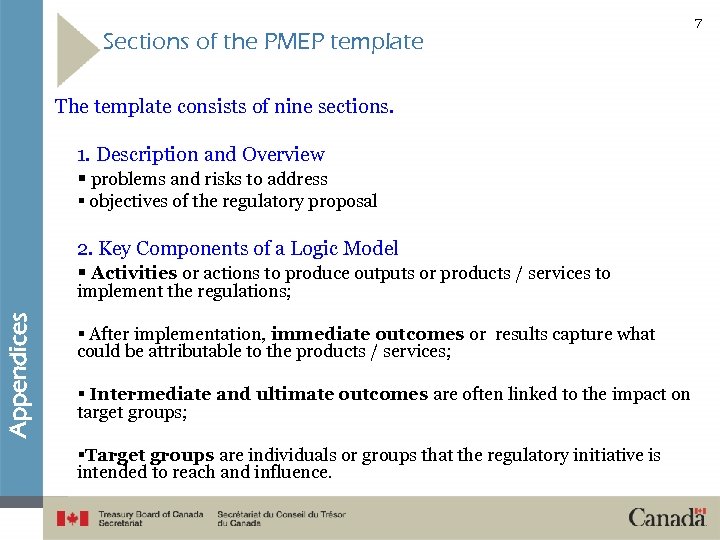
Sections of the PMEP template 7 The template consists of nine sections. 1. Description and Overview § problems and risks to address § objectives of the regulatory proposal 2. Key Components of a Logic Model § Activities or actions to produce outputs or products / services to Appendices implement the regulations; § After implementation, immediate outcomes or results capture what could be attributable to the products / services; § Intermediate and ultimate outcomes are often linked to the impact on target groups; §Target groups are individuals or groups that the regulatory initiative is intended to reach and influence.

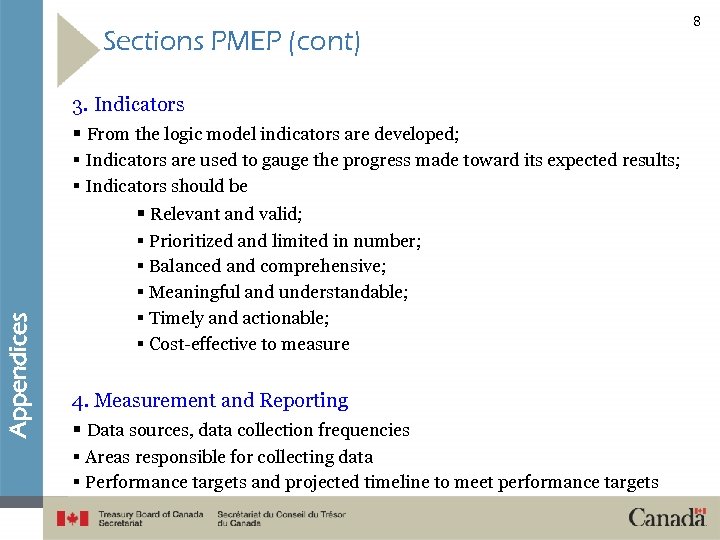
Sections PMEP (cont) 3. Indicators § From the logic model indicators are developed; § Indicators are used to gauge the progress made toward its expected results; § Indicators should be Appendices § Relevant and valid; § Prioritized and limited in number; § Balanced and comprehensive; § Meaningful and understandable; § Timely and actionable; § Cost-effective to measure 4. Measurement and Reporting § Data sources, data collection frequencies § Areas responsible for collecting data § Performance targets and projected timeline to meet performance targets 8
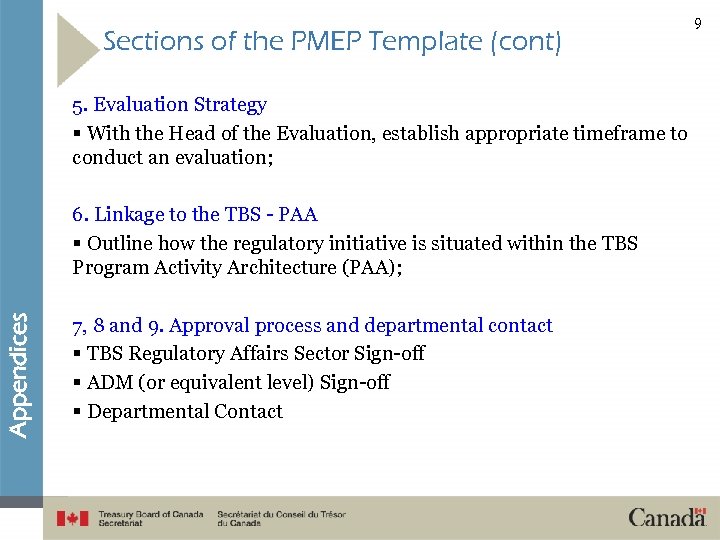
Sections of the PMEP Template (cont) 5. Evaluation Strategy § With the Head of the Evaluation, establish appropriate timeframe to conduct an evaluation; Appendices 6. Linkage to the TBS - PAA § Outline how the regulatory initiative is situated within the TBS Program Activity Architecture (PAA); 7, 8 and 9. Approval process and departmental contact § TBS Regulatory Affairs Sector Sign-off § ADM (or equivalent level) Sign-off § Departmental Contact 9
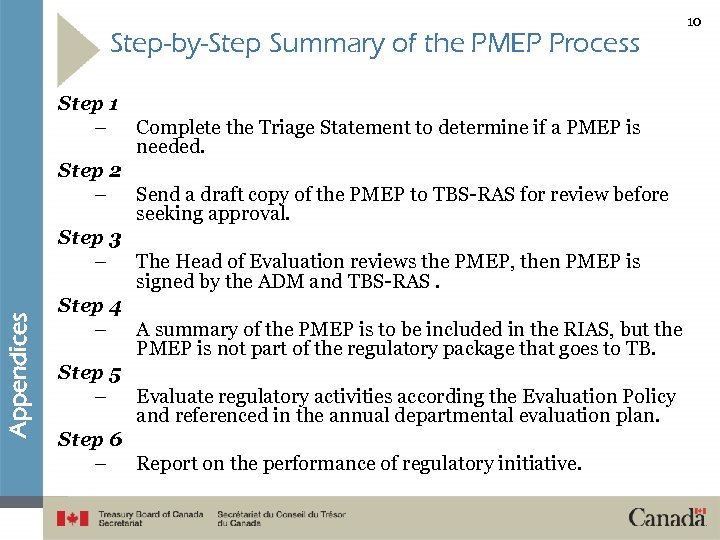
Appendices Step-by-Step Summary of the PMEP Process 10 Step 1 – Complete the Triage Statement to determine if a PMEP is needed. Step 2 – Send a draft copy of the PMEP to TBS-RAS for review before seeking approval. Step 3 – The Head of Evaluation reviews the PMEP, then PMEP is signed by the ADM and TBS-RAS. Step 4 – A summary of the PMEP is to be included in the RIAS, but the PMEP is not part of the regulatory package that goes to TB. Step 5 – Evaluate regulatory activities according the Evaluation Policy and referenced in the annual departmental evaluation plan. Step 6 – Report on the performance of regulatory initiative.
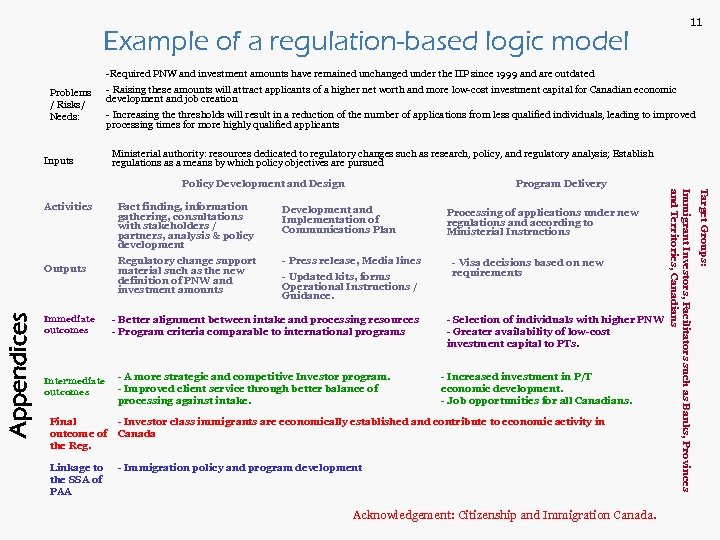
Example of a regulation-based logic model Problems / Risks/ Needs: -Required PNW and investment amounts have remained unchanged under the IIP since 1999 and are outdated - Raising these amounts will attract applicants of a higher net worth and more low-cost investment capital for Canadian economic development and job creation - Increasing the thresholds will result in a reduction of the number of applications from less qualified individuals, leading to improved processing times for more highly qualified applicants Inputs Ministerial authority: resources dedicated to regulatory changes such as research, policy, and regulatory analysis; Establish regulations as a means by which policy objectives are pursued Outputs Immediate outcomes Intermediate outcomes Fact finding, information gathering, consultations with stakeholders / partners, analysis & policy development Development and Implementation of Communications Plan Regulatory change support material such as the new definition of PNW and investment amounts - Press release, Media lines - Updated kits, forms Operational Instructions / Guidance. - Better alignment between intake and processing resources - Program criteria comparable to international programs - A more strategic and competitive Investor program. - Improved client service through better balance of processing against intake. Processing of applications under new regulations and according to Ministerial Instructions - Visa decisions based on new requirements - Selection of individuals with higher PNW - Greater availability of low-cost investment capital to PTs. - Increased investment in P/T economic development. - Job opportunities for all Canadians. Final outcome of the Reg. - Investor class immigrants are economically established and contribute to economic activity in Canada Linkage to the SSA of PAA - Immigration policy and program development Acknowledgement: Citizenship and Immigration Canada. Target Groups: Activities Program Delivery Immigrant Investors, Facilitators such as Banks, Provinces and Territories, Canadians Policy Development and Design Appendices 11
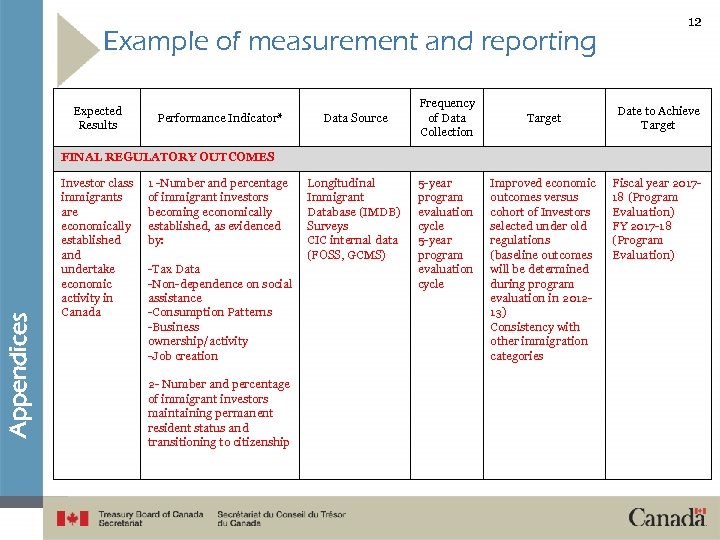
Example of measurement and reporting Expected Results Performance Indicator* Data Source Frequency of Data Collection Target 12 Date to Achieve Target Appendices FINAL REGULATORY OUTCOMES Investor class immigrants are economically established and undertake economic activity in Canada 1 -Number and percentage of immigrant investors becoming economically established, as evidenced by: -Tax Data -Non-dependence on social assistance -Consumption Patterns -Business ownership/activity -Job creation 2 - Number and percentage of immigrant investors maintaining permanent resident status and transitioning to citizenship Longitudinal Immigrant Database (IMDB) Surveys CIC internal data (FOSS, GCMS) 5 -year program evaluation cycle Improved economic outcomes versus cohort of Investors selected under old regulations (baseline outcomes will be determined during program evaluation in 201213) Consistency with other immigration categories Fiscal year 201718 (Program Evaluation) FY 2017 -18 (Program Evaluation)
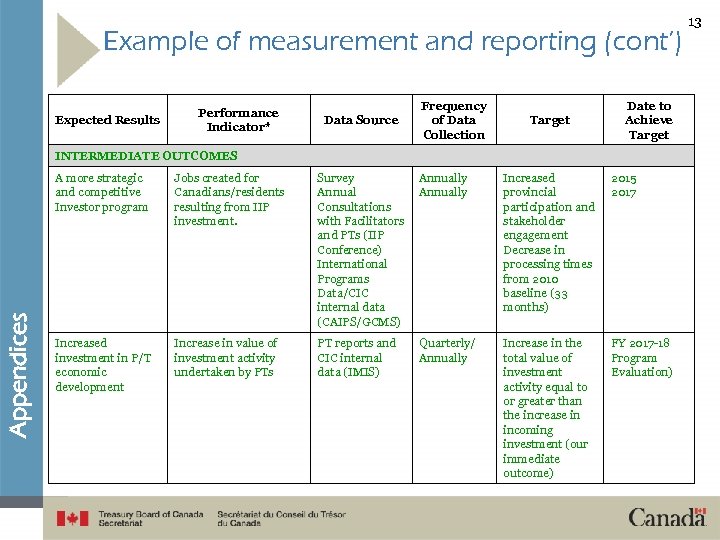
Example of measurement and reporting (cont’) Expected Results Performance Indicator* Data Source Frequency of Data Collection Target Date to Achieve Target INTERMEDIATE OUTCOMES Appendices A more strategic and competitive Investor program Jobs created for Canadians/residents resulting from IIP investment. Survey Annual Consultations with Facilitators and PTs (IIP Conference) International Programs Data/CIC internal data (CAIPS/GCMS) Annually Increased provincial participation and stakeholder engagement Decrease in processing times from 2010 baseline (33 months) 2015 2017 Increased investment in P/T economic development Increase in value of investment activity undertaken by PTs PT reports and CIC internal data (IMIS) Quarterly/ Annually Increase in the total value of investment activity equal to or greater than the increase in incoming investment (our immediate outcome) FY 2017 -18 Program Evaluation) 13
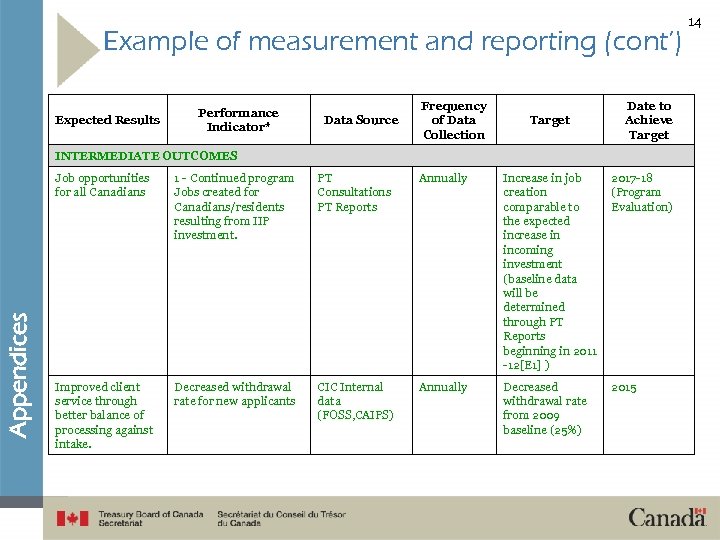
Example of measurement and reporting (cont’) Expected Results Performance Indicator* Data Source Frequency of Data Collection Target Date to Achieve Target INTERMEDIATE OUTCOMES Appendices Job opportunities for all Canadians 1 - Continued program Jobs created for Canadians/residents resulting from IIP investment. PT Consultations PT Reports Annually Increase in job creation comparable to the expected increase in incoming investment (baseline data will be determined through PT Reports beginning in 2011 -12[E 1] ) 2017 -18 (Program Evaluation) Improved client service through better balance of processing against intake. Decreased withdrawal rate for new applicants CIC Internal data (FOSS, CAIPS) Annually Decreased withdrawal rate from 2009 baseline (25%) 2015 14
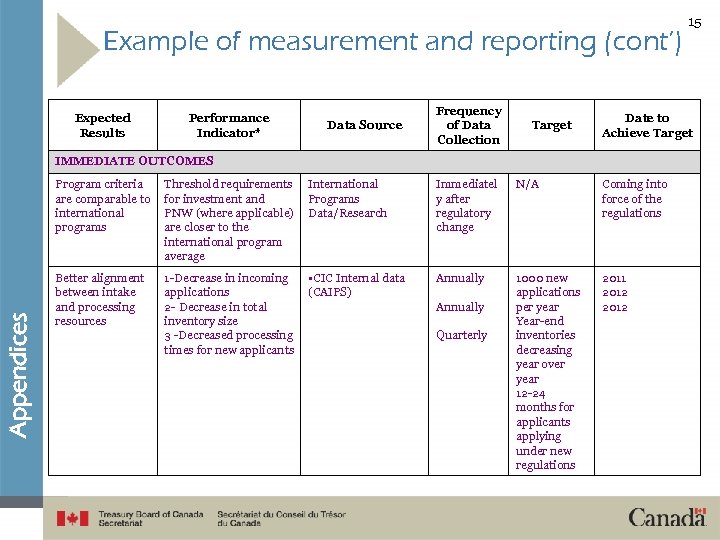
Example of measurement and reporting (cont’) Expected Results Performance Indicator* Data Source Frequency of Data Collection Target Date to Achieve Target IMMEDIATE OUTCOMES Appendices Program criteria are comparable to international programs Threshold requirements International for investment and Programs PNW (where applicable) Data/Research are closer to the international program average Better alignment between intake and processing resources 1 -Decrease in incoming applications 2 - Decrease in total inventory size 3 -Decreased processing times for new applicants • CIC Internal data (CAIPS) Immediatel y after regulatory change N/A Coming into force of the regulations Annually 1000 new applications per year Year-end inventories decreasing year over year 12 -24 months for applicants applying under new regulations 2011 2012 Annually Quarterly 15
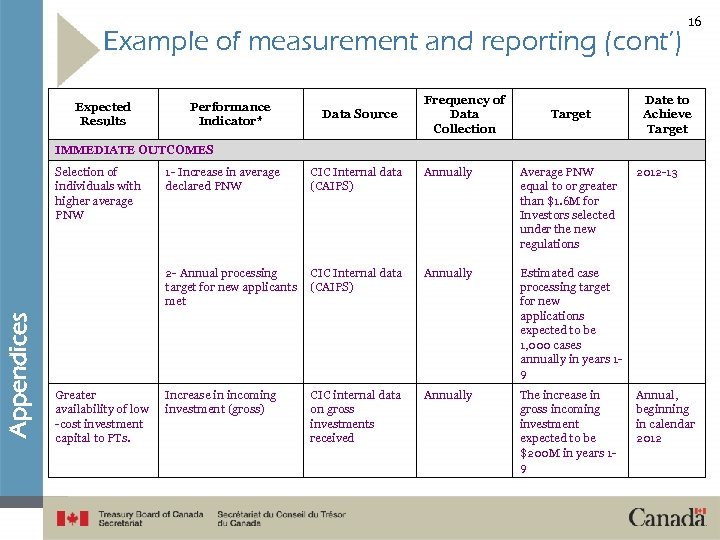
Example of measurement and reporting (cont’) Expected Results Performance Indicator* Data Source Frequency of Data Collection Target 16 Date to Achieve Target IMMEDIATE OUTCOMES Greater availability of low -cost investment capital to PTs. CIC Internal data (CAIPS) Annually Average PNW equal to or greater than $1. 6 M for Investors selected under the new regulations 2 - Annual processing CIC Internal data target for new applicants (CAIPS) met Appendices Selection of individuals with higher average PNW 1 - Increase in average declared PNW Annually Estimated case processing target for new applications expected to be 1, 000 cases annually in years 19 Increase in incoming investment (gross) Annually The increase in gross incoming investment expected to be $200 M in years 19 CIC internal data on gross investments received 2012 -13 Annual, beginning in calendar 2012
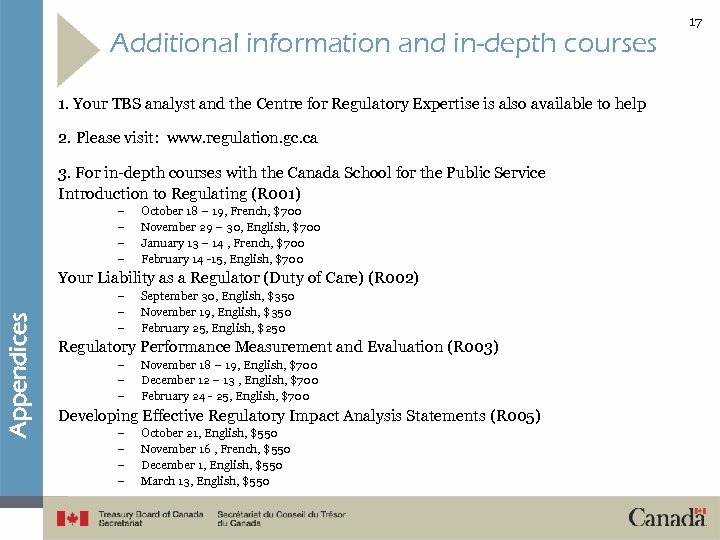
Additional information and in-depth courses 1. Your TBS analyst and the Centre for Regulatory Expertise is also available to help 2. Please visit: www. regulation. gc. ca 3. For in-depth courses with the Canada School for the Public Service Introduction to Regulating (R 001) – – October 18 – 19, French, $700 November 29 – 30, English, $700 January 13 – 14 , French, $700 February 14 -15, English, $700 Appendices Your Liability as a Regulator (Duty of Care) (R 002) – – – September 30, English, $350 November 19, English, $350 February 25, English, $250 Regulatory Performance Measurement and Evaluation (R 003) – – – November 18 – 19, English, $700 December 12 – 13 , English, $700 February 24 - 25, English, $700 Developing Effective Regulatory Impact Analysis Statements (R 005) – – October 21, English, $550 November 16 , French, $550 December 1, English, $550 March 13, English, $550 17
Скачать презентацию The Cabinet Directive on Streamlining Regulation Regulatory Affairs
87a89f8481e44480976443994b156ba5.ppt