 Скачать презентацию The Business of Small Business Forum Part V
94fbab1ddd1c9fa56ee72cd7f40efee9.ppt
- Количество слайдов: 79



The Business of Small Business Forum Part V: Safety and Health Issues In Small Construction Firms May 30, 2007 Occupational Safety and Health Administration Directorate of Cooperative and State Programs Office of Small Business Assistance
Business of Small Business Safety and Health Issues in Small Construction Firms Carmen Shafer, CSP Corporate Safety Manager
Overview • Who We Are • Our Safety Program and Goals • Statistics • Change • Benefits • Safety Mindset • Challenges We Still Face
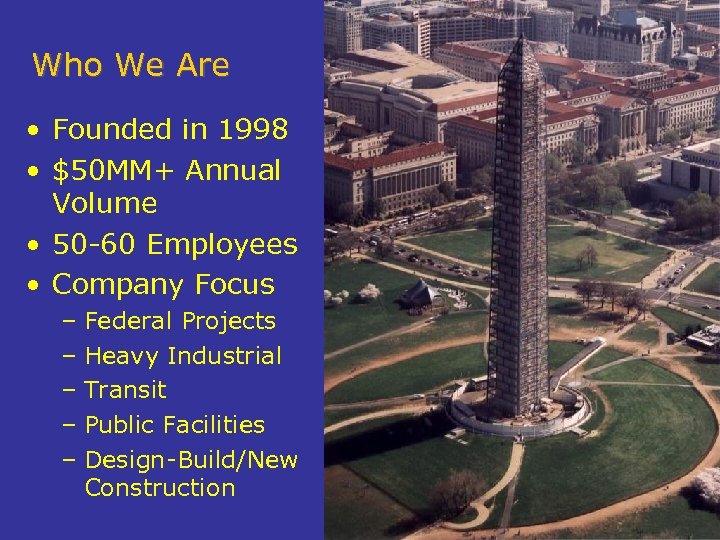
Who We Are • Founded in 1998 • $50 MM+ Annual Volume • 50 -60 Employees • Company Focus – Federal Projects – Heavy Industrial – Transit – Public Facilities – Design-Build/New Construction
Our Primary Goal • Protecting our employees, our subcontractors and members of the public from harm
New Program • As the nature G-W’s work changed a new safety plan was developed using ANSI A 10. 38 and OSHA guidelines as templates • G-W’s new program includes the use of many OSHA Resources
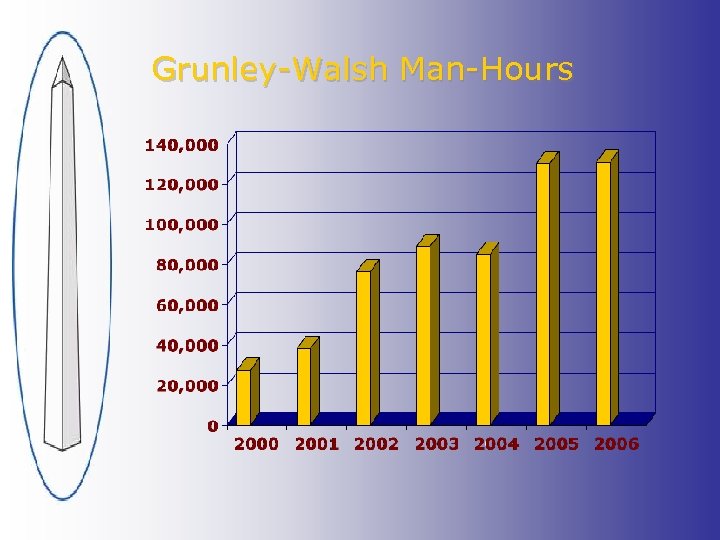
Grunley-Walsh Man-Hours
How We Do It • Employee Involvement • Planning and Follow-Through • Individual Development • Continual Improvement
OSHA Resources Utilized • Training using Susan Harwood Grant Materials – Fall Protection – Steel Erection • Free safety training through MOSH • “Quick Cards” for on-site training • OSHA Website • Boilerplate safety plans – BBP and EAP, checklists, etc.
OSHA Resources Utilized • Participation in DFWP through AGC as an alliance member • Attendance at ACCSH to learn of forthcoming regulations
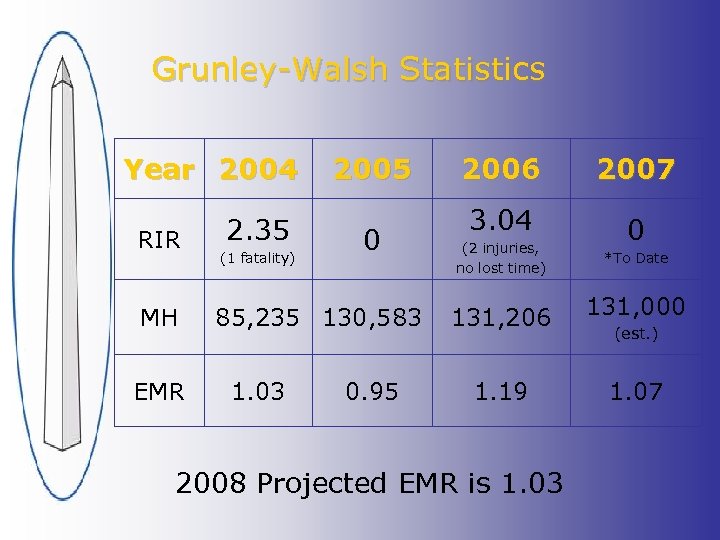
Grunley-Walsh Statistics Year 2004 RIR MH EMR 2. 35 (1 fatality) 2005 0 85, 235 130, 583 1. 03 0. 95 2006 2007 3. 04 0 (2 injuries, no lost time) *To Date 131, 206 131, 000 1. 19 1. 07 2008 Projected EMR is 1. 03 (est. )
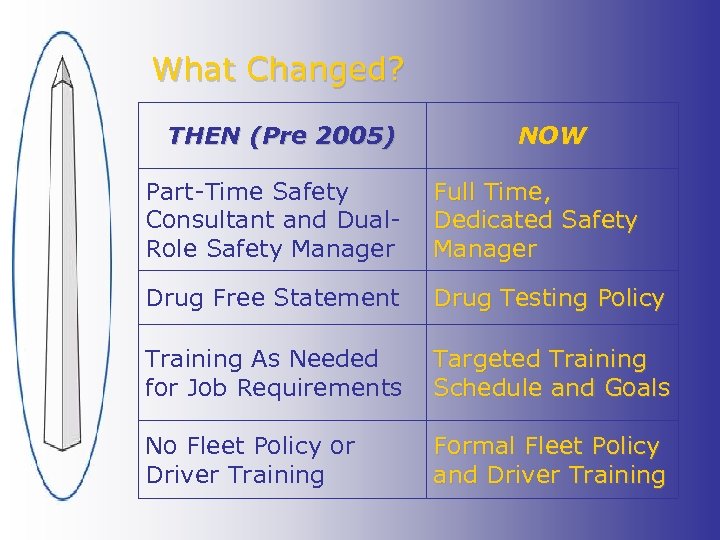
What Changed? THEN (Pre 2005) NOW Part-Time Safety Consultant and Dual. Role Safety Manager Full Time, Dedicated Safety Manager Drug Free Statement Drug Testing Policy Training As Needed for Job Requirements Targeted Training Schedule and Goals No Fleet Policy or Driver Training Formal Fleet Policy and Driver Training
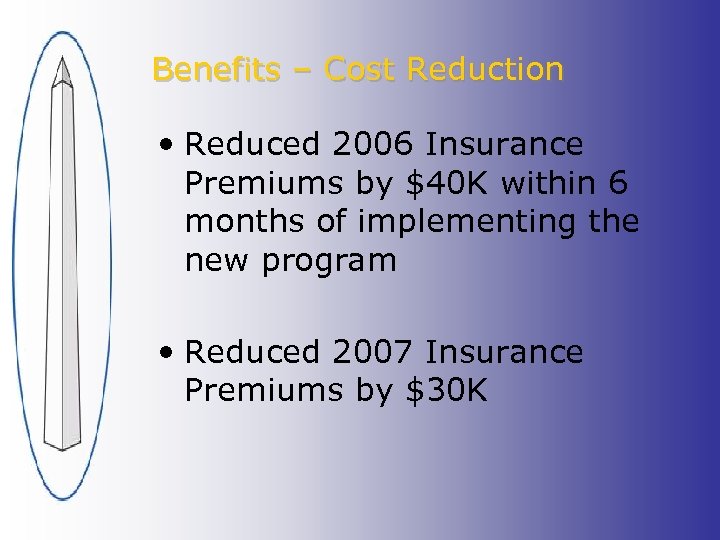
Benefits – Cost Reduction • Reduced 2006 Insurance Premiums by $40 K within 6 months of implementing the new program • Reduced 2007 Insurance Premiums by $30 K
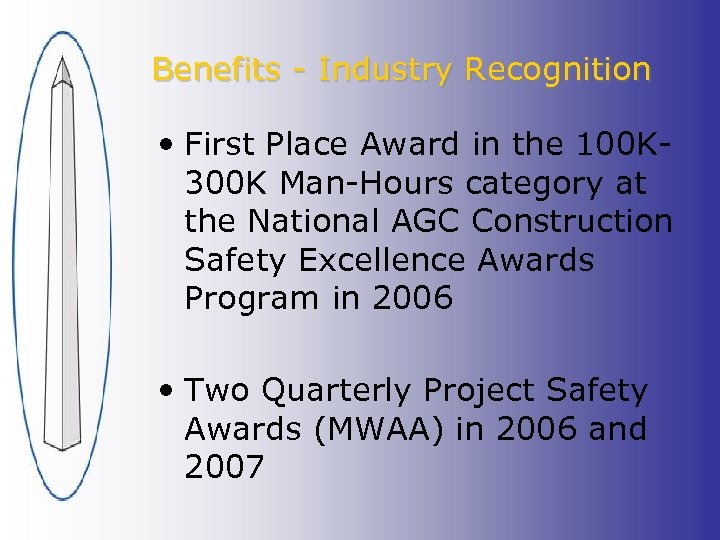
Benefits - Industry Recognition • First Place Award in the 100 K 300 K Man-Hours category at the National AGC Construction Safety Excellence Awards Program in 2006 • Two Quarterly Project Safety Awards (MWAA) in 2006 and 2007
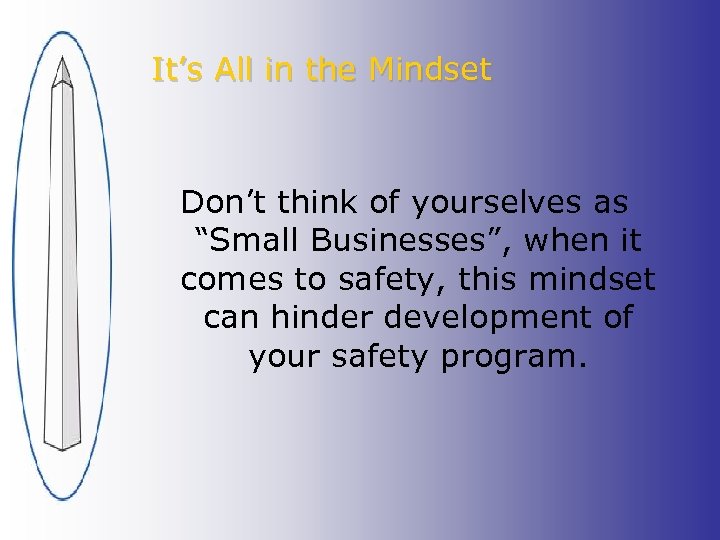
It’s All in the Mindset Don’t think of yourselves as “Small Businesses”, when it comes to safety, this mindset can hinder development of your safety program.
Myth • OSHA Fines and Medical Bills are part of the cost of doing business
G-W’s Mindset • OSHA Fines and Medical Bills are costs that reduce our profit – These costs are indicators that we are doing something wrong
Myth • Insurance Rates always go up, there’s nothing we can do about that
G-W Mindset • We can control our insurance rates through minimizing and managing our risk. – Reduce Accidents and incidents – Reduce Injuries & Manage Cases – Implement effective programs
Myth • If I did everything OSHA says I have to do, I will go out of business
G-W Mindset • OSHA is the Law and are the minimum requirements • Doing what OSHA and our contracts require is the cost of doing business. • There is Help – OSHA/DOL Provides Free Resources to help the small business meet many of its requirements at minimal cost
Myth • Construction is Dangerous Work, Accidents Happen
G-W Mindset • Construction is Dangerous Work. • However, these hazards are known and can be minimized – Planning – Training – Follow-Through
Challenges We Face • Locating Resources – Need for quality safety personnel to staff projects • Educating our Trades People – Need for Bilingual personnel to assist with training • Time – Getting personnel away from the project to participate in training, committees, etc. – Convincing Employees & Subs to take the time to plan, train, and do it right the first time…
Challenges We Face • OSHA’s Construction Challenge Program and VPP for Mobile Worksites – Currently working on application process
Aim High Our program is founded on the concept and commitment to create a pre-eminent, world-class safety culture
The Business of Small Business in T. A. Loving Company and AGC Presenter Linwood Smith, T. A. Loving Associated General Contractors of America
Discussion Items • • T. A. Loving involvement in safety and health AGC involvement in safety and health How the two are compatible How OSHA’s cooperative programs assist the small contractor • Cooperative programs help the companies bottom line
T. A. Loving • • • 80 years of building experience, Establish in 1925 One of the nation's consistently top-ranked 400 contractors Three operating divisions – Building, Utilities, Bridge/Heavy Safety and health is a value to the company How Safety and health effects our bottom line
Associated General Contractors of America • Oldest and the largest of nationwide trade associations in the construction industry. • Founded in 1918 at the request of President Woodrow Wilson • AGC represents more than 32, 000 firms in the construction industry in 98 chapters throughout the United States. • 7, 000 of the nation’s leading general contractors • More than 12, 00 specialty contractors, • 13, 000 material suppliers, engaged in the following construction – buildings, shopping centers, factories, industrial centers, warehouses, bridges, highways, tunnels, airports, water works facilities, multi-family housing, dams, water conservation projects, defense facilities, and municipal utilities. • Of these firms, 90% are small businesses and most of them are family owned and operated.
T. A. Loving Involvement with AGC • T. A. Loving President is Past President of AGC National • Recent Past-Chairman of AGC Safety and Health Committee • Assisted in the growth of cooperative programs participation during chairmanship • Challenge Administrator with participants and 3 graduates • Member of Roadway Work Zone Alliance and the Drug-Free Workplace Alliance • Several AGC members are VPP Star • CHASE Partnership • Current AGC representative on ACCSH and current committee Chairman
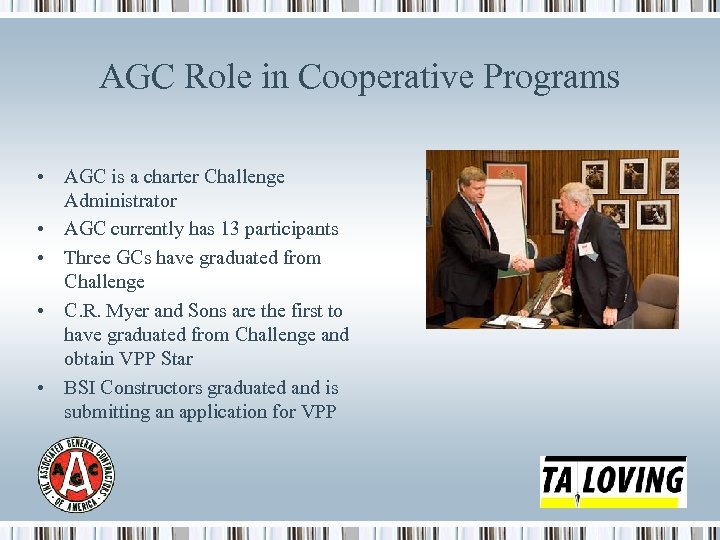
AGC Role in Cooperative Programs • AGC is a charter Challenge Administrator • AGC currently has 13 participants • Three GCs have graduated from Challenge • C. R. Myer and Sons are the first to have graduated from Challenge and obtain VPP Star • BSI Constructors graduated and is submitting an application for VPP
Strategic Partnerships • CHASE Partnership (Construction Health and Safety Excellence ) • 1998 partnership charter and was agreed upon on January 9, 2001 • had three award levels, Red (lowest), White (intermediate) and Blue (most stringent) • decreased serious injuries, illnesses, and fatalities for participating contractors • improvement of existing safety and health programs • 2003 – 81 participants and 9, 967 employees involved in CHASE • CHASE expired in October 2004 • AGC now focused on Challenge and VPP-C
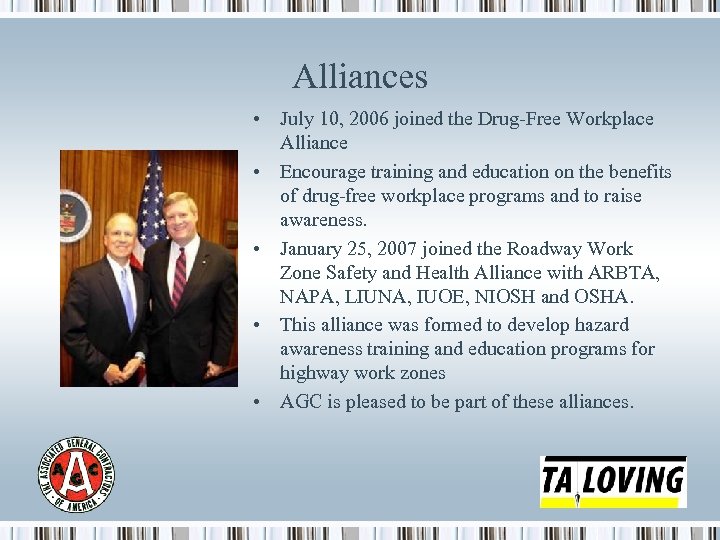
Alliances • July 10, 2006 joined the Drug-Free Workplace Alliance • Encourage training and education on the benefits of drug-free workplace programs and to raise awareness. • January 25, 2007 joined the Roadway Work Zone Safety and Health Alliance with ARBTA, NAPA, LIUNA, IUOE, NIOSH and OSHA. • This alliance was formed to develop hazard awareness training and education programs for highway work zones • AGC is pleased to be part of these alliances.
North Carolina Cooperative Programs • • Partnership Agreements Carolina Building Star N. C. Dep. Of Labor Safety Awards Program Consultative Services
T. A. Loving Support of Cooperative Programs • Original Purpose and intent of OSHA • 1991 Hamlet Chicken Processing Plant Fire • Cooperative Programs Vs. Enforcement
The Business of Small Business Forum – Part V Presented by: John Masarick May 30, 2007
Independent Electrical Contractors n n n A National Association of Electrical and System Contractors 73 Chapters Nationwide 3500 Members 100, 000 Electricians Providing Training for 10, 000 Apprentices
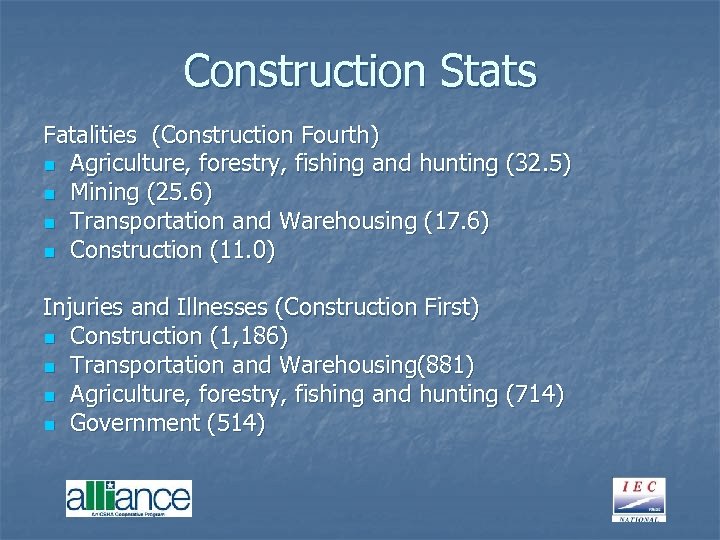
Construction Stats Fatalities (Construction Fourth) n Agriculture, forestry, fishing and hunting (32. 5) n Mining (25. 6) n Transportation and Warehousing (17. 6) n Construction (11. 0) Injuries and Illnesses (Construction First) n Construction (1, 186) n Transportation and Warehousing(881) n Agriculture, forestry, fishing and hunting (714) n Government (514)
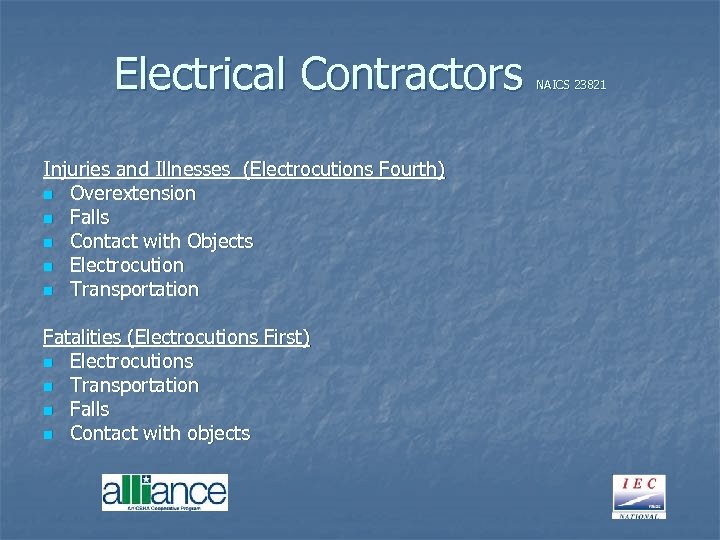
Electrical Contractors Injuries and Illnesses (Electrocutions Fourth) n Overextension n Falls n Contact with Objects n Electrocution n Transportation Fatalities (Electrocutions First) n Electrocutions n Transportation n Falls n Contact with objects NAICS 23821
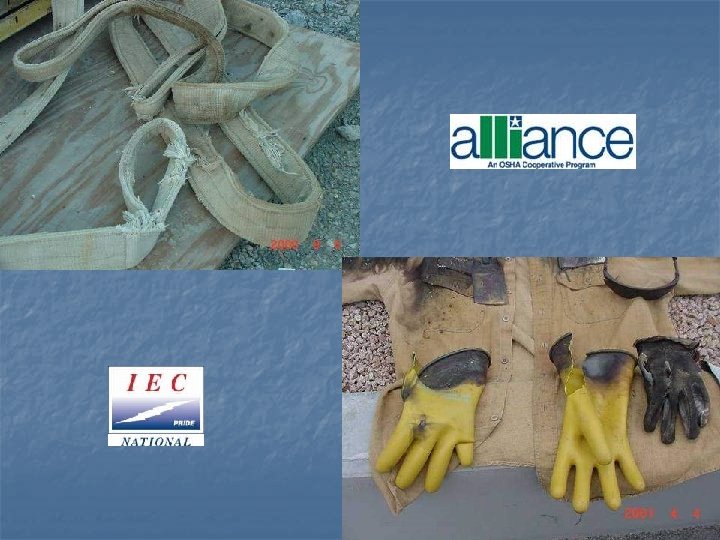
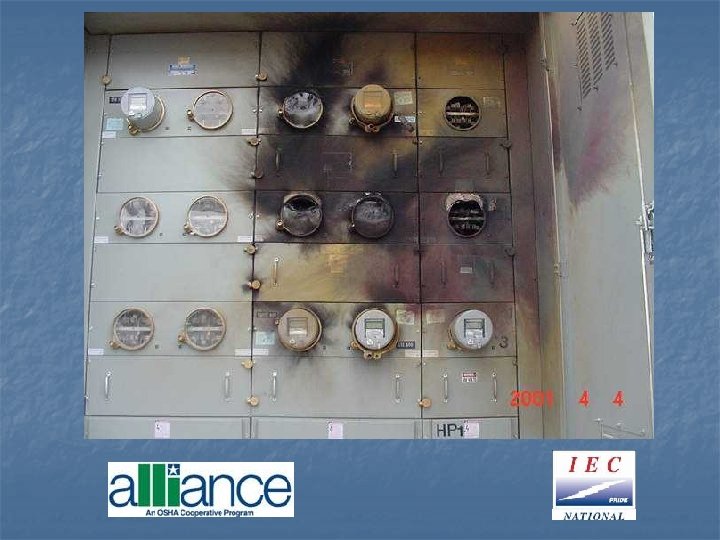
Safety on the Jobsite n If less than 50 workers, employer or supervisor oversees jobsite safety n If greater than 50 workers, company hires a safety director to oversee safety. n Smaller Contractors need to access safety material quickly.
How Does Safety Impact your Business n n n n Cost of Insurance Lost Time Lost Productivity Workers are a Valuable Asset Contractors Compete for Workers Shrinking Workforce Retention Other Costs
What Made OSHA’s Cooperative Program Attractive to IEC n n n Many safety committee members also participated in the development of other regulations. Information about OSHA’s new alliance was found on their web site. Other associations in construction had partnered with OSHA. Alliance appeared have advantages. Safety regulations and other information could be obtained directly from the source.
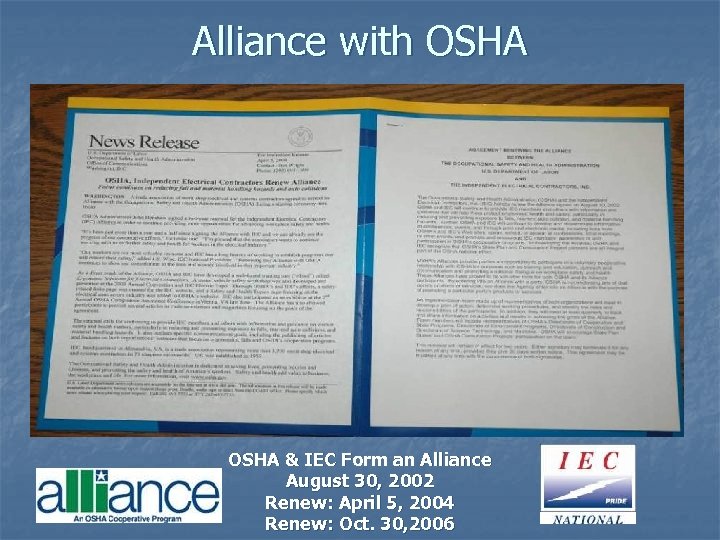
Alliance with OSHA & IEC Form an Alliance August 30, 2002 Renew: April 5, 2004 Renew: Oct. 30, 2006
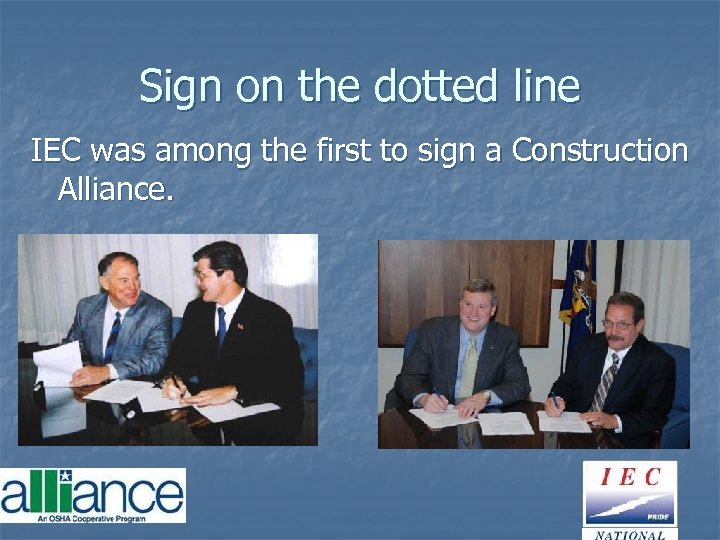
Sign on the dotted line IEC was among the first to sign a Construction Alliance.
IEC Considered OSHA’s Cooperative Programs n n n Alliance Partnership Challenge Program
What the OSHA/IEC Alliance Includes n Falls n n Material Handling n n The number one cause of injuries and fatalities in construction. 30% of the claims from IEC contractors were related to ergonomics. Fleet Accidents n Automobile accidents are the second leading cause of injuries in construction. Our insurance partner recommenced including fleet accidents because of its high incident rate.
Benefits OSHA n Reach more Employers and Employees n Break down old barriers IEC n Members participate on Implementation Team with OSHA Staff n Break down old barriers
Outreach Sources n Inform the Membership Association Magazine (IEC INSIGHTS) n Safety Newsletter (IEC National Codes & Safety Newsletter) n E-mail newsletter n Web Page (Safety Page) n Convention and EXPO n
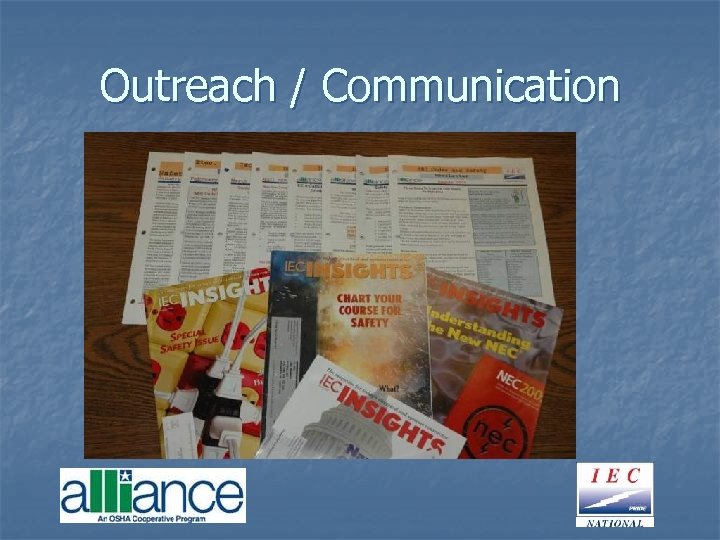
Outreach / Communication
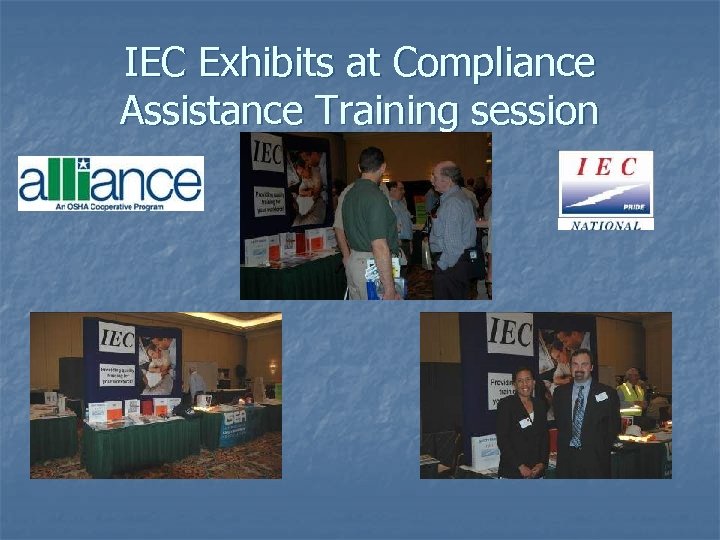
Accomplishments of the OSHA / IEC Alliance n n n n Quarterly Alliance Meeting OSHA Attends IEC Safety Committee Meetings Ergonomic E-tool: Solutions for Contractors Electrical Contractors Safety and Health Topic page 10 Hour Supervisors Training Attendance at Training Sessions / Shows Participate at Roundtable Members Form Alliance/Partnerships/Challenge
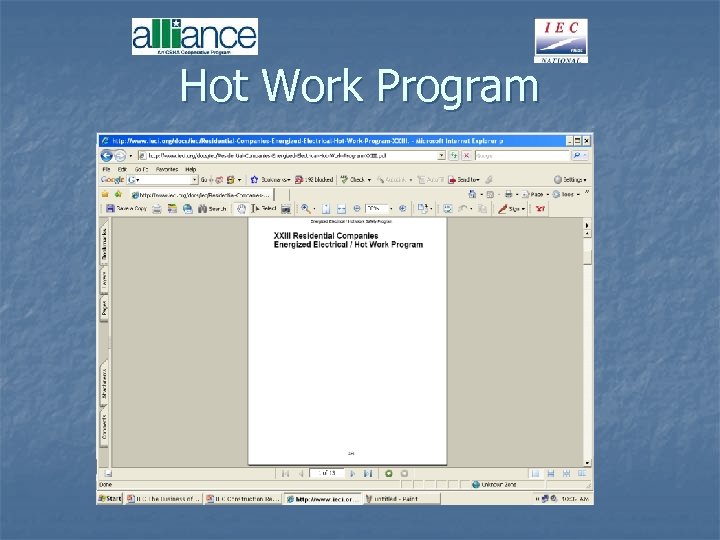
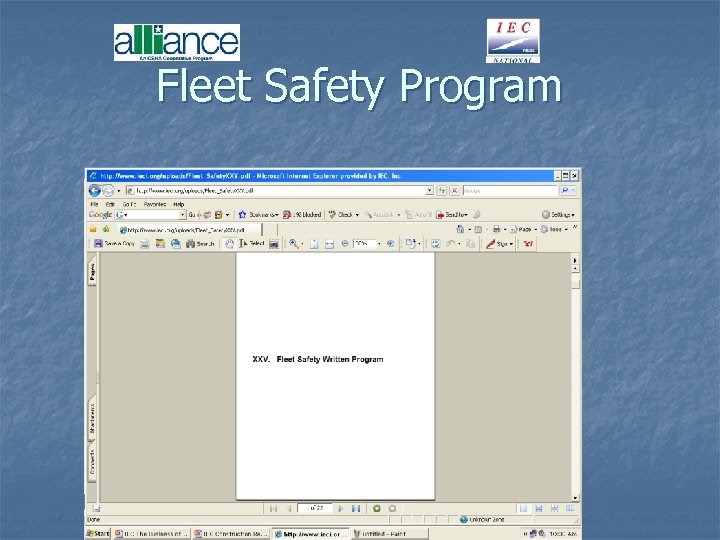
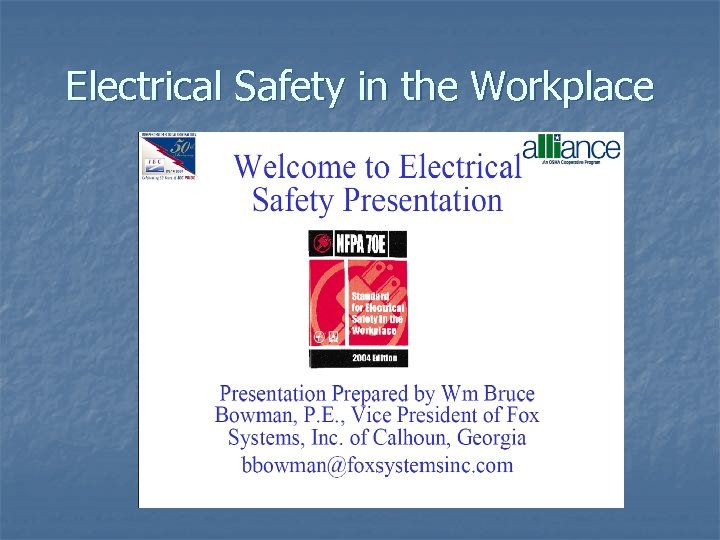
Continued…. n n Construction Challenge Hot Work Program Fleet Safety Written Program Welcome to Electrical Safety Program (Arc Flash)
Benefits to the Members n n n Safety Newsletter Safety Web site Monthly Safety Video to Chapters
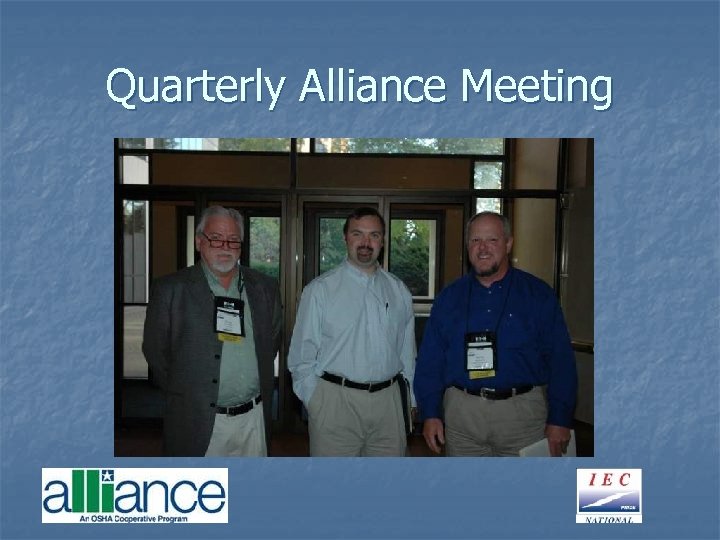
Quarterly Alliance Meeting
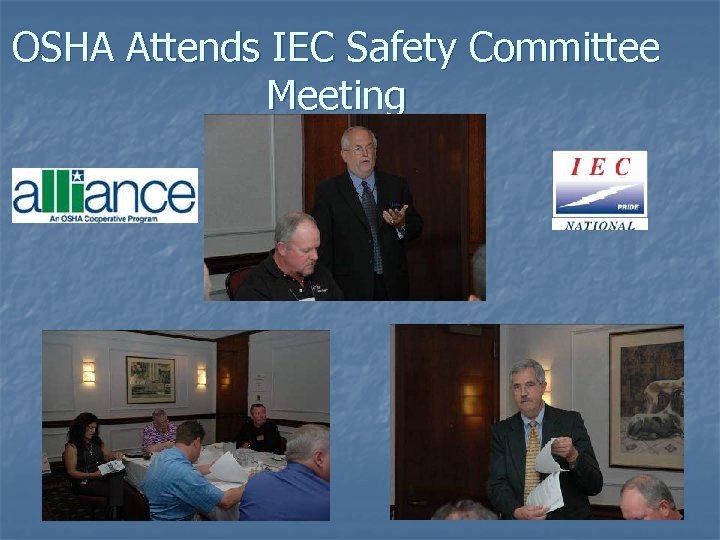
OSHA Attends IEC Safety Committee Meeting
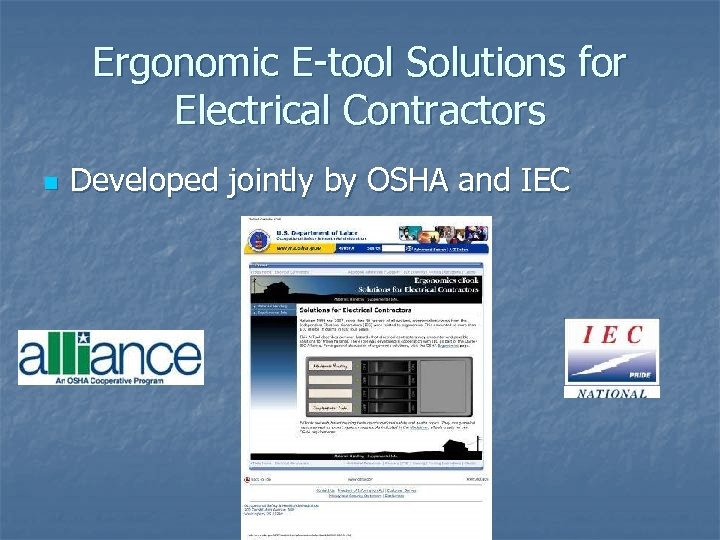
Ergonomic E-tool Solutions for Electrical Contractors n Developed jointly by OSHA and IEC
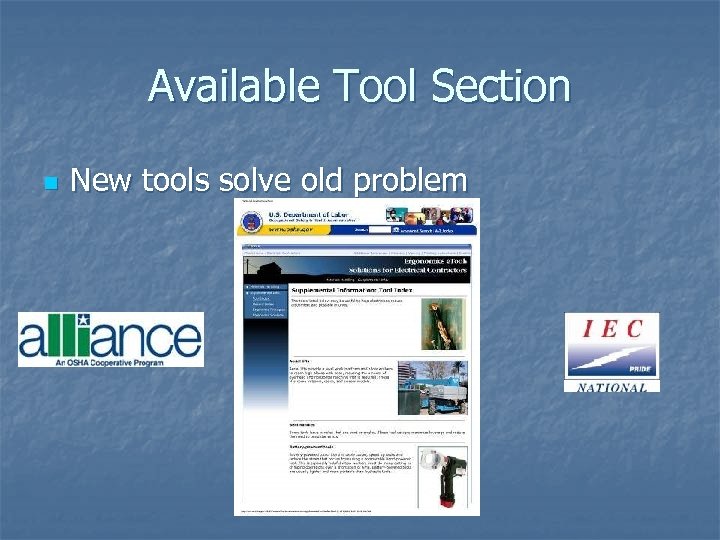
Available Tool Section n New tools solve old problem
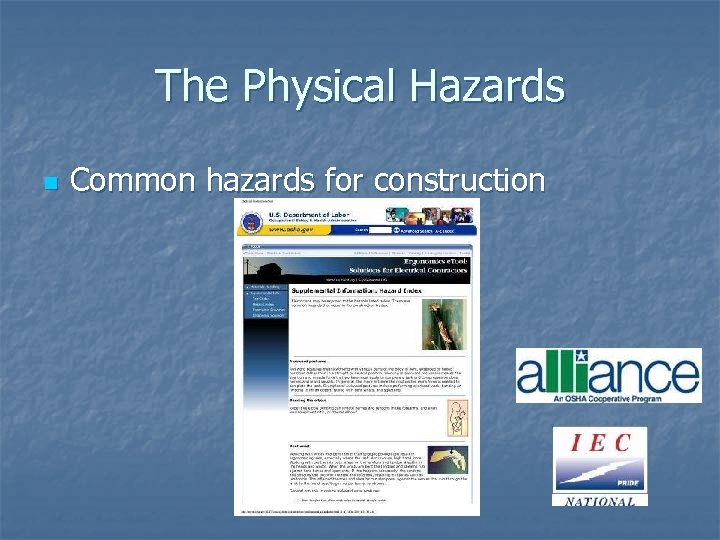
The Physical Hazards n Common hazards for construction
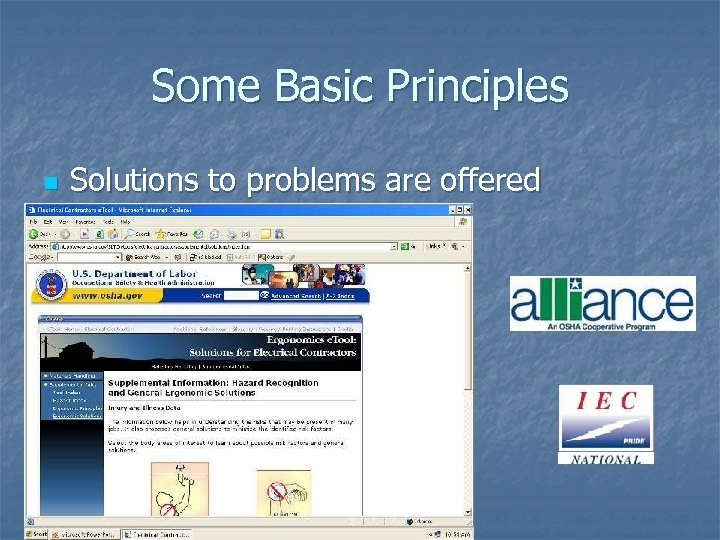
Some Basic Principles n Solutions to problems are offered
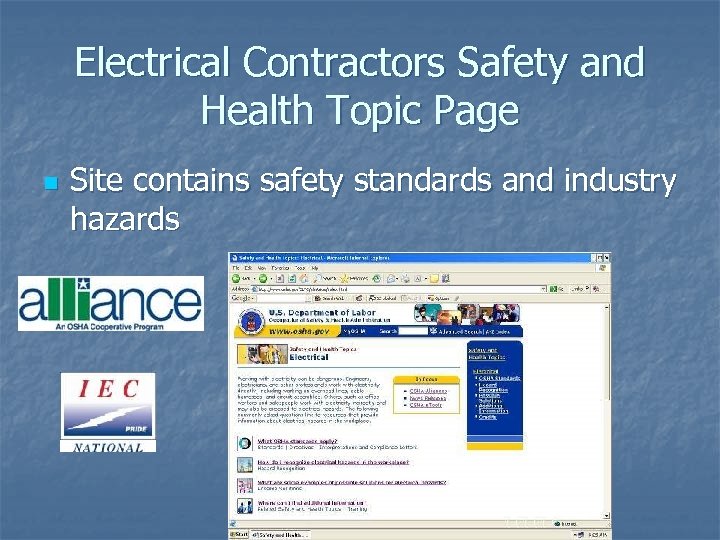
Electrical Contractors Safety and Health Topic Page n Site contains safety standards and industry hazards
10 Hour OSHA Supervisors Training n n n Chapters were surveyed for desired training. IEC members worked with OSHA to develop the course and prepare material. Class to be conducted at 2005 IEC Convention and IEC Electric EXPO. Training was designed for small businesses supervisors that are also responsible for safety. Supervisors were issued a 10 Hour OSHA certificate.
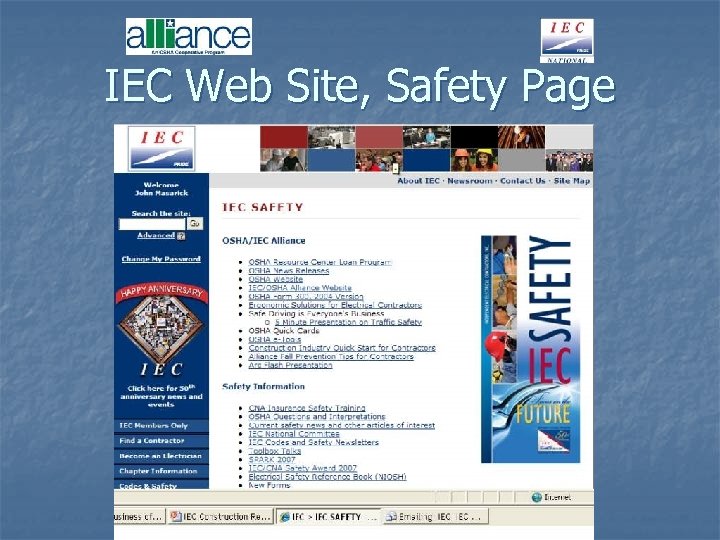
IEC Web Site, Safety Page
Hot Work Program
Fleet Safety Program
Electrical Safety in the Workplace
IEC Exhibits at Compliance Assistance Training session
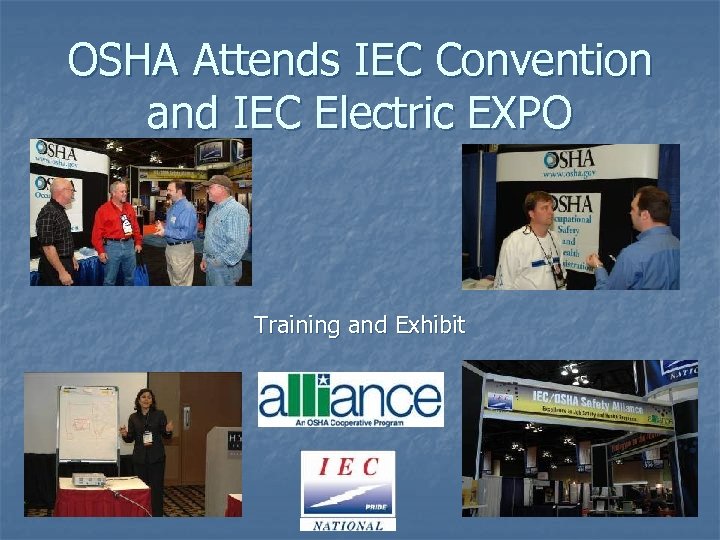
OSHA Attends IEC Convention and IEC Electric EXPO Training and Exhibit
Construction Roundtable: Fall Protection and Design for Safety Workgroup n n n Workgroups are made up of representatives from construction organizations having an Alliance with OSHA. All work together to promote safety. Backgrounds of individuals are varied. The workgroup meets three to four times a year. The Falls Prevention workgroup have produced Quick Cards and Fall Prevention Training. Design for Safety Workgroup has developed a web site, a Power Point presentation and 10 hour training for Engineers.
Challenge n n Three Phase Program Five Companies Participated Two Companies have Completed Program Looking for more participants
Members Form Alliances, Partnerships and Challenge Program n n Roadmap forming an alliance came from a quarterly Alliance meeting IEC members see the value in working together with OSHA n n n 3 Members formed Alliances 2 Partnerships 5 Challenge participants
Assets of the OSHA Cooperative Program n News from OSHA for IEC safety newsletter n Improved perception of OSHA by construction n IEC is informed of OSHA resources including e-tools, quick cards, training programs n IEC is better informed of upcoming OSHA events n IEC was able to participate in Challenge n IEC members are perusing VPP status n Increased hits on IEC safety page
Questions?
 Скачать презентацию The Business of Small Business Forum Part V
94fbab1ddd1c9fa56ee72cd7f40efee9.ppt