 Скачать презентацию The Bronze Age of Ancient Greek Society 1
60862f623595e7d729f505334ae0d664.ppt
- Количество слайдов: 11



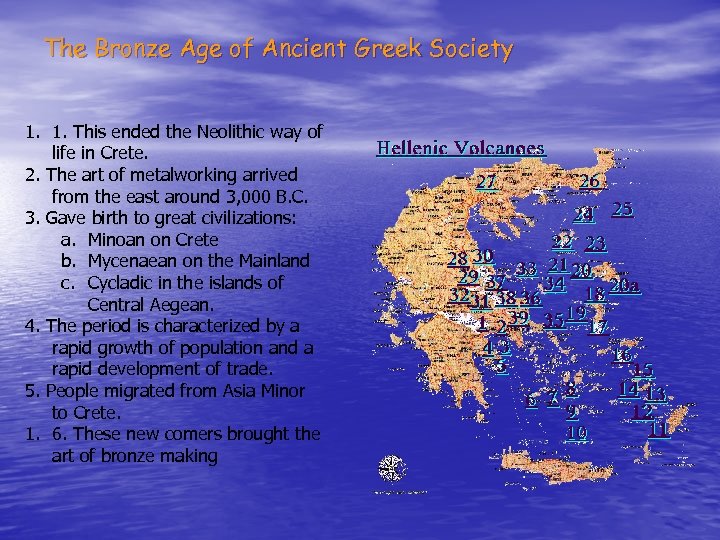
The Bronze Age of Ancient Greek Society 1. 1. This ended the Neolithic way of life in Crete. 2. The art of metalworking arrived from the east around 3, 000 B. C. 3. Gave birth to great civilizations: a. Minoan on Crete b. Mycenaean on the Mainland c. Cycladic in the islands of Central Aegean. 4. The period is characterized by a rapid growth of population and a rapid development of trade. 5. People migrated from Asia Minor to Crete. 1. 6. These new comers brought the art of bronze making
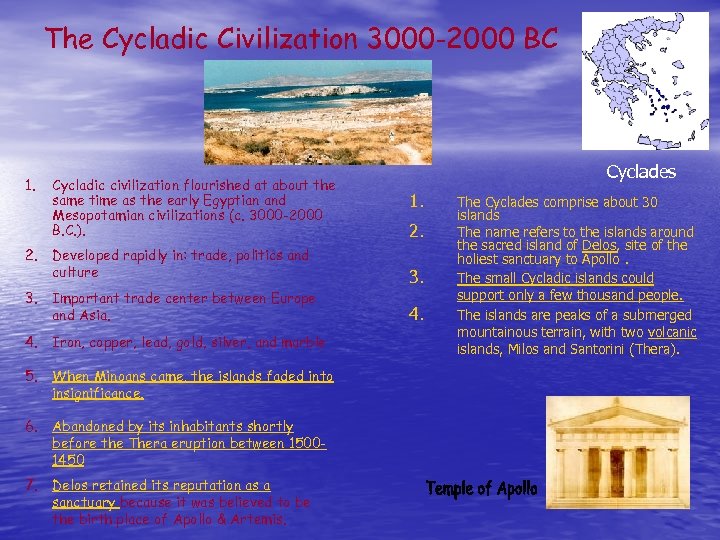
The Cycladic Civilization 3000 -2000 BC 1. 2. Cycladic civilization flourished at about the same time as the early Egyptian and Mesopotamian civilizations (c. 3000 -2000 B. C. ). Cyclades 1. 2. Developed rapidly in: trade, politics and culture 3. Important trade center between Europe and Asia. 4. Iron, copper, lead, gold, silver, and marble 5. When Minoans came, the islands faded into insignificance. 6. Abandoned by its inhabitants shortly before the Thera eruption between 15001450 7. Delos retained its reputation as a sanctuary because it was believed to be the birth place of Apollo & Artemis. The Cyclades comprise about 30 islands The name refers to the islands around the sacred island of Delos, site of the holiest sanctuary to Apollo. The small Cycladic islands could support only a few thousand people. The islands are peaks of a submerged mountainous terrain, with two volcanic islands, Milos and Santorini (Thera).
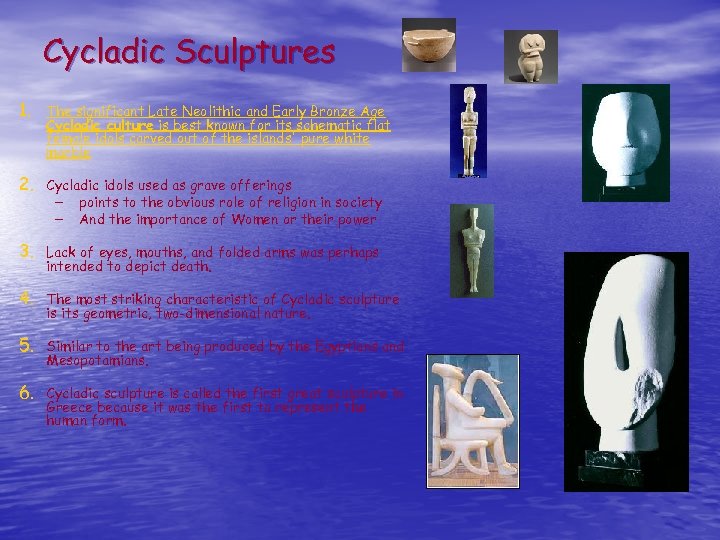
Cycladic Sculptures 1. The significant Late Neolithic and Early Bronze Age Cycladic culture is best known for its schematic flat female idols carved out of the islands' pure white marble 2. Cycladic idols used as grave offerings – – points to the obvious role of religion in society And the importance of Women or their power 3. Lack of eyes, mouths, and folded arms was perhaps intended to depict death. 4. The most striking characteristic of Cycladic sculpture is its geometric, two-dimensional nature. 5. Similar to the art being produced by the Egyptians and Mesopotamians. 6. Cycladic sculpture is called the first great sculpture in Greece because it was the first to represent the human form.
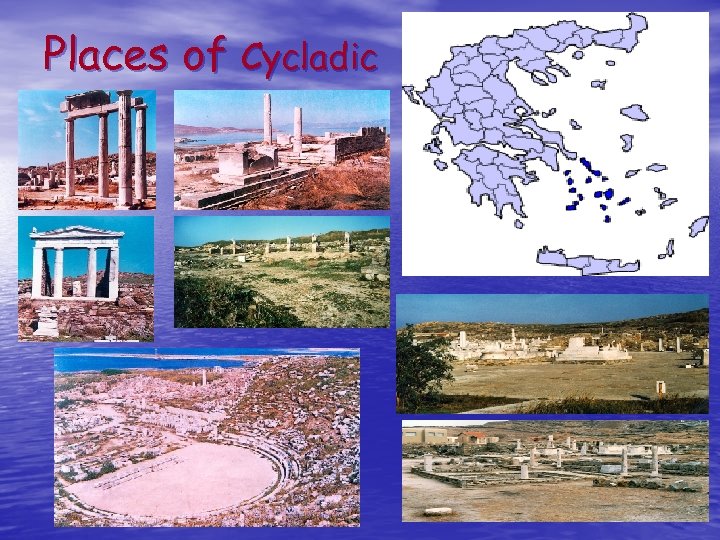
Places of Cycladic
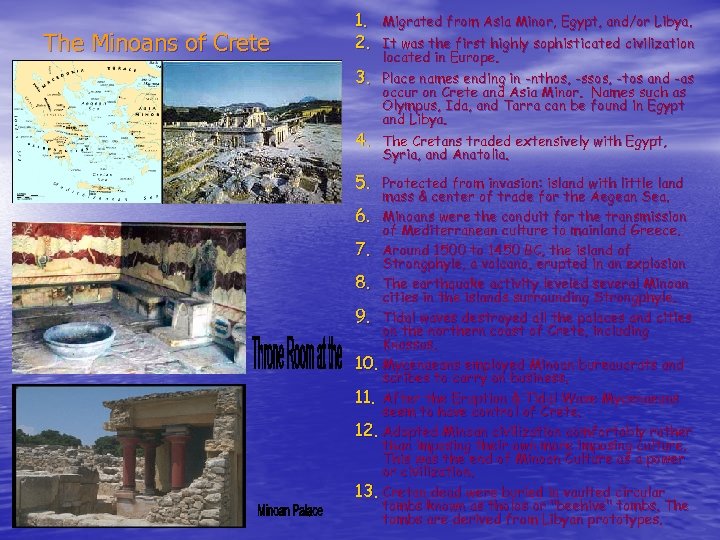
The Minoans of Crete 1. Migrated from Asia Minor, Egypt, and/or Libya. 2. It was the first highly sophisticated civilization located in Europe. 3. Place names ending in -nthos, -ssos, -tos and -as occur on Crete and Asia Minor. Names such as Olympus, Ida, and Tarra can be found in Egypt and Libya. 4. The Cretans traded extensively with Egypt, Syria, and Anatolia. 5. Protected from invasion: island with little land mass & center of trade for the Aegean Sea. 6. Minoans were the conduit for the transmission of Mediterranean culture to mainland Greece. 7. Around 1500 to 1450 BC, the island of Strongphyle, a volcano, erupted in an explosion 8. The earthquake activity leveled several Minoan cities in the islands surrounding Strongphyle. 9. Tidal waves destroyed all the palaces and cities on the northern coast of Crete, including Knossos. 10. Mycenaeans employed Minoan bureaucrats and scribes to carry on business. 11. After the Eruption & Tidal Wave Mycenaeans seem to have control of Crete. 12. Adopted Minoan civilization comfortably rather than imposing their own more imposing culture. This was the end of Minoan Culture as a power or civilization. 13. Cretan dead were buried in vaulted circular tombs known as tholos or "beehive" tombs. The tombs are derived from Libyan prototypes.
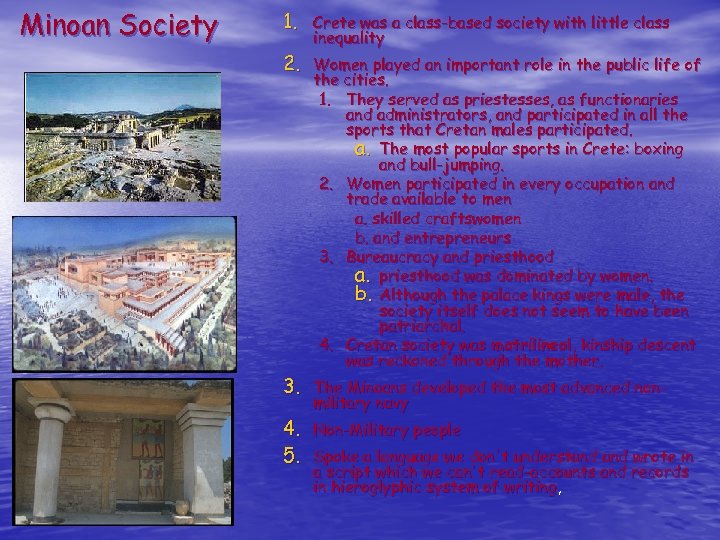
Minoan Society 1. Crete was a class-based society with little class inequality 2. Women played an important role in the public life of the cities. 1. They served as priestesses, as functionaries and administrators, and participated in all the sports that Cretan males participated. a. The most popular sports in Crete: boxing and bull-jumping. 2. Women participated in every occupation and trade available to men a. skilled craftswomen b. and entrepreneurs 3. Bureaucracy and priesthood a. priesthood was dominated by women. b. Although the palace kings were male, the society itself does not seem to have been patriarchal. 4. Cretan society was matrilineal, kinship descent was reckoned through the mother. 3. The Minoans developed the most advanced nonmilitary navy 4. Non-Military people 5. Spoke a language we don't understand wrote in a script which we can't read-accounts and records in hieroglyphic system of writing,
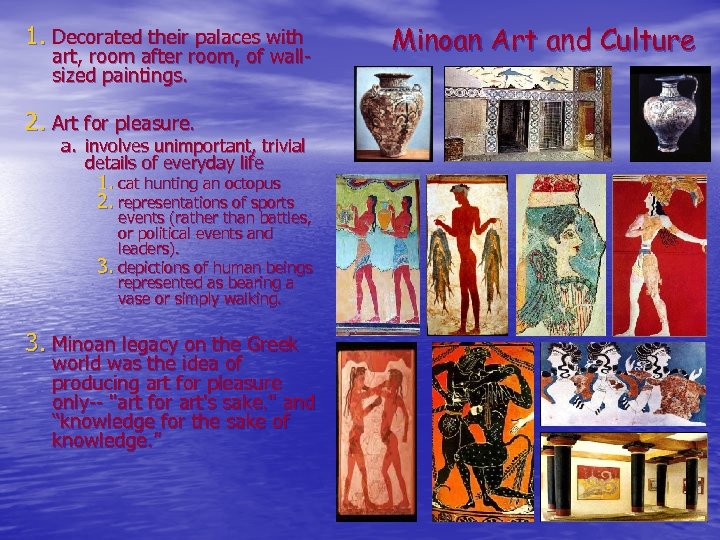
1. Decorated their palaces with art, room after room, of wallsized paintings. 2. Art for pleasure. a. involves unimportant, trivial details of everyday life 1. cat hunting an octopus 2. representations of sports events (rather than battles, or political events and leaders). 3. depictions of human beings represented as bearing a vase or simply walking. 3. Minoan legacy on the Greek world was the idea of producing art for pleasure only-- "art for art's sake. " and “knowledge for the sake of knowledge. ” Minoan Art and Culture
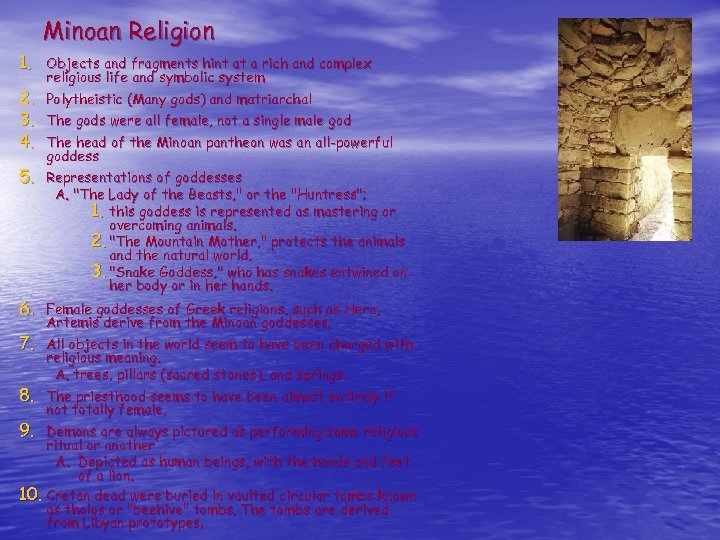
Minoan Religion 1. Objects and fragments hint at a rich and complex 2. 3. 4. religious life and symbolic system Polytheistic (Many gods) and matriarchal The gods were all female, not a single male god The head of the Minoan pantheon was an all-powerful goddess 5. Representations of goddesses A. "The Lady of the Beasts, " or the "Huntress"; 1. this goddess is represented as mastering or overcoming animals. 2. "The Mountain Mother, " protects the animals and the natural world. 3. "Snake Goddess, " who has snakes entwined on her body or in her hands. 6. Female goddesses of Greek religions, such as Hera, Artemis derive from the Minoan goddesses. 7. All objects in the world seem to have been charged with religious meaning. A. trees, pillars (sacred stones), and springs. 8. The priesthood seems to have been almost entirely if not totally female, 9. Demons are always pictured as performing some religious ritual or another A. Depicted as human beings, with the hands and feet of a lion. 10. Cretan dead were buried in vaulted circular tombs known as tholos or "beehive" tombs. The tombs are derived from Libyan prototypes.
Minoan Re. Cap 1. 2. 3. 4. 5. 6. 7. 8. 9. 10. The Minoan civilization, named after the mythical King Minos, developed in Crete in 2600 B. C. Remains of large villages were found as well as sculpture and pottery. Around 2000 B. C. , the Minoans had a flourishing economic, political, social and cultural organization. The Minoan period was characterized by important trade activities and the construction of impressive palaces such as Knossos, Malia and Phaistos. The first writing in the Greek World, called Linear A, appeared for the first time in Crete. The Minoan also developed a strong fleet and had power and influence over all the Aegean while establishing many colonies in various places. Minoan civilization had peaceful or friendly relations with the other civilizations of the Aegean. The Minoan civilization disappeared suddenly around 1500 B. C. due to the huge volcanic eruption of the island of Santorini. The eruption caused an enormous earthquake and huge tidal waves. Around 1500 B. C. the rival Mycenaean civilization took control of the trade network of Crete.
Mask of Agamemnon And they started to buy things from the Phoenicians (or Canaanites) with their gold. Greek graves from this time excavated at Mycenae (my-SEEN-ay) have a lot of gold cups and jewelry and beautiful swords in them, which are now in the National Archaeological Museum in Athens, Greece. The Greeks of this time are sometimes called the Myceneans (my-sin-AY-ans) after this site. Lion Gate at Mycenae As they got to know these other people, the Greeks began to copy their ways of doing things. The Greeks started to have kings instead of village headmen. These kings had palaces to live in and collected taxes which they stored in big storerooms. The palaces had big stone walls around them. The stones were so big that later Greeks thought the walls must have been built by giants, whom they called Cyclops. Some Greeks learned to write, in a sort of hieroglyphics called Linear B, so that they could keep records of what taxes had been collected. The kings made their people build paved roads. In addition to maybe working as soldiers for other countries, the Greeks seem to have sailed around the Mediterranean Sea and the Black Sea picking fights with people on their own, and taking their gold, and probably also taking the people they met as slaves. One of these raids, around 1250 BC, may have been to attack the city of Troy, in northern Turkey. Stories about the Trojan War (the war with Troy) were passed down
 Скачать презентацию The Bronze Age of Ancient Greek Society 1
60862f623595e7d729f505334ae0d664.ppt