 Скачать презентацию The Brain Eater Lloyd K Gwishiri National Medical
The Brain Eater.pptx
- Количество слайдов: 35



The Brain Eater Lloyd K. Gwishiri National Medical University O. O. Bogomolates Department of Family Medicine Kyiv, Ukraine Teacher: Anton Oleksandrovych Volosovets
What is Creutzfeldt-Jakob disease? Creutzfeldt-Jakob disease is a degenerative brain disorder that leads to dementia and, ultimately, death. Symptoms of Creutzfeldt-Jakob disease (CJD) sometimes resemble those of other dementia-like brain disorders. Creutzfeldt-Jakob is rapidly progressive.
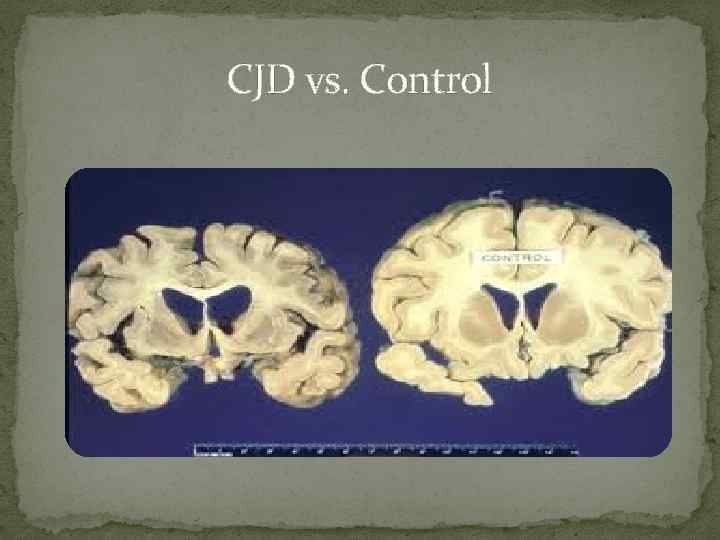
CJD vs. Control
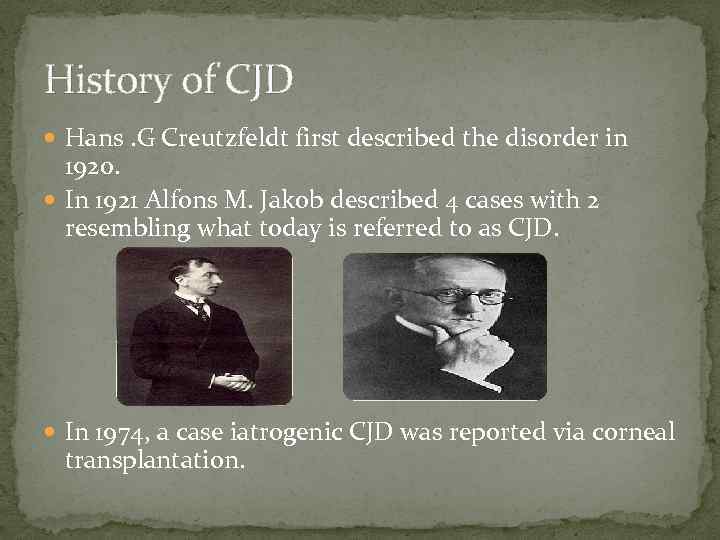
History of CJD Hans. G Creutzfeldt first described the disorder in 1920. In 1921 Alfons M. Jakob described 4 cases with 2 resembling what today is referred to as CJD. In 1974, a case iatrogenic CJD was reported via corneal transplantation.
History of CJD In 1985 there were reported cases of spread through contaminated human derived growth hormone.
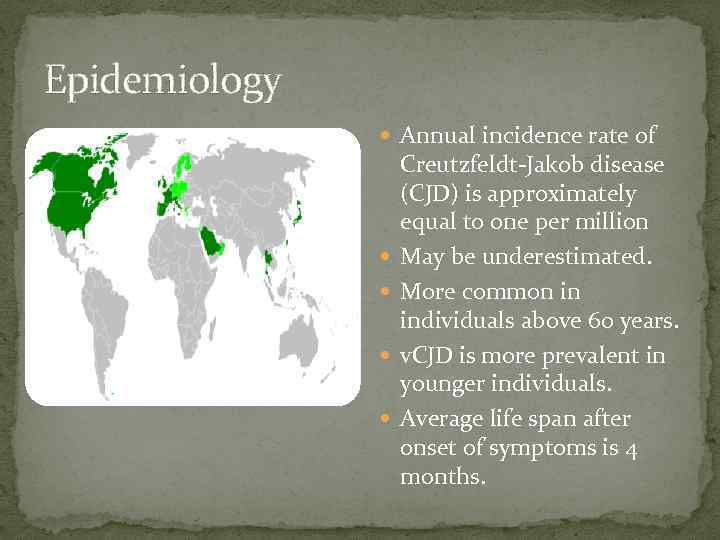
Epidemiology Annual incidence rate of Creutzfeldt-Jakob disease (CJD) is approximately equal to one per million May be underestimated. More common in individuals above 60 years. v. CJD is more prevalent in younger individuals. Average life span after onset of symptoms is 4 months.
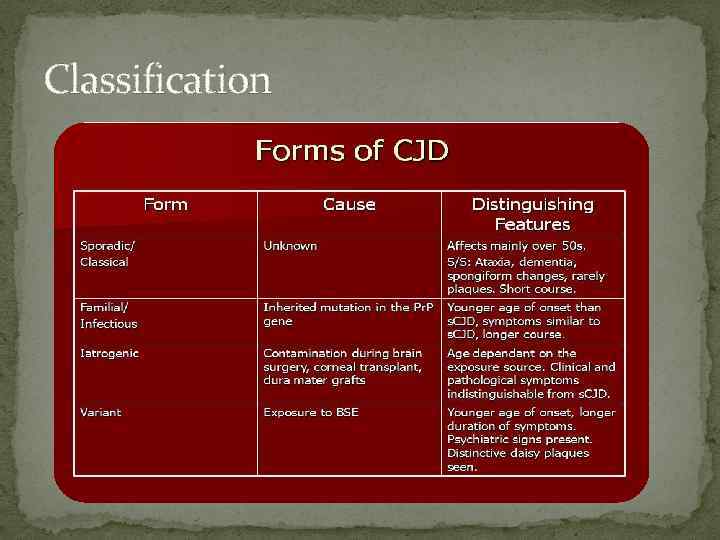
Classification
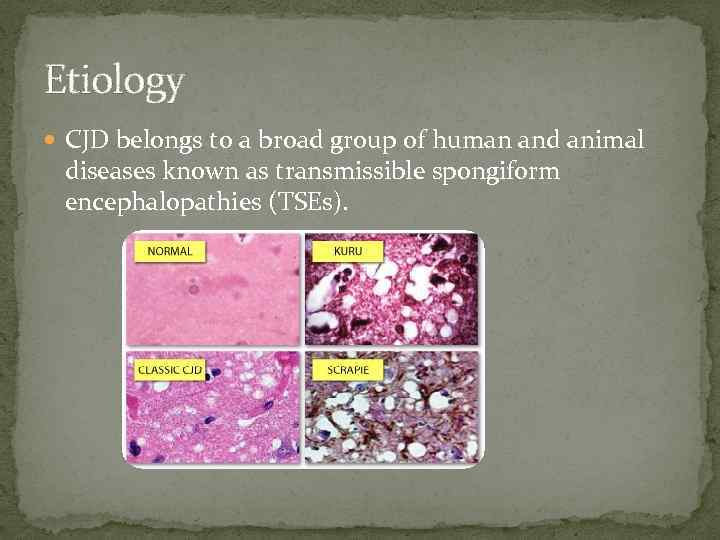
Etiology CJD belongs to a broad group of human and animal diseases known as transmissible spongiform encephalopathies (TSEs).

Etiology The causative agent of this disease is an abnormal protein known as a prion. Prions were first discovered in the 1960's by radiation biologist Tikvah Alper and the mathematician John Stanley Griffith. Prions are proteins with an abnormal fold known as an amyloid fold. They have very stable structures in the form of beta pleated sheets. Prions do not multiply in the host organism that they infect.
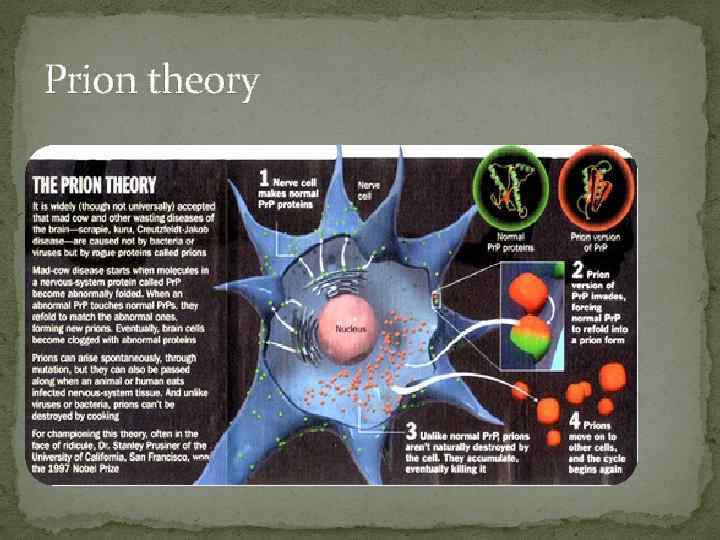
Prion theory
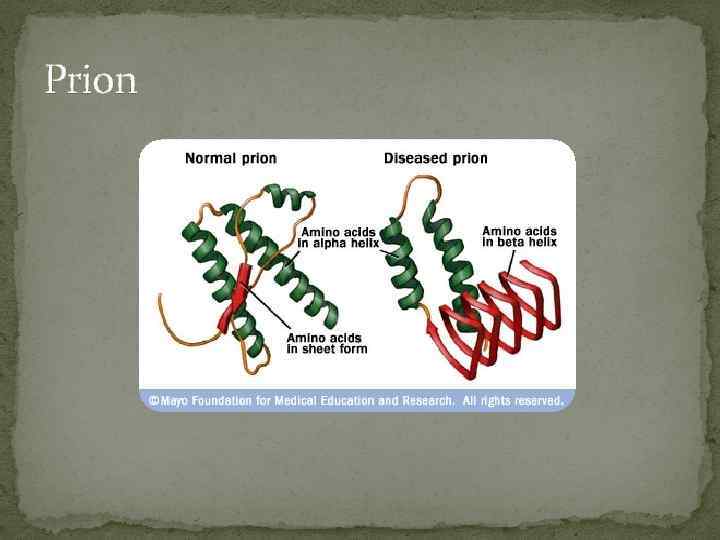
Prion
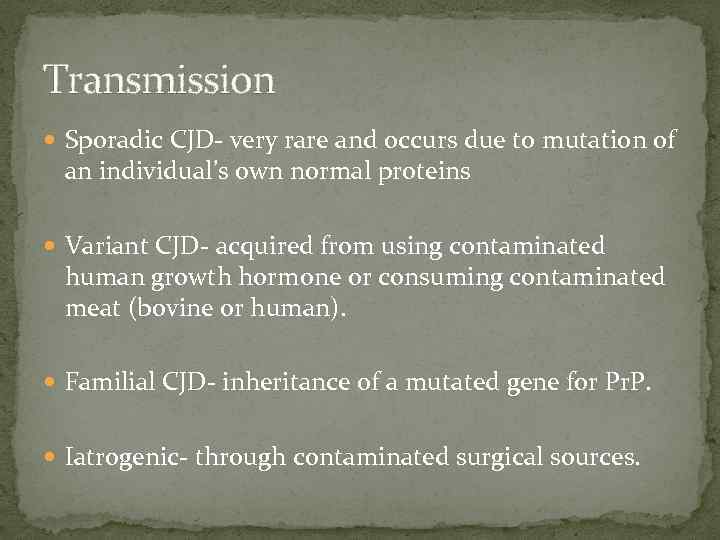
Transmission Sporadic CJD- very rare and occurs due to mutation of an individual’s own normal proteins Variant CJD- acquired from using contaminated human growth hormone or consuming contaminated meat (bovine or human). Familial CJD- inheritance of a mutated gene for Pr. P. Iatrogenic- through contaminated surgical sources.
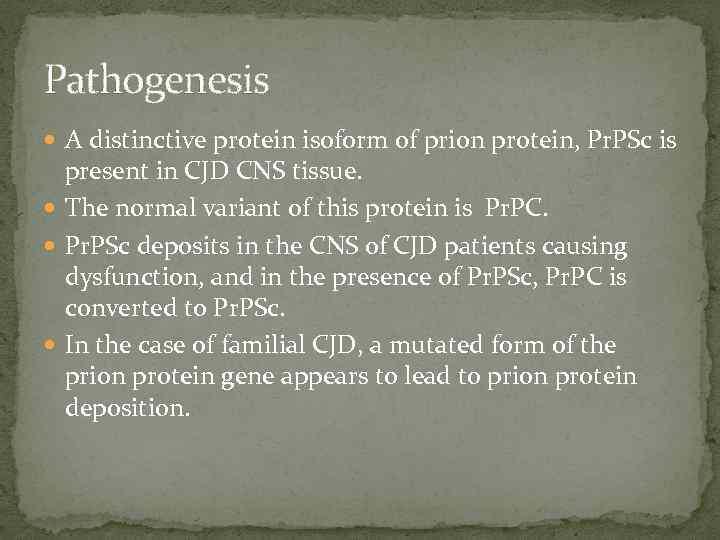
Pathogenesis A distinctive protein isoform of prion protein, Pr. PSc is present in CJD CNS tissue. The normal variant of this protein is Pr. PC. Pr. PSc deposits in the CNS of CJD patients causing dysfunction, and in the presence of Pr. PSc, Pr. PC is converted to Pr. PSc. In the case of familial CJD, a mutated form of the prion protein gene appears to lead to prion protein deposition.
Pathogenesis This was tested in several experiments, the presence of a mutated prion protein gene as a transgene in mice was found to induce a spongiform neuropathology. This suggests that the mutant Pr. PSc is sufficient to produce disease. The pathogenesis of sporadic Creutzfeldt-Jakob disease remains unclear. It has been hypothesized that a spontaneous somatic change in conformation of prion protein in the CNS initiates the disease.
Pathogenesis A number of reports have been published that demonstrate the presence of prion-like elements in yeast. Experiments show that these elements lead to aggregation and amyloid formation of a protein. These studies suggest that prions as a cause of abnormal phenotypes may be more widespread than realized.
Pathogenesis Recently, misfolded proteins have been hypothesized to underlie a number of neurodegenerative diseases. These diseases may not be transmissible in the same way as the sub acute spongiform encephalopathies such as CJD are. However, they are assumed to affect the CNS in a prion like mechanism. In addition, the pathogenic proteins are also misfolded.
Pathology The pathologic condition is essentially degenerative with grossly evident cerebral atrophy. Microscopic findings are similar to those of other prion diseases with neuronal loss, astrocytosis, and the development of cytoplasmic vacuoles in neurons and astrocytes. Amyloid plaques that contain the abnormal Pr. P are found in the areas of infected tissue in most cases. There is no inflammation. The cortex and basal ganglia are most affected, but all parts of the neuraxis may be involved. Early lesions are more severe in the gray matter
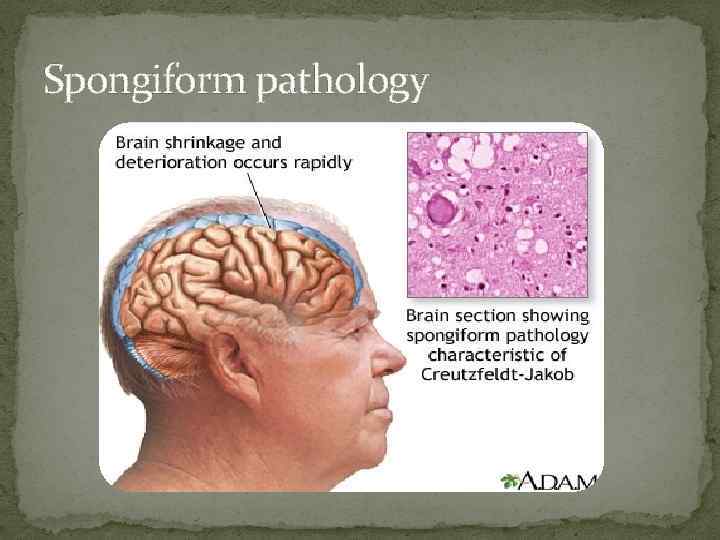
Spongiform pathology
Clinical Manifestations
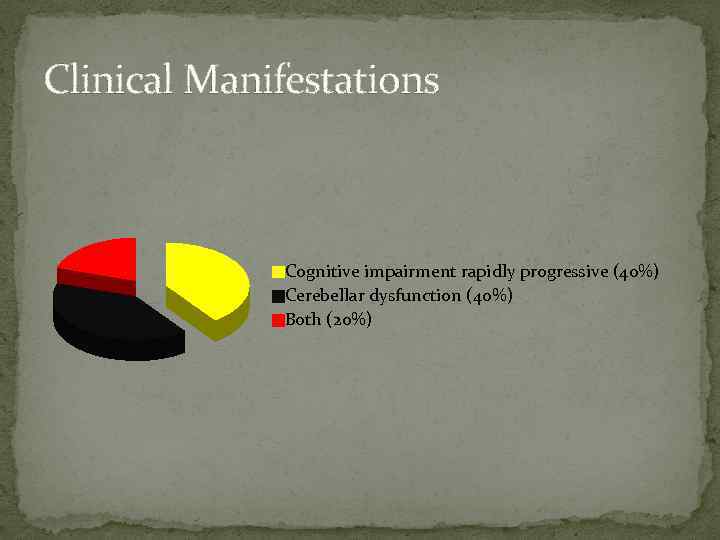
Clinical Manifestations Cognitive impairment rapidly progressive (40%) Cerebellar dysfunction (40%) Both (20%)
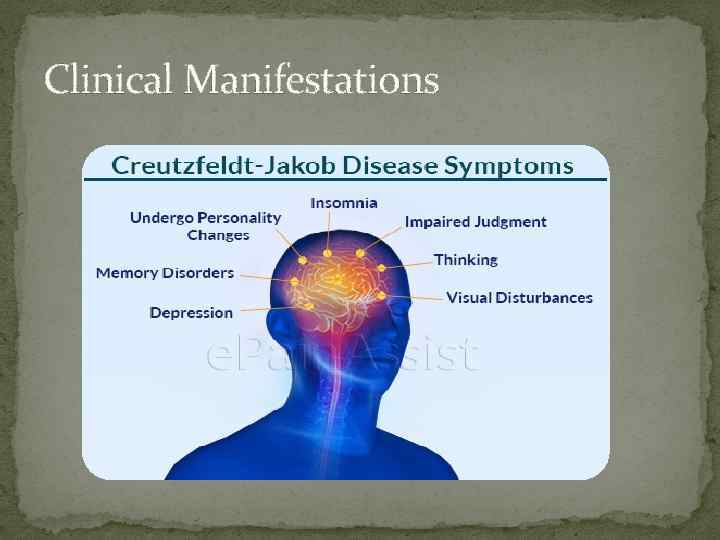
Clinical Manifestations The clinical features include a gradual onset of dementia in middle or late life. Vague, prodromal symptoms of anxiety, fatigue, dizziness, headache, impaired judgment, and unusual behavior may occur. Once memory loss starts, it progresses rapidly, and other characteristic signs appear, sometimes abruptly.
Clinical Manifestations The most frequently seen signs, aside from dementia, are pyramidal tract disease weakness stiffness of the limbs accompanying reflex changes Extrapyramidal signs Tremor rigidity, Dysarthria slowness of movement myoclonus (often stimulus sensitive).
Clinical manifestations In advanced stages of the disease, patients have difficulties with movement, swallowing and talking. In the final stage, patients lose all mental and physical function and may lapse into a coma. Many patients die from an infection such as pneumonia. The average duration of disease from the onset of symptoms to death is four to six months. Ninety percent of patients die within a year.
Diagnostic Criteria CDC Sporadic 1. Diagnosed by standard neuropathological techniques; and/or immunocytochemically; and/or Western blot confirmed protease-resistant r. P; and /or presence of scrapie-associated fibrils
Diagnostic Criteria CDC 2. Rapidly progressive dementia and at least two out of the following four clinical features: Myoclonus Visual or cerebellar signs Pyramidal/extrapyramidal signs Akinetic mutism AND a positive result on at least one of the following laboratory tests: a typical EEG (periodic sharp wave complexes) during an illness of any duration; and/or a positive 14 -3 -3 cerebrospinal fluid (CSF) assay in patients with a disease duration of less than 2 years Magnetic resonance imaging (MRI) high signal abnormalities in caudate nucleus and/or putamen on diffusion-weighted imaging (DWI) or fluid attenuated inversion recovery (FLAIR).
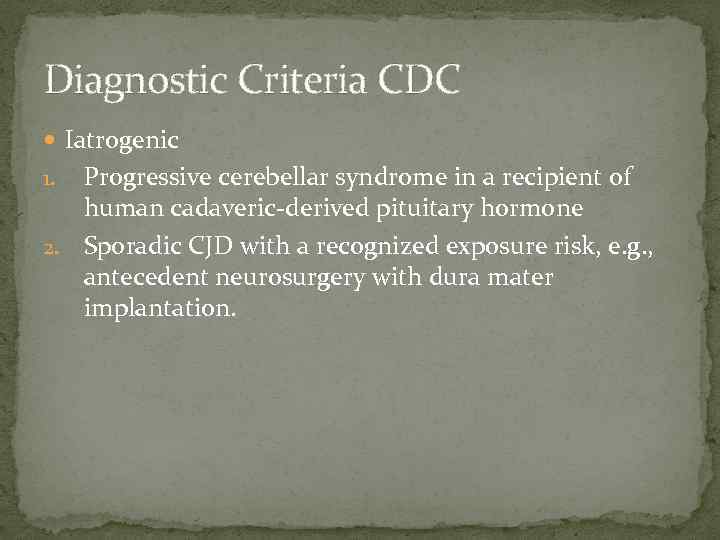
Diagnostic Criteria CDC Iatrogenic Progressive cerebellar syndrome in a recipient of human cadaveric-derived pituitary hormone 2. Sporadic CJD with a recognized exposure risk, e. g. , antecedent neurosurgery with dura mater implantation. 1.
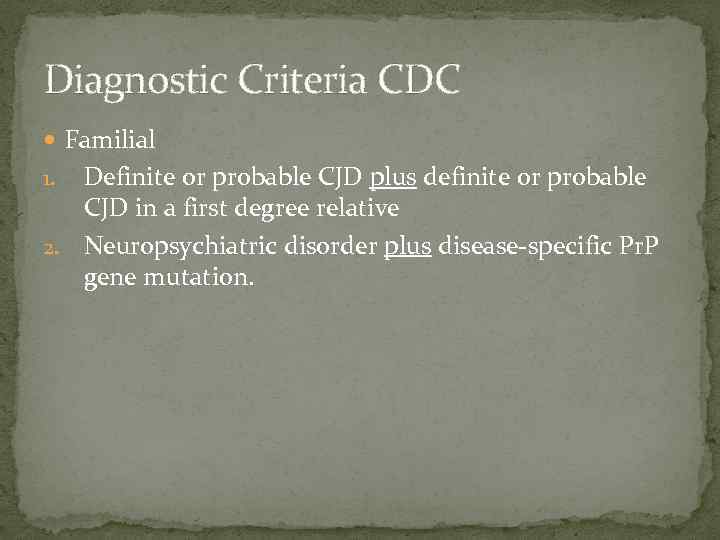
Diagnostic Criteria CDC Familial Definite or probable CJD plus definite or probable CJD in a first degree relative 2. Neuropsychiatric disorder plus disease-specific Pr. P gene mutation. 1.
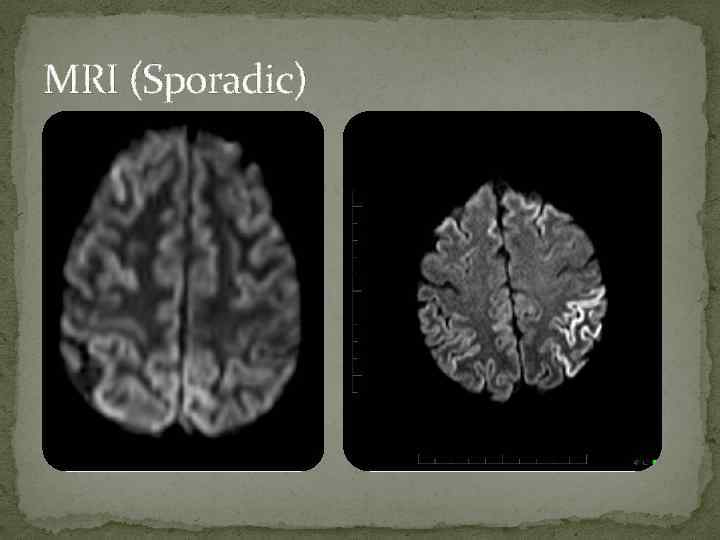
MRI (Sporadic)
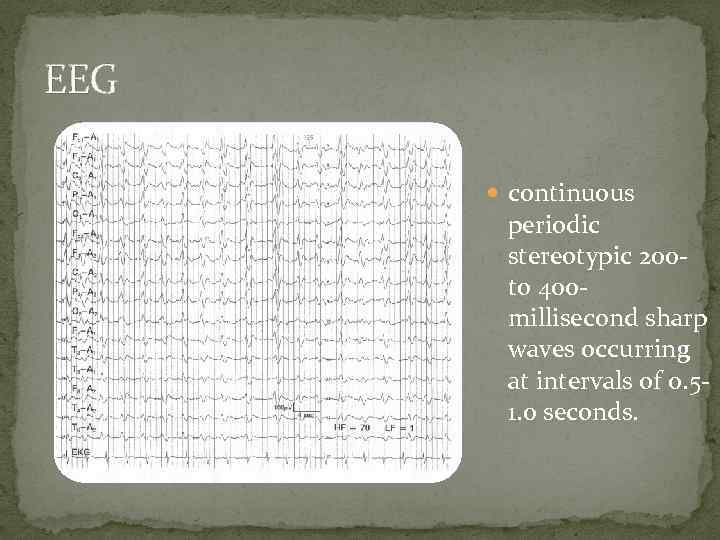
EEG continuous periodic stereotypic 200 - to 400 millisecond sharp waves occurring at intervals of 0. 51. 0 seconds.
Control MANAGEMENT OF CASES No specific available treatment Patients should be excluded from blood, organ or other body tissue donations. Identify source of infection MANAGEMENT OF CONTACTS Patients with potential exposure to CJD should be informed of their risk

Treatment Options Symptomatic Antidepressents Clonazepam Tremors Sodium Valproate Pain Opium based anaelgesics
Treatment on trial Pentosan polysulphate Infused into the individual's lateral ventricle PPS appears to slow down CJD's progression
References Appleby, B. S. , & Zerr, I. (2012). Sporadic Creutzfeldt-Jakob disease Changes not only in the brain? . Neurology, 79(10), 965 -966. de Villemeur, T. B. (2012). Creutzfeldt-Jakob disease. Handbook of clinical neurology, 112, 1191 -1193. Merritt, H. H. (2010). Merritt's neurology. L. P. Rowland, & T. A. Pedley (Eds. ). Lippincott Williams & Wilkins. Riley, D. E. , Lang, A. E. , & Lewis, A. (2010). Creutzfeldt– Jacob Disease. Encyclopedia of Movement Disorders, 1, 263. Sikorska, B. , Knight, R. , Ironside, J. W. , & Liberski, P. P. (2012). Creutzfeldt-Jakob disease. In Neurodegenerative Diseases (pp. 76 -90). Springer US.


THANK YOU
Скачать презентацию The Brain Eater Lloyd K Gwishiri National Medical
The Brain Eater.pptx