 Скачать презентацию The Bottom Up Solution to the Triacylglycerol Lipidome
c4f5669cd1b1b757498cdf5c3e31c39e.ppt
- Количество слайдов: 37




The Bottom Up Solution to the Triacylglycerol Lipidome William Craig Byrdwell Florida Atlantic University Dept. of Chemistry & Biochem. Boca Raton, FL 33432

Overview • What is Atmospheric Pressure Chemical Ionization (APCI) mass spectrometry (MS)? • What does an APCI-MS mass spectrum look like? • What Information does an APCI-MS mass spectrum contain? • What Information is desired from MS of TAG? • Critical Ratios provide structural information • Critical Values and Critical Limits define Cases • The Complete Bottom Up Solution • The Shape of the Triacylglycerol Lipidome
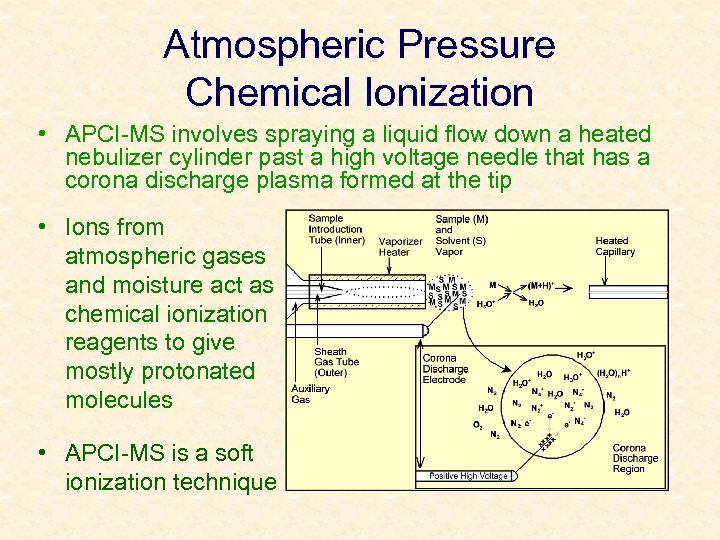
Atmospheric Pressure Chemical Ionization • APCI-MS involves spraying a liquid flow down a heated nebulizer cylinder past a high voltage needle that has a corona discharge plasma formed at the tip • Ions from atmospheric gases and moisture act as chemical ionization reagents to give mostly protonated molecules • APCI-MS is a soft ionization technique
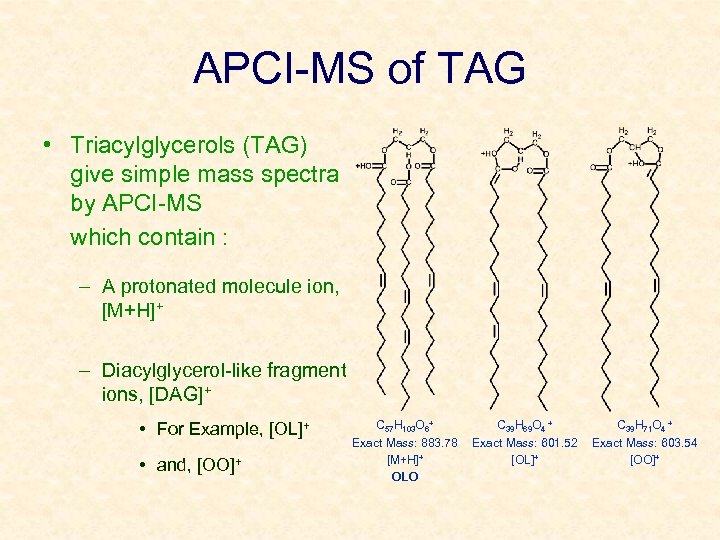
APCI-MS of TAG • Triacylglycerols (TAG) give simple mass spectra by APCI-MS which contain : – A protonated molecule ion, [M+H]+ – Diacylglycerol-like fragment ions, [DAG]+ • For Example, [OL]+ • and, [OO]+ C 57 H 103 O 6+ Exact Mass: 883. 78 [M+H]+ OLO C 39 H 69 O 4 + Exact Mass: 601. 52 [OL]+ C 39 H 71 O 4 + Exact Mass: 603. 54 [OO]+
![APCI-MS Mass Spectra of AAA TAG [MH]+ 1 Type I TAG [AA]+ 1 [MH]+](https://present5.com/presentation/c4f5669cd1b1b757498cdf5c3e31c39e/image-5.jpg "APCI-MS Mass Spectra of AAA TAG [MH]+ 1 Type I TAG [AA]+ 1 [MH]+")
APCI-MS Mass Spectra of AAA TAG [MH]+ 1 Type I TAG [AA]+ 1 [MH]+ [AA]+ Type I (AAA) TAG give two ions: ¯Protonated Molecule, [M+H]+ ¯One Diacylglycerol ion, [DAG]+ The proportion of the Protonated Molecule, [M+H]+, to the Diacylglycerol ion, [DAG]+, depends on the amount of unsaturation in the TAG. 1 [AA]+ [MH]+ Saturated TAG Polyunsaturated TAG e. g. Ln. Ln e. g. SSS
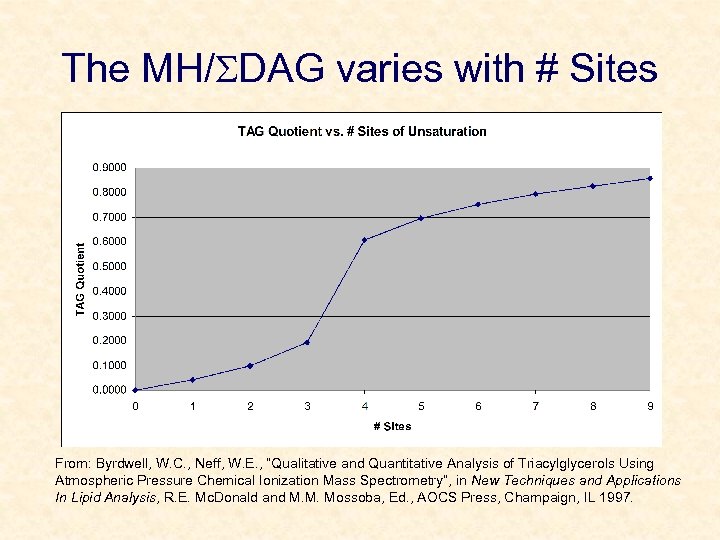
The MH/SDAG varies with # Sites From: Byrdwell, W. C. , Neff, W. E. , “Qualitative and Quantitative Analysis of Triacylglycerols Using Atmospheric Pressure Chemical Ionization Mass Spectrometry”, in New Techniques and Applications In Lipid Analysis, R. E. Mc. Donald and M. M. Mossoba, Ed. , AOCS Press, Champaign, IL 1997.
![APCI-MS Mass Spectra of ABA/AAB TAG [MH]+ 1 1 [AB]+ Type II TAG [AA]+](https://present5.com/presentation/c4f5669cd1b1b757498cdf5c3e31c39e/image-7.jpg "APCI-MS Mass Spectra of ABA/AAB TAG [MH]+ 1 1 [AB]+ Type II TAG [AA]+")
APCI-MS Mass Spectra of ABA/AAB TAG [MH]+ 1 1 [AB]+ Type II TAG [AA]+ [MH]+ Type II (ABA/AAB) TAG give three ions: ¯Protonated Molecule, [M+H]+ ¯Two Diacylglycerol ions, [DAG]+ 1 The proportion of the Protonated Molecule, [M+H]+, to the Diacylglycerol ions, [DAG]+, depends on the amount of unsaturation in the TAG. [AB]+[MH]+ [AB]+ [AA]+ e. g. SSP Ln. OLn/Ln. O [MH]+ Polyunsaturated TAG Saturated TAG
![APCI-MS Mass Spectra of ABA/AAB TAG [MH]+ 1 1 [AB]+ Type II TAG [AA]+](https://present5.com/presentation/c4f5669cd1b1b757498cdf5c3e31c39e/image-8.jpg "APCI-MS Mass Spectra of ABA/AAB TAG [MH]+ 1 1 [AB]+ Type II TAG [AA]+")
APCI-MS Mass Spectra of ABA/AAB TAG [MH]+ 1 1 [AB]+ Type II TAG [AA]+ [MH]+ Type II (ABA/AAB) TAG give three ions: ¯Protonated Molecule, [M+H]+ ¯Two Diacylglycerol ions, [DAG]+ 1 The proportion of the Protonated Diacylglycerol fragment Molecule, [M+H]+, to theions, [DAG]+, depends on Diacylglycerol ion, [DAG]+, the location depends on of the Fatty Acid (FA) in the TAG. the amount of unsaturation in the TAG. [AB]+[MH]+ [AB]+ + [AA]+ e. g. Ln. OLn [MH]+ ABA TAG AAB Saturated TAG
![APCI-MS Mass Spectra of ABC TAG Type III TAG [MH]+ 1 [AB]+ [BC]+ [AB]+](https://present5.com/presentation/c4f5669cd1b1b757498cdf5c3e31c39e/image-9.jpg "APCI-MS Mass Spectra of ABC TAG Type III TAG [MH]+ 1 [AB]+ [BC]+ [AB]+")
APCI-MS Mass Spectra of ABC TAG Type III TAG [MH]+ 1 [AB]+ [BC]+ [AB]+ 1 [BC]+ [AC]+ [MH]+ Type III (ABC) TAG give three ions: ¯Protonated Molecule, [M+H]+ ¯Three Diacylglycerol ions, [DAG]+ 1 The proportion of the Protonated Molecule, [M+H]+, to the Diacylglycerol ions, [DAG]+, depends on the amount of unsaturation in the TAG. + [AB][MH]+ [BC]+ + [AB] [AC]+ + [BC] [AC]+ e. g. Ln. LS SPM [MH]+ Polyunsaturated TAG Saturated TAG
![APCI-MS Mass Spectra of ABC TAG Type III TAG [MH]+ 1 [AB]+ [BC]+ [AB]+](https://present5.com/presentation/c4f5669cd1b1b757498cdf5c3e31c39e/image-10.jpg "APCI-MS Mass Spectra of ABC TAG Type III TAG [MH]+ 1 [AB]+ [BC]+ [AB]+")
APCI-MS Mass Spectra of ABC TAG Type III TAG [MH]+ 1 [AB]+ [BC]+ [AB]+ 1 [BC]+ [AC]+ [MH]+ Type III (ABC) TAG give three ions: [AC]+ ¯Protonated Molecule, [M+H]+ ¯Three Diacylglycerol ions, [DAG]+ 1 The proportion of the sn-1, 3 [DAG]+ from the Diacylglycerol fragment ions, regioisomer is energetically [DAG]+, depends on disfavored. It is expected to be the location of the Fatty Acid (FA) smallest [DAG]+ ion. in the TAG. [MH]+ [AB]+ [BC]+ [AC]+ [MH]+ CAB TAG ABC
![APCI-MS Mass Spectra of ABA/AAB TAG 1 [AB]+ [AA]+ 1 [AB]+ Type II TAG](https://present5.com/presentation/c4f5669cd1b1b757498cdf5c3e31c39e/image-11.jpg "APCI-MS Mass Spectra of ABA/AAB TAG 1 [AB]+ [AA]+ 1 [AB]+ Type II TAG")
APCI-MS Mass Spectra of ABA/AAB TAG 1 [AB]+ [AA]+ 1 [AB]+ Type II TAG [AA]+ [MH]+ For Example: PPO = 0. 87 The proportion of the Diacylglycerol fragment ions, [DAG]+, depends on the location of the Fatty Acid (FA) in the TAG. 1 [MH]+ For Example: POP = 0. 29 + [MH] [AA]+ [AB]+ Should be no AA > AB
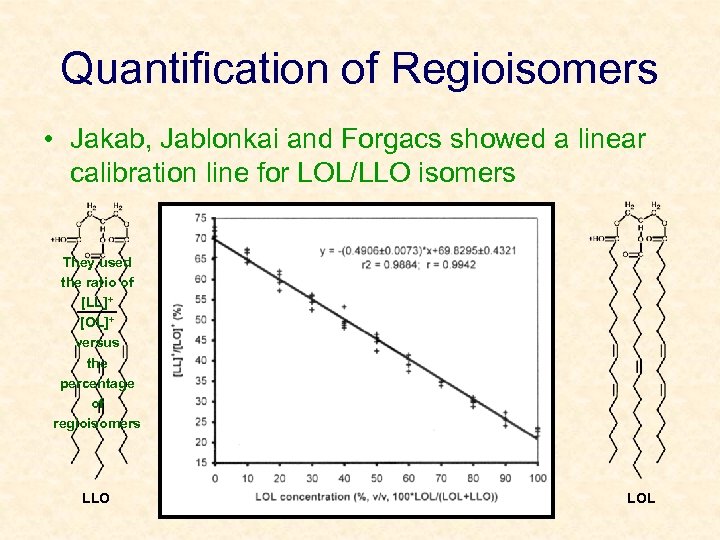
Quantification of Regioisomers • Jakab, Jablonkai and Forgacs showed a linear calibration line for LOL/LLO isomers They used the ratio of [LL]+ [OL]+ versus the percentage of regioisomers LLO LOL

Quantification of Regioisomers • The calibration line could be converted to go from low to high. 75 70 65 60 [LL]+/[LO]+ (%) We could make the ratio of [LL]+ [OL]+ versus the percentage of LLO go from Low to High 55 50 45 40 35 30 25 20 15 0 LOL 10 20 30 40 50 60 70 80 LLO concentration (% v/v, 100*LLO/(LOL+LLO)) 90 100 LLO

Quantification of Regioisomers • When the plot is converted to go from low to high, any observed ratio should fall on the line. 75 70 65 [LL]+/[LO]+ (%) 60 55 50 45 40 35 30 25 20 15 0 10 20 30 40 50 60 70 80 LLO concentration (% v/v, 100*LLO/(LOL+LLO)) 90 100

Quantification of Regioisomers • The equation for the calibration line can be found in terms of %LLO: 75 70 65 [LL]+/[LO]+ (%) 60 55 50 45 40 35 30 25 20 15 0 10 20 30 40 50 60 70 80 LLO concentration (% v/v, 100*LLO/(LOL+LLO)) 90 100

Quantification of Regioisomers • Or, the equation for the calibration line can be found in terms of % LOL: 75 70 65 [LL]+/[LO]+ (%) 60 55 50 45 40 35 30 25 20 15 0 10 20 30 40 50 60 70 80 LLO concentration (% v/v, 100*LLO/(LOL+LLO)) 90 100
![The Critical Ratios for ABA/AAB TAG • The [AA]+/[AB]+ ratio provides information to be](https://present5.com/presentation/c4f5669cd1b1b757498cdf5c3e31c39e/image-17.jpg "The Critical Ratios for ABA/AAB TAG • The [AA]+/[AB]+ ratio provides information to be")
The Critical Ratios for ABA/AAB TAG • The [AA]+/[AB]+ ratio provides information to be able to quantify the amounts of regioisomers. • The [MH]+/S[DAG]+ ratio provides information about the amount of unsaturation in a TAG. • These ratios act a ‘Critical Ratios’ to provide structural information about a Type II TAG.
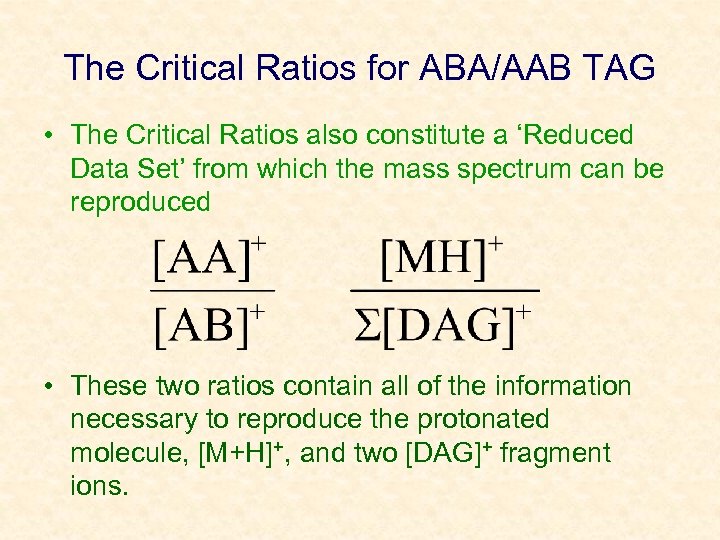
The Critical Ratios for ABA/AAB TAG • The Critical Ratios also constitute a ‘Reduced Data Set’ from which the mass spectrum can be reproduced • These two ratios contain all of the information necessary to reproduce the protonated molecule, [M+H]+, and two [DAG]+ fragment ions.
![The Critical Ratios for ABC TAG • The [AC]+/([AB]++[BC]+) ratio provides information to be](https://present5.com/presentation/c4f5669cd1b1b757498cdf5c3e31c39e/image-19.jpg "The Critical Ratios for ABC TAG • The [AC]+/([AB]++[BC]+) ratio provides information to be")
The Critical Ratios for ABC TAG • The [AC]+/([AB]++[BC]+) ratio provides information to be able to quantify the amounts of regioisomers. • The [MH]+/S[DAG]+ ratio provides information about the amount of unsaturation in a TAG. • These ratios act as ‘Critical Ratios’ to provide structural information about a Type III TAG.
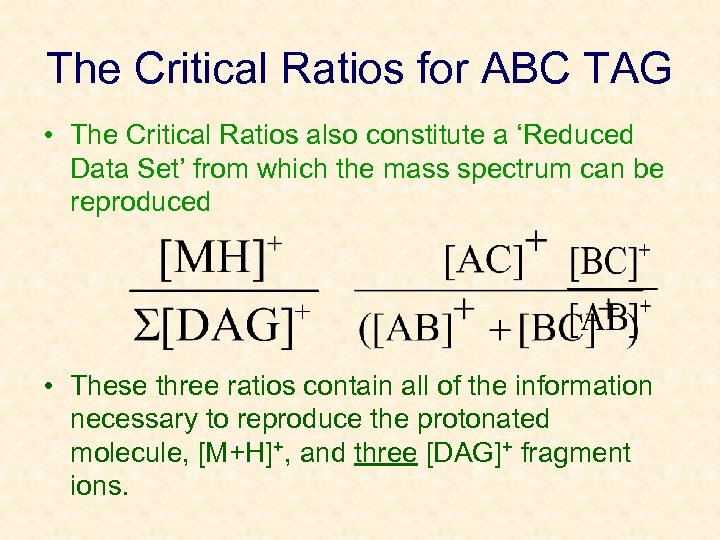
The Critical Ratios for ABC TAG • The Critical Ratios also constitute a ‘Reduced Data Set’ from which the mass spectrum can be reproduced • These three ratios contain all of the information necessary to reproduce the protonated molecule, [M+H]+, and three [DAG]+ fragment ions.
![The Shape of the AAA TAG Lipidome 1 [AA]+ [MH]+ Base Peak [MH]+ 1](https://present5.com/presentation/c4f5669cd1b1b757498cdf5c3e31c39e/image-21.jpg "The Shape of the AAA TAG Lipidome 1 [AA]+ [MH]+ Base Peak [MH]+ 1")
The Shape of the AAA TAG Lipidome 1 [AA]+ [MH]+ Base Peak [MH]+ 1 [AA]+ Case 2 Critical Value 1 [AA]+ Case 1 [MH]+ [AA]+ Base Peak

The Bottom Up Solution for an AAA TAG
![The Critical Value for the ABA TAG Lipidome 1 [AA]+ [AB]+ [MH]+ Base Peak](https://present5.com/presentation/c4f5669cd1b1b757498cdf5c3e31c39e/image-23.jpg "The Critical Value for the ABA TAG Lipidome 1 [AA]+ [AB]+ [MH]+ Base Peak")
The Critical Value for the ABA TAG Lipidome 1 [AA]+ [AB]+ [MH]+ Base Peak [MH]+ 1 [AB]+ [AA]+ Case 2 Critical Value 1 Case 1 [AB]+ [AA]+ [MH]+ [DAG]+ Base Peak
![The Critical Limit for the ABA TAG Lipidome 1 [AB]+ [MH]+ Base Peak [MH]+](https://present5.com/presentation/c4f5669cd1b1b757498cdf5c3e31c39e/image-24.jpg "The Critical Limit for the ABA TAG Lipidome 1 [AB]+ [MH]+ Base Peak [MH]+")
The Critical Limit for the ABA TAG Lipidome 1 [AB]+ [MH]+ Base Peak [MH]+ 1 [AB]+ [AA]+ Case 2 Critical Limit 1 Case 1 [AB]+ [AA]+ [MH]+ [DAG]+ Base Peak

Quantification of Regioisomers • A calibration line for % ABA can be found 75 70 65 [AA]+/[AB]+ (%) 60 55 50 45 40 35 30 25 20 15 0 10 20 30 40 50 60 70 80 90 AAB concentration (% v/v, 100*AAB/(ABA+AAB)) 100
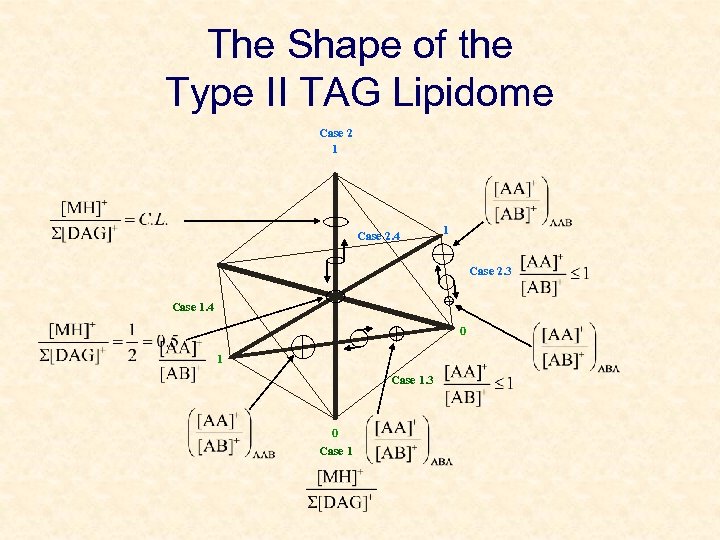
The Shape of the Type II TAG Lipidome Case 2 1 Case 2. 4 1 Case 2. 3 Case 1. 4 0 1 Case 1. 3 0 Case 1
![N Y Case 2. 0 Y + = 100 % (base peak) % [M+H]](https://present5.com/presentation/c4f5669cd1b1b757498cdf5c3e31c39e/image-27.jpg "N Y Case 2. 0 Y + = 100 % (base peak) % [M+H]")
N Y Case 2. 0 Y + = 100 % (base peak) % [M+H] Y N N a Case n. 3 strong [AA] + preference or large difference in FA unsat. [DAG]+ Y †Implies % [M+H]+ Case n. 4 Case 2. 0 = 100 % (base peak) Y Same for Both Cases: N† Case 2. 4† [AA]+ ³ [AB]+ Case 1. 0 = 100 % (base peak) Case 1. 3 % [AB]+ = 100 % (base peak) N† Case 2. 3 [AA]+ < [AB]+ Case 1. 4† % [AA]+ = 100 % (base peak)
![The Shape of the Type III TAG Lipidome Case 2 [M+H]+ Base Peak Case](https://present5.com/presentation/c4f5669cd1b1b757498cdf5c3e31c39e/image-28.jpg "The Shape of the Type III TAG Lipidome Case 2 [M+H]+ Base Peak Case")
The Shape of the Type III TAG Lipidome Case 2 [M+H]+ Base Peak Case 2. 4 CL 2 CV 2 Case 2. 3 Case 1. 4 Case 1. 3 [DAG]+ base peak Case 1
![Critical Ratios and Mass Spectra for Type I TAG [MH]+ [AA]+ Case PPP 0.](https://present5.com/presentation/c4f5669cd1b1b757498cdf5c3e31c39e/image-29.jpg "Critical Ratios and Mass Spectra for Type I TAG [MH]+ [AA]+ Case PPP 0.")
Critical Ratios and Mass Spectra for Type I TAG [MH]+ [AA]+ Case PPP 0. 00 100. 00 1 0. 00 SSS 0. 00 100. 00 1 OOO 3. 24 100. 00 1 LLL 120. 07 LLL 100. 00 83. 28 2 Ln. Ln 222. 80 Ln. Ln 100. 00 44. 88 2 TAG MH/SDAG PPP 0. 00 SSS
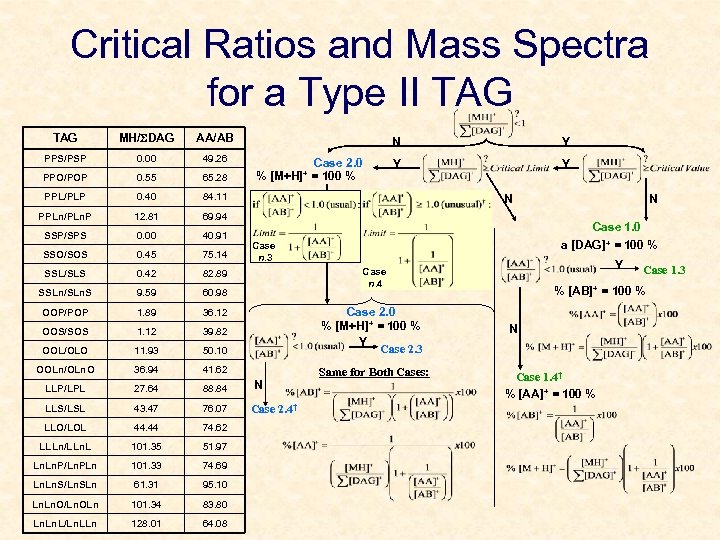
Critical Ratios and Mass Spectra for a Type II TAG MH/SDAG AA/AB PPS/PSP 0. 00 49. 26 PPO/POP 0. 55 65. 28 PPL/PLP 0. 40 12. 81 0. 00 40. 91 SSO/SOS 0. 45 75. 14 SSL/SLS 0. 42 82. 89 SSLn/SLn. S 9. 59 60. 98 OOP/POP 1. 89 36. 12 OOS/SOS 1. 12 39. 82 OOL/OLO 11. 93 50. 10 OOLn/OLn. O 36. 94 41. 62 Case 2. 0 = 100 % Y Y 69. 94 SSP/SPS % [M+H]+ Y 84. 11 PPLn/PLn. P N LLP/LPL 27. 64 88. 84 LLS/LSL 43. 47 76. 07 LLO/LOL 44. 44 74. 62 LLLn/LLn. L 101. 35 51. 97 Ln. P/Ln. PLn 101. 33 74. 69 Ln. S/Ln. SLn 61. 31 95. 10 Ln. O/Ln. OLn 101. 34 83. 80 Ln. L/Ln. LLn 128. 01 64. 08 N N Case 1. 0 a [DAG]+ = 100 % Case n. 3 Y Case n. 4 Case 2. 0 % [M+H]+ = 100 % Y Case 2. 3 N Case 2. 4† Same for Both Cases: Case 1. 3 % [AB]+ = 100 % N Case 1. 4† % [AA]+ = 100 %
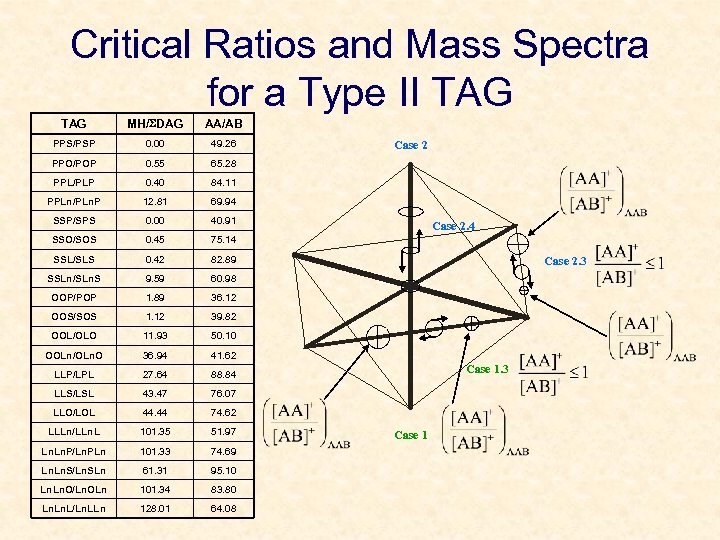
Critical Ratios and Mass Spectra for a Type II TAG MH/SDAG AA/AB PPS/PSP 0. 00 49. 26 PPO/POP 0. 55 65. 28 PPL/PLP 0. 40 84. 11 PPLn/PLn. P 12. 81 69. 94 SSP/SPS 0. 00 40. 91 SSO/SOS 0. 45 75. 14 SSL/SLS 0. 42 82. 89 SSLn/SLn. S 9. 59 60. 98 OOP/POP 1. 89 36. 12 OOS/SOS 1. 12 39. 82 OOL/OLO 11. 93 50. 10 OOLn/OLn. O 36. 94 41. 62 LLP/LPL 27. 64 88. 84 LLS/LSL 43. 47 76. 07 LLO/LOL 44. 44 74. 62 LLLn/LLn. L 101. 35 51. 97 Ln. P/Ln. PLn 101. 33 74. 69 Ln. S/Ln. SLn 61. 31 95. 10 Ln. O/Ln. OLn 101. 34 83. 80 Ln. L/Ln. LLn 128. 01 64. 08 Case 2. 4 Case 2. 3 Case 1
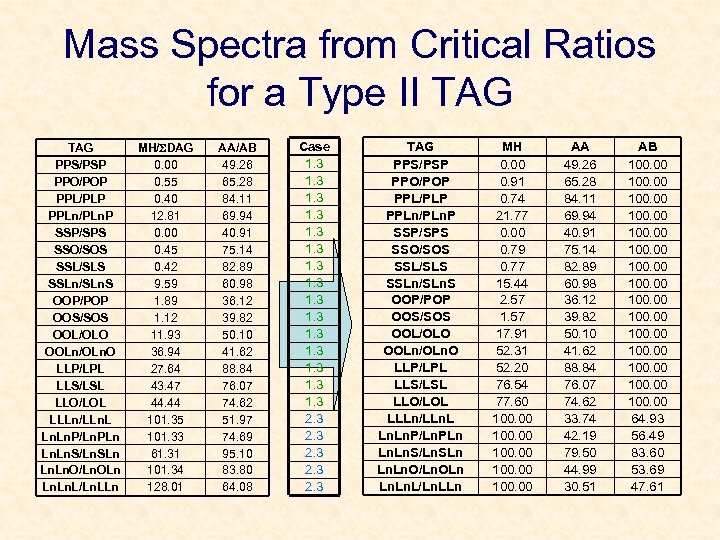
Mass Spectra from Critical Ratios for a Type II TAG PPS/PSP PPO/POP PPL/PLP PPLn/PLn. P SSP/SPS SSO/SOS SSL/SLS SSLn/SLn. S OOP/POP OOS/SOS OOL/OLO OOLn/OLn. O LLP/LPL LLS/LSL LLO/LOL LLLn/LLn. L Ln. P/Ln. PLn Ln. S/Ln. SLn Ln. O/Ln. OLn Ln. L/Ln. LLn MH/SDAG 0. 00 0. 55 0. 40 12. 81 0. 00 0. 45 0. 42 9. 59 1. 89 1. 12 11. 93 36. 94 27. 64 43. 47 44. 44 101. 35 101. 33 61. 31 101. 34 128. 01 AA/AB 49. 26 65. 28 84. 11 69. 94 40. 91 75. 14 82. 89 60. 98 36. 12 39. 82 50. 10 41. 62 88. 84 76. 07 74. 62 51. 97 74. 69 95. 10 83. 80 64. 08 Case 1. 3 1. 3 2. 3 TAG PPS/PSP PPO/POP PPL/PLP PPLn/PLn. P SSP/SPS SSO/SOS SSL/SLS SSLn/SLn. S OOP/POP OOS/SOS OOL/OLO OOLn/OLn. O LLP/LPL LLS/LSL LLO/LOL LLLn/LLn. L Ln. P/Ln. PLn Ln. S/Ln. SLn Ln. O/Ln. OLn Ln. L/Ln. LLn MH 0. 00 0. 91 0. 74 21. 77 0. 00 0. 79 0. 77 15. 44 2. 57 17. 91 52. 31 52. 20 76. 54 77. 60 100. 00 AA 49. 26 65. 28 84. 11 69. 94 40. 91 75. 14 82. 89 60. 98 36. 12 39. 82 50. 10 41. 62 88. 84 76. 07 74. 62 33. 74 42. 19 79. 50 44. 99 30. 51 AB 100. 00 100. 00 64. 93 56. 49 83. 60 53. 69 47. 61
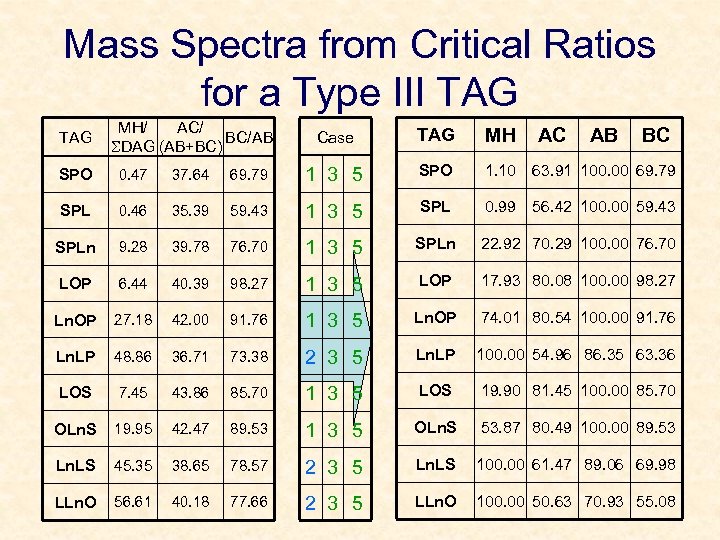
Mass Spectra from Critical Ratios for a Type III TAG MH/ AC/ BC/AB SDAG (AB+BC) Case TAG MH AC AB BC SPO 0. 47 37. 64 69. 79 1 3 5 SPO 1. 10 63. 91 100. 00 69. 79 SPL 0. 46 35. 39 59. 43 1 3 5 SPL 0. 99 56. 42 100. 00 59. 43 SPLn 9. 28 39. 78 76. 70 1 3 5 SPLn 22. 92 70. 29 100. 00 76. 70 LOP 6. 44 40. 39 98. 27 1 3 5 LOP 17. 93 80. 08 100. 00 98. 27 Ln. OP 27. 18 42. 00 91. 76 1 3 5 Ln. OP 74. 01 80. 54 100. 00 91. 76 Ln. LP 48. 86 36. 71 73. 38 2 3 5 Ln. LP 100. 00 54. 96 86. 35 63. 36 LOS 7. 45 43. 86 85. 70 1 3 5 LOS 19. 90 81. 45 100. 00 85. 70 OLn. S 19. 95 42. 47 89. 53 1 3 5 OLn. S 53. 87 80. 49 100. 00 89. 53 Ln. LS 45. 35 38. 65 78. 57 2 3 5 Ln. LS 100. 00 61. 47 89. 06 69. 98 LLn. O 56. 61 40. 18 77. 66 2 3 5 LLn. O 100. 00 50. 63 70. 93 55. 08

Conclusions • Critical Ratios provide structural information, such as the percentage of regioisomers. • The Bottom Up Solution allows data to be expressed as Critical Ratios, to provide information at face value. • The mass spectrum of any TAG can be reproduced from its Critical Ratios.

Conclusions • Critical Ratios constitute a ‘reduced data set’. • It takes fewer Critical Ratios to express the data than the raw abundances. • The Critical Ratios provide more information in fewer values than raw abundances alone.

Acknowledgements • Thanks to William E. Neff for his years of collaboration and friendship • Thanks to Kathleen Warner, Sevim Erhan, and the National Center for Agricultural Utilization Research (NCAUR) in Peoria, IL for collaboration and loan of a triple-stage quadrupole (TSQ) instrument • For more information see: http: //Byrdwell. com or http: //The. Bottom. Up. Solution. com
Other Web Links • Mass Lists for fragments from APCI-MS of triacylglycerols (TAG) can be found at: ¯http: //www. triacylglycerols. com • Mass Lists for fragments from APCI-MS of sphingolipids can be found at: ¯http: //www. sphingomyelin. com • More information regarding LC/MS analysis of TAG can be found at: ¯http: //www. hplc-ms. com
Скачать презентацию The Bottom Up Solution to the Triacylglycerol Lipidome
c4f5669cd1b1b757498cdf5c3e31c39e.ppt