 Скачать презентацию the Borne Identity Data Literacy for all
49ac76241cd4f86d34dc25a19534db40.ppt
- Количество слайдов: 62



(the Borne Identity) Data Literacy for all ! (the Borne ultimatum) Knowledge Discovery from Mining Big Data Kirk Borne @Kirk. DBorne George Mason University School of Physics, Astronomy, & Computational Sciences http: //classweb. gmu. edu/kborne/
The Big Data Manifesto (the Borne Ultimatum) • More data is not just more data … more is different! • Discover the unknowns. • Address massive Data-to-Knowledge (D 2 K) challenge. • Data Literacy for all ! 2
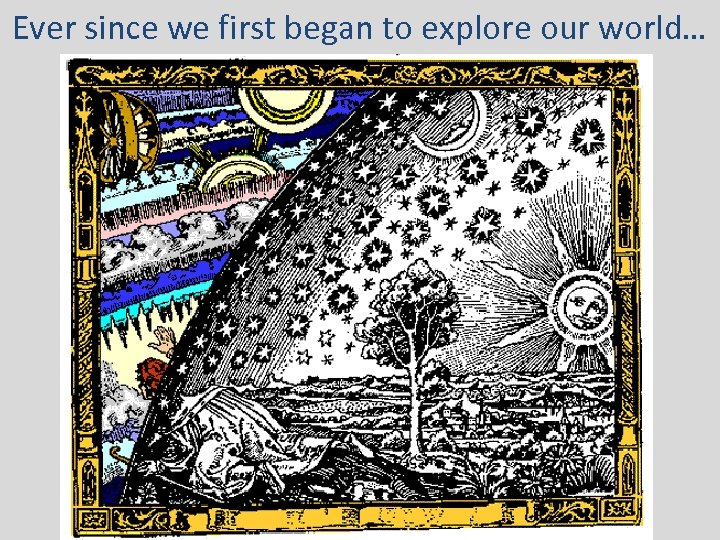
Ever since we first began to explore our world…
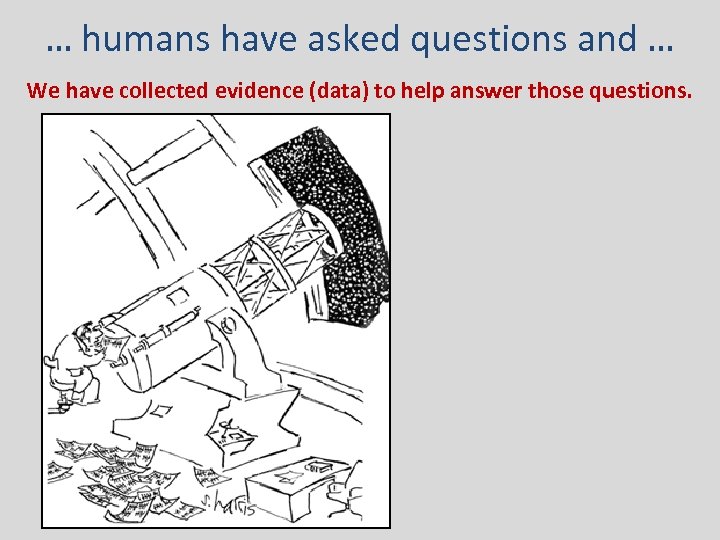
… humans have asked questions and … We have collected evidence (data) to help answer those questions.
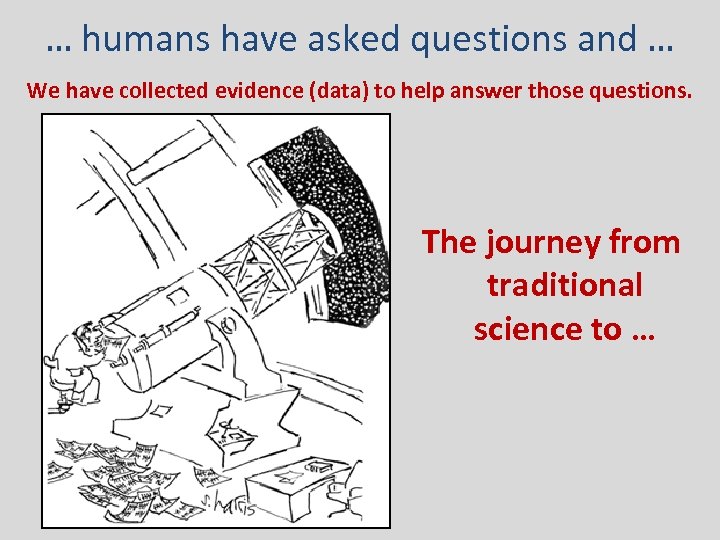
… humans have asked questions and … We have collected evidence (data) to help answer those questions. The journey from traditional science to …
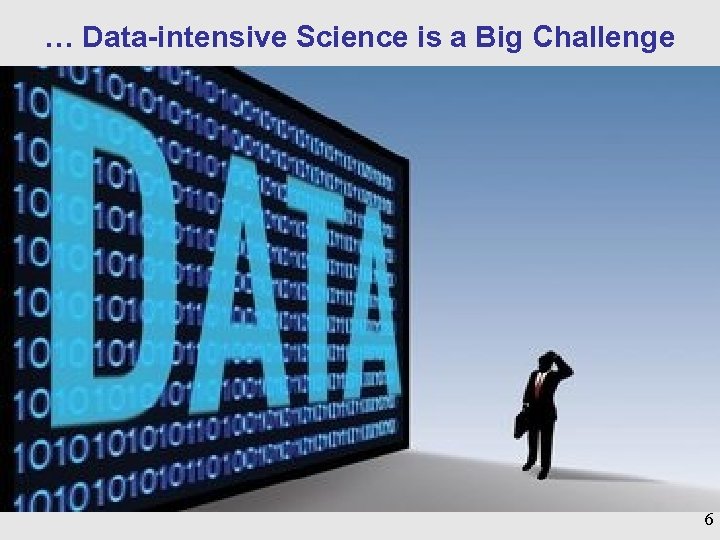
… Data-intensive Science is a Big Challenge 6
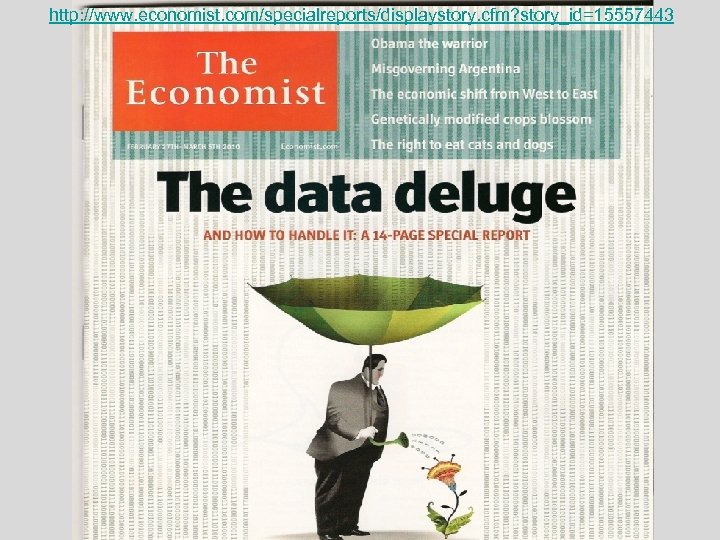
http: //www. economist. com/specialreports/displaystory. cfm? story_id=15557443
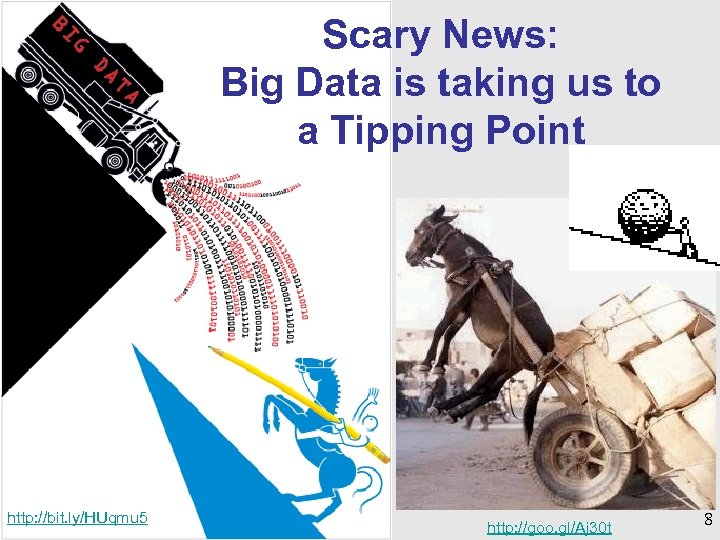
Scary News: Big Data is taking us to a Tipping Point http: //bit. ly/HUqmu 5 http: //goo. gl/Aj 30 t 8
Promising News: Big Data leads to Big Insights and New Discoveries http: //news. nationalgeographic. com/news/2010/11/photogalleries/101103 -nasa-space-shuttle-discovery-firsts-pictures/ 9
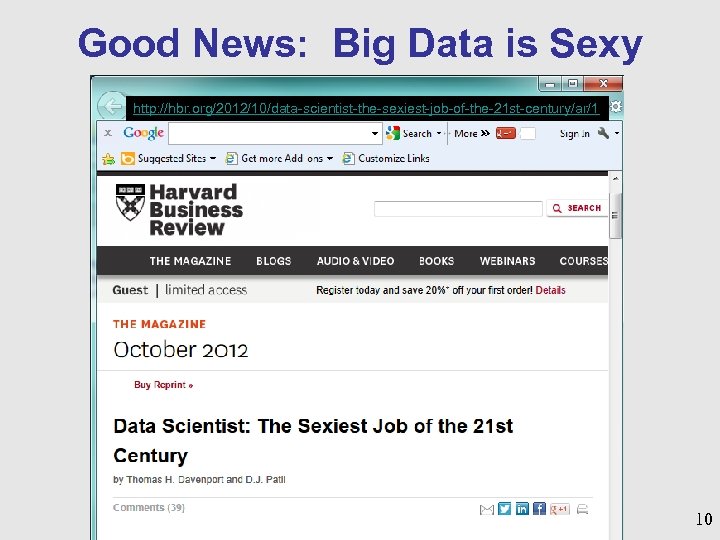
Good News: Big Data is Sexy http: //hbr. org/2012/10/data-scientist-the-sexiest-job-of-the-21 st-century/ar/1 http: //dilbert. com/strips/comic/2012 -09 -05/ 10
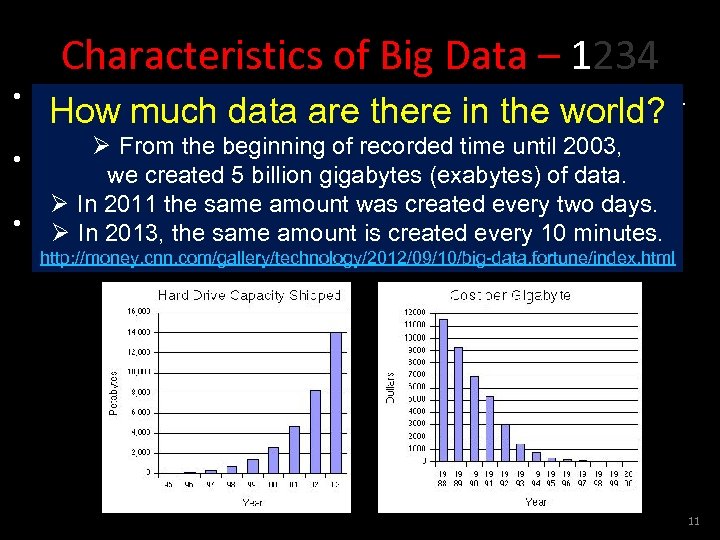
Characteristics of Big Data – 1234 • Computing power doubles every 18 months (Moore’s Law). . . Howimprovement in 10 years there in the world? much data are • 100 x Ø From the beginning of recorded time until 2003, • I/O bandwidth increases ~10% / year we created 5 billion gigabytes (exabytes) of data. • <3 x improvement in 10 years. Ø In 2011 the same amount was created every two days. • The. In 2013, thedata doubles every year. . . Ø amount of same amount is created every 10 minutes. • 1000 x in 10 years, and 1, 000 x in 20 yrs. http: //money. cnn. com/gallery/technology/2012/09/10/big-data. fortune/index. html 11
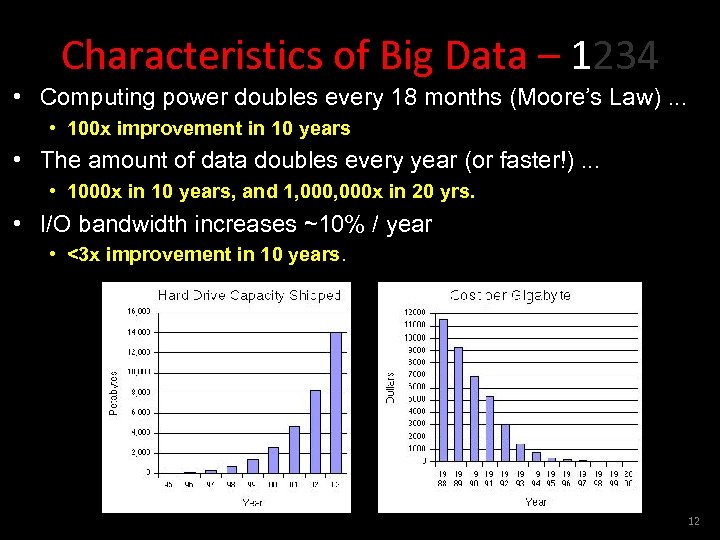
Characteristics of Big Data – 1234 • Computing power doubles every 18 months (Moore’s Law). . . • 100 x improvement in 10 years • The amount of data doubles every year (or faster!). . . • 1000 x in 10 years, and 1, 000 x in 20 yrs. • I/O bandwidth increases ~10% / year • <3 x improvement in 10 years. 12
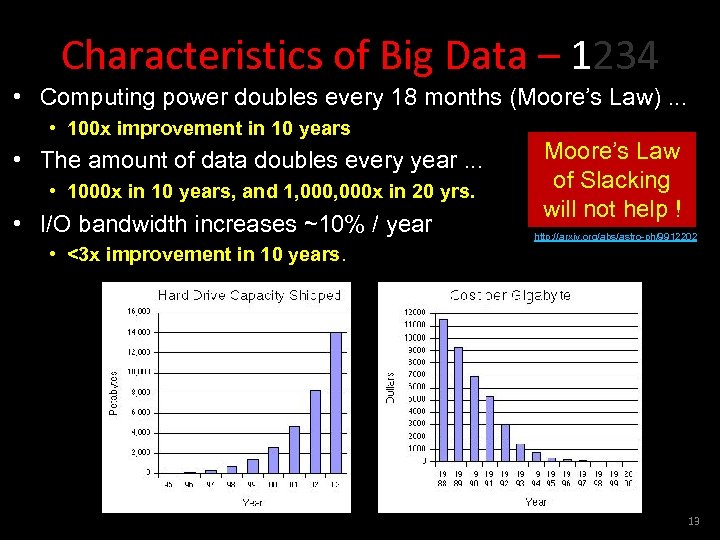
Characteristics of Big Data – 1234 • Computing power doubles every 18 months (Moore’s Law). . . • 100 x improvement in 10 years • The amount of data doubles every year. . . • 1000 x in 10 years, and 1, 000 x in 20 yrs. • I/O bandwidth increases ~10% / year Moore’s Law of Slacking will not help ! http: //arxiv. org/abs/astro-ph/9912202 • <3 x improvement in 10 years. 13
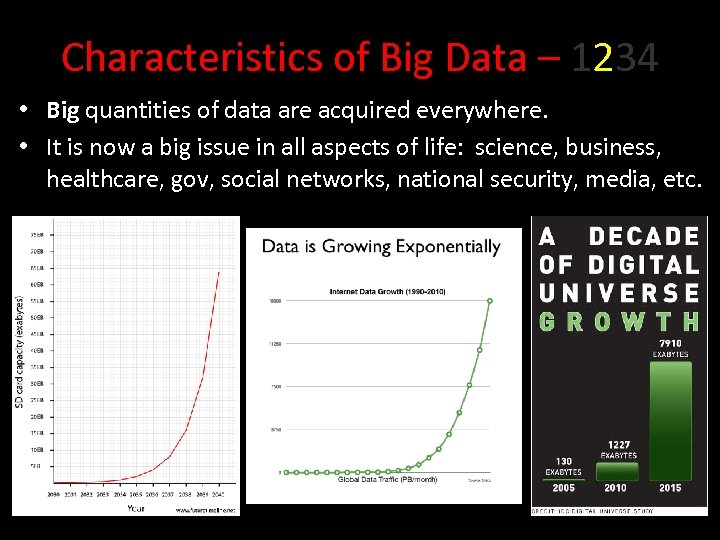
Characteristics of Big Data – 1234 • Big quantities of data are acquired everywhere. • It is now a big issue in all aspects of life: science, business, healthcare, gov, social networks, national security, media, etc.
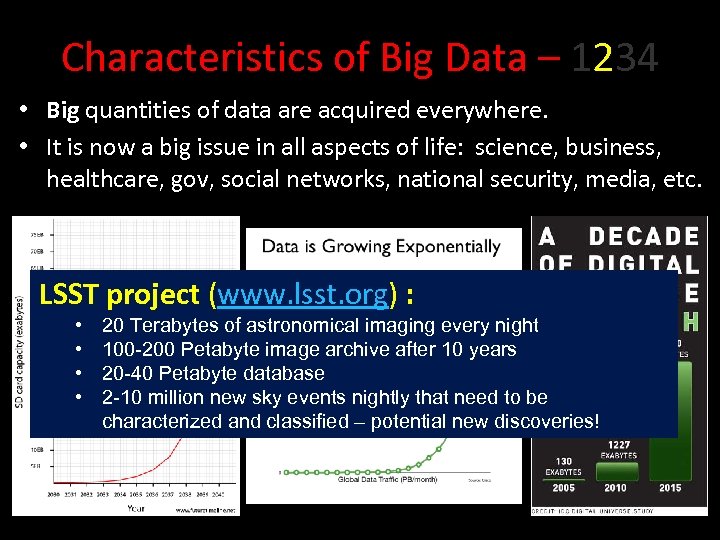
Characteristics of Big Data – 1234 • Big quantities of data are acquired everywhere. • It is now a big issue in all aspects of life: science, business, healthcare, gov, social networks, national security, media, etc. LSST project (www. lsst. org) : • • 20 Terabytes of astronomical imaging every night 100 -200 Petabyte image archive after 10 years 20 -40 Petabyte database 2 -10 million new sky events nightly that need to be characterized and classified – potential new discoveries!
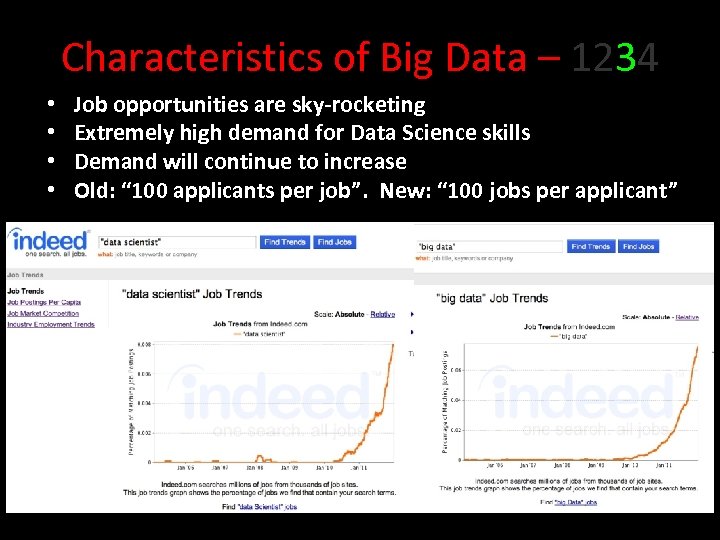
Characteristics of Big Data – 1234 • • Job opportunities are sky-rocketing Extremely high demand for Data Science skills Demand will continue to increase Old: “ 100 applicants per job”. New: “ 100 jobs per applicant”
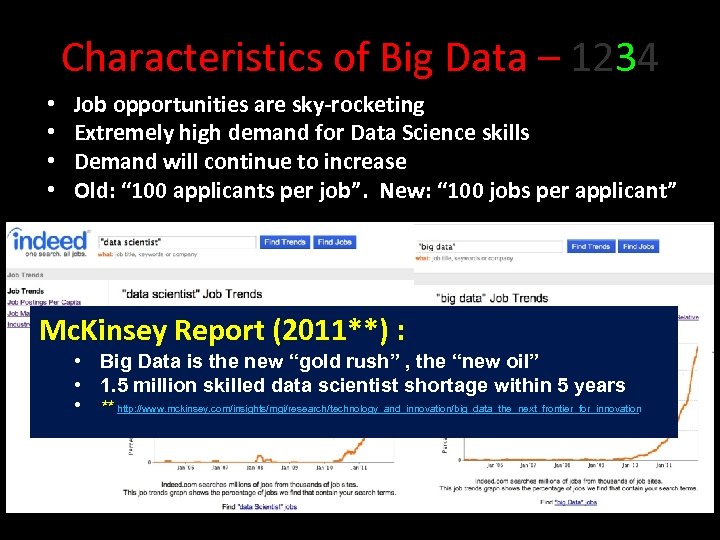
Characteristics of Big Data – 1234 • • Job opportunities are sky-rocketing Extremely high demand for Data Science skills Demand will continue to increase Old: “ 100 applicants per job”. New: “ 100 jobs per applicant” Mc. Kinsey Report (2011**) : • Big Data is the new “gold rush” , the “new oil” • 1. 5 million skilled data scientist shortage within 5 years • ** http: //www. mckinsey. com/insights/mgi/research/technology_and_innovation/big_data_the_next_frontier_for_innovation
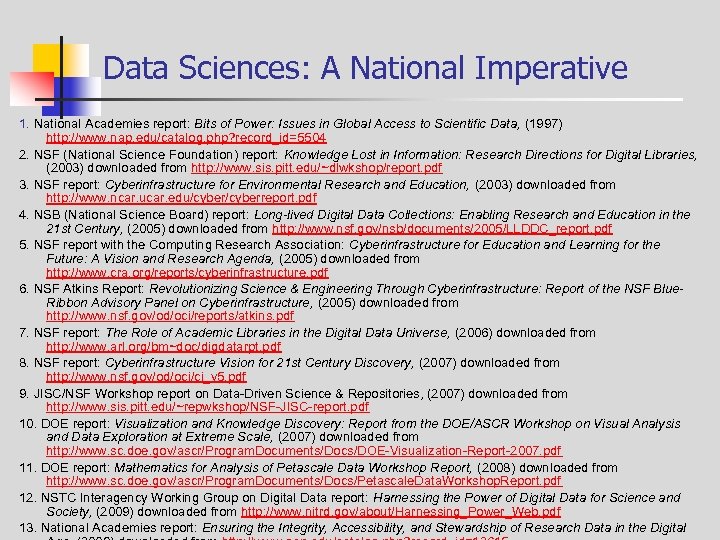
Data Sciences: A National Imperative 1. National Academies report: Bits of Power: Issues in Global Access to Scientific Data, (1997) http: //www. nap. edu/catalog. php? record_id=5504 2. NSF (National Science Foundation) report: Knowledge Lost in Information: Research Directions for Digital Libraries, (2003) downloaded from http: //www. sis. pitt. edu/~dlwkshop/report. pdf 3. NSF report: Cyberinfrastructure for Environmental Research and Education, (2003) downloaded from http: //www. ncar. ucar. edu/cyberreport. pdf 4. NSB (National Science Board) report: Long-lived Digital Data Collections: Enabling Research and Education in the 21 st Century, (2005) downloaded from http: //www. nsf. gov/nsb/documents/2005/LLDDC_report. pdf 5. NSF report with the Computing Research Association: Cyberinfrastructure for Education and Learning for the Future: A Vision and Research Agenda, (2005) downloaded from http: //www. cra. org/reports/cyberinfrastructure. pdf 6. NSF Atkins Report: Revolutionizing Science & Engineering Through Cyberinfrastructure: Report of the NSF Blue. Ribbon Advisory Panel on Cyberinfrastructure, (2005) downloaded from http: //www. nsf. gov/od/oci/reports/atkins. pdf 7. NSF report: The Role of Academic Libraries in the Digital Data Universe, (2006) downloaded from http: //www. arl. org/bm~doc/digdatarpt. pdf 8. NSF report: Cyberinfrastructure Vision for 21 st Century Discovery, (2007) downloaded from http: //www. nsf. gov/od/oci/ci_v 5. pdf 9. JISC/NSF Workshop report on Data-Driven Science & Repositories, (2007) downloaded from http: //www. sis. pitt. edu/~repwkshop/NSF-JISC-report. pdf 10. DOE report: Visualization and Knowledge Discovery: Report from the DOE/ASCR Workshop on Visual Analysis and Data Exploration at Extreme Scale, (2007) downloaded from http: //www. sc. doe. gov/ascr/Program. Documents/Docs/DOE-Visualization-Report-2007. pdf 11. DOE report: Mathematics for Analysis of Petascale Data Workshop Report, (2008) downloaded from http: //www. sc. doe. gov/ascr/Program. Documents/Docs/Petascale. Data. Workshop. Report. pdf 12. NSTC Interagency Working Group on Digital Data report: Harnessing the Power of Digital Data for Science and Society, (2009) downloaded from http: //www. nitrd. gov/about/Harnessing_Power_Web. pdf 13. National Academies report: Ensuring the Integrity, Accessibility, and Stewardship of Research Data in the Digital
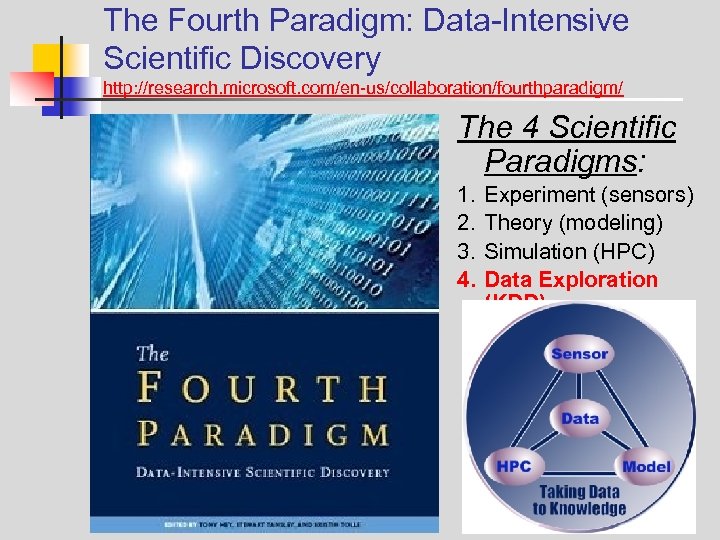
The Fourth Paradigm: Data-Intensive Scientific Discovery http: //research. microsoft. com/en-us/collaboration/fourthparadigm/ The 4 Scientific Paradigms: 1. 2. 3. 4. Experiment (sensors) Theory (modeling) Simulation (HPC) Data Exploration (KDD)
Characteristics of Big Data – 1234 • The emergence of Data Science and Data-Oriented Science (the 4 th paradigm of science). q “Computational literacy and data literacy are critical for all. ” - Kirk Borne 20
Characteristics of Big Data – 1234 • The emergence of Data Science and Data-Oriented Science (the 4 th paradigm of science). q “Computational literacy and data literacy are critical for all. ” - Kirk Borne • A complete data collection on any complex domain (e. g. , Earth, or the Universe, or the Human Body) has the potential to encode the knowledge of that domain, waiting to be mined and discovered. q “Somewhere, something incredible is waiting to be known. ” - Carl Sagan 21
Characteristics of Big Data – 1234 • The emergence of Data Science and Data-Oriented Science (the 4 th paradigm of science). q “Computational literacy and data literacy are critical for all. ” - Kirk Borne • A complete data collection on any complex domain (e. g. , Earth, or the Universe, or the Human Body) has the potential to encode the knowledge of that domain, waiting to be mined and discovered. q “Somewhere, something incredible is waiting to be known. ” - Carl Sagan • We call this “X-Informatics”: addressing the D 2 K (Data-to. Knowledge) Challenge in any discipline X using Data Science. • Examples: Astroinformatics, Bioinformatics, Geoinformatics, Climate Informatics, Ecological Informatics, Biodiversity Informatics, Environmental Informatics, Health Informatics, Medical Informatics, Neuroinformatics, Crystal Informatics, Cheminformatics, Discovery Informatics, and more. 22
Characterizing the Big Data Hype n If the only distinguishing characteristic was that we have lots of data, we would call it “Lots of Data”. 23
Characterizing the Big Data Hype n n If the only distinguishing characteristic was that we have lots of data, we would call it “Lots of Data”. Big Data characteristics: the 3+n V’s = 1. 2. 3. 4. 5. 6. 7. 8. Volume (lots of data = “Tonnabytes”) Variety (complexity, curse of dimensionality) Velocity (rate of data and information flow) V V V 24
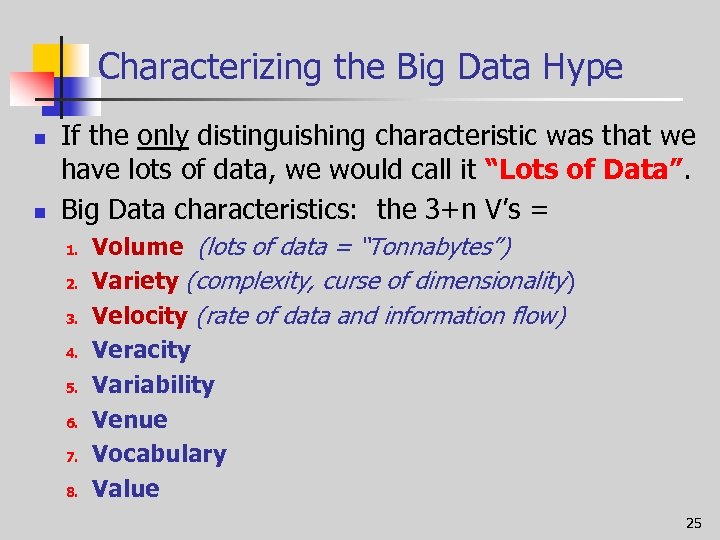
Characterizing the Big Data Hype n n If the only distinguishing characteristic was that we have lots of data, we would call it “Lots of Data”. Big Data characteristics: the 3+n V’s = 1. 2. 3. 4. 5. 6. 7. 8. Volume (lots of data = “Tonnabytes”) Variety (complexity, curse of dimensionality) Velocity (rate of data and information flow) Veracity Variability Venue Vocabulary Value 25
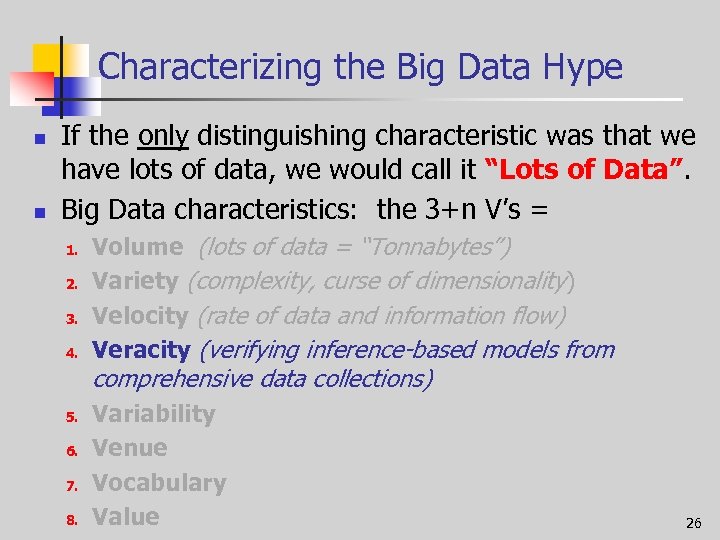
Characterizing the Big Data Hype n n If the only distinguishing characteristic was that we have lots of data, we would call it “Lots of Data”. Big Data characteristics: the 3+n V’s = 1. 2. 3. 4. Volume (lots of data = “Tonnabytes”) Variety (complexity, curse of dimensionality) Velocity (rate of data and information flow) Veracity (verifying inference-based models from comprehensive data collections) 5. 6. 7. 8. Variability Venue Vocabulary Value 26
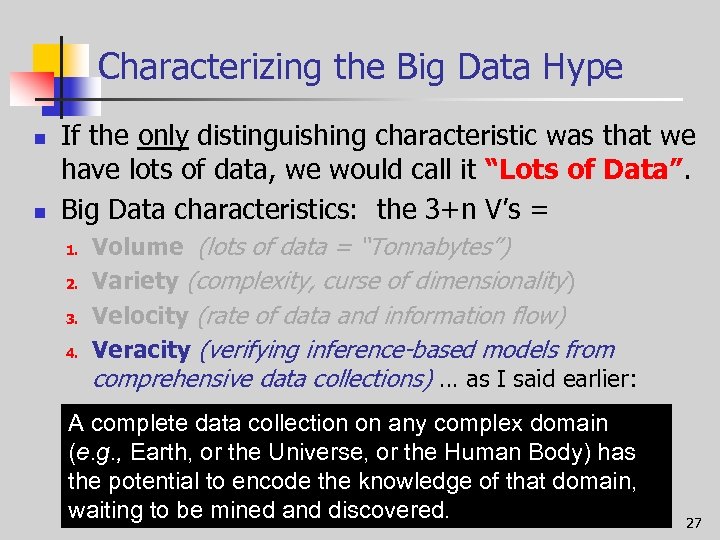
Characterizing the Big Data Hype n n If the only distinguishing characteristic was that we have lots of data, we would call it “Lots of Data”. Big Data characteristics: the 3+n V’s = Volume (lots of data = “Tonnabytes”) 2. Variety (complexity, curse of dimensionality ) 3. Velocity (rate of data and information flow) 4. Veracity (verifying inference-based models from comprehensive data collections) … as I said earlier: 5. Variability A complete data collection on any complex domain 6. Venue (e. g. , Earth, or the Universe, or the Human Body) has the potential to 7. Vocabulary encode the knowledge of that domain, waiting to be mined and discovered. 8. Value 1. 27
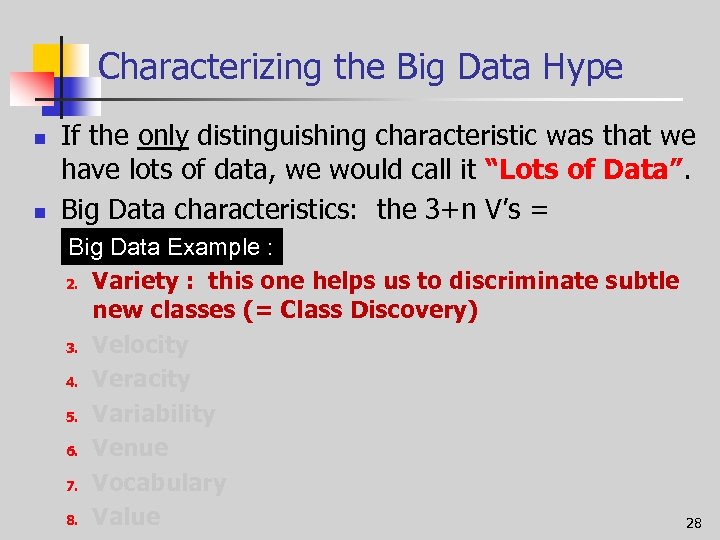
Characterizing the Big Data Hype n n If the only distinguishing characteristic was that we have lots of data, we would call it “Lots of Data”. Big Data characteristics: the 3+n V’s = Volume Big Data Example : 2. Variety : this one helps us to discriminate subtle new classes (= Class Discovery) 3. Velocity 4. Veracity 5. Variability 6. Venue 7. Vocabulary 8. Value 28 1.
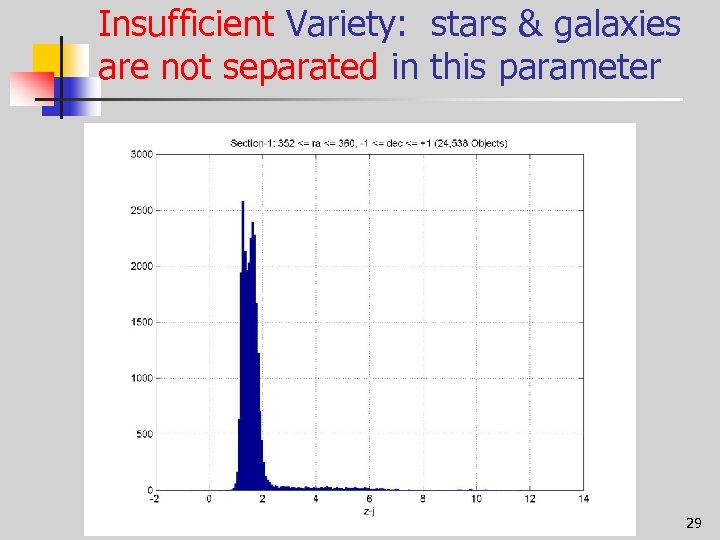
Insufficient Variety: stars & galaxies are not separated in this parameter 29
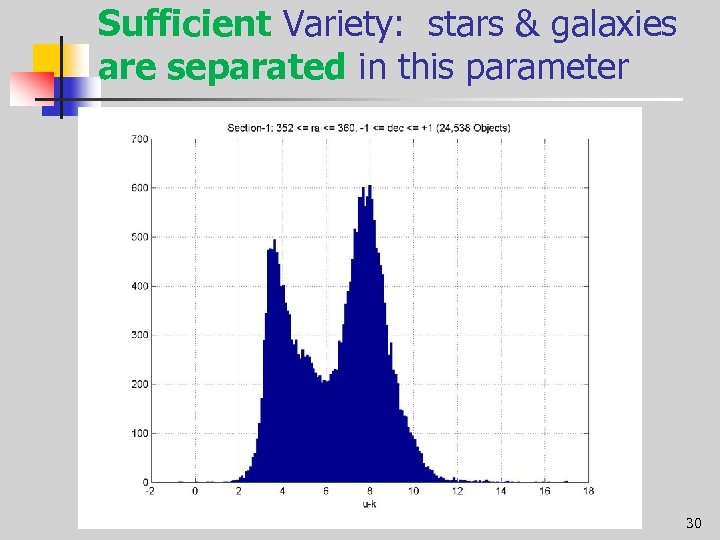
Sufficient Variety: stars & galaxies are separated in this parameter 30
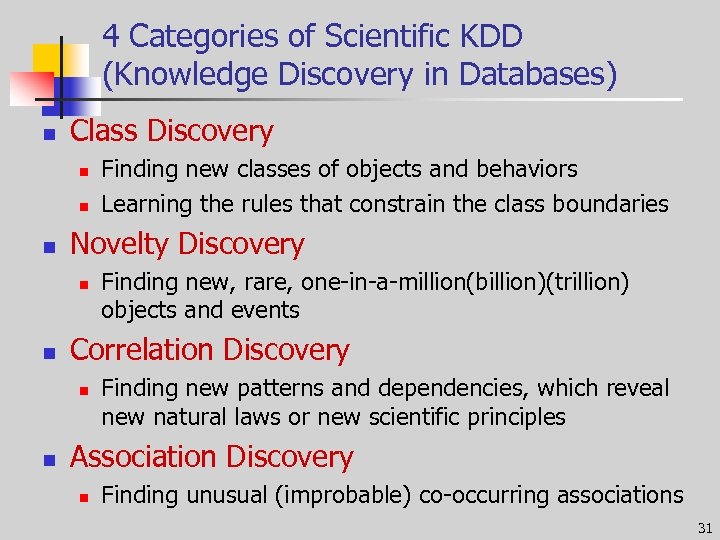
4 Categories of Scientific KDD (Knowledge Discovery in Databases) n Class Discovery n n n Novelty Discovery n n Finding new, rare, one-in-a-million(billion)(trillion) objects and events Correlation Discovery n n Finding new classes of objects and behaviors Learning the rules that constrain the class boundaries Finding new patterns and dependencies, which reveal new natural laws or new scientific principles Association Discovery n Finding unusual (improbable) co-occurring associations 31
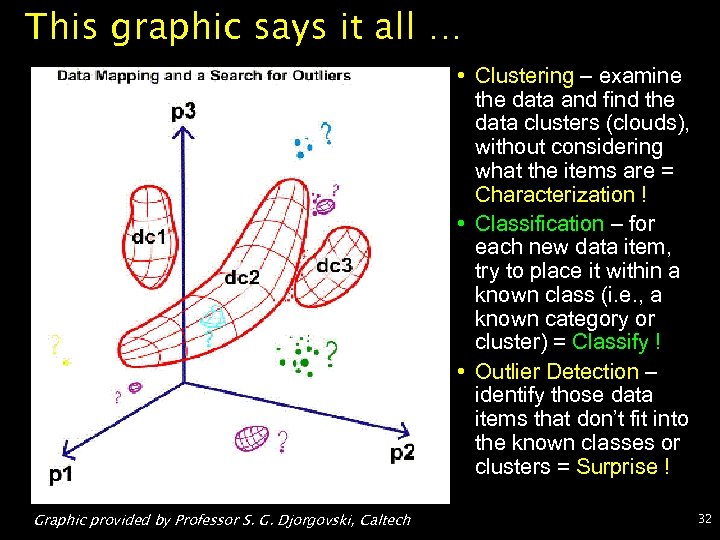
This graphic says it all … • Clustering – examine the data and find the data clusters (clouds), without considering what the items are = Characterization ! • Classification – for each new data item, try to place it within a known class (i. e. , a known category or cluster) = Classify ! • Outlier Detection – identify those data items that don’t fit into the known classes or clusters = Surprise ! Graphic provided by Professor S. G. Djorgovski, Caltech 32
Scientists have been doing Data Mining for centuries “The data are mine, and you can’t have them!” • Seriously. . . • Scientists love to classify things. . . (Supervised Learning. e. g. , classification) • Scientists love to characterize things. . . (Unsupervised Learning. e. g. , clustering) • And we love to discover new things. . . (Semi-supervised Learning. e. g. , outlier detection) 33
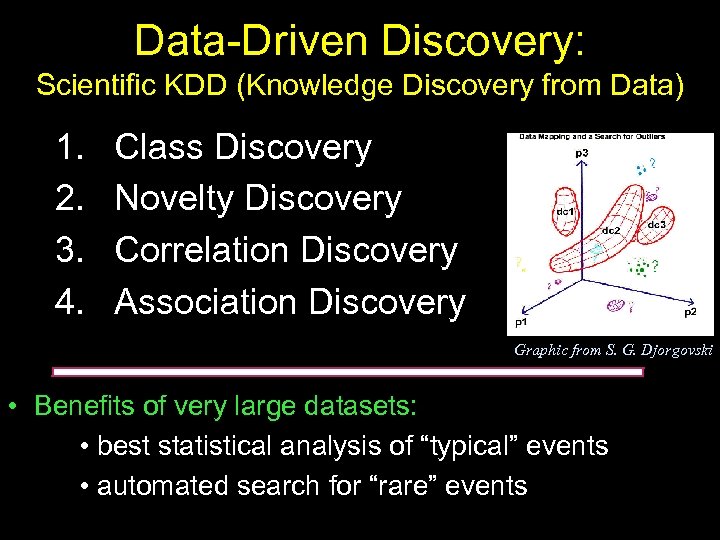
Data-Driven Discovery: Scientific KDD (Knowledge Discovery from Data) 1. 2. 3. 4. Class Discovery Novelty Discovery Correlation Discovery Association Discovery Graphic from S. G. Djorgovski • Benefits of very large datasets: • best statistical analysis of “typical” events • automated search for “rare” events
Scientific Data-to-Knowledge Problem 1 -a • The Class Discovery Problem : (clustering) – Find distinct clusters of multivariate scientific parameters that separate objects within a data set. – Find new classes of objects or new behaviors. – What is the significance of the clusters (statistically and scientifically)? – What is the optimal algorithm for finding friends-of-friends or nearest neighbors in very high dimensions (complex data with Variety)? • N is >1010, so what is the most efficient way to sort? • Number of dimensions > 1000 – therefore, we have an enormous subspace search problem
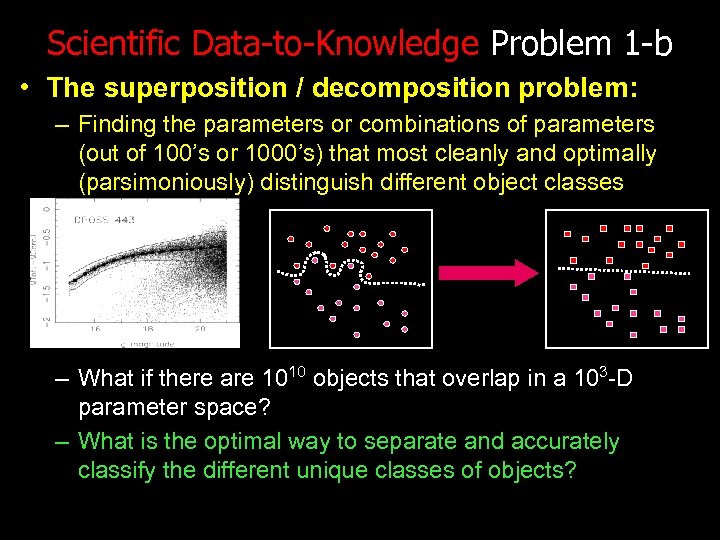
Scientific Data-to-Knowledge Problem 1 -b • The superposition / decomposition problem: – Finding the parameters or combinations of parameters (out of 100’s or 1000’s) that most cleanly and optimally (parsimoniously) distinguish different object classes – What if there are 1010 objects that overlap in a 103 -D parameter space? – What is the optimal way to separate and accurately classify the different unique classes of objects?
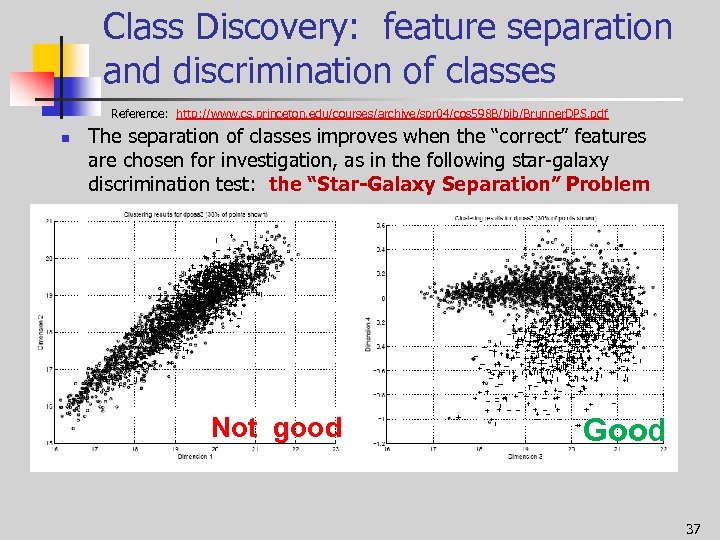
Class Discovery: feature separation and discrimination of classes Reference: http: //www. cs. princeton. edu/courses/archive/spr 04/cos 598 B/bib/Brunner. DPS. pdf n The separation of classes improves when the “correct” features are chosen for investigation, as in the following star-galaxy discrimination test: the “Star-Galaxy Separation” Problem Not good Good 37
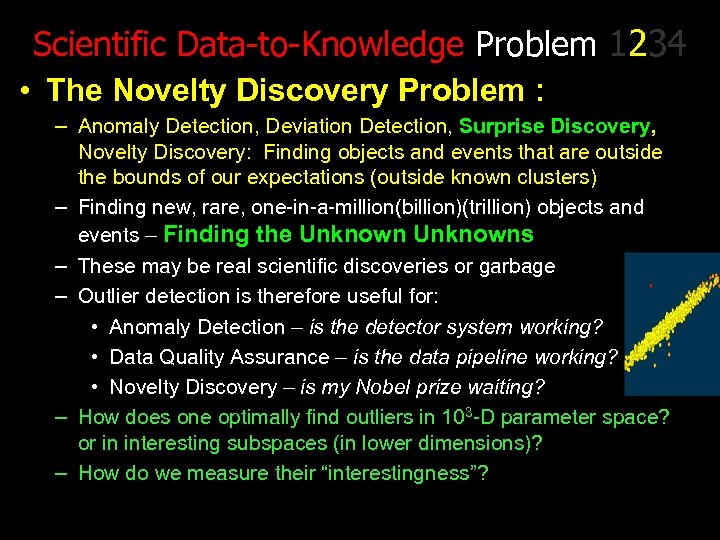
Scientific Data-to-Knowledge Problem 1234 • The Novelty Discovery Problem : – Anomaly Detection, Deviation Detection, Surprise Discovery, Novelty Discovery: Finding objects and events that are outside the bounds of our expectations (outside known clusters) – Finding new, rare, one-in-a-million(billion)(trillion) objects and events – Finding the Unknowns – These may be real scientific discoveries or garbage – Outlier detection is therefore useful for: • Anomaly Detection – is the detector system working? • Data Quality Assurance – is the data pipeline working? • Novelty Discovery – is my Nobel prize waiting? – How does one optimally find outliers in 103 -D parameter space? or in interesting subspaces (in lower dimensions)? – How do we measure their “interestingness”?
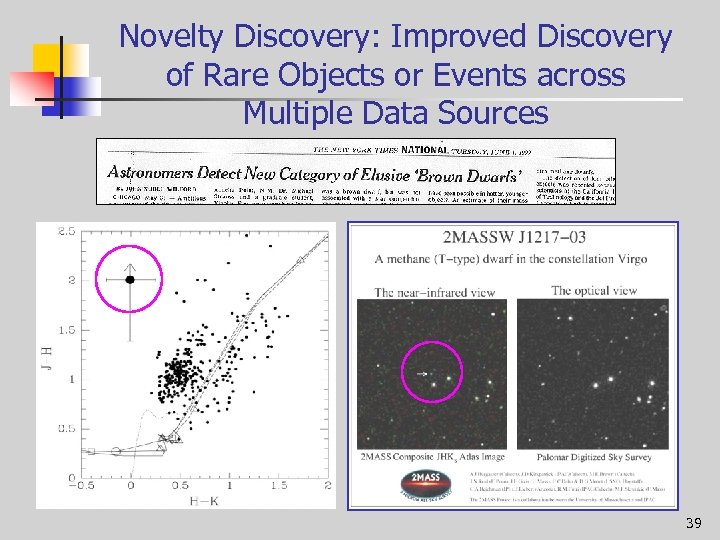
Novelty Discovery: Improved Discovery of Rare Objects or Events across Multiple Data Sources 39
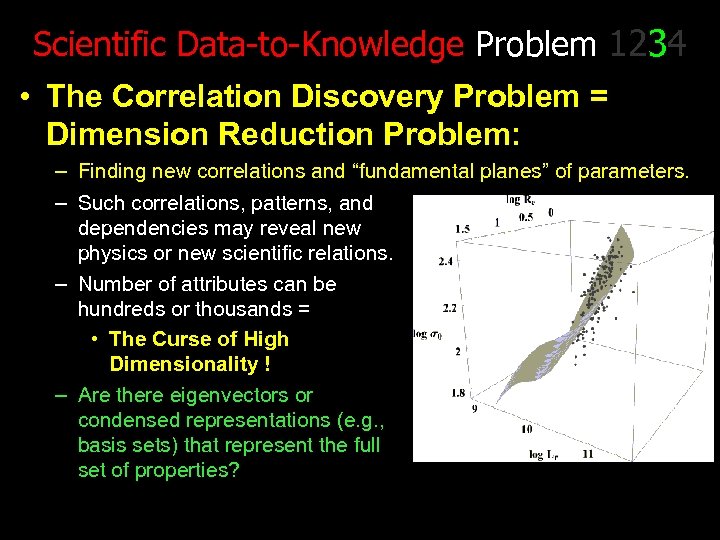
Scientific Data-to-Knowledge Problem 1234 • The Correlation Discovery Problem = Dimension Reduction Problem: – Finding new correlations and “fundamental planes” of parameters. – Such correlations, patterns, and dependencies may reveal new physics or new scientific relations. – Number of attributes can be hundreds or thousands = • The Curse of High Dimensionality ! – Are there eigenvectors or condensed representations (e. g. , basis sets) that represent the full set of properties?
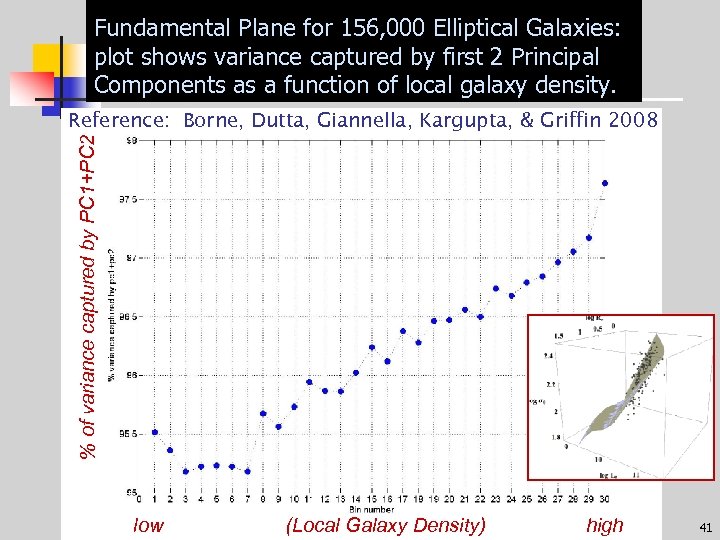
Fundamental Plane for 156, 000 Elliptical Galaxies: plot shows variance captured by first 2 Principal Components as a function of local galaxy density. % of variance captured by PC 1+PC 2 Reference: Borne, Dutta, Giannella, Kargupta, & Griffin 2008 n Slide Content • • • Slide content low (Local Galaxy Density) high 41
Scientific Data-to-Knowledge Problem 1234 • The Association Discovery Problem : Link Analysis – Network Analysis – Graph Mining Ø Identify connections between different events (or objects) Ø Find unusual (improbable) co-occurring combinations of data attribute values Ø Find data items that have much fewer than “ 6 degrees of separation” Ø Identifying such connectivity in our scientific databases and knowledge repositories can lead to new insights, new knowledge, new discoveries.
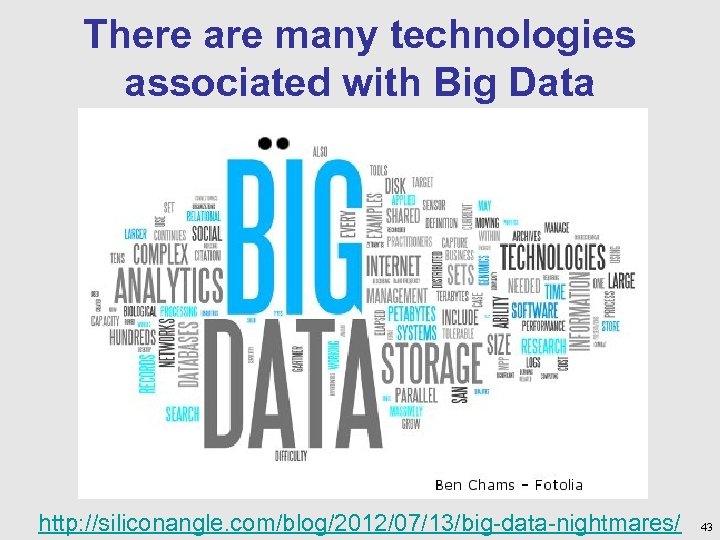
There are many technologies associated with Big Data http: //siliconangle. com/blog/2012/07/13/big-data-nightmares/ 43
One approach to Big Data: Computational Science (Hadoop, Map/Reduce) http: //www. bigdatabytes. com/wp-content/uploads/2012/01/big-data. jpg 44
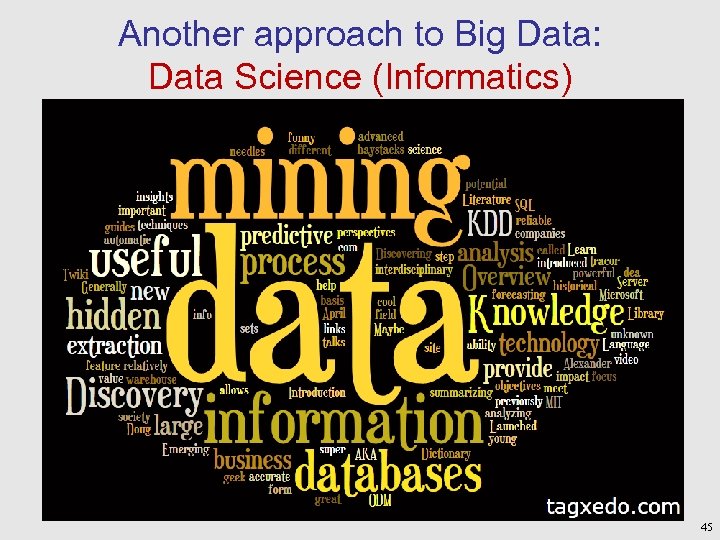
Another approach to Big Data: Data Science (Informatics) 45
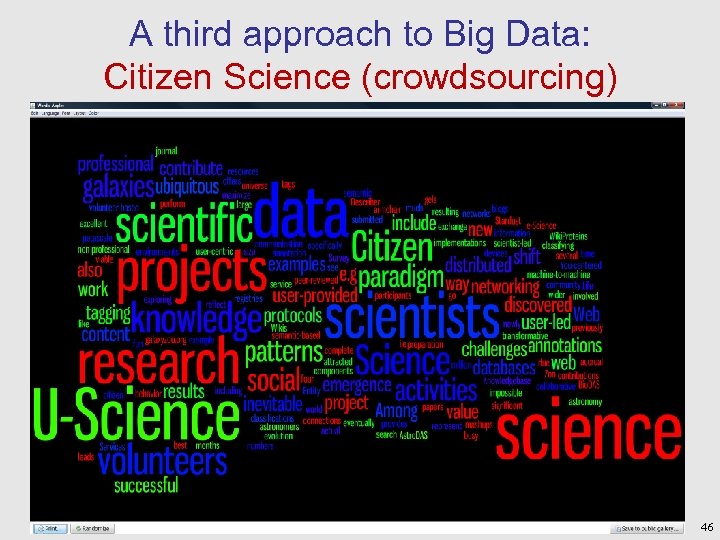
A third approach to Big Data: Citizen Science (crowdsourcing) 46
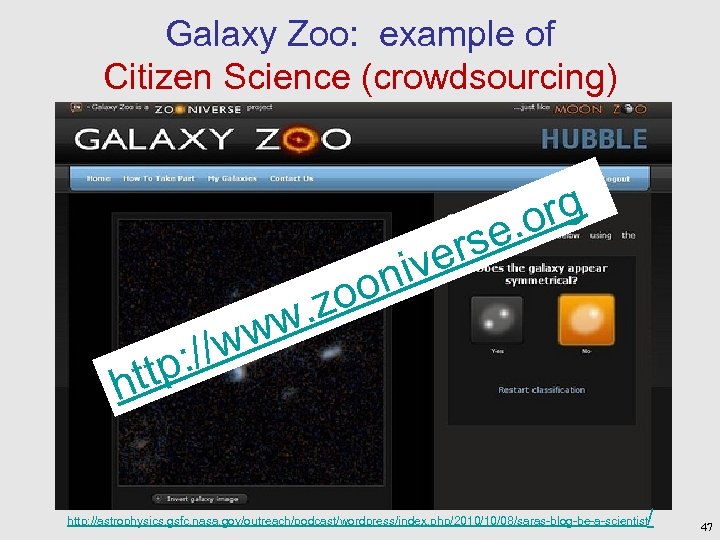
Galaxy Zoo: example of Citizen Science (crowdsourcing) er iv n oo. z tp: ht ww //w org e. s / http: //astrophysics. gsfc. nasa. gov/outreach/podcast/wordpress/index. php/2010/10/08/saras-blog-be-a-scientist 47
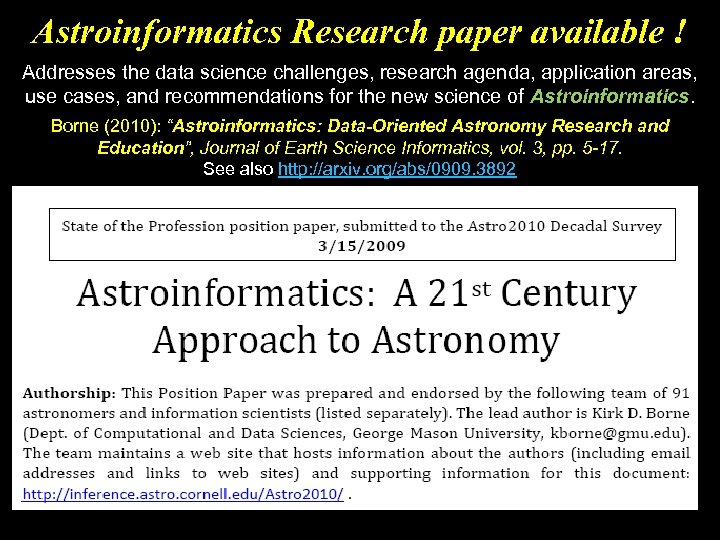
Astroinformatics Research paper available ! Addresses the data science challenges, research agenda, application areas, use cases, and recommendations for the new science of Astroinformatics. Borne (2010): “Astroinformatics: Data-Oriented Astronomy Research and Education”, Journal of Earth Science Informatics, vol. 3, pp. 5 -17. See also http: //arxiv. org/abs/0909. 3892
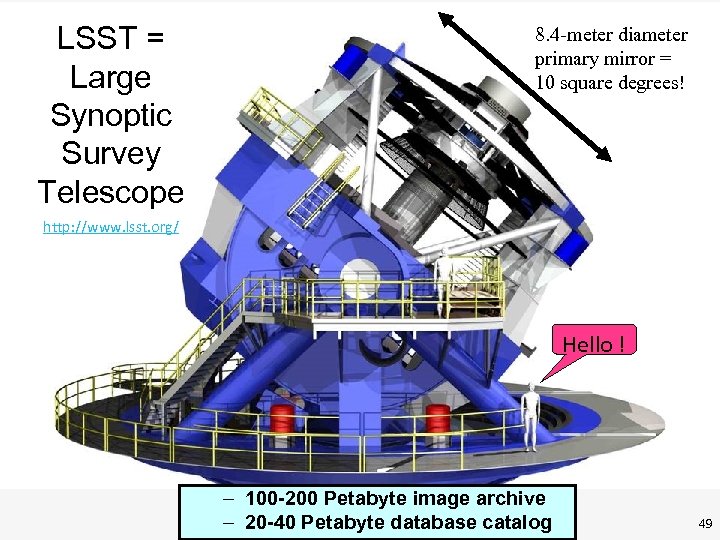
LSST = Large Synoptic Survey Telescope 8. 4 -meter diameter primary mirror = 10 square degrees! http: //www. lsst. org/ Hello ! – 100 -200 Petabyte image archive – 20 -40 Petabyte database catalog 49
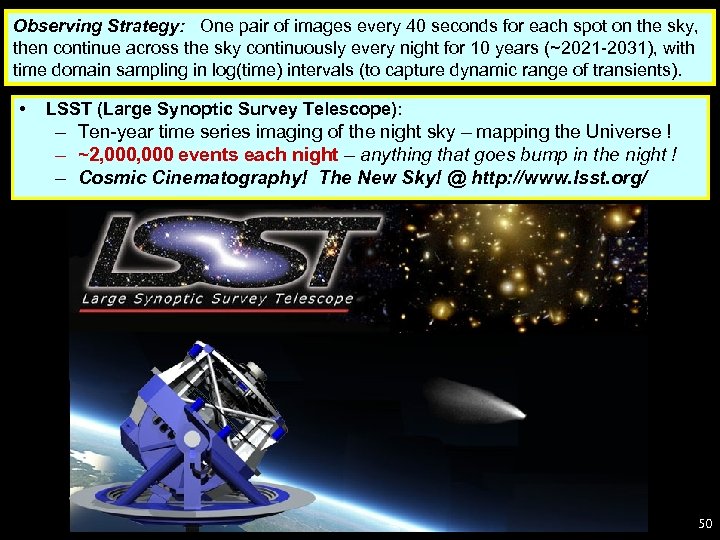
Observing Strategy: One pair of images every 40 seconds for each spot on the sky, then continue across the sky continuously every night for 10 years (~2021 -2031), with time domain sampling in log(time) intervals (to capture dynamic range of transients). • LSST (Large Synoptic Survey Telescope): – Ten-year time series imaging of the night sky – mapping the Universe ! – ~2, 000 events each night – anything that goes bump in the night ! – Cosmic Cinematography! The New Sky! @ http: //www. lsst. org/ 50
The LSST Informatics and Statistics Science Collaboration (ISSC) Research Team • The ISSC team focuses on several research areas: – Statistics – Data & Information Visualization – Data mining (machine learning) Informatics – Data-intensive computing & analysis – Large-scale scientific data management • These areas represent Statistics and the science of Informatics (Astroinformatics) = Data-intensive Science = the 4 th Paradigm of Scientific Research – Addressing the LSST “Data to Knowledge” challenge – Helping to discover the unknowns 51
The LSST ISSC Research Team • Chairperson: K. Borne, GMU • Core team: 3 astronomers + 2 = – – K. Borne (astroinformatics) Eric Feigelsen, Tom Loredo (astrostatistics) Jogesh Babu (statistics) Alex Gray (computer science, data mining) • Full team: 41 scientists – ~60% astronomers – ~30% statisticians – ~10% data mining, machine learning computer scientists http: //www. lsstcorp. org/Science. Collaborators/Science. Members. php http: //aurora. gmu. edu/~kborne/LSST-Informatics-and-Statistics. pdf 52
Some key astronomy problems that require informatics and statistical techniques … Astroinformatics & Astrostatistics! • • • • Probabilistic Cross-Matching of objects from different catalogues The distance problem (e. g. , Photometric Redshift estimators) Star-Galaxy separation ; QSO-Star separation Cosmic-Ray Detection in images Supernova Detection and Classification Morphological Classification (galaxies, AGN, gravitational lenses, . . . ) Class and Subclass Discovery (brown dwarfs, methane dwarfs, . . . ) Dimension Reduction = Correlation Discovery Learning Rules for improved classifiers Classification of massive data streams Real-time Classification of Astronomical Events Clustering of massive data collections Novelty, Anomaly, Outlier Detection in massive databases http: //aurora. gmu. edu/~kborne/LSST-Informatics-and-Statistics. pdf 53
ISSC “current topics” • Advancing the field = Community-building: • Astroinformatics + Astrostatistics (several workshops this year!!) • Education, education! (Citizen Science, undergrad+grad ed…) • LSST Event Characterization vs. Classification • Sparse time series and the LSST observing cadence • Challenge Problems, such as the Photo-z challenge and the Supernova Photometric Classification challenge • Testing algorithms on the LSST simulations: images/catalogs PLUS observing cadence – can we recover known classes of variability? • Generating and/or accumulating training samples of numerous classes (especially variables and transients) • Proposing a mini-survey during the science verification year (Science Commissioning): • e. g. , high-density and evenly-spaced observations of extragalactic and Galactic test fields are obtained, to generate training sets for variability classification and assessment thereof • Science Data Quality Assessment (SDQA): R&D efforts to support LSST Data Management team http: //aurora. gmu. edu/~kborne/LSST-Informatics-and-Statistics. pdf 54
Agenda of ISSC Workshop at LSST Project Meeting, August 2012 Brief talks by team members: – Kirk Borne: Outlier Detection for Surprise Discovery in Big Data – Jogesh Babu: Statistical Resources – Nathan De Lee: The VIDA Astroinformatics Portal – Matthew Graham: Characterizing and Classifying CRTS – Joseph Richards: Time-Domain Discovery and Classification – Sam Schmidt: Upcoming Challenges for Photometric Redshifts – Lior Shamir: Automatic Analysis of Galaxy Morphology – John Wallin: Citizen Science and Machine Learning – Jake Vanderplas: Astro. ML – Machine Learning for Astronomy http: //aurora. gmu. edu/~kborne/LSST-Informatics-and-Statistics. pdf 55
Why do all of this? … for 4 very simple reasons: • (1) Any real data collection may consist of millions, or billions, or trillions of sampled data points. • (2) Any real data set will probably have many hundreds (or thousands) of measured attributes (features, dimensions). • (3) Humans can make mistakes when staring for hours at long lists of numbers, especially in a dynamic data stream. • (4) The use of a data-driven model provides an objective, scientific, rational, and justifiable test of a hypothesis. 56
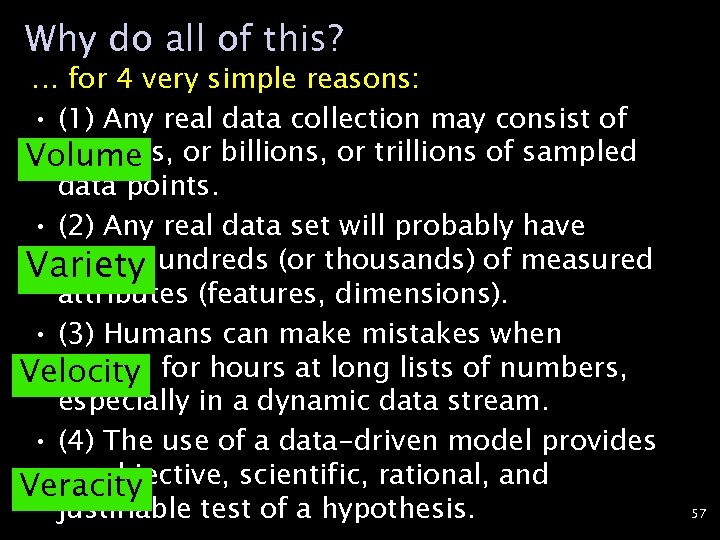
Why do all of this? … for 4 very simple reasons: • (1) Any real data collection may consist of millions, Volume or billions, or trillions of sampled data points. • (2) Any real data set will probably have many Varietyhundreds (or thousands) of measured attributes (features, dimensions). • (3) Humans can make mistakes when staring Velocity for hours at long lists of numbers, especially in a dynamic data stream. • (4) The use of a data-driven model provides an objective, scientific, rational, and Veracity justifiable test of a hypothesis. 57
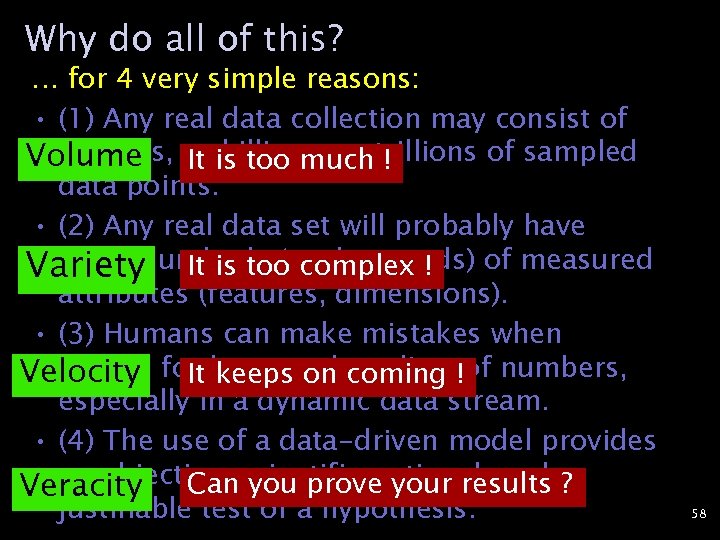
Why do all of this? … for 4 very simple reasons: • (1) Any real data collection may consist of millions, It billions, or ! Volume or is too muchtrillions of sampled data points. • (2) Any real data set will probably have many It is too complex ! Varietyhundreds (or thousands) of measured attributes (features, dimensions). • (3) Humans can make mistakes when staring It keeps on coming Velocity for hours at long lists !of numbers, especially in a dynamic data stream. • (4) The use of a data-driven model provides an objective, you prove your results Veracity Canscientific, rational, and ? justifiable test of a hypothesis. 58
Knowledge Discovery from Mining Big Data – 12 • By collecting a thorough set of parameters (high -dimensional data) for a complete set of items within our domain of study, we should be able to build a “perfect” statistical model for that domain. • In other words, Big Data becomes the model for a domain X = we call this X-informatics. • Anything we want to know about that domain is specified and encoded within the data. • The goal of Big Data Science is to find those encodings, patterns, and knowledge nuggets. • Example : Big-Data Vision? Whole-population analytics 59
Knowledge Discovery from Mining Big Data – 12 • By collecting a thorough set of parameters (high -dimensional data) for a complete set of items within our domain of study, we should be able to build a “perfect” statistical model for that domain. • In other words, Big Data becomes the model for a domain X = we call this X-informatics. • Anything we want to know about that domain is specified and encoded within the data. • The goal of Big Data Science is to find those encodings, patterns, and knowledge nuggets. • Recall what we said before … 60
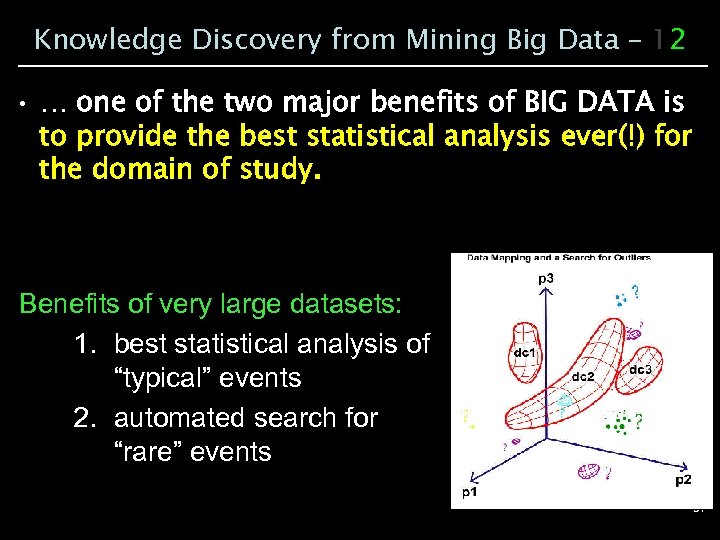
Knowledge Discovery from Mining Big Data – 12 • … one of the two major benefits of BIG DATA is to provide the best statistical analysis ever(!) for the domain of study. Benefits of very large datasets: 1. best statistical analysis of “typical” events 2. automated search for “rare” events 61
 Скачать презентацию the Borne Identity Data Literacy for all
49ac76241cd4f86d34dc25a19534db40.ppt