 Скачать презентацию The Boolean Satisfiability Problem Theory and Practice Bart
7235b4d17d738d87ddc851748d939c04.ppt
- Количество слайдов: 71



The Boolean Satisfiability Problem: Theory and Practice Bart Selman Cornell University Joint work with Carla Gomes. 1
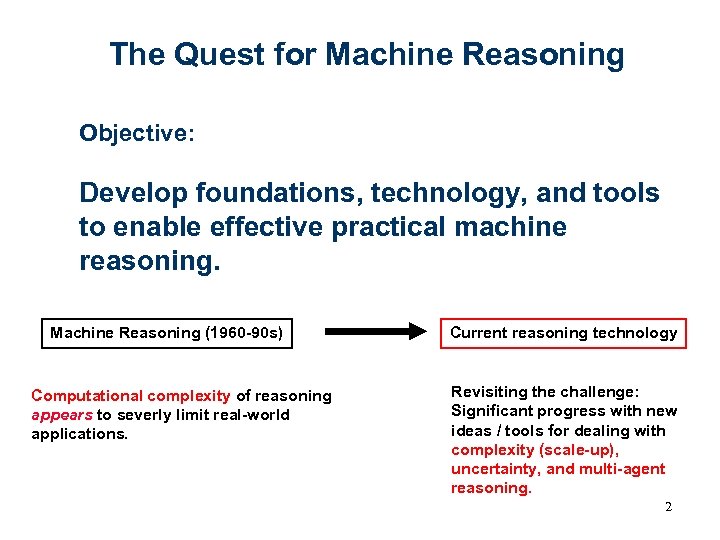
The Quest for Machine Reasoning Objective: Develop foundations, technology, and tools to enable effective practical machine reasoning. Machine Reasoning (1960 -90 s) Computational complexity of reasoning appears to severly limit real-world applications. Current reasoning technology Revisiting the challenge: Significant progress with new ideas / tools for dealing with complexity (scale-up), uncertainty, and multi-agent reasoning. 2
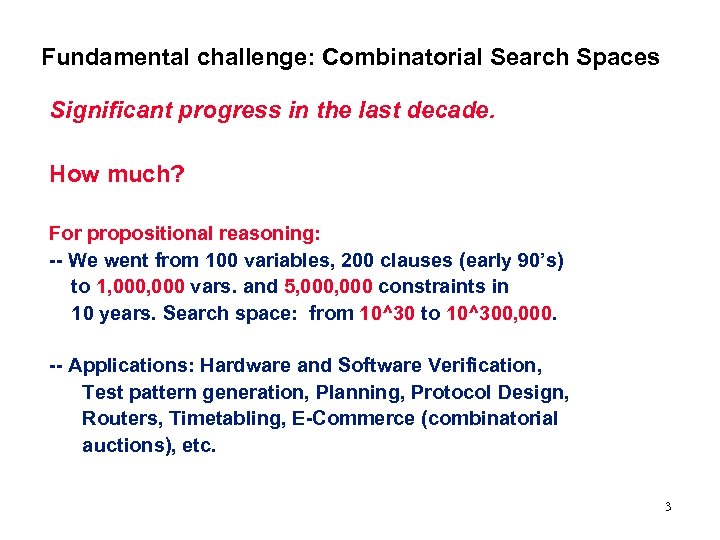
Fundamental challenge: Combinatorial Search Spaces Significant progress in the last decade. How much? For propositional reasoning: -- We went from 100 variables, 200 clauses (early 90’s) to 1, 000 vars. and 5, 000 constraints in 10 years. Search space: from 10^30 to 10^300, 000. -- Applications: Hardware and Software Verification, Test pattern generation, Planning, Protocol Design, Routers, Timetabling, E-Commerce (combinatorial auctions), etc. 3
How can deal with such large combinatorial spaces and still do a decent job? I’ll discuss recent formal insights into combinatorial search spaces and their practical implications that makes searching such ultra-large spaces possible. Brings together ideas from physics of disordered systems (spin glasses), combinatorics of random structures, and algorithms. But first, what is BIG? 4
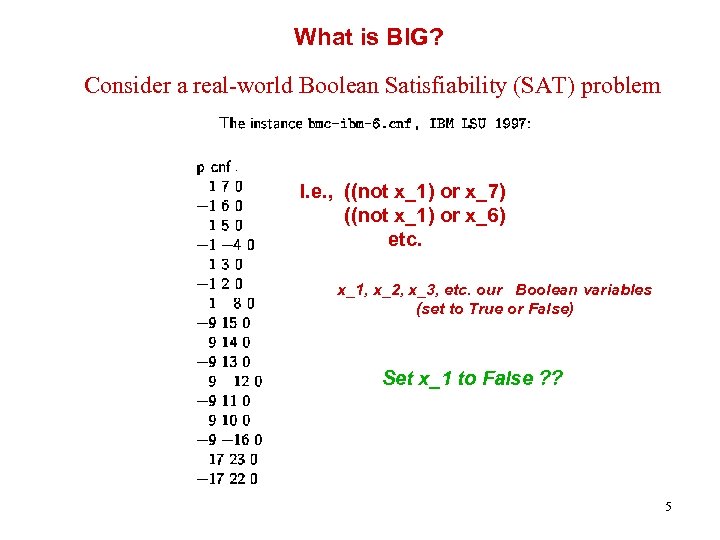
What is BIG? Consider a real-world Boolean Satisfiability (SAT) problem I. e. , ((not x_1) or x_7) ((not x_1) or x_6) etc. x_1, x_2, x_3, etc. our Boolean variables (set to True or False) Set x_1 to False ? ? 5
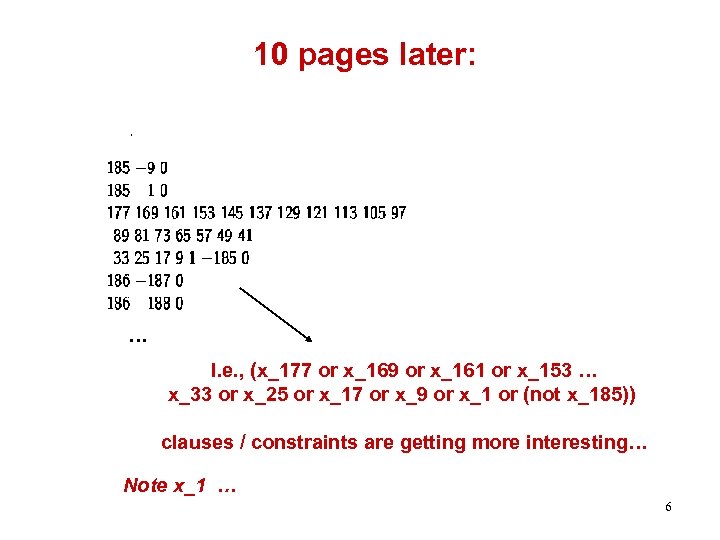
10 pages later: … I. e. , (x_177 or x_169 or x_161 or x_153 … x_33 or x_25 or x_17 or x_9 or x_1 or (not x_185)) clauses / constraints are getting more interesting… Note x_1 … 6
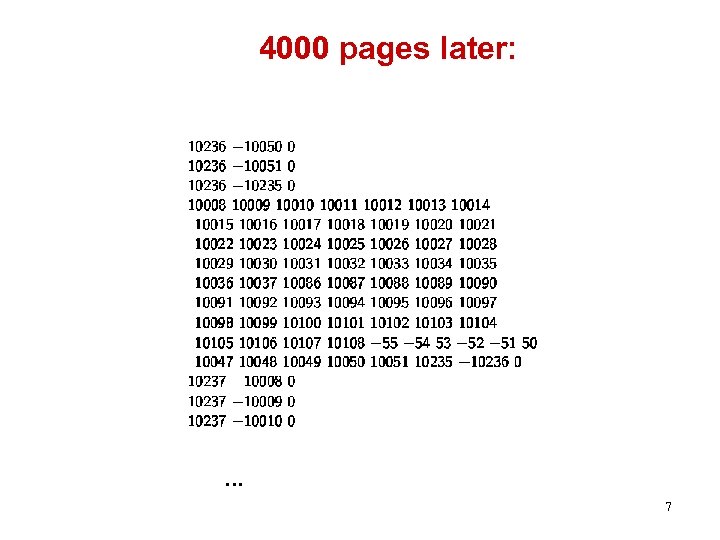
4000 pages later: … 7
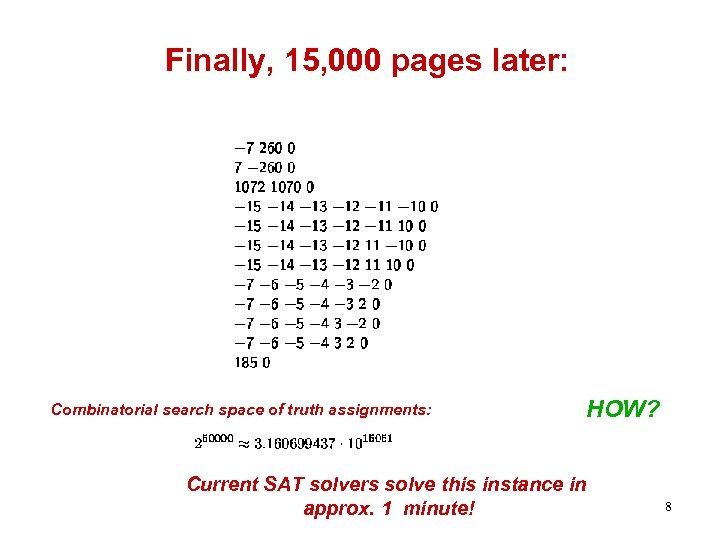
Finally, 15, 000 pages later: Combinatorial search space of truth assignments: HOW? Current SAT solvers solve this instance in approx. 1 minute! 8
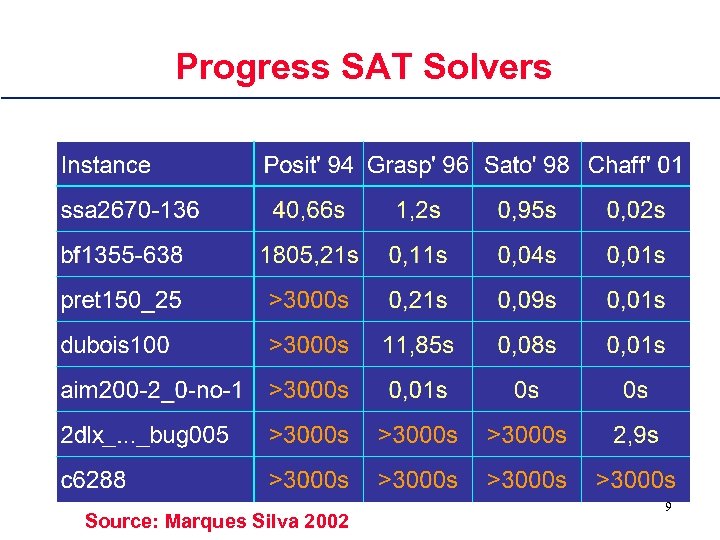
Progress SAT Solvers Source: Marques Silva 2002 9
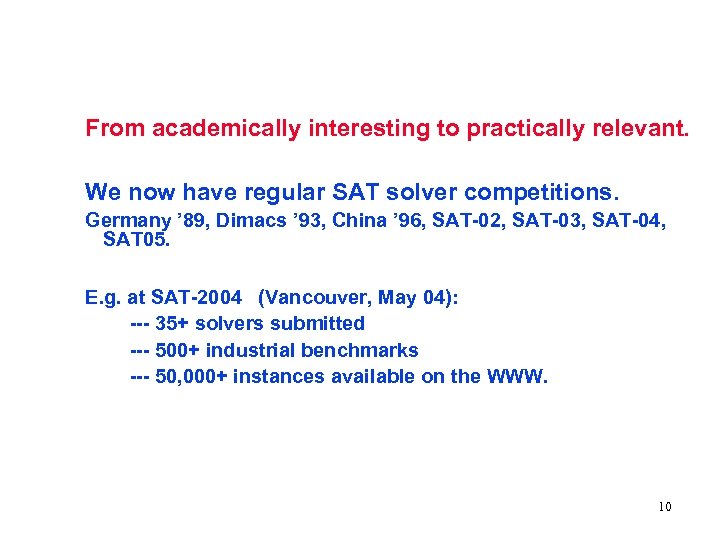
From academically interesting to practically relevant. We now have regular SAT solver competitions. Germany ’ 89, Dimacs ’ 93, China ’ 96, SAT-02, SAT-03, SAT-04, SAT 05. E. g. at SAT-2004 (Vancouver, May 04): --- 35+ solvers submitted --- 500+ industrial benchmarks --- 50, 000+ instances available on the WWW. 10
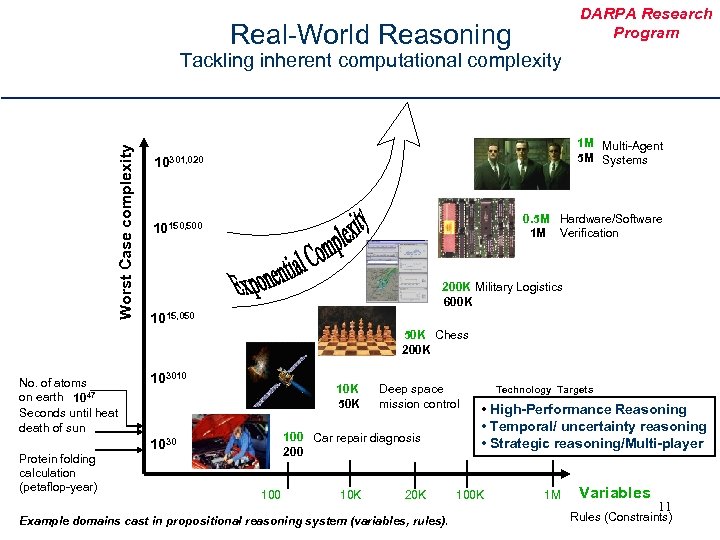
DARPA Research Program Real-World Reasoning Worst Case complexity Tackling inherent computational complexity 10301, 020 1 M Multi-Agent 5 M Systems 10150, 500 0. 5 M Hardware/Software 1 M Verification 200 K Military Logistics 600 K 1015, 050 50 K Chess 200 K No. of atoms on earth 1047 Seconds until heat death of sun Protein folding calculation (petaflop-year) 103010 10 K 50 K Deep space mission control 100 Car repair diagnosis 200 1030 10 K 20 K Example domains cast in propositional reasoning system (variables, rules). Technology Targets • High-Performance Reasoning • Temporal/ uncertainty reasoning • Strategic reasoning/Multi-player 100 K 1 M Variables 11 Rules (Constraints)
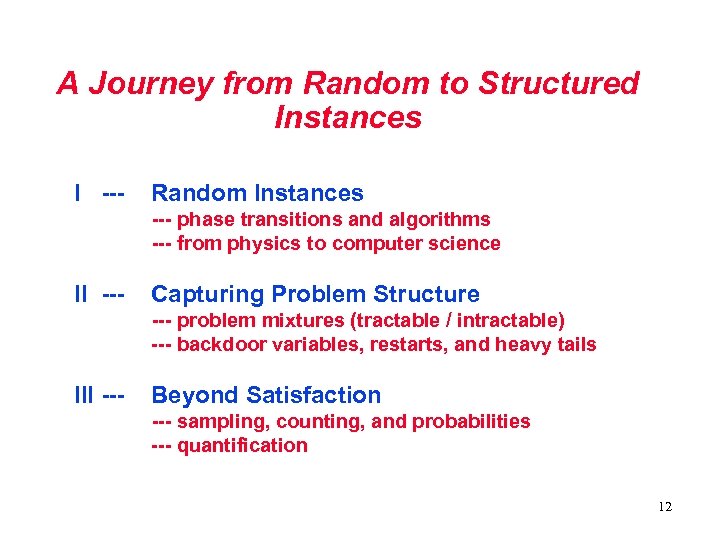
A Journey from Random to Structured Instances I --- Random Instances --- phase transitions and algorithms --- from physics to computer science II --- Capturing Problem Structure --- problem mixtures (tractable / intractable) --- backdoor variables, restarts, and heavy tails III --- Beyond Satisfaction --- sampling, counting, and probabilities --- quantification 12
Part I) ---- Random Instances Easy-Hard-Easy patterns (computational) and SAT/UNSAT phase transitions (“structural”). Their study provides an interplay of work from statistical physics, computer science, and combinatorics. We’ll briefly consider “The State of Random 3 -SAT”.
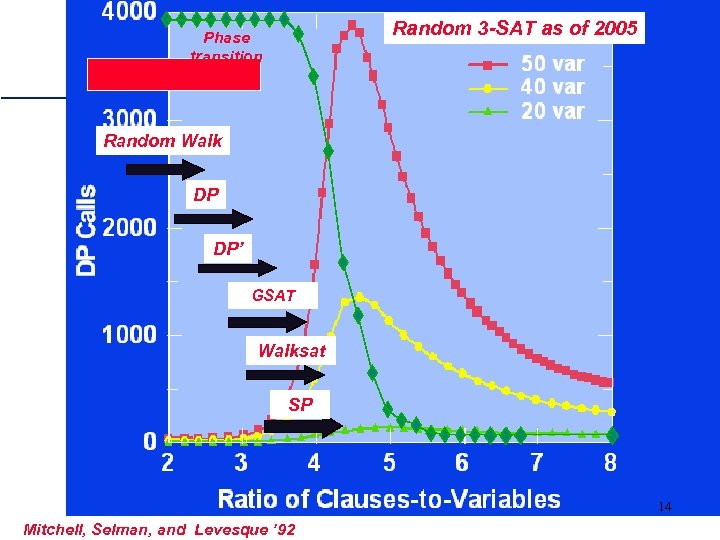
Random 3 -SAT as of 2005 Phase transition Linear time algs. Random Walk DP DP’ GSAT Walksat SP 14 Mitchell, Selman, and Levesque ’ 92
Linear time results --- Random 3 -SAT Random walk up to ratio 1. 36 (Alekhnovich and Ben Sasson 03). empirically up to 2. 5 Davis Putnam (DP) up to 3. 42 (Kaporis et al. ’ 02) empirically up to 3. 6 exponential, ratio 4. 0 and up (Achlioptas and Beame ’ 02) approx. 400 vars at phase transition GSAT up till ratio 3. 92 (Selman et al. ’ 92, Zecchina et al. ‘ 02) approx. 1, 000 vars at phase transition Walksat up till ratio 4. 1 (empirical, Selman et al. ’ 93) approx. 100, 000 vars at phase transition Survey propagation (SP) up till 4. 2 (empirical, Mezard, Parisi, Zecchina ’ 02) approx. 1, 000 vars near phase transition Unsat phase: little algorithmic progress. Exponential resolution lower-bound (Chvatal and Szemeredi 1988) 15
Linear time results --- Random 3 -SAT Random walk up to ratio 1. 36 (Alekhnovich and Ben Sasson 03). empirically up to 2. 5 Davis Putnam (DP) up to 3. 42 (Kaporis et al. ’ 02) empirically up to 3. 6 exponential, ratio 4. 0 and up (Achlioptas and Beame ’ 02) approx. 400 vars at phase transition GSAT up till ratio 3. 92 (Selman et al. ’ 92, Zecchina et al. ‘ 02) approx. 1, 000 vars at phase transition Walksat up till ratio 4. 1 (empirical, Selman et al. ’ 93) approx. 100, 000 vars at phase transition Survey propagation (SP) up till 4. 2 (empirical, Mezard, Parisi, Zecchina ’ 02) approx. 1, 000 vars near phase transition Unsat phase: little algorithmic progress. Exponential resolution lower-bound (Chvatal and Szemeredi 1988) 16
Linear time results --- Random 3 -SAT Random walk up to ratio 1. 36 (Alekhnovich and Ben Sasson 03). empirically up to 2. 5 Davis Putnam (DP) up to 3. 42 (Kaporis et al. ’ 02) empirically up to 3. 6 exponential, ratio 4. 0 and up (Achlioptas and Beame ’ 02) approx. 400 vars at phase transition GSAT up till ratio 3. 92 (Selman et al. ’ 92, Zecchina et al. ‘ 02) approx. 1, 000 vars at phase transition Walksat up till ratio 4. 1 (empirical, Selman et al. ’ 93) approx. 100, 000 vars at phase transition Survey propagation (SP) up till 4. 2 (empirical, Mezard, Parisi, Zecchina ’ 02) approx. 1, 000 vars near phase transition Unsat phase: little algorithmic progress. Exponential resolution lower-bound (Chvatal and Szemeredi 1988) 17
Linear time results --- Random 3 -SAT Random walk up to ratio 1. 36 (Alekhnovich and Ben Sasson 03). empirically up to 2. 5 Davis Putnam (DP) up to 3. 42 (Kaporis et al. ’ 02) empirically up to 3. 6 exponential, ratio 4. 0 and up (Achlioptas and Beame ’ 02) approx. 400 vars at phase transition GSAT up till ratio 3. 92 (Selman et al. ’ 92, Zecchina et al. ‘ 02) approx. 1, 000 vars at phase transition Walksat up till ratio 4. 1 (empirical, Selman et al. ’ 93) approx. 100, 000 vars at phase transition Survey propagation (SP) up till 4. 2 (empirical, Mezard, Parisi, Zecchina ’ 02) approx. 1, 000 vars near phase transition Unsat phase: little algorithmic progress. Exponential resolution lower-bound (Chvatal and Szemeredi 1988) 18
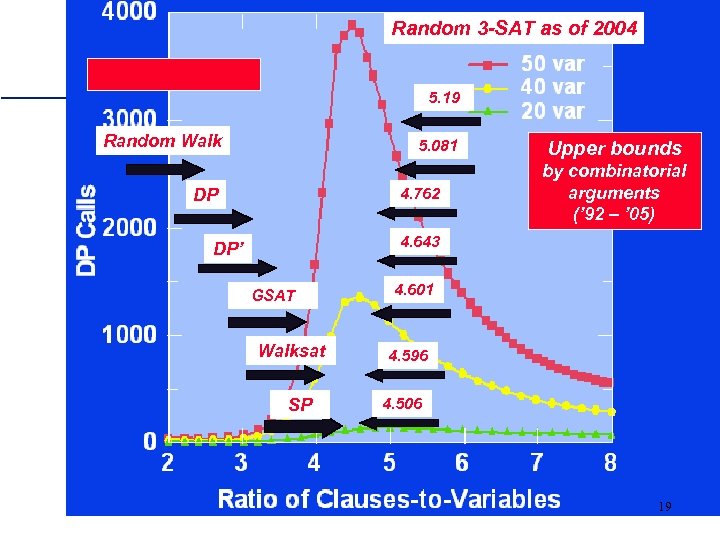
Random 3 -SAT as of 2004 Linear time algs. 5. 19 Random Walk 5. 081 4. 762 DP Upper bounds by combinatorial arguments (’ 92 – ’ 05) 4. 643 DP’ GSAT Walksat SP 4. 601 4. 596 4. 506 19
Exact Location of Threshold Surprisingly challenging problem. . . Current rigorously proved results: 3 SAT threshold lies between 3. 42 and 4. 506. Motwani et al. 1994; Broder et al. 1992; Frieze and Suen 1996; Dubois 1990, 1997; Kirousis et al. 1995; Friedgut 1997; Archlioptas et al. 1999; Beame, Karp, Pitassi, and Saks 1998; Impagliazzo and Paturi 1999; Bollobas, Borgs, Chayes, Han Kim, and Wilson 1999; Achlioptas, Beame and Molloy 2001; Frieze 2001; Zecchina et al. 2002; Kirousis et al. 2004; Gomes and Selman, Nature ’ 05; Achlioptas et al. Nature ’ 05; and ongoing… Empirical: 4. 25 --- Mitchell, Selman, and Levesque ’ 92, Crawford ’ 93.
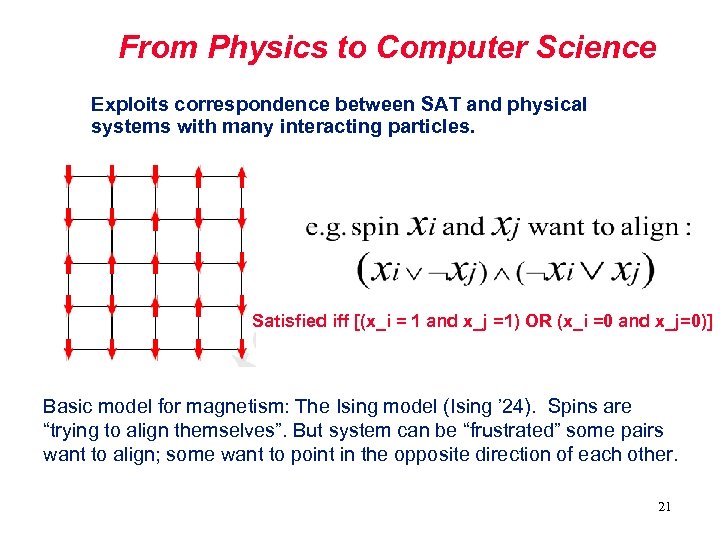
From Physics to Computer Science Exploits correspondence between SAT and physical systems with many interacting particles. Satisfied iff [(x_i = 1 and x_j =1) OR (x_i =0 and x_j=0)] Basic model for magnetism: The Ising model (Ising ’ 24). Spins are “trying to align themselves”. But system can be “frustrated” some pairs want to align; some want to point in the opposite direction of each other. 21
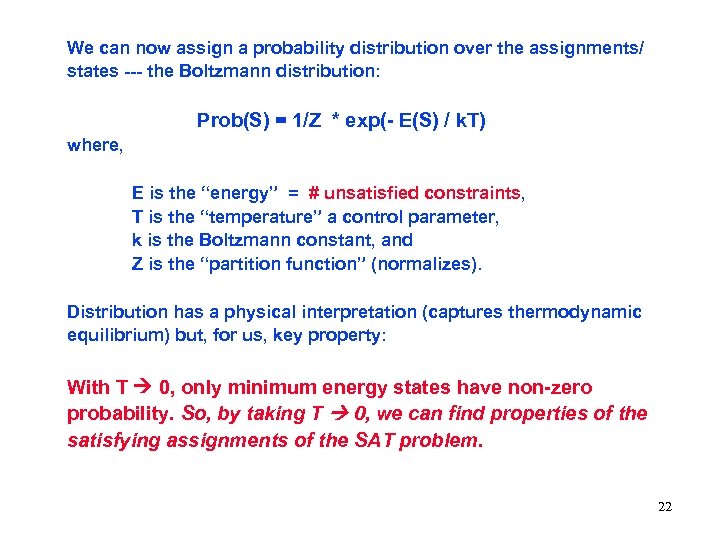
We can now assign a probability distribution over the assignments/ states --- the Boltzmann distribution: Prob(S) = 1/Z * exp(- E(S) / k. T) where, E is the “energy” = # unsatisfied constraints, T is the “temperature” a control parameter, k is the Boltzmann constant, and Z is the “partition function” (normalizes). Distribution has a physical interpretation (captures thermodynamic equilibrium) but, for us, key property: With T 0, only minimum energy states have non-zero probability. So, by taking T 0, we can find properties of the satisfying assignments of the SAT problem. 22
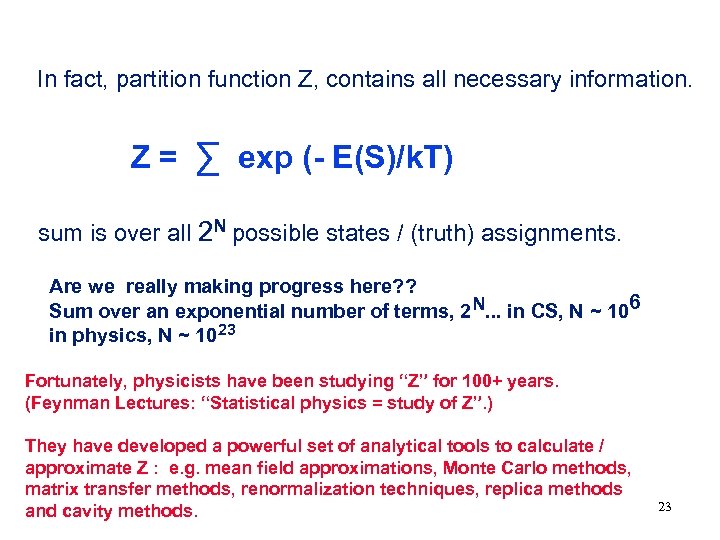
In fact, partition function Z, contains all necessary information. Z = ∑ exp (- E(S)/k. T) sum is over all 2 N possible states / (truth) assignments. Are we really making progress here? ? Sum over an exponential number of terms, 2 N. . . in CS, N ~ 106 in physics, N ~ 1023 Fortunately, physicists have been studying “Z” for 100+ years. (Feynman Lectures: “Statistical physics = study of Z”. ) They have developed a powerful set of analytical tools to calculate / approximate Z : e. g. mean field approximations, Monte Carlo methods, matrix transfer methods, renormalization techniques, replica methods and cavity methods. 23
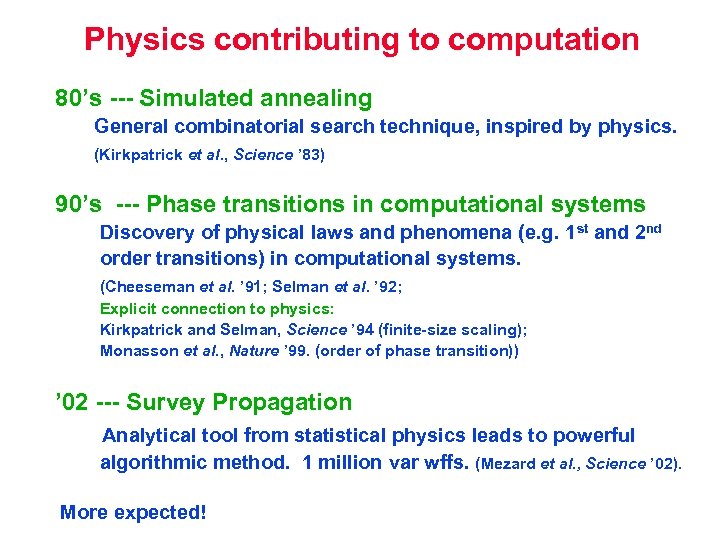
Physics contributing to computation 80’s --- Simulated annealing General combinatorial search technique, inspired by physics. (Kirkpatrick et al. , Science ’ 83) 90’s --- Phase transitions in computational systems Discovery of physical laws and phenomena (e. g. 1 st and 2 nd order transitions) in computational systems. (Cheeseman et al. ’ 91; Selman et al. ’ 92; Explicit connection to physics: Kirkpatrick and Selman, Science ’ 94 (finite-size scaling); Monasson et al. , Nature ’ 99. (order of phase transition)) ’ 02 --- Survey Propagation Analytical tool from statistical physics leads to powerful algorithmic method. 1 million var wffs. (Mezard et al. , Science ’ 02). More expected!
A Journey from Random to Structured Instances I --- algorithms --- phase transitions and Random Instances --- from physics to computer science II --- Capturing Problem Structure --- problem mixtures (tractable / intractable) --- backdoor variables, restarts, and heavy-tails III --- Beyond Satisfaction --- sampling, counting, and probabilities --- quantification 25
Part II) --- Capturing Problem Structure Results and algorithms for hard random k-SAT problems have had significant impact on development of practical SAT solvers. However… Next challenge: Dealing with SAT problems with more inherent structure. Topics (with lots of room for further analysis): A) Mixtures of tractable/intractable stucture B) Backdoor variables and heavy tails 26
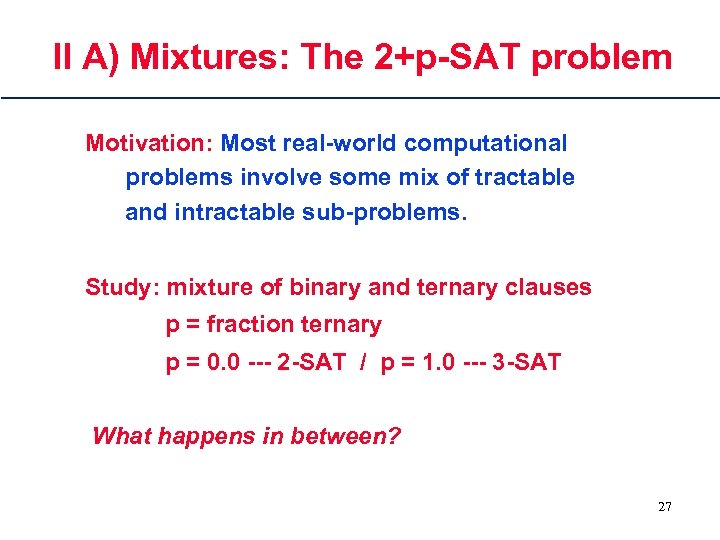
II A) Mixtures: The 2+p-SAT problem Motivation: Most real-world computational problems involve some mix of tractable and intractable sub-problems. Study: mixture of binary and ternary clauses p = fraction ternary p = 0. 0 --- 2 -SAT / p = 1. 0 --- 3 -SAT What happens in between? 27
Phase transitions (as expected…) Computational properties (surprise…) (Monasson, Zecchina, Kirkpatrick, Selman, Troyansky 1999. ) 28
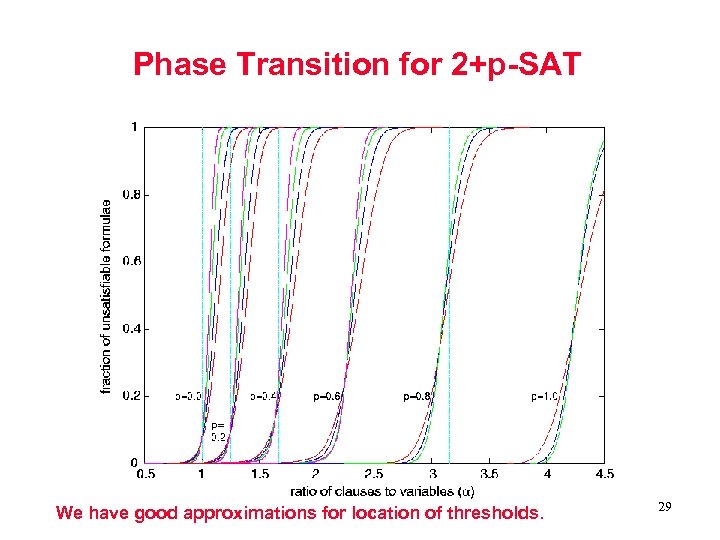
Phase Transition for 2+p-SAT We have good approximations for location of thresholds. 29
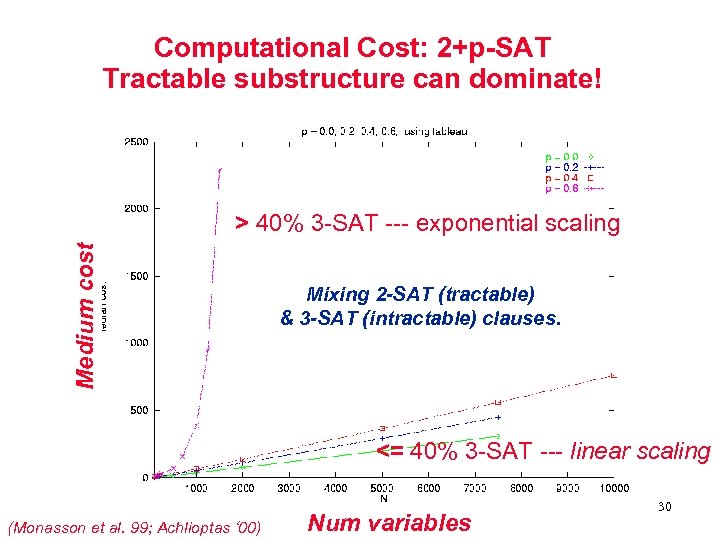
Computational Cost: 2+p-SAT Tractable substructure can dominate! Medium cost > 40% 3 -SAT --- exponential scaling Mixing 2 -SAT (tractable) & 3 -SAT (intractable) clauses. <= 40% 3 -SAT --- linear scaling (Monasson et al. 99; Achlioptas ‘ 00) Num variables 30
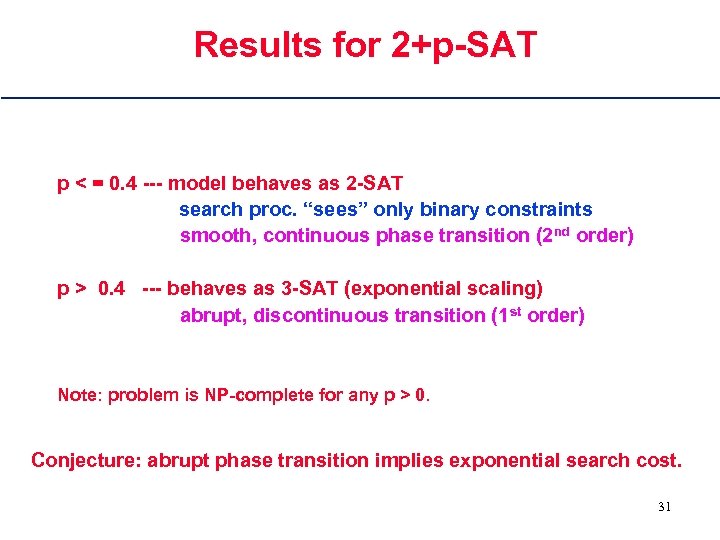
Results for 2+p-SAT p < = 0. 4 --- model behaves as 2 -SAT search proc. “sees” only binary constraints smooth, continuous phase transition (2 nd order) p > 0. 4 --- behaves as 3 -SAT (exponential scaling) abrupt, discontinuous transition (1 st order) Note: problem is NP-complete for any p > 0. Conjecture: abrupt phase transition implies exponential search cost. 31
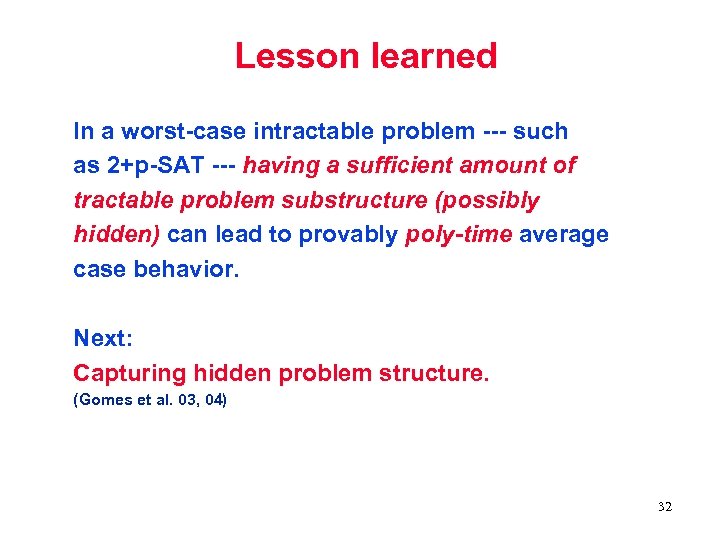
Lesson learned In a worst-case intractable problem --- such as 2+p-SAT --- having a sufficient amount of tractable problem substructure (possibly hidden) can lead to provably poly-time average case behavior. Next: Capturing hidden problem structure. (Gomes et al. 03, 04) 32
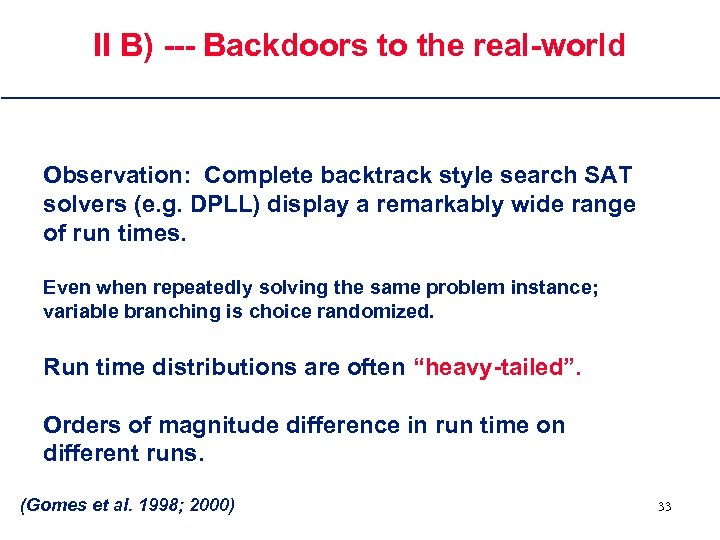
II B) --- Backdoors to the real-world Observation: Complete backtrack style search SAT solvers (e. g. DPLL) display a remarkably wide range of run times. Even when repeatedly solving the same problem instance; variable branching is choice randomized. Run time distributions are often “heavy-tailed”. Orders of magnitude difference in run time on different runs. (Gomes et al. 1998; 2000) 33
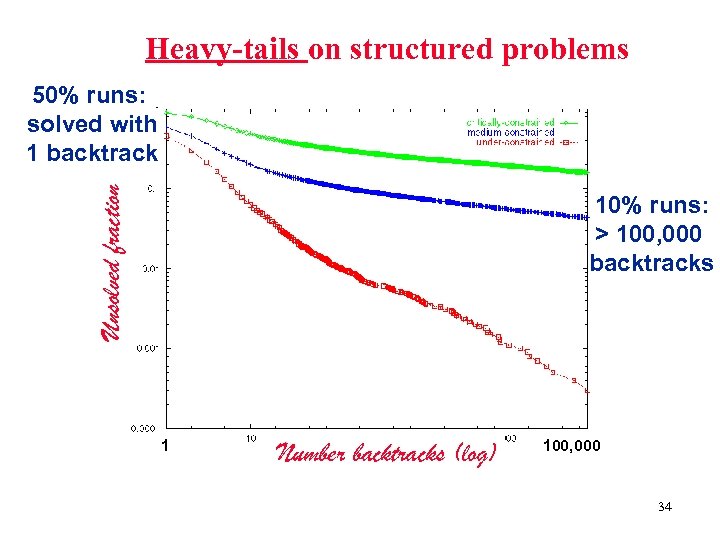
Heavy-tails on structured problems Unsolved fraction 50% runs: solved with 1 backtrack 10% runs: > 100, 000 backtracks 1 Number backtracks (log) 100, 000 34
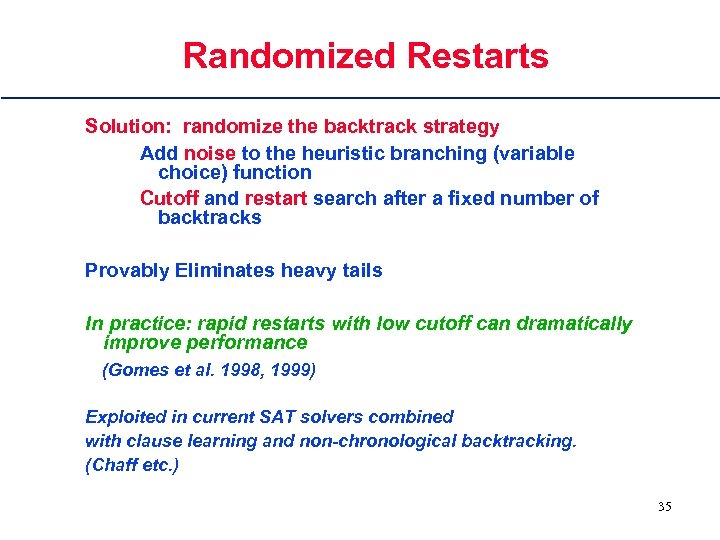
Randomized Restarts Solution: randomize the backtrack strategy Add noise to the heuristic branching (variable choice) function Cutoff and restart search after a fixed number of backtracks Provably Eliminates heavy tails In practice: rapid restarts with low cutoff can dramatically improve performance (Gomes et al. 1998, 1999) Exploited in current SAT solvers combined with clause learning and non-chronological backtracking. (Chaff etc. ) 35
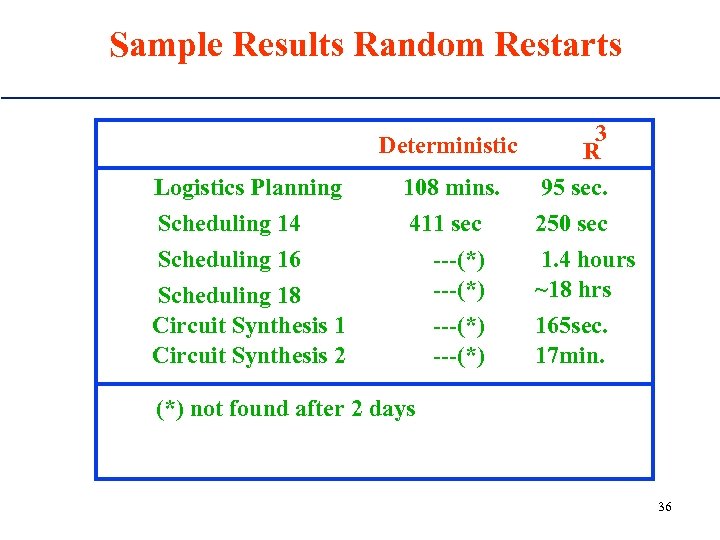
Sample Results Random Restarts Logistics Planning 108 mins. 3 R 95 sec. Scheduling 14 Scheduling 16 Scheduling 18 Circuit Synthesis 1 Circuit Synthesis 2 411 sec ---(*) 250 sec 1. 4 hours ~18 hrs Deterministic ---(*) 165 sec. 17 min. (*) not found after 2 days 36
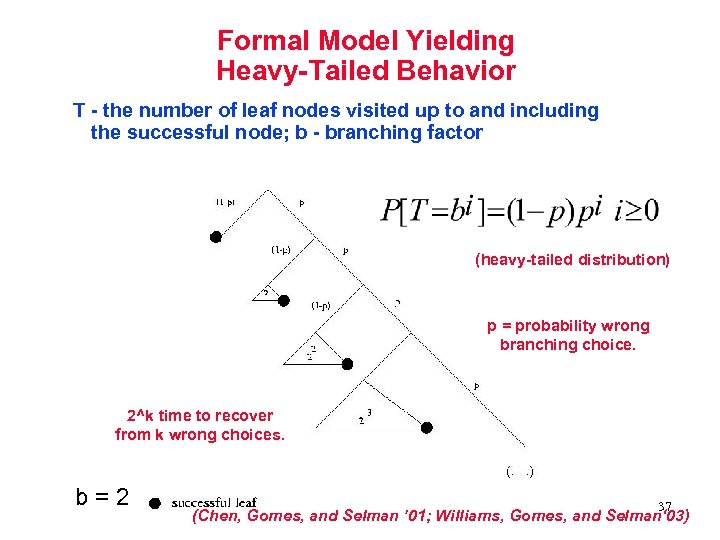
Formal Model Yielding Heavy-Tailed Behavior T - the number of leaf nodes visited up to and including the successful node; b - branching factor (heavy-tailed distribution) p = probability wrong branching choice. 2^k time to recover from k wrong choices. b=2 37 (Chen, Gomes, and Selman ’ 01; Williams, Gomes, and Selman‘ 03)
Intuitively: Exponential penalties hidden in backtrack search, consisting of large inconsistent subtrees in the search space. But, for restarts to be effective, you also need short runs. Where do short runs come from? 39
Explaining short runs: Backdoors to tractability Informally: A backdoor to a given problem is a subset of the variables such that once they are assigned values, the polynomial propagation mechanism of the SAT solver solves the remaining formula. Formal definition includes the notion of a “subsolver”: a polynomial simplification procedure with certain general characteristics found in current DPLL SAT solvers. Backdoors correspond to “clever reasoning shortcuts” in the search space.
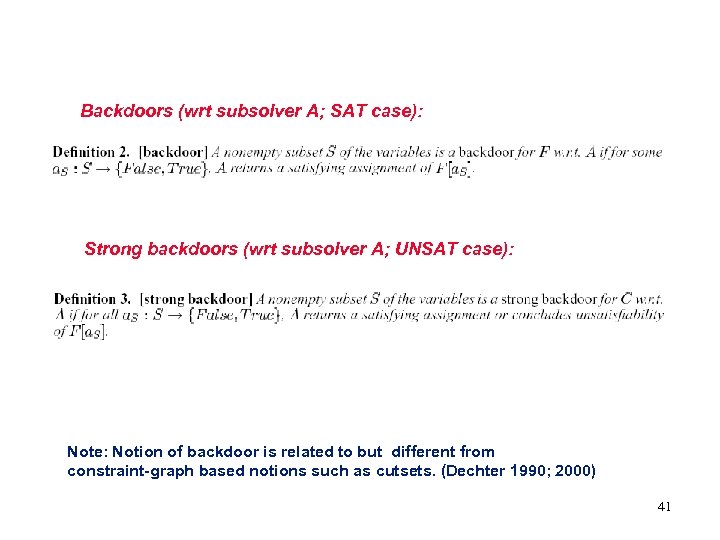
Backdoors (wrt subsolver A; SAT case): Strong backdoors (wrt subsolver A; UNSAT case): Note: Notion of backdoor is related to but different from constraint-graph based notions such as cutsets. (Dechter 1990; 2000) 41
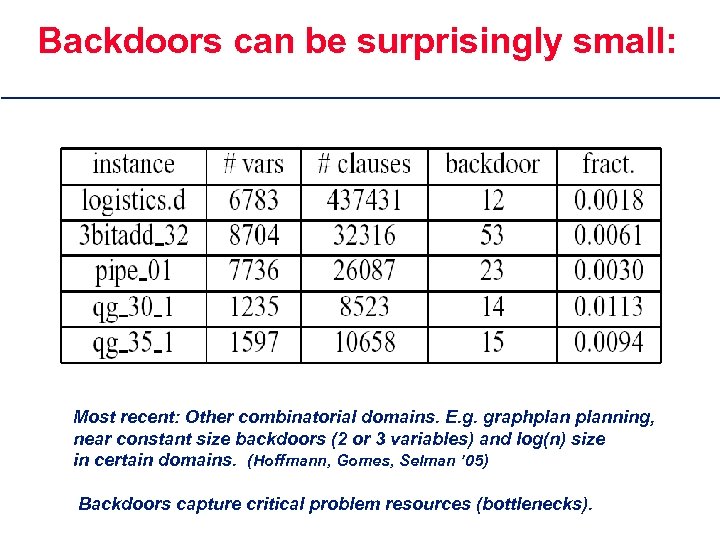
Backdoors can be surprisingly small: Most recent: Other combinatorial domains. E. g. graphplanning, near constant size backdoors (2 or 3 variables) and log(n) size in certain domains. (Hoffmann, Gomes, Selman ’ 05) Backdoors capture critical problem resources (bottlenecks).
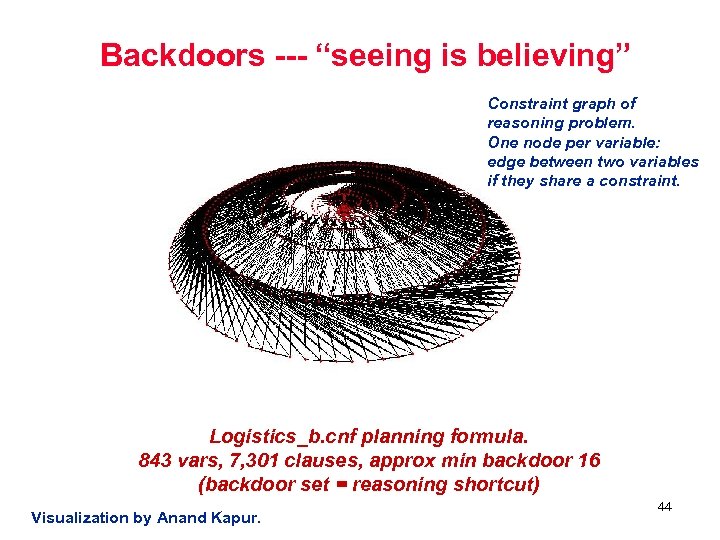
Backdoors --- “seeing is believing” Constraint graph of reasoning problem. One node per variable: edge between two variables if they share a constraint. Logistics_b. cnf planning formula. 843 vars, 7, 301 clauses, approx min backdoor 16 (backdoor set = reasoning shortcut) Visualization by Anand Kapur. 44
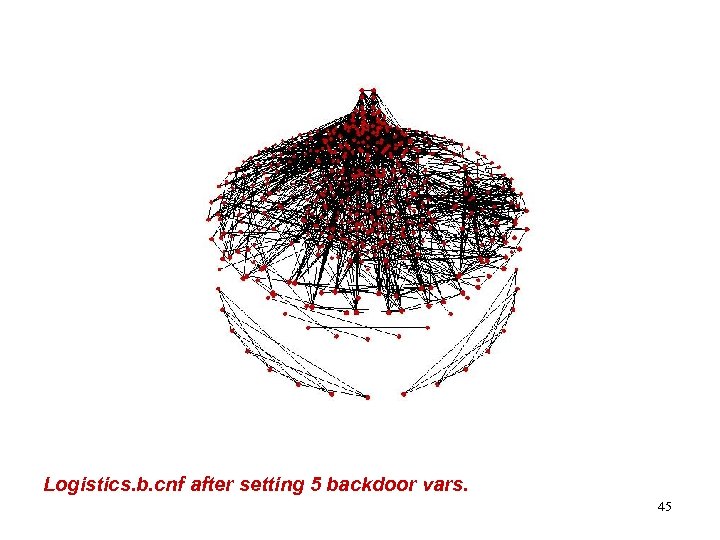
Logistics. b. cnf after setting 5 backdoor vars. 45
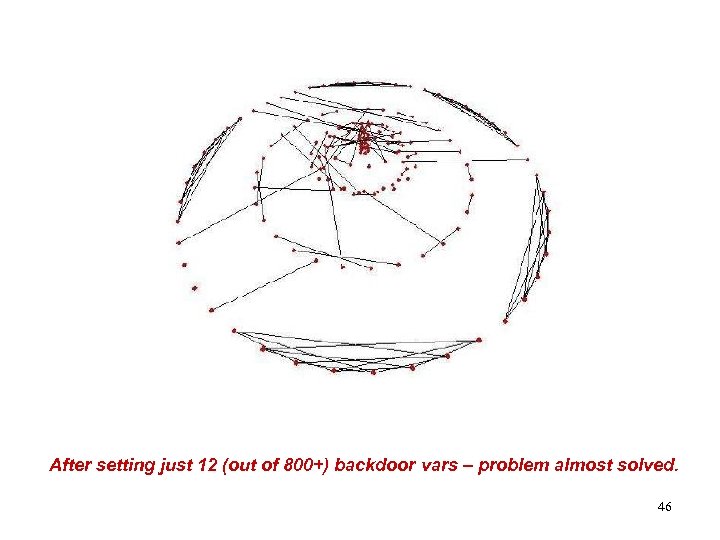
After setting just 12 (out of 800+) backdoor vars – problem almost solved. 46
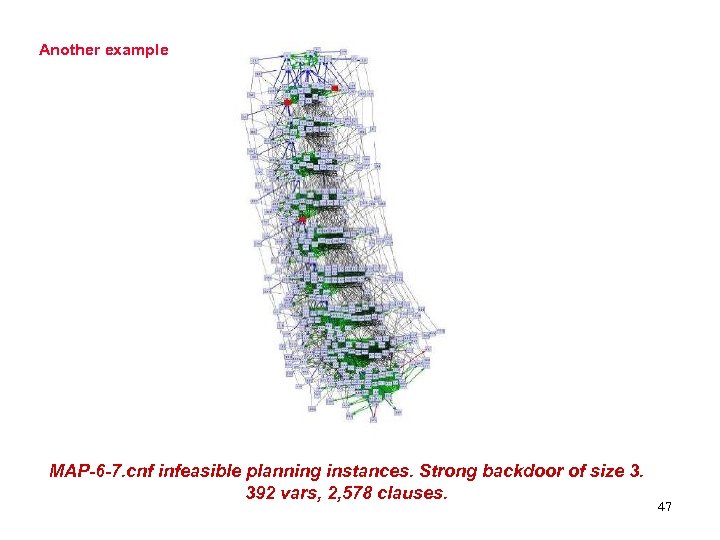
Another example MAP-6 -7. cnf infeasible planning instances. Strong backdoor of size 3. 392 vars, 2, 578 clauses. 47
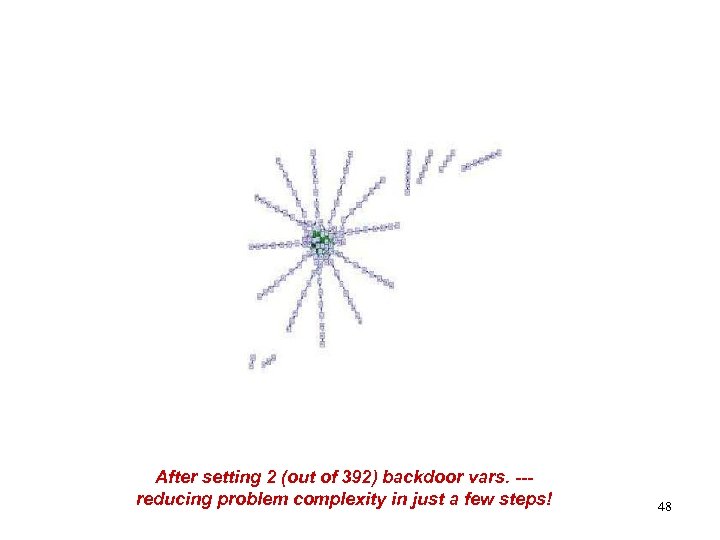
After setting 2 (out of 392) backdoor vars. --reducing problem complexity in just a few steps! 48
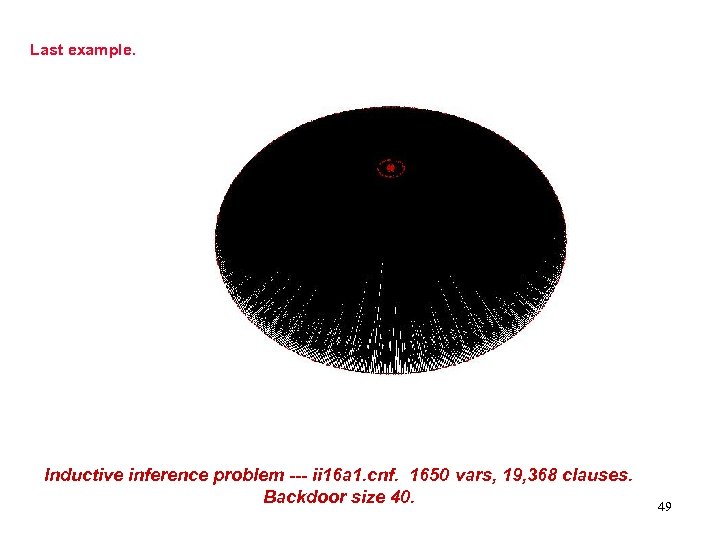
Last example. Inductive inference problem --- ii 16 a 1. cnf. 1650 vars, 19, 368 clauses. Backdoor size 40. 49
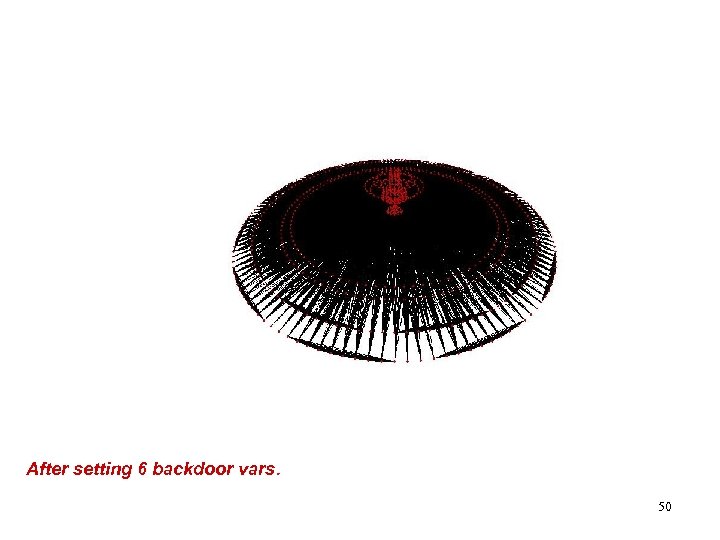
After setting 6 backdoor vars. 50
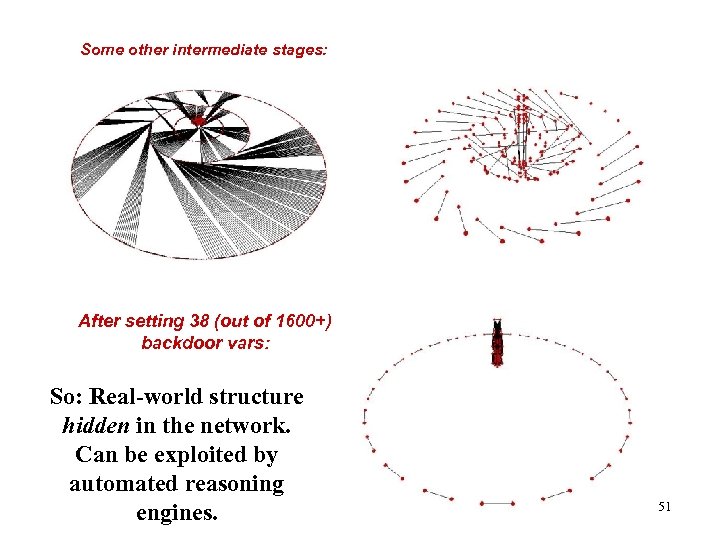
Some other intermediate stages: After setting 38 (out of 1600+) backdoor vars: So: Real-world structure hidden in the network. Can be exploited by automated reasoning engines. 51
But… we also need to take into account the cost of finding the backdoor! We considered: Generalized Iterative Deepening Randomized Generalized Iterative Deepening Variable and value selection heuristics (as in current solvers) 52
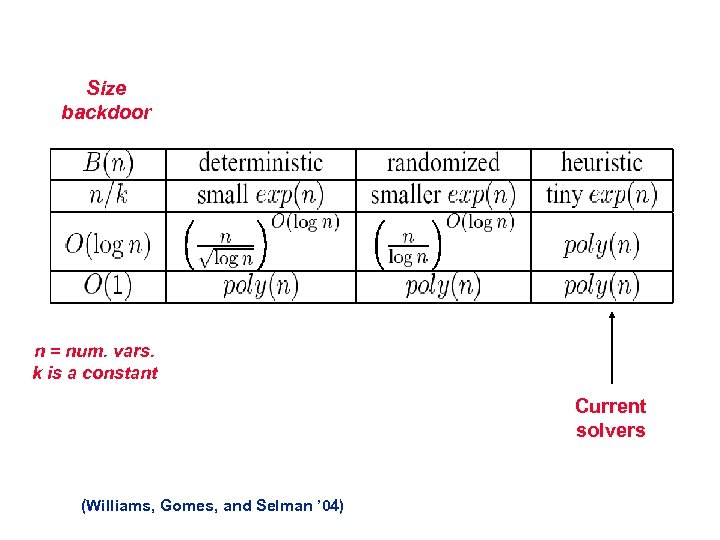
Size backdoor n = num. vars. k is a constant Current solvers (Williams, Gomes, and Selman ’ 04)
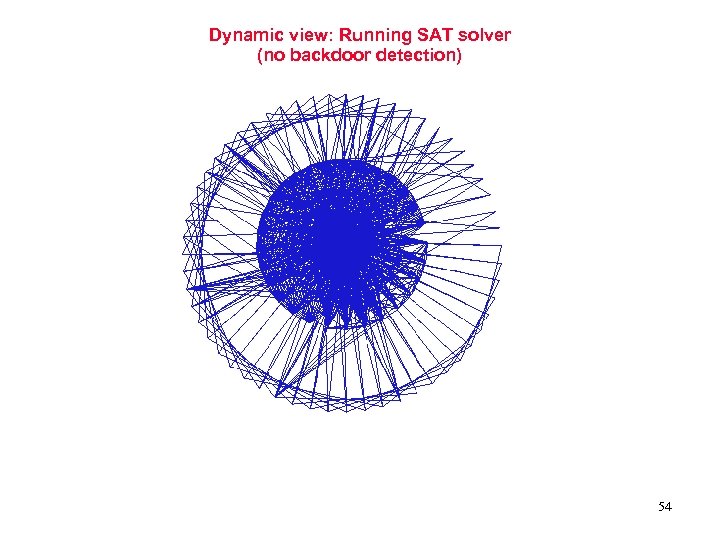
Dynamic view: Running SAT solver (no backdoor detection) 54
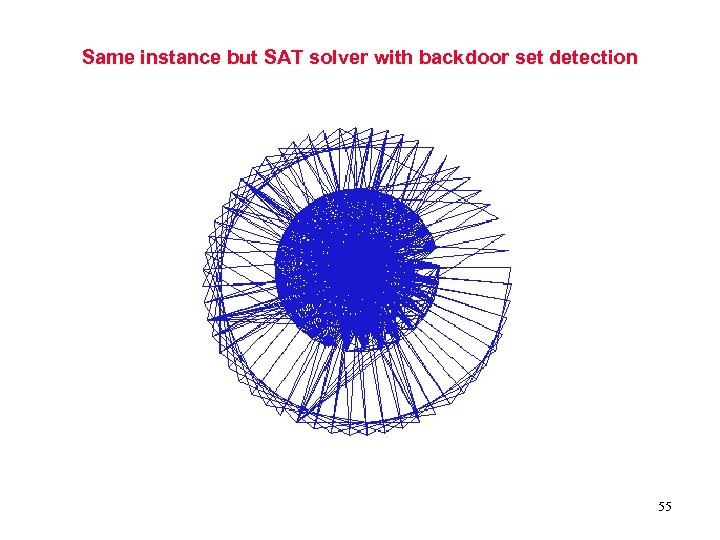
Same instance but SAT solver with backdoor set detection 55
A Journey from Random to Structured Instances I --- Random Instances --- phase transitions and algorithms II --- Capturing Problem Structure --- problem mixtures (tractable / intractable) --- backdoor variables and heavy tails III --- Beyond Satisfaction --- sampling, counting, and probabilities --- quantifiers 56
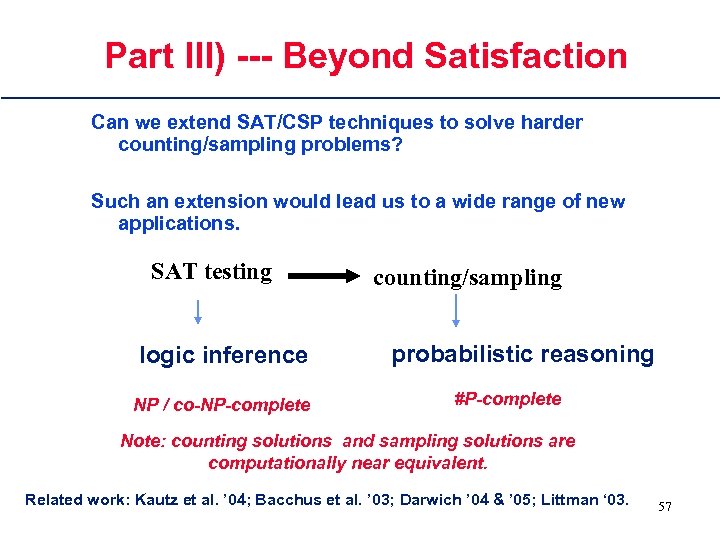
Part III) --- Beyond Satisfaction Can we extend SAT/CSP techniques to solve harder counting/sampling problems? Such an extension would lead us to a wide range of new applications. SAT testing logic inference NP / co-NP-complete counting/sampling probabilistic reasoning #P-complete Note: counting solutions and sampling solutions are computationally near equivalent. Related work: Kautz et al. ’ 04; Bacchus et al. ’ 03; Darwich ’ 04 & ’ 05; Littman ‘ 03. 57
Standard Methods for Sampling: Markov Chain Monte Carlo (MCMC) Based on setting up a Markov chain with a predefined stationary distribution. E. g. simulated annealing. Draw samples from the stationary distribution by running the Markov chain for a sufficiently long time. Problem: for interesting problems, Markov chain takes exponential time to converge to its stationary distribution. Bottom line: standard MCMC (e. g. simulate annealing) too slow. 58
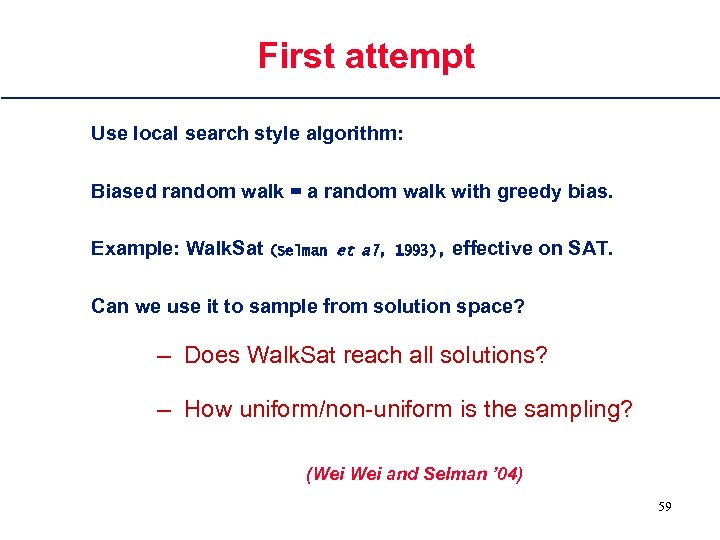
First attempt Use local search style algorithm: Biased random walk = a random walk with greedy bias. Example: Walk. Sat (Selman et al, 1993), effective on SAT. Can we use it to sample from solution space? – Does Walk. Sat reach all solutions? – How uniform/non-uniform is the sampling? (Wei and Selman ’ 04) 59
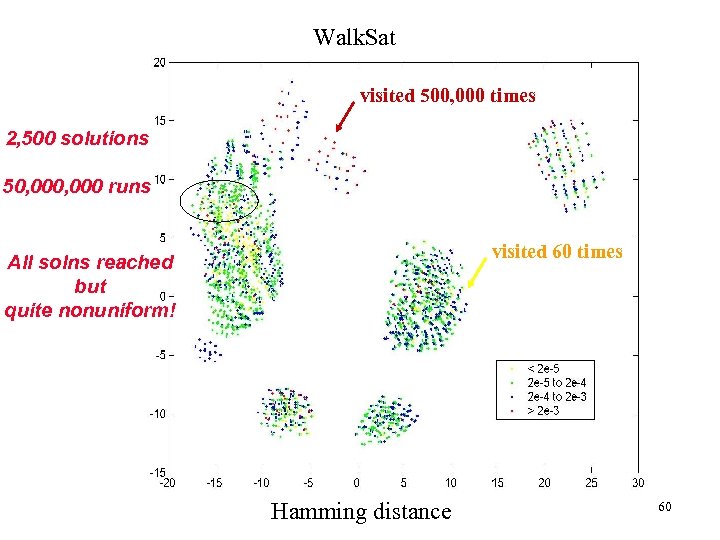
Walk. Sat visited 500, 000 times 2, 500 solutions 50, 000 runs visited 60 times All solns reached but quite nonuniform! Hamming distance 60
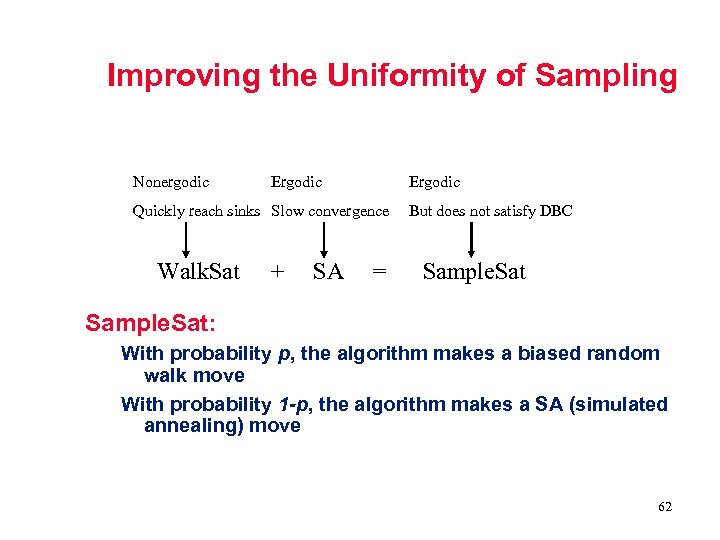
Improving the Uniformity of Sampling Nonergodic Ergodic Quickly reach sinks Slow convergence Walk. Sat + SA = But does not satisfy DBC Sample. Sat: With probability p, the algorithm makes a biased random walk move With probability 1 -p, the algorithm makes a SA (simulated annealing) move 62
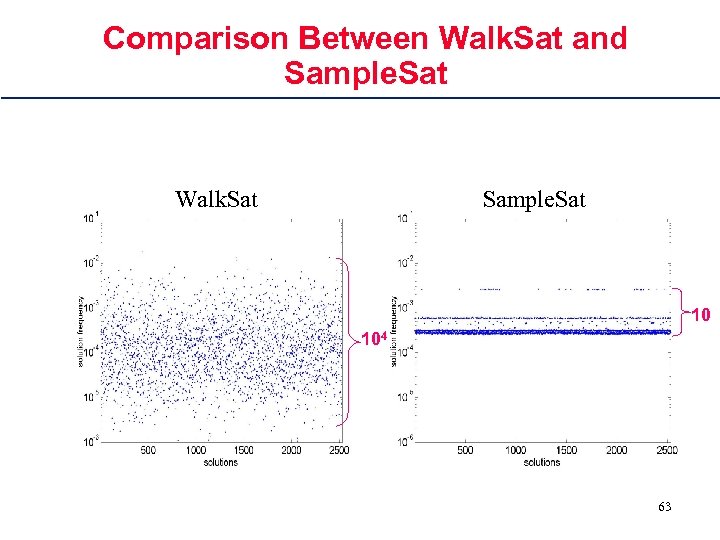
Comparison Between Walk. Sat and Sample. Sat Walk. Sat Sample. Sat 10 104 63
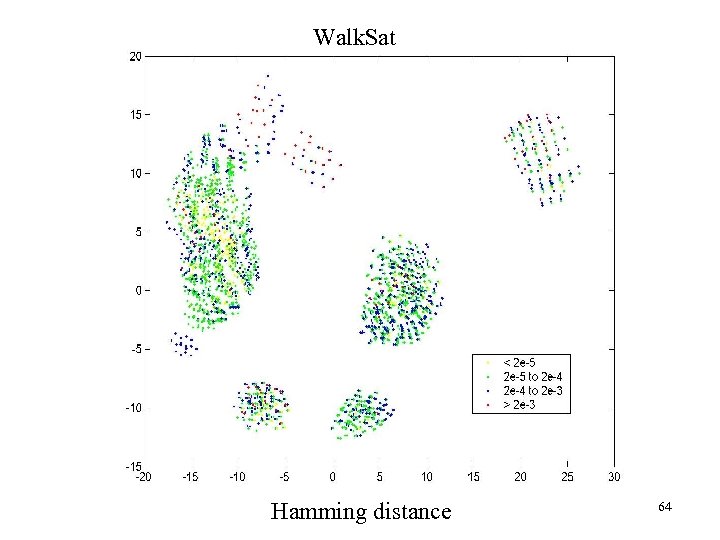
Walk. Sat Hamming distance 64
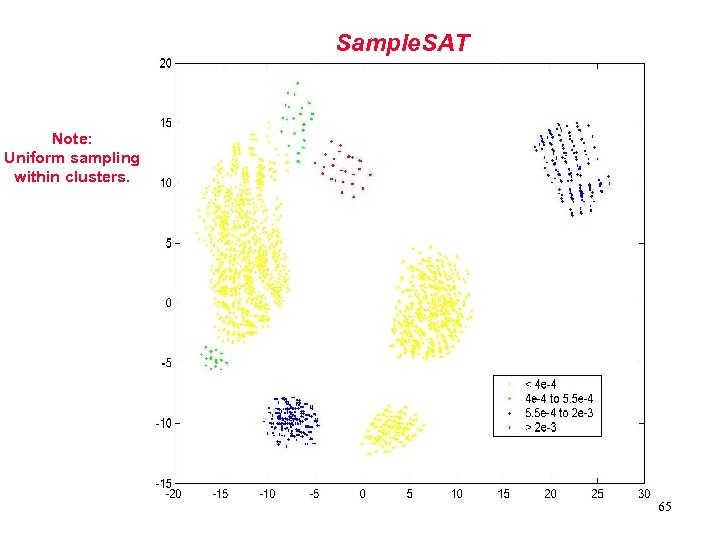
Sample. Sat Sample. SAT Note: Uniform sampling within clusters. Hamming Distance 65
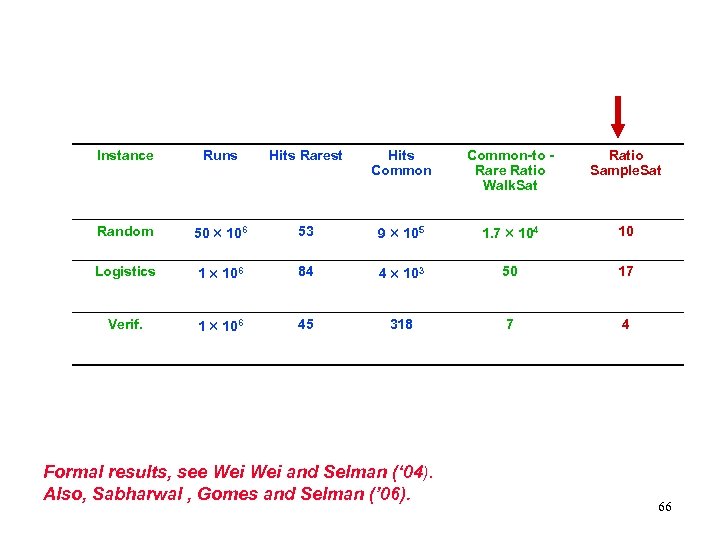
Instance Runs Hits Rarest Hits Common-to Rare Ratio Walk. Sat Ratio Sample. Sat Random 50 106 53 9 105 1. 7 104 10 Logistics 1 106 84 4 103 50 17 Verif. 1 106 45 318 7 4 Formal results, see Wei and Selman (‘ 04). Also, Sabharwal , Gomes and Selman (’ 06). 66
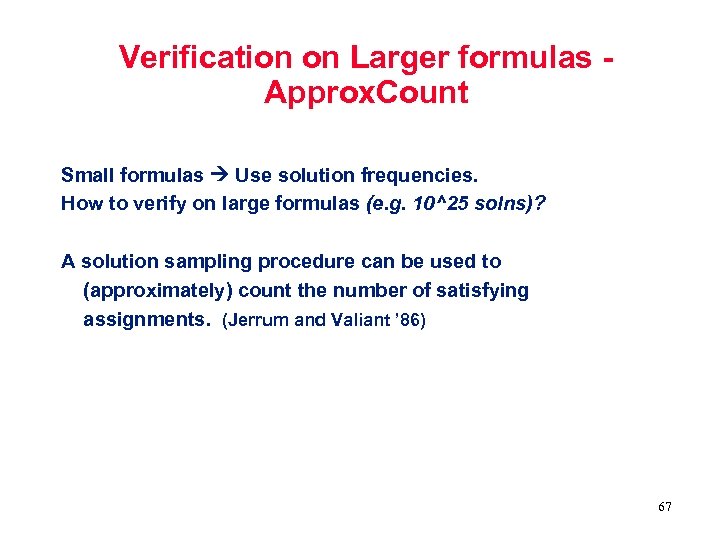
Verification on Larger formulas Approx. Count Small formulas Use solution frequencies. How to verify on large formulas (e. g. 10^25 solns)? A solution sampling procedure can be used to (approximately) count the number of satisfying assignments. (Jerrum and Valiant ’ 86) 67
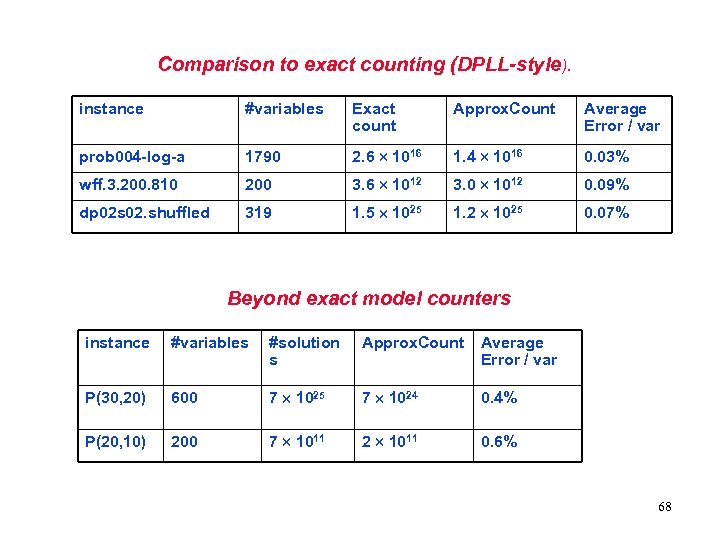
Comparison to exact counting (DPLL-style). instance #variables Exact count Approx. Count Average Error / var prob 004 -log-a 1790 2. 6 1016 1. 4 1016 0. 03% wff. 3. 200. 810 200 3. 6 1012 3. 0 1012 0. 09% dp 02 s 02. shuffled 319 1. 5 1025 1. 2 1025 0. 07% Beyond exact model counters instance #variables #solution s Approx. Count Average Error / var P(30, 20) 600 7 1025 7 1024 0. 4% P(20, 10) 200 7 1011 2 1011 0. 6% 68
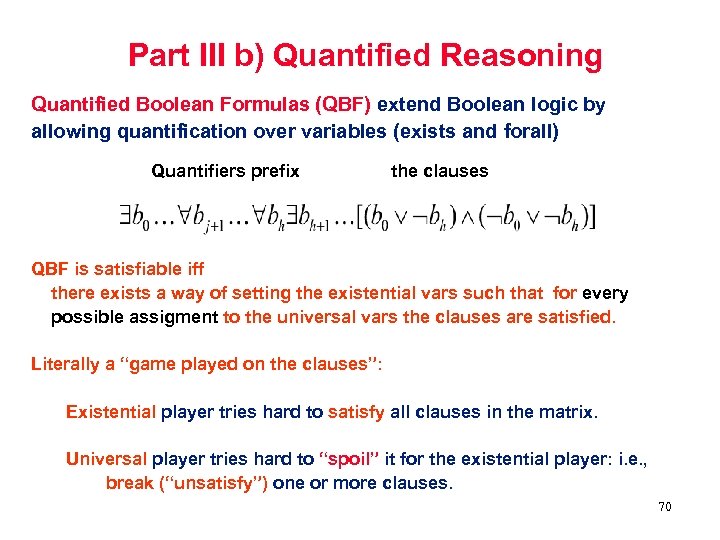
Part III b) Quantified Reasoning Quantified Boolean Formulas (QBF) extend Boolean logic by allowing quantification over variables (exists and forall) Quantifiers prefix the clauses QBF is satisfiable iff there exists a way of setting the existential vars such that for every possible assigment to the universal vars the clauses are satisfied. Literally a “game played on the clauses”: Existential player tries hard to satisfy all clauses in the matrix. Universal player tries hard to “spoil” it for the existential player: i. e. , break (“unsatisfy”) one or more clauses. 70
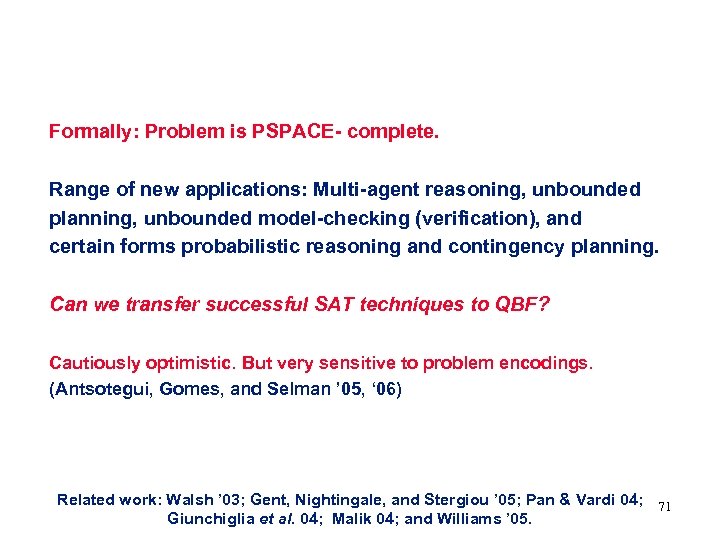
Formally: Problem is PSPACE- complete. Range of new applications: Multi-agent reasoning, unbounded planning, unbounded model-checking (verification), and certain forms probabilistic reasoning and contingency planning. Can we transfer successful SAT techniques to QBF? Cautiously optimistic. But very sensitive to problem encodings. (Antsotegui, Gomes, and Selman ’ 05, ‘ 06) Related work: Walsh ’ 03; Gent, Nightingale, and Stergiou ’ 05; Pan & Vardi 04; 71 Giunchiglia et al. 04; Malik 04; and Williams ’ 05.
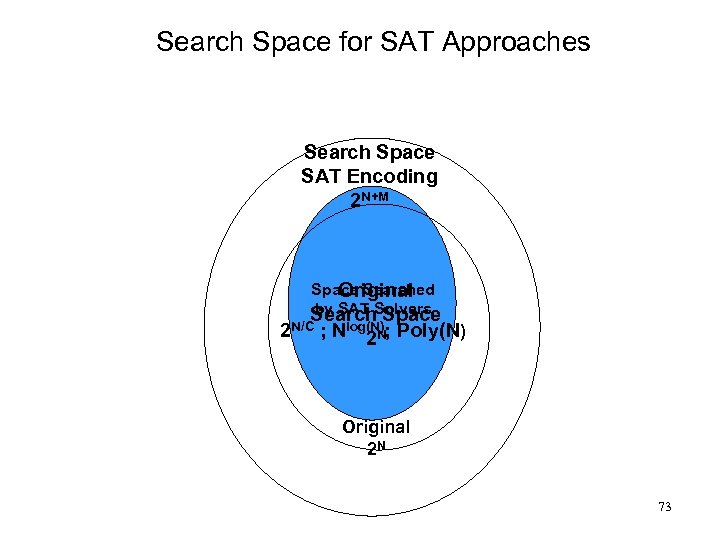
Search Space for SAT Approaches Search Space SAT Encoding 2 N+M Space Searched Original by SAT Space Search. Solvers 2 N/C ; Nlog(N); Poly(N) 2 N Original 2 N 73
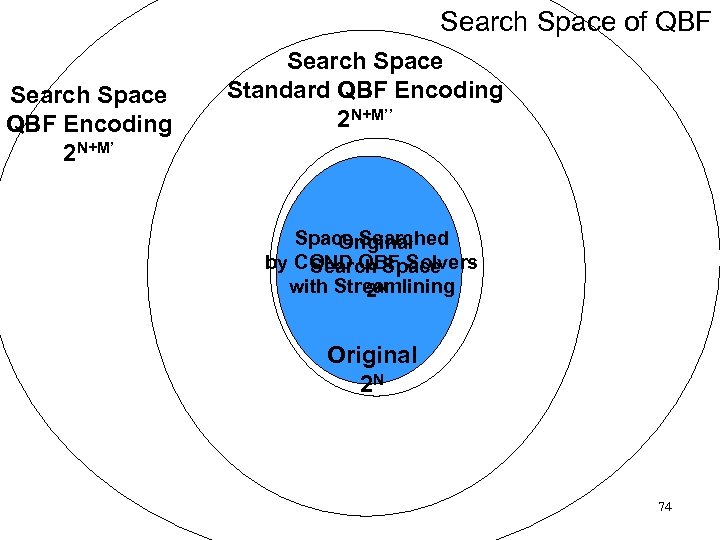
Search Space of QBF Search Space QBF Encoding 2 N+M’ Search Space Standard QBF Encoding 2 N+M’’ Space Searched Original by COND QBF Solvers Search Space with Streamlining 2 N Original 2 N 74
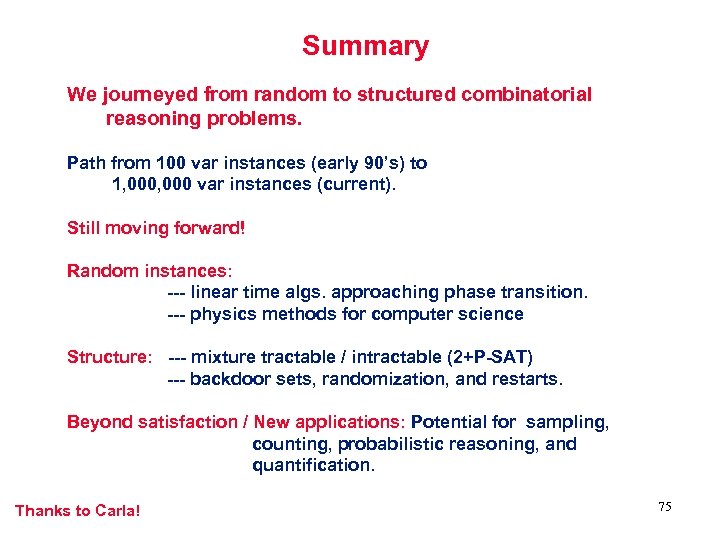
Summary We journeyed from random to structured combinatorial reasoning problems. Path from 100 var instances (early 90’s) to 1, 000 var instances (current). Still moving forward! Random instances: --- linear time algs. approaching phase transition. --- physics methods for computer science Structure: --- mixture tractable / intractable (2+P-SAT) --- backdoor sets, randomization, and restarts. Beyond satisfaction / New applications: Potential for sampling, counting, probabilistic reasoning, and quantification. Thanks to Carla! 75

The End 76
Скачать презентацию The Boolean Satisfiability Problem Theory and Practice Bart
7235b4d17d738d87ddc851748d939c04.ppt