 Скачать презентацию The Black Death Bubonic plague came to
Британия_Лекция 2.ppt
- Количество слайдов: 24



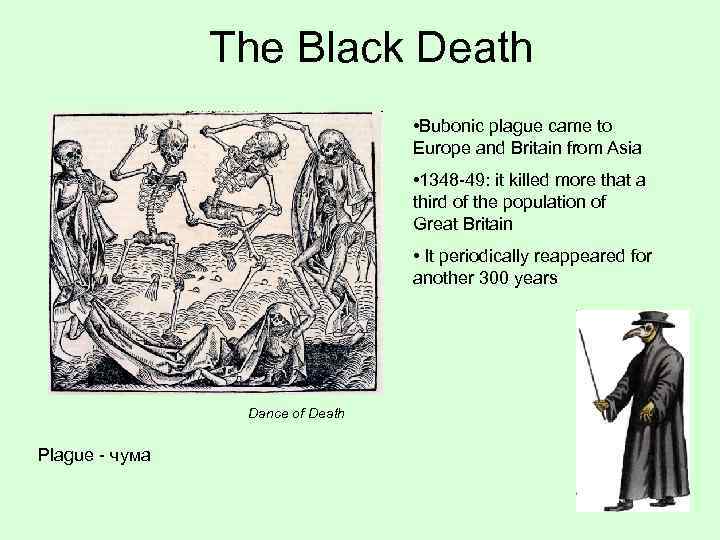
The Black Death • Bubonic plague came to Europe and Britain from Asia • 1348 -49: it killed more that a third of the population of Great Britain • It periodically reappeared for another 300 years Dance of Death Plague - чума
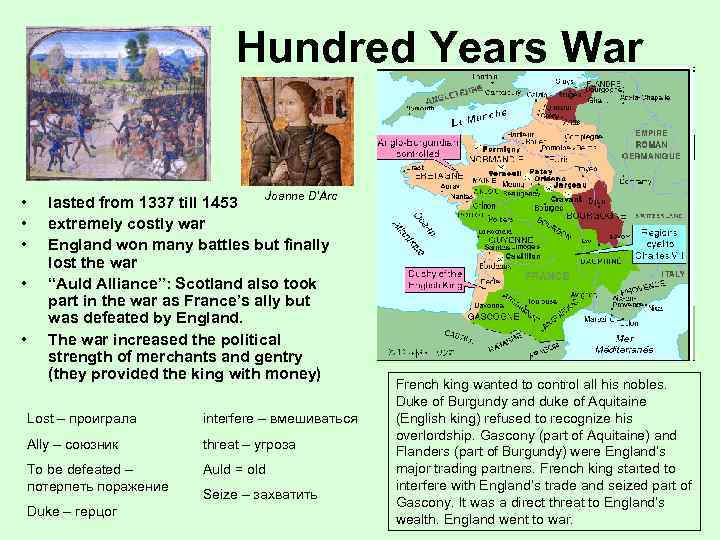
Hundred Years War • • • Joanne D’Arc lasted from 1337 till 1453 extremely costly war England won many battles but finally lost the war “Auld Alliance”: Scotland also took part in the war as France’s ally but was defeated by England. The war increased the political strength of merchants and gentry (they provided the king with money) Lost – проиграла interfere – вмешиваться Ally – союзник threat – угроза To be defeated – потерпеть поражение Auld = old Duke – герцог Seize – захватить French king wanted to control all his nobles. Duke of Burgundy and duke of Aquitaine (English king) refused to recognize his overlordship. Gascony (part of Aquitaine) and Flanders (part of Burgundy) were England’s major trading partners. French king started to interfere with England’s trade and seized part of Gascony. It was a direct threat to England’s wealth. England went to war.
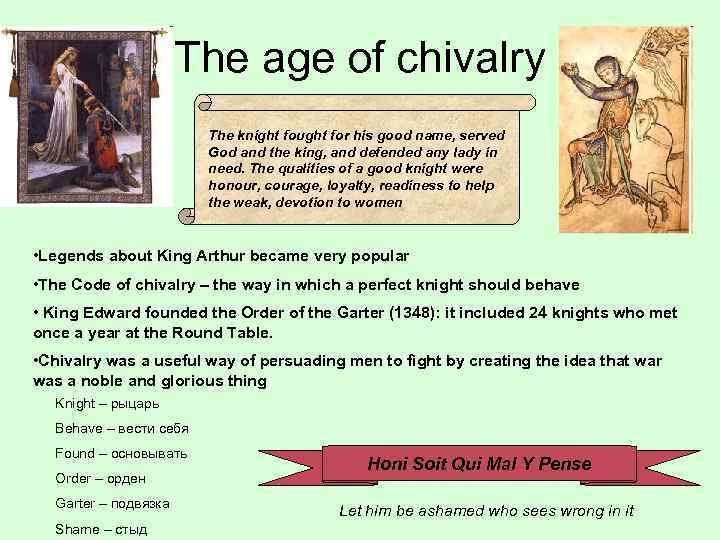
The age of chivalry The knight fought for his good name, served God and the king, and defended any lady in need. The qualities of a good knight were honour, courage, loyalty, readiness to help the weak, devotion to women • Legends about King Arthur became very popular • The Code of chivalry – the way in which a perfect knight should behave • King Edward founded the Order of the Garter (1348): it included 24 knights who met once a year at the Round Table. • Chivalry was a useful way of persuading men to fight by creating the idea that war was a noble and glorious thing Knight – рыцарь Behave – вести себя Found – основывать Order – орден Garter – подвязка Shame – стыд Honi Soit Qui Mal Y Pense Let him be ashamed who sees wrong in it
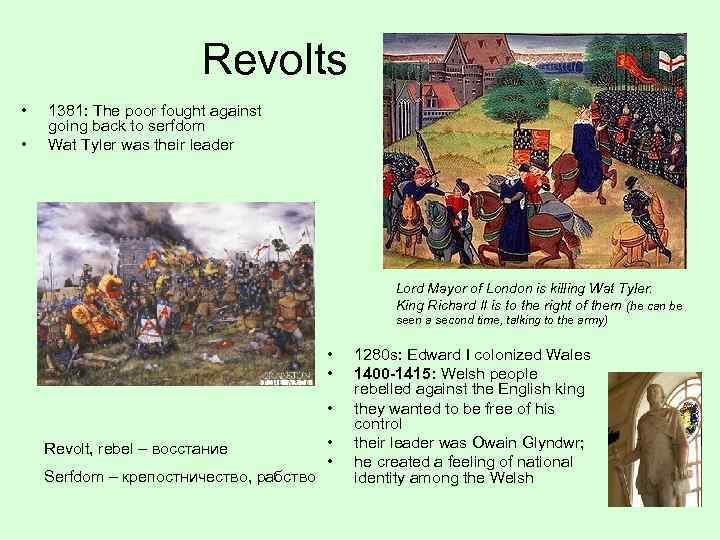
Revolts • • 1381: The poor fought against going back to serfdom Wat Tyler was their leader Lord Mayor of London is killing Wat Tyler. King Richard II is to the right of them (he can be seen a second time, talking to the army) • • • Revolt, rebel – восстание Serfdom – крепостничество, рабство • • 1280 s: Edward I colonized Wales 1400 -1415: Welsh people rebelled against the English king they wanted to be free of his control their leader was Owain Glyndwr; he created a feeling of national identity among the Welsh
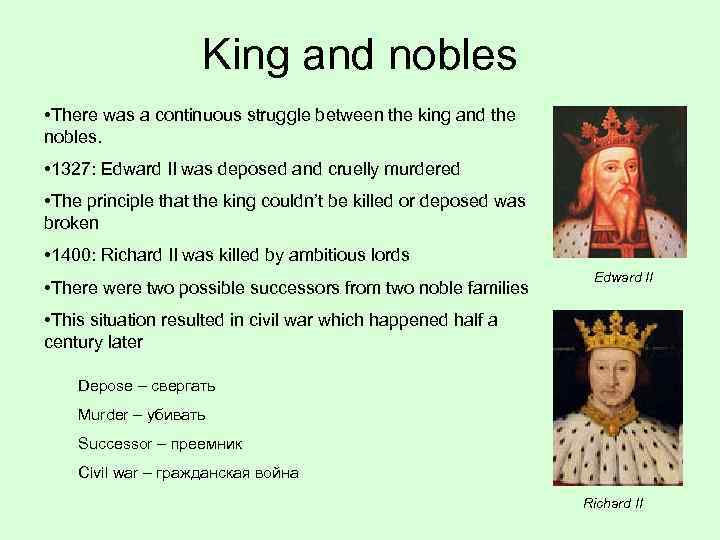
King and nobles • There was a continuous struggle between the king and the nobles. • 1327: Edward II was deposed and cruelly murdered • The principle that the king couldn’t be killed or deposed was broken • 1400: Richard II was killed by ambitious lords • There were two possible successors from two noble families Edward II • This situation resulted in civil war which happened half a century later Depose – свергать Murder – убивать Successor – преемник Civil war – гражданская война Richard II
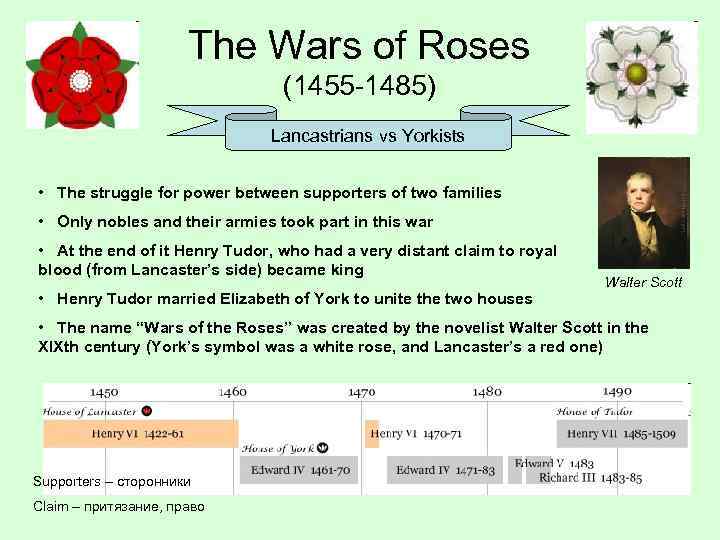
The Wars of Roses (1455 -1485) Lancastrians vs Yorkists • The struggle for power between supporters of two families • Only nobles and their armies took part in this war • At the end of it Henry Tudor, who had a very distant claim to royal blood (from Lancaster’s side) became king • Henry Tudor married Elizabeth of York to unite the two houses Walter Scott • The name “Wars of the Roses” was created by the novelist Walter Scott in the XIXth century (York’s symbol was a white rose, and Lancaster’s a red one) Supporters – сторонники Claim – притязание, право
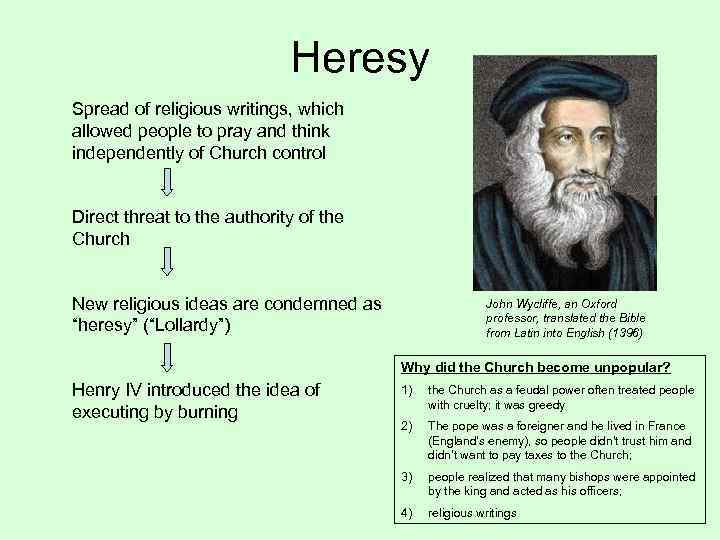
Heresy Spread of religious writings, which allowed people to pray and think independently of Church control Direct threat to the authority of the Church New religious ideas are condemned as “heresy” (“Lollardy”) John Wycliffe, an Oxford professor, translated the Bible from Latin into English (1396) Why did the Church become unpopular? Henry IV introduced the idea of executing by burning 1) the Church as a feudal power often treated people with cruelty; it was greedy 2) The pope was a foreigner and he lived in France (England’s enemy), so people didn’t trust him and didn’t want to pay taxes to the Church; 3) people realized that many bishops were appointed by the king and acted as his officers; 4) religious writings
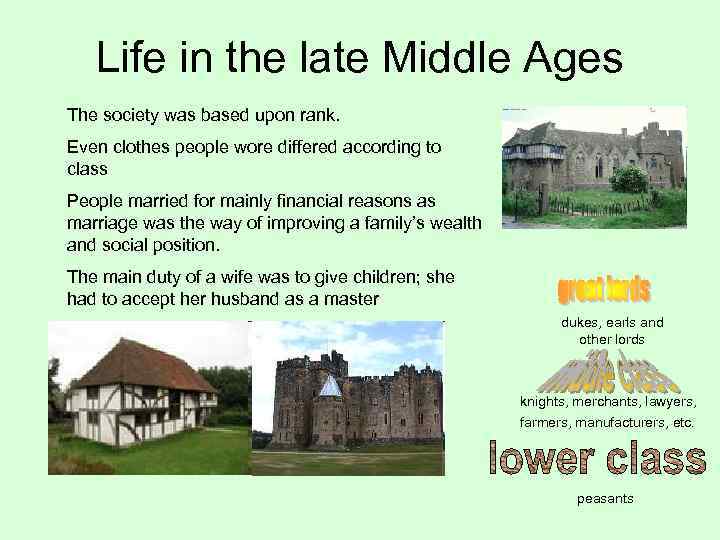
Life in the late Middle Ages The society was based upon rank. Even clothes people wore differed according to class People married for mainly financial reasons as marriage was the way of improving a family’s wealth and social position. The main duty of a wife was to give children; she had to accept her husband as a master dukes, earls and other lords knights, merchants, lawyers, farmers, manufacturers, etc. peasants
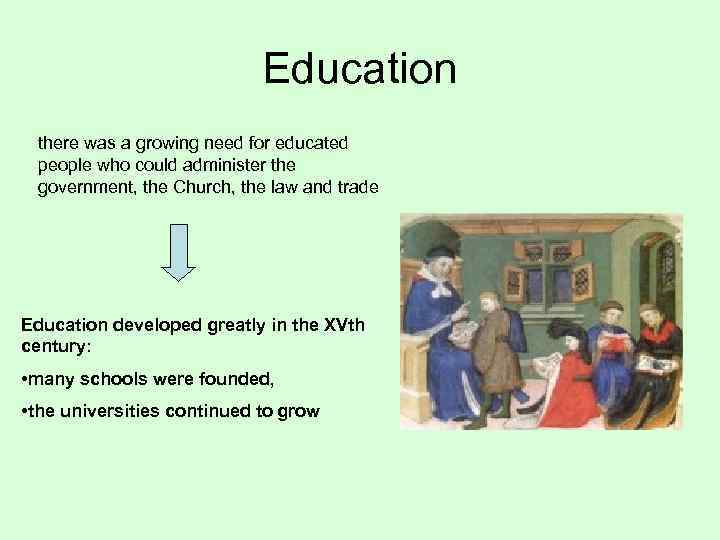
Education there was a growing need for educated people who could administer the government, the Church, the law and trade Education developed greatly in the XVth century: • many schools were founded, • the universities continued to grow
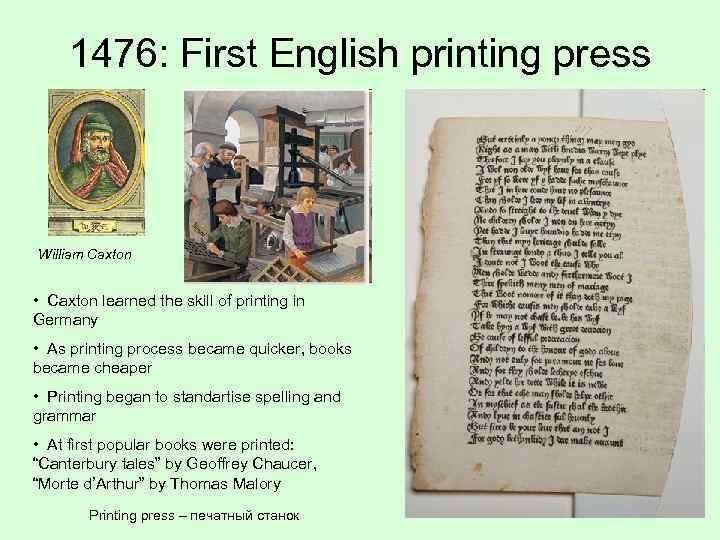
1476: First English printing press William Caxton • Caxton learned the skill of printing in Germany • As printing process became quicker, books became cheaper • Printing began to standartise spelling and grammar • At first popular books were printed: “Canterbury tales” by Geoffrey Chaucer, “Morte d’Arthur” by Thomas Malory Printing press – печатный станок
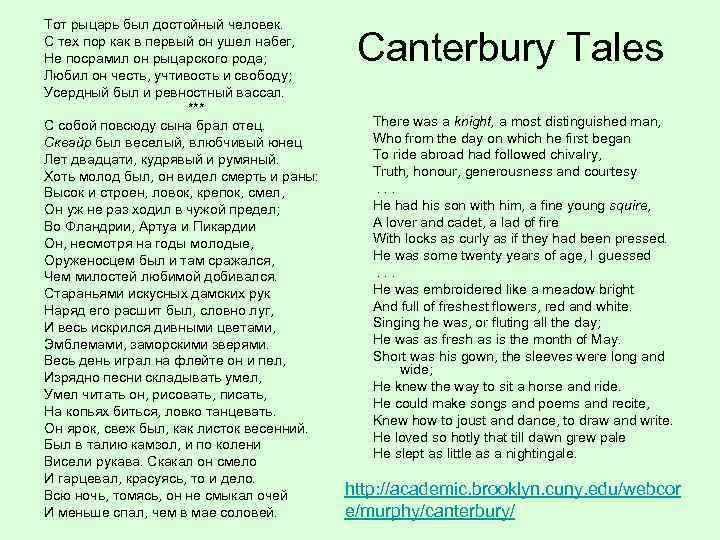
Тот рыцарь был достойный человек. С тех пор как в первый он ушел набег, Не посрамил он рыцарского рода; Любил он честь, учтивость и свободу; Усердный был и ревностный вассал. *** С собой повсюду сына брал отец. Сквайр был веселый, влюбчивый юнец Лет двадцати, кудрявый и румяный. Хоть молод был, он видел смерть и раны: Высок и строен, ловок, крепок, смел, Он уж не раз ходил в чужой предел; Во Фландрии, Артуа и Пикардии Он, несмотря на годы молодые, Оруженосцем был и там сражался, Чем милостей любимой добивался. Стараньями искусных дамских рук Наряд его расшит был, словно луг, И весь искрился дивными цветами, Эмблемами, заморскими зверями. Весь день играл на флейте он и пел, Изрядно песни складывать умел, Умел читать он, рисовать, писать, На копьях биться, ловко танцевать. Он ярок, свеж был, как листок весенний. Был в талию камзол, и по колени Висели рукава. Скакал он смело И гарцевал, красуясь, то и дело. Всю ночь, томясь, он не смыкал очей И меньше спал, чем в мае соловей. Canterbury Tales There was a knight, a most distinguished man, Who from the day on which he first began To ride abroad had followed chivalry, Truth, honour, generousness and courtesy . . . He had his son with him, a fine young squire, A lover and cadet, a lad of fire With locks as curly as if they had been pressed. He was some twenty years of age, I guessed . . . He was embroidered like a meadow bright And full of freshest flowers, red and white. Singing he was, or fluting all the day; He was as fresh as is the month of May. Short was his gown, the sleeves were long and wide; He knew the way to sit a horse and ride. He could make songs and poems and recite, Knew how to joust and dance, to draw and write. He loved so hotly that till dawn grew pale He slept as little as a nightingale. http: //academic. brooklyn. cuny. edu/webcor e/murphy/canterbury/
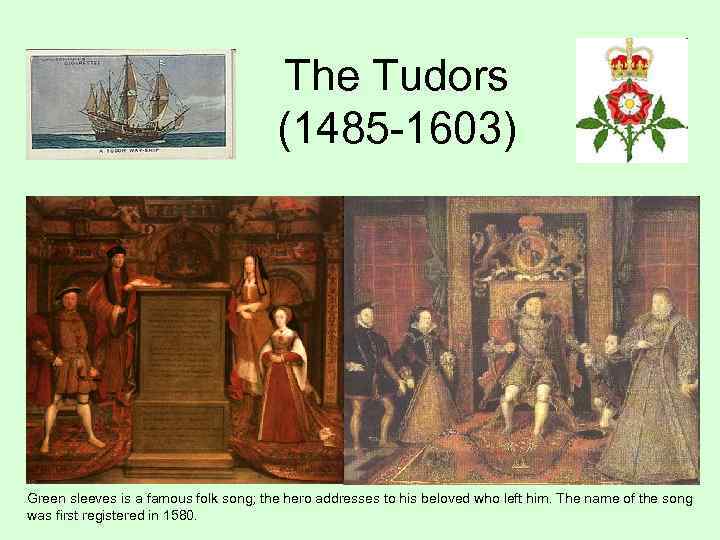
The Tudors (1485 -1603) Green sleeves is a famous folk song; the hero addresses to his beloved who left him. The name of the song was first registered in 1580.
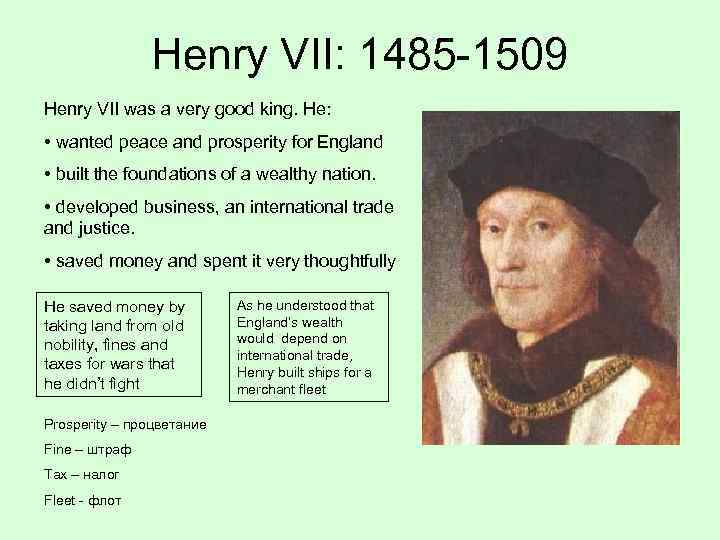
Henry VII: 1485 -1509 Henry VII was a very good king. He: • wanted peace and prosperity for England • built the foundations of a wealthy nation. • developed business, an international trade and justice. • saved money and spent it very thoughtfully He saved money by taking land from old nobility, fines and taxes for wars that he didn’t fight Prosperity – процветание Fine – штраф Tax – налог Fleet - флот As he understood that England’s wealth would depend on international trade, Henry built ships for a merchant fleet
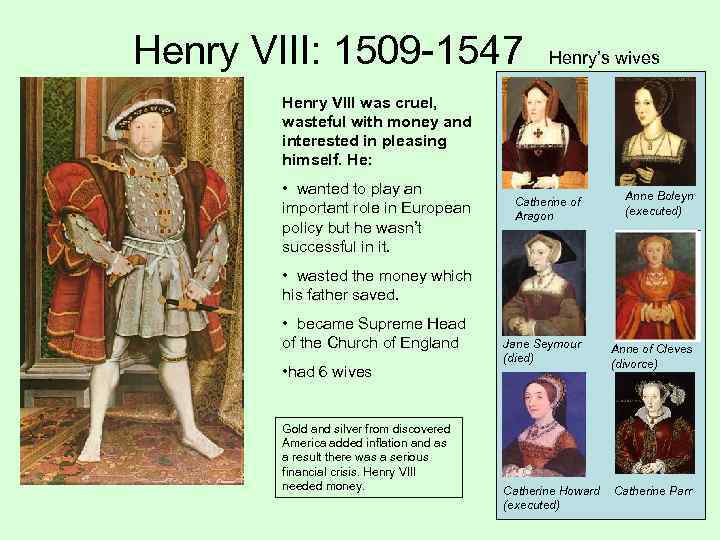
Henry VIII: 1509 -1547 Henry’s wives Henry VIII was cruel, wasteful with money and interested in pleasing himself. He: • wanted to play an important role in European policy but he wasn’t successful in it. Catherine of Aragon Anne Boleyn (executed) Jane Seymour (died) Anne of Cleves (divorce) • wasted the money which his father saved. • became Supreme Head of the Church of England • had 6 wives Gold and silver from discovered America added inflation and as a result there was a serious financial crisis. Henry VIII needed money. Catherine Howard Catherine Parr (executed)
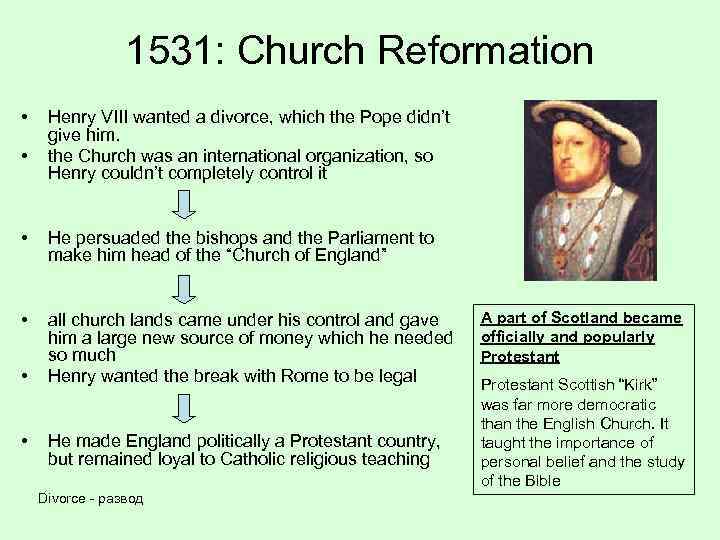
1531: Church Reformation • • Henry VIII wanted a divorce, which the Pope didn’t give him. the Church was an international organization, so Henry couldn’t completely control it • He persuaded the bishops and the Parliament to make him head of the “Church of England” • all church lands came under his control and gave him a large new source of money which he needed so much Henry wanted the break with Rome to be legal • • He made England politically a Protestant country, but remained loyal to Catholic religious teaching Divorce - развод A part of Scotland became officially and popularly Protestant Scottish “Kirk” was far more democratic than the English Church. It taught the importance of personal belief and the study of the Bible
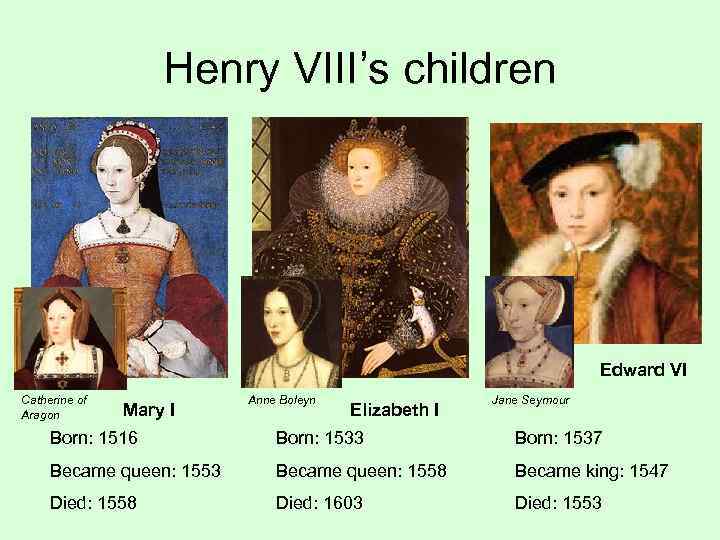
Henry VIII’s children Edward VI Catherine of Aragon Mary I Anne Boleyn Elizabeth I Jane Seymour Born: 1516 Born: 1533 Born: 1537 Became queen: 1553 Became queen: 1558 Became king: 1547 Died: 1558 Died: 1603 Died: 1553
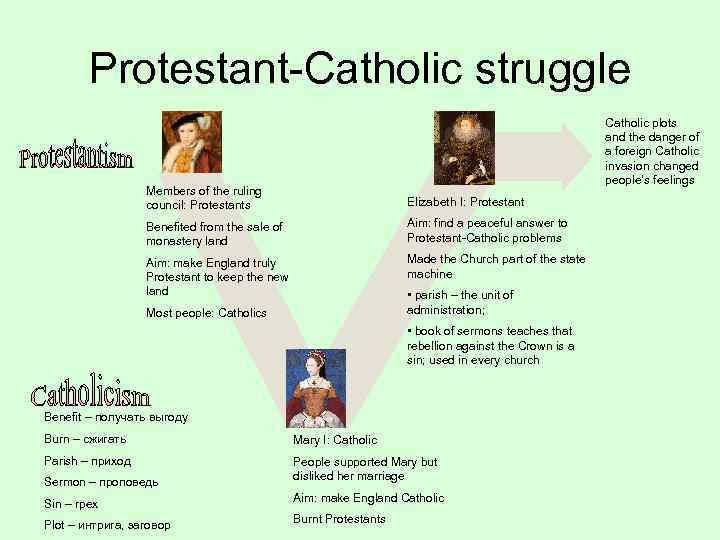
Protestant-Catholic struggle Catholic plots and the danger of a foreign Catholic invasion changed people’s feelings Members of the ruling council: Protestants Elizabeth I: Protestant Benefited from the sale of monastery land Aim: find a peaceful answer to Protestant-Catholic problems Aim: make England truly Protestant to keep the new land Made the Church part of the state machine • parish – the unit of administration; Most people: Catholics • book of sermons teaches that rebellion against the Crown is a sin; used in every church Benefit – получать выгоду Burn – сжигать Mary I: Catholic Parish – приход People supported Mary but disliked her marriage Sermon – проповедь Sin – грех Plot – интрига, заговор Aim: make England Catholic Burnt Protestants
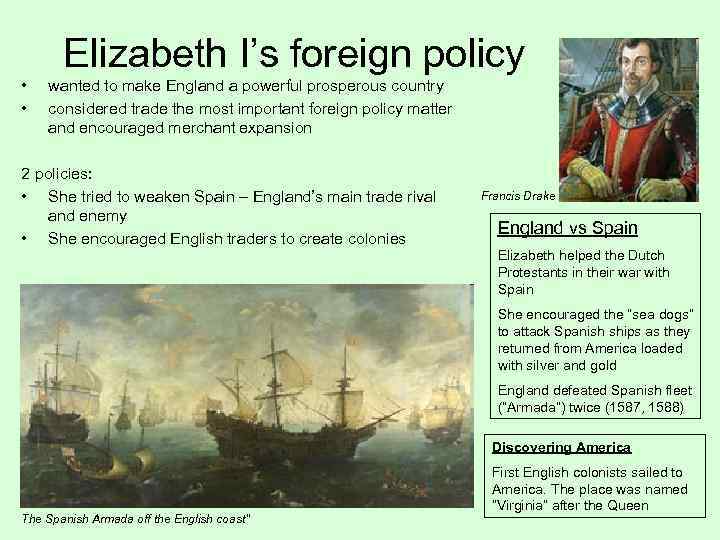
Elizabeth I’s foreign policy • • wanted to make England a powerful prosperous country considered trade the most important foreign policy matter and encouraged merchant expansion 2 policies: • She tried to weaken Spain – England’s main trade rival and enemy • She encouraged English traders to create colonies Francis Drake England vs Spain Elizabeth helped the Dutch Protestants in their war with Spain She encouraged the “sea dogs” to attack Spanish ships as they returned from America loaded with silver and gold England defeated Spanish fleet (“Armada”) twice (1587, 1588) Discovering America The Spanish Armada off the English coast" First English colonists sailed to America. The place was named “Virginia” after the Queen
The Tudors and Parliament • • The Tudors didn’t like governing through Parliament. They didn’t get rid of it because they needed money and the support of merchants and landowners • • Parliament was supposed to: Agree to the taxes Make the laws whish the king suggested Advise the king when he asked to do it Perhaps Henry VIII didn’t realize that by inviting Parliament to make new laws for the Reformation he was giving it a level of authority it never had before. Tudor monarchs were not more democratic than earlier kings, but by using Parliament to strengthen their policy, they increased parliament’s authority. Govern – править Get rid of sth – избавляться от чего-то Strengthen – укреплять Increase – усиливать
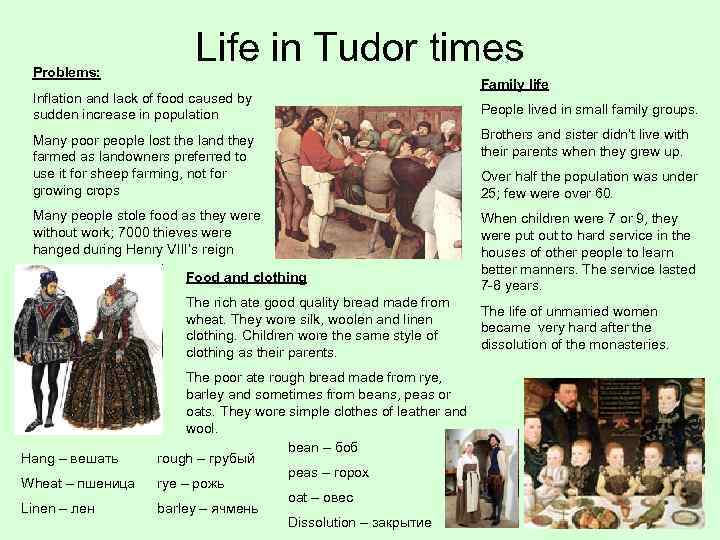
Problems: Life in Tudor times Inflation and lack of food caused by sudden increase in population Family life People lived in small family groups. Many poor people lost the land they farmed as landowners preferred to use it for sheep farming, not for growing crops Brothers and sister didn’t live with their parents when they grew up. Many people stole food as they were without work; 7000 thieves were hanged during Henry VIII’s reign When children were 7 or 9, they were put out to hard service in the houses of other people to learn better manners. The service lasted 7 -8 years. Food and clothing The rich ate good quality bread made from wheat. They wore silk, woolen and linen clothing. Children wore the same style of clothing as their parents. Hang – вешать Wheat – пшеница Linen – лен The poor ate rough bread made from rye, barley and sometimes from beans, peas or oats. They wore simple clothes of leather and wool. bean – боб rough – грубый peas – горох rye – рожь oat – овес barley – ячмень Dissolution – закрытие Over half the population was under 25; few were over 60. The life of unmarried women became very hard after the dissolution of the monasteries.
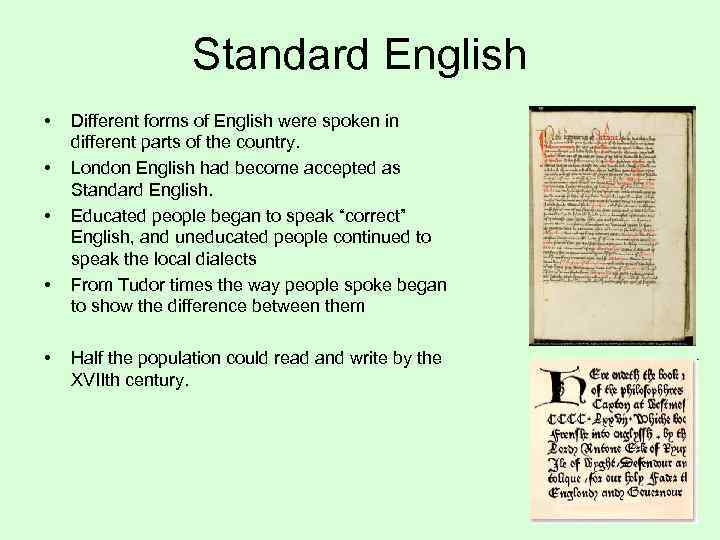
Standard English • • • Different forms of English were spoken in different parts of the country. London English had become accepted as Standard English. Educated people began to speak “correct” English, and uneducated people continued to speak the local dialects From Tudor times the way people spoke began to show the difference between them Half the population could read and write by the XVIIth century.
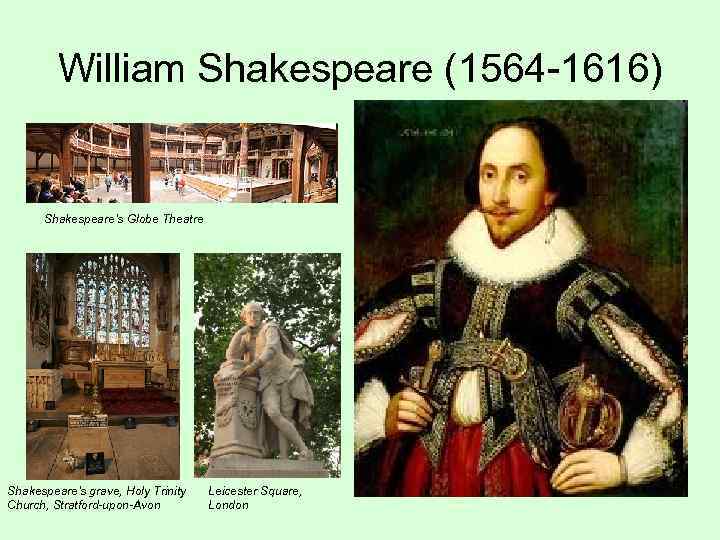
William Shakespeare (1564 -1616) Shakespeare’s Globe Theatre Shakespeare's grave, Holy Trinity Church, Stratford-upon-Avon Leicester Square, London
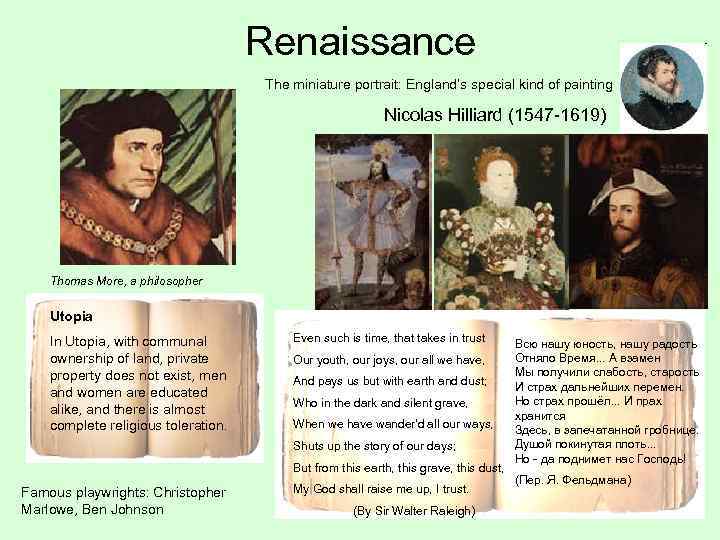
Renaissance The miniature portrait: England’s special kind of painting Nicolas Hilliard (1547 -1619) Thomas More, a philosopher Utopia In Utopia, with communal ownership of land, private property does not exist, men and women are educated alike, and there is almost complete religious toleration. Famous playwrights: Christopher Marlowe, Ben Johnson Even such is time, that takes in trust Всю нашу юность, нашу радость Отняло Время. . . А взамен Our youth, our joys, our all we have, Мы получили слабость, старость And pays us but with earth and dust; И страх дальнейших перемен. Но страх прошёл. . . И прах Who in the dark and silent grave, хранится When we have wander'd all our ways, Здесь, в запечатанной гробнице. Душой покинутая плоть. . . Shuts up the story of our days; Но - да поднимет нас Господь! But from this earth, this grave, this dust, (Пер. Я. Фельдмана) My God shall raise me up, I trust. (By Sir Walter Raleigh)
Скачать презентацию The Black Death Bubonic plague came to
Британия_Лекция 2.ppt