 Скачать презентацию The Birth of Italy The Institutionalization of Italy
Presentation_Novosibirsk.pptx
- Количество слайдов: 79




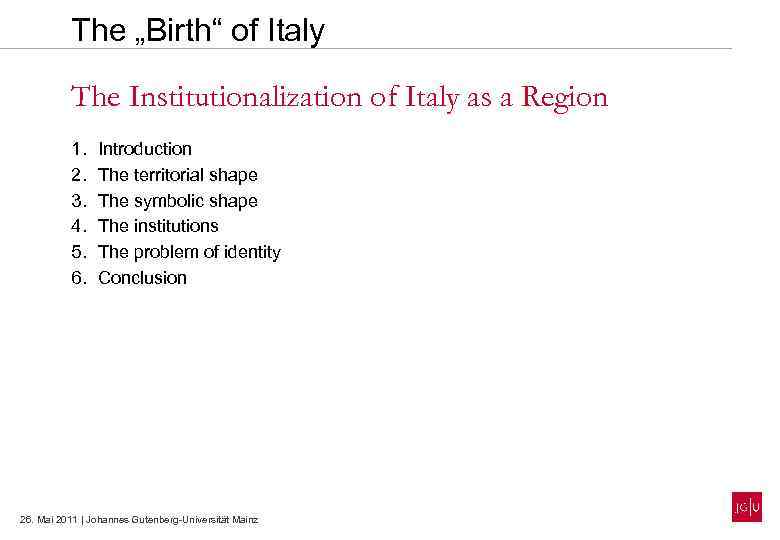
The „Birth“ of Italy The Institutionalization of Italy as a Region 1. 2. 3. 4. 5. 6. Introduction The territorial shape The symbolic shape The institutions The problem of identity Conclusion 26. Mai 2011 | Johannes Gutenberg-Universität Mainz
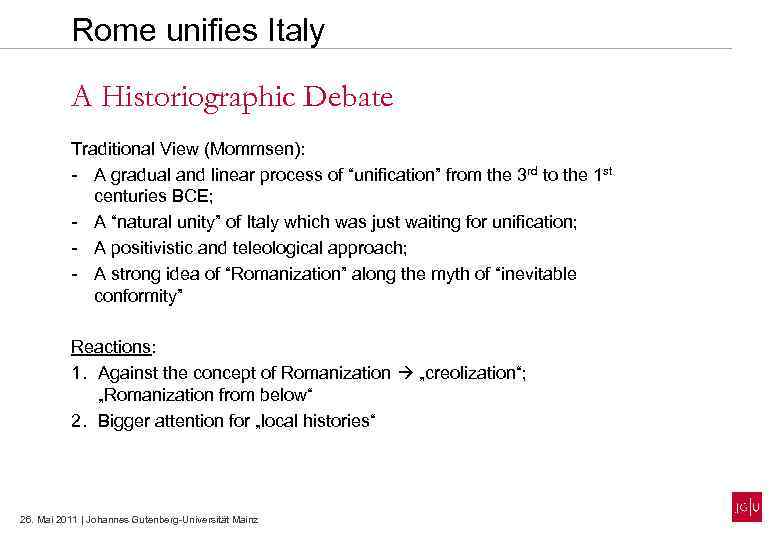
Rome unifies Italy A Historiographic Debate Traditional View (Mommsen): - A gradual and linear process of “unification” from the 3 rd to the 1 st centuries BCE; - A “natural unity” of Italy which was just waiting for unification; - A positivistic and teleological approach; - A strong idea of “Romanization” along the myth of “inevitable conformity” Reactions: 1. Against the concept of Romanization „creolization“; „Romanization from below“ 2. Bigger attention for „local histories“ 26. Mai 2011 | Johannes Gutenberg-Universität Mainz
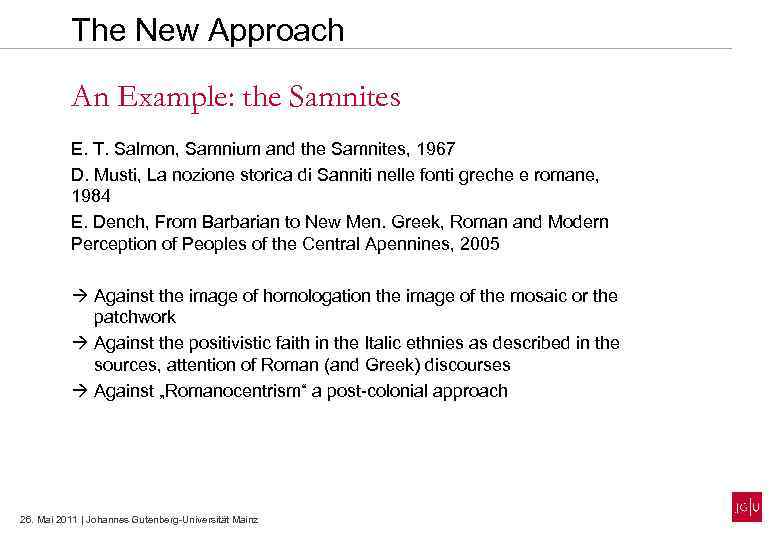
The New Approach An Example: the Samnites E. T. Salmon, Samnium and the Samnites, 1967 D. Musti, La nozione storica di Sanniti nelle fonti greche e romane, 1984 E. Dench, From Barbarian to New Men. Greek, Roman and Modern Perception of Peoples of the Central Apennines, 2005 Against the image of homologation the image of the mosaic or the patchwork Against the positivistic faith in the Italic ethnies as described in the sources, attention of Roman (and Greek) discourses Against „Romanocentrism“ a post-colonial approach 26. Mai 2011 | Johannes Gutenberg-Universität Mainz
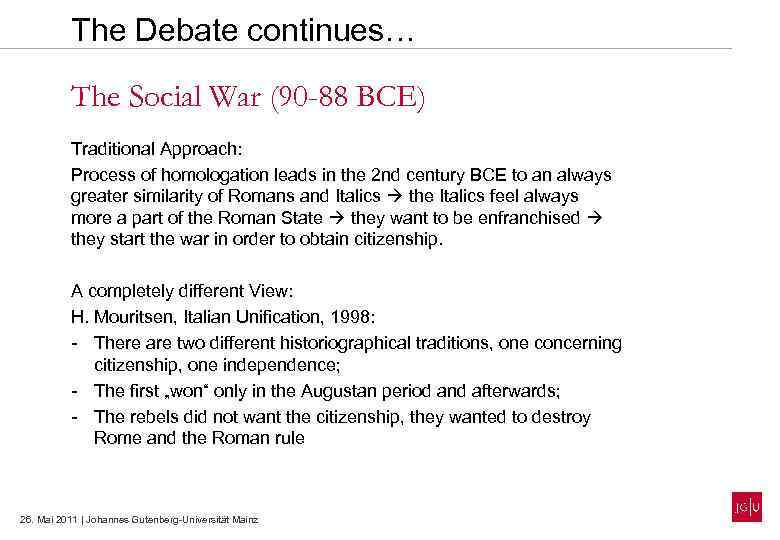
The Debate continues… The Social War (90 -88 BCE) Traditional Approach: Process of homologation leads in the 2 nd century BCE to an always greater similarity of Romans and Italics the Italics feel always more a part of the Roman State they want to be enfranchised they start the war in order to obtain citizenship. A completely different View: H. Mouritsen, Italian Unification, 1998: - There are two different historiographical traditions, one concerning citizenship, one independence; - The first „won“ only in the Augustan period and afterwards; - The rebels did not want the citizenship, they wanted to destroy Rome and the Roman rule 26. Mai 2011 | Johannes Gutenberg-Universität Mainz
What to do now? New Questions to ask 1. Recovering a „Romanocentric“ perspective but in new terms: aim is understanding how the Romans saw the Italic allies and what they thought about them, independently from how the allies „really“ were 2. The central question: how and when did the Romans arrive to perceive Italy as a whole, as a „region“, developing in discourse, next to the known differentiation of the various populations and areas, also „myths“ of unity and homogeneity? 3. How did they politically and culturally „operated“ such construction and how did this work back on the life conditions of the Italics? 4. Only now it will be possible to ask again, whether an Italic identity existed, whether it was „adopted“ by the Italics and which role did it play in the explosion of the Social War. 26. Mai 2011 | Johannes Gutenberg-Universität Mainz
Methodological Approach „Spatial Turn“ - This approach requires a strong attention for spatial and geographic elements: - Italy as a region is the product of a social and cultural construction of space - The theorical frame of reference is therefore the „spatial turn“ “all spatialities are political because they are the (covert) medium and (disguised) expression of asymmetrical relations of power” (Keith-Pile 1993) The Romans were aware of their possibility of operating in space and through space with political aims, as they were aware of the cultural and social significance of space „manipulation“. 26. Mai 2011 | Johannes Gutenberg-Universität Mainz
Methodological Approach Territoriality R. D. Sack, Human Territoriality. Its Theory and History, 1986: “a spatial strategy to affect, influence or control resources and people, by controlling area; and, as a strategy, territoriality can be turned on and off. In geographical terms it is a form of spatial behavior” or, in other words, “an attempt by an individual or group to affect, influence or control people, phenomena and relationships by delimiting a geographical area and asserting control over it” (Paasi). Territoriality has a central relevance in the construction, development and maintenance of ethnic identities. But how to investigate this in reference to 2 nd-century Italy? 26. Mai 2011 | Johannes Gutenberg-Universität Mainz
The Model The „Institutionalization of Regions“ A. Paasi, Territories, Boundaries and Consciousness, 1996 Regions: (1) territorial entities which are not simply parts of “space” but are products of spatial construction (on a material as on a symbolic level). (2) an intermediate geographical reality, collocated inside a wider political context and at the same time embracing different smaller entities – in a broader and more complex context of territoriality. Regions are one step in a multilevel systems of belonging and identity (city, region, State) Territorial and ethnic identity are always segmentary: never clearcut, always multiple, with the possibility of assigning saliency in different moments to different levels 26. Mai 2011 | Johannes Gutenberg-Universität Mainz
The Model Segmentary Identities In no way were such collective identities exclusionary; nor can we point to a priori hierarchies among them. For example, the collective identity of a citizen of ancient Syracuse could be articulated as “Syracusan”, “Corinthian colonist”, “Siceliot” (= a Greek living in Sicily, of whatever origin), “Dorian” and “Greek”. These identities would find expression according to the circumstances. In his political and civic relationship to other citizens of Syracuse he (women shared ethnicity but not full citizenship) was a Syracusan. In terms of international relations the Syracusan’s Corinthian affiliation and Dorian identity were meaningful. In terms of cult practices he or she shared Dorian nomima and dress. In relation to the native populations of Sicily and to the menacing Phoenicians, as well as to Greeks of the mainland, a Syracusan was primarily a Siceliot. In relation to Olympia (where the prominence of western Greek dedications has been noted) or to the Persian wars (e. g. , Gelon’s claim to supreme command), Syracusans were Greek (Malkin 2001). 26. Mai 2011 | Johannes Gutenberg-Universität Mainz
The Model Fluid Identities Regions, as identities, are: - Social (and political) constructs - Constantly re-negotiated - Subject to historical and cultural change - “one expression of time-space specific relations and structures of society, being formed through the development of society” Overcome the traditional distinction „history“ vs. „geography“ M. Foucault: A critique could be carried out of this devaluation of space that has prevailed for generations. Did it start with Bergson, or before? Space was treated as the dead, the fixed, the undialectical, the immobile. Time, on the contrary, was richness, fecundity, life, dialectic. For all those who confuse history with the old schemas of evolution, living continuity, organic development, the progress of consciousness or the project of existence, the use of spatial terms seems to have the air of an anti-history. If one started to talk in terms of space that meant one was hostile to time. 26. Mai 2011 | Johannes Gutenberg-Universität Mainz
The Model How does a region born? Process of INSTITUTIONALIZATION: “institutionalisation is a sociospatial process in which a territorial unit emerges as part of the spatial structure of the society concerned, becomes established and identified in various spheres of social action and consciousness, and may eventually vanish or deinstitutionalise in regional transformation” 26. Mai 2011 | Johannes Gutenberg-Universität Mainz
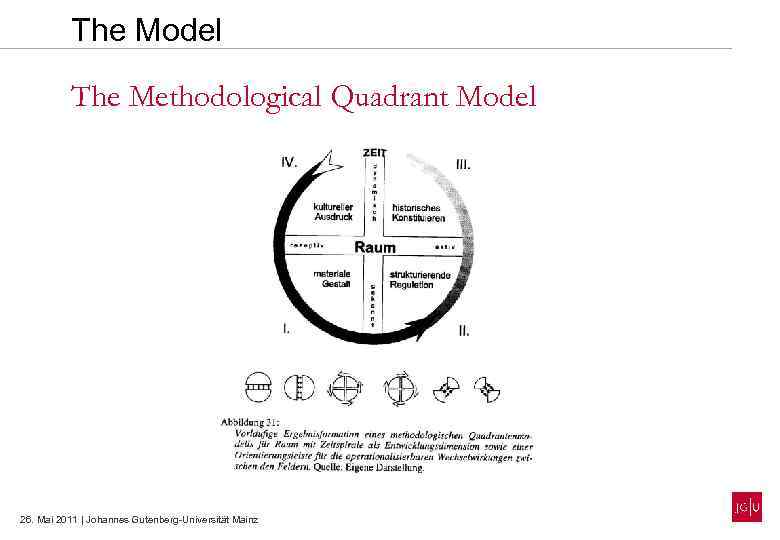
The Model The Methodological Quadrant Model 26. Mai 2011 | Johannes Gutenberg-Universität Mainz
The Model Who is the Agent? The institutionalization of a region is never a pure „bottom-up“ phenomenon. App. , Rom. 10. 1. 6 (transl. H. White): These peoples, and also the Pannonians, the Rhaetians, the Noricans, the Mysians of Europe, and the other neighbouring tribes who inhabited the right bank of the Danube, the Romans distinguish from one another just like the various Greek peoples are distinguished from each other, and they call each by its own name, but they consider the whole of Illyria as embraced under a common designation. Whence this idea took its start I have not been able to find out, but it continues to this day, for they farm the taxes of all the nations from the source of the Danube to the Euxine Sea under one head, and call it the Illyrian tax. Identify the „tactics and strategies of power“ (Foucault) 26. Mai 2011 | Johannes Gutenberg-Universität Mainz
The Model The Institutionalization: Four Steps 1. The genesis of a territorial shape boundaries and borders 2. The genesis of a conceptual (symbolic) shape „invention of traditions“ (Hobsbawm), „narrative boundaries“, „naturalization“ of the territory 3. Emergence of specific institutions consolidation of the region 4. Established role as a part of the regional system and of regional consciousness consolidation of the regional identity Applied to Republican Italy: 1. When and how are the borders of Italy defined? 2. What discourses insist on „Panitalic“ common characters? 3. What institutions are common to the entire Italy but different from the other territories (provinces)? 4. How and when can we identify an idea of „Italicness“, either as part of Roman discourse or as part of Italic self-representation? 26. Mai 2011 | Johannes Gutenberg-Universität Mainz
The Sources The Eternal Problem - Almost complete lack of contemporary sources - Importance of Livy, Dionysius of Halikarnassos, Plutarch, Appian - The problem of using Greek sources to reconstruct Roman discourses (e. g. Polybius, Lycophron) - Complete lack of Italic (non-Roman) literary sources - Necessity to use epigraphy and numismatics, but scarcity also of these kinds of sources 26. Mai 2011 | Johannes Gutenberg-Universität Mainz
The Territorial Shape Two Questions 1. How was the territory of Italy, as a region, limited? 2. When were its borders defined, and “Italy” appeared thus to be a clearly understandable territorial extension from Roman perspective? “Territorializing processes are needed not only historically to produce the identity of assemblages at each spatial scale but also to maintain it in the presence of destabilizing processes of deterritorialization” (De Landa 2006) G. Massa, La formazione del concetto d’Italia. Tradizioni politiche e storiografiche nell’età precedente la ‘rivoluzione romana’, 1996. 26. Mai 2011 | Johannes Gutenberg-Universität Mainz
The Territorial Shape Roman Expansion 5 th century BCE: wars against the Volsci and the Aequi 396: Capture of Veii 343 -295: Samnitic Wars 280 -272: Tarentine (or Pyrrhic) War 3 rd century: Expansion in the North (Cisalpina, wars against the Gauls) Institutional aspects: complex patchwork of colonies, municipia, free cities, towns and areas bond to Rome by treaties, etc. 26. Mai 2011 | Johannes Gutenberg-Universität Mainz
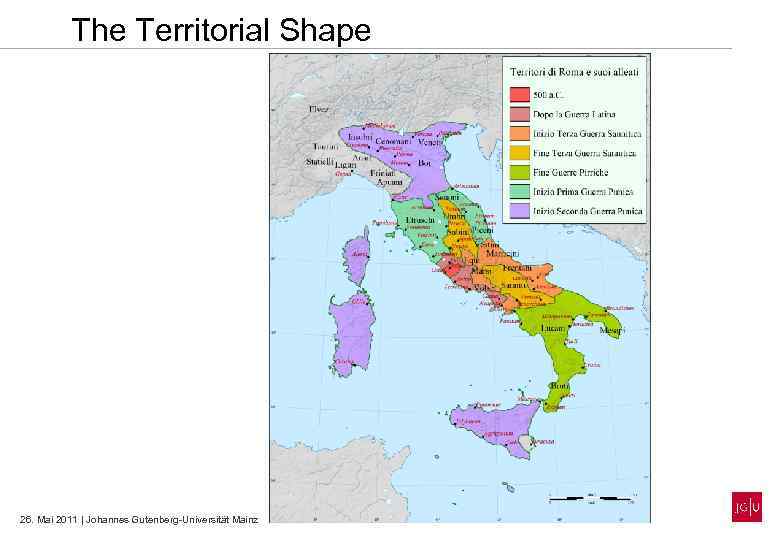
The Territorial Shape 26. Mai 2011 | Johannes Gutenberg-Universität Mainz
The Territorial Shape Italy as Area of Roman Influence 306 BCE: Philinos‘ Treaty? Tarentine War: Polybius and the Roman Hegemony over Italy Pyrrhus „in Italy“: contemporary idea or later projection? First Punic War: consolidation of the concept of Italy as core of Roman power (Radke) 26. Mai 2011 | Johannes Gutenberg-Universität Mainz
The Territorial Shape The Boundary of Italy: the Alps - Fixation of the boundary at the Alps: what does it mean? - Natural elements (mountains, rivers) as boundaries: a constant - „Naturalization“ of the Alpine boundary - Chronology: since when are the Alps the boundary of Italy? Cato in Servius Decision of the Senate in 183 BCE (according to Livy) Foundation of Aquileia (181 BCE) and following episodes Polybius and the role of the Alps 26. Mai 2011 | Johannes Gutenberg-Universität Mainz
The Territorial Shape Polybius defines Italy as a whole has the shape of a triangle of which the one or eastern side is bounded by the Ionian Strait and then continuously by the Adriatic Gulf, the next side, that turned to the south and west, by the Sicilian and Tyrrhenian Seas. The apex of the triangle, formed by the meeting of these two sides, is the southernmost cape of Italy known as Cocynthus and separating the Ionian Strait from the Sicilian Sea. The remaining or northern and inland side of the triangle is bounded continuously by the chain of the Alps which beginning at Marseilles and the northern coasts of the Sardinian Sea stretches in an unbroken line almost to the head of the whole Adriatic, only failing to join that sea by stopping at quite a short distance from it. At the foot of this chain, which we should regard as the base of the triangle, on its southern side, lies the last plain of all Italy to the north. It is with this that we are now concerned, a plain surpassing in fertility any other in Europe with which we are acquainted. 26. Mai 2011 | Johannes Gutenberg-Universität Mainz
The Territorial Shape The Role of the Punic Wars - The First Punic War (Radke) - The Hannibalic War: the crossing of the Alps and the Defection of the Italic allies the construction of a cultural memory of fear and almost destruction - Livy and the Sibylline Books: The state was at this time suddenly occupied with a question of a religious nature, in consequence of the discovery of a prediction in the Sibylline books, which had been inspected on account of there having been so many showers of stones this year. It ran thus: “Whensoever a foreign enemy should bring war into the land of Italy, he may be driven out of Italy and conquered, if the Idaean Mother should be brought from Pessinus to Rome (quandoque hostis alienigena terrae Italiae bellum intulisset eum pelli Italia uincique posse si mater Idaea a Pessinunte Romam aduecta foret). 26. Mai 2011 | Johannes Gutenberg-Universität Mainz
The Territorial Shape The Italian Territory as Symbol of Rome - Treatment of the ambassadors - Historiographical narrative of subsequent conquest (first Italy, then the rest…) - Oracles identifying in Italy the core of Roman power - Italy in Roman political discourse: the example of Tiberius Gracchus (133 BCE): “The wild beasts that roam over Italy, " he would say, "have every one of them a cave or lair to lurk in; but the men who fight and die for Italy enjoy the common air and light, indeed, but nothing else; houseless and homeless they wander about with their wives and children. And it is with lying lips that their imperators exhort the soldiers in their battles to defend sepulchres and shrines from the enemy; for not a man of them has an hereditary altar, not one of all these many Romans an ancestral tomb, but they fight and die to support others in wealth and luxury, and though they are styled masters of the world, they have not a single clod of earth that is their own”. 26. Mai 2011 | Johannes Gutenberg-Universität Mainz
The Territorial Shape The Inclusion of Cisalpina is a part of Italy (geographically speaking) already in the 2 nd century BCE: - Cato - Polybius But Cisalpina shows a separation of the GEOGRAPHICAL concept of Italy (territorial shape) from the ADMINISTRATIVE concept of Italy when it is organized as a province. But when does it happen? Theory 1: at the end of the 3 rd century BCE (Carcopino) Theory 2: with Sulla, around 80 BCE (Mommsen) Theory 3: with Pompeius Strabo, in 89 BCE (Ewins) Theory 4: around 100 BCE (Cassola) Theory 5: it was never a province (Marino) 26. Mai 2011 | Johannes Gutenberg-Universität Mainz
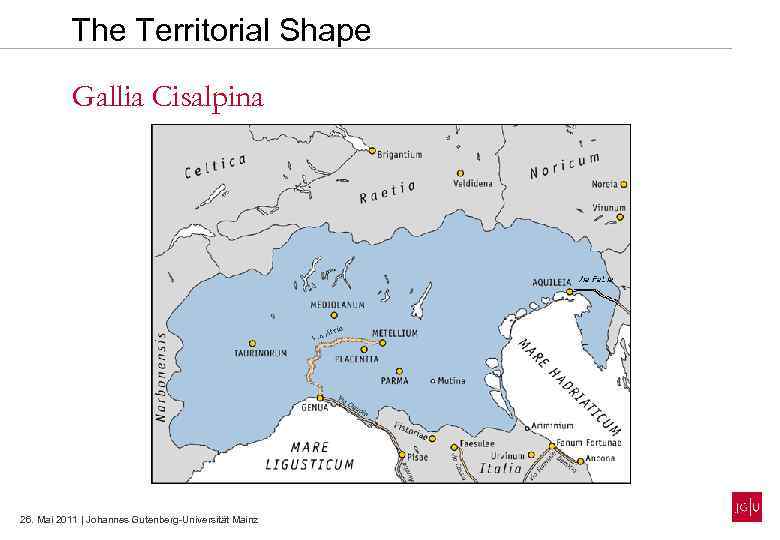
The Territorial Shape Gallia Cisalpina 26. Mai 2011 | Johannes Gutenberg-Universität Mainz
The Territorial Shape The De-Provincialization of Cisalpina 49 BCE: Concession of Roman citizenship 42 BCE: Final De-Provincialization of Gallia Cisalpina But: the administrative separation of Cisalpina DOES NOT endanger the idea of a geographic unity of Italy was it conceived of only as a provisional measure? Boundaries moving: from the Aesis-Rubicon, then the Formio, then (18 -12 BCE) also Histria becomes part of Italy. 26. Mai 2011 | Johannes Gutenberg-Universität Mainz
The Territorial Shape The Road System The road was the fundamental element for the production of territorial space in the creation of Roman Empire. The road caused places to become unified that were at distance, for example, Rimini and Rome. The road structured the Roman view of space that was linear and emphasised the connectivity between cities (places of local government). Equally, the road altered the nature of space by connecting places that were divided by range of mountains and also simply by avoiding contact with former rivals to Rome such as Veii. In this sense, the road was a mechanism of Roman power that physically reshaped the landscape after Roman control had initially been asserted through military intervention. The ability to alter the nature of space and to produce a cultural form that emphasised the interconnection between cities created a new viewpoint of territory that was no longer fragmented or divided. The emphasis on Rome as the centre of the road system assured the city’s cultural and political dominance over the places on the roads themselves (Laurence 1999). 26. Mai 2011 | Johannes Gutenberg-Universität Mainz
The Territorial Shape Roads constructing Space - Connection and Unification Name-giving Influence of further development of centers and towns Shaping space perception through the milestones 26. Mai 2011 | Johannes Gutenberg-Universität Mainz
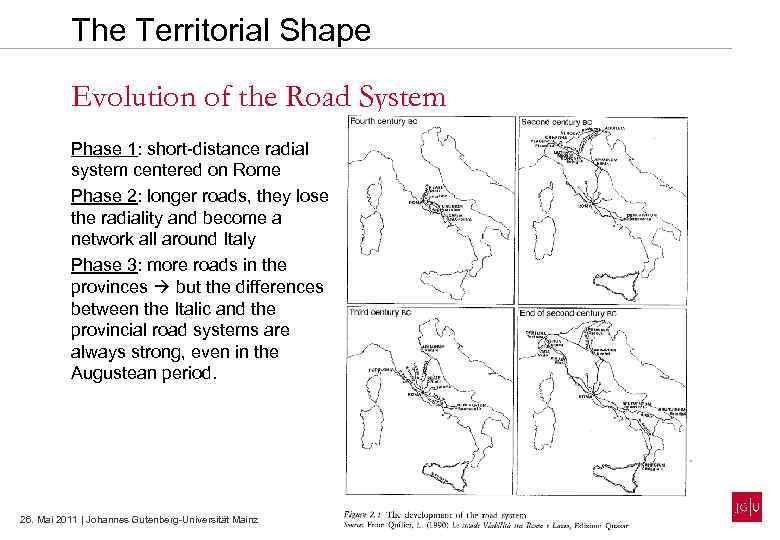
The Territorial Shape Evolution of the Road System Phase 1: short-distance radial system centered on Rome Phase 2: longer roads, they lose the radiality and become a network all around Italy Phase 3: more roads in the provinces but the differences between the Italic and the provincial road systems are always strong, even in the Augustean period. 26. Mai 2011 | Johannes Gutenberg-Universität Mainz
The Symbolic Shape The „Second Step“ -Traditions which establish the region as a unit - Symbols and narrative structures - Common past, common traditions, etc. Hobsbawm, the „invention of traditions“ A. P. Cohen, The Symbolic Construction of Communities, London – New York 1985: Regions, as all communities, become “important repositories of symbols”, “which distinguish it from other communities”. “The symbols of community are mental constructs: they provide people with the means to make meaning. In so doing, they also provide them with the means to express the particular meaning which the community has for them” 26. Mai 2011 | Johannes Gutenberg-Universität Mainz
The Symbolic Shape The Name Italia A concept with a long history: Etymology unknown. Ancient authors: from the veal (vitulus), or from an eponymic hero, Italos. 1) The term indicates maybe only the southern part of Calabria 26. Mai 2011 | Johannes Gutenberg-Universität Mainz
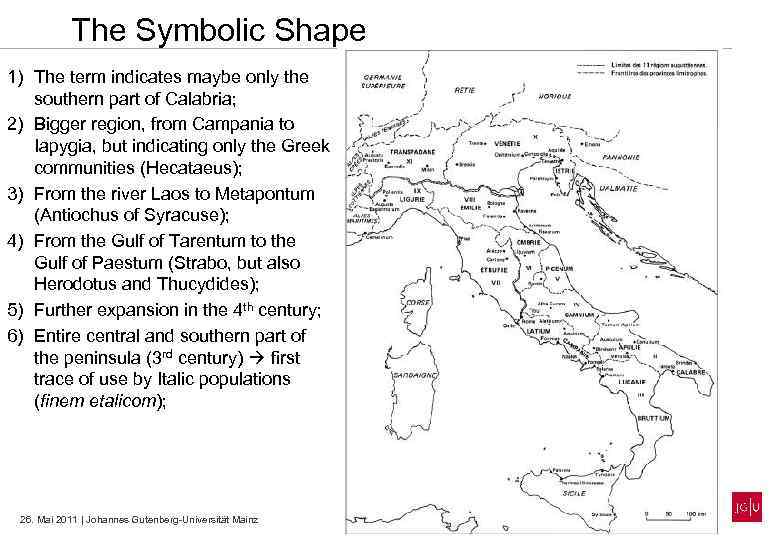
The Symbolic Shape 1) The term indicates maybe only the southern part of Calabria; 2) Bigger region, from Campania to Iapygia, but indicating only the Greek communities (Hecataeus); 3) From the river Laos to Metapontum (Antiochus of Syracuse); 4) From the Gulf of Tarentum to the Gulf of Paestum (Strabo, but also Herodotus and Thucydides); 5) Further expansion in the 4 th century; 6) Entire central and southern part of the peninsula (3 rd century) first trace of use by Italic populations (finem etalicom); 26. Mai 2011 | Johannes Gutenberg-Universität Mainz
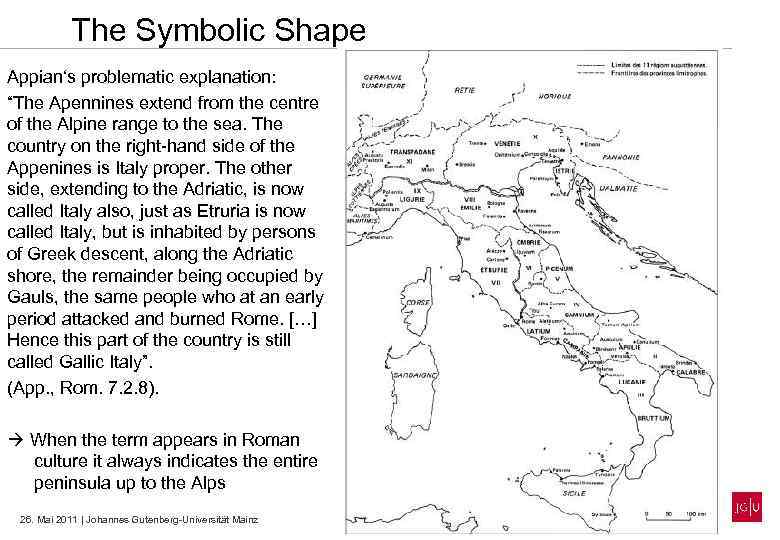
The Symbolic Shape Appian‘s problematic explanation: “The Apennines extend from the centre of the Alpine range to the sea. The country on the right-hand side of the Appenines is Italy proper. The other side, extending to the Adriatic, is now called Italy also, just as Etruria is now called Italy, but is inhabited by persons of Greek descent, along the Adriatic shore, the remainder being occupied by Gauls, the same people who at an early period attacked and burned Rome. […] Hence this part of the country is still called Gallic Italy”. (App. , Rom. 7. 2. 8). When the term appears in Roman culture it always indicates the entire peninsula up to the Alps 26. Mai 2011 | Johannes Gutenberg-Universität Mainz
The Symbolic Shape The Second Punic War That man now on horseback in the space of six days had traversed the whole length of Italy, men kept saying, and had fought, standards against standards, with Hasdrubal in Gaul on a day on which Hannibal had believed the consul had his camp established facing his own in Apulia. Thus a single consul in defence of both regions of Italy had confronted two armies and two generals, here with his strategy and there in person. (Liv. 28. 9. 12 -13). Polybius: definition of Italia and “Italic”. 26. Mai 2011 | Johannes Gutenberg-Universität Mainz
The Symbolic Shape Terra Italia - Expression used for the first time by Cato, who extended Italy up to the Alps; - It is used in reference to Hannibal‘s devastations; - It appears in the agrarian law of 111 BCE; - It assumes the character of an „official“, „legal“ term, which does not need further definition. Terra Italia indicates without doubts geographically the entire territory of the peninsula. 26. Mai 2011 | Johannes Gutenberg-Universität Mainz
The Symbolic Shape Autochthony and Consanguinity Myths constructing the common tradition of different groups: - Either based on migration of entire groups - Or based on movements of single mythological heros (as Odysseus) Both ways to demonstrate consanguinity 26. Mai 2011 | Johannes Gutenberg-Universität Mainz
The Symbolic Shape Genesis of Consanguinity 270 BCE: the Mamertines ask help from the Romans appealing to their consanguinity (Polybius) Alfius and the Samnite origin of the Mamertines; Second Punic War: development of the opposed concept of alienigena; Ennius: particular attention for myths of familiarity (Rape of the Sabine Women: “When the spoils you have taken are from a son-inlaw, what label will you put on them? ”); Cato: celebration of Italic consanguinity 26. Mai 2011 | Johannes Gutenberg-Universität Mainz
The Symbolic Shape Movements of population Pansabinism structure of the ver sacrum: Strabo Picentes and Samnites are „colonies“ of the Sabines and from the Samnites further derive Bruttii and Lucani; Varro umbilicus Italiae is the island in the lake of Cutilia Idea of Greek origin: Timaeus Samnites, Lucanians and Bruttii derived, through the Sabines, from the Spartans. Probably anti-Roman origin: “in the context of fourth-century confrontation with Rome, the more peoples that could conveniently be linked in by tales of kinship to Tarentum, the better” (Emma Dench) Rapidly overtaken by the Romans in since the 3 rd century BCE for their own aims 26. Mai 2011 | Johannes Gutenberg-Universität Mainz
The Symbolic Shape The Veneti - Separation from the Celts; - Antenor and connection to the Trojan myth; - Connection to the Homeric Heneti of Paphlagonia 26. Mai 2011 | Johannes Gutenberg-Universität Mainz
The Symbolic Shape Myths of Greek Origin -Odysseus: Telegonus, son of Ulysses and Circe, sent by his mother to find his father, by a storm was carried to Ithaca, and there, driven by hunger, began to lay waste the fields. Ulysses and Telemachus, not knowing who he was, took up arms against him. Ulysses was killed by his son Telegonus; it had been told him by an oracle to beware of death at his son’s hands. Telegonus on discovering who he was, with Telemachus and Penelope returned to his home on the island of Aeaea by Minerva’s instructions. They brought the body of Ulysses to Circe, and buried it there. By the advice of Minerva again, Telegonus married Penelope, and Telemachus married Circe. From Circe and Telemachus Latinus was born, who gave his name to the Latin language; from Penelope and Telegonus Italus was born, who called the country Italy from his own name (Hyg. , Fab. 137) - Not considered by Cato and his peers 26. Mai 2011 | Johannes Gutenberg-Universität Mainz
The Symbolic Shape Autochthony and Heterochthony - Zenodotus and Strabo Sabines and Umbrians are indigenous to Italy - Problems of migration: the arrival of the Romans Dardanus (including therefore the Veneti in the autochthony) - Principle of exclusion: Greeks, Etruscans, Celts Cato “thought that all Greeks should be expelled from Italy” (Plin. , HN 7. 113) From every side assistance was eagerly rendered; for the inhabitants of Italy, in their terror at the Gallic invasion, no longer thought of the matter as a question of alliance with Rome, or of the war as undertaken to support Roman supremacy, but each people regarded it as a danger menacing themselves and their own city and territory (Polyb. 2. 23. 12) Chasing the Etruscans as foundation of State and time 26. Mai 2011 | Johannes Gutenberg-Universität Mainz
The Symbolic Shape Cato -Insistence on Italic consanguineity; -Insertion of Gallia Cisalpina -„Exclusion“ of the Greeks “cultivated a sense of pride in Roman values and qualities. But more than that. His actions and writings endeavored to give definition to those values. For such an objective, confrontation with Hellenic practices [and myths!] proved to be eminently serviceable, a means whereby to sharpen perception of national principles” (E. Gruen, Culture and National Identity in Republican Rome, Ithaca 1992) 26. Mai 2011 | Johannes Gutenberg-Universität Mainz
The Symbolic Shape The Romans and the Greeks -Greek narratives of Rome as a Greek polis (since the 5 th century); - Their acceptance in some circles -Chronological evolution: up to the 4 th century (Achaen descent), from the 4 th to the 2 nd century (Trojan origin as non-Greek one) “When the [Tarentine] envoys urged these considerations, Pyrrhus remembered the capture of Troy, which he took to be an omen of his success in the war, as he was a descendant of Achilles making war upon a colony of Trojans” (Paus. 1. 12. 1) -Success of the Aeneadic tradition particularly strong since the 3 rd and even more since the 3 nd century BCE -2 nd century BCE: more generalized acceptance of consanguinity with the Greeks 26. Mai 2011 | Johannes Gutenberg-Universität Mainz
The Symbolic Shape Italy as a Center -Structure of „concentric centrality“ -Italy as „symbolic center“ of the Empire -Cicero and Livy: Rome could be only in Italy and the war with the Samnites is a war for the control of Italy 26. Mai 2011 | Johannes Gutenberg-Universität Mainz
The Symbolic Shape The „laudes Italiae“ -Discursive construction of landscape -Reference to geographical deterministic theories (as the Hippocraic Airs, Waters and Places) Hence, it was the divine intelligence that set the city of the Roman people in a peerless and temperate country, in order that it might acquire the right to command the whole world (Vitr. 6. 1. 11) -Image of the unity in diversity - Chronology: clear traces of such arguments already in Polybius Transformation of nature in landscape 26. Mai 2011 | Johannes Gutenberg-Universität Mainz
How to Download the Presentation Academia. edu http: //uni-mainz. academia. edu/Filippo. Carla/Teaching-Documents Here you can download this power point presentation! 26. Mai 2011 | Johannes Gutenberg-Universität Mainz
The Institutions The Third Step Institutions define administratively and politically the region They make the region more „visible“ and present in everyday life Appian and the Illyrian tax (first lesson) Institutions in two senses: -Real institutions (taxes, local government, elections, etc. ) -Media and communications (local newspapers and televisions) -„Values“ and „uses“ which identify the region (in partial overlapping with the symbolic shape) Two kinds: -Institutions aimed at defining the region (administrative structures) -Institutions not aimet at that, but which achieve that as a consequence of their existence 26. Mai 2011 | Johannes Gutenberg-Universität Mainz
Institutions Citizenship First and basic institution in the Roman period From this point of view it becomes a common institution of Italy with the Social War (90 -89 BCE) and with the inclusion of Cisalpina (4941 BCE) the legal status of the inhabitants of Italy is different from the status of the inhabitants of the provinces. 26. Mai 2011 | Johannes Gutenberg-Universität Mainz
Institutions Mores „Values“ which are recognized as typical of the Italic peoples and distinguishing them from the other groups. Together with the myths of consanguinity, they construct the image “of a compact and integrated political community with a high degree of mechanical solidarity” (Tim Cornell) Mos maiorum as the most important element -Originally relative to family traditions (mores of the single family) -3 rd century BCE: set of canons referred to the entire Roman population -Cato: shift to represent the entire “Italic community”. New image which “by contrast, amalgamates everybody’s ancestors, and blurs all periods: ‘our ancestors have always done so’” 26. Mai 2011 | Johannes Gutenberg-Universität Mainz
Institutions The mores according to Cato Pansabinism Roman mores come from the Sabines The Sabines are pious and severi quorum disciplina victores Romani in multis secuti sunt (Cat. , Orig. Fr. 2. 22 Chassignet) Also physiognomic elements: a “Sabine face”. Sabinism in political discussion: invention of Sabine origins (G. D. Farney, Ethnic Identity and Aristocratic Competition in Republican Rome, Cambridge 2007). Paraetymologies of the names Sabine (from sebesthai) in Varro, Pliny and other authors Construction of the mythical figure of Numa Pompilius: “It was Numa’s native disposition, then, as I incline to believe, that tempered his soul with noble qualities, and his training was not in foreign studies, but in the stern and austere discipline of the ancient Sabines, a race incorruptible as any race of the olden time” (Liv. 1. 18. 4). 26. Mai 2011 | Johannes Gutenberg-Universität Mainz
Institutions General Virtues of the Italic Peoples Consanguinity overlapping of Roman and Italic virtues further unifying factor „Italia dei mores romani“ (Massa) 1) Military virtues: good warriors (Tiberius Gracchus in Appian; „Italic virtue“ in Vergil‘s Aeneis) also the Greeks know of this topos 2) Moral and religious virtues Exclusion of the non-Italics: Greeks and Etruscans are characterized by luxury (tryphé) and by cunningness (topoi of Greek origin) Celts by wild savage violence; primitive people 26. Mai 2011 | Johannes Gutenberg-Universität Mainz
Institutions Negative Aspects? Italic people (Samnites, Ligurians, etc. ) are often presented as coarse; the Samnites are in Livy montani atque agrestes, the Ligurians in Cato duri atque agrestes. But this is not a radical denial of their sharing the Roman mores. The mores are in them simply in a less refined and still „potential“ form: for a full development they need the civilizing influence of Rome. It is virtue not yet subject to the control of law and reason. Rome assumes the teleological historical function of bringing the Italic virtues to full completion. They are in any case exempt from the „opposites of virtue“ which can be found among the Etruscans and the Greeks, and they are not so completely uncivilized as the Celts. The two groups of Italics in Vergil‘s Aeneis. 26. Mai 2011 | Johannes Gutenberg-Universität Mainz
Institutions Italy in juridical and sacral terms -Ager Romanus (where particular religious rites can be done) can exist only in Italy 210 BCE -The pontifex maximus cannot leave Italy 205 BCE -Relevant for Romans are the prodigies happening in Italy: Throughout most of the Republican period, at any rate, many of the prodigies can be seen to operate as a kind of signalling system whereby the Roman senate, by accepting as prodigia publica those prodigies especially which were reported from the non-Roman towns of Italy, could acknowledge the anxieties and identify with the religious sensibilities of Italians, particularly at times of severe stress upon the whole fabric of the confederacy. The senate could as well occasionally convey warnings or other sub-texts through the content of expiatory rites, and, overall, by appropriating the responsibility to expiate non-Roman prodigies at Rome with Roman priests, could assert Roman hegemony over Italy in the religious sphere parallel to its assertion of hegemony in the temporal sphere. (E. Mc. Bain) 26. Mai 2011 | Johannes Gutenberg-Universität Mainz
Institutions Lawgiving Could the Romans release laws which were compulsory also for the allies? Tabula Bantina and lex Appuleia -Fundus fieri: formal approval -Examples of laws that were surely also meant to be observed by the allies in the 2 nd century BCE. -Particular example: the senatus consultum de Bacchanalibus (189 BCE) Polybius: “all crimes committed in Italy requiring a public investigation, such as treason, conspiracy, poisoning, or wilful murder, are in the hands of the Senate. Besides, if any individual or state among the Italian allies requires a controversy to be settled, a penalty to be assessed, help or protection to be afforded, — all this is the province of the Senate” (6. 13. 4 -5). Demonstration the “murders” of 180 BCE 26. Mai 2011 | Johannes Gutenberg-Universität Mainz
Institutions A third meaning of Italia? Galsterer – Mouritsen: in juridical sense Italia is only the ager Romanus It can be like this in the legislation (fundus fieri) but there are surely exceptions (terra Italia in the agrarian law of 111) and It surely does not contradict the geographic definition of Italy It did not have real practical effects 26. Mai 2011 | Johannes Gutenberg-Universität Mainz
Institutions The praefecturae Two kinds: -Elected praefects -Praefects sent from Rome They do not replace local institutions, can reside in fora, municipia or colonies They have probably only a judicial function and probably only in cases involving Romans They are substantially „helping“ the praetor urbanus But: it means that there are many cases They are the first form of diffusion on the Italian territory of a clearly Roman institutions, dividing and organizing the territory First praefects sent around 318 BCE but the system is fully structured in the 2 nd century BCE 26. Mai 2011 | Johannes Gutenberg-Universität Mainz
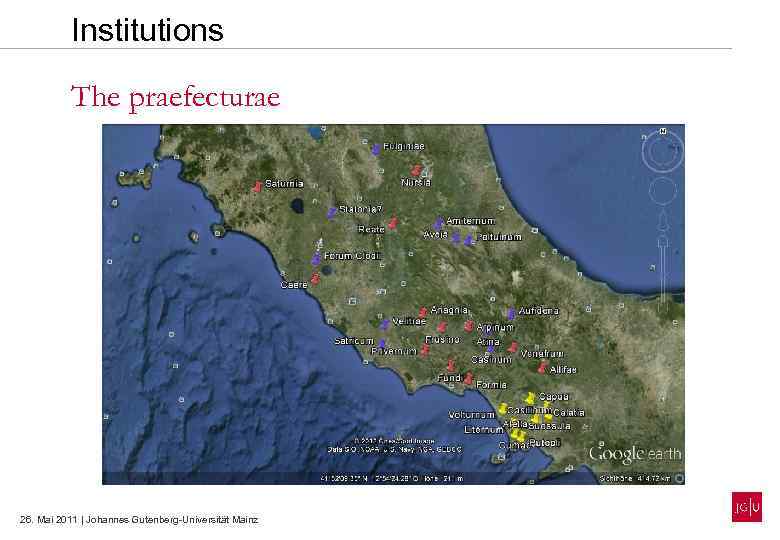
Institutions The praefecturae 26. Mai 2011 | Johannes Gutenberg-Universität Mainz
Institutions The Army -Formula togatorum: the Latins and Italics provide soldiers -They are not in the legions, but are organized in their own cohorts -They live in the same camp with the Romans, they share booty and prizes; orders and communications are in Latin (at least among the commanders) “Even more were the various allied forces kept together by the one common enterprise – war. […] The Roman army was the glue that held them together, and fighting under Roman command, as well as the combat experience alongside Roman troops, gave life and substance to treaties with the conquering power. It was in the army where allied soldiers got used to Latin, not only as a medium of communication but also as the language of power. Obviously, then, the army developed centripetal effects in the system of the Roman alliance. These centripetal forces grew stronger with every year the alliance was in place and with every victory it achieved” (P. and A. Eich). 26. Mai 2011 | Johannes Gutenberg-Universität Mainz
Institutions The Foundation of Colonies -Roman and Latin colonies -Founded only on Italic territory (one exception: the Latin colony of Carteia in Spain, 171 BCE) -Re-organization of the territory on a Roman model -Mixing population at least Romans and locals, but probably the colonies were founded with groups coming from different regions of Italy onomastic researches in local epigraphy / the case of Ennius -Cf. with the forms of viritane assignment of land (e. g. division and distribution of the ager Gallicus et Picenus in 232 BCE) 26. Mai 2011 | Johannes Gutenberg-Universität Mainz
Institutions Migration “how do territorialized geographies or spatialities relate to geographies of mobility, either conceptually or representationally? How are hybridity and diasporas, and the question of cosmopolitanism, dealt within territorialized geographical schemes? ” (Talbert-Raaflaub) 1) Forced: deportation (individuals and groups) 2) Voluntary assignment of land or simple search for new opportunities (especially in Cisalpina) The myth of the ius migrandi for the Latins The importance of marriages Construction of social networks including Romans and Italics of different origins: - The case of Titus Manlius and Geminus Maecius: for they were all known to one another, particularly the men of mark” (Liv. 8. 7. 3) - The case of the Bacchanalia 26. Mai 2011 | Johannes Gutenberg-Universität Mainz
Institutions Coinage 1) Greek coinage (and maybe Etruscan): 6 th-4 th century BCE 2) Beginnings of Roman coinage (end 4 th century) on Campanian standard 3) 3 rd century: simultaneous circulation of many different coins of different origin 4) Second Punic War: great explosion of minting activity on all sides 5) After the war: very few towns are allowed to mint; reduction to the Roman standard; complete domination in Italy of Roman coinage Different from the provinces 26. Mai 2011 | Johannes Gutenberg-Universität Mainz
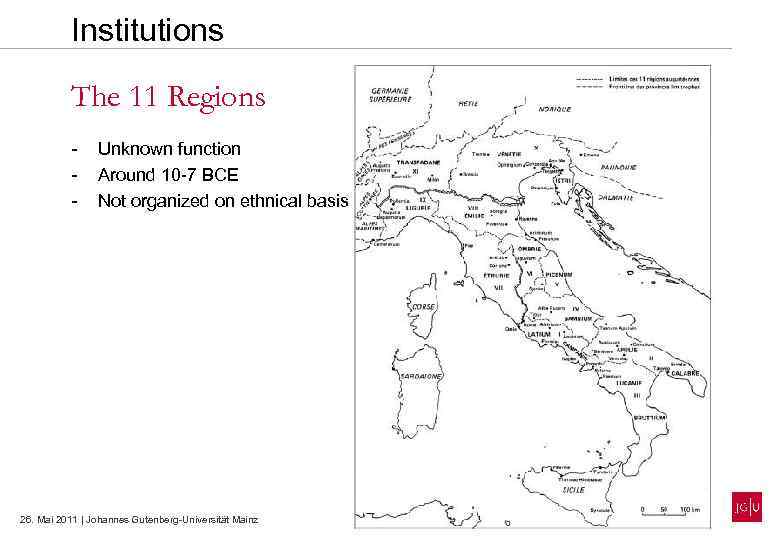
Institutions The 11 Regions - Unknown function Around 10 -7 BCE Not organized on ethnical basis 26. Mai 2011 | Johannes Gutenberg-Universität Mainz
The Italic Identity and Ethnicity -Identity from a constructivistic perspective -Distinguish etic and emic approaches to ethnicity: if the Romans imposed an Italic identity and if the Italics accepted it -Identity and Otherness: first look for identity where there is contact with Others -Segmentary identities: the appearance of an Italic identity cannot be argued or dismissed on the basis of the existence or not existence of other local identites (Samnites – Etruscans, etc. ) not sufficient to talk of „unaccomplished identity“ (A. Giardina) -The example of the Tabulae Iguvinae -Cicero‘s two fatherlands and their limits -Saliency and context: Ennius‘ statement nos sumus Romani, qui fuvimus ante Rudini (Ann. 525 Skutsch) and his “three hearts” 26. Mai 2011 | Johannes Gutenberg-Universität Mainz
The Italic Identity Traces of an Italic Identity Segmentariness and saliency: the Etruscan inscriptions from Africa („border of the Dardanians“, tul dardanium) The meaning of Italic in Polybius (who must have taken a Roman definition!) There is an idea of Italicness FROM ROMAN SIDE since at least the 2 nd century BCE; the Romans see themselves sometimes as part of this community, sometimes not – a matter of saliency! 26. Mai 2011 | Johannes Gutenberg-Universität Mainz
The Italic Identity The Italic side Italics and others: the use of the word Italic in the provinces defines communities of Italics generally living together and sometimes acting together: 197 BCE exules Italici generis living in Leucas opened the doors of the city when it was besieged by the Romans (Livy): but it is again an external description by the Romans. In general already at the end of the 3 rd century: groups of Romans and Italics (mostly merchants) outside of Italy, defined often Italics or Romans and Italics, or Romans and Latins and Italics. Here we must look, in this points of contact with non-Italics, forms of self-representation 26. Mai 2011 | Johannes Gutenberg-Universität Mainz
The Italic Identity Italic Self-Representation 193 BCE: inscription from Halaesa, Sicily: Italicei / L(ucium) Cornelium Sc[ip]i[one]m / honoris caussa Inscriptions from Delos: -What are Romans and what are Italics? -How are they organized? -The “Agora des Italiens” -A good example of saliency: the bilingual inscription from Rhene: -Quintus Avilius Gai filius Lanuvinus / Κόιντος Ἀύλλιος Γαίου υἱὸς ‛Ρωμαῖος Inscriptions from other parts of the East confirm the same picture Information about the communities killed by Mithridates in 88 BCE 26. Mai 2011 | Johannes Gutenberg-Universität Mainz
The Italic Identity The Desire for Citizenship Did the Italics want Roman citizenship? 1) Abandon functionalistic interpretations: “people are guided to act by the relationships in which they are embedded and by the stories with which they identify – and rarely because of the interests we impute to them” (Somers-Gibson) 2) Chronology of the sources: is the traditional view of the Social War a construction of the Augustean Age (Mouritsen)? 3) How did the rebel Italics identify themselves? 4) Can we organize all available evidence in a way which makes sense? 26. Mai 2011 | Johannes Gutenberg-Universität Mainz
The Italic Identity Some „Early“ Sources Cnaeus Pompeius, the son of Sextus, being consul, in my presence, when I was serving my first campaign in his army, had a conference with Publius Vettius Scato, the general of the Marsians, between the camps. And I recollect that Sextus Pompeius, the brother of the consul, a very learned and wise man, came thither from Rome to the conference. And when Scato had saluted him, “What, ” said he, “am I to call you? ”—“Call me, ” said he, “one who is by inclination a friend, by necessity an enemy. ” That conference was conducted with fairness: there was no fear, no suspicion, even their mutual hatred was not great, for the allies were not seeking to take our city from us, but to be themselves admitted to share the privileges of it Cic. , Phil. 12. 27 Also Diodorus Siculus and Valerius Maximus confirm such a picture: the Social War as a sort of civil war 26. Mai 2011 | Johannes Gutenberg-Universität Mainz
The Italic Identity The Genesis of an Italic Identity -The Roman imposition of a common identity on the Italics was working since at least the beginning of the 2 nd century; -100 years later, the Italics had started indeed identifying themselves as Italic and therefore as „relatives“ and not „subjects“ of the Romans; -Problem of abuses of the Roman magistrates wish of provocatio? But: does it mean that they wanted citizenship? -Avoid monocausal interpretations -Do not mix up legal and identity issues 26. Mai 2011 | Johannes Gutenberg-Universität Mainz
The Italic Identity The Issue of Citizenship -Introduced at the end of the 2 nd century; -123 -122 BCE; lex Acilia de repetundis still admitted that they are not interested; - absolutely no trace in the activity of Tiberius Gracchus; - 125 BCE: Fulvius Flaccus -123 BCE: Gaius Gracchus the introduction of a distinction of Italics and Latins - ius civitatis per magistratum adipiscendae (125 -89 BCE? ) -91 BCE: Livius Drusus -Did the Cimbric wars with the military effort they required (and the provincialization of Cisalpina) work as a catalyzer? 26. Mai 2011 | Johannes Gutenberg-Universität Mainz
The Italic Identity The Social War -Rebellion at Asculum -Lex Iulia (90 BCE): Etruscans and Umbrians obtain the citizenship -Division of the aims of the rebels: who goes on has at least now for sure other intentions -Lex Plautia Papiria (89 BCE) -Lex de civitate (88 BCE) -Last lex concerning Samnites and Lucanians (87 BCE) 26. Mai 2011 | Johannes Gutenberg-Universität Mainz
The Italic Identity Which Identity for the Rebels? … the Italians were trying to create some sort of common identity for themselves. This identity, it seems, grew out of a category ‘of Italians’ created by the Romans, a categorization to which the Italians were objecting in terms of its political and institutional implications, but which nevertheless capable of being adopted by them. Italia as a concept was being fought over as hotly as the land itself (A. Burnett) The rebels organize them around concepts and an identity, which is exactly the one the Romans had constructed around them and do not go back to previous, pre-Roman constructions of ethnicity and identity -Organization of the State (not federal!) -Name adopted and given to the capital Corfinium -Minting of coins 26. Mai 2011 | Johannes Gutenberg-Universität Mainz
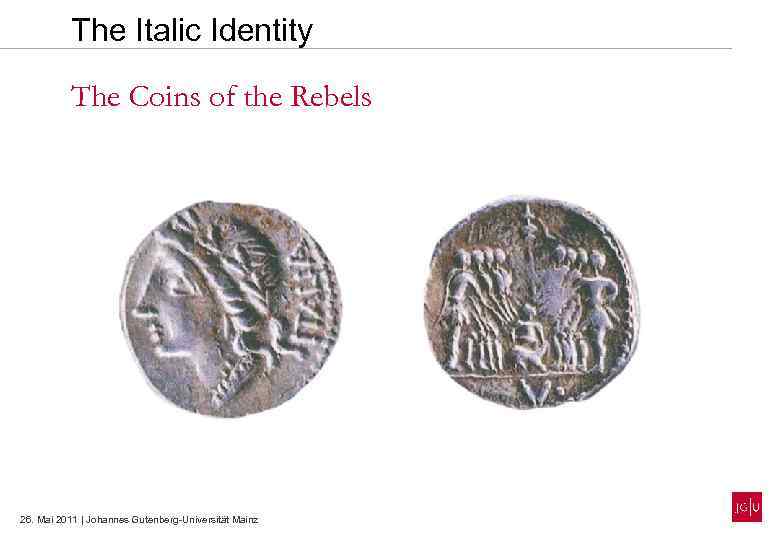
The Italic Identity The Coins of the Rebels 26. Mai 2011 | Johannes Gutenberg-Universität Mainz
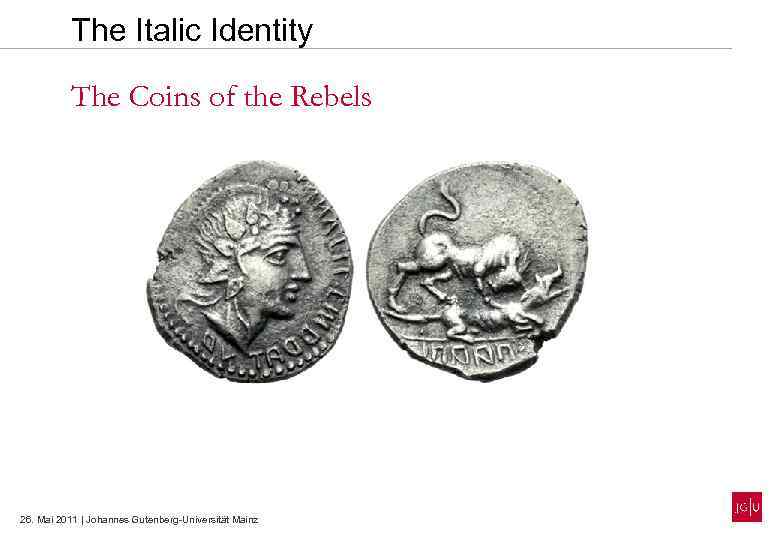
The Italic Identity The Coins of the Rebels 26. Mai 2011 | Johannes Gutenberg-Universität Mainz
The Italic Identity After the Social War Teleological explanation of the Italian unification and of the Social War Italic identity based on the unity in diversity: And although now they are all Romans, they are not the less distinguished, some by the names of Ombri and Tyrrheni, others by those of Heneti, Ligurians, and Insubri (Strab. 5. 1. 10). It in no form of unaccomplished identity, even if the birth of the Principate and the new political direction taken by Rome will have no interest in increasing the difference between Italy and the provinces and rather to construct a world organized around the Emperor and all the rest 26. Mai 2011 | Johannes Gutenberg-Universität Mainz
Conclusions What is Ethnic Identity? R. Jenkins, Rethinking Ethnicity. Arguments and Explorations, London 1997. A “basic social constructionist model” which consists of four points: “ethnicity emphasizes cultural differentiation (although identity is always a dialectic between similarity and difference; ethnicity is cultural – based in shared meanings – but it is produced and reproduced in social interaction; ethnicity is to some extent variable and manipulable, not definitively fixed and unchanging; and ethnicity as a social identity is both collective and individual, externalized and internalized” 26. Mai 2011 | Johannes Gutenberg-Universität Mainz
Conclusions Ethnic Identity Ethnic identity is fluid and dynamic It is developed in discourse It is centered on the opposition Us-Others It has a very strong territorial basis Is the Italic identity ethnical? “the communal, the local, the national and the ‘racial’ are to be understood as historically and contextually specific social constructions of the ethnic theme, allotropes of ethnical identification” (Jenkins) Distinguish between groups and categories, between external and internal identity the Italic identity is the result of a process of INTERNALIZATION 26. Mai 2011 | Johannes Gutenberg-Universität Mainz
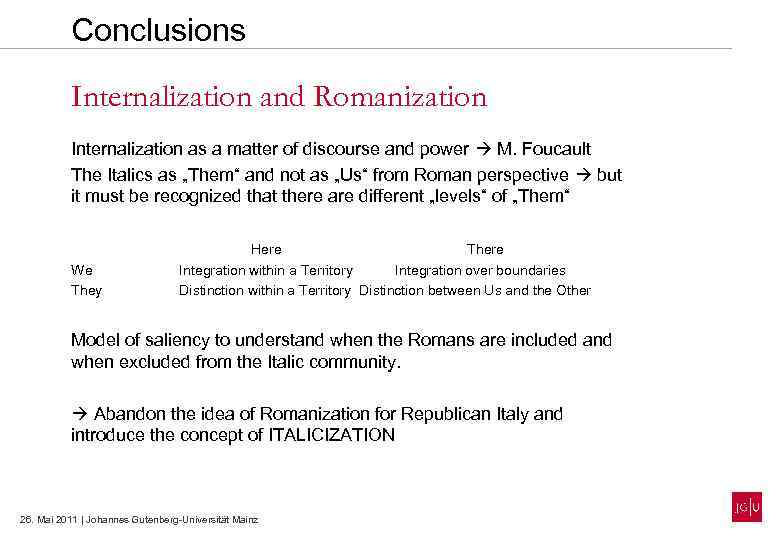
Conclusions Internalization and Romanization Internalization as a matter of discourse and power M. Foucault The Italics as „Them“ and not as „Us“ from Roman perspective but it must be recognized that there are different „levels“ of „Them“ Here We They There Integration within a Territory Integration over boundaries Distinction within a Territory Distinction between Us and the Other Model of saliency to understand when the Romans are included and when excluded from the Italic community. Abandon the idea of Romanization for Republican Italy and introduce the concept of ITALICIZATION 26. Mai 2011 | Johannes Gutenberg-Universität Mainz
Скачать презентацию The Birth of Italy The Institutionalization of Italy
Presentation_Novosibirsk.pptx