 Скачать презентацию The birth of a new beast BITRE COLLOQUIUM
0a51e3dfa494e22fd74dabbecc5d34a2.ppt
- Количество слайдов: 27



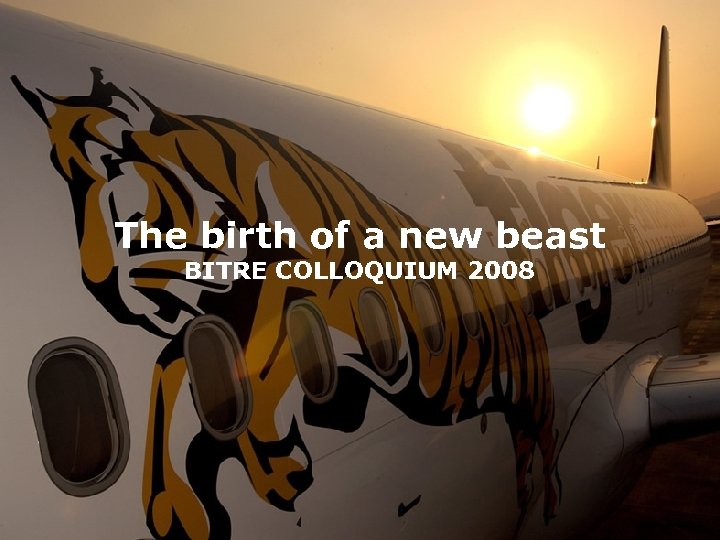
The birth of a new beast BITRE COLLOQUIUM 2008
Tiger Aviation – Overview
Tiger Aviation – Overview • Tiger Airways Pte Ltd based at Singapore’s Changi International Airport, was established in December 2003 and commenced operations in September 2004 as Singapore's first low-cost carrier and remains the only true LCC in the region – 5 million passengers have flown on Tiger • Tiger Airways Australia obtained it’s own Air Operator’s Certificate (AOC) in November 2007 and commenced operations shortly thereafter. It is 100% owned by the Tiger Aviation Group (“Tiger”) * • Tiger currently serves 15 cities across Asia within a range of four-hour flying radius of Singapore using its 8 Airbus 320 aircraft and 13 points in Australia out of its Melbourne hub with 4 Airbus 320 s • Tiger aims to bring the low cost / low fares revolution to the fastest growing and most populous region in the world by adopting a low fares and high volume positioning approach • Incheon Tiger Airways, South Korea, to be established later this year *Tiger Aviation is the holding company of both Tiger Airways Pte Ltd and Tiger Airways Australia
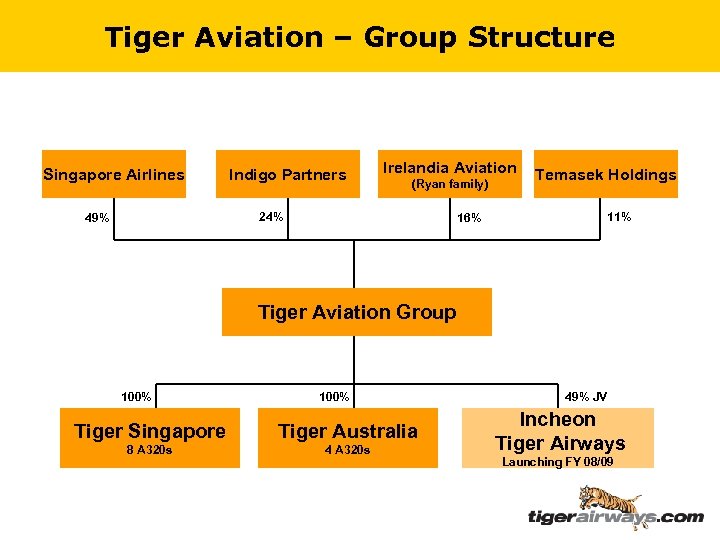
Tiger Aviation – Group Structure Singapore Airlines Indigo Partners Irelandia Aviation (Ryan family) 24% 49% Temasek Holdings 11% 16% Tiger Aviation Group 100% Tiger Singapore Tiger Australia 8 A 320 s 49% JV Incheon Tiger Airways Launching FY 08/09
Recent Highlights • • • More than 3 years of operations and carried in excess of 5 million passengers Network from Singapore expanded to include additional services to Mainland China, India, Australia and Malaysia Tiger Airways is the biggest low cost airline to mainland China (by passengers carried) Fleet of new aircraft increased to 12 in service with a further 60 deliveries scheduled through to 2016 Widest geographic coverage in Asia Pacific with single fleet type and ETOPS long-range services Several industry leading product innovations increasing ancillary revenues including flight ‘combo’s’ – allowing passengers to book flights from Singapore to Melbourne via Darwin (for example) CAPA Award for Best Low Cost Airline in 2006 Passenger numbers increased by 50% in FY 2007/08 Pilot Cadet Training Scheme in Australia to be launched
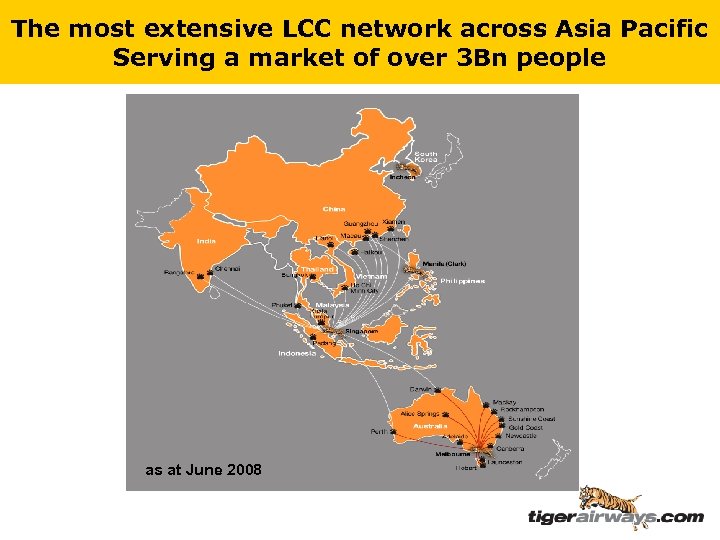
The most extensive LCC network across Asia Pacific Serving a market of over 3 Bn people as at June 2008
Tiger Aviation – Disciplined Low Cost Carrier
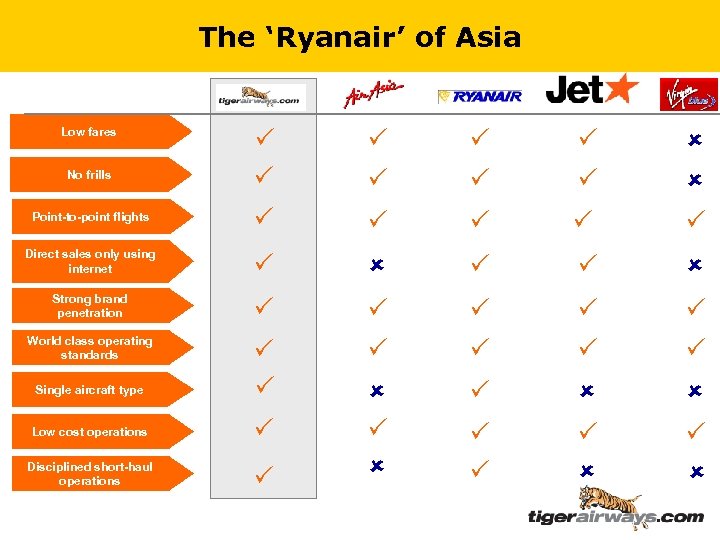
The ‘Ryanair’ of Asia Direct sales only using internet Strong brand penetration World class operating standards Low fares No frills Point-to-point flights Single aircraft type Low cost operations Disciplined short-haul operations
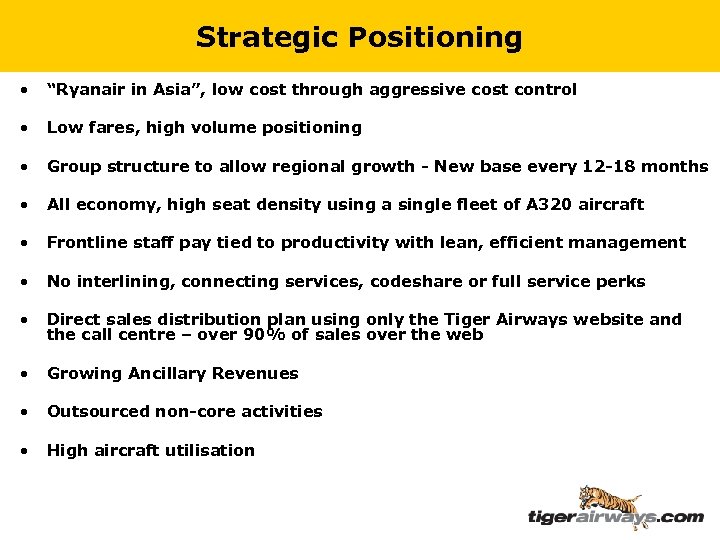
Strategic Positioning • “Ryanair in Asia”, low cost through aggressive cost control • Low fares, high volume positioning • Group structure to allow regional growth - New base every 12 -18 months • All economy, high seat density using a single fleet of A 320 aircraft • Frontline staff pay tied to productivity with lean, efficient management • No interlining, connecting services, codeshare or full service perks • Direct sales distribution plan using only the Tiger Airways website and the call centre – over 90% of sales over the web • Growing Ancillary Revenues • Outsourced non-core activities • High aircraft utilisation
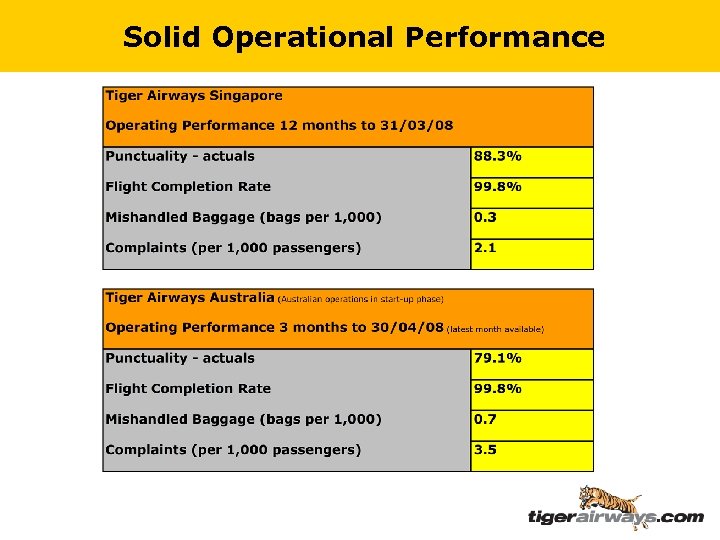
Solid Operational Performance

A Growing Tiger
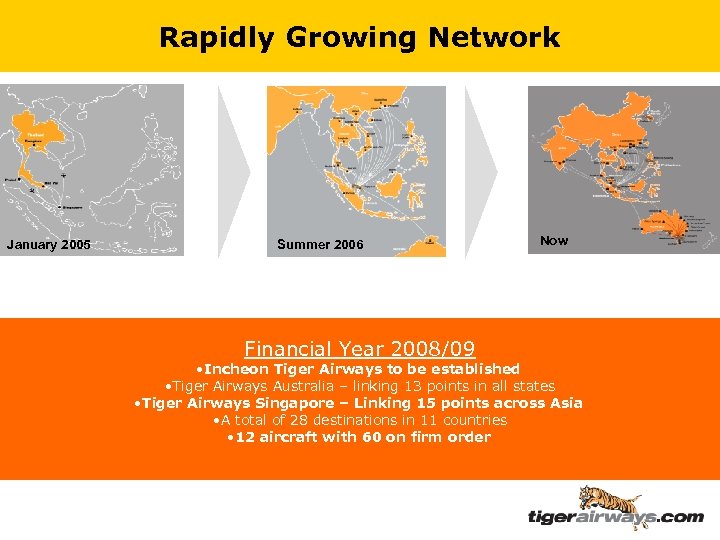
Rapidly Growing Network January 2005 Summer 2006 Financial Year 2008/09 Now • Incheon Tiger Airways to be established • Tiger Airways Australia – linking 13 points in all states • Tiger Airways Singapore – Linking 15 points across Asia • A total of 28 destinations in 11 countries • 12 aircraft with 60 on firm order
Tiger Aviation – Well Positioned
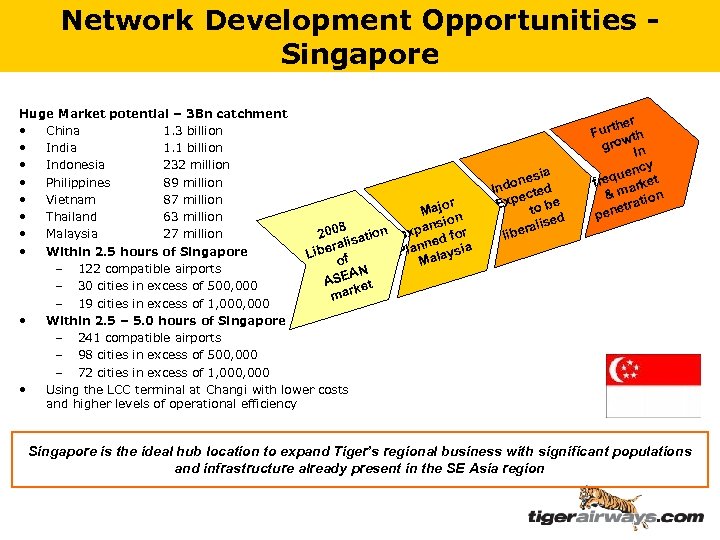
Network Development Opportunities Singapore Huge Market potential – 3 Bn catchment • China 1. 3 billion • India 1. 1 billion • Indonesia 232 million • Philippines 89 million • Vietnam 87 million r Majo n • Thailand 63 million nsio • Malaysia 27 million 2008 sation expa d for ne rali • Within 2. 5 hours of Singapore Plan laysia Libe f o Ma – 122 compatible airports N A ASE et – 30 cities in excess of 500, 000 k mar – 19 cities in excess of 1, 000 • Within 2. 5 – 5. 0 hours of Singapore – 241 compatible airports – 98 cities in excess of 500, 000 – 72 cities in excess of 1, 000 • Using the LCC terminal at Changi with lower costs and higher levels of operational efficiency esia don ed In ect Exp to be ised eral lib her Furt th grow In ncy que ket fre ar & m tion tra ene p Singapore is the ideal hub location to expand Tiger’s regional business with significant populations and infrastructure already present in the SE Asia region
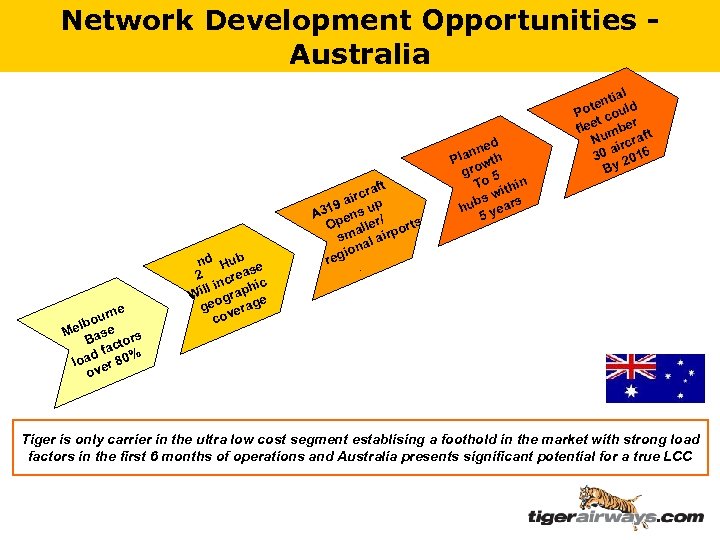
Network Development Opportunities Australia ne our lb Me ase rs B cto d fa % loa er 80 ov nd Hub e as 2 cre ic h l in Wil ograp e ge verag co aft ircr p 9 a A 31 ens u / Op aller orts sm l airp ona egi r ed ann th Pl w gro 5 To ithin w ubs ears h 5 y tial ten uld Po co t r flee mbe ft Nu ircra a 30 2016 By Tiger is only carrier in the ultra low cost segment establising a foothold in the market with strong load factors in the first 6 months of operations and Australia presents significant potential for a true LCC
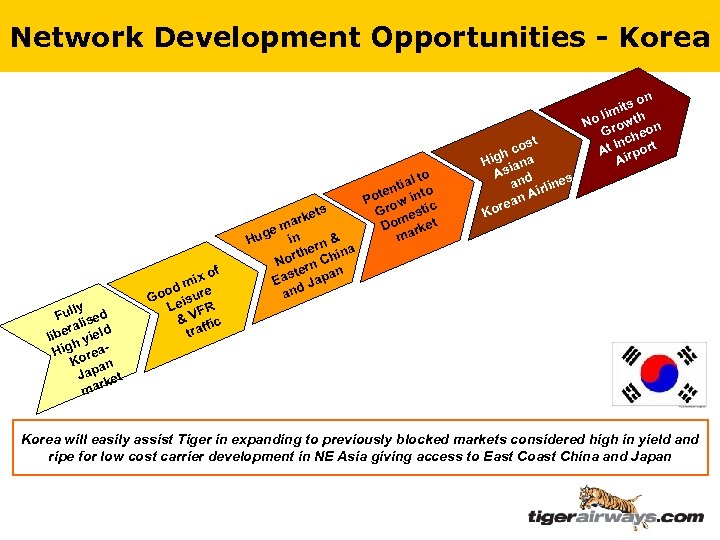
Network Development Opportunities - Korea ly Ful ised ral d libe h yiel Hig orea. K an Jap ket r ma f ix o m od e Go eisur L FR & V fic traf ets ark m uge in H rn & the hina r No rn C n te Eas Japa and to tial o en t Pot ow in c Gr esti m Do arket m ost hc a Hig ian As d an irlines n. A rea Ko on its lim No rowth n G eo nch rt I At irpo A Korea will easily assist Tiger in expanding to previously blocked markets considered high in yield and ripe for low cost carrier development in NE Asia giving access to East Coast China and Japan

How do we achieve this growth?
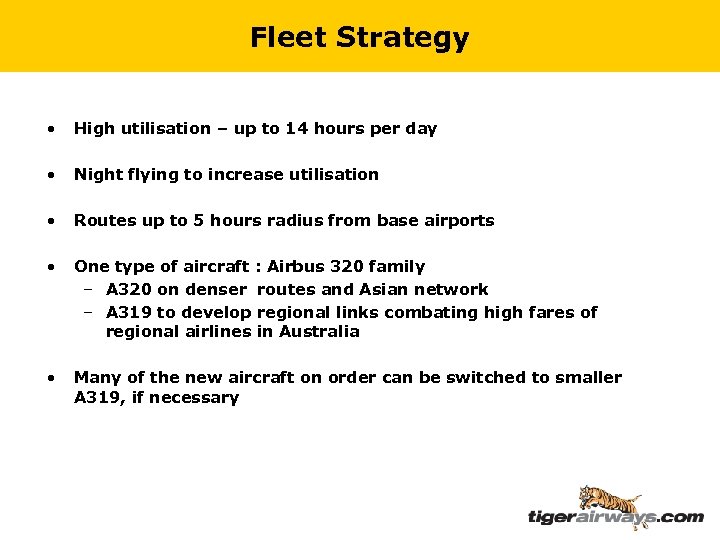
Fleet Strategy • High utilisation – up to 14 hours per day • Night flying to increase utilisation • Routes up to 5 hours radius from base airports • One type of aircraft : Airbus 320 family – A 320 on denser routes and Asian network – A 319 to develop regional links combating high fares of regional airlines in Australia • Many of the new aircraft on order can be switched to smaller A 319, if necessary
Fleet Expansion – 72 aircraft in Tiger Airways fleet by 2016 – Deployed in operating bases across Singapore, Australia, Korea and additional Asian bases – Investment in aircraft exceeds US $ 4. 3 bn
Tiger Aviation – What’s next?
Overview of the market in Australia • With rising fuel costs the incumbent airlines are scrambling to reduce costs after years of excessive profits. • Other major airlines are grounding aircraft, reducing or pulling out of routes • Tiger Airways Australia has the lowest cost base and is the low fare market leader • Tiger Airways has a fantastic opportunity to fill the gap left by the incumbents especially to more regional areas. • Exploring all opportunities to operate International Services utilising Australian based crews and aircraft
Overview of the market in SE Asia • Tiger Airways is the only low cost airline to operate in all of the world’s leading growth markets (India, China and SE Asia) • Concept of low fare airlines remains relatively new to Asia, with less than 5% of current passengers travelling on low fares, majority of Asians have never flown but are becoming more confident about travel • Traditional services typically operated by full service carriers using wide bodied aircraft between major airports with relatively low frequency. • Regulatory barriers are greater than in Europe or North America but are slowly being through the ASEAN Roadmap
The next opportunity – North Asia Incheon Tiger Airways will be first major low cost carrier to be established in North East Asia The region has some of the strongest growth economies in the world and access to key growth markets on China’s East Coast – 1 billion people live within 2 hours flying time of Incheon. Korea has liberal agreements with China and Japan (with restrictions on some metros such as Tokyo) Traffic rights are also expected to be available to existing Tiger Airways destinations such as Macau and Clark (The Philippines).
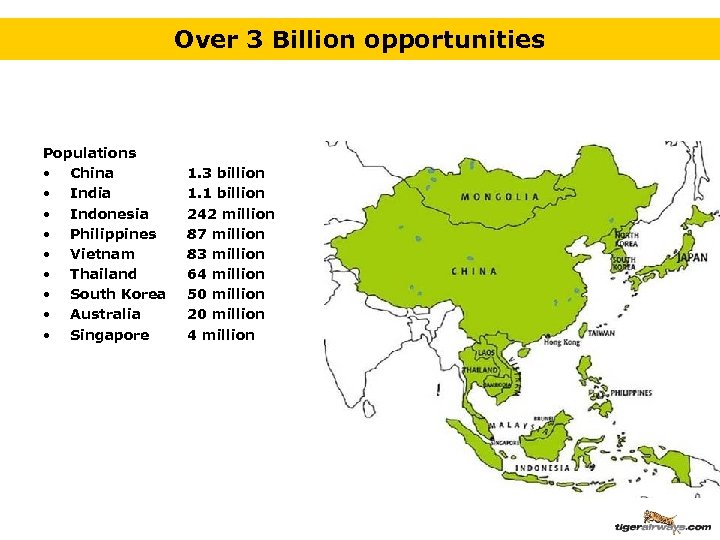
Over 3 Billion opportunities Populations • China • India • Indonesia • Philippines • Vietnam • Thailand • South Korea • Australia • Singapore 1. 3 billion 1. 1 billion 242 million 87 million 83 million 64 million 50 million 20 million 4 million
Tiger Aviation – Summary
Tiger Aviation – In Summary • Tiger Airways is and will continue to be an important part of the Australian aviation market. • Real competition has finally arrived and the winners are the Australian traveling public – they want our low fares. • Tiger Airways is committed to long term growth across the Asia Pacific region, supported by a firm order of 60 additional aircraft by 2016. • The low fare revolution has arrived in Australia and its here to stay !
Thank You
Скачать презентацию The birth of a new beast BITRE COLLOQUIUM
0a51e3dfa494e22fd74dabbecc5d34a2.ppt