 Скачать презентацию The Bernays-Schönfinkel Fragment of First-Order Autoepistemic Logic Peter
7f25a4f142be69c874853df73c4e9fa2.ppt
- Количество слайдов: 22



The Bernays-Schönfinkel Fragment of First-Order Autoepistemic Logic Peter Baumgartner MPI Informatik, Saarbrücken The BS Fragment of FO AEL
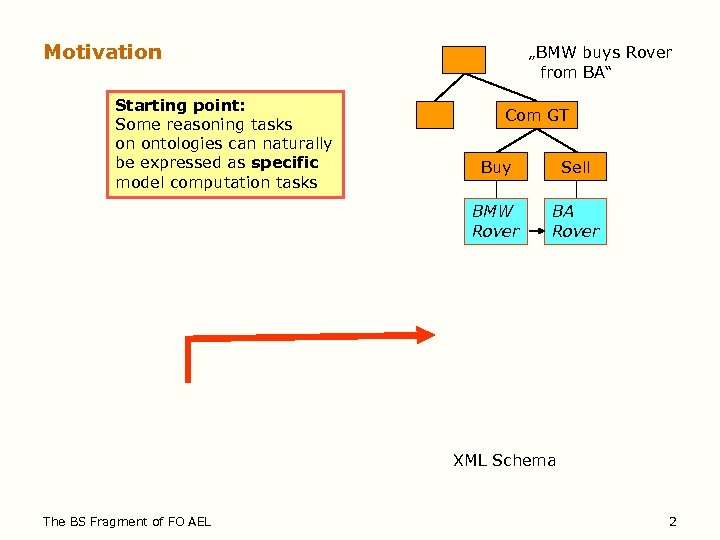
Motivation Starting point: Some reasoning tasks on ontologies can naturally be expressed as specific model computation tasks „BMW buys Rover from BA“ Com GT Buy Sell BMW Rover BA Rover XML Schema The BS Fragment of FO AEL 2
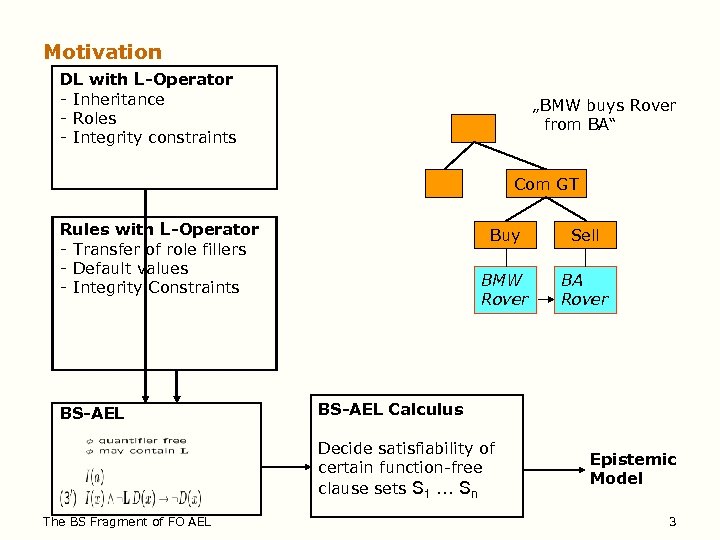
Motivation DL with L-Operator - Inheritance - Roles - Integrity constraints „BMW buys Rover from BA“ Com GT Rules with L-Operator - Transfer of role fillers - Default values - Integrity Constraints BS-AEL Buy Sell BMW Rover BA Rover BS-AEL Calculus Decide satisfiability of certain function-free clause sets S 1 … Sn The BS Fragment of FO AEL Epistemic Model 3
Contents • Semantics of Propositional Autoepistemic Logic • Semantics of First-Order Autoepistemic Logic • Transformation of Bernays-Schönfinkel Fragment of Autoepistemic Logic to clausal-like form • Calculus to compute epistemic models for clausal-like forms The BS Fragment of FO AEL 4
Propositional Autoepistemic Logic The BS Fragment of FO AEL 5
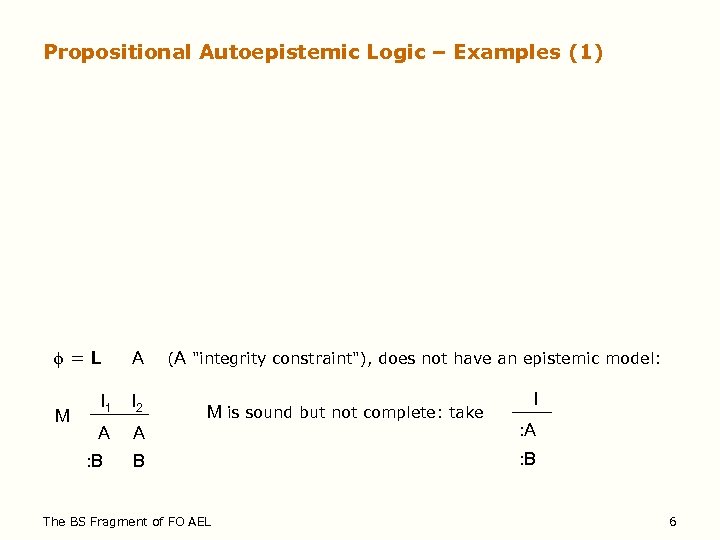
Propositional Autoepistemic Logic – Examples (1) =L M A (A "integrity constraint"), does not have an epistemic model: I I 1 I 2 A A : A B : B M is sound but not complete: take The BS Fragment of FO AEL 6
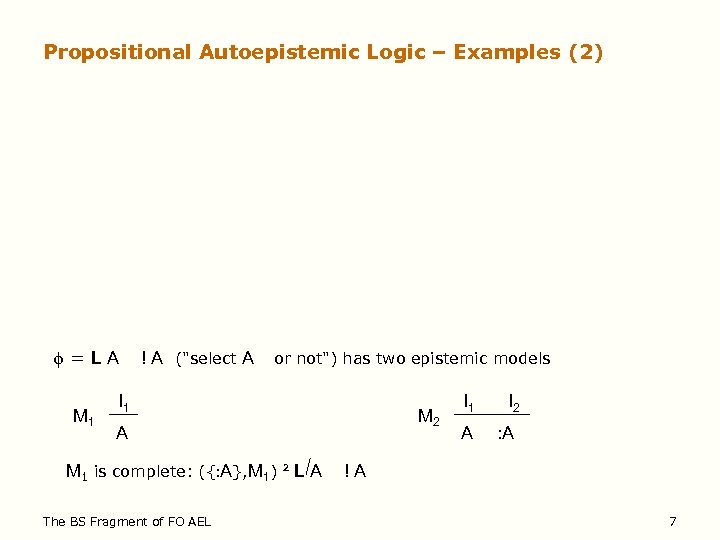
Propositional Autoepistemic Logic – Examples (2) =LA M 1 ! A ("select A or not") has two epistemic models I 1 M 2 A M 1 is complete: ({: A}, M 1) ² L A The BS Fragment of FO AEL I 1 A I 2 : A !A 7
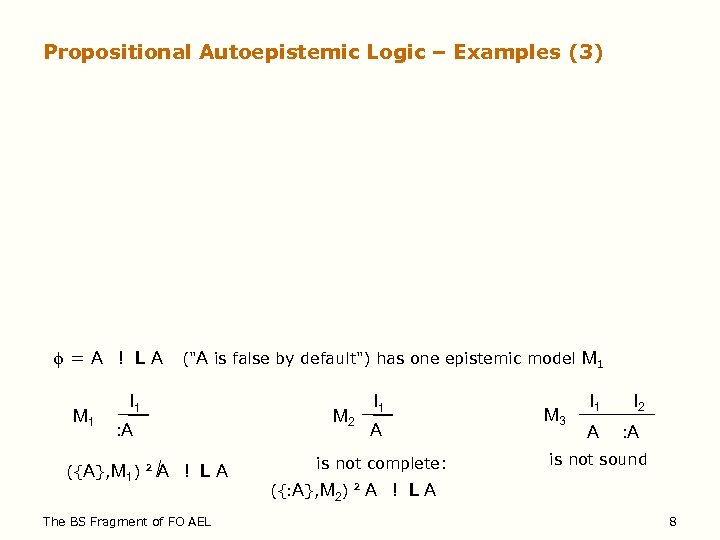
Propositional Autoepistemic Logic – Examples (3) =A ! LA M 1 ("A is false by default") has one epistemic model M 1 I 1 : A ({A}, M 1) ² A ! L A The BS Fragment of FO AEL M 2 I 1 A is not complete: M 3 I 1 A I 2 : A is not sound ({: A}, M 2) ² A ! L A 8
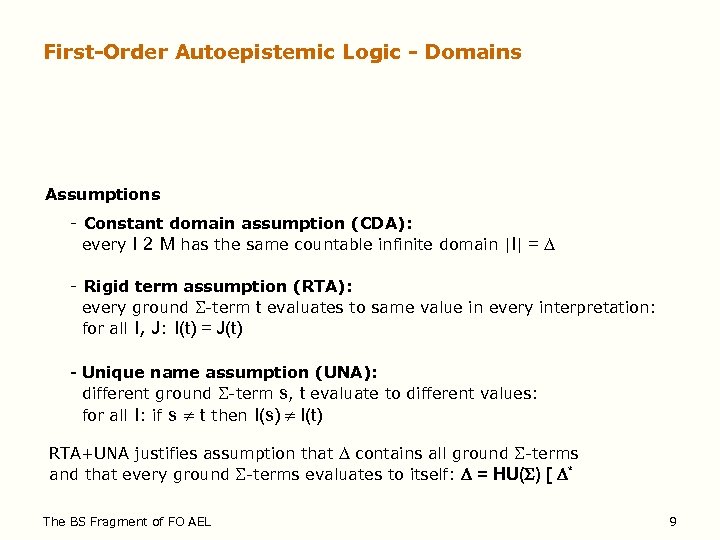
First-Order Autoepistemic Logic - Domains Assumptions - Constant domain assumption (CDA): every I 2 M has the same countable infinite domain |I| = - Rigid term assumption (RTA): every ground -term t evaluates to same value in every interpretation: for all I, J: I(t) = J(t) - Unique name assumption (UNA): different ground -term s, t evaluate to different values: for all I: if s t then I(s) I(t) RTA+UNA justifies assumption that contains all ground -terms and that every ground -terms evaluates to itself: = HU( ) [ * The BS Fragment of FO AEL 9
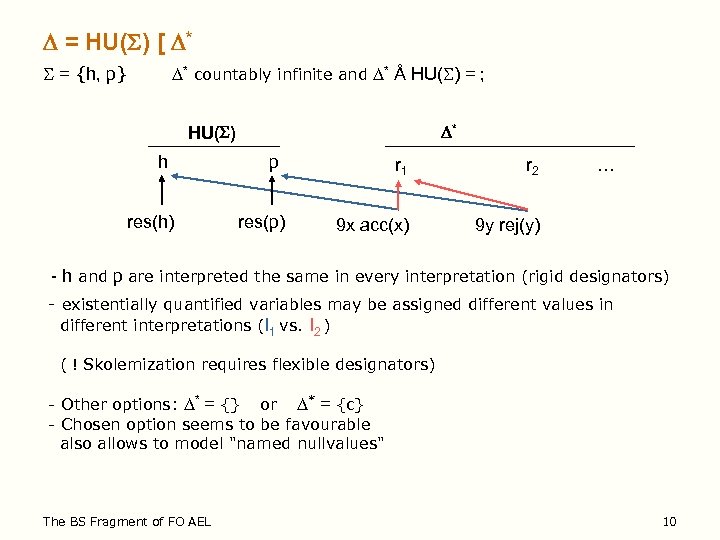
= HU( ) [ * = {h, p} * countably infinite and * Å HU( ) = ; * HU( ) h res(h) p res(p) r 1 r 2 9 x acc(x) 9 y rej(y) . . . - h and p are interpreted the same in every interpretation (rigid designators) - existentially quantified variables may be assigned different values in different interpretations (I 1 vs. I 2 ) ( ! Skolemization requires flexible designators) - Other options: * = {} or * = {c} - Chosen option seems to be favourable also allows to model "named nullvalues" The BS Fragment of FO AEL 10
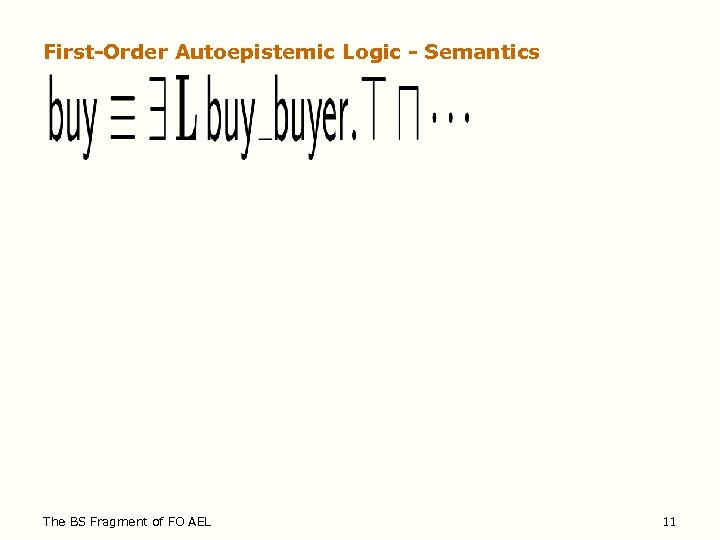
First-Order Autoepistemic Logic - Semantics The BS Fragment of FO AEL 11
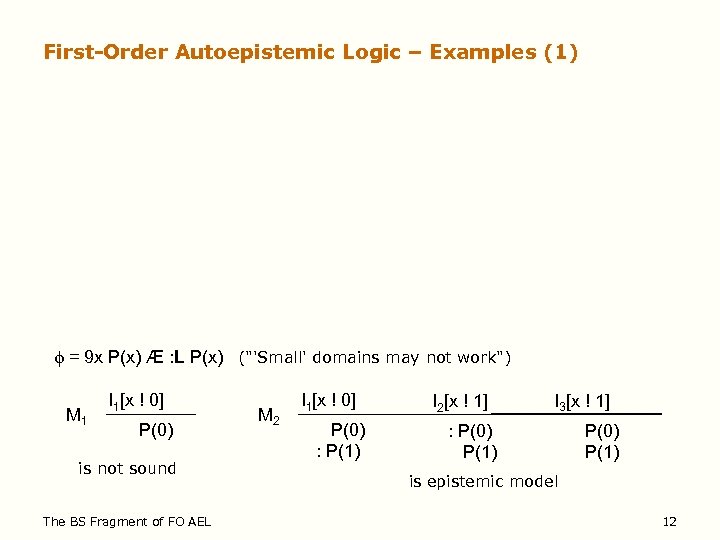
First-Order Autoepistemic Logic – Examples (1) = 9 x P(x) Æ : L P(x) ("'Small' domains may not work") M 1 I 1[x ! 0] P(0) is not sound The BS Fragment of FO AEL M 2 I 1[x ! 0] P(0) : P(1) I 2[x ! 1] I 3[x ! 1] : P(0) P(1) is epistemic model 12
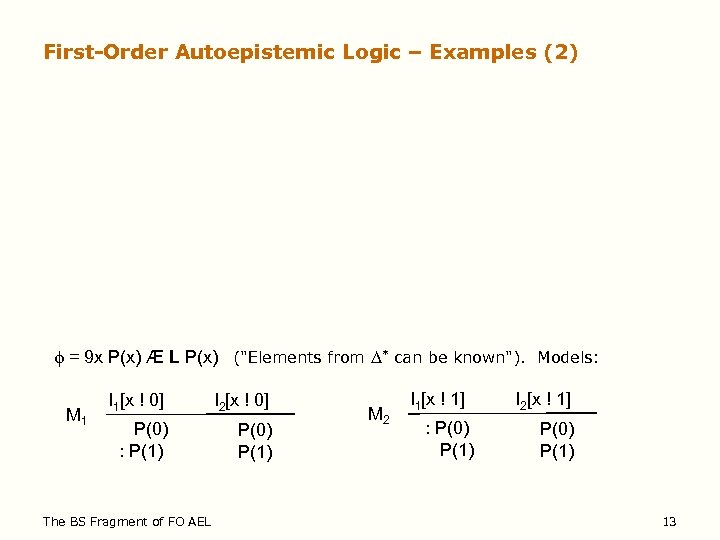
First-Order Autoepistemic Logic – Examples (2) = 9 x P(x) Æ L P(x) ("Elements from * can be known"). Models: M 1 I 1[x ! 0] I 2[x ! 0] P(0) : P(1) P(0) P(1) The BS Fragment of FO AEL M 2 I 1[x ! 1] : P(0) P(1) I 2[x ! 1] P(0) P(1) 13
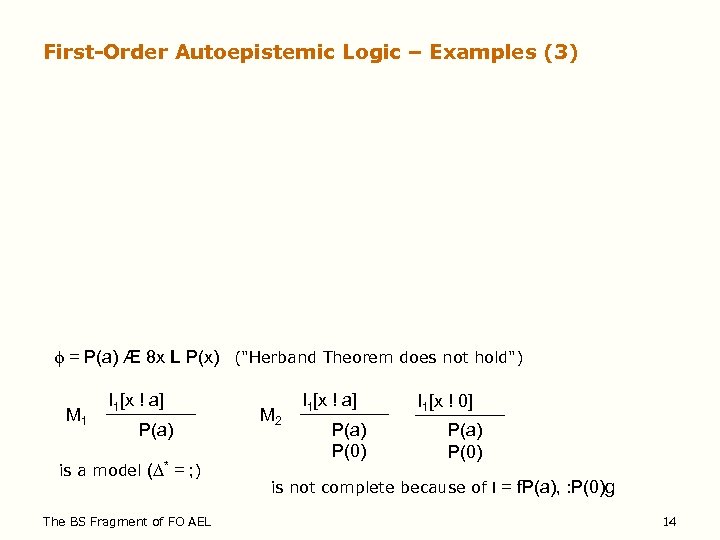
First-Order Autoepistemic Logic – Examples (3) = P(a) Æ 8 x L P(x) ("Herband Theorem does not hold") M 1 I 1[x ! a] P(a) is a model ( * = ; ) The BS Fragment of FO AEL M 2 I 1[x ! a] P(a) P(0) I 1[x ! 0] P(a) P(0) is not complete because of I = f. P(a), : P(0)g 14
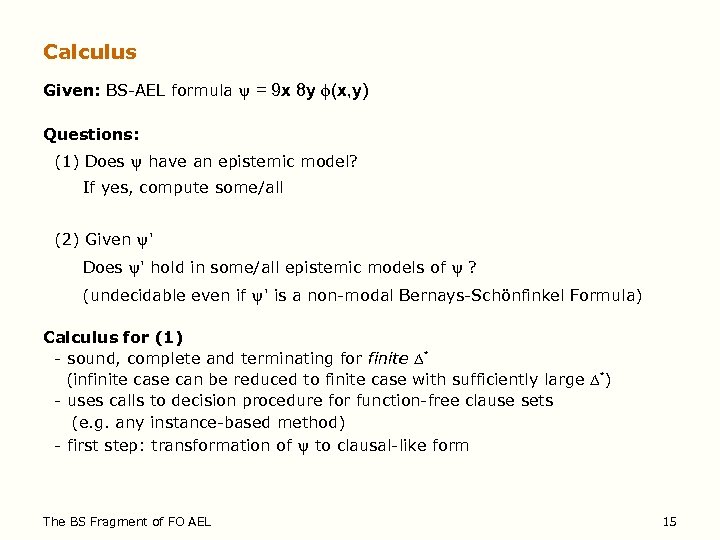
Calculus Given: BS-AEL formula = 9 x 8 y (x, y) Questions: (1) Does have an epistemic model? If yes, compute some/all (2) Given ' Does ' hold in some/all epistemic models of ? (undecidable even if ' is a non-modal Bernays-Schönfinkel Formula) Calculus for (1) - sound, complete and terminating for finite * (infinite case can be reduced to finite case with sufficiently large *) - uses calls to decision procedure for function-free clause sets (e. g. any instance-based method) - first step: transformation of to clausal-like form The BS Fragment of FO AEL 15
![Skolemization causes Problems [Baader, Hollunder 95] a R D C Ø Ø Ø (1)](https://present5.com/presentation/7f25a4f142be69c874853df73c4e9fa2/image-16.jpg "Skolemization causes Problems [Baader, Hollunder 95] a R D C Ø Ø Ø (1)")
Skolemization causes Problems [Baader, Hollunder 95] a R D C Ø Ø Ø (1) implies (2) But from (1) and (3), (4) does not follow So, consequences depend from syntax! Possible Solution (not here) Apply rules to known objects only, those explicitly mentioned: The BS Fragment of FO AEL 16
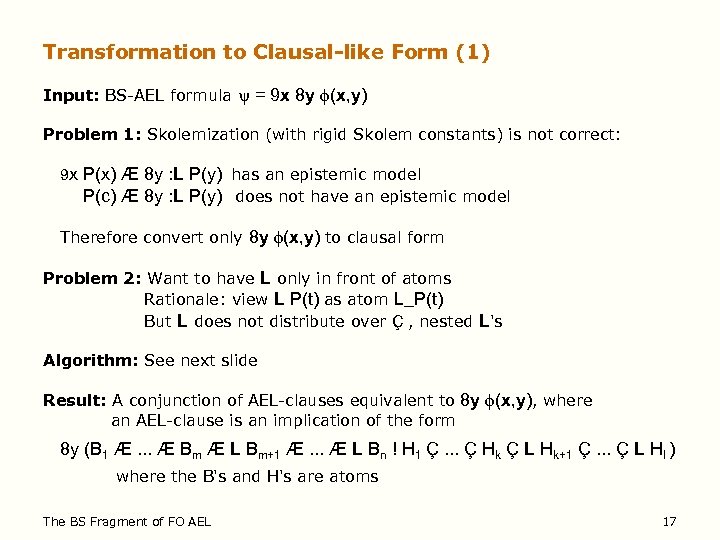
Transformation to Clausal-like Form (1) Input: BS-AEL formula = 9 x 8 y (x, y) Problem 1: Skolemization (with rigid Skolem constants) is not correct: 9 x P(x) Æ 8 y : L P(y) has an epistemic model P(c) Æ 8 y : L P(y) does not have an epistemic model Therefore convert only 8 y (x, y) to clausal form Problem 2: Want to have L only in front of atoms Rationale: view L P(t) as atom L_P(t) But L does not distribute over Ç , nested L's Algorithm: See next slide Result: A conjunction of AEL-clauses equivalent to 8 y (x, y), where an AEL-clause is an implication of the form 8 y (B 1 Æ. . . Æ Bm Æ L Bm+1 Æ. . . Æ L Bn ! H 1 Ç. . . Ç Hk Ç L Hk+1 Ç. . . Ç L Hl ) where the B's and H's are atoms The BS Fragment of FO AEL 17
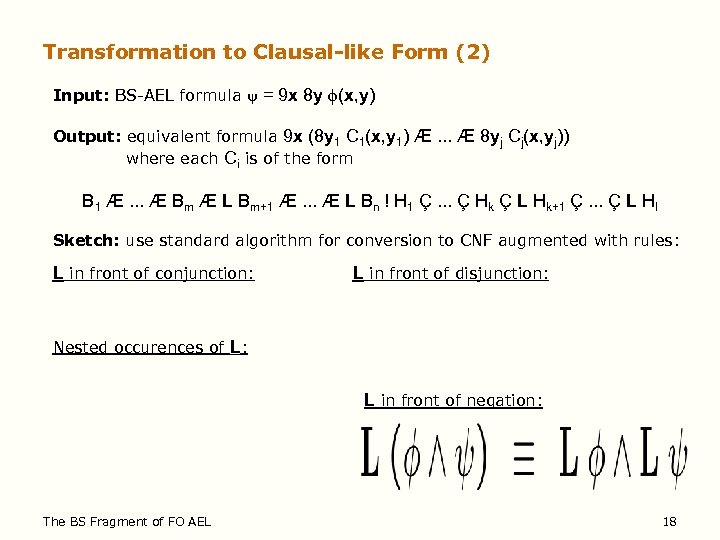
Transformation to Clausal-like Form (2) Input: BS-AEL formula = 9 x 8 y (x, y) Output: equivalent formula 9 x (8 y 1 C 1(x, y 1) Æ. . . Æ 8 yj Cj(x, yj)) where each Ci is of the form B 1 Æ. . . Æ Bm Æ L Bm+1 Æ. . . Æ L Bn ! H 1 Ç. . . Ç Hk Ç L Hk+1 Ç. . . Ç L Hl Sketch: use standard algorithm for conversion to CNF augmented with rules: L in front of conjunction: L in front of disjunction: Nested occurences of L: L in front of negation: The BS Fragment of FO AEL 18
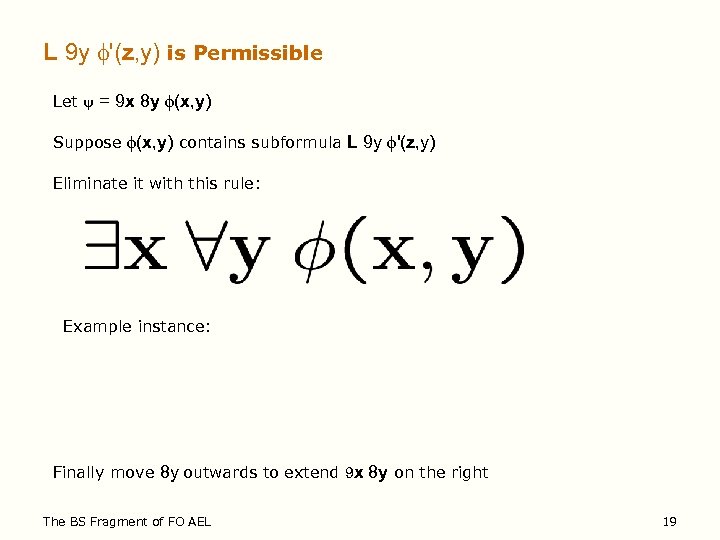
L 9 y '(z, y) is Permissible Let = 9 x 8 y (x, y) Suppose (x, y) contains subformula L 9 y '(z, y) Eliminate it with this rule: Example instance: Finally move 8 y outwards to extend 9 x 8 y on the right The BS Fragment of FO AEL 19
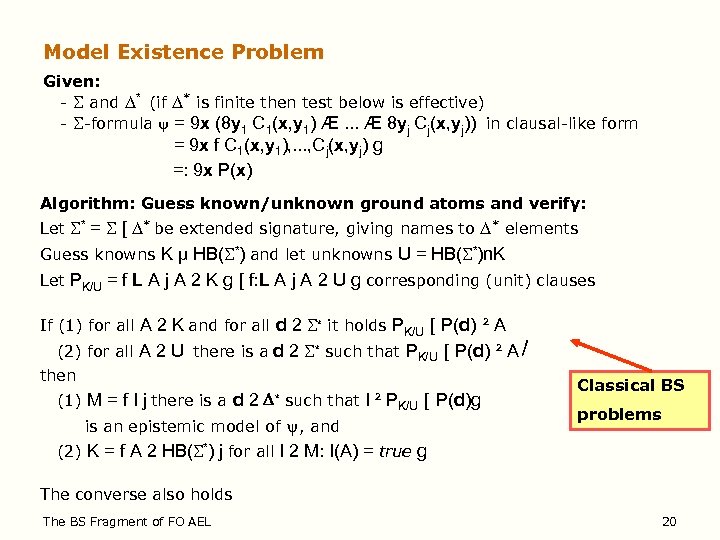
Model Existence Problem Given: - and * (if * is finite then test below is effective) - -formula = 9 x (8 y 1 C 1(x, y 1) Æ. . . Æ 8 yj Cj(x, yj)) in clausal-like form = 9 x f C 1(x, y 1), . . . , Cj(x, yj) g =: 9 x P(x) Algorithm: Guess known/unknown ground atoms and verify: Let * = [ * be extended signature, giving names to * elements Guess knowns K µ HB( *) and let unknowns U = HB( *)n. K Let PK/U = f L A j A 2 K g [ f: L A j A 2 U g corresponding (unit) clauses If (1) for all A 2 K and for all d 2 * it holds PK/U [ P(d) ² A (2) for all A 2 U there is a d 2 * such that PK/U [ P(d) ² A then (1) M = f I j there is a d 2 * such that I ² PK/U [ P(d)g is an epistemic model of , and Classical BS problems (2) K = f A 2 HB( *) j for all I 2 M: I(A) = true g The converse also holds The BS Fragment of FO AEL 20
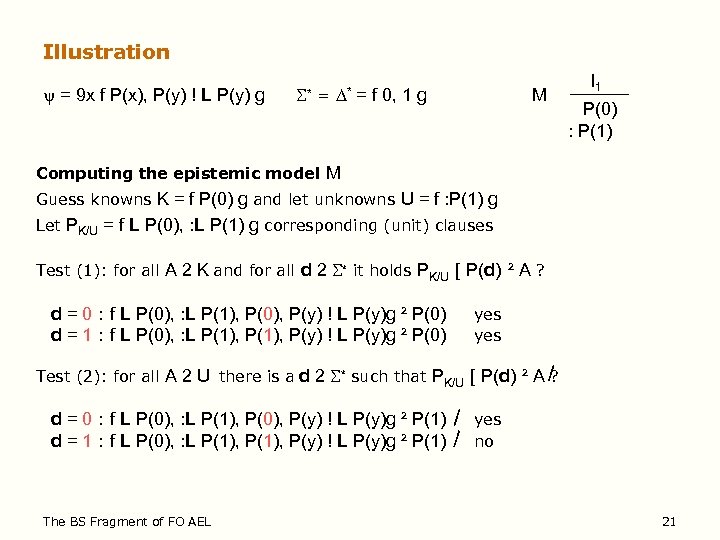
Illustration = 9 x f P(x), P(y) ! L P(y) g * = f 0, 1 g M I 1 P(0) : P(1) Computing the epistemic model M Guess knowns K = f P(0) g and let unknowns U = f : P(1) g Let PK/U = f L P(0), : L P(1) g corresponding (unit) clauses Test (1): for all A 2 K and for all d 2 * it holds PK/U [ P(d) ² A ? d = 0 : f L P(0), : L P(1), P(0), P(y) ! L P(y)g ² P(0) d = 1 : f L P(0), : L P(1), P(y) ! L P(y)g ² P(0) yes Test (2): for all A 2 U there is a d 2 * such that PK/U [ P(d) ² A ? d = 0 : f L P(0), : L P(1), P(0), P(y) ! L P(y)g ² P(1) d = 1 : f L P(0), : L P(1), P(y) ! L P(y)g ² P(1) The BS Fragment of FO AEL yes no 21
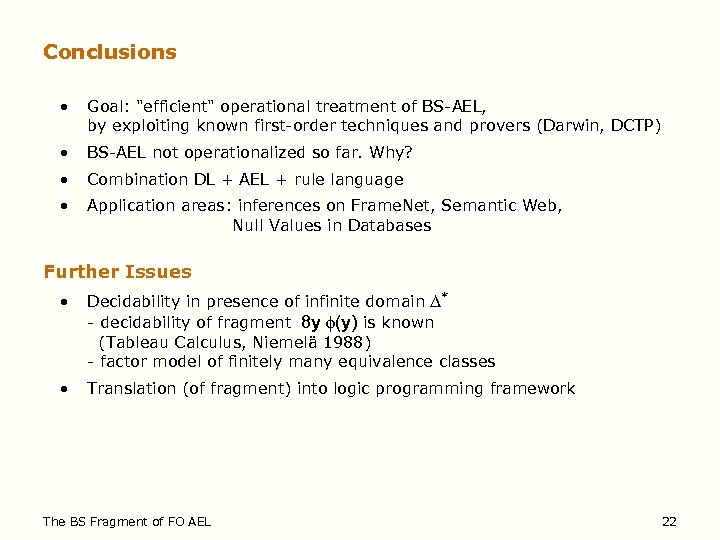
Conclusions • Goal: "efficient" operational treatment of BS-AEL, by exploiting known first-order techniques and provers (Darwin, DCTP) • BS-AEL not operationalized so far. Why? • Combination DL + AEL + rule language • Application areas: inferences on Frame. Net, Semantic Web, Null Values in Databases Further Issues • Decidability in presence of infinite domain * - decidability of fragment 8 y (y) is known (Tableau Calculus, Niemelä 1988) - factor model of finitely many equivalence classes • Translation (of fragment) into logic programming framework The BS Fragment of FO AEL 22
Скачать презентацию The Bernays-Schönfinkel Fragment of First-Order Autoepistemic Logic Peter
7f25a4f142be69c874853df73c4e9fa2.ppt