 Скачать презентацию The Bees Algorithm and Its Applications Dr Ziad
3f9c6bb74ae885327bfbdcec856cf079.ppt
- Количество слайдов: 74



The Bees Algorithm, and Its Applications Dr. Ziad Salem, HDD, Ph. D, Bs. C. Spezs 1@hotmail. com Computer Engineering Department Electrical and Electronic Engineering Faculty Aleppo University, Aleppo, Syrian Arab Republic Masaryk University, Brno, Czech Republic , Wed 08 Apr 2009 1
Outlines Introduction Intelligent Swarm –based optimisation The Bees Algorithm Bees in Nature Proposed Bees Algorithm Simple Example BA Applications to Data mining Conclusion Masaryk University, Brno, Czech Republic , Wed 08 Apr 2009 2
Introduction There was a great interest between researchers to generate search algorithms that find near-optimal solutions in reasonable running time The Swarm-based Algorithm is a search algorithm capable of locating good solutions efficiently The algorithm could be considered as belonging to the category of “Intelligent Optimisation Tools” Masaryk University, Brno, Czech Republic , Wed 08 Apr 2009 3
Swarm-based Optimisation Algorithm SOAs mince nature’s methods to derive a search towards the optimal solution The key difference between SOAs and direct search algorithms such as Hill Climbing is that SOAs use a population of solutions for every iteration instead of a single solution As a population of solutions is processed in an iteration, the outcome of each iteration is also a population of solutions Masaryk University, Brno, Czech Republic , Wed 08 Apr 2009 4
Hill Climbing Is a mathematical optimization technique which belongs to the family of local search It can be used to solve problems that have many solutions, some of which are better than others It starts with a random (potentially poor) solution, and iteratively makes small changes to the solution, each time improving it a little. When the algorithm cannot see any improvement anymore, it terminates. Ideally, at that point the current solution is close to optimal, but it is not guaranteed that hill climbing will ever come close 5 to the optimal solution Masaryk University, Brno, Czech Republic , Wed 08 Apr 2009
Hill Climbing It can be applied to the traveling Salesman Problem. It is easy to find a solution that visits all the cities but will be very poor compared to the optimal solution Hill climbing is used widely in AI, for reaching a goal state from a starting node. Masaryk University, Brno, Czech Republic , Wed 08 Apr 2009 6
Swarm-based Optimisation Algorithm If an optimisation problem has a single optimum, SOA population members can be expected to join to that optimum solution If an optimisation problem has multiple optimal solutions, SOA can be used to capture them in its final populations Masaryk University, Brno, Czech Republic , Wed 08 Apr 2009 7
Swarm-based Optimisation Algorithm SOAs include: The Ant Colony Optimisation (ACO) algorithm The Genetic Algorithm (GA) The Particle Swarm Optimisation (PSO) algorithm Others……(Bees Algorithm (BA)) Masaryk University, Brno, Czech Republic , Wed 08 Apr 2009 8
Ant Colony Optimisation (ACO) ACO is a very successful algorithm which emulates the behaviour of real ants Ants are capable of finding the shortest path from the food source to their nest using a chemical substance called pheromone to guide their search A passing lost ant will follow this trail depends on the quality of the pheromone laid on the ground as the ants move Masaryk University, Brno, Czech Republic , Wed 08 Apr 2009 9
Particle Swarm Optimisation (PSO) PSO is an optimisation procedure based on the social behaviour of groups of organisations (for example the flocking of birds and the schooling of fish) Individual solutions in a population are viewed as “particles” that evolve or change their positions with time Each particle modifies its position in search space according to its own experience and also that of a neighbouring particle by remembering that best position visited by itself and its neighbours (combining local and global search methods) 10 Masaryk University, Brno, Czech Republic , Wed 08 Apr 2009
Genetic Algorithm (GA) GA is based on natural selection and genetic recombination GA works by choosing solutions from the current population and then apply genetic operators (such as mutation and crossover) to create a new population GA exploits historical information to speculate on new search areas with improved performance GA advantage: It performs global search Masaryk University, Brno, Czech Republic , Wed 08 Apr 2009 11
SOAs Applications SOA techniques can be used in a number of applications The U. S. military is investigating swarm techniques for controlling vehicles The European Space Agency is thinking about an orbital swarm for self assembly NASA is investigating the use of swarm technology for planetary mapping Masaryk University, Brno, Czech Republic , Wed 08 Apr 2009 12
Application to SOAs in Data Mining Some researchers proposed a Particle Swarm Optimizer as a tool for Data Mining They found that Particle Swarm Optimizers proved to be a suitable candidate for classification tasks Reference Tiago Sousa, Ana Neves, Arlindo Silva, Swarm Optimisation as a New Tool for Data Mining. Proceedings of the 17 th International Symposium on Parallel and Distributed Processing, Page: 144. 2 , 2003, ISBN: 0 -7695 -1926 -1 Masaryk University, Brno, Czech Republic , Wed 08 Apr 2009 13
The Bees Algorithm (BA) Bees in nature Proposed Bees Algorithm Masaryk University, Brno, Czech Republic , Wed 08 Apr 2009 14
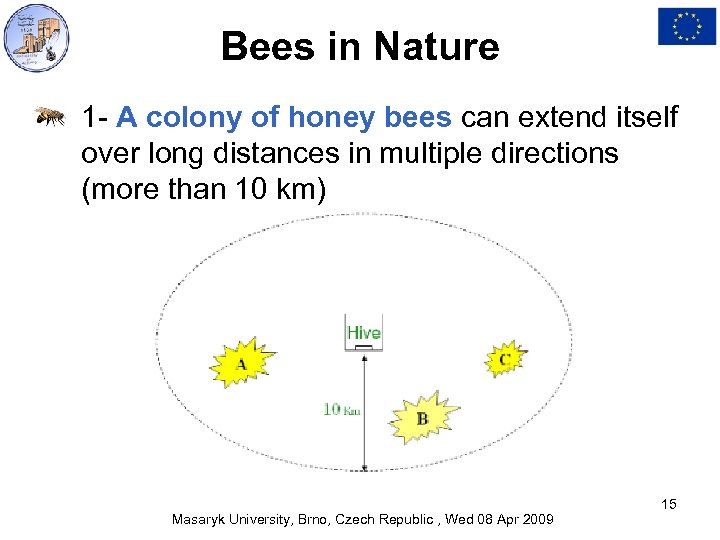
Bees in Nature 1 - A colony of honey bees can extend itself over long distances in multiple directions (more than 10 km) Masaryk University, Brno, Czech Republic , Wed 08 Apr 2009 15
Bees in Nature Flower patches with plentiful amounts of nectar or pollen that can be collected with less effort should be visited by more bees, whereas patches with less nectar or pollen should receive fewer bees Masaryk University, Brno, Czech Republic , Wed 08 Apr 2009 16
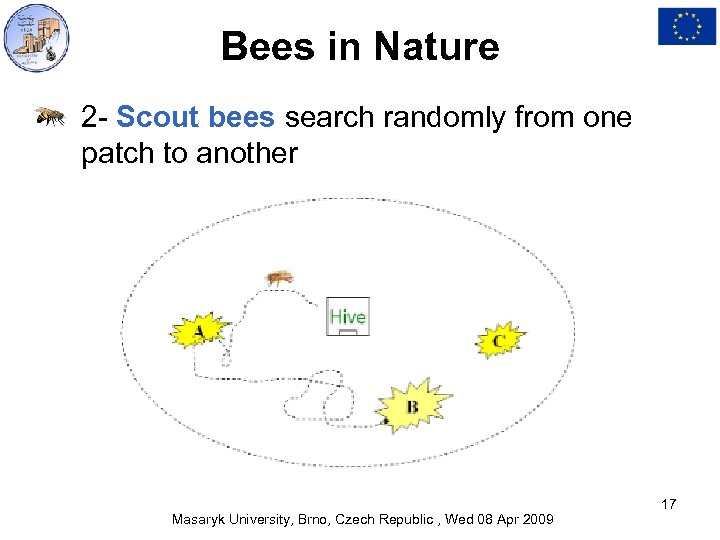
Bees in Nature 2 - Scout bees search randomly from one patch to another Masaryk University, Brno, Czech Republic , Wed 08 Apr 2009 17
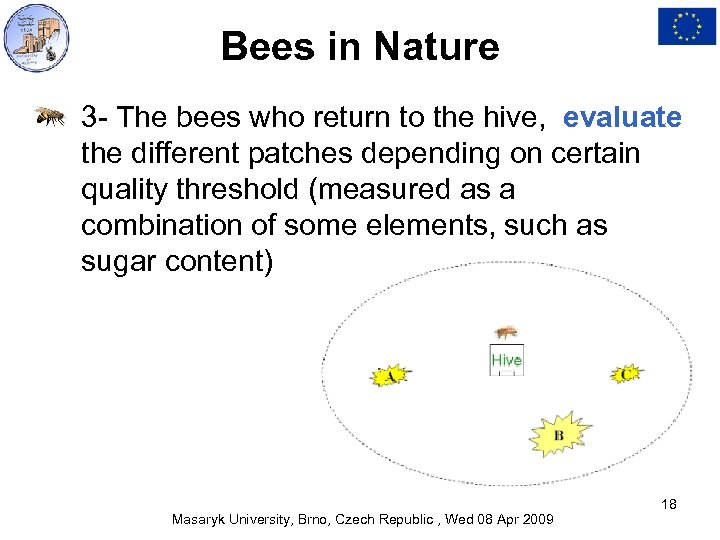
Bees in Nature 3 - The bees who return to the hive, evaluate the different patches depending on certain quality threshold (measured as a combination of some elements, such as sugar content) Masaryk University, Brno, Czech Republic , Wed 08 Apr 2009 18
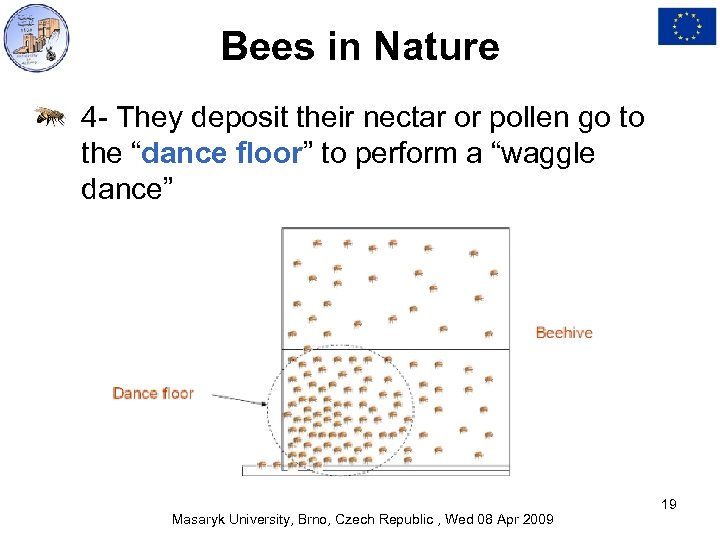
Bees in Nature 4 - They deposit their nectar or pollen go to the “dance floor” to perform a “waggle dance” Masaryk University, Brno, Czech Republic , Wed 08 Apr 2009 19
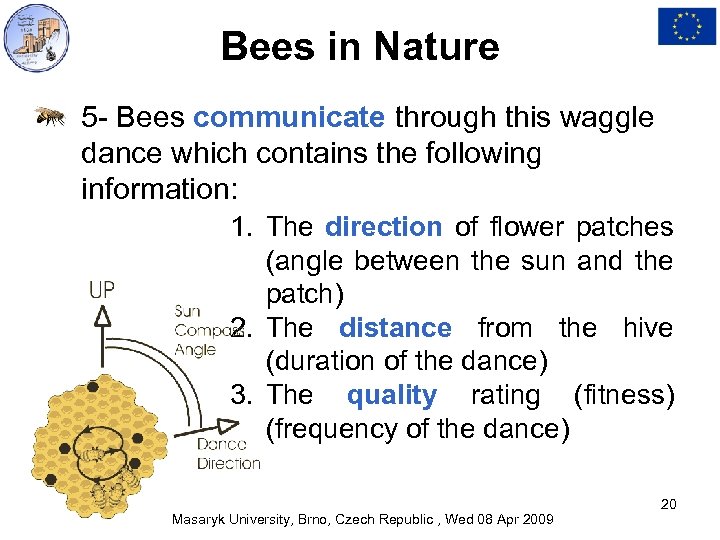
Bees in Nature 5 - Bees communicate through this waggle dance which contains the following information: 1. The direction of flower patches (angle between the sun and the patch) 2. The distance from the hive (duration of the dance) 3. The quality rating (fitness) (frequency of the dance) Masaryk University, Brno, Czech Republic , Wed 08 Apr 2009 20
Bees in Nature These information helps the colony to send its bees precisely 6 - Follower bees go after the dancer bee to the patch to gather food efficiently and quickly Masaryk University, Brno, Czech Republic , Wed 08 Apr 2009 21
Bees in Nature 7 - The same patch will be advertised in the waggle dance again when returning to the hive is it still good enough as a food source (depending on the food level) and more bees will be recruited to that source 8 - More bees visit flower patches with plentiful amounts of nectar or pollen Masaryk University, Brno, Czech Republic , Wed 08 Apr 2009 22
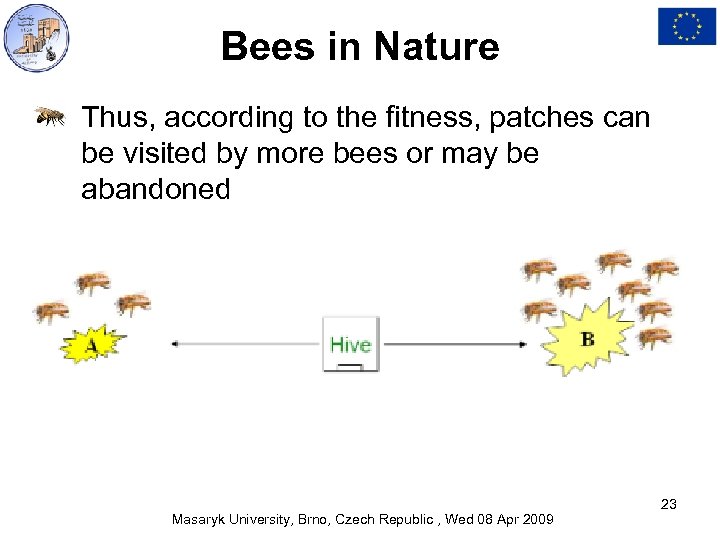
Bees in Nature Thus, according to the fitness, patches can be visited by more bees or may be abandoned Masaryk University, Brno, Czech Republic , Wed 08 Apr 2009 23
Proposed Bees Algorithm (BA) The Bees Algorithm is an optimisation algorithm inspired by the natural foraging behaviour of honey bees to find the optimal solution The following figure shows the pseudo code of the algorithm in its simplest form Masaryk University, Brno, Czech Republic , Wed 08 Apr 2009 24
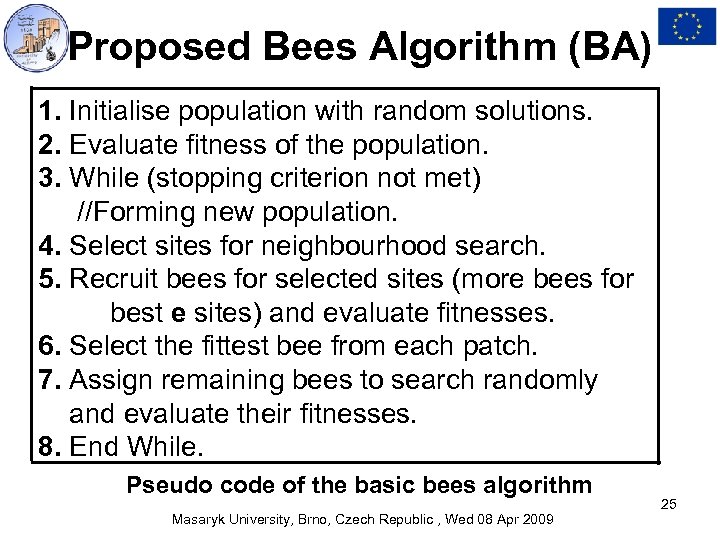
Proposed Bees Algorithm (BA) 1. Initialise population with random solutions. 2. Evaluate fitness of the population. 3. While (stopping criterion not met) //Forming new population. 4. Select sites for neighbourhood search. 5. Recruit bees for selected sites (more bees for best e sites) and evaluate fitnesses. 6. Select the fittest bee from each patch. 7. Assign remaining bees to search randomly and evaluate their fitnesses. 8. End While. Pseudo code of the basic bees algorithm Masaryk University, Brno, Czech Republic , Wed 08 Apr 2009 25
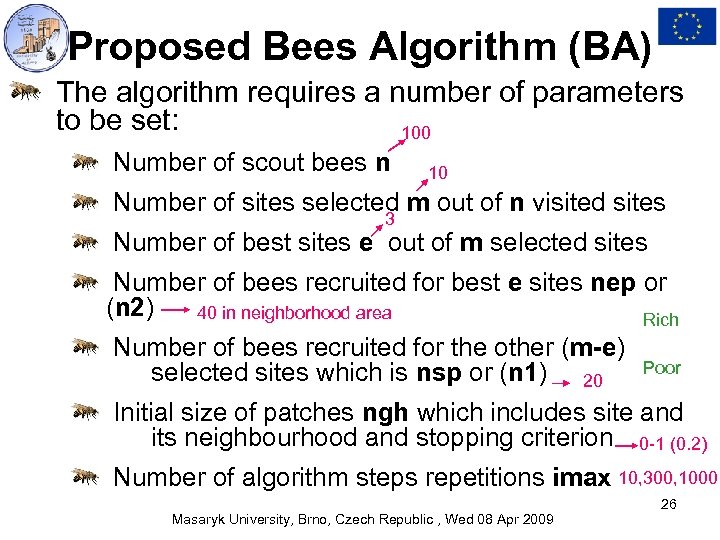
Proposed Bees Algorithm (BA) The algorithm requires a number of parameters to be set: 100 Number of scout bees n 10 Number of sites selected m out of n visited sites 3 Number of best sites e out of m selected sites Number of bees recruited for best e sites nep or (n 2) 40 in neighborhood area Rich Number of bees recruited for the other (m-e) selected sites which is nsp or (n 1) 20 Poor Initial size of patches ngh which includes site and its neighbourhood and stopping criterion 0 -1 (0. 2) Number of algorithm steps repetitions imax 10, 300, 1000 Masaryk University, Brno, Czech Republic , Wed 08 Apr 2009 26
Proposed Bees Algorithm (BA) The following figure shows the flowchart of the Basic Bees Algorithm Masaryk University, Brno, Czech Republic , Wed 08 Apr 2009 27
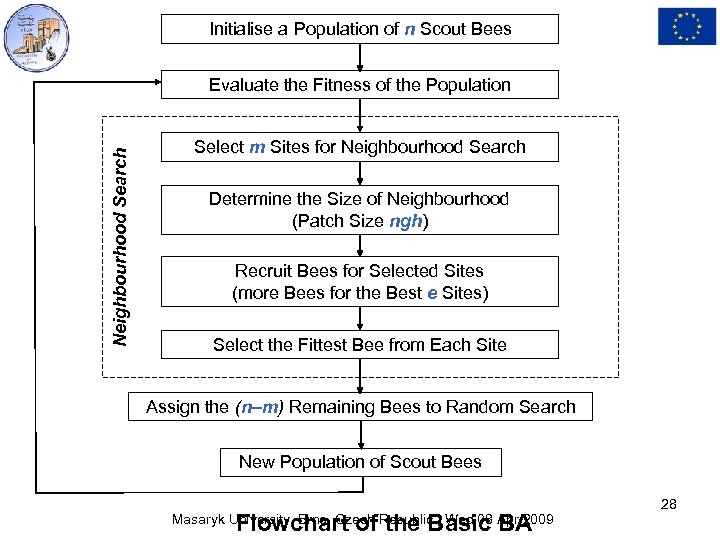
Initialise a Population of n Scout Bees Neighbourhood Search Evaluate the Fitness of the Population Select m Sites for Neighbourhood Search Determine the Size of Neighbourhood (Patch Size ngh) Recruit Bees for Selected Sites (more Bees for the Best e Sites) Select the Fittest Bee from Each Site Assign the (n–m) Remaining Bees to Random Search New Population of Scout Bees Flowchart of the Basic BA Masaryk University, Brno, Czech Republic , Wed 08 Apr 2009 28
Proposed Bees Algorithm (BA) The following is a description of the algorithm steps 1 - The algorithm starts with the n scout bees being placed randomly in the search space. (for example n=100) Masaryk University, Brno, Czech Republic , Wed 08 Apr 2009 29
Proposed Bees Algorithm (BA) 2 - The fitnesses of the sites visited by the scout bees after return are evaluated in step 2 as follow: The first scout bee is taken and trained with the data. (for example: if we get 200 correct answer out of 1000 record, the bee will give the evolution of 20%) The second scout bee is taken and the same process is repeated and we my get 50% The processes will be repeated on the all scout bees and evaluated through evaluation function known as Fitness, which changes upon the studied 30 Masaryk University, Brno, Czech Republic , Wed 08 Apr 2009 problem
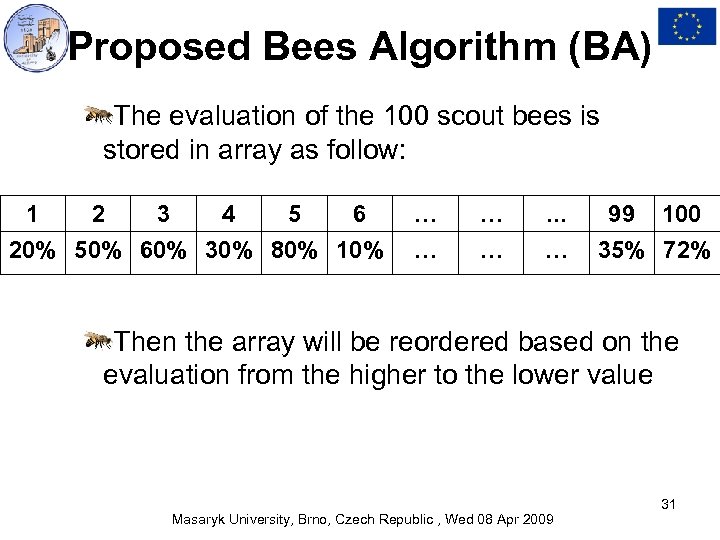
Proposed Bees Algorithm (BA) The evaluation of the 100 scout bees is stored in array as follow: 1 2 3 4 5 6 20% 50% 60% 30% 80% 10% … … . . . … 99 100 35% 72% Then the array will be reordered based on the evaluation from the higher to the lower value Masaryk University, Brno, Czech Republic , Wed 08 Apr 2009 31
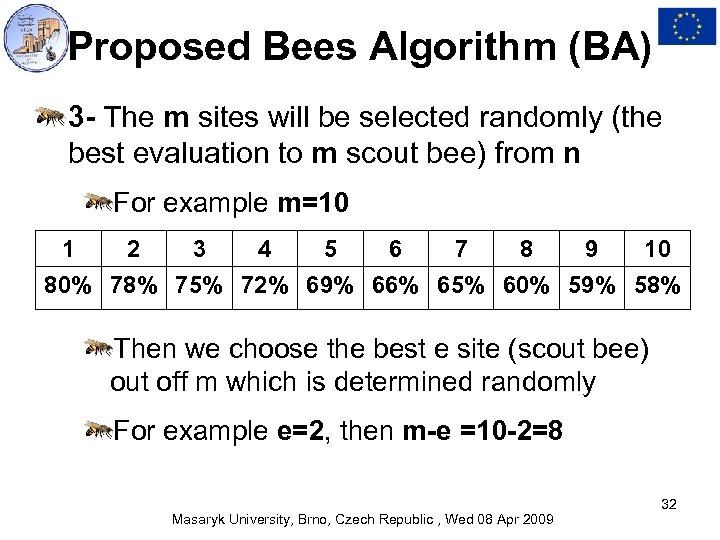
Proposed Bees Algorithm (BA) 3 - The m sites will be selected randomly (the best evaluation to m scout bee) from n For example m=10 1 2 3 4 5 6 7 8 9 10 80% 78% 75% 72% 69% 66% 65% 60% 59% 58% Then we choose the best e site (scout bee) out off m which is determined randomly For example e=2, then m-e =10 -2=8 Masaryk University, Brno, Czech Republic , Wed 08 Apr 2009 32
Proposed Bees Algorithm (BA) 4 - A neighborhood search sites of size ngh is selected Thus in this step a neighborhood size ngh is determined which will be used to update the m bees declared in the previous step This is important as there might be better solutions than the original solution in the neighborhood area Suppose ngh=0. 5 Masaryk University, Brno, Czech Republic , Wed 08 Apr 2009 33
Proposed Bees Algorithm (BA) 5 - Recruit Bees for the selected sites and evaluate the fitness of the sites Number of bees (n 2) will be selected randomly to be sent to e sites (n 2=40) and choosing n 1 bees randomly which their number is less than n 2, (n 1=20) to be sent to m-e sites Masaryk University, Brno, Czech Republic , Wed 08 Apr 2009 34
Proposed Bees Algorithm (BA) 6 - Choosing the best bee from each site (the highest fitness) to form the next bee population This is not exist in nature, it has been placed in the algorithm to reduce the number of sites to be explored Masaryk University, Brno, Czech Republic , Wed 08 Apr 2009 35
Proposed Bees Algorithm (BA) The best bee from each site of m sites is selected as follow: The first site will be taken (for example a site from e sites) An array contains n 2=40 bees will be constructed, where the value of each bee is equal to the value of the original scout bee with a little modification depending on the neighborhood ngh Masaryk University, Brno, Czech Republic , Wed 08 Apr 2009 36
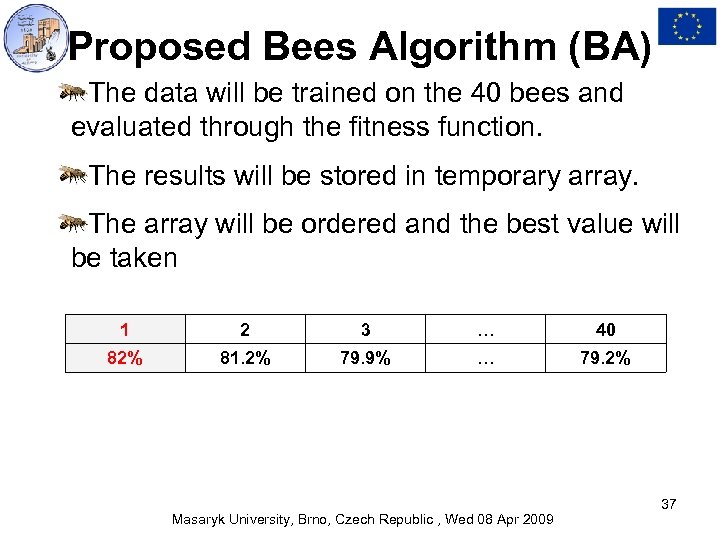
Proposed Bees Algorithm (BA) The data will be trained on the 40 bees and evaluated through the fitness function. The results will be stored in temporary array. The array will be ordered and the best value will be taken 1 2 3 … 40 82% 81. 2% 79. 9% … 79. 2% Masaryk University, Brno, Czech Republic , Wed 08 Apr 2009 37
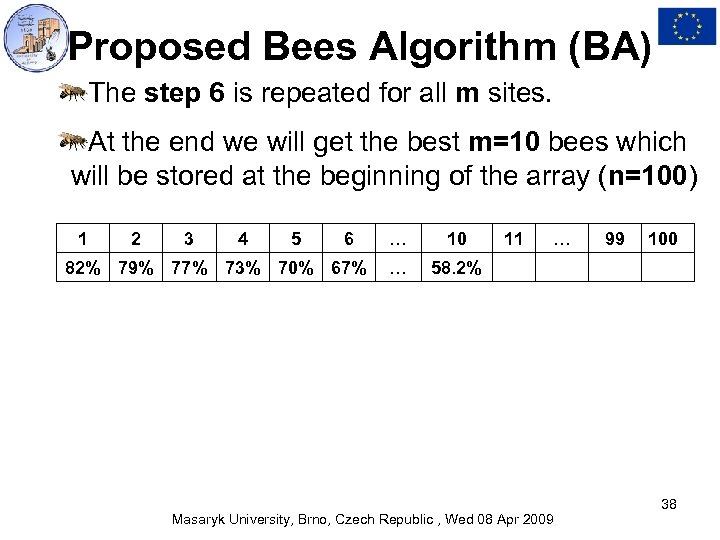
Proposed Bees Algorithm (BA) The step 6 is repeated for all m sites. At the end we will get the best m=10 bees which will be stored at the beginning of the array (n=100) 1 2 3 4 5 6 82% 79% 77% 73% 70% 67% … 10 … 11 … 58. 2% Masaryk University, Brno, Czech Republic , Wed 08 Apr 2009 99 100 38
Proposed Bees Algorithm (BA) Searches in the neighborhood of the best e sites which represent more promising solutions are made more detailed by recruiting more bees to follow them than the other selected bees. Together with scouting, this differential recruitment is a key operation of the Bees Algorithm Masaryk University, Brno, Czech Republic , Wed 08 Apr 2009 39
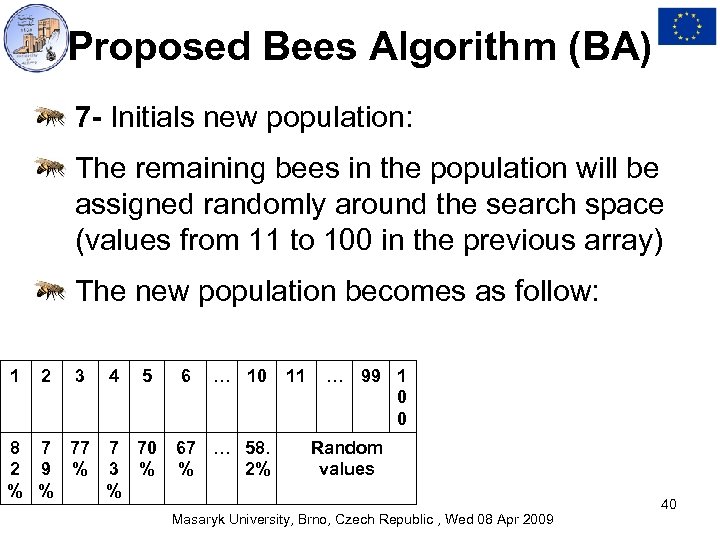
Proposed Bees Algorithm (BA) 7 - Initials new population: The remaining bees in the population will be assigned randomly around the search space (values from 11 to 100 in the previous array) The new population becomes as follow: 1 2 3 4 5 8 7 77 7 70 2 9 % 3 % % 6 … 10 67 … 58. % 2% 11 … 99 1 0 0 Random values Masaryk University, Brno, Czech Republic , Wed 08 Apr 2009 40
Proposed Bees Algorithm (BA) 8 - The loop counter is reduced and the steps two to seven are repeated until the stopping criterion is met. (ending the number of the repetitions imax) For example imax=1000 Masaryk University, Brno, Czech Republic , Wed 08 Apr 2009 41
Proposed Bees Algorithm (BA) At the end of each iteration, the colony will have two parts to its new population representatives from each selected patch and other scout bees assigned to conduct random searches Masaryk University, Brno, Czech Republic , Wed 08 Apr 2009 42
Simple Example: Function Optimisation Here a simple example about how Bees algorithm works The example explains the use of bees algorithm to get the best value representing a mathematical function (functional optimal) Masaryk University, Brno, Czech Republic , Wed 08 Apr 2009 43
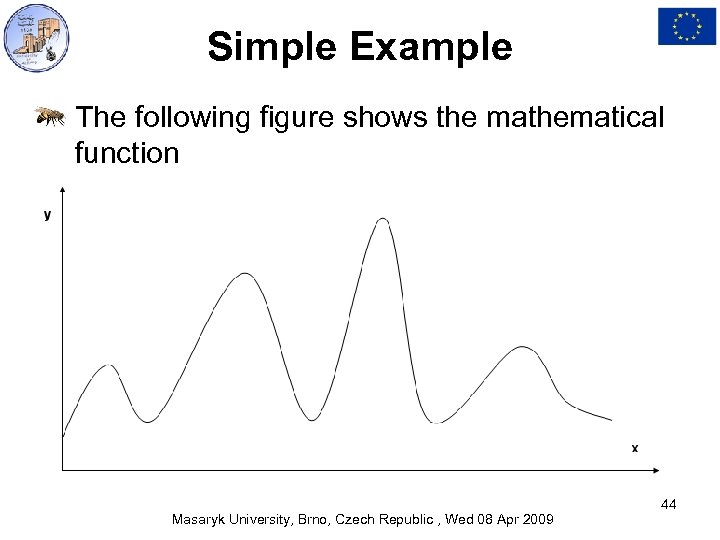
Simple Example The following figure shows the mathematical function Masaryk University, Brno, Czech Republic , Wed 08 Apr 2009 44
Simple Example 1 - The first step is to initiate the population with any 10 scout bees with random search and evaluate the fitness. (n=10) Masaryk University, Brno, Czech Republic , Wed 08 Apr 2009 45
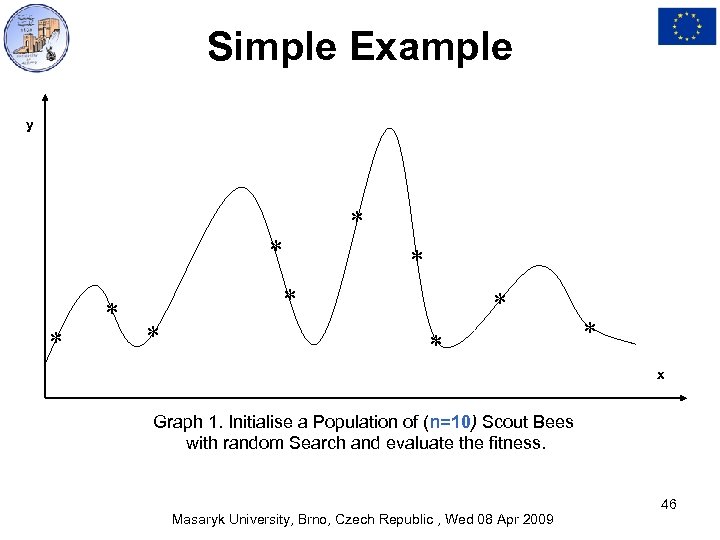
Simple Example y * * * * * x Graph 1. Initialise a Population of (n=10) Scout Bees with random Search and evaluate the fitness. Masaryk University, Brno, Czech Republic , Wed 08 Apr 2009 46
Simple Example 2 - Population evaluation fitness: an array of 10 values in constructed and ordered in ascending way from the highest value of y to the lowest value of y depending on the previous mathematical function Masaryk University, Brno, Czech Republic , Wed 08 Apr 2009 47
Simple Example 3 - The best m site is chosen randomly ( the best evaluation to m scout bee) from n m=5, e=2, m-e=3 Masaryk University, Brno, Czech Republic , Wed 08 Apr 2009 48
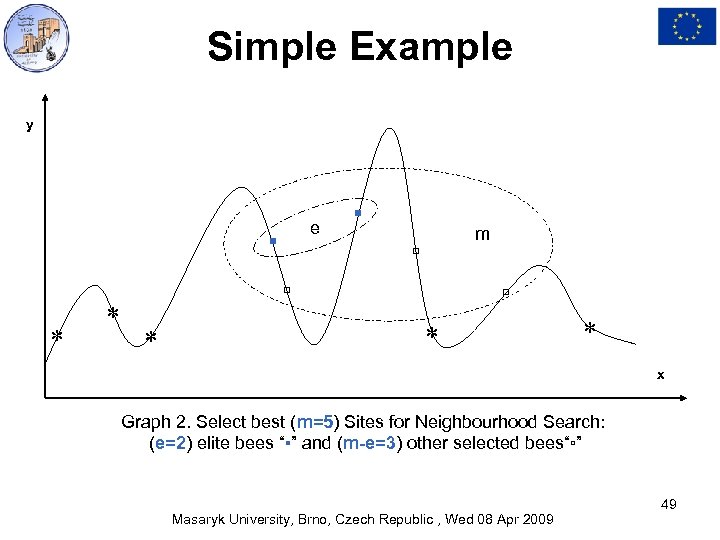
Simple Example y e ▪ * * ▪ m ▫ ▫ * * x Graph 2. Select best (m=5) Sites for Neighbourhood Search: (e=2) elite bees “▪” and (m-e=3) other selected bees“▫” Masaryk University, Brno, Czech Republic , Wed 08 Apr 2009 49
Simple Example 4 - Select a neighborhood search site upon ngh size: Assign random neighborhood ngh as follow Masaryk University, Brno, Czech Republic , Wed 08 Apr 2009 50
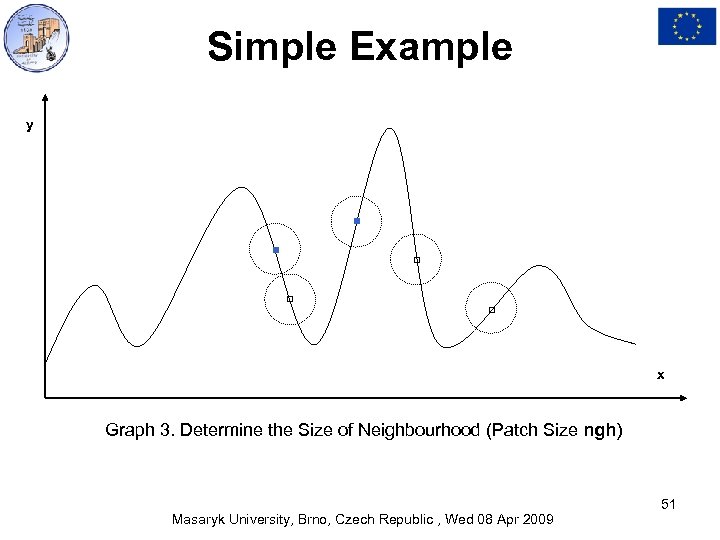
Simple Example y ▪ ▪ ▫ ▫ ▫ x Graph 3. Determine the Size of Neighbourhood (Patch Size ngh) Masaryk University, Brno, Czech Republic , Wed 08 Apr 2009 51
Simple Example 5 - recruits more bees to the selected sites and evaluate the fitness to the sites: Sending bees to e sites (rich sites) and m-e sites (poor sites). More bees will be sent to the e site. n 2 = 4 (rich) n 1 = 2 (poor) Masaryk University, Brno, Czech Republic , Wed 08 Apr 2009 52
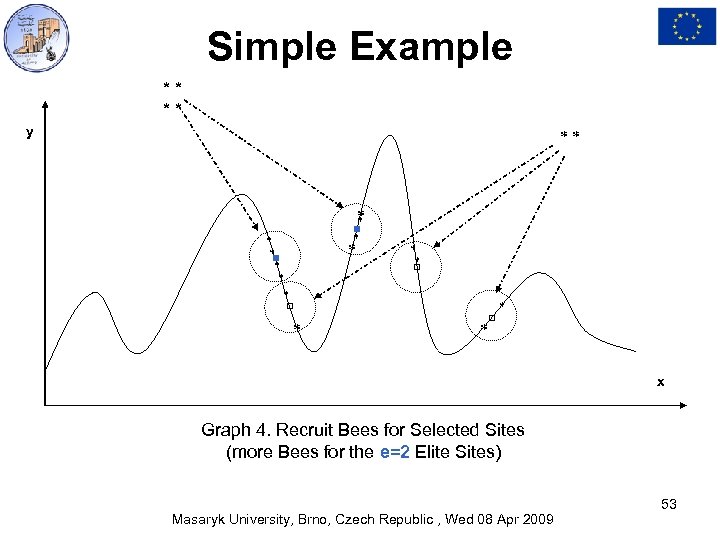
Simple Example ** ** y ** * ▪ * * * ▪ ▫ * * * ▫ ▫ * * x Graph 4. Recruit Bees for Selected Sites (more Bees for the e=2 Elite Sites) Masaryk University, Brno, Czech Republic , Wed 08 Apr 2009 53
Simple Example 6 - Select the best bee from each location (higher fitness) to form the new bees population. Choosing the best bee from every m site as follow: Masaryk University, Brno, Czech Republic , Wed 08 Apr 2009 54
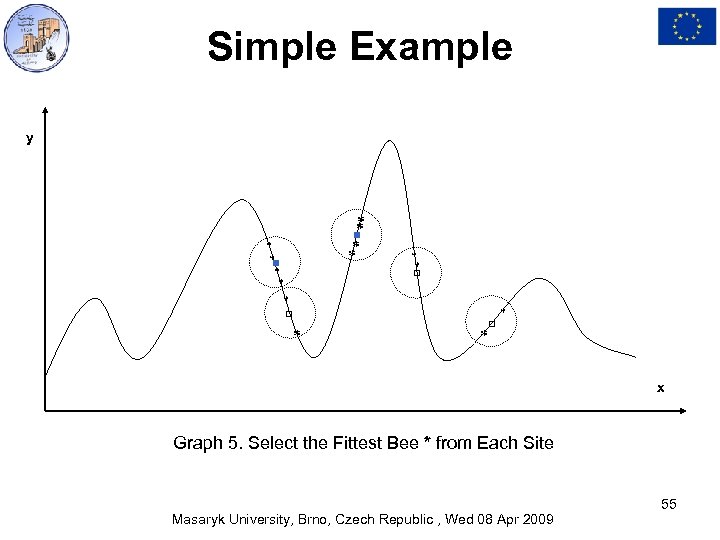
Simple Example y * * ▪ * * * ▪ ▫ * * * ▫ ▫ * * x Graph 5. Select the Fittest Bee * from Each Site Masaryk University, Brno, Czech Republic , Wed 08 Apr 2009 55
Simple Example 7 - initializes a new population: Taking the old values (5) and assigning random values (5) to the remaining values n-m Masaryk University, Brno, Czech Republic , Wed 08 Apr 2009 56
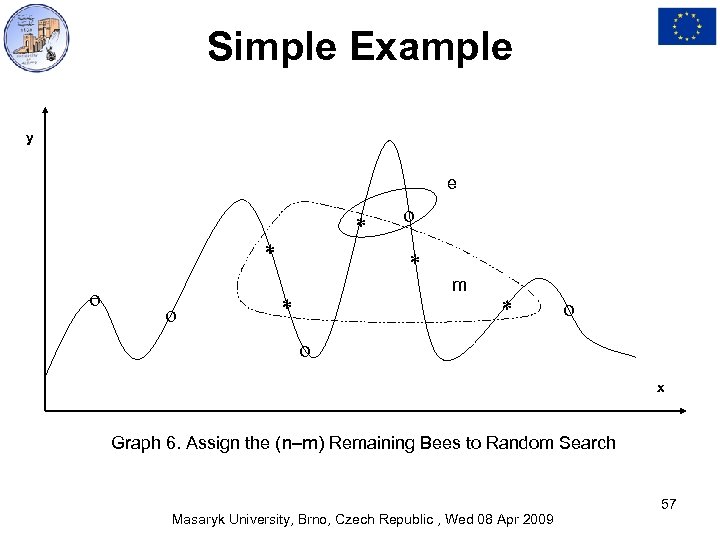
Simple Example y e * * o o o * * m * o o x Graph 6. Assign the (n–m) Remaining Bees to Random Search Masaryk University, Brno, Czech Republic , Wed 08 Apr 2009 57
Simple Example 8 - the loop counter will be reduced and the steps from two to seven will be repeated until reaching the stopping condition (ending the number of repetitions imax) At the end we reach the best solution as shown in the following figure This best value (best bees from m) will represent the optimum answer to the mathematical function Masaryk University, Brno, Czech Republic , Wed 08 Apr 2009 58
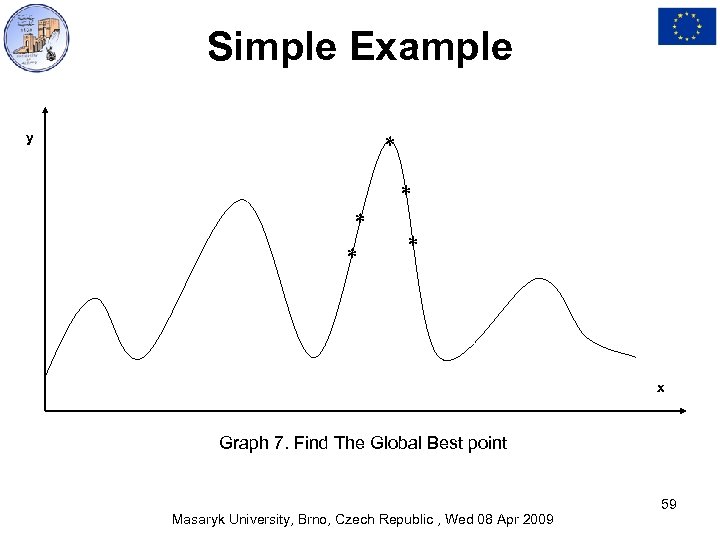
Simple Example y * * * x Graph 7. Find The Global Best point Masaryk University, Brno, Czech Republic , Wed 08 Apr 2009 59
BA- Applications Function Optimisation BA for TSP Training NN classifiers like MLP, LVQ, RBF and SNNs Control Chart Pattern Recognitions Wood Defect Classification ECG Classification Electronic Design Masaryk University, Brno, Czech Republic , Wed 08 Apr 2009 60
BA- Applications Mechanical designs like: Design of welded beam Design of coil spring Digital Filter Optimisation Fuzzy Control Design Data Clustering (solving the local optimum for K-means algorithm) Robot control Masaryk University, Brno, Czech Republic , Wed 08 Apr 2009 61
Data Mining Rules Pruning Using BA The aim of the research is to develop a good learning algorithm able to generate a good set of rules RULES-5 Inductive Learning algorithm has been used for extracting if-then classification rules from set of examples have continuous and discrete attributes Masaryk University, Brno, Czech Republic , Wed 08 Apr 2009 62
Data Clustering Using BA K-means clustering is one of the most popular clustering methods because of its simplicity and computational efficiency. K-means clustering involves search and optimization The main problem with this clustering method is its tendency to converge to local optima A work has been done by integrating the simplicity of the k-means algorithm with the capability of the Bees Algorithm to avoid local optima Masaryk University, Brno, Czech Republic , Wed 08 Apr 2009 63
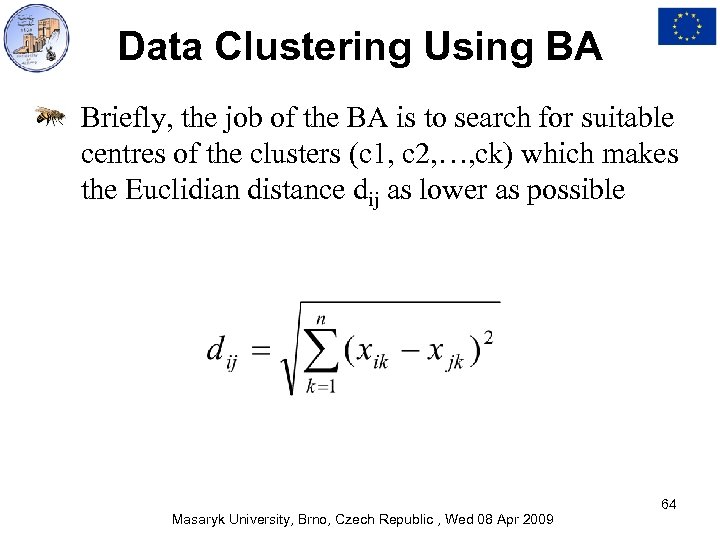
Data Clustering Using BA Briefly, the job of the BA is to search for suitable centres of the clusters (c 1, c 2, …, ck) which makes the Euclidian distance dij as lower as possible Masaryk University, Brno, Czech Republic , Wed 08 Apr 2009 64
Optimising NNs for Identification of Wood Defects Using the BA An application of the Bees Algorithm to the optimisation of neural networks for the identification of defects in wood veneer sheets Authors claimed that the accuracy obtained is comparable to that achieved using backpropagation However, the Bees Algorithm proved to be considerably faster Masaryk University, Brno, Czech Republic , Wed 08 Apr 2009 65
Application of the BA to Fuzzy Clustering A work has been done on combining the Bees Algorithm with the FCM algorithm which improved the fuzzy clustering results compared to the traditional C-means algorithm in most cases They also proved that the Bees Algorithms produces better results than those of the GA combined with FCM Masaryk University, Brno, Czech Republic , Wed 08 Apr 2009 66
BA pros and cons The advantages of the BA Very efficient in finding optimal solutions Overcoming the problem of local optima The disadvantages of the BA It is using a number of tunable parameters The parameters values could be set by conducting a small number of trails Masaryk University, Brno, Czech Republic , Wed 08 Apr 2009 67
Conclusion A new optimisation algorithm has been presented Authors claimed that the algorithm has remarkable robustness, producing 100% success rate in all cases they have tackled The algorithm outperformed other techniques in terms of speed of optimisation and accuracy of the obtained results Masaryk University, Brno, Czech Republic , Wed 08 Apr 2009 68
BA Web Site (Cardiff University, UK) http: //www. bees-algorithm. com/ Masaryk University, Brno, Czech Republic , Wed 08 Apr 2009 69
Acknowledgment • Thanks to the Erasmus windows 3 Consortium, especially the Lund University team, Sweden (the main coordinator of the project) who gave me the chance to participate in this project • Thanks to the host university, Masaryk University team, especially Dr. Lubomir Poplinsky from IF, and Mrs Amal Al-Khatib from the international office who made the life easy for me in Brno Masaryk University, Brno, Czech Republic , Wed 08 Apr 2009 70
References • Salem Z. Ades N and Hilali E. RULES-5 Algorithm Enhancement by Using Bees Algorithm, Res. J. of Aleppo Univ. Engineering Science Series No. 66. 2009 • Pham DT, Ghanbarzadeh A, Koc E, Otri S, Rahim S and Zaidi M. The Bees Algorithm. Technical Note, Manufacturing Engineering Centre, Cardiff University, UK, 2005 • Pham DT, Afify A, Koc A. "Manufacturing cell formation using the Bees Algorithm". IPROMS 2007 Innovative Production Machines and Systems Virtual Conference, Cardiff, UK. • Pham DT, Koc E, Lee JY, and Phrueksanant J. Using the Bees Algorithm to schedule jobs for a machine, Proc Eighth International Conference on Laser Metrology, CMM and Machine Tool Performance, LAMDAMAP, Euspen, UK, Cardiff, p. 430 -439, 2007. • Pham D. T. , Ghanbarzadeh A. , Koc E. , Otri S. , Rahim S. , and M. Zaidi. "The Bees Algorithm A Novel Tool for Complex Optimisation Problems"", Proceedings of IPROMS 2006 Conference, pp. 454 -461 • Pham DT, Soroka AJ, Ghanbarzadeh A, Koc E, Otri S, and Packianather M. Optimising neural networks for identification of wood defects using the Bees Algorithm, Proc 2006 IEEE International Conference on Industrial Informatics, Singapore, 2006. Masaryk University, Brno, Czech Republic , Wed 08 Apr 2009 71
References • Pham DT, Darwish AH, Eldukhri EE, Otri S. "Using the Bees Algorithm to tune a fuzzy logic controller for a robot gymnast. "", Proceedings of IPROMS 2007 Conference • Pham DT, Otri S, Afify A, Mahmuddin M, and Al-Jabbouli H. Data clustering using the Bees Algorithm, Proc 40 th CIRP Int. Manufacturing Systems Seminar, Liverpool, 2007. • Pham DT, Ghanbarzadeh A. "Multi-Objective Optimisation using the Bees Algorithm"", Proceedings of IPROMS 2007 Conference • Pham DT, Muhamad Z, Mahmuddin M, Ghanbarzadeh A, Koc E, Otri S. Using the bees algorithm to optimise a support vector machine for wood defect classification. IPROMS 2007 Innovative Production Machines and Systems Virtual Conference, Cardiff, UK. • Pham DT, Koc E, Ghanbarzadeh A, and Otri S. Optimisation of the weights of multi-layered perceptrons using the Bees Algorithm, Proc 5 th International Symposium on Intelligent Manufacturing Systems, Turkey, 2006. • Pham DT, Soroka AJ, Koc E, Ghanbarzadeh A, and Otri S. Some applications of the Bees Algorithm in engineering design and manufacture, Proc Int. Conference on Manufacturing Automation (ICMA 2007), Singapore, 2007. Masaryk University, Brno, Czech Republic , Wed 08 Apr 2009 72
References • Pham DT, Ghanbarzadeh A, Koc E, and Otri S. Application of the Bees Algorithm to the training of radial basis function networks for control chart pattern recognition, Proc 5 th CIRP International Seminar on Intelligent Computation in Manufacturing Engineering (CIRP ICME '06), Ischia, Italy, 2006. • Pham DT, Otri S, Ghanbarzadeh A, and Koc E. Application of the Bees Algorithm to the training of learning vector quantisation networks for control chart pattern recognition, Proc Information and Communication Technologies (ICTTA'06), Syria, p. 1624 -1629, 2006. • Pham DT, Castellani M, and Ghanbarzadeh A. Preliminary design using the Bees Algorithm, Proc Eighth International Conference on Laser Metrology, CMM and Machine Tool Performance, LAMDAMAP, Euspen, UK, Cardiff, p. 420 -429, 2007. Masaryk University, Brno, Czech Republic , Wed 08 Apr 2009 73

References Thanks for your attention Masaryk University, Brno, Czech Republic , Wed 08 Apr 2009 74
Скачать презентацию The Bees Algorithm and Its Applications Dr Ziad
3f9c6bb74ae885327bfbdcec856cf079.ppt