 Скачать презентацию The Battle of Britain Fighters A Flight Test
710756ccc6845f950b65151b5de331cf.ppt
- Количество слайдов: 28



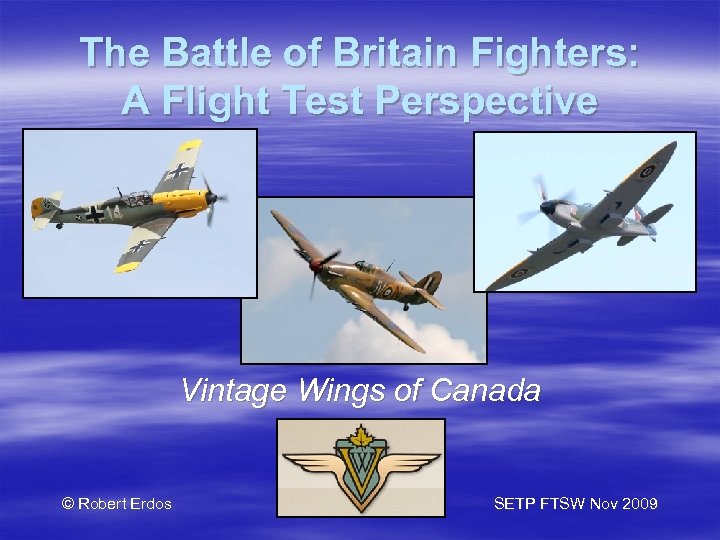
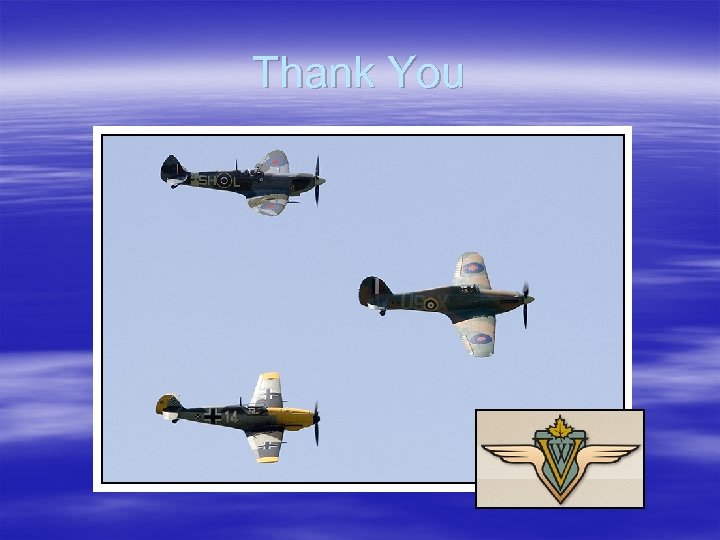
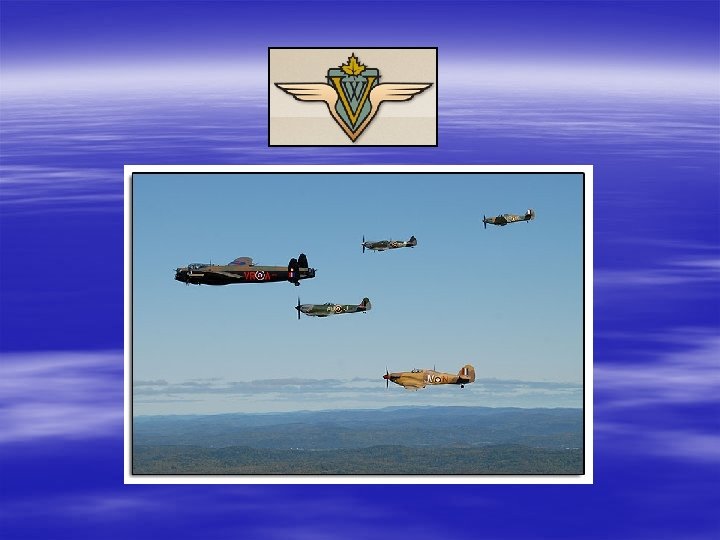
The Battle of Britain Fighters: A Flight Test Perspective Vintage Wings of Canada © Robert Erdos SETP FTSW Nov 2009
How On Earth… …did you get to fly all three Battle of Britain fighters!?
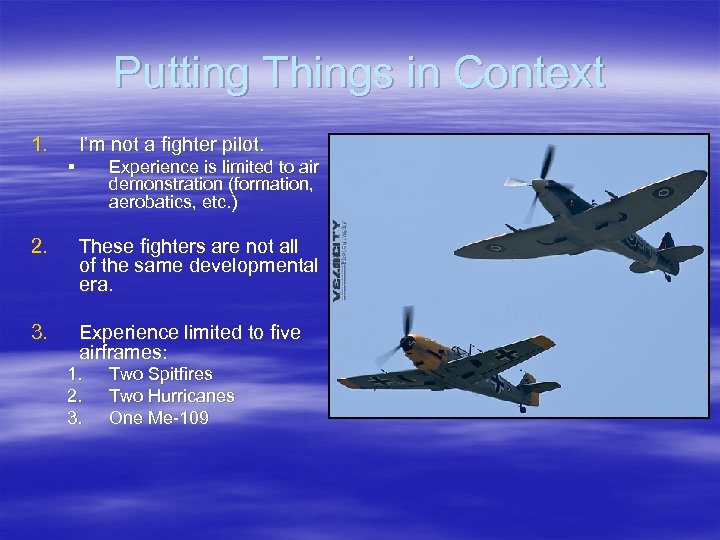
Putting Things in Context 1. I’m not a fighter pilot. § Experience is limited to air demonstration (formation, aerobatics, etc. ) 2. These fighters are not all of the same developmental era. 3. Experience limited to five airframes: 1. 2. 3. Two Spitfires Two Hurricanes One Me-109
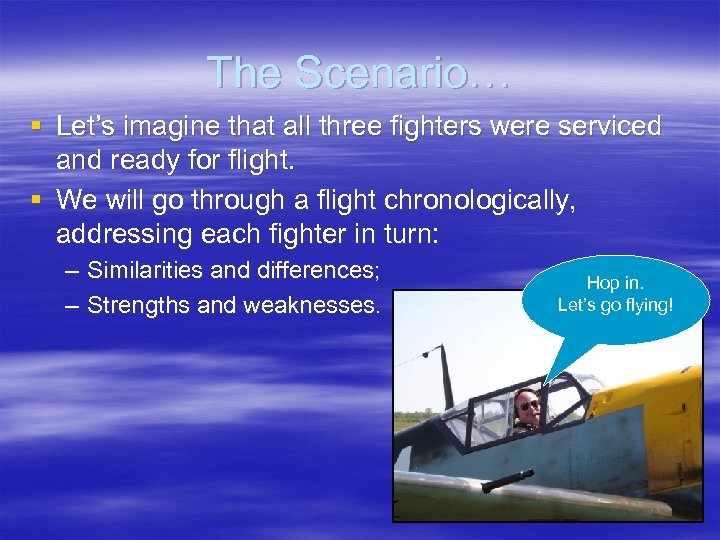
The Scenario… § Let’s imagine that all three fighters were serviced and ready for flight. § We will go through a flight chronologically, addressing each fighter in turn: – Similarities and differences; – Strengths and weaknesses. Hop in. Let’s go flying!
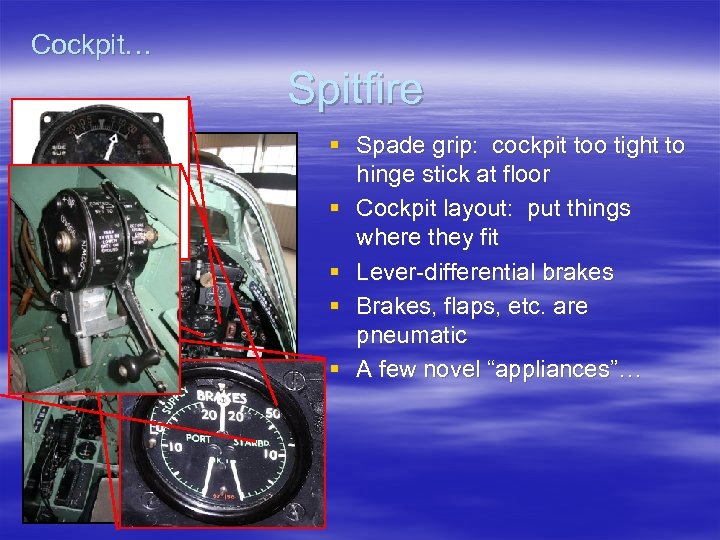
Cockpit… Spitfire § Spade grip: cockpit too tight to hinge stick at floor § Cockpit layout: put things where they fit § Lever-differential brakes § Brakes, flaps, etc. are pneumatic § A few novel “appliances”…
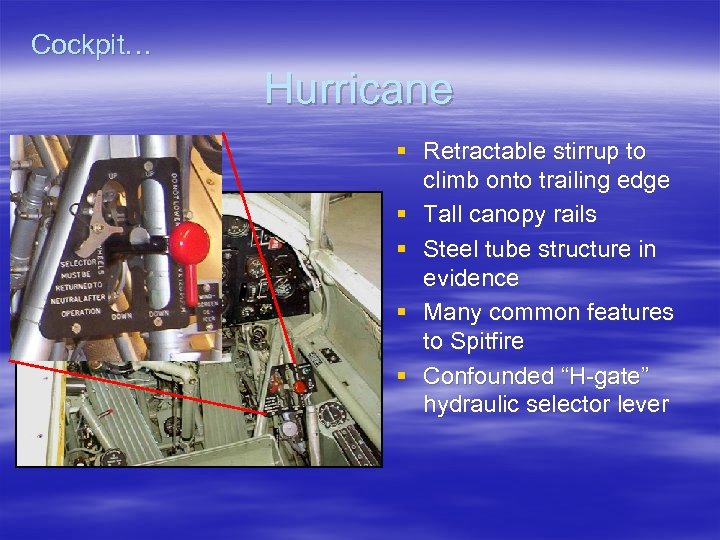
Cockpit… Hurricane § Retractable stirrup to climb onto trailing edge § Tall canopy rails § Steel tube structure in evidence § Many common features to Spitfire § Confounded “H-gate” hydraulic selector lever
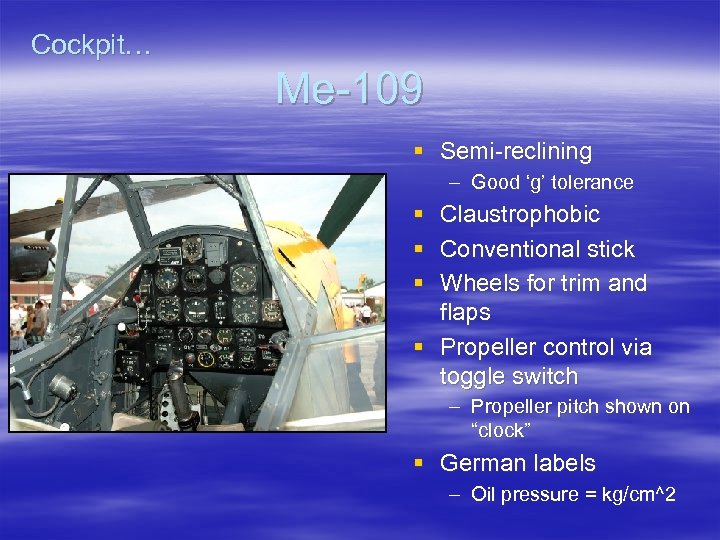
Cockpit… Me-109 § Semi-reclining – Good ‘g’ tolerance § § § Claustrophobic Conventional stick Wheels for trim and flaps § Propeller control via toggle switch – Propeller pitch shown on “clock” § German labels – Oil pressure = kg/cm^2
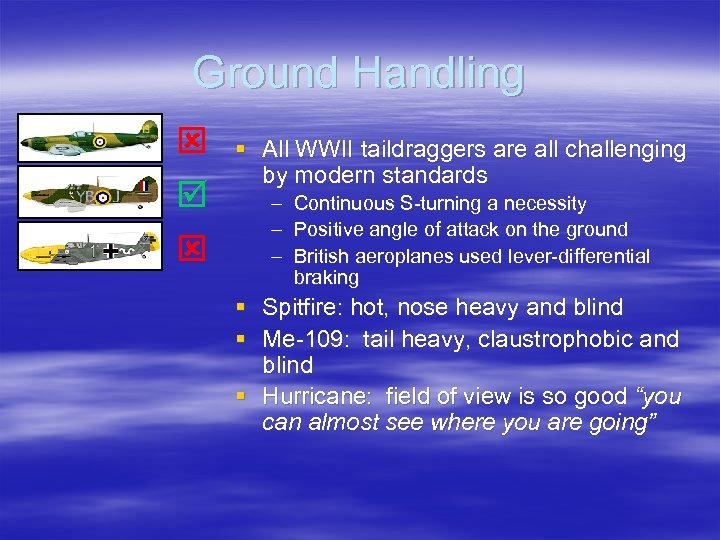
Ground Handling § All WWII taildraggers are all challenging by modern standards – Continuous S-turning a necessity – Positive angle of attack on the ground – British aeroplanes used lever-differential braking § Spitfire: hot, nose heavy and blind § Me-109: tail heavy, claustrophobic and blind § Hurricane: field of view is so good “you can almost see where you are going”
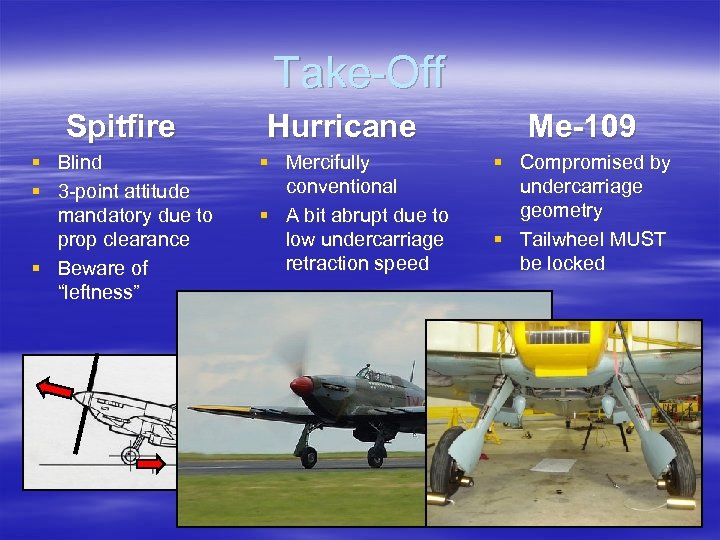
Take-Off Spitfire § Blind § 3 -point attitude mandatory due to prop clearance § Beware of “leftness” Hurricane § Mercifully conventional § A bit abrupt due to low undercarriage retraction speed Me-109 § Compromised by undercarriage geometry § Tailwheel MUST be locked
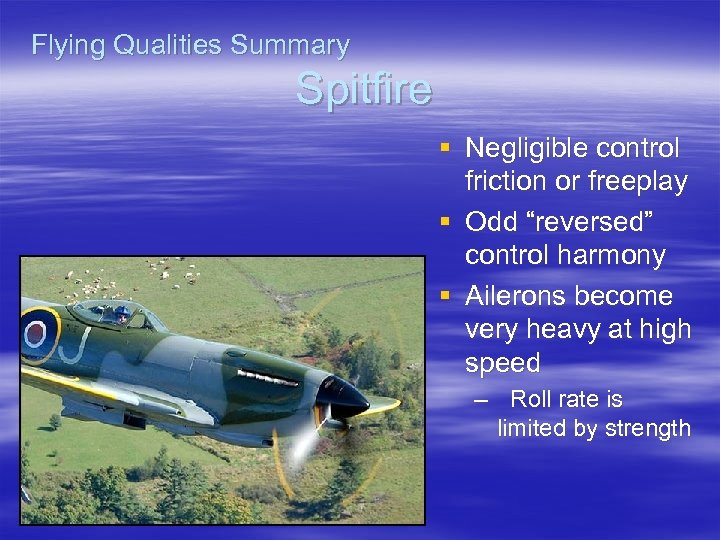
Flying Qualities Summary Spitfire § Negligible control friction or freeplay § Odd “reversed” control harmony § Ailerons become very heavy at high speed – Roll rate is limited by strength
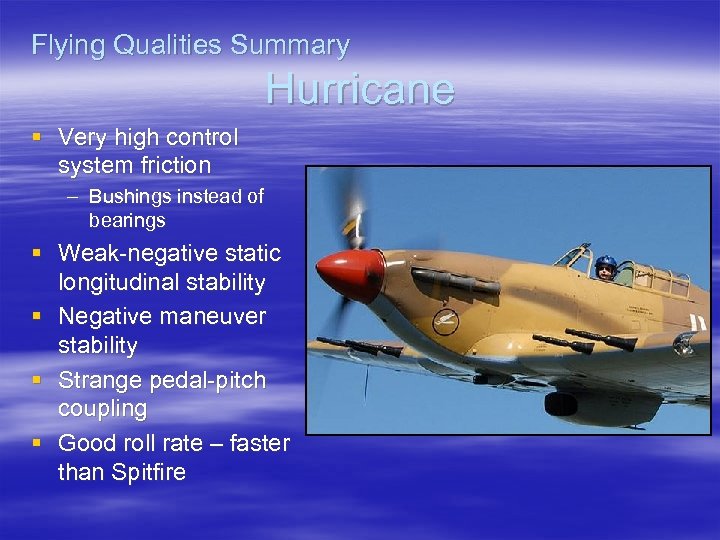
Flying Qualities Summary Hurricane § Very high control system friction – Bushings instead of bearings § Weak-negative static longitudinal stability § Negative maneuver stability § Strange pedal-pitch coupling § Good roll rate – faster than Spitfire
Flying Qualities Summary Me-109 § Very low directional stability § No rudder trim § Instances of aileron stall § Elevator extremely heavy at high speeds § No propeller governor!
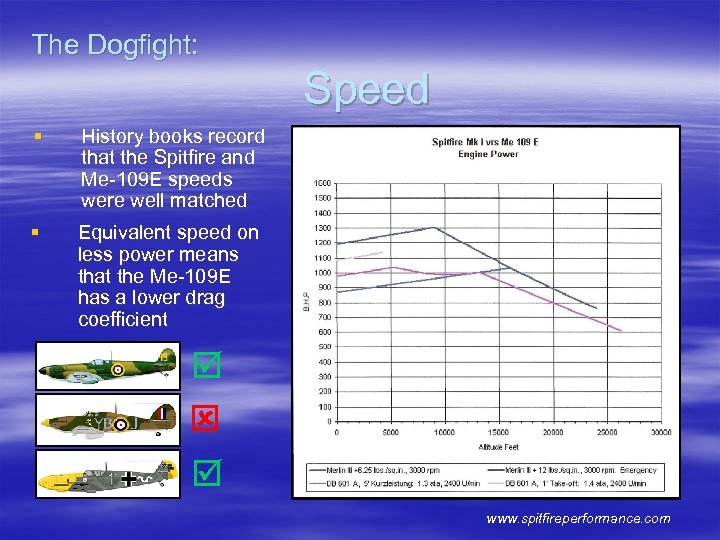
The Dogfight: Speed § History books record that the Spitfire and Me-109 E speeds were well matched § Equivalent speed on less power means that the Me-109 E has a lower drag coefficient www. spitfireperformance. com
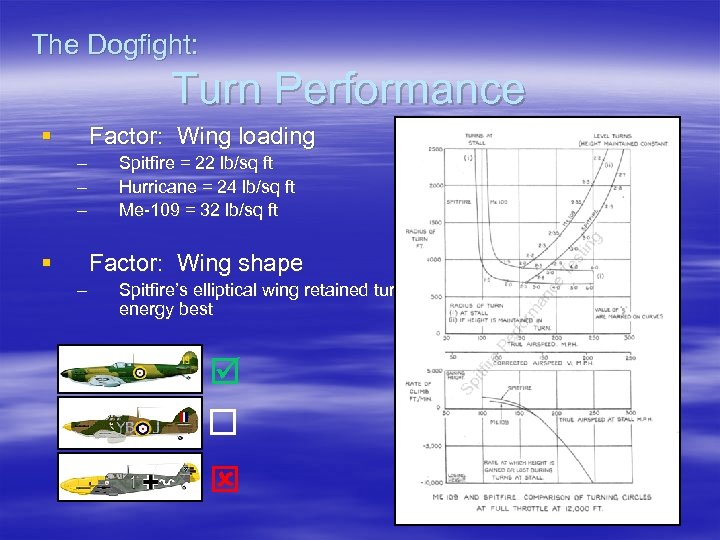
The Dogfight: Turn Performance § Factor: Wing loading – – – § Spitfire = 22 lb/sq ft Hurricane = 24 lb/sq ft Me-109 = 32 lb/sq ft Factor: Wing shape – Spitfire’s elliptical wing retained turn energy best
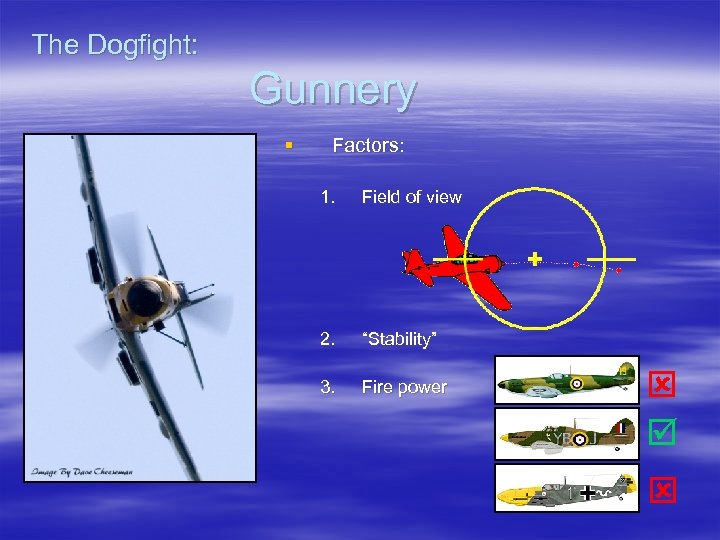
The Dogfight: Gunnery § Factors: 1. Field of view 2. “Stability” 3. Fire power
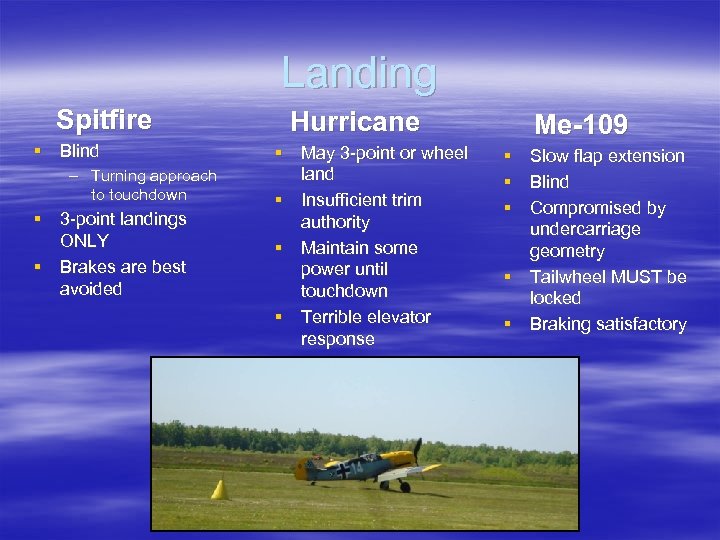
Landing Spitfire § Blind – Turning approach to touchdown § 3 -point landings ONLY § Brakes are best avoided Hurricane § May 3 -point or wheel land § Insufficient trim authority § Maintain some power until touchdown § Terrible elevator response Me-109 § Slow flap extension § Blind § Compromised by undercarriage geometry § Tailwheel MUST be locked § Braking satisfactory
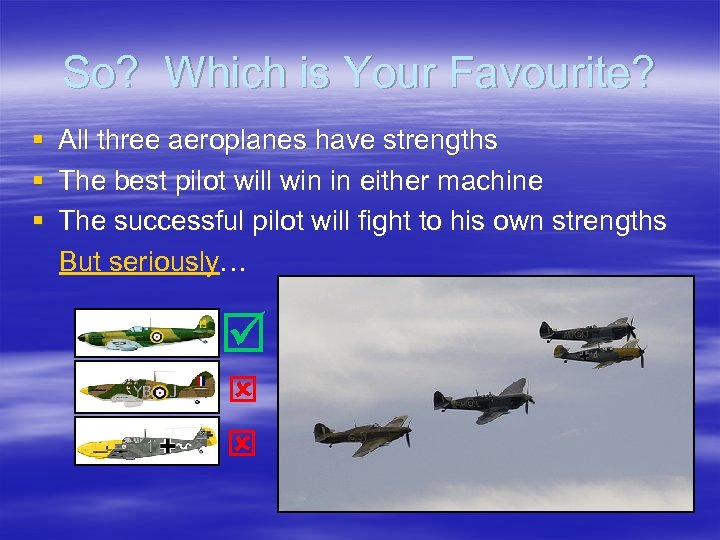
So? Which is Your Favourite? § All three aeroplanes have strengths § The best pilot will win in either machine § The successful pilot will fight to his own strengths But seriously…
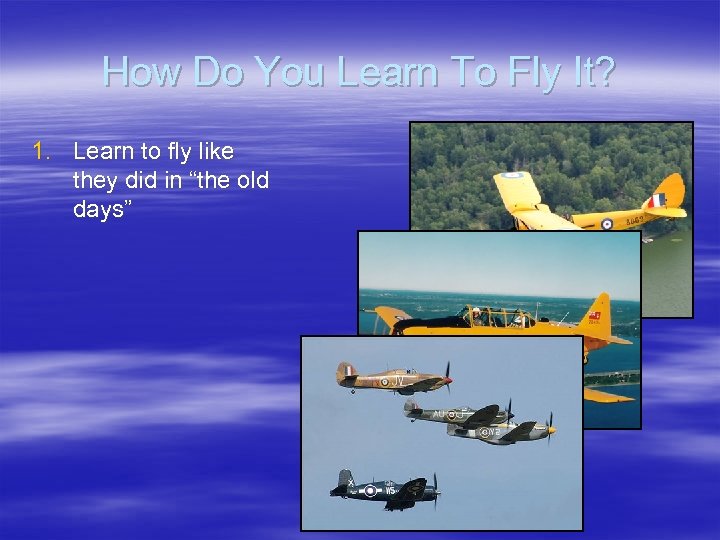
How Do You Learn To Fly It? 1. Learn to fly like they did in “the old days”
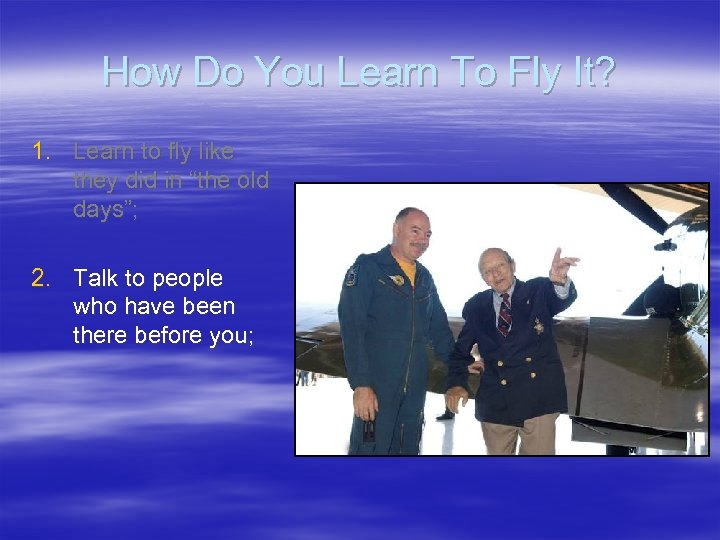
How Do You Learn To Fly It? 1. Learn to fly like they did in “the old days”; 2. Talk to people who have been there before you;
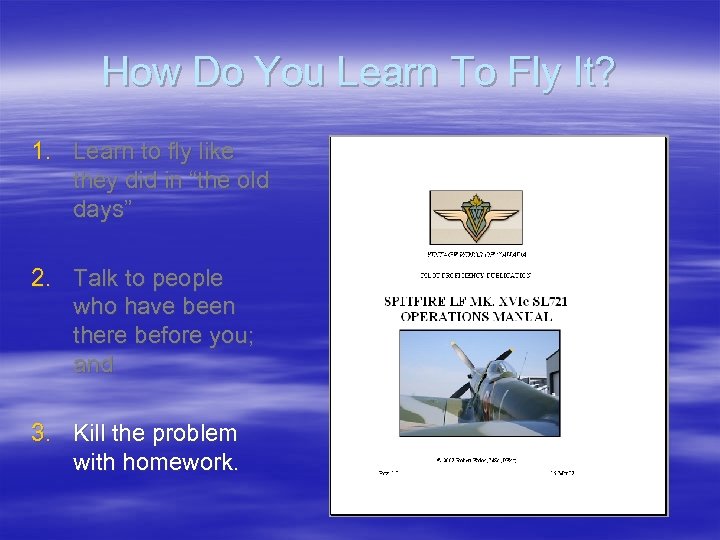
How Do You Learn To Fly It? 1. Learn to fly like they did in “the old days” 2. Talk to people who have been there before you; and 3. Kill the problem with homework.
Thank You
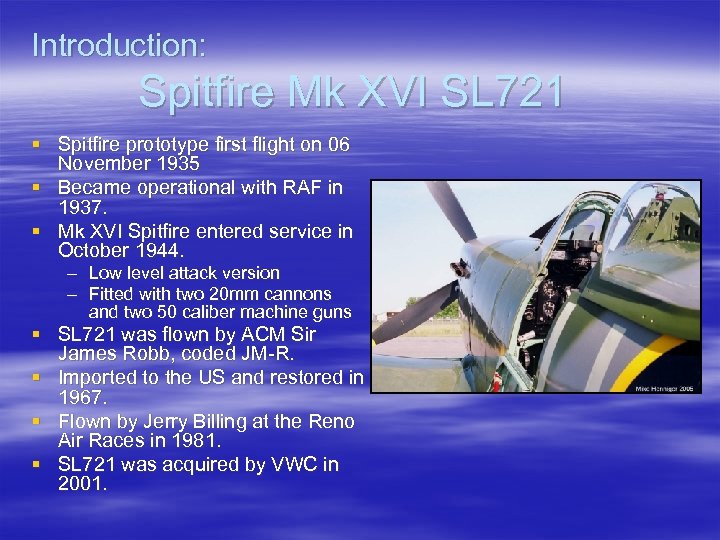
Introduction: Spitfire Mk XVI SL 721 § Spitfire prototype first flight on 06 November 1935 § Became operational with RAF in 1937. § Mk XVI Spitfire entered service in October 1944. – Low level attack version – Fitted with two 20 mm cannons and two 50 caliber machine guns § SL 721 was flown by ACM Sir James Robb, coded JM-R. § Imported to the US and restored in 1967. § Flown by Jerry Billing at the Reno Air Races in 1981. § SL 721 was acquired by VWC in 2001.
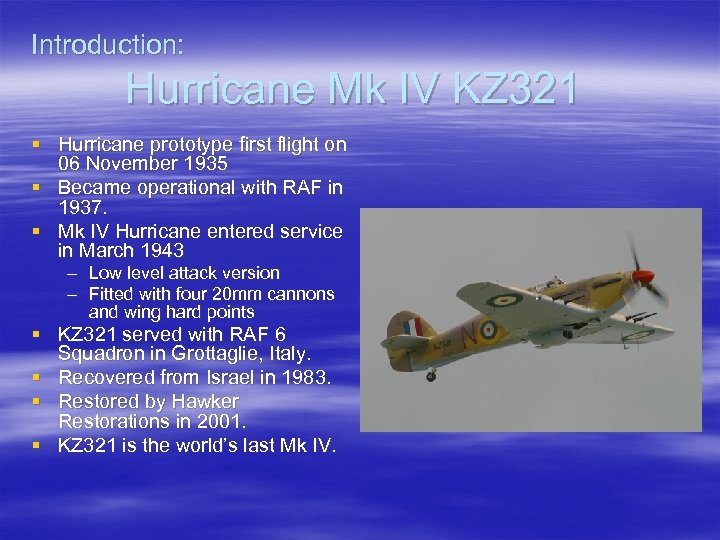
Introduction: Hurricane Mk IV KZ 321 § Hurricane prototype first flight on 06 November 1935 § Became operational with RAF in 1937. § Mk IV Hurricane entered service in March 1943 – Low level attack version – Fitted with four 20 mm cannons and wing hard points § KZ 321 served with RAF 6 Squadron in Grottaglie, Italy. § Recovered from Israel in 1983. § Restored by Hawker Restorations in 2001. § KZ 321 is the world’s last Mk IV.
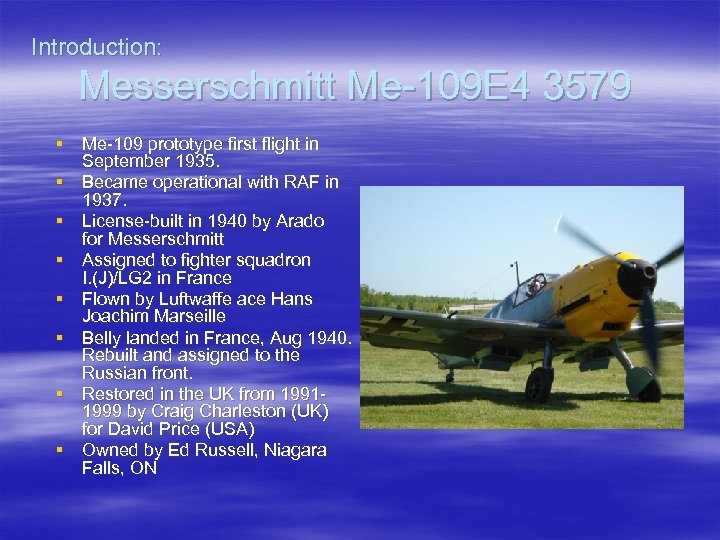
Introduction: Messerschmitt Me-109 E 4 3579 § Me-109 prototype first flight in September 1935. § Became operational with RAF in 1937. § License-built in 1940 by Arado for Messerschmitt § Assigned to fighter squadron I. (J)/LG 2 in France § Flown by Luftwaffe ace Hans Joachim Marseille § Belly landed in France, Aug 1940. Rebuilt and assigned to the Russian front. § Restored in the UK from 19911999 by Craig Charleston (UK) for David Price (USA) § Owned by Ed Russell, Niagara Falls, ON
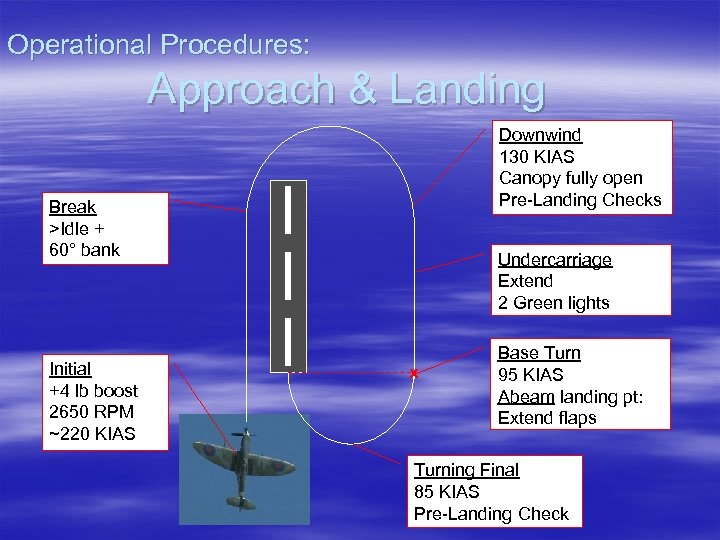
Operational Procedures: Approach & Landing Downwind 130 KIAS Canopy fully open Pre-Landing Checks Break >Idle + 60° bank Initial +4 lb boost 2650 RPM ~220 KIAS Undercarriage Extend 2 Green lights x Base Turn 95 KIAS Abeam landing pt: Extend flaps Turning Final 85 KIAS Pre-Landing Check
Spare pics
Questions? What does “fluggeschwindigkeit” mean? !
Скачать презентацию The Battle of Britain Fighters A Flight Test
710756ccc6845f950b65151b5de331cf.ppt