 Скачать презентацию The basic idea of our course
Intercultural-Business1.pptx
- Количество слайдов: 61



The basic idea of our course • • International market is segmented There are: Geographical segmentation Geopolitical segmentation • But also cultural segmentation
Cultural segmentation • International market is not homogenious from the point of view of cultural traits
Cultural traits • Language • Religion • Ethnicity • Customs • Institutions • Social inequality
Importance of the subject • The history of the subject goes back to the late 1960 s • Geert Hofstede = the question = are theories in psychology, organization sociology, and management of the universal validity?
Geert Hofstede • Culture’ s Consequences (1980) on cultural differences • Cultures and Organizations: Software of the Mind (1991) on cultural encouters
The partcicular idea of our course • We are entering a given market and we need information on its cultural assumptions •
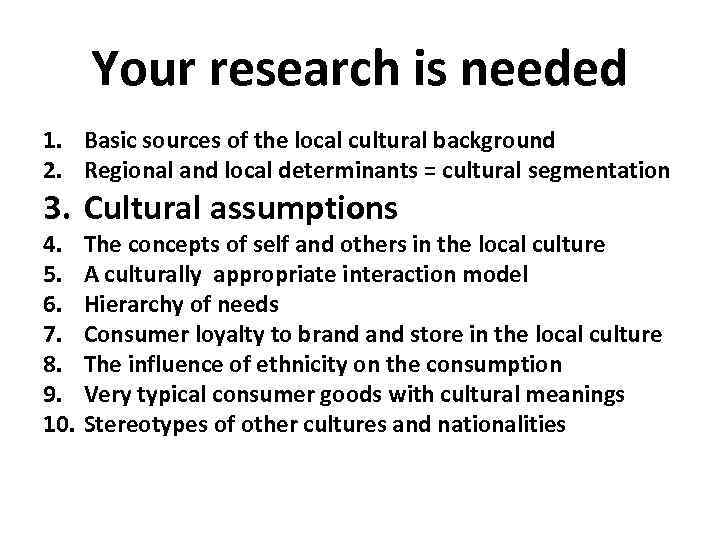
Your research is needed 1. Basic sources of the local cultural background 2. Regional and local determinants = cultural segmentation 3. Cultural assumptions 4. 5. 6. 7. 8. 9. 10. The concepts of self and others in the local culture A culturally appropriate interaction model Hierarchy of needs Consumer loyalty to brand store in the local culture The influence of ethnicity on the consumption Very typical consumer goods with cultural meanings Stereotypes of other cultures and nationalities
Exam • an Essay on one of the two following themes: • (a) you are entering a market = what kind of information about cultural segmentation of this market you need • (b) you know the local market and you have been asked to prepare a report on its cultural segmentation
Readings • 1. Jean-Claude Usunier, Marketing across cultures, 5 th edition, Pearson Education Ltd, Edinburgh, 2009. • 2. G. Hofstede, G. J. Hofstede, M. Minkov, Cultures and Organizations. Softwere of the Mind. Intercultural Cooperation and Its Importance for Survival, Mc. Graw. Hill, New York, 2010.
Culture as Mental Programming • Every person carries within him- or herself patterns of thinking, feeling, and potential acting that were learned throughout the person’s lifetime. • Much of it was acquired in early childhood, because at that time a person is most susceptible to learning and assimilating.
Culture as Mental Programming • such patterns of thinking, feeling, and acting mental programs, can be called , software of the mind.
Culture as Mental Programming • Does it mean that people are programmed the way computers are? • A person’s behavior is only partially predetermined by his or her mental programs: • he or she has a basic ability to deviate from them and to react in ways that are new, creative, destructive, or unexpected.
Culture as Mental Programming • The sources of one’s mental programs lie within the social environments in which one grew up and collected one’s life experiences. The programming starts within the family; it continues within the neighborhood, at school, in youth groups, at the workplace, and in the living community.
Culture as Mental Programming • A customary term for such mental software is culture
Culture (narrow) • Several meanings: (a) from Latin = „tilling of the soil” (b) Western languages = „civilization” or „refinement of the mind” (education, art, literature)
Culture (broader = our) • Catchword for all patters of thinking, feeling, and acting • (not only activities supposed to refine the mind, but also the ordinary and menial things in life = greetings, eating, showing or not showing feelings , keeping a certain physical distance from others, making love, and mantaining body hygiene).
Culture is collective • A collective phenomenon = (partly) shared with people who live or lived within the same social environment • the collective programming of the mind that distinguishes the members of one group or category of people from others
Culture and human nature • Culture = human nature = an individual’s personality
Culture and human nature • • The human ability to feel: fear anger love joy sadness shame
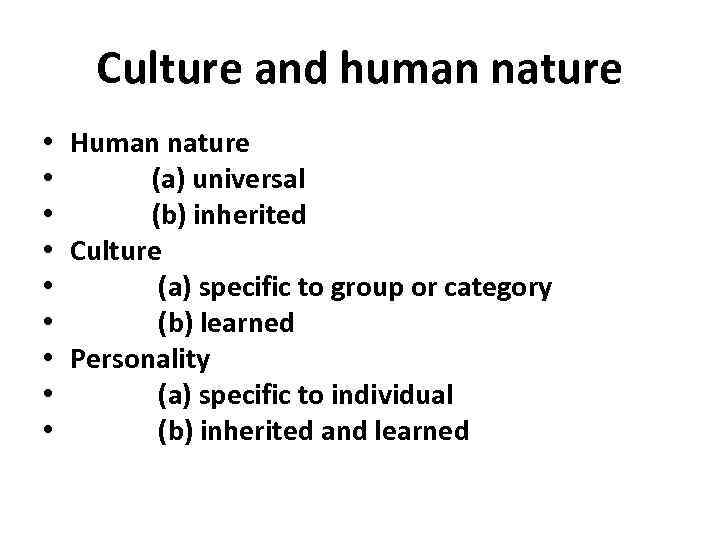
Culture and human nature • • • Human nature (a) universal (b) inherited Culture (a) specific to group or category (b) learned Personality (a) specific to individual (b) inherited and learned
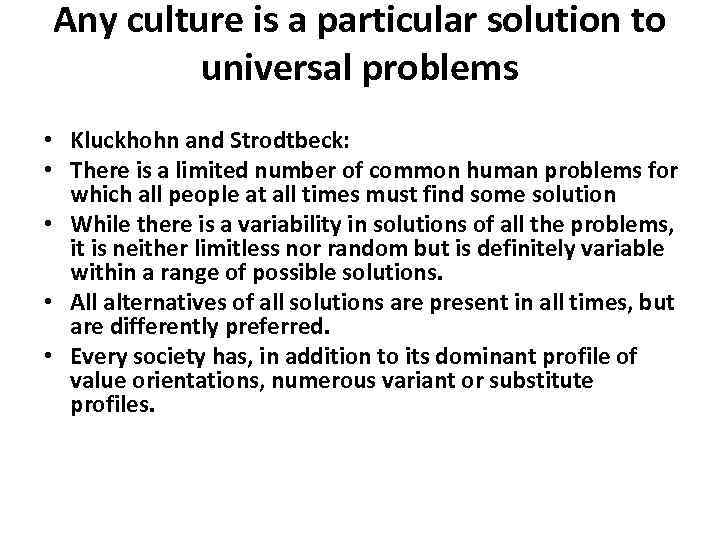
Any culture is a particular solution to universal problems • Kluckhohn and Strodtbeck: • There is a limited number of common human problems for which all people at all times must find some solution • While there is a variability in solutions of all the problems, it is neither limitless nor random but is definitely variable within a range of possible solutions. • All alternatives of all solutions are present in all times, but are differently preferred. • Every society has, in addition to its dominant profile of value orientations, numerous variant or substitute profiles.
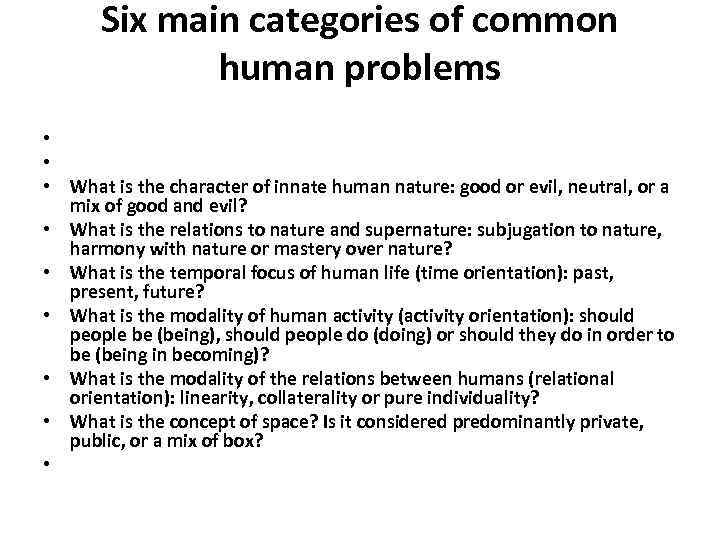
Six main categories of common human problems • • • What is the character of innate human nature: good or evil, neutral, or a mix of good and evil? • What is the relations to nature and supernature: subjugation to nature, harmony with nature or mastery over nature? • What is the temporal focus of human life (time orientation): past, present, future? • What is the modality of human activity (activity orientation): should people be (being), should people do (doing) or should they do in order to be (being in becoming)? • What is the modality of the relations between humans (relational orientation): linearity, collaterality or pure individuality? • What is the concept of space? Is it considered predominantly private, public, or a mix of box? •
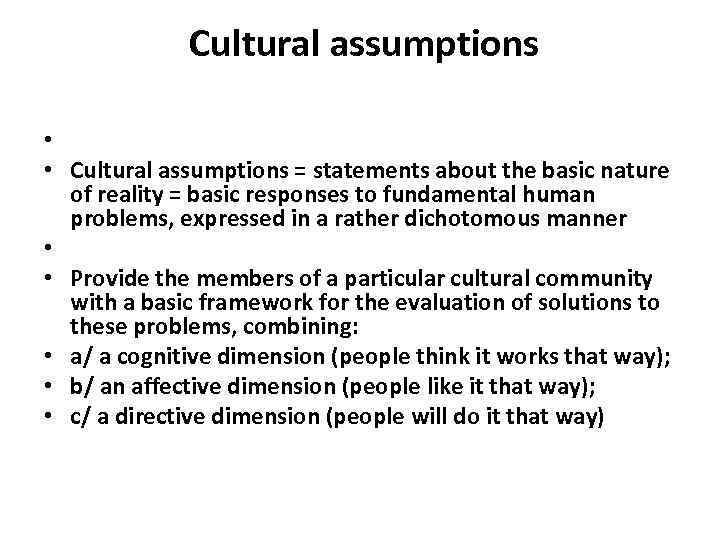
Cultural assumptions • • Cultural assumptions = statements about the basic nature of reality = basic responses to fundamental human problems, expressed in a rather dichotomous manner • • Provide the members of a particular cultural community with a basic framework for the evaluation of solutions to these problems, combining: • a/ a cognitive dimension (people think it works that way); • b/ an affective dimension (people like it that way); • c/ a directive dimension (people will do it that way)
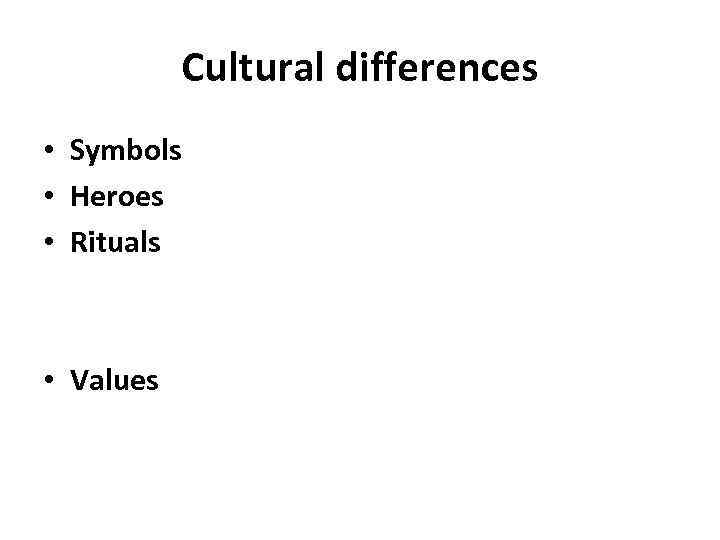
Cultural differences • Symbols • Heroes • Rituals • Values
Symbols • Words, gestures, pictures, or objects that carry a particular meaning that is recognized as such only by those who share the cultures
Heroes • Persons, alive or dead, real or imaginery, who possess characteristics that are highly prized in a culture and thus serve as models for behaviour
Rituals • Collective activities that are technically superfluous to reach desired ends but that, within a culture, are considered socially essential.
Practices • Operational knowledge to reach an implement everyday decisions
Values • The core of culture • They deal with pairings such as the following: • Evil versus good • Dirty versus clean …
Cultural assumptions have an impact on: • • consumer behavior market research marketing management advertising communication •
Cultural Dynamics • The 6 modalities are to be found in every societies • People „are” and people „do” everywhere • There always chlidren and parents • Variations • What is dominant?
Three major areas • time • space • the concept of the self and the others
Time • 1. Is time money? • 2. Monochronic versus polychronic use of time • 3. Linearity versus cyclicity of time • 4. Temporal orientations
Is time money? • Economicity of time
Monochronic versus polychronic • Do you do one or many things at a time?
Linearity versus cyclicity • Time as a line or as a cycle
Temporal orientations • Past • Present • future
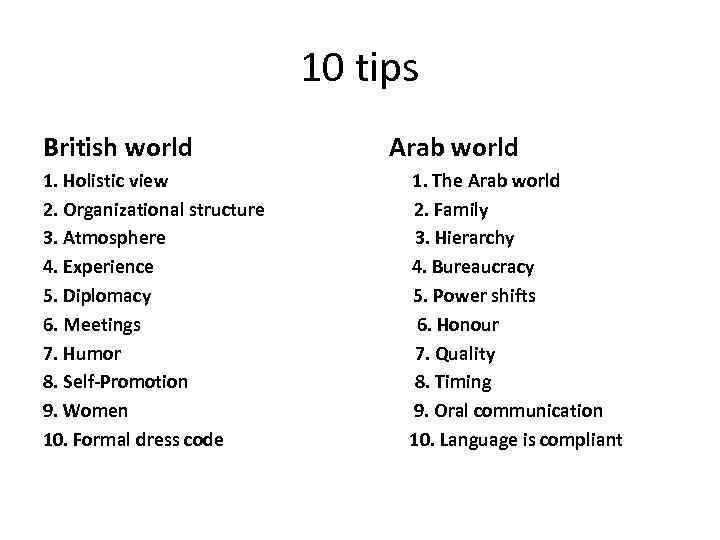
10 tips British world Arab world 1. Holistic view 1. The Arab world 2. Organizational structure 2. Family 3. Atmosphere 3. Hierarchy 4. Experience 4. Bureaucracy 5. Diplomacy 5. Power shifts 6. Meetings 6. Honour 7. Humor 7. Quality 8. Self-Promotion 8. Timing 9. Women 9. Oral communication 10. Formal dress code 10. Language is compliant
Time orientation • 3 main origins of cyclicity of time: (a) religious assumptions about reincarnation of the soul; • (b) natural rhythms of years, seasons and days; • (c) the social division of time periods = arbitrary
Space • The keys words: “in” and “out” • or • (a) member/non-member (b) belonging/not belonging)
What is space? • a three dimensional expanse in which all material objects are located
Space: two kinds • physical (towns, countries) • or • abstract (religion, education, ideas)
Physical space • Individuals defend their space against invasion (a fullelevator syndrome) • The “language of space” is culturally given and provided the codes concerning social distance • Proxemics = concept of culturally determined using of space • In Western cultures, there are three primary zones of space: • 1/ the intimate zone (0 -45 mm); • 2/ the personal zone (45 mm-1 m) • 3/ the social zone (1 -2 m)
Different cultures in terms of physical space • • a/ what are the size of the three zones? b/ to which extent do they overlap? c/ who is allowed to enter these zones? d/ what is considered as adequate sensory exchange within definite interpersonal distances? •
Social perception of spaces • depends on availability or scarcity of physical space = “smaller, better” (Japan, miniaturization of objects) versus “bigger, better” (America as a Cadillac culture)
Space-related cultural assumptions • a/ are people insiders or outsiders? • b/ what are the rights and obligations for ingroup people? • c/ is it possible for outsiders to gain insider status? • d/ what are the group membership conditions for those willing to enter the abstract space •
Space – practical aspect • How to make contacts (negotiations, personal selling) with people with a strong ingroup orientation? • a/ we should know the network of the group connections • b/ we should know how decisions are made in this group
Readings: • Jean-Claude Usunier, Marketing across cultures, pp. 16 -31.
Concepts of self and the other
Concepts of the self and the other • How a society is organized?
Concepts of the self and the other • People have basic assumptions about their presence in their society and these assumptions differ across cultures
Concepts of the self and the other • Basic assumptions are related to: - sociodemographic categories (age, sex, social classes) - idealized conducts in particular roles (the perfect wife, man, child, businessman
How should we treat uknown people? • Is human nature basically good or bad?
Apprising others • Emphasis can be placed on: • (a) age • (b) sex • (c) social classes
Apprising others • Who are the persons to be considered trustworthy and reliable, with whom it is possible to do business?
Apprising oneself • Emphasis can be placed on: • (a) self-esteem: low/high • (b) perceived potency: low/high • (c) level of activity: low/high
Relating the individual to the group • Individualism versus collectivism
The coming sessions • Interaction models • Culture and consumer behavior • Equivalence in cross-cultural research • Global marketing or intercultural marketing?
Interaction models • • 1/ in any society only particular interactions between people are culturally appropriate, the others are considered inappropriate; • 2/ these appropriate interactions constitute models of appropriate behavior.
Interaction models (2) • 3/ these interactions concern; • Equality or inequality in interpersonal interactions = power distance; • Interaction with others or for others = masculinity versus femininity; • Dealing with uncertainty = uncertainty avoidance; • Relying on oneself or on others =self-reliance versus dependence; • Communicating with others = communication styles. •
Interaction models (3) • 4/ interaction models refer to action as such and to its cultural determinants; the questions concerning action are: • Why to act? = fatalism versus proactive view; • What is action? = ‘speech’ versus ‘deed’ orientation; • Relation between action and thinking = intellectual styles; • Relation between wishes and action = ‘wishful thinking’ orientation; • Relation between feeling and action = affective versus neutral cultures; • Dealing with rules = practical rules versus ideal rules. • Read: Usunier, pp. 43 -57.
Скачать презентацию The basic idea of our course
Intercultural-Business1.pptx