 Скачать презентацию The Barriere Lake Trilateral Agreement Algonquins of Barriere
f314d91c326e6a2e0830087c52ebea9d.ppt
- Количество слайдов: 57



The Barriere Lake Trilateral Agreement Algonquins of Barriere Lake, Gouvernement du Québec, Government of Canada
MITCHIKANIBIKOK INIK Trilateral Agreement Territory: Location Trilateral Agreement Territory La Verendrye Wildlife Reserve Boundary Rapid Lake Community Quebec
MITCHIKANIBIKOK INIK Agreement Objectives n n To develop for implementation, a draft ecosystem-based Integrated Resource Management Plan (IRMP) with a commitment to the principles of sustainable development, conservation, protection of the traditional way of life of the Algonquins, & versatile resource use. To reconcile forestry operations and sports hunting and fishing with the environmental concerns & traditional way-of-life of the Algonquins of Barriere Lake.
MITCHIKANIBIKOK INIK Significance as Pilot Project n n practical ‘sustainable development’ Basis for co-management and resource revenue sharing arrangements with government blends traditional ways with modern development processes common working environment for regional stakeholders n n n documents cultural & ecological aspects of aboriginal way-of-life creates educational & operational model Identifies cultural and environmental candidate protected areas
MITCHIKANIBIKOK INIK Phases of the Trilateral Agreement n n n Phase I: the collection, inventory, study and analysis of data respecting renewable resources & their uses on the territory Phase II: preparation of a draft IRMP Phase III: formulation of recommendations regarding draft IRMP implementation
MITCHIKANIBIKOK INIK Guiding Principles n n continuation of the traditional way-of-life conservation versatile use adaptive ecosystem-based management
MITCHIKANIBIKOK INIK Phase I Activities n n Indigenous Knowledge Program Natural Resources & Sustainable Development Program Economic/Social Development Program Measures to Harmonize Forestry Activities with the traditional activities of the Algonquins
MITCHIKANIBIKOK INIK Logical Framework
MITCHIKANIBIKOK INIK Indigenous Knowledge Program n To document Algonquin ecological & social knowledge for incorporation into the IRMP, & thereby facilitate harmonization of Algonquin & non-Algonquin land-use regimes consistent with the interest of the Algonquins of Barriere Lake.
MITCHIKANIBIKOK INIK SAS Mapping LEGEND Sacred Areas Occupancy Burial Sites Moose Yards Spawning Areas Sugar Bush Roots Wood Tobacco Medicinal Plants
MITCHIKANIBIKOK INIK Algonquin Toponymy LEGEND Toponym Site Hydrography Roads
MITCHIKANIBIKOK INIK Big Game Kills LEGEND Bear Deer Moose
MITCHIKANIBIKOK INIK Areas of Concern Management Strategy ABL Areas of Concern (SAS) Algonquin traditional occupancy and use sites documented during Phase I - Strategies & Prescriptions developed by IRMP Technical Team in consultation with ABL for Phase II IRMP planning. Ministry of Natural Resources, Wildlife and Parks Guidelines & Land Affectation Quebec Forest Act
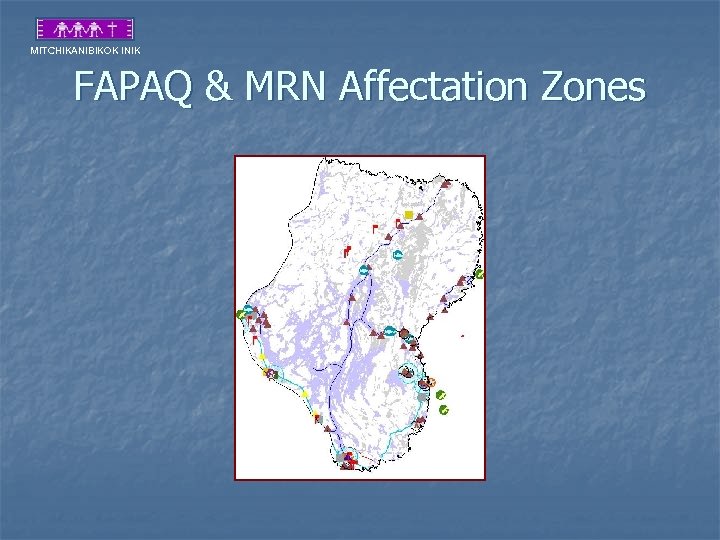
MITCHIKANIBIKOK INIK FAPAQ & MRN Affectation Zones
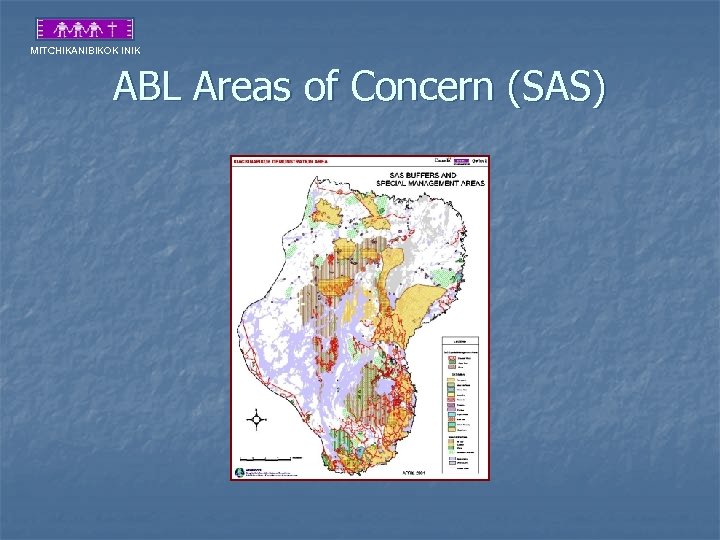
MITCHIKANIBIKOK INIK ABL Areas of Concern (SAS)
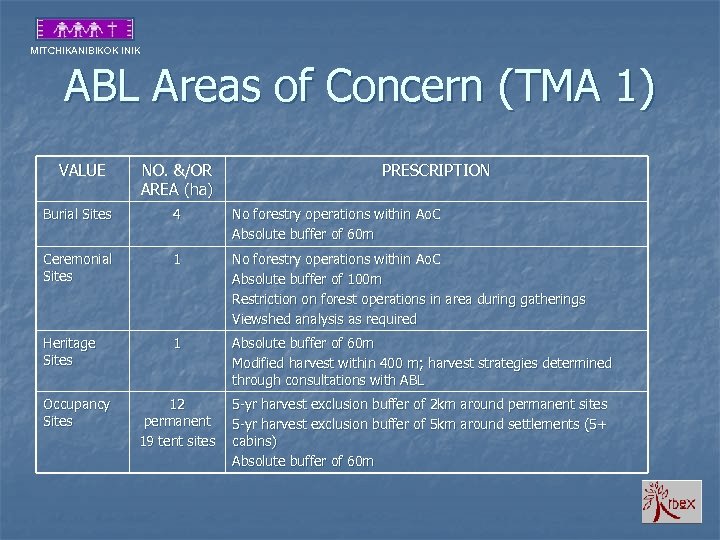
MITCHIKANIBIKOK INIK ABL Areas of Concern (TMA 1) VALUE NO. &/OR AREA (ha) PRESCRIPTION Burial Sites 4 No forestry operations within Ao. C Absolute buffer of 60 m Ceremonial Sites 1 No forestry operations within Ao. C Absolute buffer of 100 m Restriction on forest operations in area during gatherings Viewshed analysis as required Heritage Sites 1 Absolute buffer of 60 m Modified harvest within 400 m; harvest strategies determined through consultations with ABL 12 permanent 19 tent sites 5 -yr harvest exclusion buffer of 2 km around permanent sites 5 -yr harvest exclusion buffer of 5 km around settlements (5+ cabins) Absolute buffer of 60 m Occupancy Sites
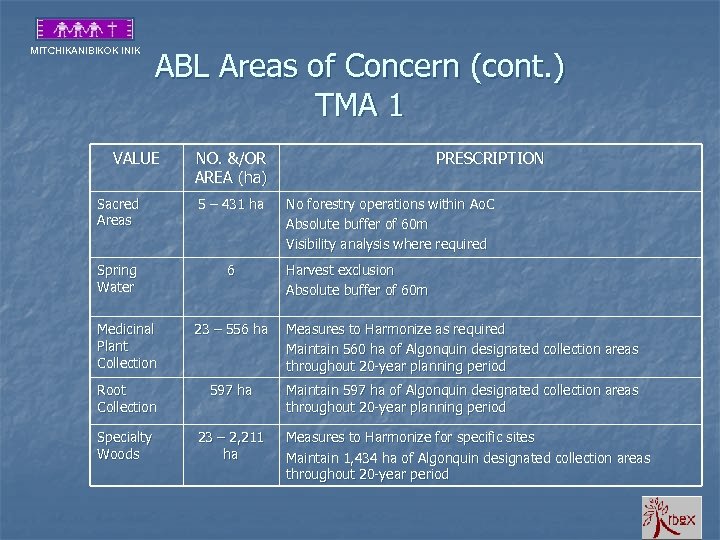
MITCHIKANIBIKOK INIK ABL Areas of Concern (cont. ) TMA 1 VALUE NO. &/OR AREA (ha) Sacred Areas 5 – 431 ha Spring Water 6 PRESCRIPTION No forestry operations within Ao. C Absolute buffer of 60 m Visibility analysis where required Harvest exclusion Absolute buffer of 60 m Medicinal Plant Collection 23 – 556 ha Measures to Harmonize as required Maintain 560 ha of Algonquin designated collection areas throughout 20 -year planning period Root Collection 597 ha Maintain 597 ha of Algonquin designated collection areas throughout 20 -year planning period Specialty Woods 23 – 2, 211 ha Measures to Harmonize for specific sites Maintain 1, 434 ha of Algonquin designated collection areas throughout 20 -year period
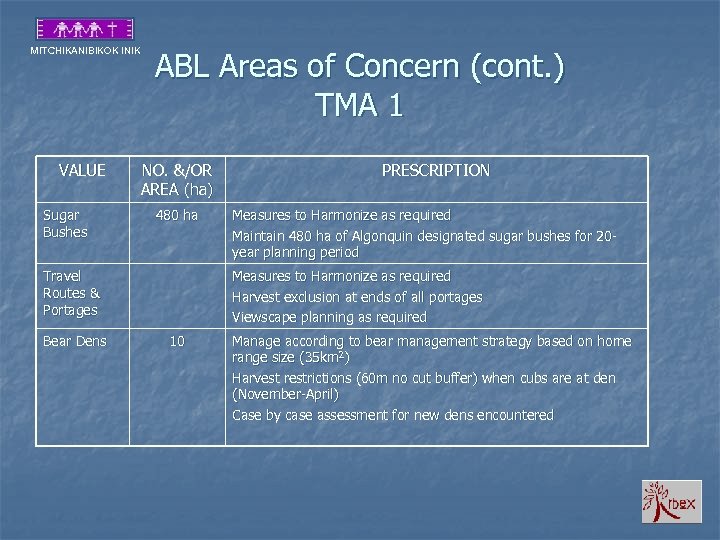
MITCHIKANIBIKOK INIK VALUE Sugar Bushes ABL Areas of Concern (cont. ) TMA 1 NO. &/OR AREA (ha) 480 ha Travel Routes & Portages Bear Dens PRESCRIPTION Measures to Harmonize as required Maintain 480 ha of Algonquin designated sugar bushes for 20 year planning period Measures to Harmonize as required Harvest exclusion at ends of all portages Viewscape planning as required 10 Manage according to bear management strategy based on home range size (35 km 2) Harvest restrictions (60 m no cut buffer) when cubs are at den (November-April) Case by case assessment for new dens encountered
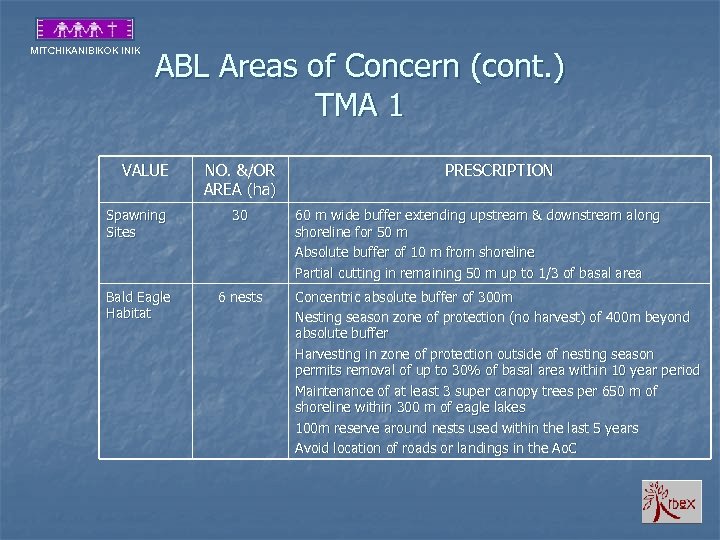
MITCHIKANIBIKOK INIK ABL Areas of Concern (cont. ) TMA 1 VALUE NO. &/OR AREA (ha) Spawning Sites 30 Bald Eagle Habitat 6 nests PRESCRIPTION 60 m wide buffer extending upstream & downstream along shoreline for 50 m Absolute buffer of 10 m from shoreline Partial cutting in remaining 50 m up to 1/3 of basal area Concentric absolute buffer of 300 m Nesting season zone of protection (no harvest) of 400 m beyond absolute buffer Harvesting in zone of protection outside of nesting season permits removal of up to 30% of basal area within 10 year period Maintenance of at least 3 super canopy trees per 650 m of shoreline within 300 m of eagle lakes 100 m reserve around nests used within the last 5 years Avoid location of roads or landings in the Ao. C
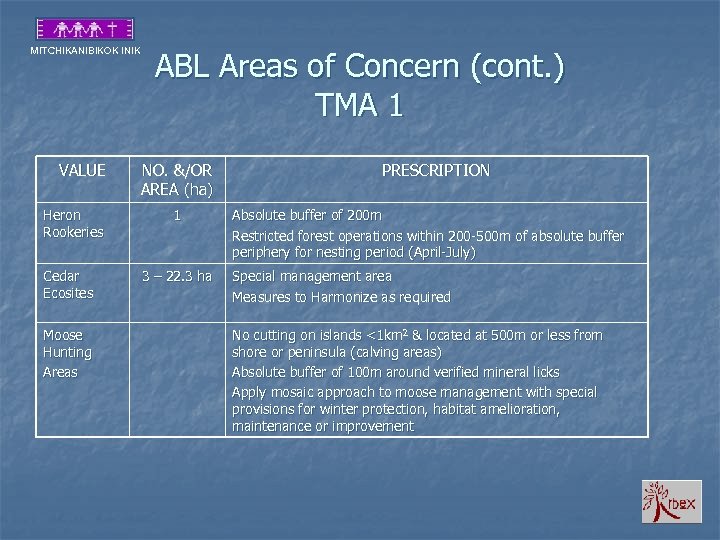
MITCHIKANIBIKOK INIK VALUE Heron Rookeries Cedar Ecosites Moose Hunting Areas ABL Areas of Concern (cont. ) TMA 1 NO. &/OR AREA (ha) 1 3 – 22. 3 ha PRESCRIPTION Absolute buffer of 200 m Restricted forest operations within 200 -500 m of absolute buffer periphery for nesting period (April-July) Special management area Measures to Harmonize as required No cutting on islands <1 km 2 & located at 500 m or less from shore or peninsula (calving areas) Absolute buffer of 100 m around verified mineral licks Apply mosaic approach to moose management with special provisions for winter protection, habitat amelioration, maintenance or improvement
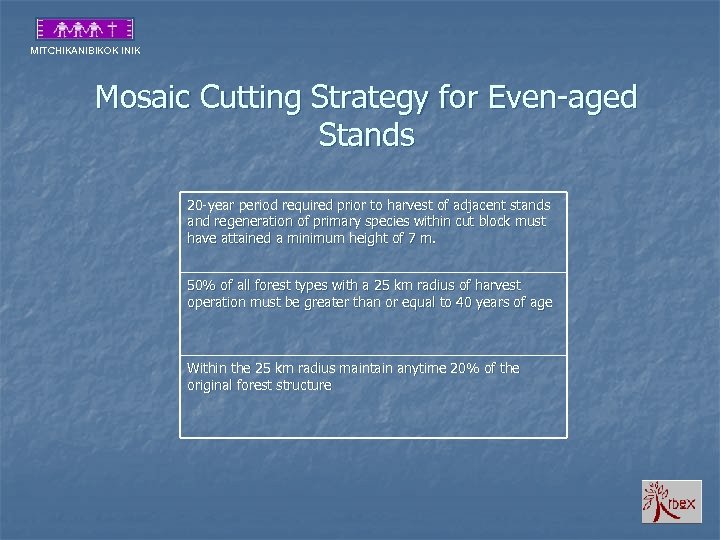
MITCHIKANIBIKOK INIK Mosaic Cutting Strategy for Even-aged Stands 20 -year period required prior to harvest of adjacent stands and regeneration of primary species within cut block must have attained a minimum height of 7 m. 50% of all forest types with a 25 km radius of harvest operation must be greater than or equal to 40 years of age Within the 25 km radius maintain anytime 20% of the original forest structure
MITCHIKANIBIKOK INIK Provisional Measures Sensitive Area Study (SAS); identification of sensitive zones to be protected within cutting areas Á Measures to Harmonize (MTH) forestry operations with the Algonquin way-of-life À
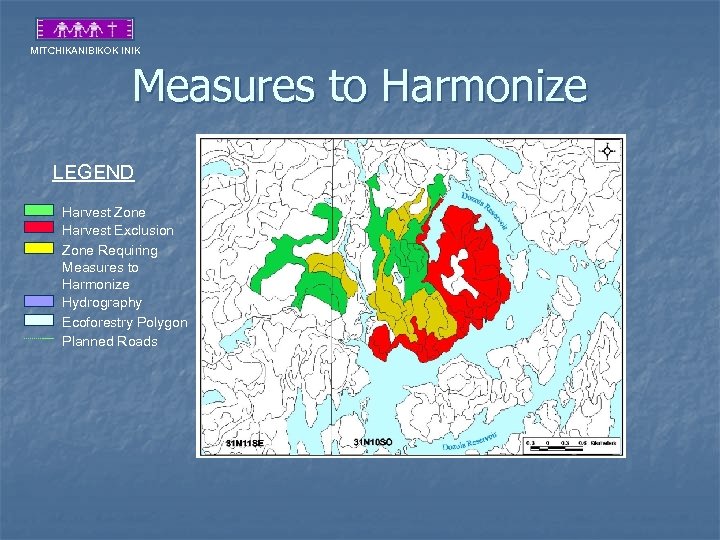
MITCHIKANIBIKOK INIK Measures to Harmonize LEGEND Harvest Zone Harvest Exclusion Zone Requiring Measures to Harmonize Hydrography Ecoforestry Polygon Planned Roads
MITCHIKANIBIKOK INIK Sustainable Development of Natural Resources n To obtain & utilize the highest quality forestry & wildlife data in the development of a sustainable adaptive management strategy for the renewable resources of the Trilateral Agreement Territory (TAT).
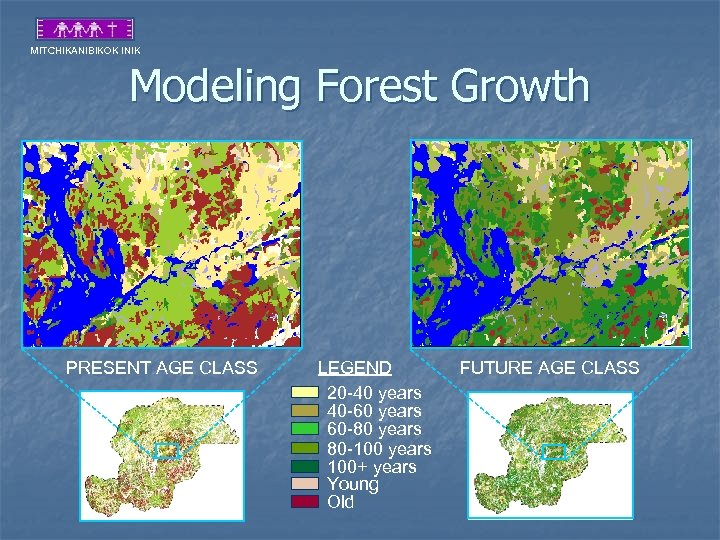
MITCHIKANIBIKOK INIK Modeling Forest Growth PRESENT AGE CLASS LEGEND 20 -40 years 40 -60 years 60 -80 years 80 -100 years 100+ years Young Old FUTURE AGE CLASS
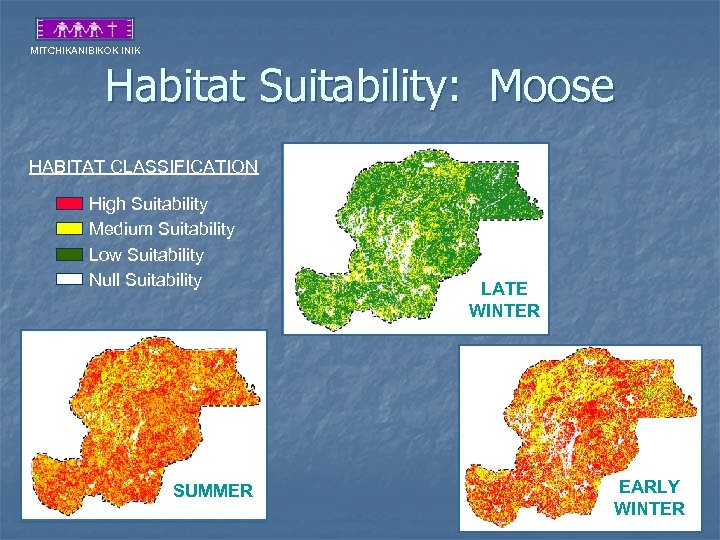
MITCHIKANIBIKOK INIK Habitat Suitability: Moose HABITAT CLASSIFICATION High Suitability Medium Suitability Low Suitability Null Suitability SUMMER LATE WINTER EARLY WINTER
MITCHIKANIBIKOK INIK Economic/Social Development Program n To profile & analyze Algonquin & non. Algonquin local & regional socio-economic activities & the legal frameworks which govern them, facilitating the selection of sustainable resource management alternatives consistent with the interests of the Algonquins of Barriere Lake.
MITCHIKANIBIKOK INIK n n n Context: Forestry in the TAT area: 10, 900 km 2 No. Common Areas (CAAFs): 7 Area occupied by CAAFs: 9, 188 km 2 No. CAAF beneficiaries: 36 Gross merchantable volume (all species): 77, 025, 340 m 3 AAC (all species): 1, 289, 687 m 3
MITCHIKANIBIKOK INIK Economic Value of Activities in the TAT (1994 Data)
MITCHIKANIBIKOK INIK Phase II Activities n n n Conservation Suitability Gap Analysis Preparation of Wildlife Management Plans Preparation of Draft Integrated Resource Management Plans for 7 Traditional Management Areas (TMA’s)
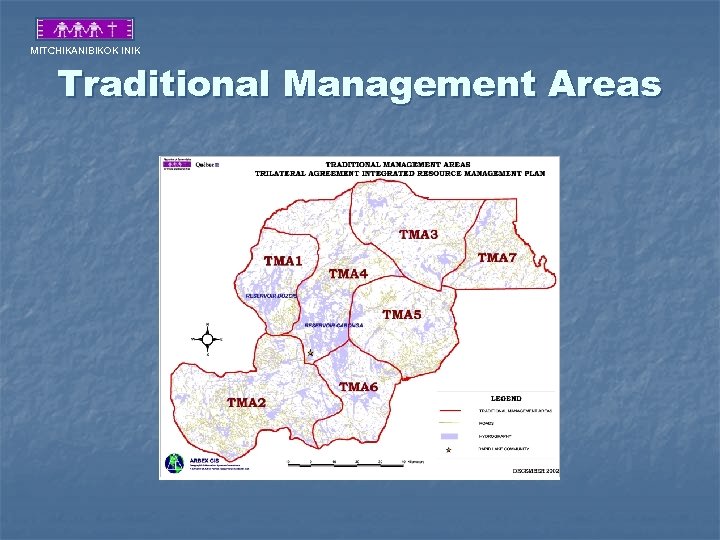
MITCHIKANIBIKOK INIK Traditional Management Areas
MITCHIKANIBIKOK INIK Conservation Suitability Analysis n n Collaboration between World Wildlife Fund - Canada & ABL (Arbex Forest Resource Consultants) Natural Regions C 2, C 3, & C 6 Data layers n n n Forest cover diversity Old growth forest Road less/intact areas Enduring features Physical habitat diversity Cutover areas
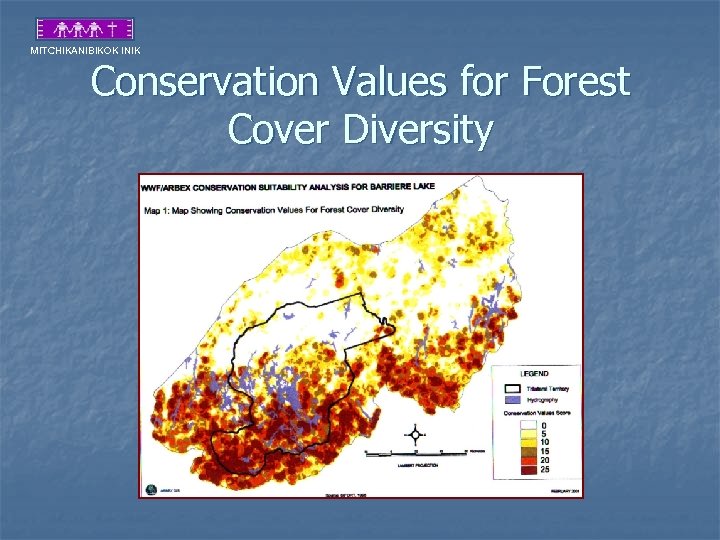
MITCHIKANIBIKOK INIK Conservation Values for Forest Cover Diversity
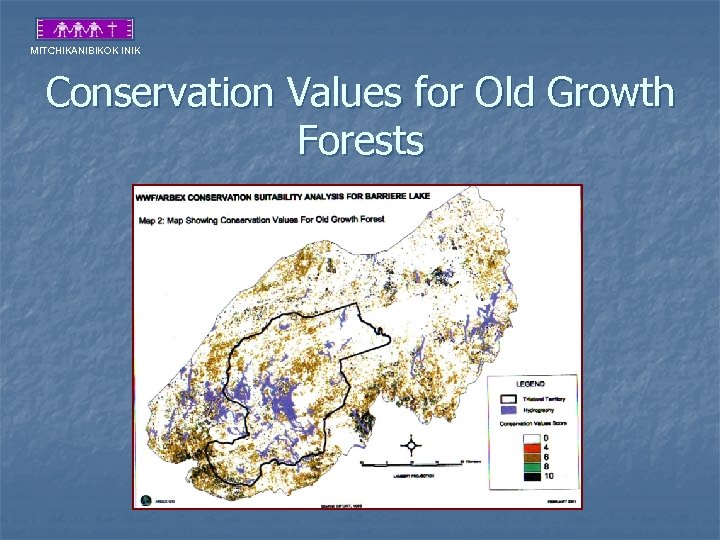
MITCHIKANIBIKOK INIK Conservation Values for Old Growth Forests
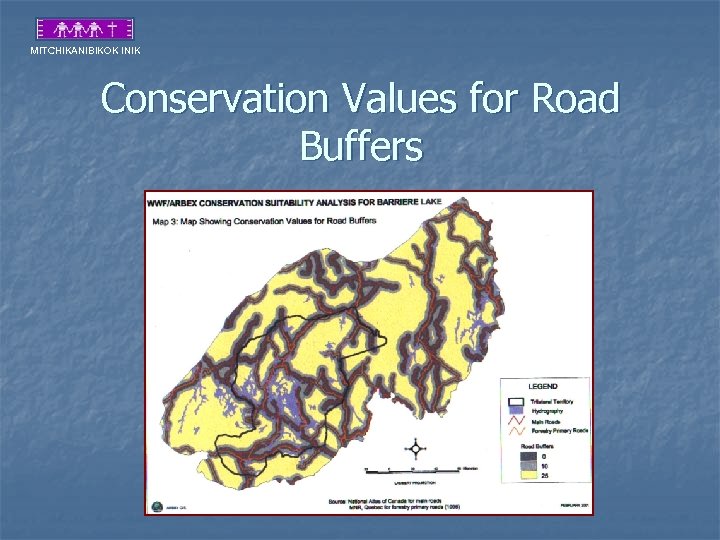
MITCHIKANIBIKOK INIK Conservation Values for Road Buffers
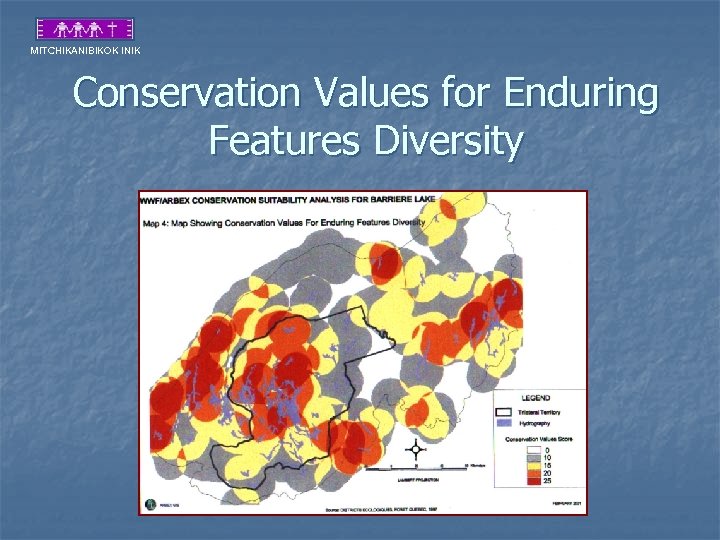
MITCHIKANIBIKOK INIK Conservation Values for Enduring Features Diversity
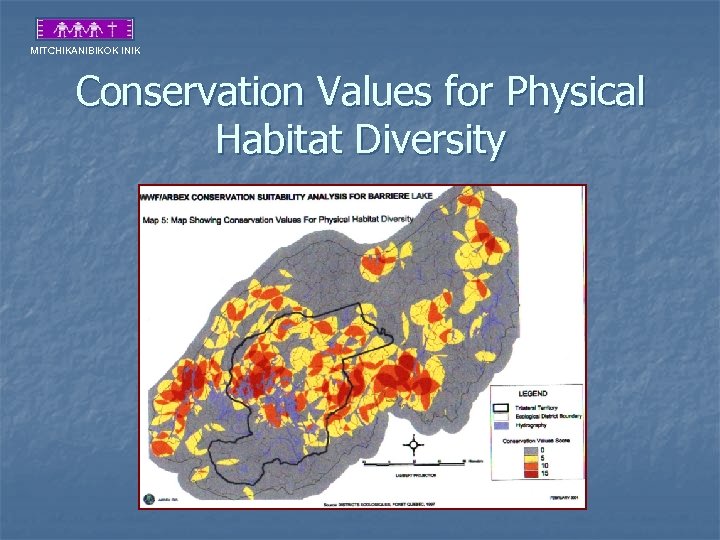
MITCHIKANIBIKOK INIK Conservation Values for Physical Habitat Diversity
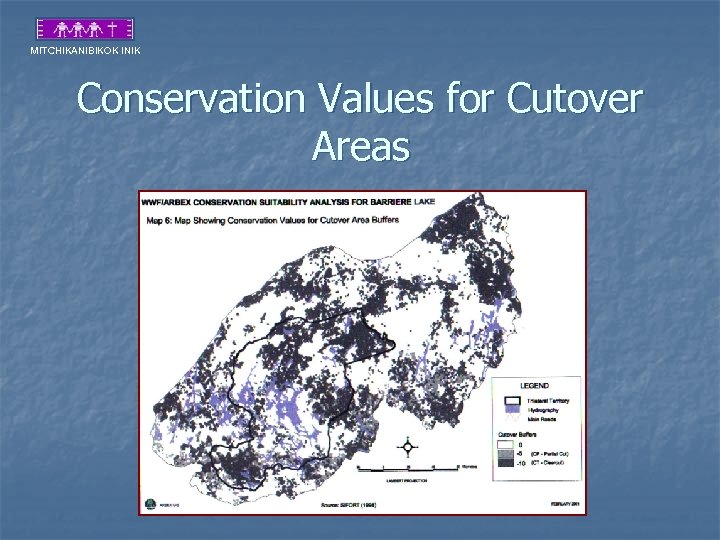
MITCHIKANIBIKOK INIK Conservation Values for Cutover Areas
MITCHIKANIBIKOK INIK Preliminary Findings - Areas within the Trilateral Agreement Territory could be considered as “candidate protection areas” for regional representation of enduring natural features. - A correlation exists between high value candidate protection areas and sites identified as culturally significant by the Algonquins.
MITCHIKANIBIKOK INIK Integrated Resource Management Planning Strategies n n n Diverse planning team involving ABL Planned public input through standard public consultation for CAAF holders & ABL community meetings Planned public inspection of final plan as a component of the Trilateral Agreement Process Algonquin values mapping & updates of maps 2000 -2003 Area of concern planning process
MITCHIKANIBIKOK INIK Planning Issues, Influences and Concerns n n n n Algonquin issues, aspirations & concerns current forest condition desired future forest condition non-timber values requiring protection existing resource uses of the territory other resource management issues current legislation & government policy issues
MITCHIKANIBIKOK INIK Benchmark Scenarios 1) Unrestricted Harvest (All Eligible Harvest Area is available for harvest) 2) Quebec Forest Act Applied 3) Quebec Forest Act & TAT Area of Concern Strategies Applied 4) Quebec Forest Act & Enhanced TAT Area of Concern Strategies Applied 5) Conservation Suitability Analysis Areas (Top 12% and 8% CSA Areas removed from EHA) * Scenarios were not developed for uneven-age management regimes as uneven-age strategies are viewed as less intrusive by the ABL.
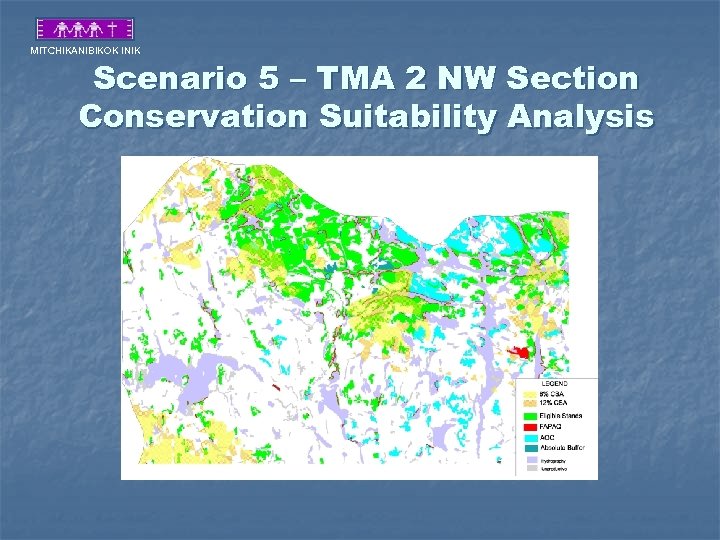
MITCHIKANIBIKOK INIK Scenario 5 – TMA 2 NW Section Conservation Suitability Analysis
MITCHIKANIBIKOK INIK Scenario Modeling / Negotiation Support n In cooperation with Quebec our planning team is developing a computer model to predict future wood supply under various management scenarios. This model will assist and support negotiations for the implementation of the IRMP by predicting the future forest condition expected to result from the implementation of each strategy and test each strategy for its ability to ensure forest sustainability while ensuring the continuance of the Algonquin traditional activities over time.
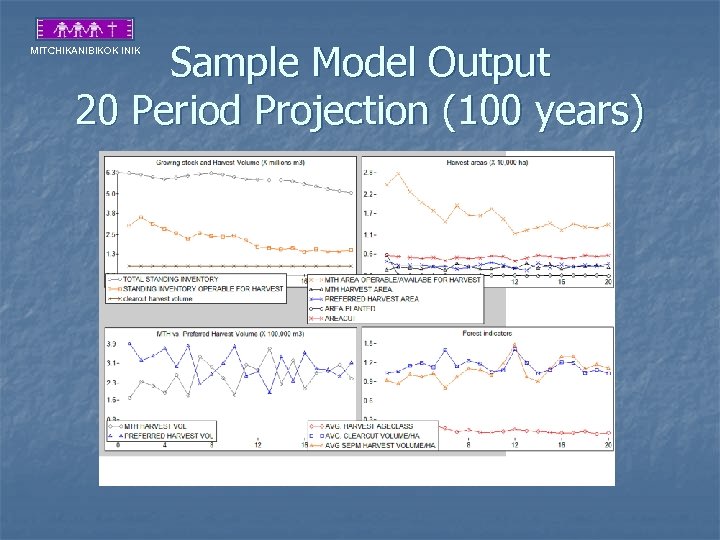
Sample Model Output 20 Period Projection (100 years) MITCHIKANIBIKOK INIK
MITCHIKANIBIKOK INIK Measuring Social Criteria and Indicators n n To know if ecosystems are being managed in a sustainably and in a culturally appropriate manner - parameters linked to sustainability of ecosystems and culture must be measured. Basis for continuous improvement of forest management from ABL perspective
MITCHIKANIBIKOK INIK Social Indicators - Process n n Development of Social Indicators is a dynamic process which will evolve with needs and new knowledge Trend data, fixed measures, indices and ratios may be used Principles will be refined and validated over time through monitoring, data collection and analysis Require inputs of time and money
MITCHIKANIBIKOK INIK Examples of Social Indicators n n n Area of Land & Quality of Resources for Subsistence & Cultural Purposes Level of Land Alienation Algonquin Values Documents & Maps used in decision making process Protection of cultural & heritage sites Level of Societael & Economic Benefit
MITCHIKANIBIKOK INIK Examples of Social Indicators (cont. ) n n n Distribution of resource benefits & revenues Level of Land Use Conflict Level of Community Satisfaction with IRMP process Participation of ABL in decision making process ABL & Scientific Databases etc.
MITCHIKANIBIKOK INIK Examples of Measures n n n Level of transmigration of Algonquin harvesters within and between TMAs Geographic distribution of harvests (percent area) within TMA Level of traditional Land Use and practise of traditional activities Level of satisfaction with hunting, trapping, fishing results Prescence/absence of ABL land use maps
MITCHIKANIBIKOK INIK Measures (cont. ) n n Level and trends in social pathologies Person/days employment (ABL) Number of work stoppages etc.
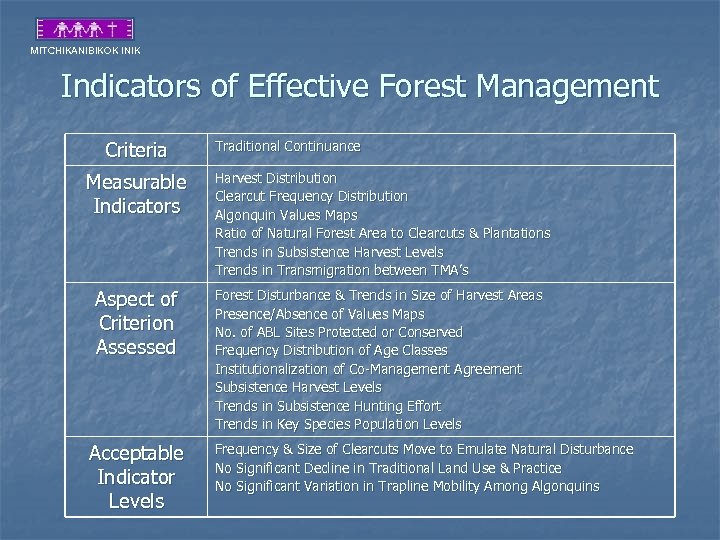
MITCHIKANIBIKOK INIK Indicators of Effective Forest Management Criteria Traditional Continuance Measurable Indicators Harvest Distribution Clearcut Frequency Distribution Algonquin Values Maps Ratio of Natural Forest Area to Clearcuts & Plantations Trends in Subsistence Harvest Levels Trends in Transmigration between TMA’s Aspect of Criterion Assessed Forest Disturbance & Trends in Size of Harvest Areas Presence/Absence of Values Maps No. of ABL Sites Protected or Conserved Frequency Distribution of Age Classes Institutionalization of Co-Management Agreement Subsistence Harvest Levels Trends in Subsistence Hunting Effort Trends in Key Species Population Levels Acceptable Indicator Levels Frequency & Size of Clearcuts Move to Emulate Natural Disturbance No Significant Decline in Traditional Land Use & Practice No Significant Variation in Trapline Mobility Among Algonquins
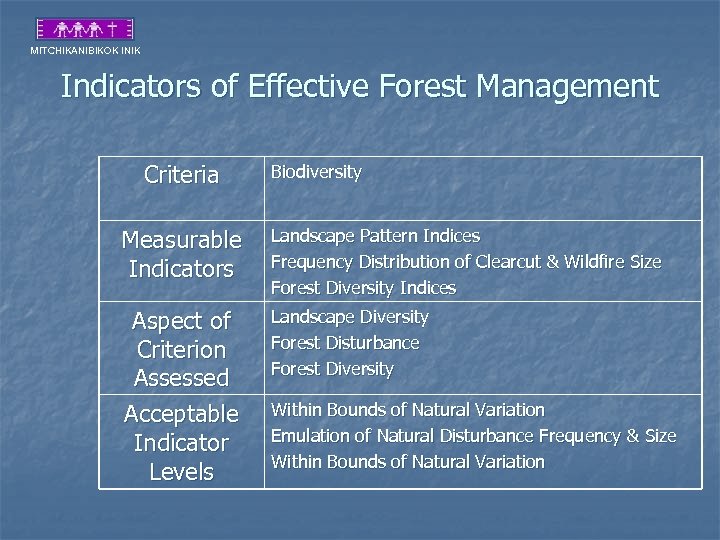
MITCHIKANIBIKOK INIK Indicators of Effective Forest Management Criteria Biodiversity Measurable Indicators Landscape Pattern Indices Frequency Distribution of Clearcut & Wildfire Size Forest Diversity Indices Aspect of Criterion Assessed Acceptable Indicator Levels Landscape Diversity Forest Disturbance Forest Diversity Within Bounds of Natural Variation Emulation of Natural Disturbance Frequency & Size Within Bounds of Natural Variation
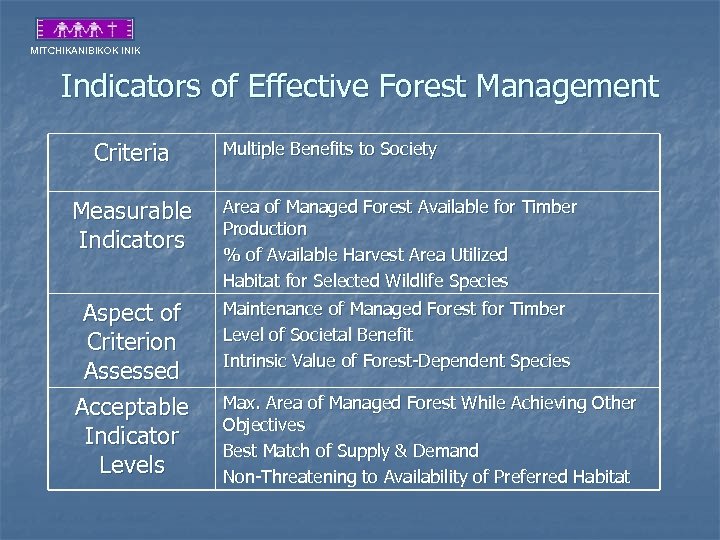
MITCHIKANIBIKOK INIK Indicators of Effective Forest Management Criteria Multiple Benefits to Society Measurable Indicators Area of Managed Forest Available for Timber Production % of Available Harvest Area Utilized Habitat for Selected Wildlife Species Aspect of Criterion Assessed Acceptable Indicator Levels Maintenance of Managed Forest for Timber Level of Societal Benefit Intrinsic Value of Forest-Dependent Species Max. Area of Managed Forest While Achieving Other Objectives Best Match of Supply & Demand Non-Threatening to Availability of Preferred Habitat
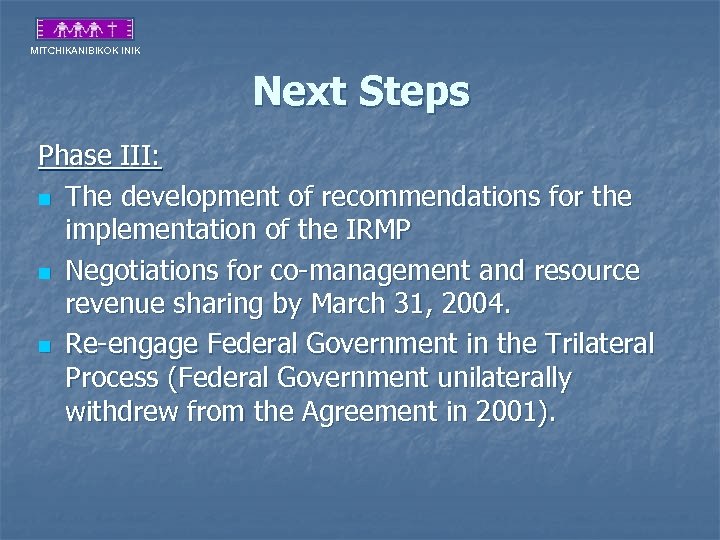
MITCHIKANIBIKOK INIK Next Steps Phase III: n The development of recommendations for the implementation of the IRMP n Negotiations for co-management and resource revenue sharing by March 31, 2004. n Re-engage Federal Government in the Trilateral Process (Federal Government unilaterally withdrew from the Agreement in 2001).
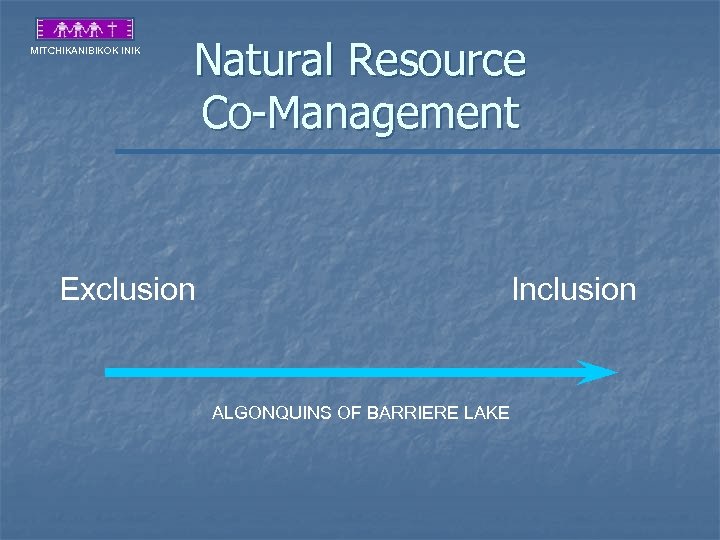
MITCHIKANIBIKOK INIK Natural Resource Co-Management Exclusion Inclusion ALGONQUINS OF BARRIERE LAKE
MITCHIKANIBIKOK INIK Further Information n n Grand Chief Carol Mc. Bride Special Representative – Algonquins of Barriere Lake Telephone: (819) 723 -2019 Bruce Byford R. P. F. Technical Advisor Arbex Forest Resource Consultants Ltd 554 Craig Road Oxford Mills, On K 0 G 1 S 0 Telephone: (613) 258 -6563 www. arbex. ca
Скачать презентацию The Barriere Lake Trilateral Agreement Algonquins of Barriere
f314d91c326e6a2e0830087c52ebea9d.ppt