


 Скачать презентацию The Awareness of Nike of MCU Students on
dbb7637fe42a01bdc8b43ba90cb3c66d.ppt
- Количество слайдов: 40
 The Awareness of Nike of MCU Students on Tayouan Campus Instructor:Ling -Huei , Shiu Group members: Ting-Fang, Chang 95420546 Ching-Ya, Chen 95420493 Huei- Shiuan, Hsu 95420145 Yin-An, Chung 95421905 1
 Presentation Outline Introduction Literature Review Method Data Analysis and Results Conclusion and Recommendation 2
 Introduction: Motivation; Purpose of The Study; Significant of The Study; Research Questions 3
 Introduction: Nike is a famous sport brand Nike emphasizes marketing Nike commercials are everywhere Nike products satisfy people of different age/gender. 5. Nike products are popular among MCU students 6. Post-purchase customer satisfaction is important issue 1. 2. 3. 4. 4
 Purpose 1. MCU students’ awareness of Nike 2. Customer satisfaction of Nike products of the students at MCU 5
 In More Details: 1. Explore whether Nike commercials affect purchase decisions of customers 2. Explore whether customer satisfaction influence repurchase of Nike products 3. Explore whether quality is the key 4. Explore whether product features attract customers of different gender 5. Explore whether price is a big concern 6
 Literature Review: Brand; Commercial; Product; Consumer Behavior ; Consumer Satisfaction 7
 Brand n Brand: “a name, term, symbol, or design, or a combination of them, intended to signify the goods or services of one seller or group of sellers” (Kotler quoted in Arnold, 1993, p. 2) 8
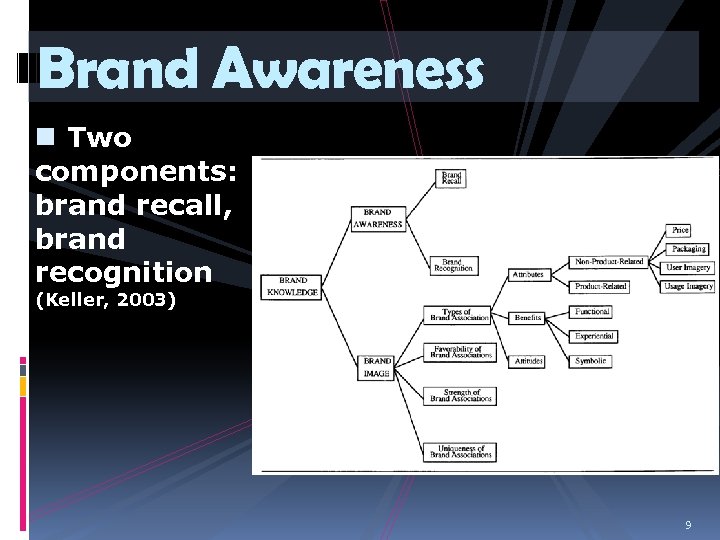 Brand Awareness n Two components: brand recall, brand recognition (Keller, 2003) 9
 Brand Image of Nike 1. Nike has established itself as equivalent to sports and sports culture 2. Nike has built its culture icon through advertising 3. Nike has achieved brand preeminence Goldman and Papson (1998) 10
 Commercial n. TV commercials are intended to make product seem special and unique (Vaid, 2003). n. A commercial reveal its message only at the end of the entire commercial (Baldwin, 1982). 11
 Celebrity n. Increasingly, celebrity associations are used to create a specific personality type for their brand (Vaid 2003). 12
 Products n. The lifeblood of organizations, products are the “public face” of a corporation (Bruce & Biemans, 1995). 13
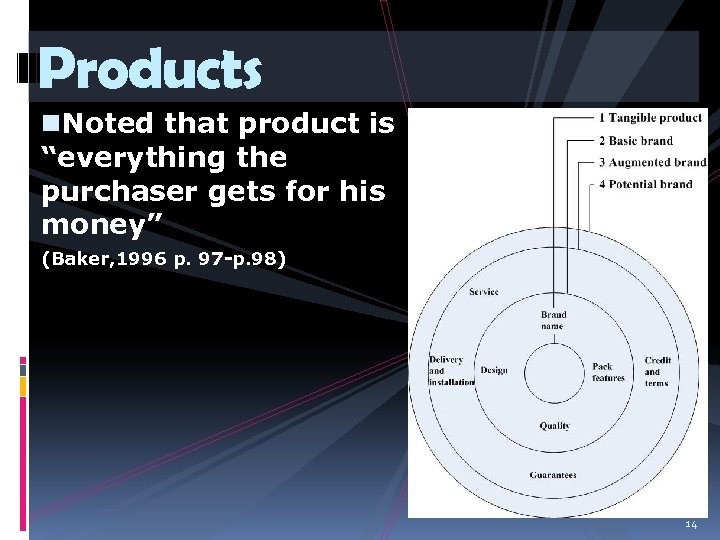 Products n. Noted that product is “everything the purchaser gets for his money” (Baker, 1996 p. 97 -p. 98) 14
 Features of Product n Other than technology, a product includes such features as physical form or design, level of quality, durability, environmental impact, and ease of use (Bovee & Thill, 1992). 15
 Quality of Product n. The American Society for Quality Control: quality indicates the characteristics of a product or service and how they satisfy stated or implied needs (cited in Summers, 2000). 16
 Consumer Behavior n ”Consumer behavior is defined as activities people undertake when obtaining, consuming, and disposing of products and services” (Blackwell, Miniard & Engel, 2001, p. 6 -p. 7 ). 17
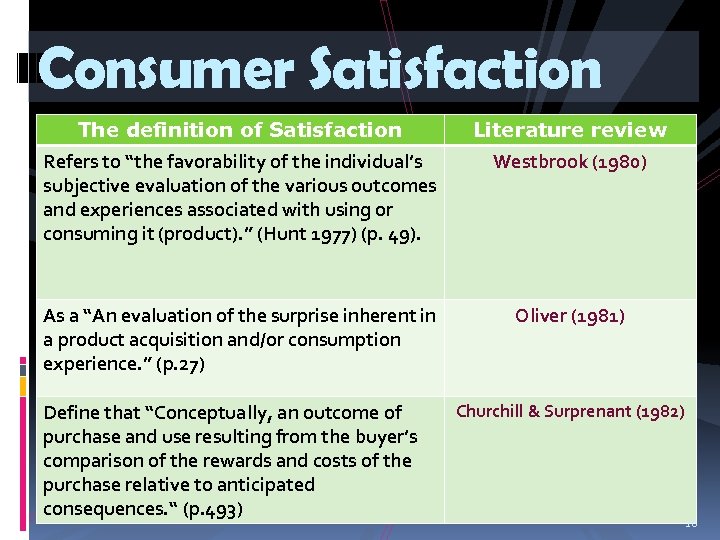 Consumer Satisfaction The definition of Satisfaction Literature review Refers to “the favorability of the individual’s subjective evaluation of the various outcomes and experiences associated with using or consuming it (product). ” (Hunt 1977) (p. 49). Westbrook (1980) As a “An evaluation of the surprise inherent in a product acquisition and/or consumption experience. ” (p. 27) Oliver (1981) Define that “Conceptually, an outcome of purchase and use resulting from the buyer’s comparison of the rewards and costs of the purchase relative to anticipated consequences. “ (p. 493) Churchill & Surprenant (1982) 18
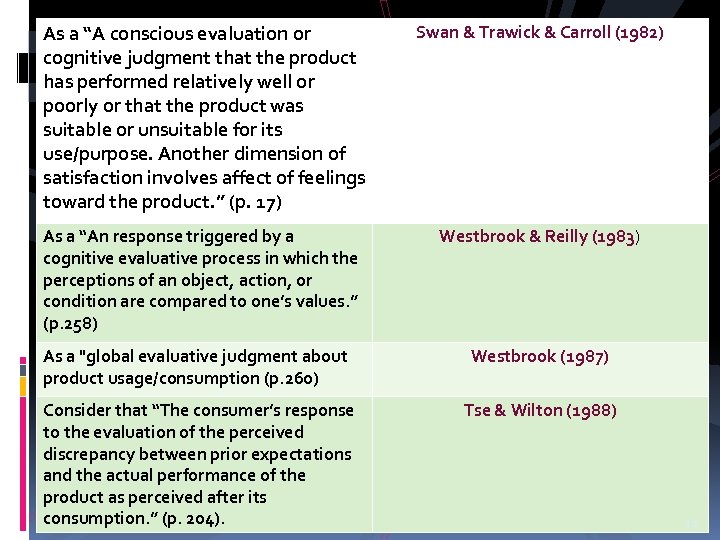 As a “A conscious evaluation or cognitive judgment that the product has performed relatively well or poorly or that the product was suitable or unsuitable for its use/purpose. Another dimension of satisfaction involves affect of feelings toward the product. ” (p. 17) Swan & Trawick & Carroll (1982) As a “An response triggered by a cognitive evaluative process in which the perceptions of an object, action, or condition are compared to one’s values. ” (p. 258) Westbrook & Reilly (1983) As a "global evaluative judgment about product usage/consumption (p. 260) Westbrook (1987) Consider that “The consumer’s response to the evaluation of the perceived discrepancy between prior expectations and the actual performance of the product as perceived after its consumption. ” (p. 204). Tse & Wilton (1988) 19
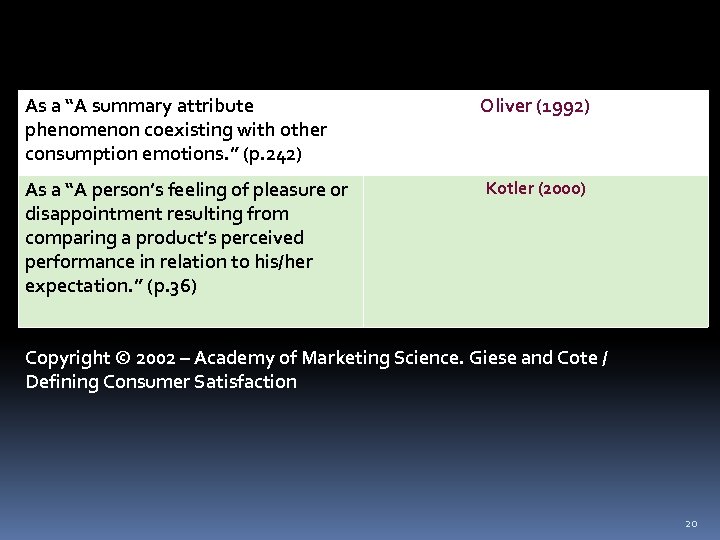 As a “A summary attribute phenomenon coexisting with other consumption emotions. ” (p. 242) Oliver (1992) As a “A person’s feeling of pleasure or disappointment resulting from comparing a product’s perceived performance in relation to his/her expectation. ” (p. 36) Kotler (2000) Copyright © 2002 – Academy of Marketing Science. Giese and Cote / Defining Consumer Satisfaction 20
 In More Detail 1. Explore whether Nike commercials affect purchase decisions of customers 2. Explore whether customer satisfaction influence repurchase of Nike products 3. Explore whether quality is the key 4. Explore whether product features attract customers of different gender 5. Explore whether price is a big concern 21
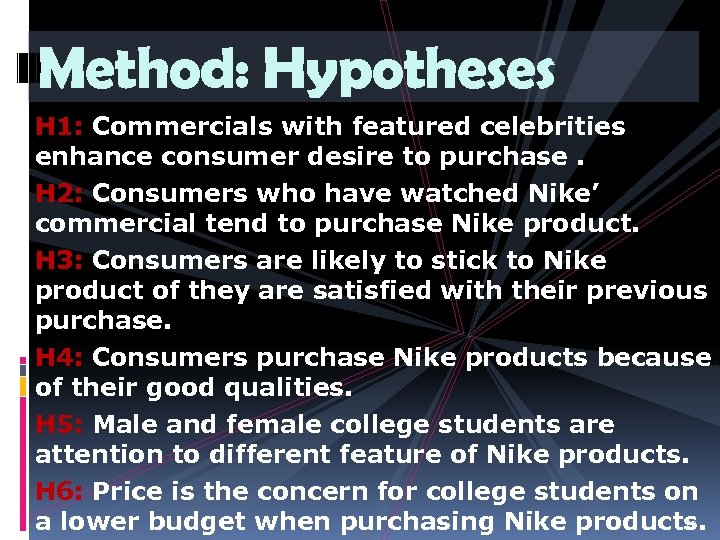 Method: Hypotheses H 1: Commercials with featured celebrities enhance consumer desire to purchase. H 2: Consumers who have watched Nike’ commercial tend to purchase Nike product. H 3: Consumers are likely to stick to Nike product of they are satisfied with their previous purchase. H 4: Consumers purchase Nike products because of their good qualities. H 5: Male and female college students are attention to different feature of Nike products. H 6: Price is the concern for college students on 22 a lower budget when purchasing Nike products.
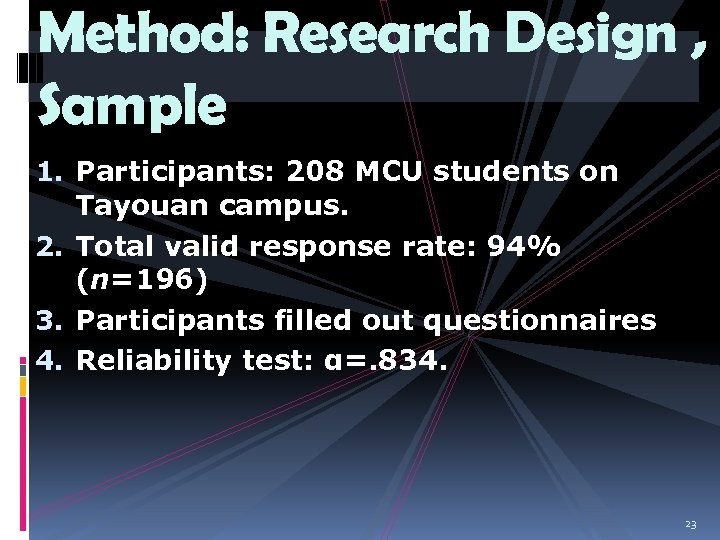 Method: Research Design , Sample 1. Participants: 208 MCU students on Tayouan campus. 2. Total valid response rate: 94% (n=196) 3. Participants filled out questionnaires 4. Reliability test: α=. 834. 23
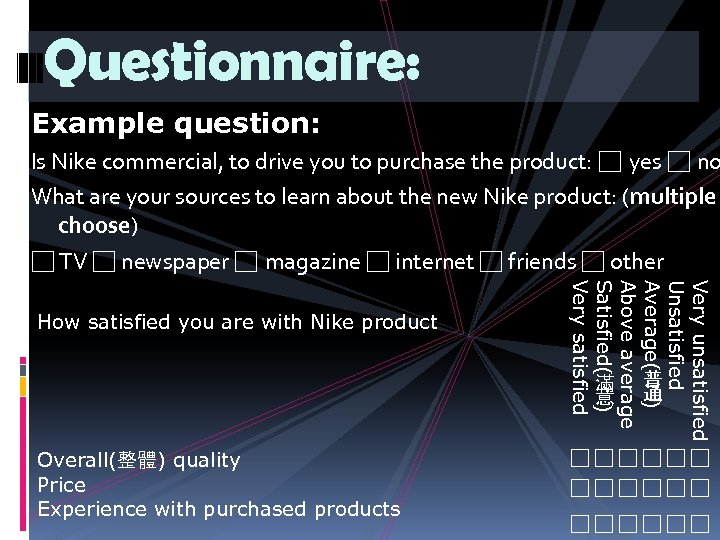 Questionnaire: Example question: Is Nike commercial, to drive you to purchase the product: □ yes □ no What are your sources to learn about the new Nike product: (multiple choose) □ TV □ newspaper □ magazine □ internet □ friends □ other Very unsatisfied Unsatisfied Average( ) Above average Satisfied( ) Very satisfied How satisfied you are with Nike product 滿 意 □ □ □ □ □ Overall(整體) quality Price Experience with purchased products 普 通
 Method: Procedure n. Participants: restaurant and library n. Questionnaire, in English only n. Participants fill out questionnaires 25
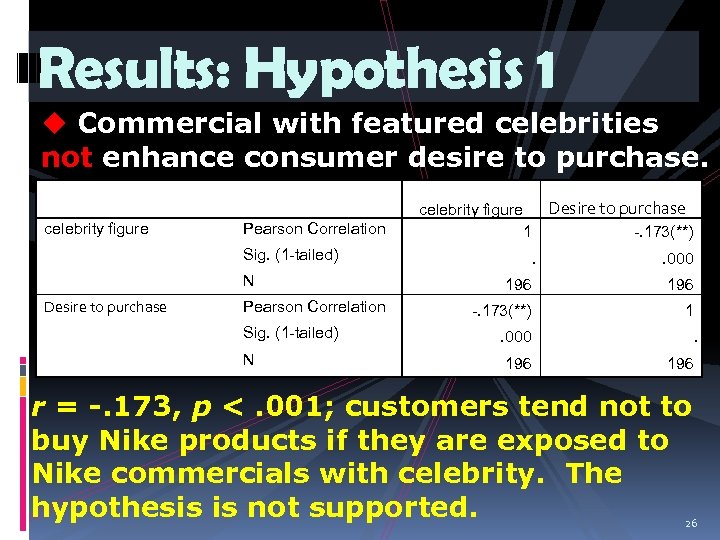 Results: Hypothesis 1 u Commercial with featured celebrities not enhance consumer desire to purchase. celebrity figure Pearson Correlation Sig. (1 -tailed) N Desire to purchase Pearson Correlation Desire to purchase celebrity figure 1 -. 173(**). . 000 196 -. 173(**) 1 Sig. (1 -tailed) . 000 N 196 r = -. 173, p <. 001; customers tend not to buy Nike products if they are exposed to Nike commercials with celebrity. The hypothesis is not supported. 26
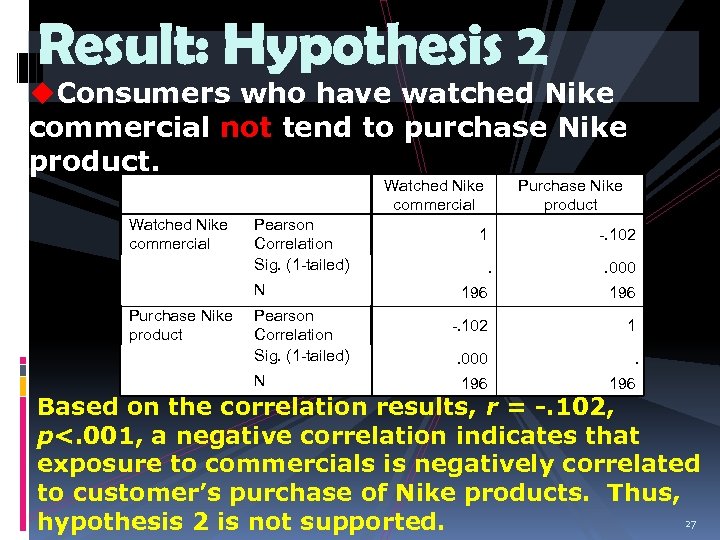 Result: Hypothesis 2 u. Consumers who have watched Nike commercial not tend to purchase Nike product. Watched Nike commercial Pearson Correlation Sig. (1 -tailed) N Purchase Nike product 1 -. 102. . 000 196 -. 102 1 . 000 196 Based on the correlation results, r = -. 102, p<. 001, a negative correlation indicates that exposure to commercials is negatively correlated to customer’s purchase of Nike products. Thus, 27 hypothesis 2 is not supported.
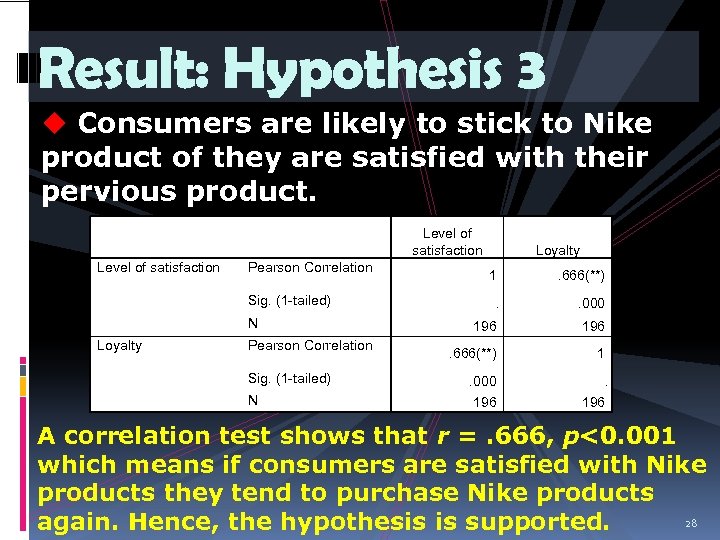 Result: Hypothesis 3 u Consumers are likely to stick to Nike product of they are satisfied with their pervious product. Level of satisfaction Pearson Correlation Loyalty 1 Sig. (1 -tailed) N Loyalty Pearson Correlation . 666(**). . 000 196 . 666(**) 1 Sig. (1 -tailed) . 000 N 196 A correlation test shows that r =. 666, p<0. 001 which means if consumers are satisfied with Nike products they tend to purchase Nike products 28 again. Hence, the hypothesis is supported.
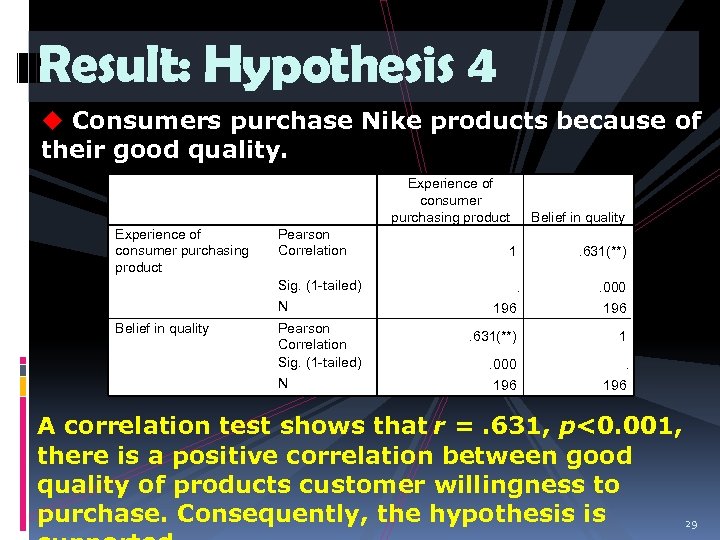 Result: Hypothesis 4 u Consumers purchase Nike products because of their good quality. Experience of consumer purchasing product Pearson Correlation 1 Sig. (1 -tailed) N Belief in quality Pearson Correlation Sig. (1 -tailed) N Belief in quality. 631(**). . 000 196 . 631(**) 1 . 000 196 A correlation test shows that r =. 631, p<0. 001, there is a positive correlation between good quality of products customer willingness to purchase. Consequently, the hypothesis is 29
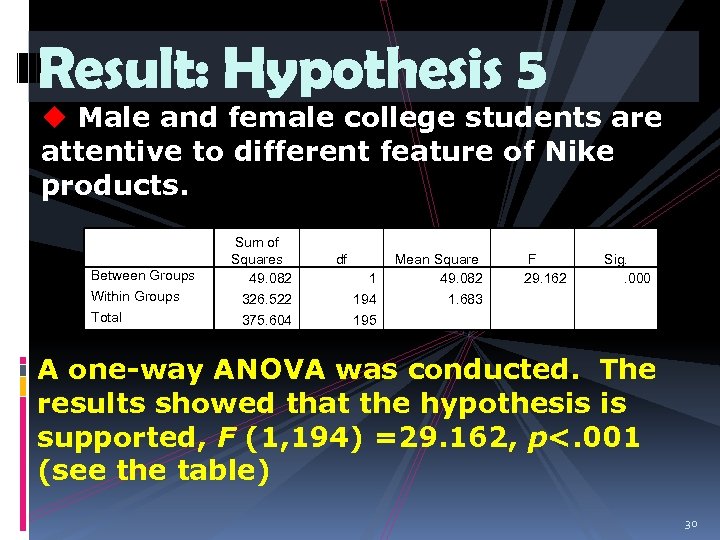 Result: Hypothesis 5 u Male and female college students are attentive to different feature of Nike products. Between Groups Within Groups Total Sum of Squares 49. 082 326. 522 375. 604 df 1 194 195 Mean Square 49. 082 1. 683 F 29. 162 Sig. . 000 A one-way ANOVA was conducted. The results showed that the hypothesis is supported, F (1, 194) =29. 162, p<. 001 (see the table) 30
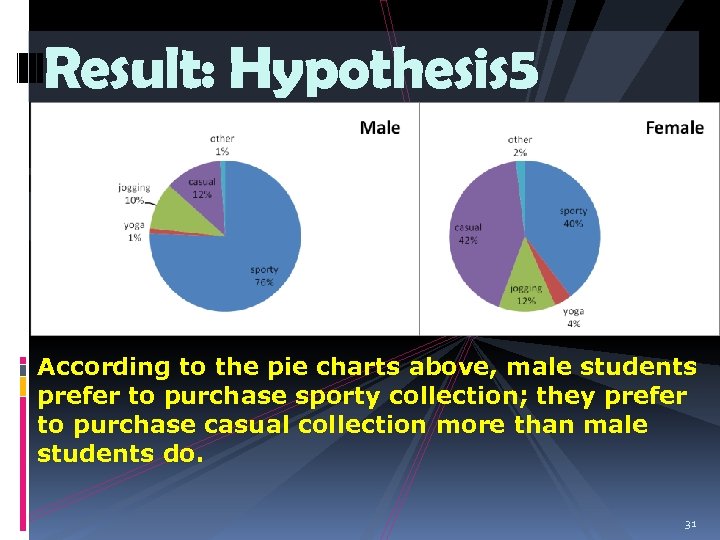 Result: Hypothesis 5 According to the pie charts above, male students prefer to purchase sporty collection; they prefer to purchase casual collection more than male students do. 31
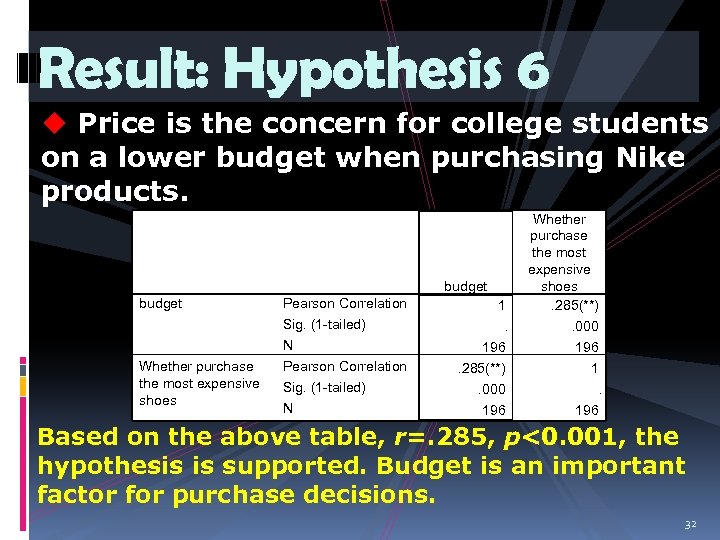 Result: Hypothesis 6 u Price is the concern for college students on a lower budget when purchasing Nike products. Whether purchase the most expensive shoes. 285(**) budget Pearson Correlation 1 Sig. (1 -tailed) N Whether purchase the most expensive shoes Pearson Correlation . . 000 196 . 285(**) 1 Sig. (1 -tailed) . 000 N 196 Based on the above table, r=. 285, p<0. 001, the hypothesis is supported. Budget is an important factor for purchase decisions. 32
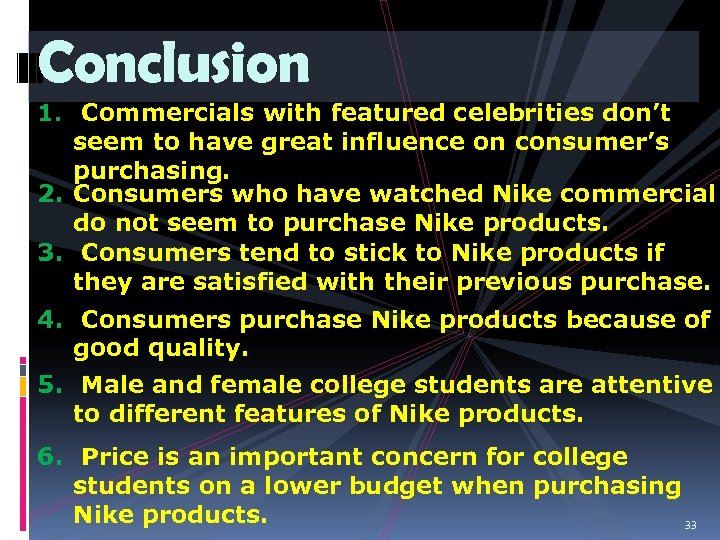 Conclusion 1. Commercials with featured celebrities don’t seem to have great influence on consumer’s purchasing. 2. Consumers who have watched Nike commercial do not seem to purchase Nike products. 3. Consumers tend to stick to Nike products if they are satisfied with their previous purchase. 4. Consumers purchase Nike products because of good quality. 5. Male and female college students are attentive to different features of Nike products. 6. Price is an important concern for college students on a lower budget when purchasing Nike products. 33
 Possible Explanations 1. Nike is equal to sports culture 2. Whether Nike runs commercial s or not, Nike has enjoyed a stable customer base
 Significance of the Study 1. Nike enjoys strong brand awareness and its commercials do not seem to enhance customers’ willingness to buy its products. 2. Suggestion: shifted focus of marketing 3. A new focus: on quality, variety of product features to meet need of consumers of different age/gender 35
 Recommendations 1. The study can have dissimilar results if it includes a bigger sample 2. Future studies may reveal different findings with different participant group -- college students in different areas in Taiwan 36
 References ØAaker, D. A. (1991). Managing Brand Equity. New York: Maxwell Macmillan International, p 7. ØAaker, D. A. & Biel, A. L. (1993). Brand Equity & Advertising. New Jersey: Lawrence Erlbaum Associates, p 71. ØArnold, D. (1993). The Handbook of Brand Management. p 2 ØCardozo, Richard N. (1965). "An Experimental Study of Consumer Effort, Expectation and Satisfaction. " Journal of Marketing Research 2 (August): p. 244 -249. ØChurchill, Gilbert A. , Jr. and Carol Surprenant. (1982). An Investigation into the Determinants of Customer Satisfaction. Journal of Marketing Research 19 (November): p. 491 -504. ØChurchill, Gulbert A. , Jr. and Peter, Paul J. (1995). Creating Value for Customers. IL: Richare D. Irwin, Inc. p. 360. ØCourtland L. B. and John V. T. Marketing. U. S. A. : Mc. Graw-Hill, Inc. p. 252, p. 258. ØDonna C. S. (2000). Quality. N. J. : Prentice-Hall, Inc. p, 4. ØGerrit. A. & W. Fred van R. (1998). Consumer Behavior: A European Perspective. New York : John Wiley. P 480 37
 References ØHoward G. , Alan O. and Rosa O. (1995). Quality Management: Tools and Methods for Improvement. U. S. A. : Richard ØHoward, Jhon A. (1994) Buyer Behavior in Marketing Strategy. N. J. : Prentice-Hall, Inc. , p 1, p 3 -4. ØHoward, John A. and J. N. Sheth. (1969). Theory of Buyer Behavior. New York: John Wiley and Sons. p. 145 -146 Howard W. B. and Christopher G. (1987). Advertising. N. Y. : Random House Inc. p 386. ØJames U. M. (2007). On Becoming A Consumer. U. S. A. : Elsevier. p, 10. ØJohn. C. M. (1987). Consumer Behavior. New York : Macmillan. London. P 278 -279 ØJohn. C. M. & Michael S. M. (2001) Consumer Behavior: a framework. N. J. : Prentice Hall. P 199 ØKotler, Philip. (2000). Marketing management. Upper Saddle River, N. J. : Prentice Hall, c 2000. p. 36 -38 ØMargaret B. and Wim G. B. (1995). Product Development. England: John Wiley and Sons Led. p. 1. 38
 References ØMartin J. E. , Luiz. M and W. Fred Van Raaij. (1998). Applied Consumer Behaviour. p. 199 ØMichael J. B. (1996). Marketing. London: MACMILLAN PRESS LTD. , p. 97, p. 98. ØOliver, Richard L. (1981). Measurement and Evaluation of Satisfaction Process in Retail Setting. Journal of Retailing 57 (Fall): p. 25 -48. ØOliver, Richard L. (1992). "An Investigation of the Attribute Basis of Emotion and Related Affects in Consumption: Suggestions for a Stage -Specific Satisfaction Framework. Advances in Consumer Research, 19. Eds. John F. Sherry and Brian Sternthal. Ann Arbor, MI: Association for Consumer Research, p. 237 -244. ØPeterson, Robert A. and William R. Wilson. (1992). Measuring Customer Satisfaction: Fact and Artifact. Journal of the Academy of Marketing Science 20 (Winter): p. 61 -71. ØRoger D. B. , Paul W. M. and James F. E. (2001). Consumer Behavior. Flordia: Harcourt, Inc. p, 6 -p, 7. ØSwan, I. Frederick Trawick, and Maxwell G. Carroll. (1982). Satisfaction Related to Predictive, Desired Expectations: A Field Study. in New Findings on Consumer Satisfaction and Complaining. H. Keith Hunt and Ralph L. Day, eds. Bloomington, IN: Indiana 39 University, p. 15 -22.
 References ØScott M. D. (2002). Brand Asset Management. San Francisco : Jossey. Bass. P. 3 ØTse, David K. and Peter C. Wilton. (1988). Models of Consumer Satisfaction: An Extension. Journal of Marketing Research, 25 (May): p. 204 -212. ØWarren K. , Sandra M. and Tom D. (1992). Marketing. N. J. : Prentice. Hall, Inc. p. 345. ØWestbrook, Robert A. (1980). Intrapersonal Affective Influences on Consumer Satisfaction with Products. Journal of Consumer Research. 7 (June): p. 49 -54. ØWestbrook, Robert A. (1987). Product/Consumption-Based Affective Responses and Postpurchase Processes. Journal of Marketing Research 24 (August): p. 258 -270. ØWestbrook, Robert A. and Michael D. Reilly. (1983). Value-Percept Disparity: An Alternative to the Disconfirmation of Expectations Theory of Consumer Satisfaction. Advances in Consumer Research 10. Eds. Richard P. Bagozzi and Alice M. Tybout. Ann Arbor, MI: Association for Consumer Research, p. 256 -261. ØWilliam J. S. Produtction/Operations Management. 40