 Скачать презентацию The Author Richard P Feynman Robert B Leighton
The Feynman Lectures on Physics.pptx
- Количество слайдов: 6



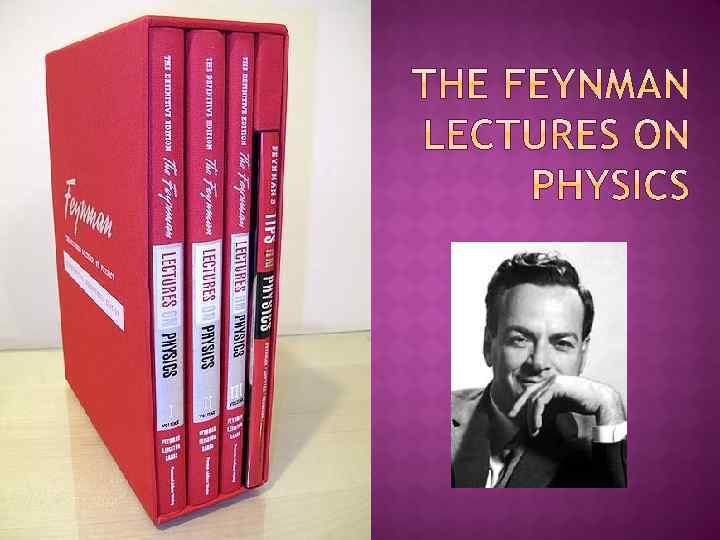
The Author: Richard P. Feynman, Robert B. Leighton and Matthew Sands. Country: United States. Publisher: Addison–Wesley. Publication date: 1964.
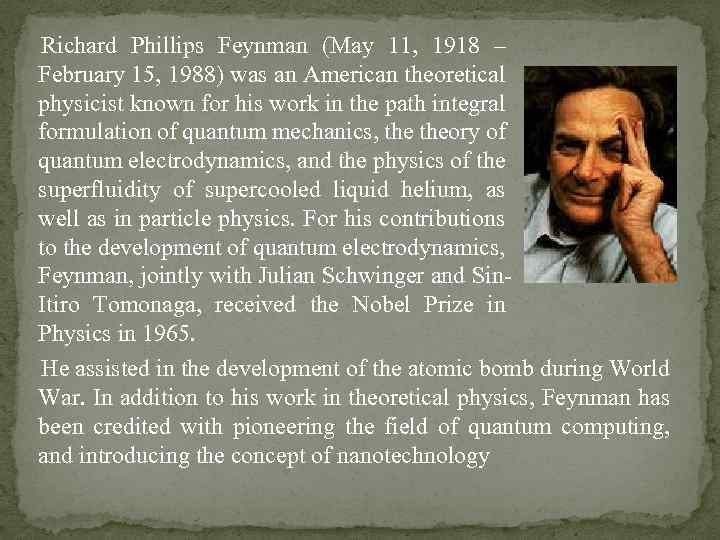
Richard Phillips Feynman (May 11, 1918 – February 15, 1988) was an American theoretical physicist known for his work in the path integral formulation of quantum mechanics, theory of quantum electrodynamics, and the physics of the superfluidity of supercooled liquid helium, as well as in particle physics. For his contributions to the development of quantum electrodynamics, Feynman, jointly with Julian Schwinger and Sin. Itiro Tomonaga, received the Nobel Prize in Physics in 1965. He assisted in the development of the atomic bomb during World War. In addition to his work in theoretical physics, Feynman has been credited with pioneering the field of quantum computing, and introducing the concept of nanotechnology
Robert Benjamin Leighton (September 10, 1919 – March 9, 1997) was a prominent American experimental physicist who spent his professional career at the California Institute of Technology (Caltech). His work over the years spanned solid state physics, cosmic ray physics, the beginnings of modern particle physics, solar physics, the planets, infrared astronomy, and millimeter- and submillimeter-wave astronomy. In the latter four fields, his pioneering work opened up entirely new areas of research that subsequently developed into vigorous scientific communities.
Matthew Linzee Sands (October 20, 1920) is an American physicist and educator. In 1972 he received a Distinguished Service Award from the American Association of Physics Teachers. In 1998 The American Physical Society awarded him the Robert R. Wilson Prize "for his many contributions to accelerator physics and the development of electronpositron and proton colliders “.
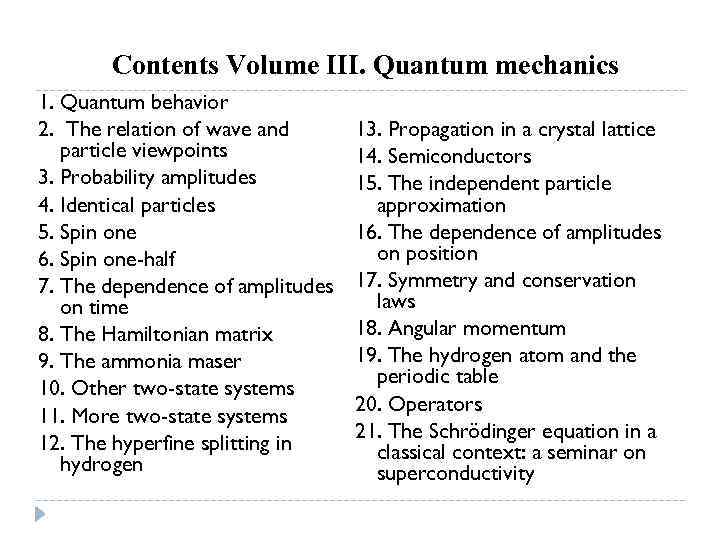
Contents Volume III. Quantum mechanics 1. Quantum behavior 2. The relation of wave and particle viewpoints 3. Probability amplitudes 4. Identical particles 5. Spin one 6. Spin one-half 7. The dependence of amplitudes on time 8. The Hamiltonian matrix 9. The ammonia maser 10. Other two-state systems 11. More two-state systems 12. The hyperfine splitting in hydrogen 13. Propagation in a crystal lattice 14. Semiconductors 15. The independent particle approximation 16. The dependence of amplitudes on position 17. Symmetry and conservation laws 18. Angular momentum 19. The hydrogen atom and the periodic table 20. Operators 21. The Schrödinger equation in a classical context: a seminar on superconductivity
Скачать презентацию The Author Richard P Feynman Robert B Leighton
The Feynman Lectures on Physics.pptx