 Скачать презентацию The Australian Synchrotron New Zealand Users Workshop September
e7244c34d4eb43fddd08d4d539277666.ppt
- Количество слайдов: 49



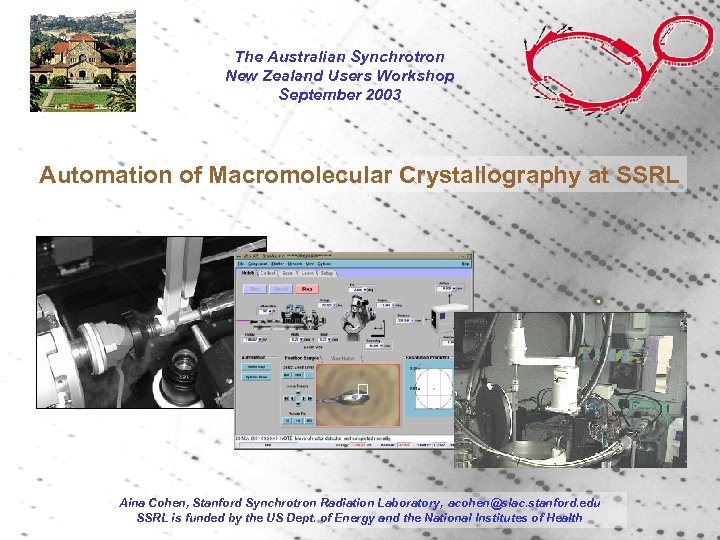
The Australian Synchrotron New Zealand Users Workshop September 2003 Automation of Macromolecular Crystallography at SSRL Robot still Aina Cohen, Stanford Synchrotron Radiation Laboratory, acohen@slac. stanford. edu SSRL is funded by the US Dept. of Energy and the National Institutes of Health
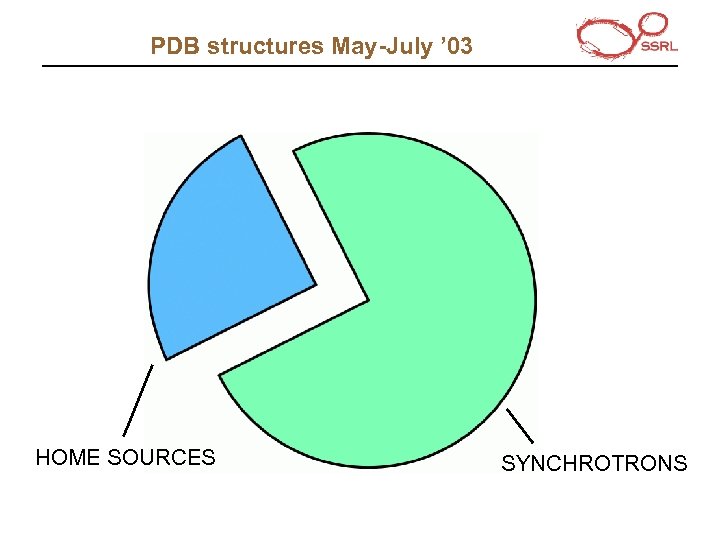
PDB structures May-July ’ 03 HOME SOURCES SYNCHROTRONS
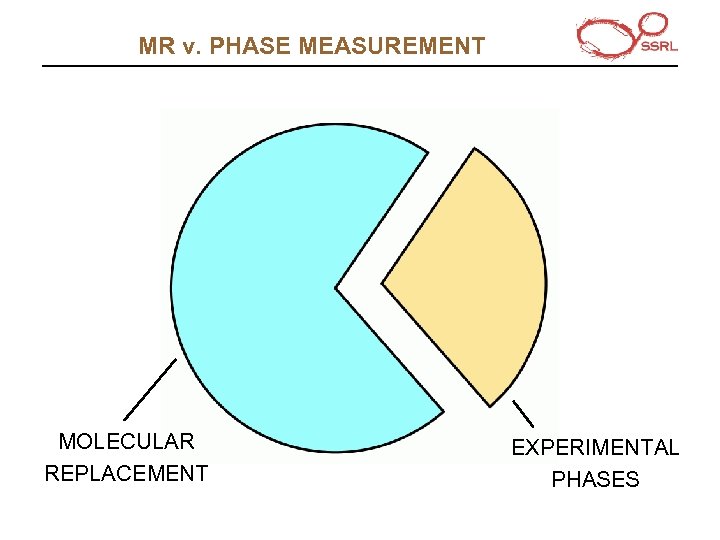
MR v. PHASE MEASUREMENT MOLECULAR REPLACEMENT EXPERIMENTAL PHASES
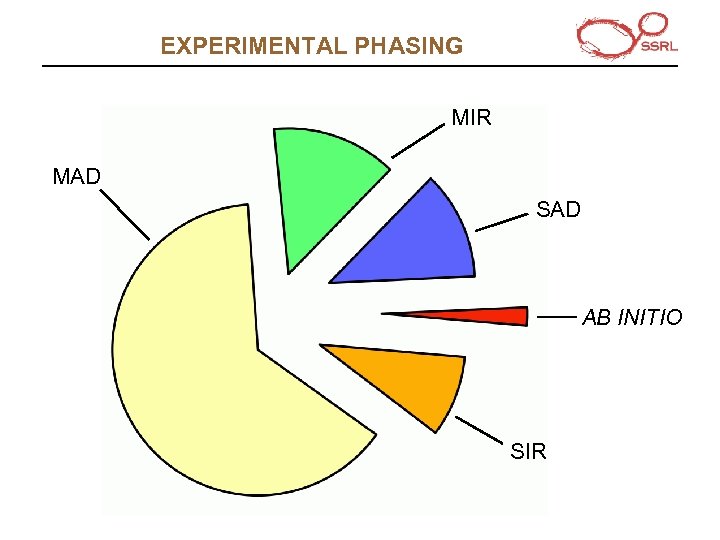
EXPERIMENTAL PHASING MIR MAD SAD AB INITIO SIR
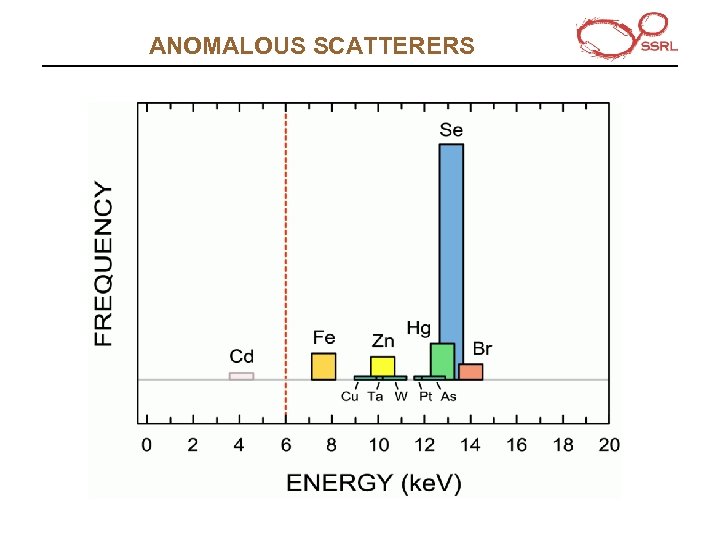
ANOMALOUS SCATTERERS
Beamline parameters To cover the great majority of samples: » ?
Beamline parameters To cover the great majority of samples: » Energy range: <6 -17 ke. V
Beamline parameters To cover the great majority of samples: » Energy range: <6 -17 ke. V » Fast energy moves
Beamline parameters To cover the great majority of samples: » Energy range: <6 -17 ke. V » Fast energy moves » Resolution: ~1 e. V
Beamline parameters To cover the great majority of samples: » Energy range: <6 -17 ke. V » Fast energy moves » Resolution: ~1 e. V » Spot size: 250 µm - <50 µm
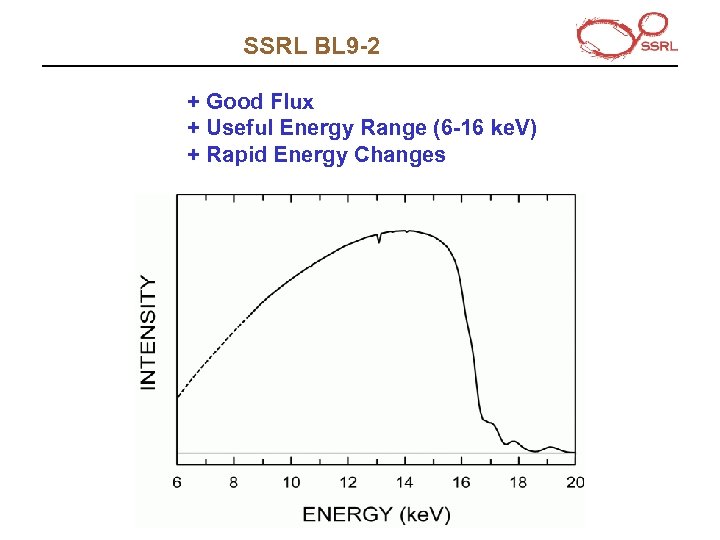
SSRL BL 9 -2 + Good Flux + Useful Energy Range (6 -16 ke. V) + Rapid Energy Changes
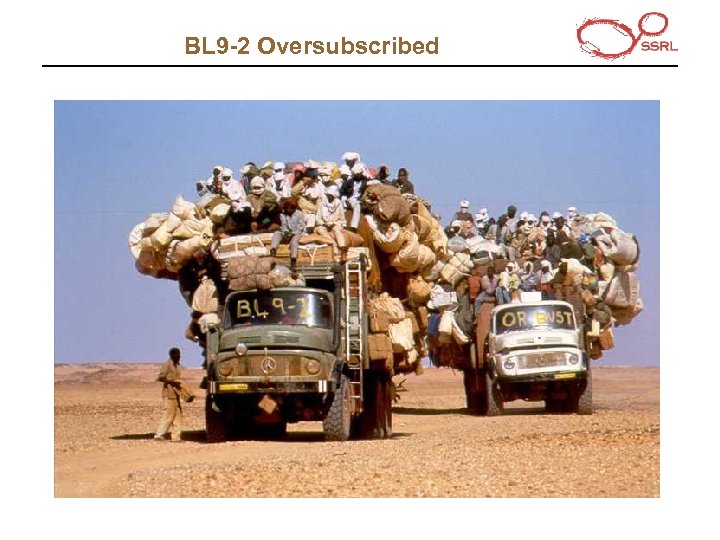
BL 9 -2 Oversubscribed
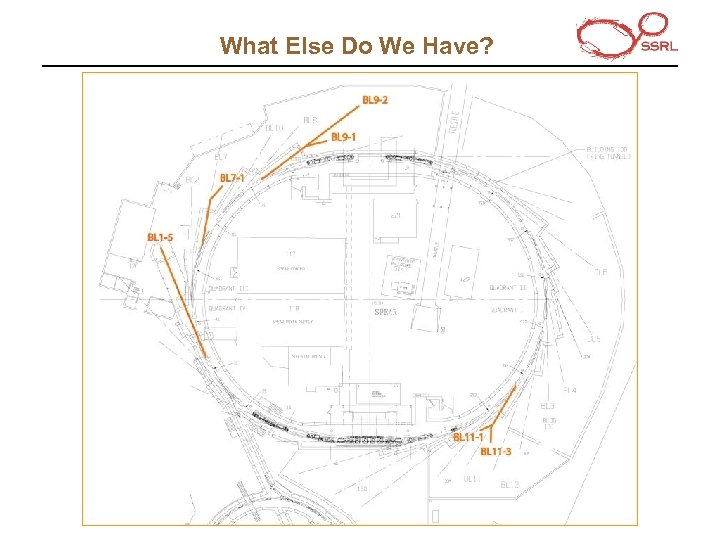
What Else Do We Have?
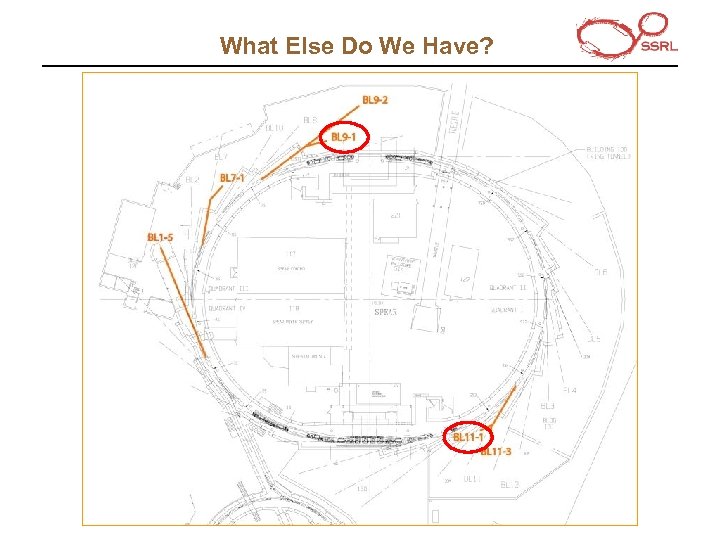
What Else Do We Have?
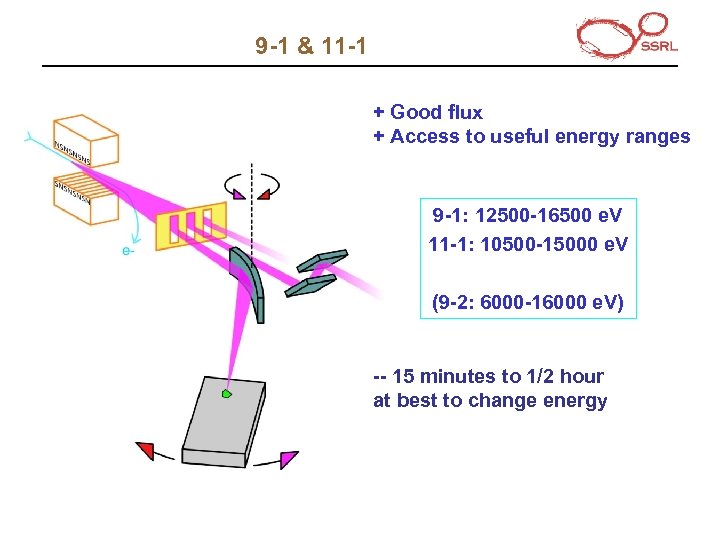
9 -1 & 11 -1 + Good flux + Access to useful energy ranges 9 -1: 12500 -16500 e. V 11 -1: 10500 -15000 e. V (9 -2: 6000 -16000 e. V) -- 15 minutes to 1/2 hour at best to change energy
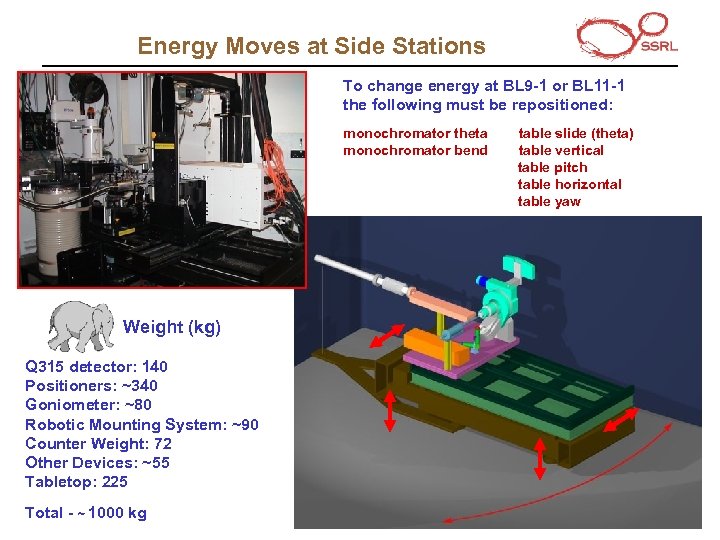
Energy Moves at Side Stations To change energy at BL 9 -1 or BL 11 -1 the following must be repositioned: monochromator theta monochromator bend Weight (kg) Q 315 detector: 140 Positioners: ~340 Goniometer: ~80 Robotic Mounting System: ~90 Counter Weight: 72 Other Devices: ~55 Tabletop: 225 Total - ~ 1000 kg table slide (theta) table vertical table pitch table horizontal table yaw
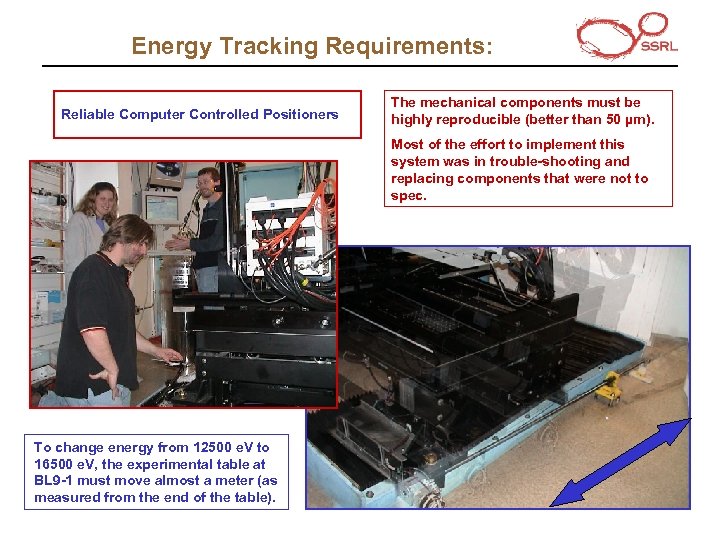
Energy Tracking Requirements: Reliable Computer Controlled Positioners The mechanical components must be highly reproducible (better than 50 µm). Most of the effort to implement this system was in trouble-shooting and replacing components that were not to spec. To change energy from 12500 e. V to 16500 e. V, the experimental table at BL 9 -1 must move almost a meter (as measured from the end of the table).
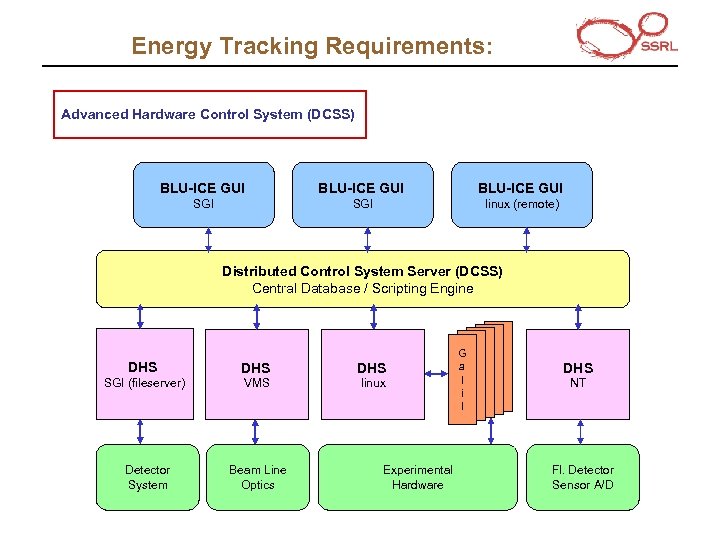
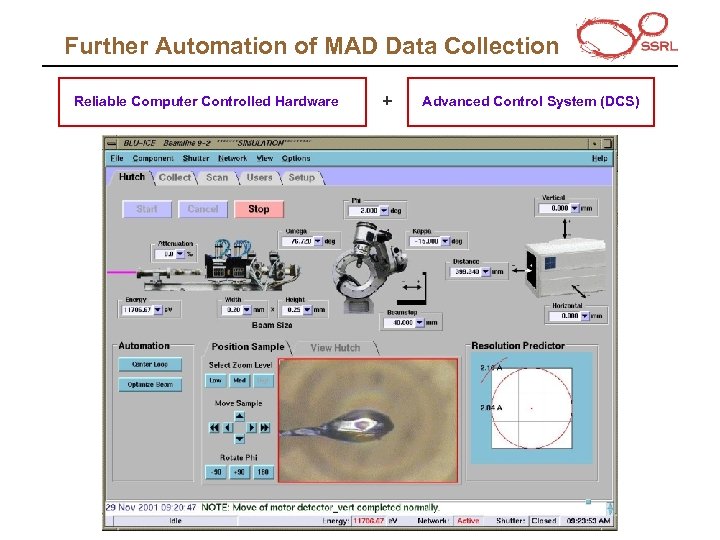
Energy Tracking Requirements: Advanced Hardware Control System (DCSS) BLU-ICE GUI SGI linux (remote) Distributed Control System Server (DCSS) Central Database / Scripting Engine DHS SGI (fileserver) VMS linux Detector System Beam Line Optics Experimental Hardware G GG GG a aa l l l i i i l l l DHS NT Fl. Detector Sensor A/D
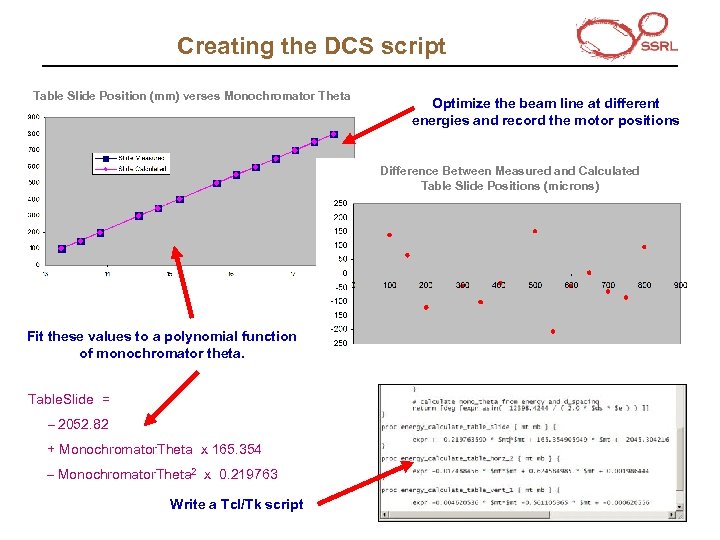
Creating the DCS script Table Slide Position (mm) verses Monochromator Theta Optimize the beam line at different energies and record the motor positions Difference Between Measured and Calculated Table Slide Positions (microns) Fit these values to a polynomial function of monochromator theta. Table. Slide = – 2052. 82 + Monochromator. Theta x 165. 354 – Monochromator. Theta 2 x 0. 219763 Write a Tcl/Tk script
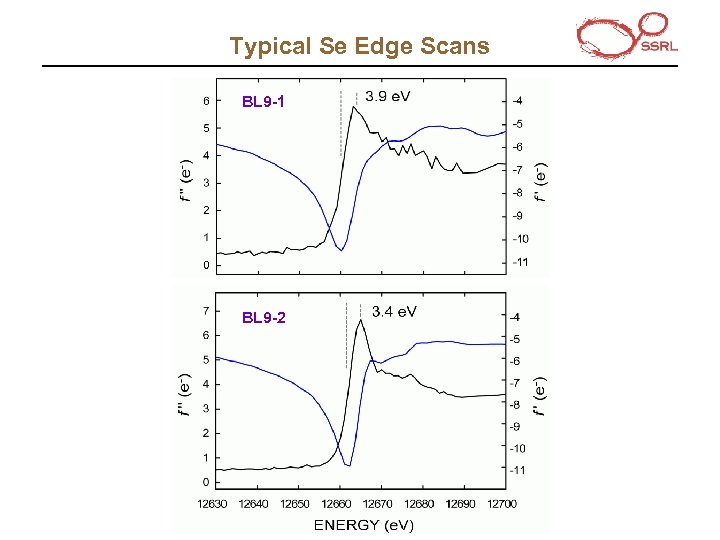
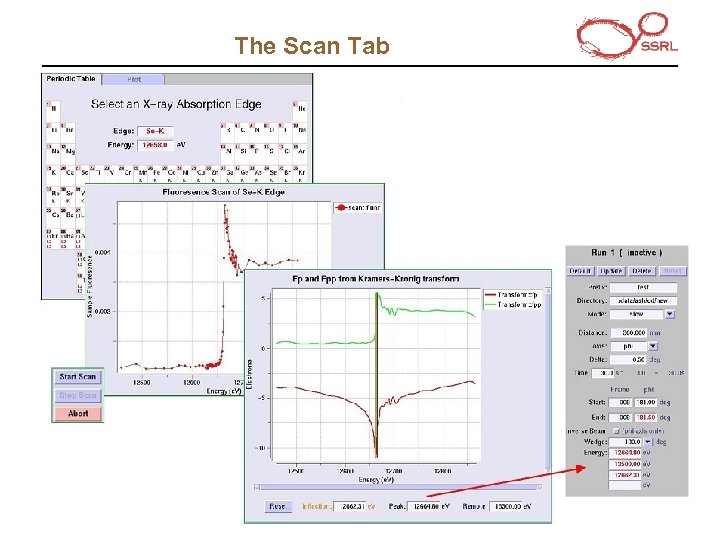
Typical Se Edge Scans BL 9 -1 BL 9 -2
The Results
Further Automation of MAD Data Collection Reliable Computer Controlled Hardware + Advanced Control System (DCS)
The Scan Tab
Automated MAD scans
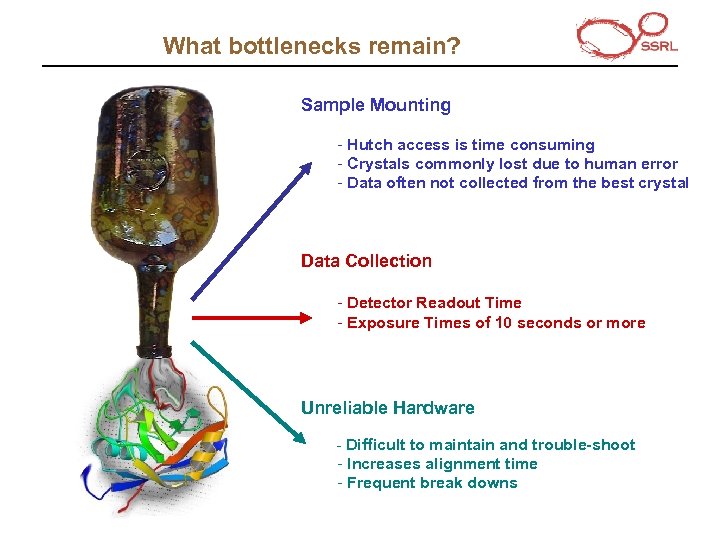
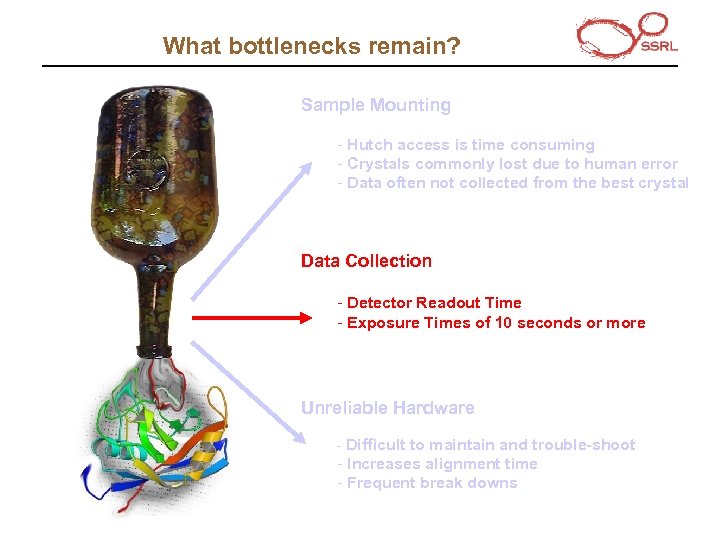
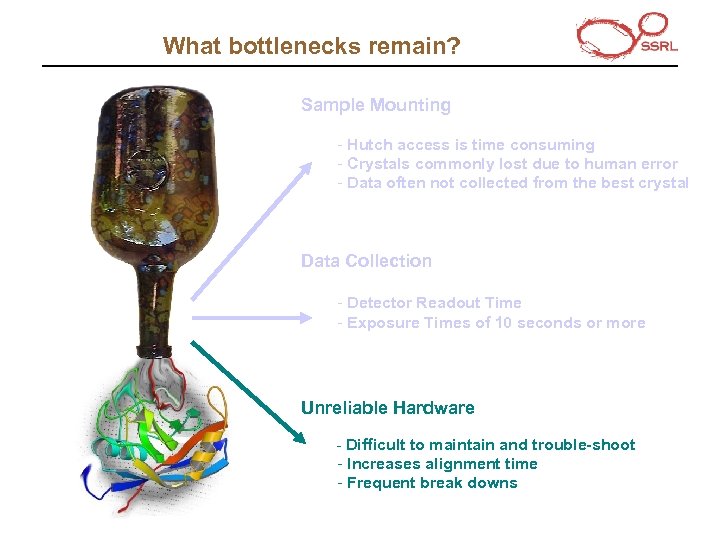
What bottlenecks remain? Sample Mounting - Hutch access is time consuming - Crystals commonly lost due to human error - Data often not collected from the best crystal Data Collection - Detector Readout Time - Exposure Times of 10 seconds or more Unreliable Hardware - Difficult to maintain and trouble-shoot - Increases alignment time - Frequent break downs
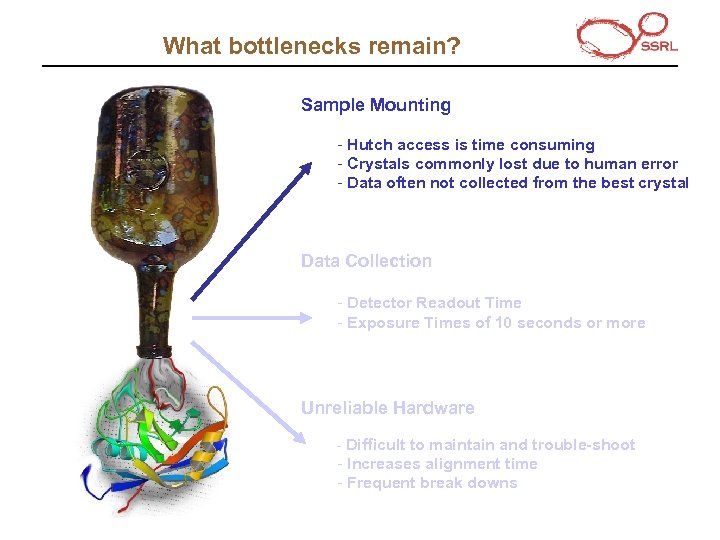
What bottlenecks remain? Sample Mounting - Hutch access is time consuming - Crystals commonly lost due to human error - Data often not collected from the best crystal Data Collection - Detector Readout Time - Exposure Times of 10 seconds or more Unreliable Hardware - Difficult to maintain and trouble-shoot - Increases alignment time - Frequent break downs
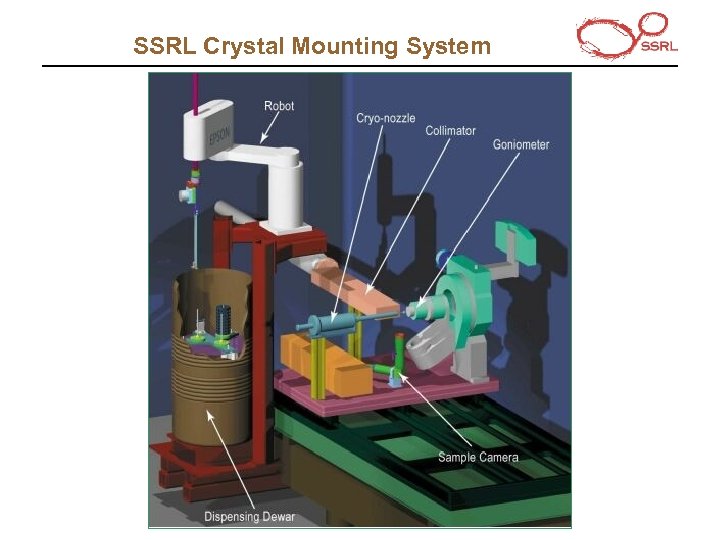
SSRL Crystal Mounting System
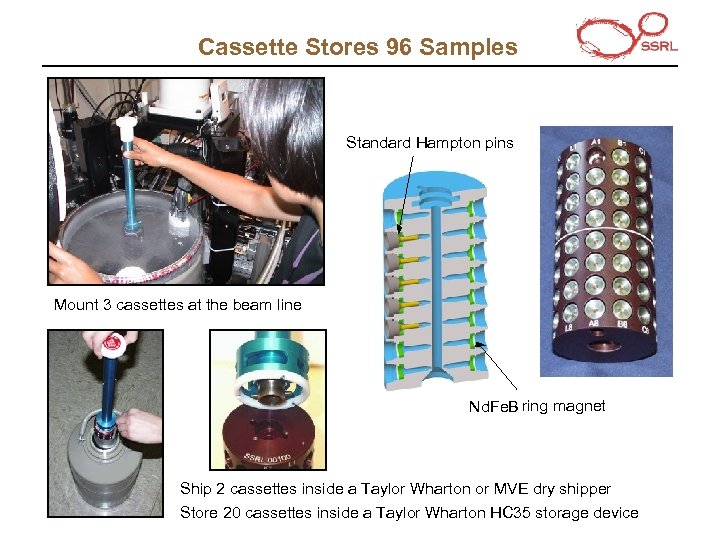
Cassette Stores 96 Samples Standard Hampton pins Mount 3 cassettes at the beam line Nd. Fe. B ring magnet • • Ship 2 cassettes inside a Taylor Wharton or MVE dry shipper Store 20 cassettes inside a Taylor Wharton HC 35 storage device
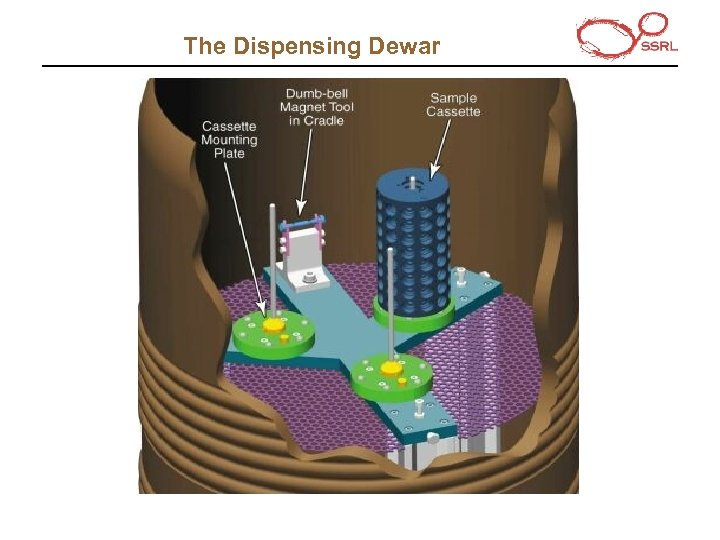
The Dispensing Dewar
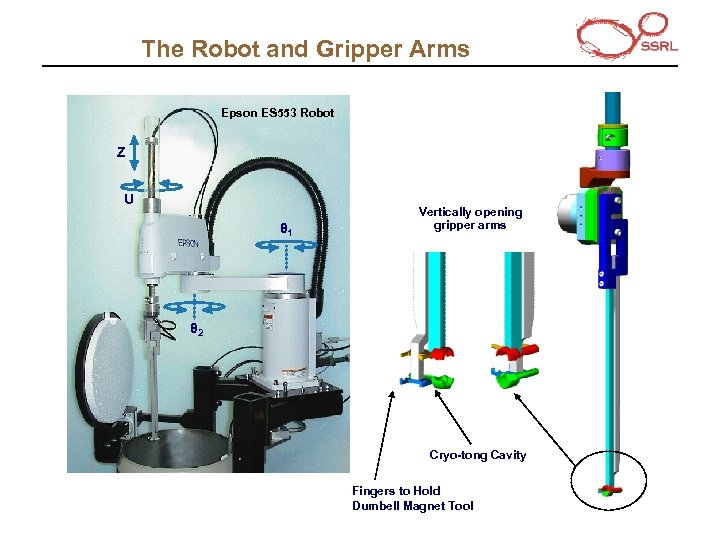
The Robot and Gripper Arms Epson ES 553 Robot Z U θ 1 Vertically opening gripper arms θ 2 Cryo-tong Cavity Fingers to Hold Dumbell Magnet Tool
Robot Demonstration
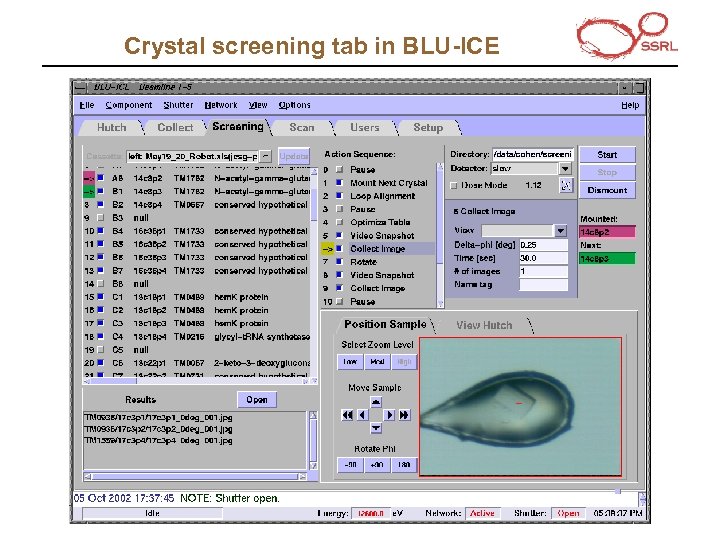
Crystal screening tab in BLU-ICE
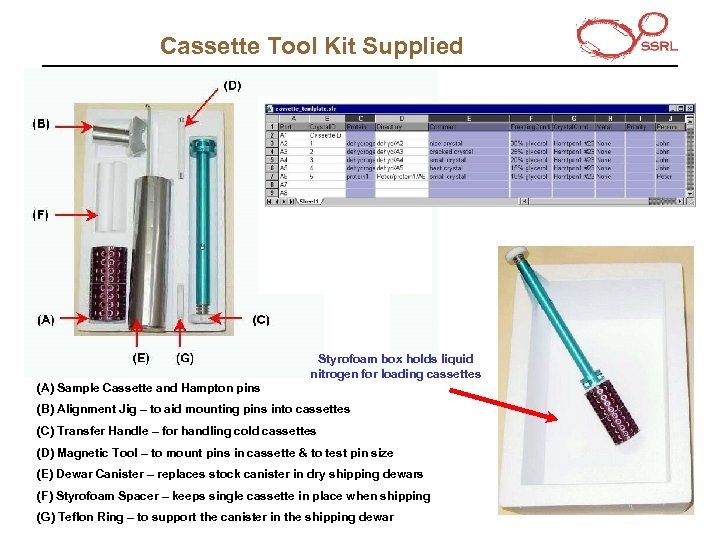
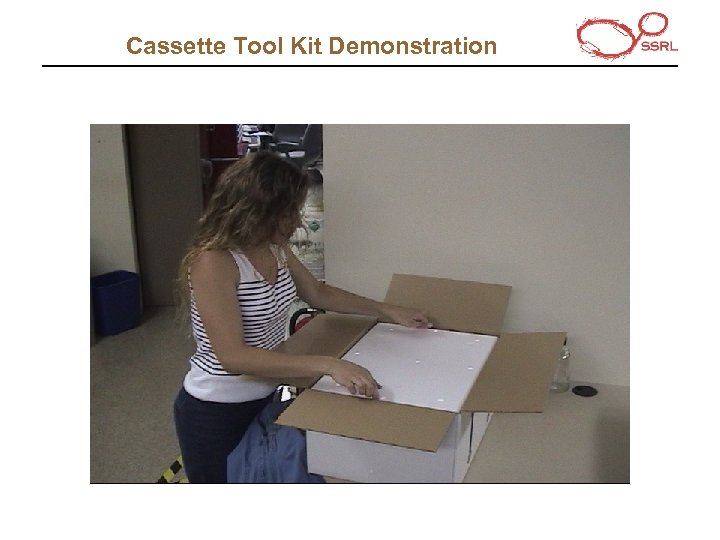
Cassette Tool Kit Supplied Styrofoam box holds liquid nitrogen for loading cassettes (A) Sample Cassette and Hampton pins (B) Alignment Jig – to aid mounting pins into cassettes (C) Transfer Handle – for handling cold cassettes (D) Magnetic Tool – to mount pins in cassette & to test pin size (E) Dewar Canister – replaces stock canister in dry shipping dewars (F) Styrofoam Spacer – keeps single cassette in place when shipping (G) Teflon Ring – to support the canister in the shipping dewar
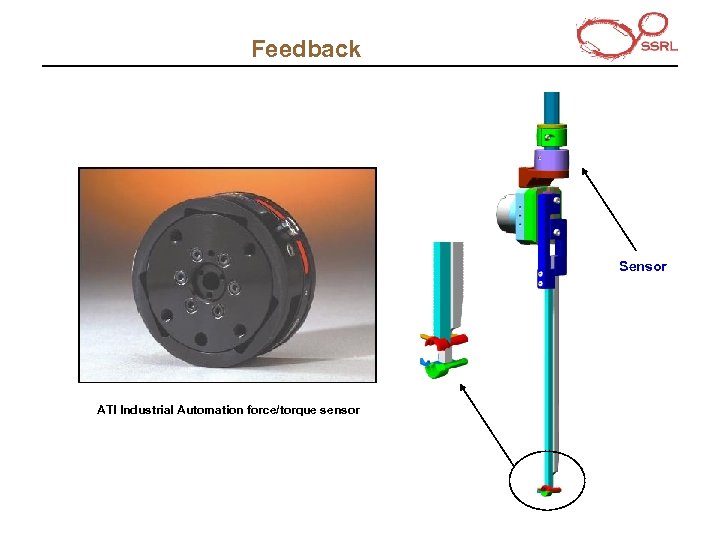
Feedback Sensor ATI Industrial Automation force/torque sensor
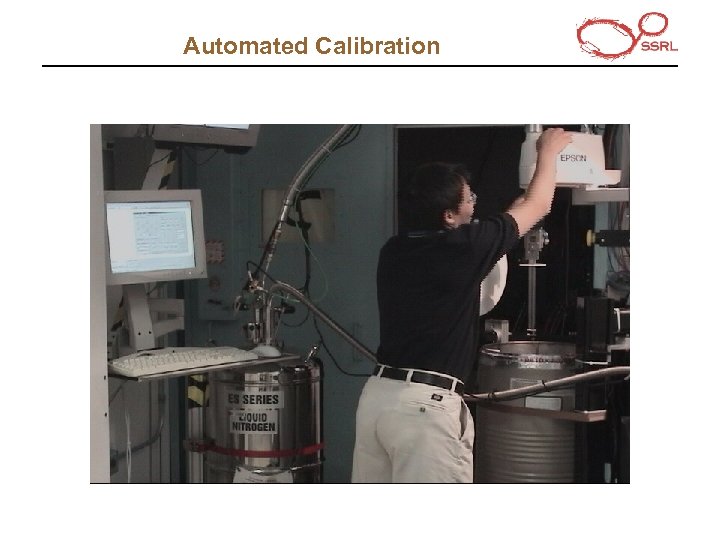
Automated Calibration
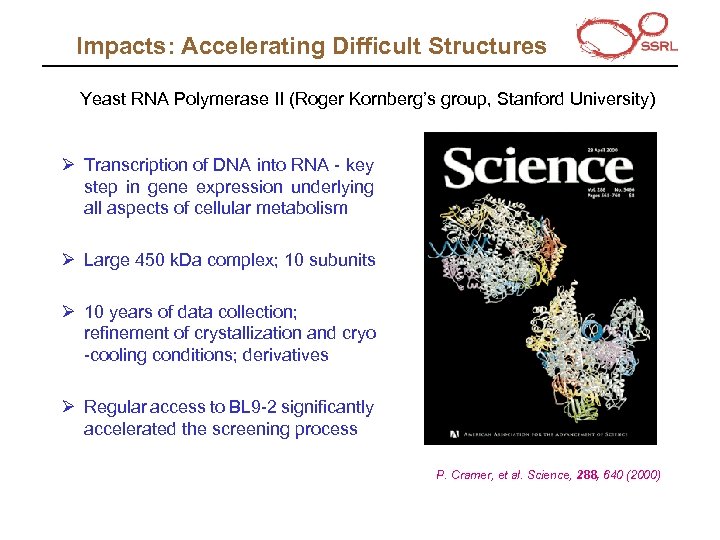
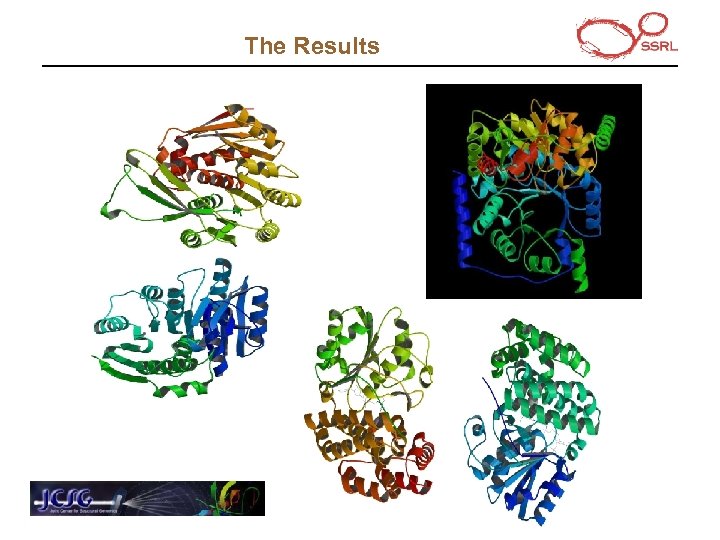
Impacts: Accelerating Difficult Structures Yeast RNA Polymerase II (Roger Kornberg’s group, Stanford University) Ø Transcription of DNA into RNA - key step in gene expression underlying all aspects of cellular metabolism Ø Large 450 k. Da complex; 10 subunits Ø 10 years of data collection; refinement of crystallization and cryo -cooling conditions; derivatives Ø Regular access to BL 9 -2 significantly accelerated the screening process P. Cramer, et al. Science, 288, 640 (2000)
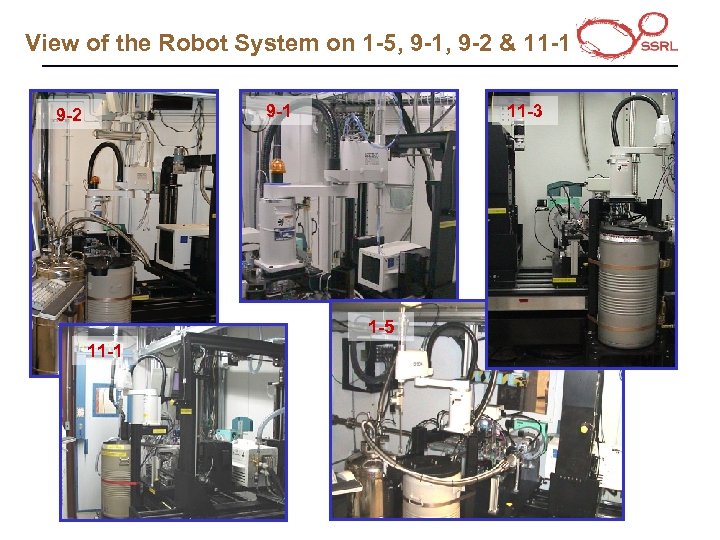
View of the Robot System on 1 -5, 9 -1, 9 -2 & 11 -1 9 -2 11 -3 1 -5 11 -1 9 -1
What bottlenecks remain? Sample Mounting - Hutch access is time consuming - Crystals commonly lost due to human error - Data often not collected from the best crystal Data Collection - Detector Readout Time - Exposure Times of 10 seconds or more Unreliable Hardware - Difficult to maintain and trouble-shoot - Increases alignment time - Frequent break downs
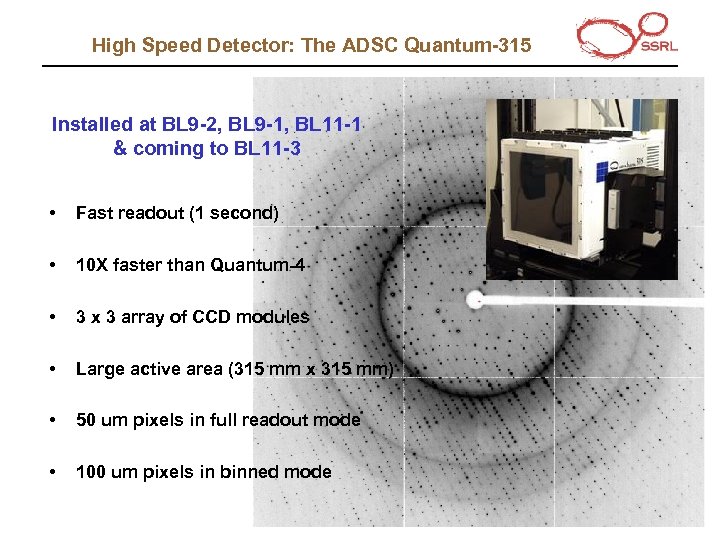
High Speed Detector: The ADSC Quantum-315 Installed at BL 9 -2, BL 9 -1, BL 11 -1 & coming to BL 11 -3 • Fast readout (1 second) • 10 X faster than Quantum-4 • 3 x 3 array of CCD modules • Large active area (315 mm x 315 mm) • 50 um pixels in full readout mode • 100 um pixels in binned mode
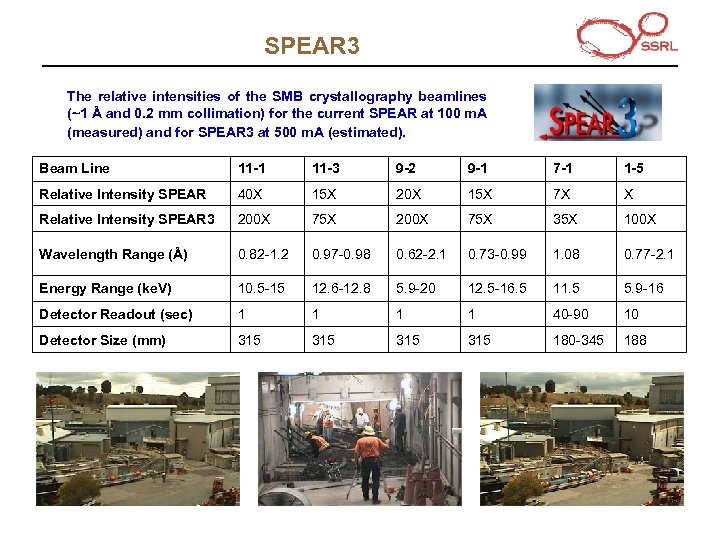
SPEAR 3 The relative intensities of the SMB crystallography beamlines (~1 Å and 0. 2 mm collimation) for the current SPEAR at 100 m. A (measured) and for SPEAR 3 at 500 m. A (estimated). Beam Line 11 -1 11 -3 9 -2 9 -1 7 -1 1 -5 Relative Intensity SPEAR 40 X 15 X 20 X 15 X 7 X X Relative Intensity SPEAR 3 200 X 75 X 35 X 100 X Wavelength Range (Å) 0. 82 -1. 2 0. 97 -0. 98 0. 62 -2. 1 0. 73 -0. 99 1. 08 0. 77 -2. 1 Energy Range (ke. V) 10. 5 -15 12. 6 -12. 8 5. 9 -20 12. 5 -16. 5 11. 5 5. 9 -16 Detector Readout (sec) 1 1 40 -90 10 Detector Size (mm) 315 180 -345 188
What bottlenecks remain? Sample Mounting - Hutch access is time consuming - Crystals commonly lost due to human error - Data often not collected from the best crystal Data Collection - Detector Readout Time - Exposure Times of 10 seconds or more Unreliable Hardware - Difficult to maintain and trouble-shoot - Increases alignment time - Frequent break downs
Unreliable Hardware
New Final Beam Conditioning System
New Final Beam Conditioning System 75 mm 150 mm
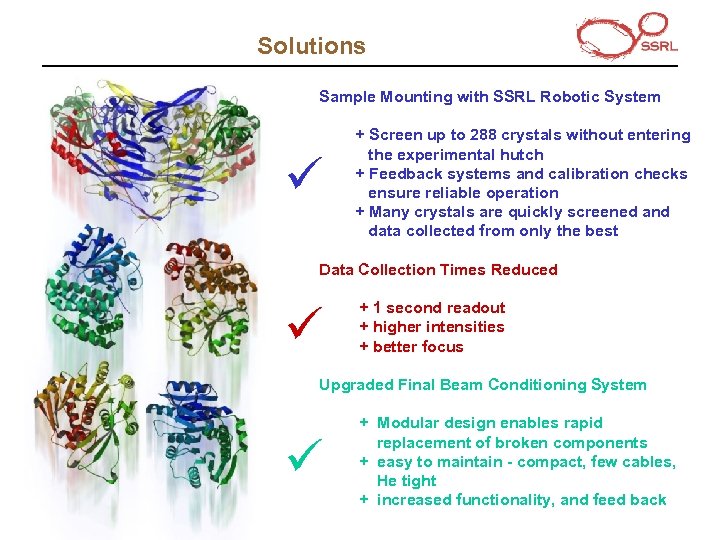
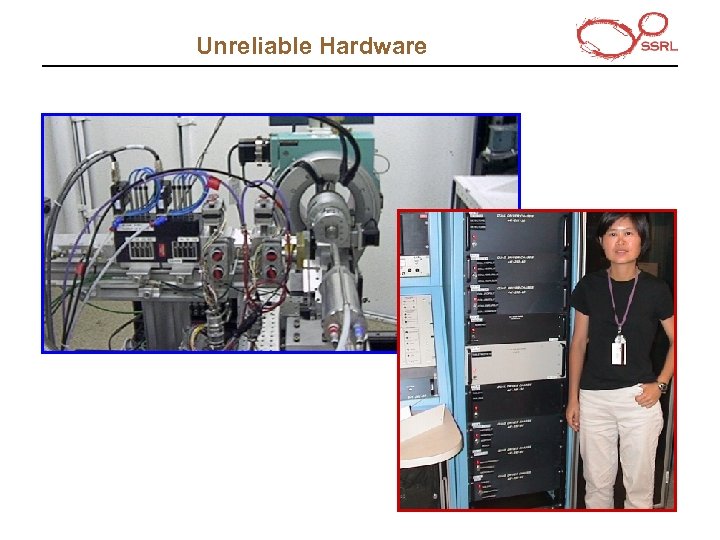
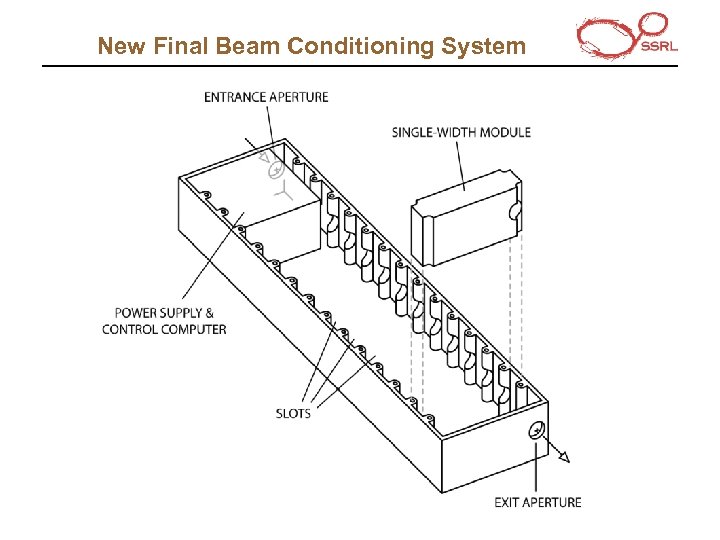
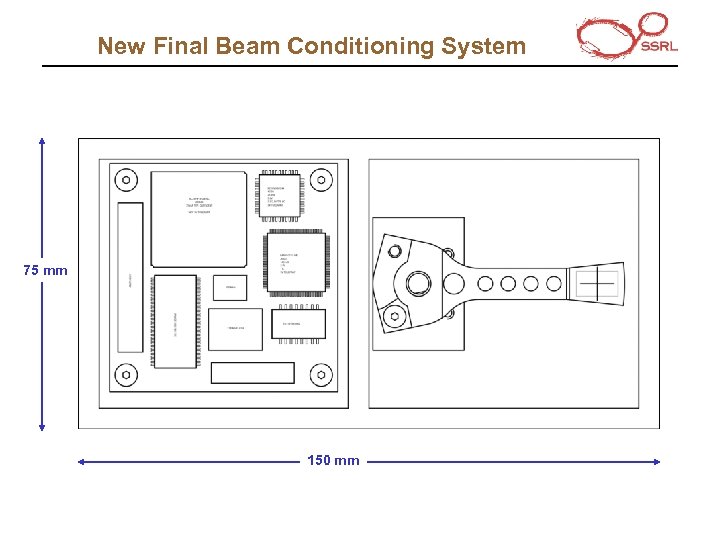
Solutions Sample Mounting with SSRL Robotic System ü + Screen up to 288 crystals without entering the experimental hutch + Feedback systems and calibration checks ensure reliable operation + Many crystals are quickly screened and data collected from only the best Data Collection Times Reduced ü + 1 second readout + higher intensities + better focus Upgraded Final Beam Conditioning System ü + Modular design enables rapid replacement of broken components + easy to maintain - compact, few cables, He tight + increased functionality, and feed back
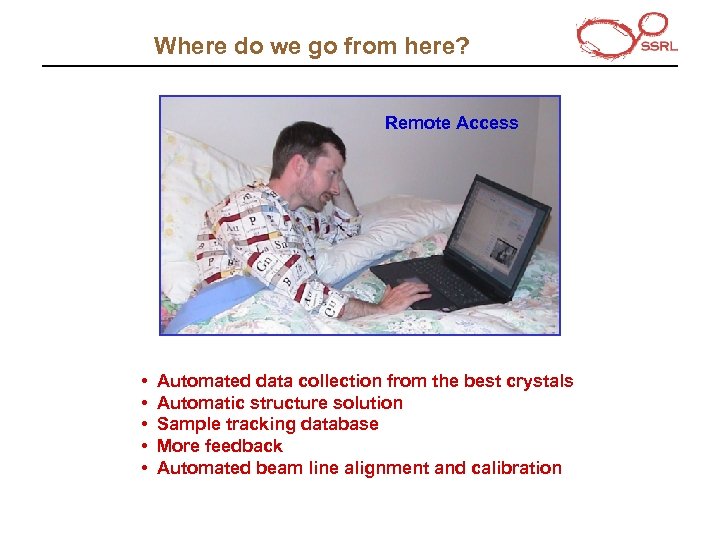
Where do we go from here? Remote Access • • • Automated data collection from the best crystals Automatic structure solution Sample tracking database More feedback Automated beam line alignment and calibration
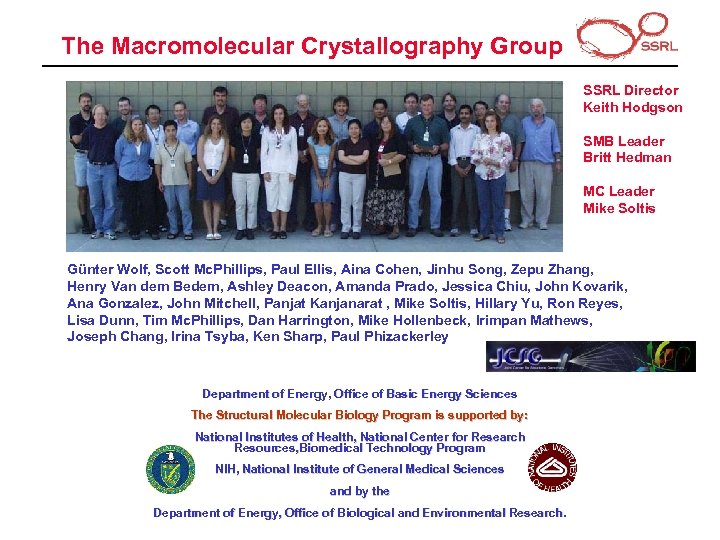
The Macromolecular Crystallography Group SSRL Director Keith Hodgson SMB Leader Britt Hedman MC Leader Mike Soltis Günter Wolf, Scott Mc. Phillips, Paul Ellis, Aina Cohen, Jinhu Song, Zepu Zhang, Henry Van dem Bedem, Ashley Deacon, Amanda Prado, Jessica Chiu, John Kovarik, Ana Gonzalez, John Mitchell, Panjat Kanjanarat , Mike Soltis, Hillary Yu, Ron Reyes, Lisa Dunn, Tim Mc. Phillips, Dan Harrington, Mike Hollenbeck, Irimpan Mathews, Joseph Chang, Irina Tsyba, Ken Sharp, Paul Phizackerley Department of Energy, Office of Basic Energy Sciences The Structural Molecular Biology Program is supported by: National Institutes of Health, National Center for Research Resources, Biomedical Technology Program NIH, National Institute of General Medical Sciences and by the Department of Energy, Office of Biological and Environmental Research.
Further reading For more details of the SSRL mounting robot, please refer to the published description of the prototype system: Cohen et al. (2002). “An automated system to mount cryo-cooled protein crystals on a synchrotron beamline, using compact sample cassettes and a small-scale robot” J. Appl. Cryst. , 35, 720 -726. http: //journals. iucr. org/j/issues/2002/06/00/he 0300. pdf
Cassette Tool Kit Demonstration
Скачать презентацию The Australian Synchrotron New Zealand Users Workshop September
e7244c34d4eb43fddd08d4d539277666.ppt