


 Скачать презентацию The Australian Approach to Fatigue Management Context and
246faa60638ba42f4cb89a483d31575d.ppt
- Количество слайдов: 25
 The Australian Approach to Fatigue Management: Context and Details Michael Coplen, M. A. , Co-Chair, HFCC Operator Fatigue Management Initiative Federal Railroad Administration Stephen Popkin, Ph. D. Co-Chair, HFCC Operator Fatigue Management Initiative Volpe Center April 22, 2003 Washington, DC Human Factors R&D Program Office of Research and Development
 Overview • Why Australia? • Evaluation Questions • Fatigue Context Factors in the Australian Railroad Industry • Principles and Philosophy of the Australian Approach OH&S Framework • Perceived benefits and current challenges • Next Steps Human Factors R&D Program Office of Research and Development
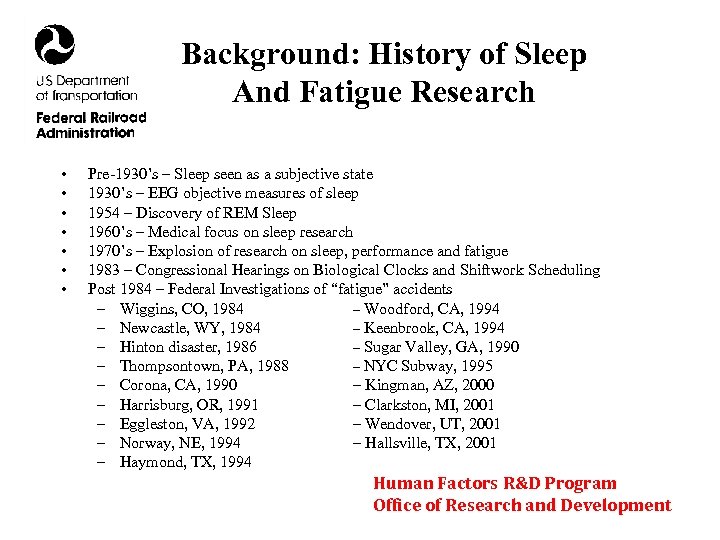 Background: History of Sleep And Fatigue Research • • Pre-1930’s – Sleep seen as a subjective state 1930’s – EEG objective measures of sleep 1954 – Discovery of REM Sleep 1960’s – Medical focus on sleep research 1970’s – Explosion of research on sleep, performance and fatigue 1983 – Congressional Hearings on Biological Clocks and Shiftwork Scheduling Post 1984 – Federal Investigations of “fatigue” accidents – Wiggins, CO, 1984 – Woodford, CA, 1994 – Newcastle, WY, 1984 – Keenbrook, CA, 1994 – Hinton disaster, 1986 – Sugar Valley, GA, 1990 – Thompsontown, PA, 1988 – NYC Subway, 1995 – Corona, CA, 1990 – Kingman, AZ, 2000 – Harrisburg, OR, 1991 – Clarkston, MI, 2001 – Eggleston, VA, 1992 – Wendover, UT, 2001 – Norway, NE, 1994 – Hallsville, TX, 2001 – Haymond, TX, 1994 Human Factors R&D Program Office of Research and Development
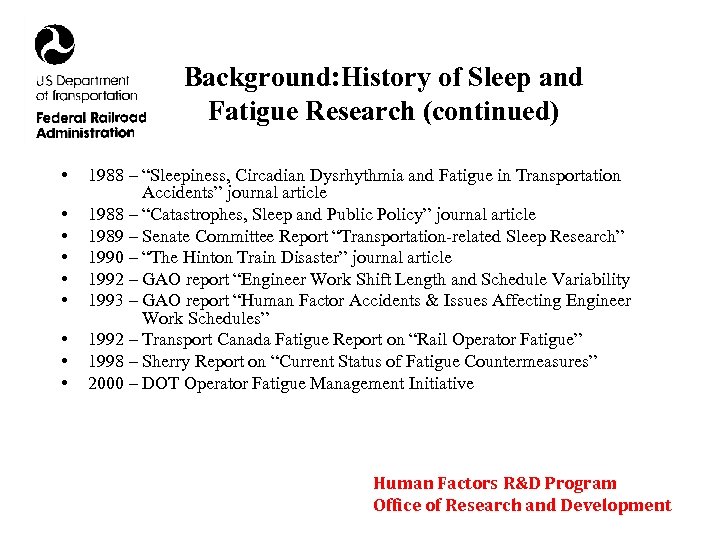 Background: History of Sleep and Fatigue Research (continued) • • • 1988 – “Sleepiness, Circadian Dysrhythmia and Fatigue in Transportation Accidents” journal article 1988 – “Catastrophes, Sleep and Public Policy” journal article 1989 – Senate Committee Report “Transportation-related Sleep Research” 1990 – “The Hinton Train Disaster” journal article 1992 – GAO report “Engineer Work Shift Length and Schedule Variability 1993 – GAO report “Human Factor Accidents & Issues Affecting Engineer Work Schedules” 1992 – Transport Canada Fatigue Report on “Rail Operator Fatigue” 1998 – Sherry Report on “Current Status of Fatigue Countermeasures” 2000 – DOT Operator Fatigue Management Initiative Human Factors R&D Program Office of Research and Development
 Why Australia? • European approach – Very prescriptive – Low tolerance to business case when compared against perceived worker well-being • Current US approach – Prescriptive – Improvements hampered by current HOS law, FELA issues, trust – Low tolerance for changes without a business case • AUS approach – Non-prescriptive – Regulator responsible for driving and enforcing the process, not solution Human Factors R&D Program Office of Research and Development
 Why Australia? • • • 4 th International Conference on Fatigue in Transportation, 2000 – Emphasis on Non-prescriptive Approaches Similar Scientific/Regulatory Pressures RE fatigue Similar Industry Fatigue Working Groups – US Work/Rest Task Force formed in 1992 – Australian Rail Consortium formed in 1995 – US NARAP formed in 1998 Fatigue Management Implementations in both US & AUS – US pilot projects fading – AUS pilot projects sustainable Difficulty in FRA assessing and addressing fatigue – Labor and management feel a threat to their bottom line – No reliable methodology to determine extent of problem or effectiveness of interventions Human Factors R&D Program Office of Research and Development
 Why Australia? 2003 Meeting Schedule • • • State Rail, Sydney, New South Wales (NSW) Pacific National Railway, Sydney Rail Tram and Bus Union (RTBU), Sydney NSW Department of Transport, Sydney Australian Rail Track Corp. (ARTC) Australian Railroad Group (ARG) University of South Australia 5 th Int’l Conference on Fatigue in Transportation Australian Rail Consortium Human Factors R&D Program Office of Research and Development
 Evaluation Questions • Is the Australian approach successful? • What are the principle contextual factors influencing the process? • What are the principle components of the Australian model? • How can AUS approach be applied to the US rail industry? • What does this suggest for future directions of FMP’s in the US transportation industry? Human Factors R&D Program Office of Research and Development
 FMP Contextual Factors In the AUS Railroad Industry • 1986 – Occupational Health and Safety and Welfare Act (SA) • 1991 – Hillmer Report Privatization of RR industry • 1993 – Rail Safety Act (NSW) – Revisited every 5 years – 2002 Act require FMP’s as condition of accreditation – Consultative approach with all stakeholders • 1994 – EEO Act • 1995 – Australian Rail Consortium formed • 2000 – “Beyond the Midnight Oil” Report – Commonwealth inquiry on fatigue in transportation • 2002 – NSW Rail Safety Act – First state to adopt FMP as a regulation Human Factors R&D Program Office of Research and Development
 FMP Contextual Factors In the AUS Railroad Industry • No Federal Rail Regulatory Authority – State Regulators only • HOS – All industrial agreements (labor/mgt. ) – NSW is only state with HOS regulation • OH&S – State by state laws – Requires “safety case” plan for each company • De facto Code of Practice developed for each company – Duty of care for employer and employees • Chain of responsibility between employee, employer, and consigner – Federal OH&S apply only to Commonwealth employees • EEO laws – Precludes age discrimination – Interpreted to include seniority Human Factors R&D Program Office of Research and Development
 Principles and Philosophy of Australian Approach • OH&S framework • Management-based regulations and company policies • Alternate compliance model • Risk-based implementation • Performance-based outcomes Human Factors R&D Program Office of Research and Development
 OH&S Framework • Legal duty of care, varies state by state – Required by regulator to have a safety plan • Established in OH&S legislation • Fatigue identified as a workplace hazard to be controlled • Medical pre-placement requirements – General sensitivity towards general medical conditions and treatments that may affect fitness for duty – Include sleep disorders • Duty of care for managers and employees Human Factors R&D Program Office of Research and Development
 Duty of Care • Shared Responsibility Model • Management responsibility – Employer responsible for minimizing risk associated with work related fatigue – Providing staff and shift system that permits sufficient opportunity to rest and recover • Employee responsibility – Employee responsible for minimizing risk associated with nonwork related fatigue – Using allocated time off to obtain sufficient sleep in order to work safely – If not possible, employee must notify employer that they may have had insufficient sleep Human Factors R&D Program Office of Research and Development
 Management-based Regulations • Co-regulatory process, few regulations • Broad policy level guidelines, not overly prescriptive • Certified company Codes of practice driven by state regulations • Role of regulator to drive process, not solution – NSW audit capability can compel compliance to certified safety plans Human Factors R&D Program Office of Research and Development
 Employee Responsibility for “Sufficient” Sleep • The 5/12 Start Rule (based upon literature and collected data) – Must obtain 5 hours sleep in 24 hours prior to work; and – 12 hours sleep in 48 hours prior to work • The Finish Rule – The period of wake-up time to the end of the shift should not exceed the amount of sleep obtained during the past 48 hours prior to commencing the shift • The Final Rule – If either rule is broken, fatigue is a potential problem and the organization should engage in an auditable fatigue risk reduction process Human Factors R&D Program Office of Research and Development
 Employee Responsibility for “Sufficient” Sleep • If start and finish rule not met, then must notify line manager. Options include: – – Additional sleep time Alternate task Sick leave Performance management approach • In event of fatigue-related incident, if employee fails to notify, then – Employee assumes at least partial responsibility Human Factors R&D Program Office of Research and Development
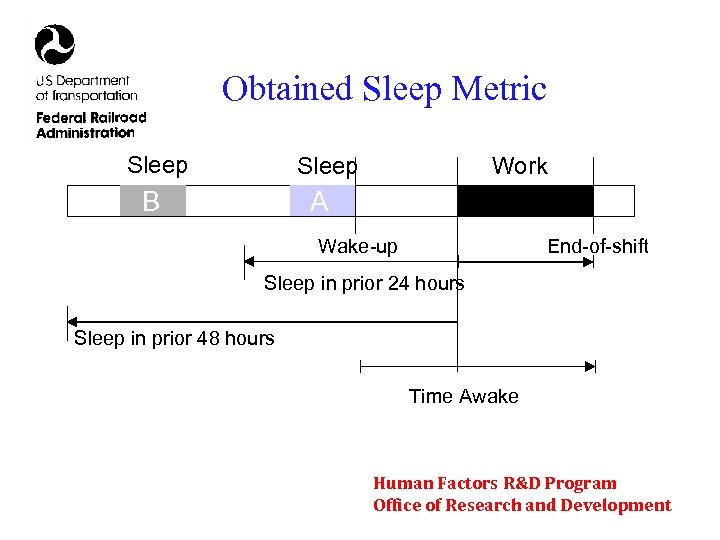 Obtained Sleep Metric Sleep B Work A End-of-shift Wake-up Sleep in prior 24 hours Sleep in prior 48 hours Time Awake Human Factors R&D Program Office of Research and Development
 Quantifying Sufficient Sleep • Rules are evidence-based from engineers’ sleep studies • Software-based fatigue model (fatigue estimation algorithm, FAID) – Evidence based data from engineers – Length and time-of-day of shifts and breaks – 7 day prior work history – Biological limits to rest and recovery • Obtained sleep model – Simple, objective, easy suited to employees and management – Count sleep prior to commencing work – Spreadsheet or paper-and-pencil versions available Human Factors R&D Program Office of Research and Development
 Employer Responsibility for Minimizing Fatigue • Fatigue Management Policy – Defined responsibilities and actions for ‘reasonably foreseeable’ situations – Accountable executive – Demonstrate appropriate methodology and compliance with S/F rules • Competency-Based Training and Education Program – For all staff responsible for decisions that impact on the targeted individuals’ opportunity to obtain sufficient sleep – Public domain provision of hard copy available to all – Web-based materials • Audit capability – Must have quantitative methodology for ensuring employees provided with opportunity to have obtained sufficient sleep to operate safely Human Factors R&D Program Office of Research and Development
 Evaluation of AUS Approach: Perceived Benefits • FMP’s viewed as a profit center rather than a cost center – Attraction and retention tool – Marketing strategy, competitive advantage • Sustainability and commitment • Unified direction with Australian Rail Consortium • Regulatory standards being adopted from Codes of Practice and company policies Human Factors R&D Program Office of Research and Development
 Evaluation of AUS Approach: Current Challenges • • • No objective data establishing success Some workers still prefer long work periods and long blocks of time off Labor seeks mandatory federal standards to establish “floor” – minimum guaranteed time off – minimum shift length – maximizing pay potential still an issue Regulatory process for FMP’s moving too quickly for some – Consultative process for accrediting FMP excludes labor Improper applications of FMP – FAID applied as a rule, not a tool in new implementations – Regulatory pressures for simple solutions – Incomplete transfer to other work groups – No buy-in process or tailored solutions for 2 nd generation Human Factors R&D Program Office of Research and Development
 Summary • Rapidly evolving and continuously changing process – Currently few regulations – Highly flexible • States learn from one another • Companies learn from one another • Trend toward national minimum standards – Effective practices approach, informal Human Factors R&D Program Office of Research and Development
 Conclusions • Better objective evidence and documentation of fatigue • Monitoring and evaluation of program performance needed • Australian contextual factors have fostered an environment suitable for flexible FMP solutions and implementations • FMP’s are sustainable due to the OH&S act, EEO interpretation, and the view that FM is a business benefit, not a cost item • Buy-in strategies are critical; must go through appropriate process • Further exploration of value of the Australian approach needed Human Factors R&D Program Office of Research and Development
 Proposed Next Steps • Determine who within the transportation enterprise is interested in this approach and participating in furthering its developing here in the USA • Conduct In-depth Evaluation of Australian FMP’s • Evaluate outcomes and objective benefits • Verbal agreement from AUS Rail Consortium for data • Availability of operational data (close call and leading indicator data) • NSW accident data • Conduct Benchmarking, Lessons Learned and Effective Practices Studies • Develop White Paper on Applicability of AUS Approach to US Rail Industry • Develop Improved Fatigue Data Collection and Surveillance Systems – Investigation protocols – Record-keeping Human Factors R&D Program Office of Research and Development
 Questions & Feedback Human Factors R&D Program Office of Research and Development