


 Скачать презентацию The attraction of m to O 2 —
8af01e558e98e7b589e38bb7fd76d59a.ppt
- Количество слайдов: 64
 The attraction of m+ to O 2 -: using muons to study oxides Steve Blundell Clarendon Laboratory, Dept. Physics, University Of Oxford, UK
 Why muons? Susceptibility is a bulk measurement measures “volume-averaged” magnetic properties Muon-spin rotation is a local measurement measures magnetic properties at a local level …so what is a muon?
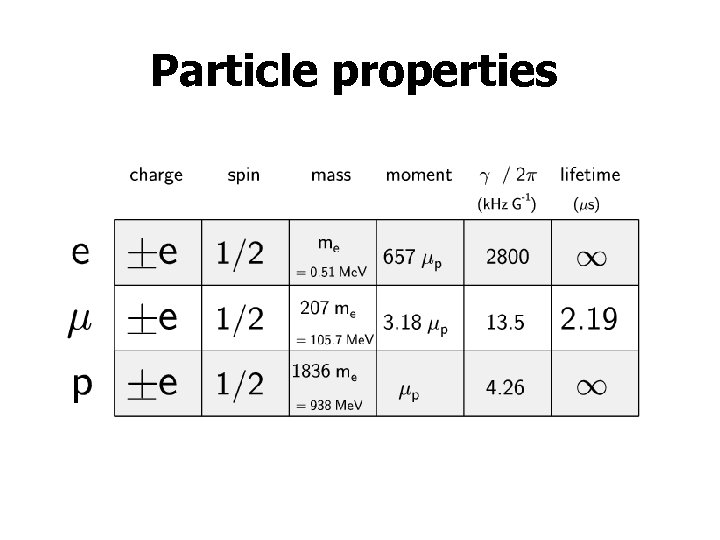 Particle properties
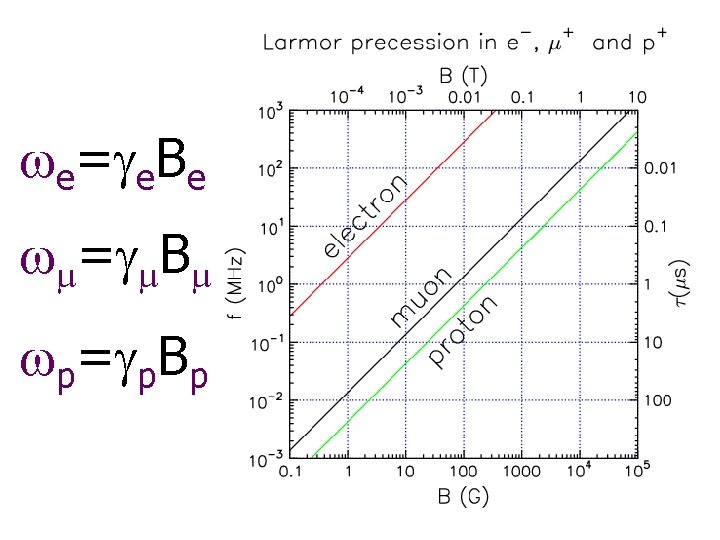 we=ge. Be wm=gm. Bm wp=gp. Bp
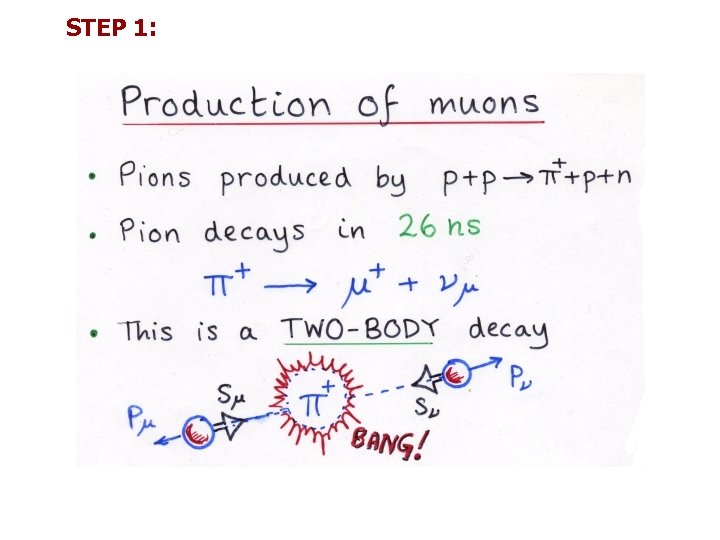 STEP 1:
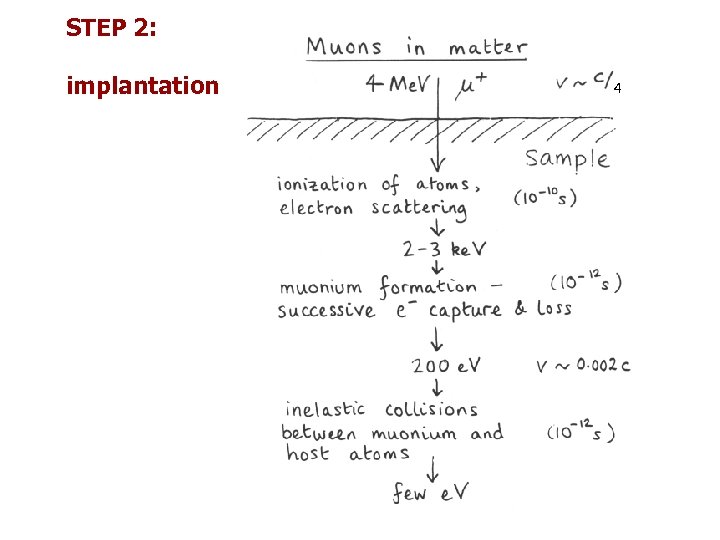 STEP 2: implantation 4
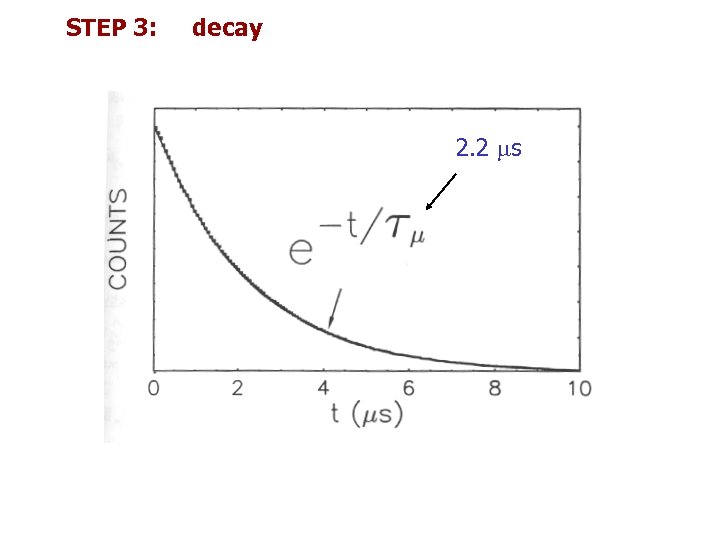 STEP 3: decay 2. 2 ms
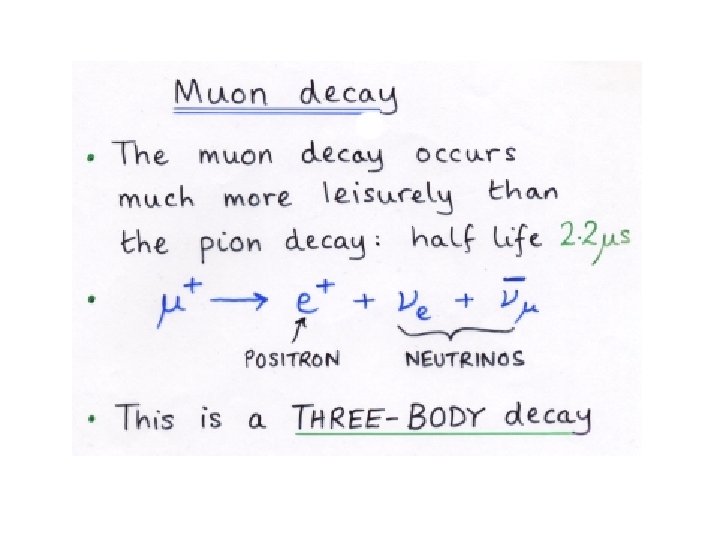
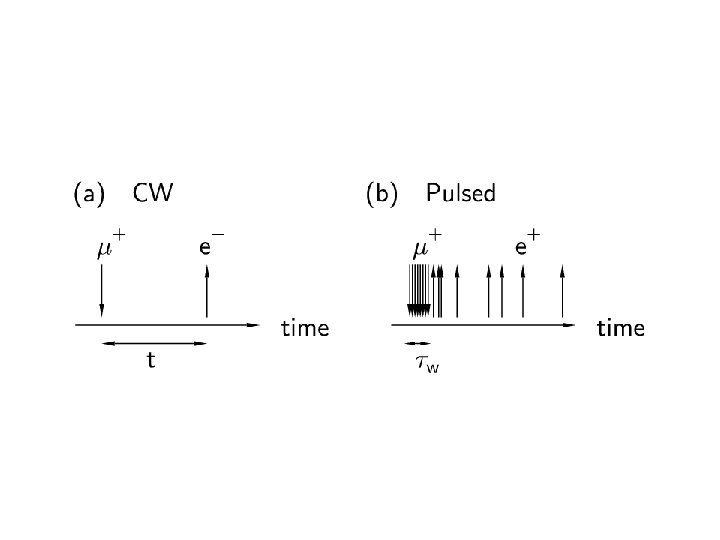
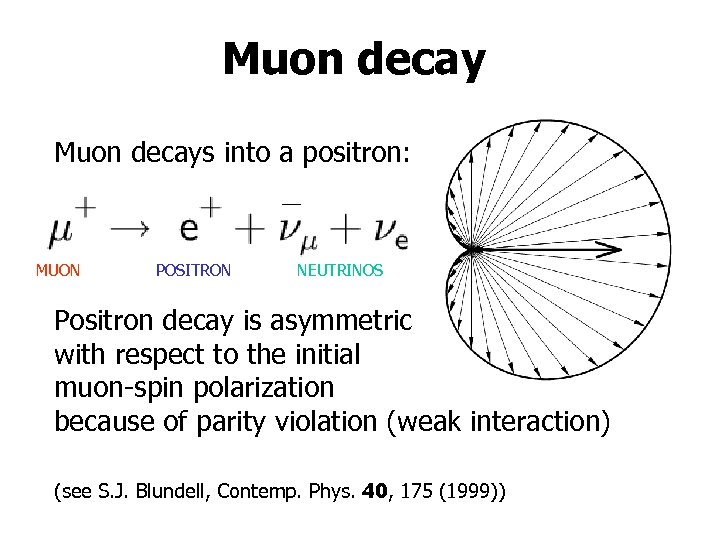 Muon decays into a positron: MUON POSITRON NEUTRINOS Positron decay is asymmetric with respect to the initial muon-spin polarization because of parity violation (weak interaction) (see S. J. Blundell, Contemp. Phys. 40, 175 (1999))
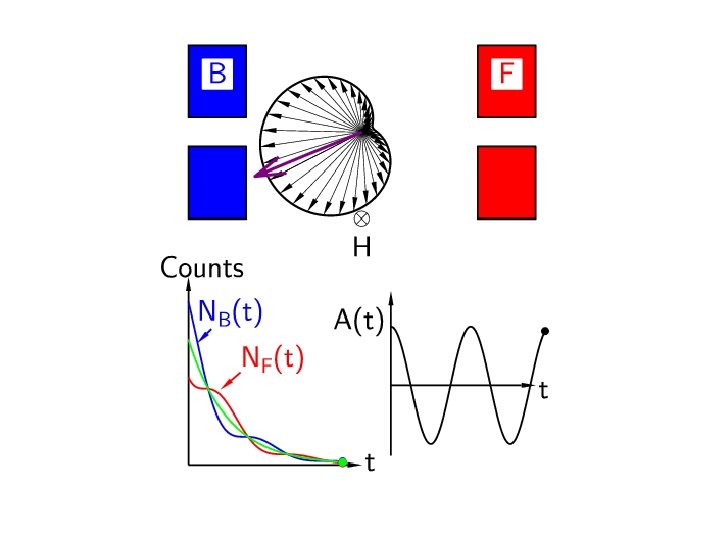
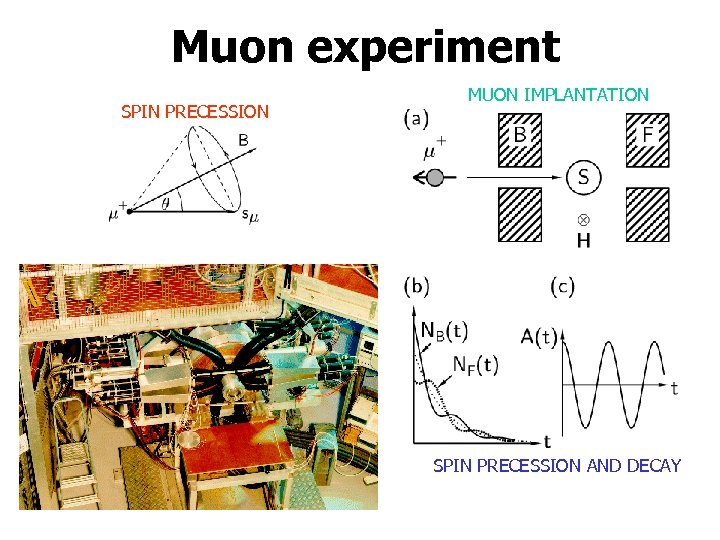 Muon experiment SPIN PRECESSION MUON IMPLANTATION SPIN PRECESSION AND DECAY
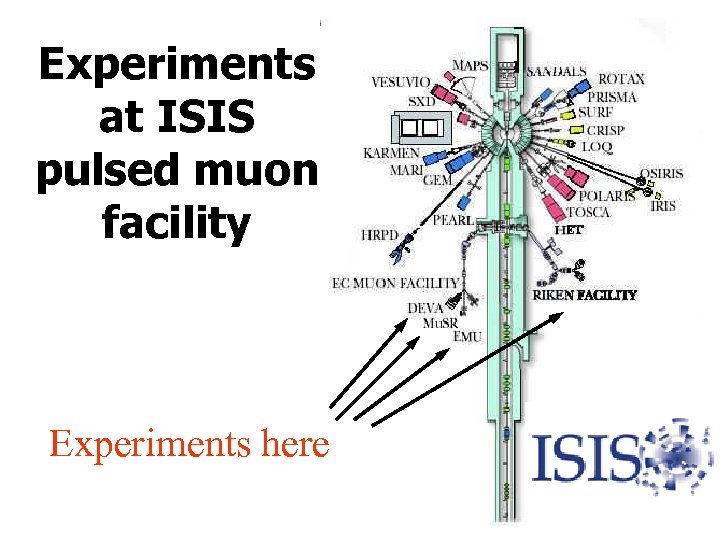 Experiments at ISIS pulsed muon facility Experiments here
 Experiments at PSI muon facility Paul Scherrer Institute, Villigen, Switzerland
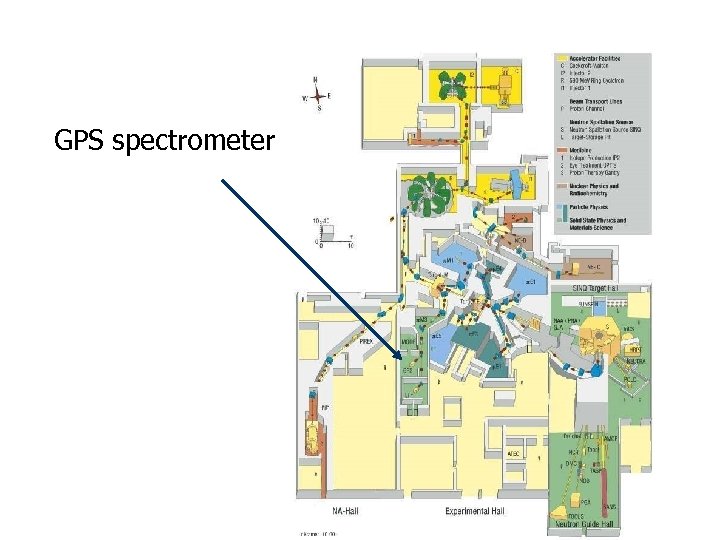 GPS spectrometer
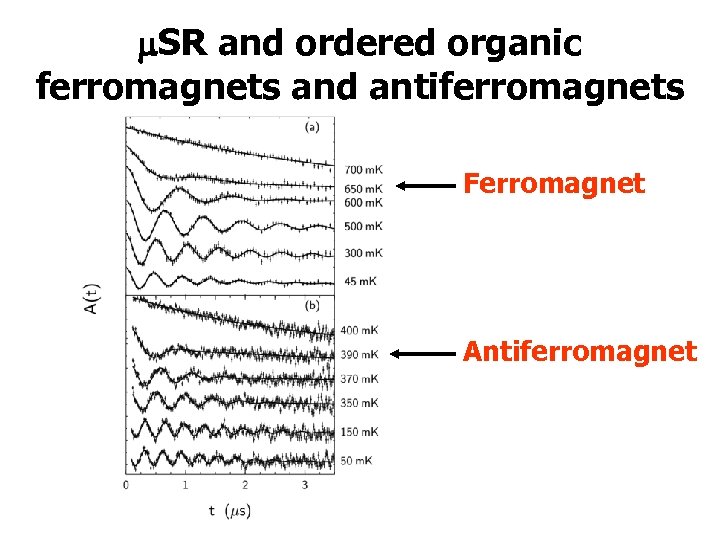
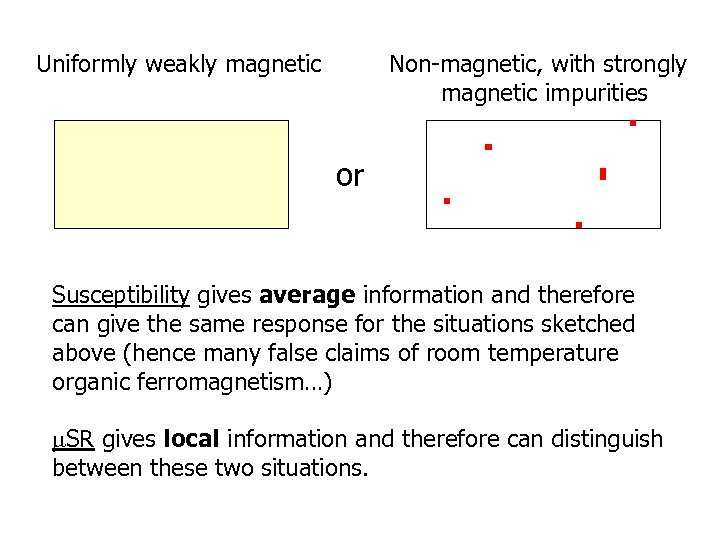
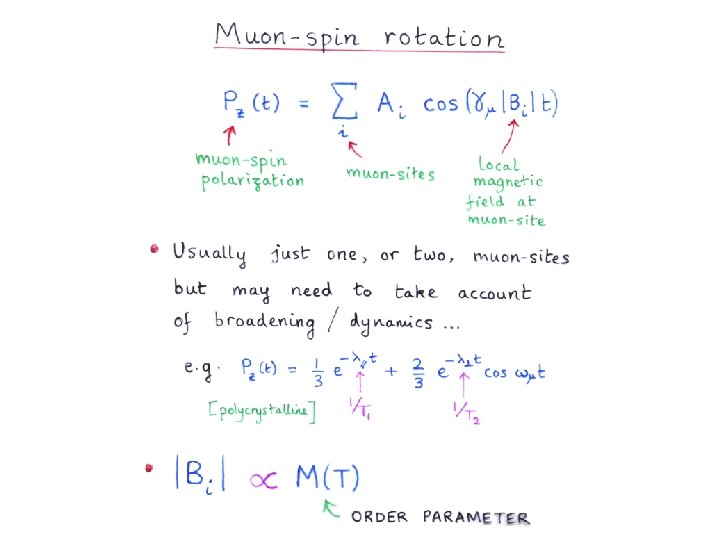
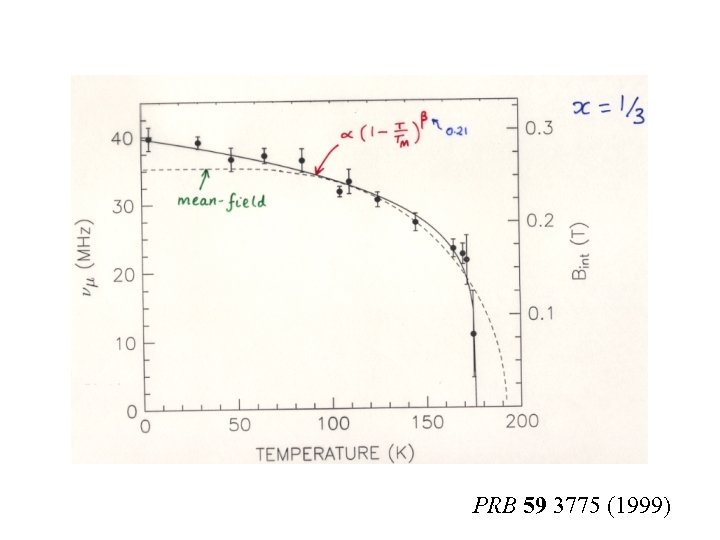
 In the presence of magnetic order, muons sense the internal magnetic field in a material, measured at the muon stopping site. The muon spin precession frequency, ωμ=2πνμ, is given by ωμ=γμBμ. This allows us to follow the temperature dependence of the magnetic order.
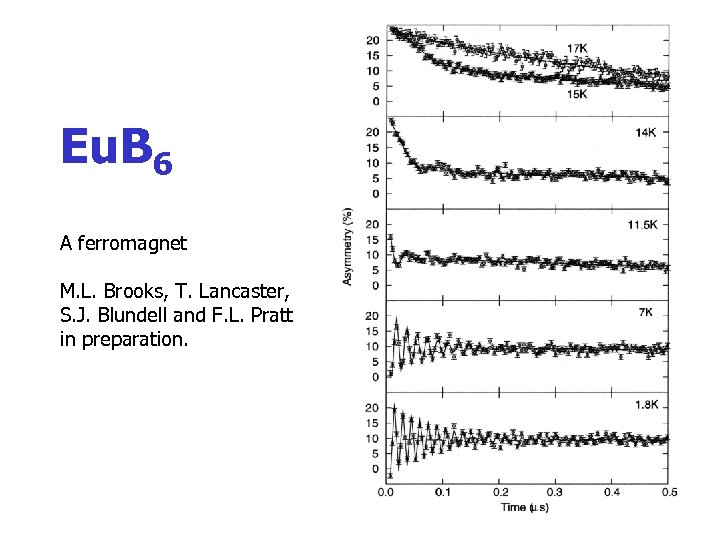 Eu. B 6 A ferromagnet M. L. Brooks, T. Lancaster, S. J. Blundell and F. L. Pratt in preparation.
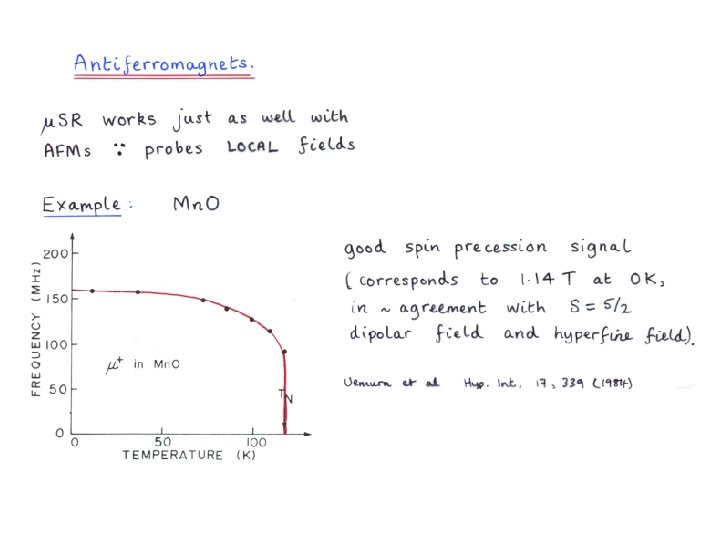
 m. SR and ordered organic ferromagnets and antiferromagnets Ferromagnet Antiferromagnet
 m. SR and ordered organic ferromagnets and antiferromagnets
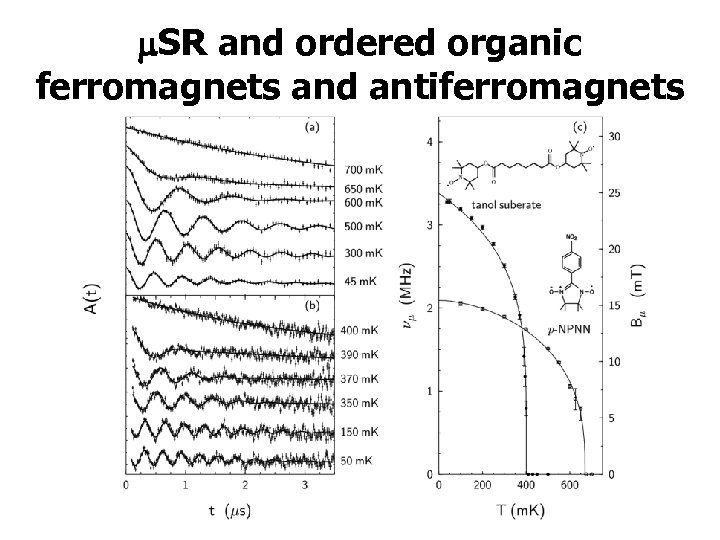
 Uniformly weakly magnetic Non-magnetic, with strongly magnetic impurities or Susceptibility gives average information and therefore can give the same response for the situations sketched above (hence many false claims of room temperature organic ferromagnetism…) m. SR gives local information and therefore can distinguish between these two situations.
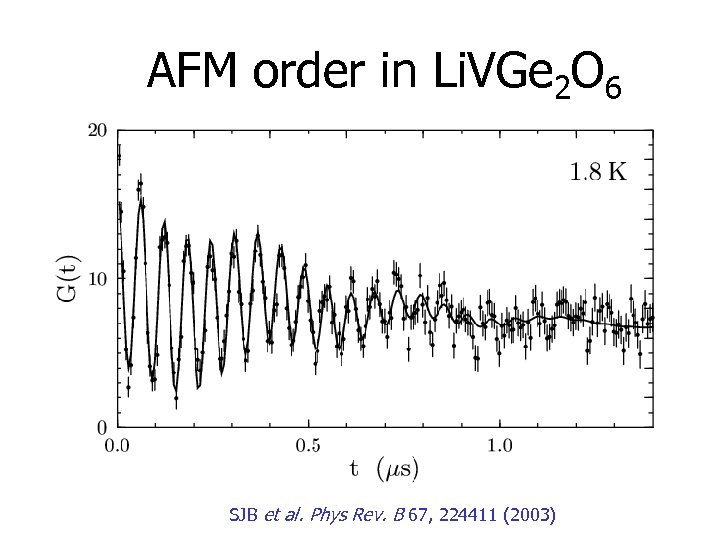 AFM order in Li. VGe 2 O 6 SJB et al. Phys Rev. B 67, 224411 (2003)
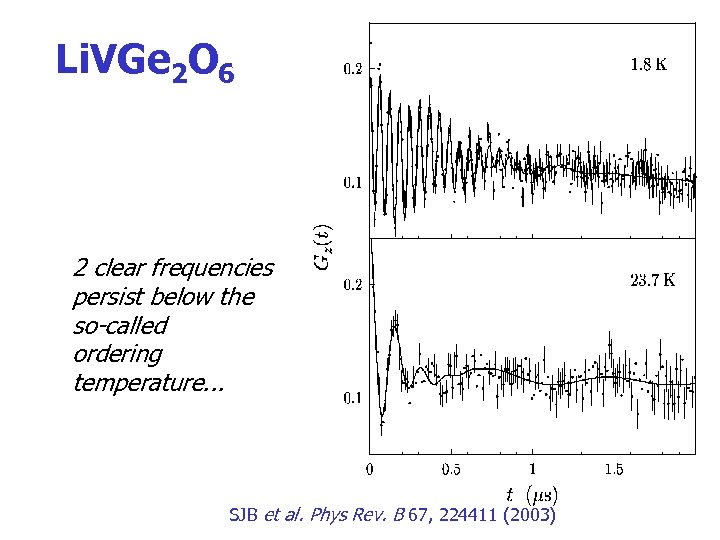 Li. VGe 2 O 6 2 clear frequencies persist below the so-called ordering temperature. . . SJB et al. Phys Rev. B 67, 224411 (2003)
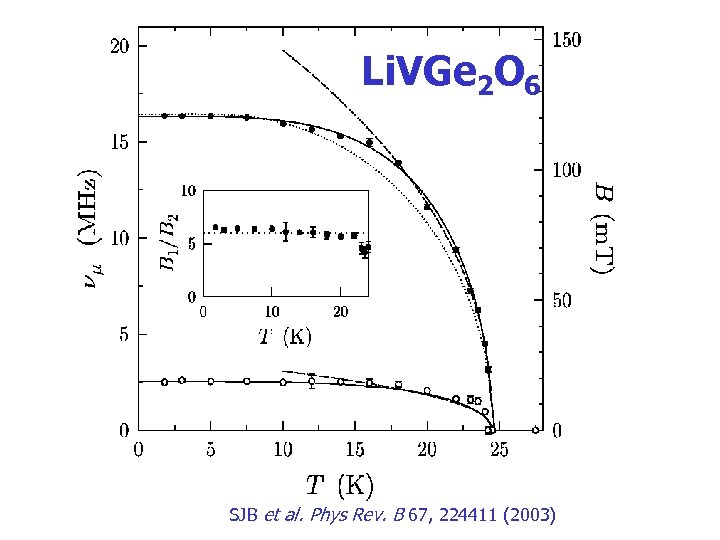 Li. VGe 2 O 6 SJB et al. Phys Rev. B 67, 224411 (2003)
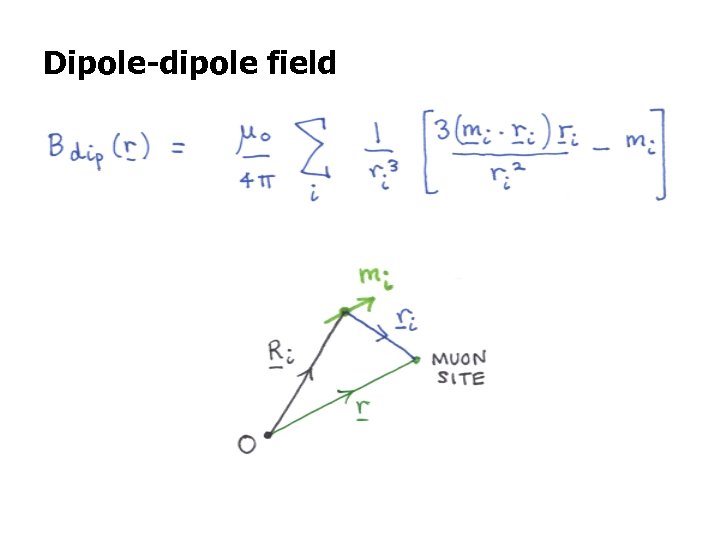 Dipole-dipole field
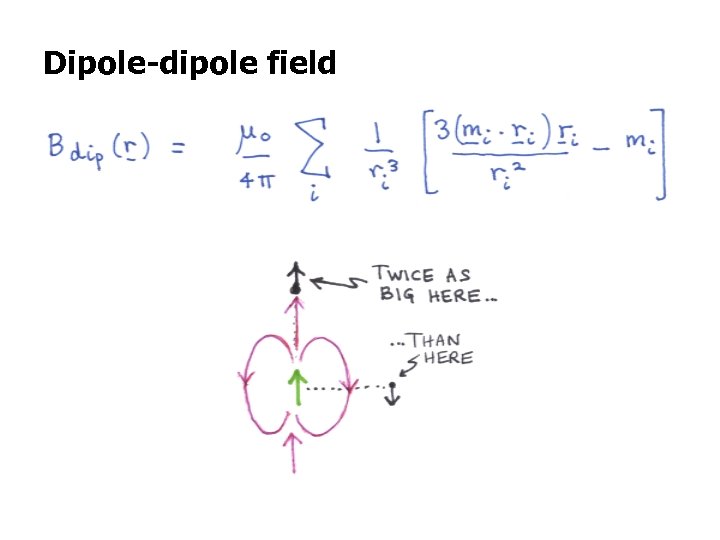 Dipole-dipole field
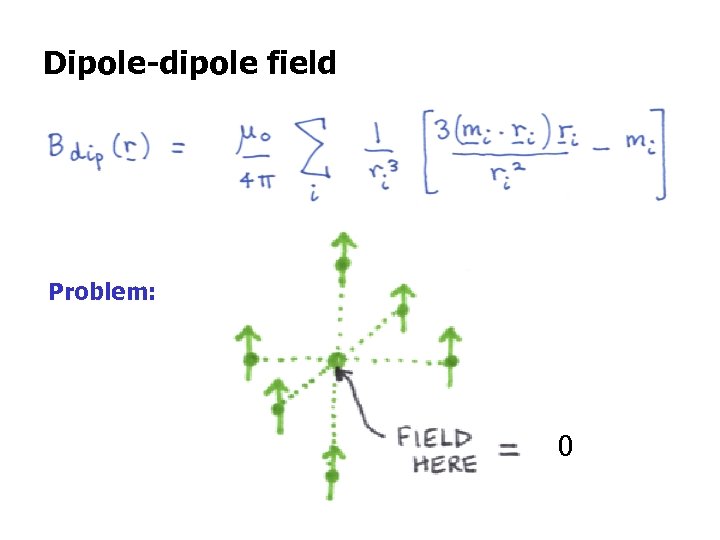 Dipole-dipole field Problem: 0
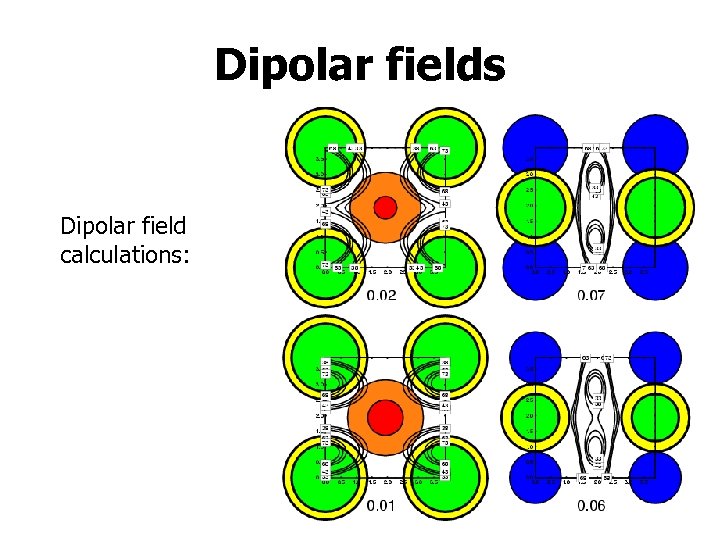 Dipolar fields Dipolar field calculations:
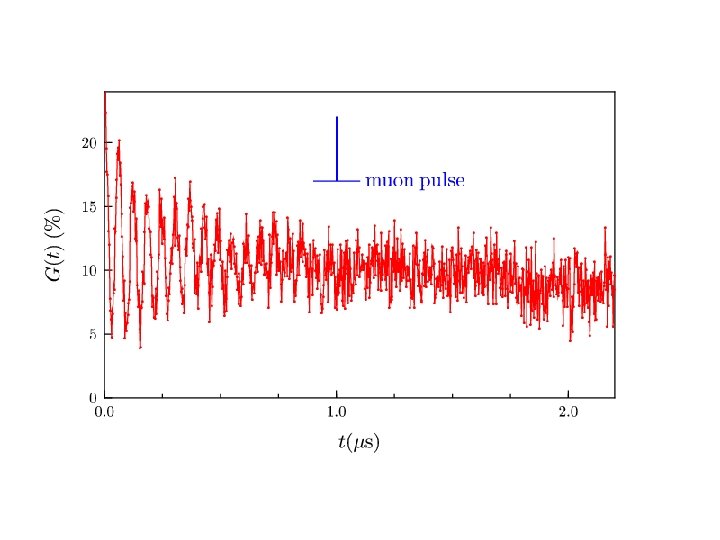
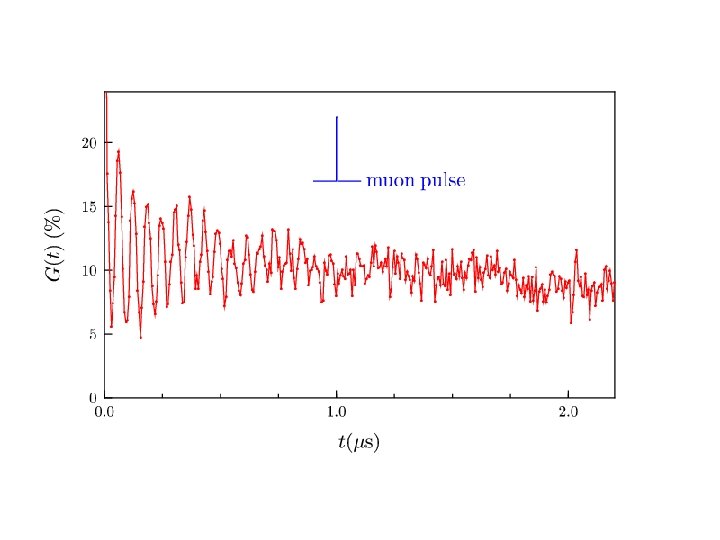
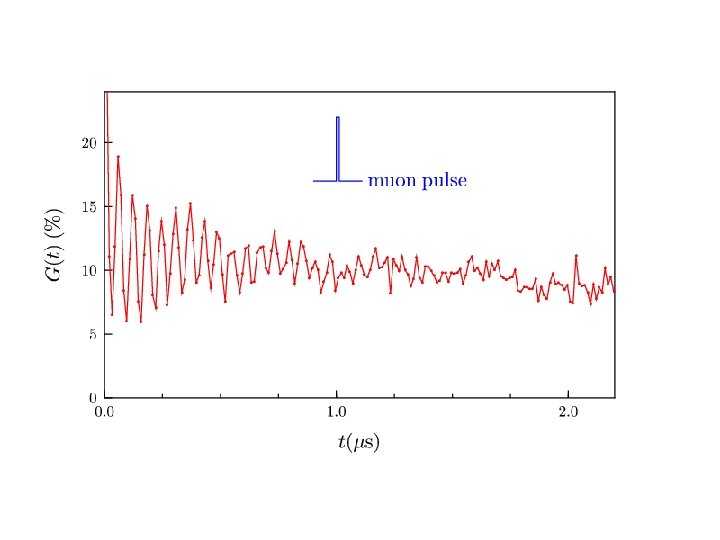
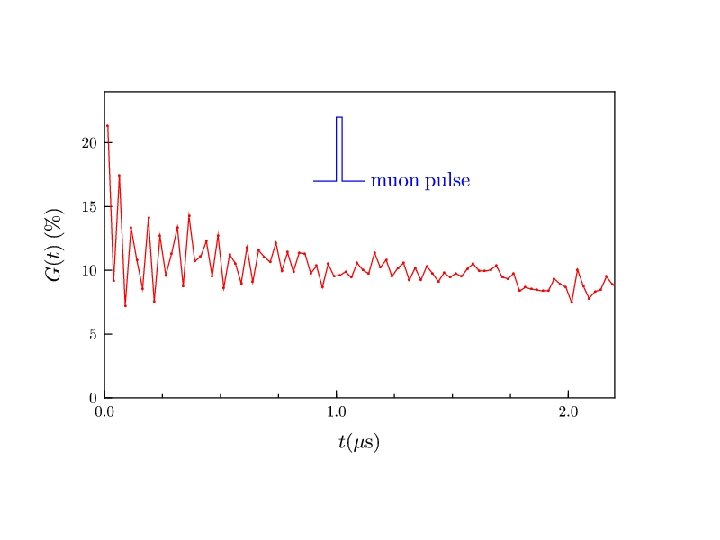
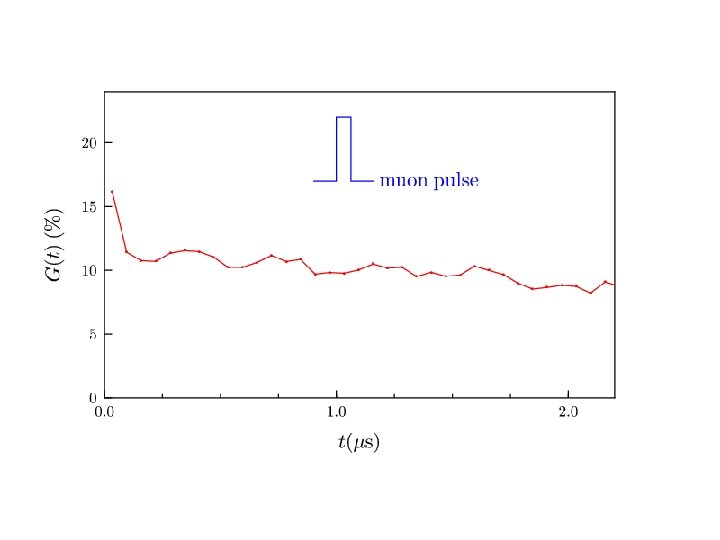
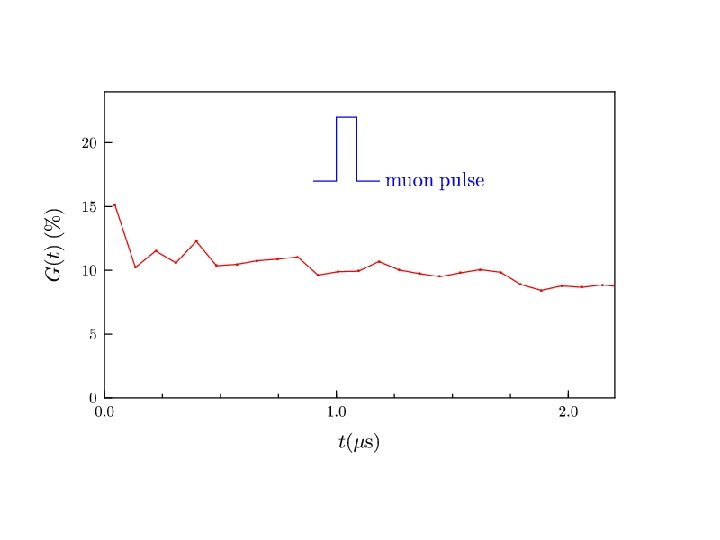
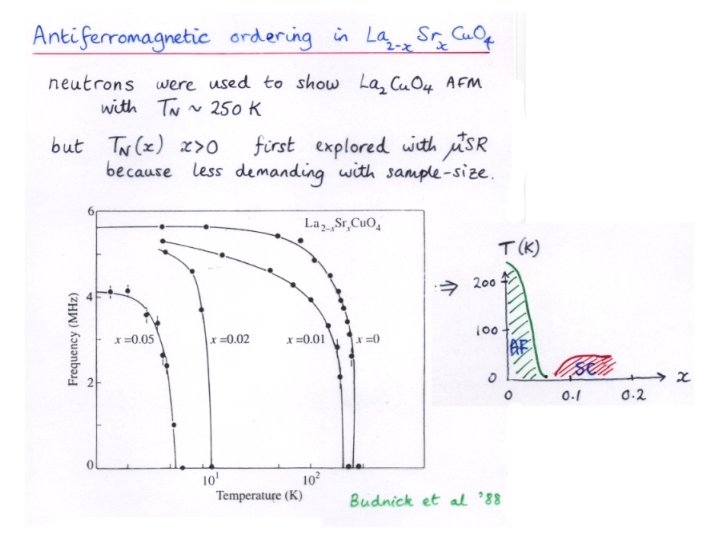
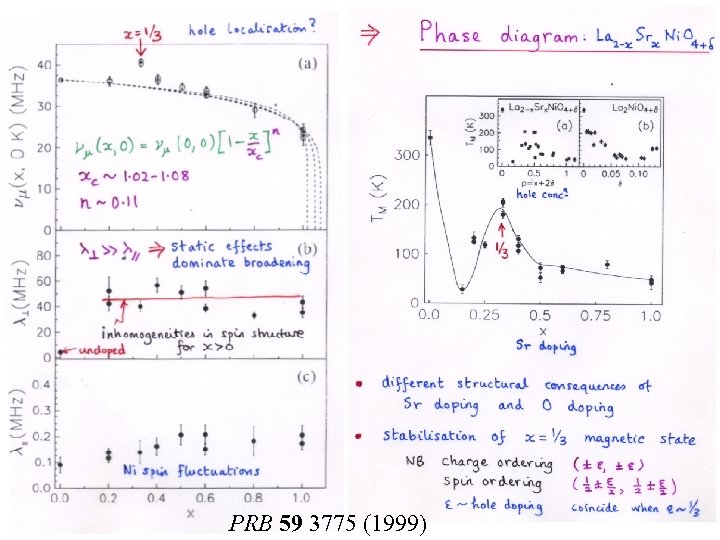
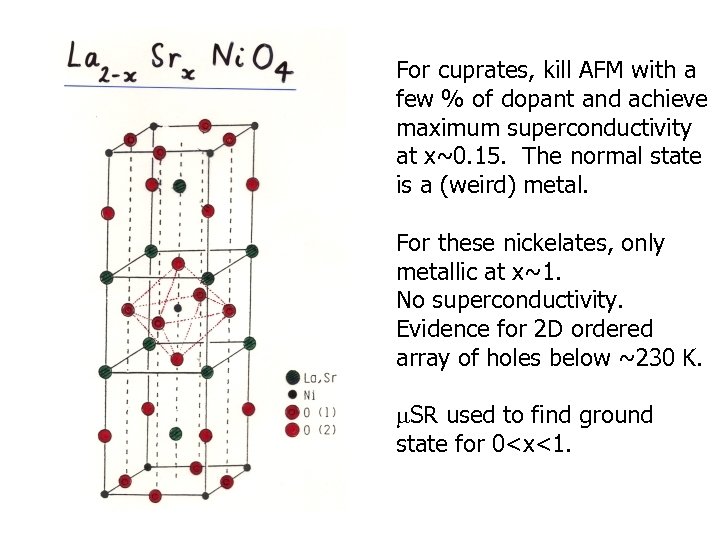 For cuprates, kill AFM with a few % of dopant and achieve maximum superconductivity at x~0. 15. The normal state is a (weird) metal. For these nickelates, only metallic at x~1. No superconductivity. Evidence for 2 D ordered array of holes below ~230 K. m. SR used to find ground state for 0
 PRB 59 3775 (1999)
 PRB 59 3775 (1999)
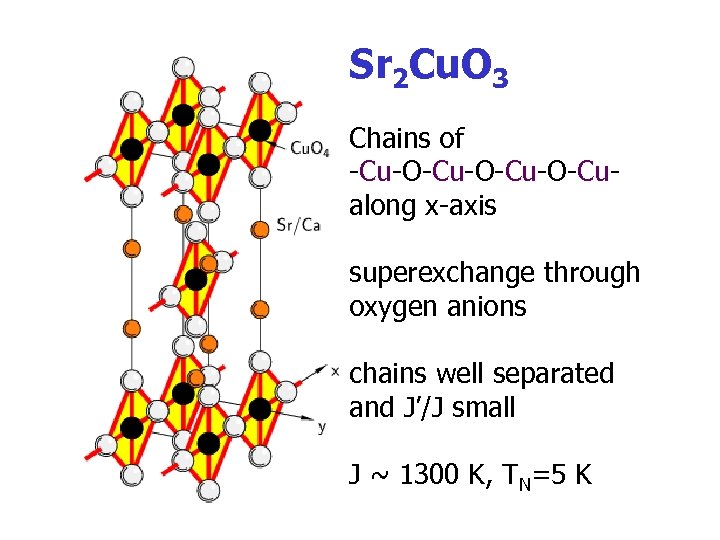 Sr 2 Cu. O 3 Chains of -Cu-O-Cu-O-Cualong x-axis superexchange through oxygen anions chains well separated and J’/J small J ~ 1300 K, TN=5 K
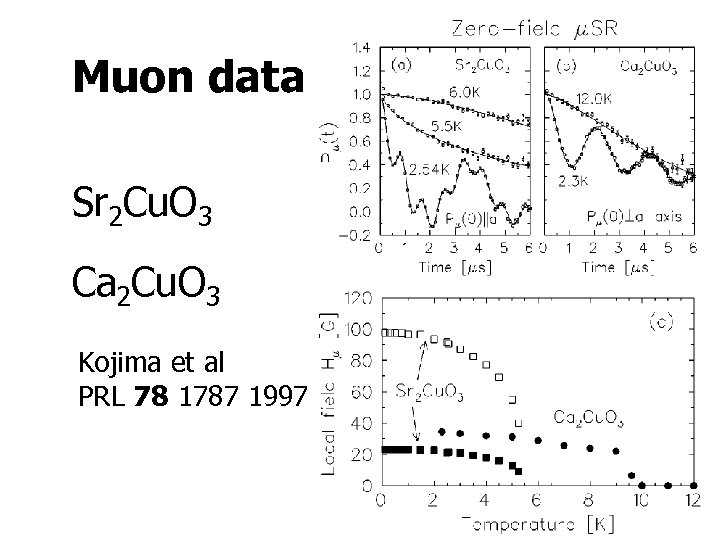 Muon data Sr 2 Cu. O 3 Ca 2 Cu. O 3 Kojima et al PRL 78 1787 1997
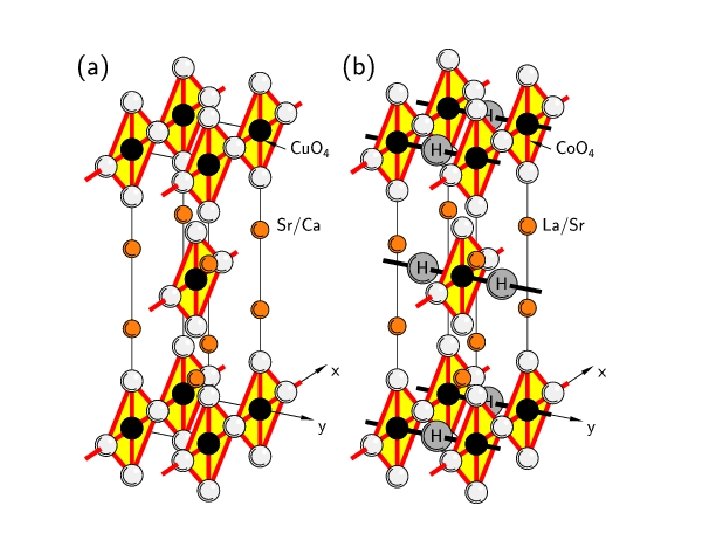
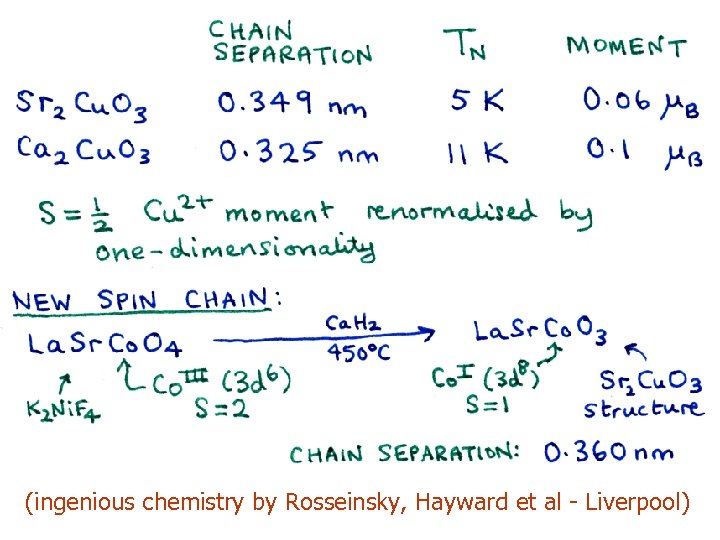 (ingenious chemistry by Rosseinsky, Hayward et al - Liverpool)
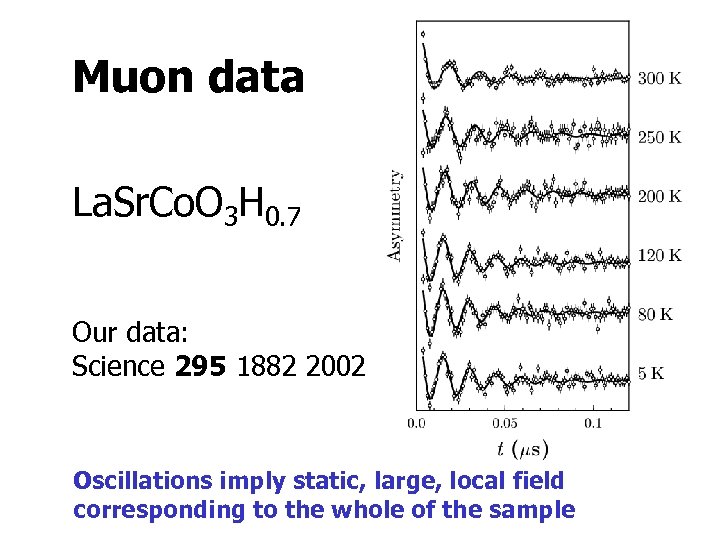 Muon data La. Sr. Co. O 3 H 0. 7 Our data: Science 295 1882 2002 Oscillations imply static, large, local field corresponding to the whole of the sample
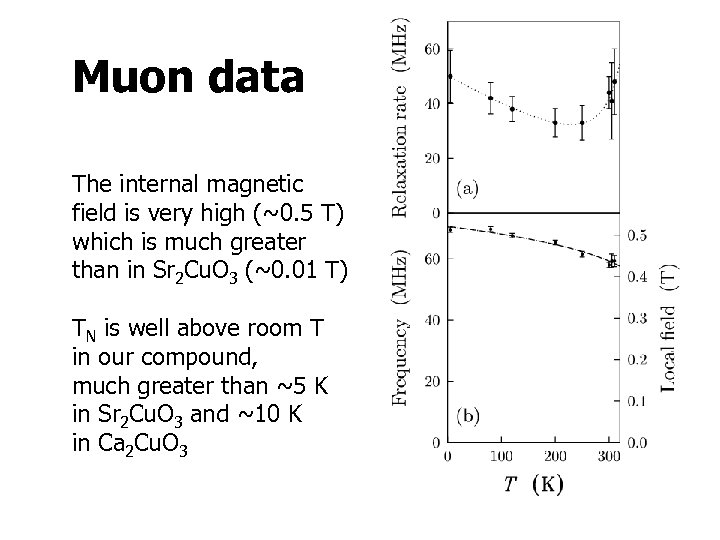 Muon data The internal magnetic field is very high (~0. 5 T) which is much greater than in Sr 2 Cu. O 3 (~0. 01 T) TN is well above room T in our compound, much greater than ~5 K in Sr 2 Cu. O 3 and ~10 K in Ca 2 Cu. O 3
 Conclusion: La. Sr. Co. O 3 H 0. 7 contains the hydride ion H- (1 s 2) Hydride ions can transmit exchange interactions very effectively! This leads to the separated chains being bridged, raising the transition temperature of our compound to well above room temperature!
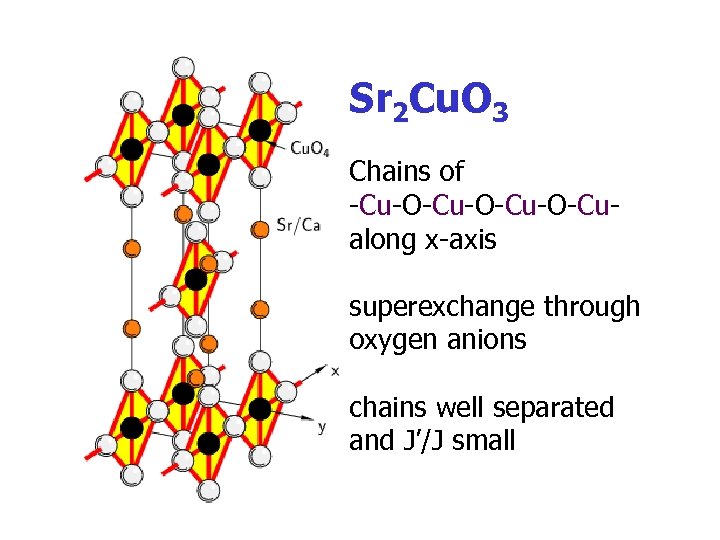 Sr 2 Cu. O 3 Chains of -Cu-O-Cu-O-Cualong x-axis superexchange through oxygen anions chains well separated and J’/J small
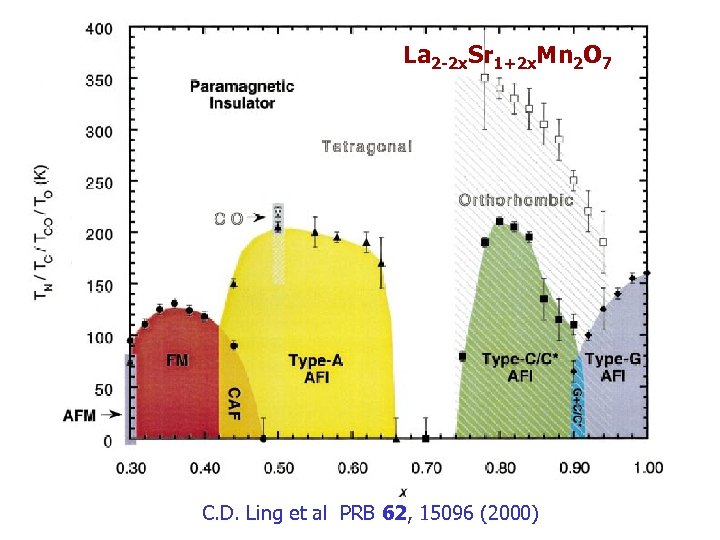 La 2 -2 x. Sr 1+2 x. Mn 2 O 7 C. D. Ling et al PRB 62, 15096 (2000)
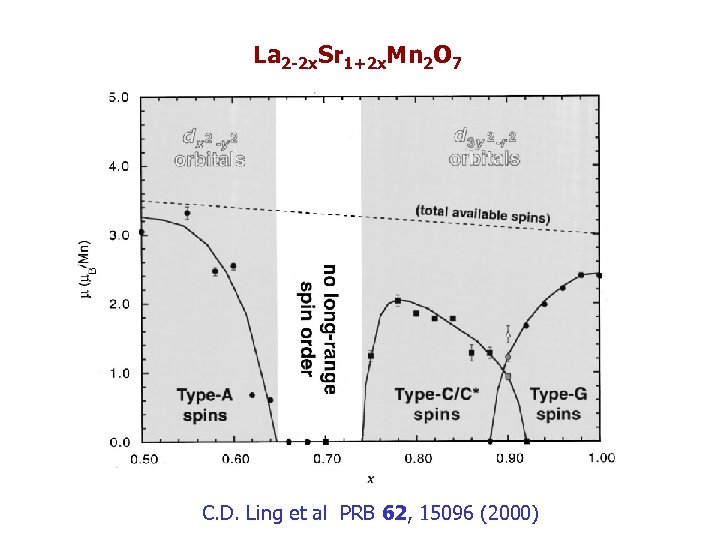 La 2 -2 x. Sr 1+2 x. Mn 2 O 7 C. D. Ling et al PRB 62, 15096 (2000)
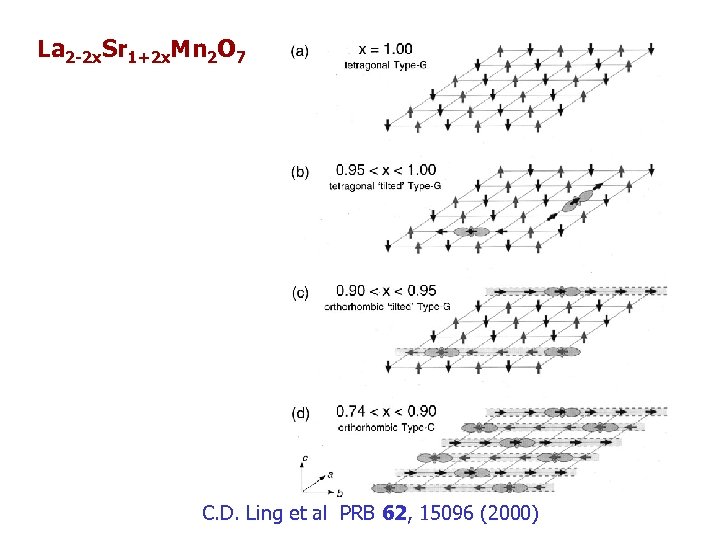 La 2 -2 x. Sr 1+2 x. Mn 2 O 7 C. D. Ling et al PRB 62, 15096 (2000)
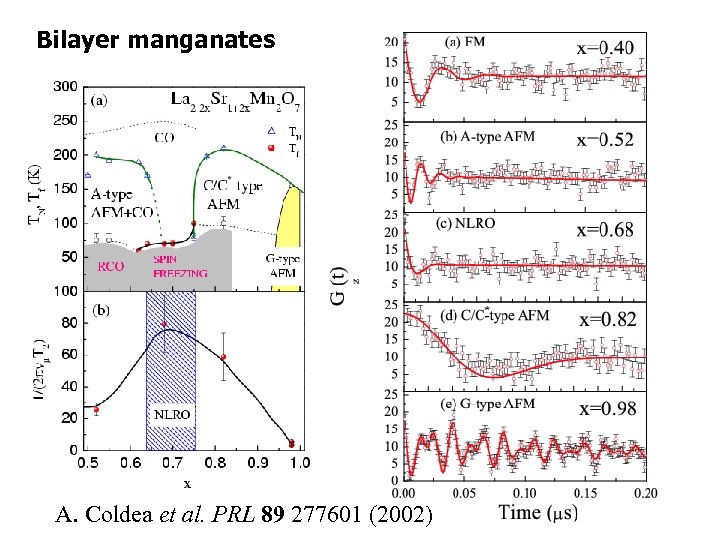 Bilayer manganates A. Coldea et al. PRL 89 277601 (2002)
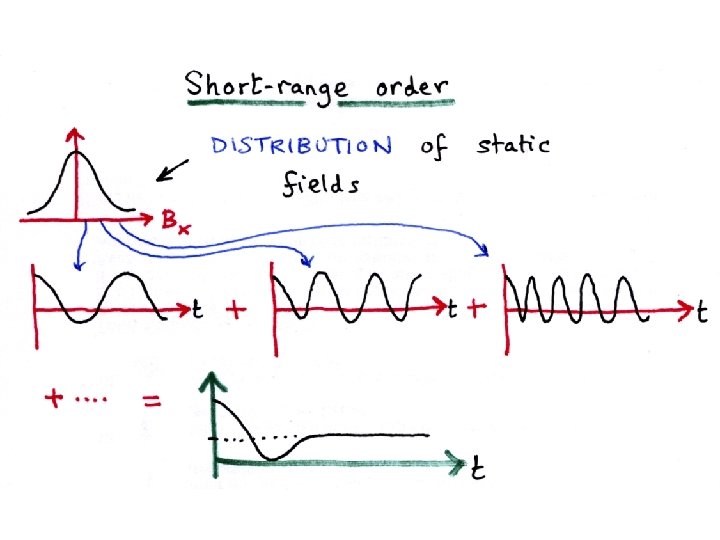
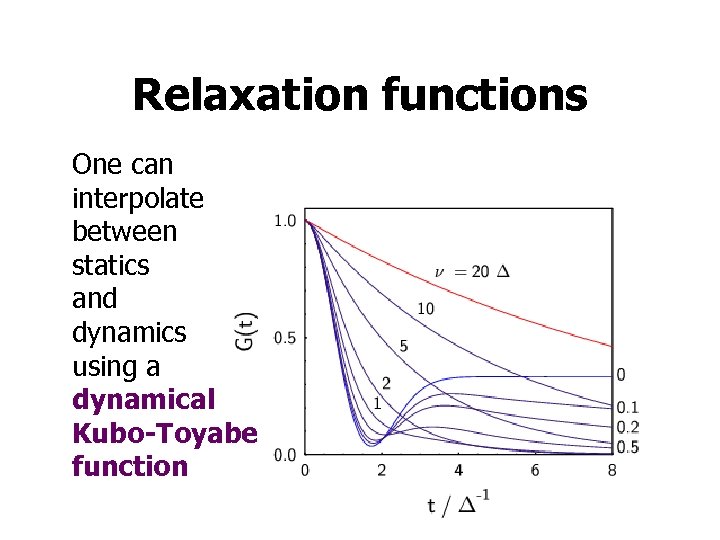 Relaxation functions One can interpolate between statics and dynamics using a dynamical Kubo-Toyabe function
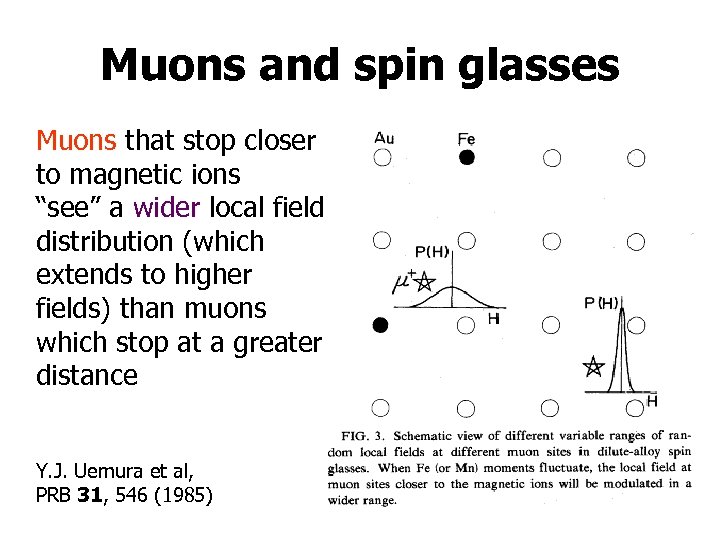 Muons and spin glasses Muons that stop closer to magnetic ions “see” a wider local field distribution (which extends to higher fields) than muons which stop at a greater distance Y. J. Uemura et al, PRB 31, 546 (1985)
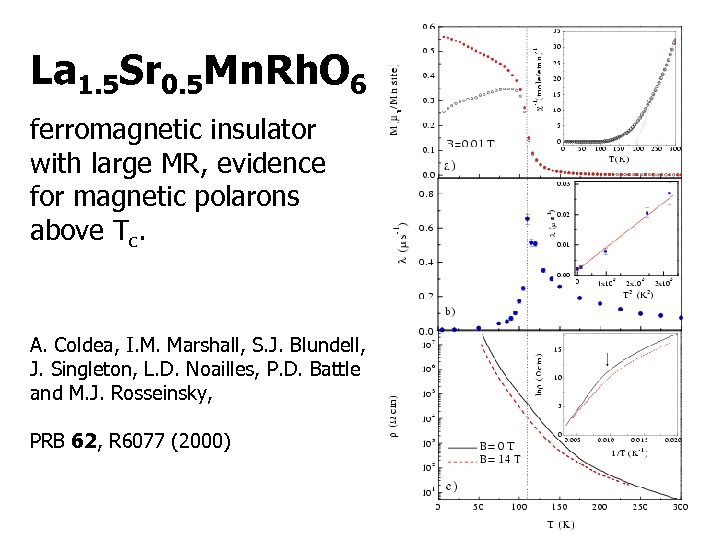 La 1. 5 Sr 0. 5 Mn. Rh. O 6 ferromagnetic insulator with large MR, evidence for magnetic polarons above Tc. A. Coldea, I. M. Marshall, S. J. Blundell, J. Singleton, L. D. Noailles, P. D. Battle and M. J. Rosseinsky, PRB 62, R 6077 (2000)
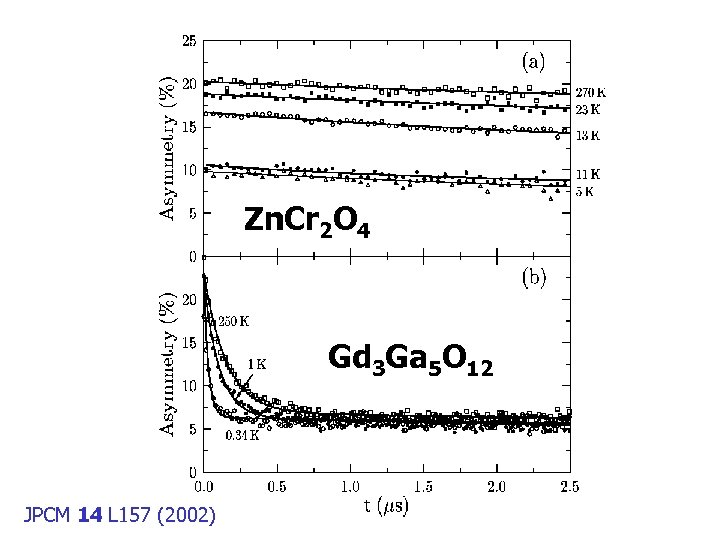 Zn. Cr 2 O 4 Gd 3 Ga 5 O 12 JPCM 14 L 157 (2002)
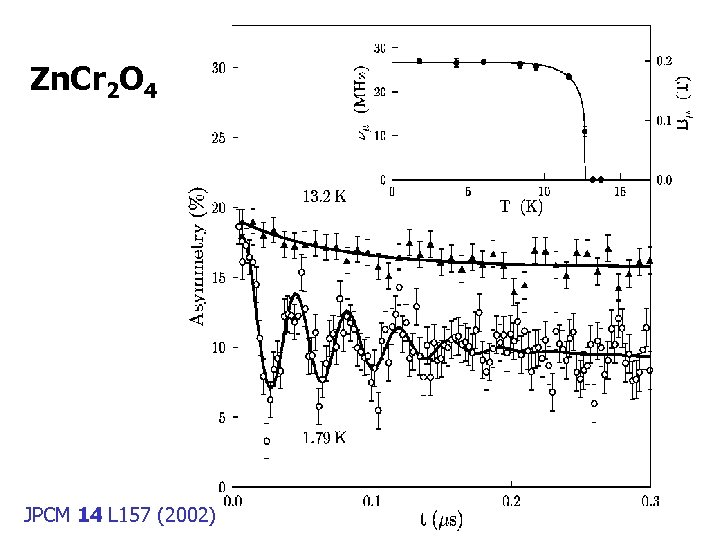 Zn. Cr 2 O 4 JPCM 14 L 157 (2002)
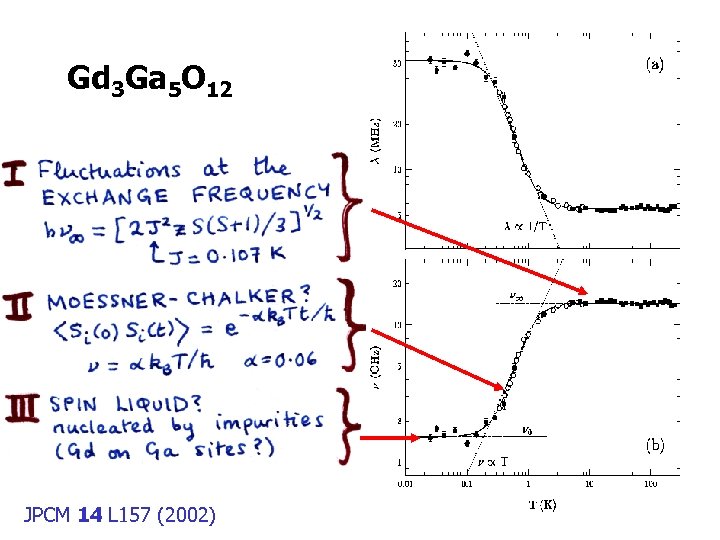 Gd 3 Ga 5 O 12 JPCM 14 L 157 (2002)
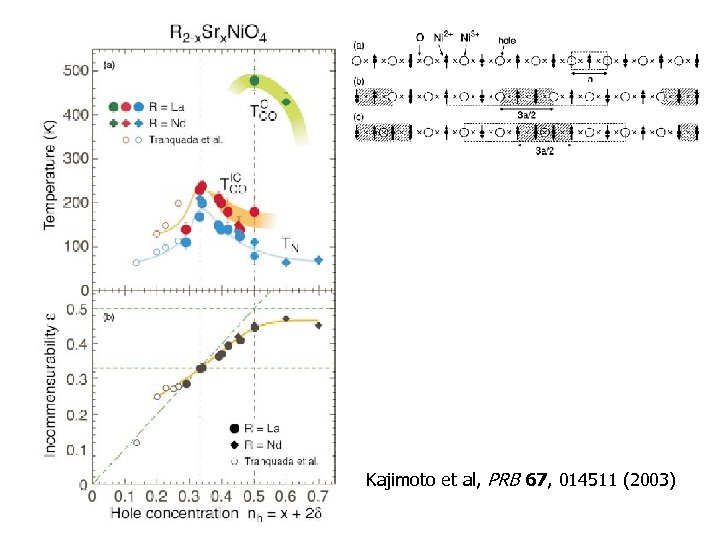 Kajimoto et al, PRB 67, 014511 (2003)
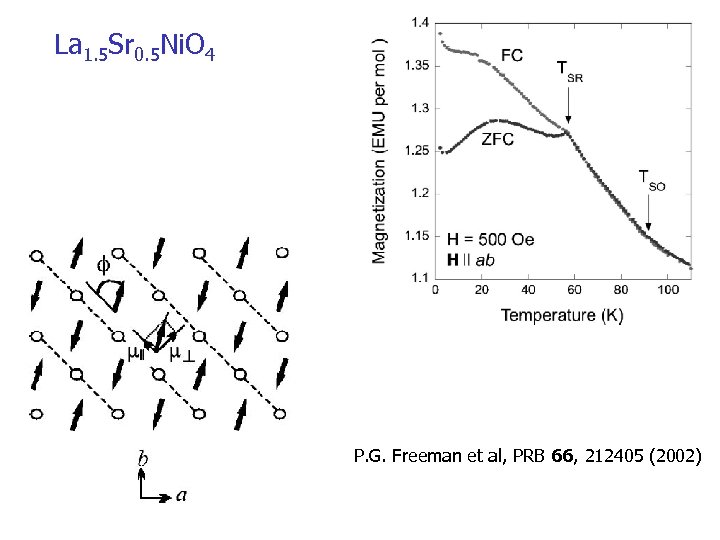 La 1. 5 Sr 0. 5 Ni. O 4 P. G. Freeman et al, PRB 66, 212405 (2002)
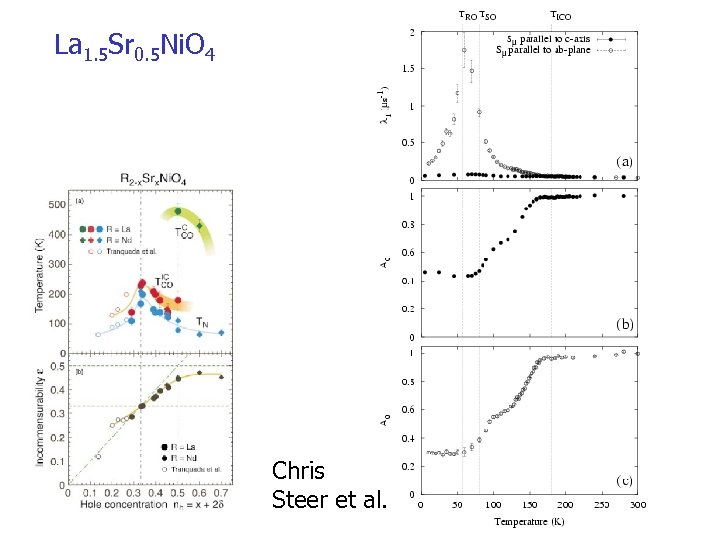 La 1. 5 Sr 0. 5 Ni. O 4 Chris Steer et al.
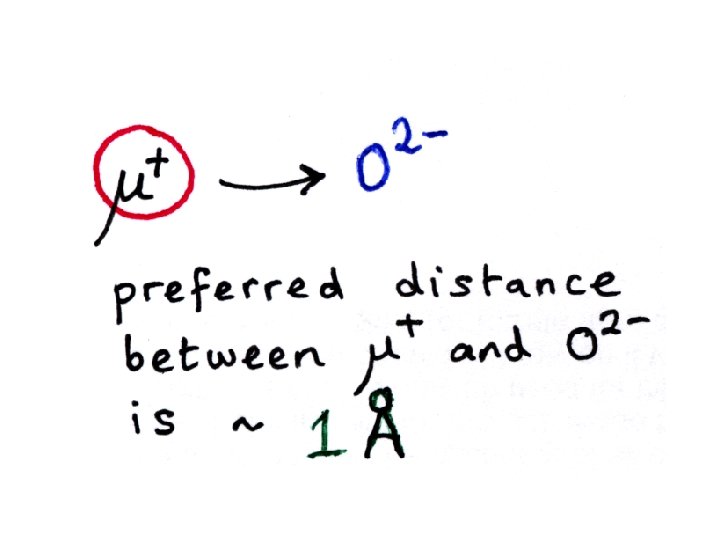
 The attraction of m+ to O 2 -: using muons to study oxides Thanks to members of the Oxford muon group, ICL Oxford, Chemistry in Liverpool, ISIS + many others and to you for your attention!