



 THE ARTICLE
 The points for discussion 1. What does the notion article denote? 2. Which kinds of article do you know? Which form do they have? 3. Which ancient words are the articles developed from? 4. When cant the indefinite definite article be used? 5. Which common nouns can the indefinite definite article be used 6. Which ways can the articles be used in some syntactical relations. 7. The use of the articles modified by specific adjectives, pronouns or numerals? 8. Special difficulties in the use of articles 9. The use of articles with proper names 10. The use of articles in some set expressions
 The points for today’s discussion 1. What does the notion article denote? 2. Which kinds of article do you know? Which form do they have? 3. Which ancient words are the articles developed from? 4. When cant the indefinite definite article be used? 5. Which common nouns can the indefinite definite article be used 6. Which ways can the articles be used in some syntactical relations. 7. The use of the articles modified by specific adjectives, pronouns or numerals?
 The article is a functional part of speech which is used either to name or specify the noun. THE DEFINITION TO KNOW…
 2. Which kinds of article do you know? Which form do they have? 3. Which ancient words are the articles developed from?
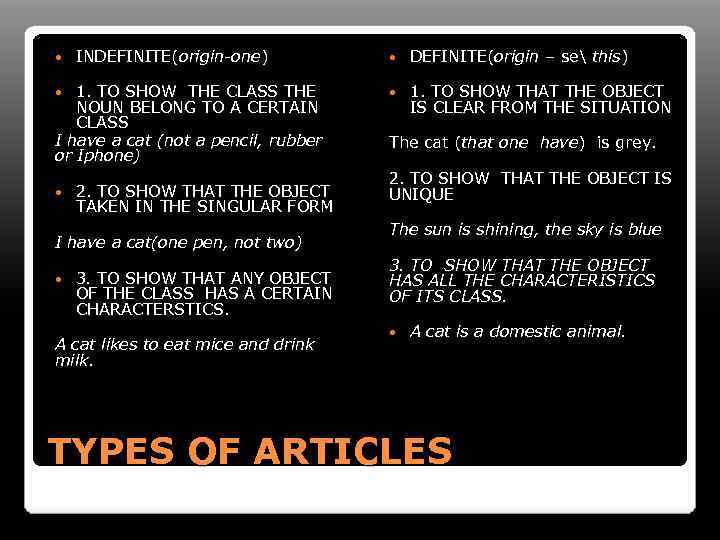 INDEFINITE(origin-one) 1. TO SHOW THE CLASS THE NOUN BELONG TO A CERTAIN CLASS I have a cat (not a pencil, rubber or Iphone) 2. TO SHOW THAT THE OBJECT TAKEN IN THE SINGULAR FORM I have a cat(one pen, not two) 3. TO SHOW THAT ANY OBJECT OF THE CLASS HAS A CERTAIN CHARACTERSTICS. A cat likes to eat mice and drink milk. DEFINITE(origin – se this) 1. TO SHOW THAT THE OBJECT IS CLEAR FROM THE SITUATION The cat (that one have) is grey. 2. TO SHOW THAT THE OBJECT IS UNIQUE The sun is shining, the sky is blue 3. TO SHOW THAT THE OBJECT HAS ALL THE CHARACTERISTICS OF ITS CLASS. A cat is a domestic animal. TYPES OF ARTICLES
 The points for today’s discussion 4. When cant the indefinite definite article be used? 5. Which common nouns can the indefinite definite article be used 6. Which ways can the articles be used in some syntactical relations. 7. The use of the articles modified by specific adjectives, pronouns or numerals?
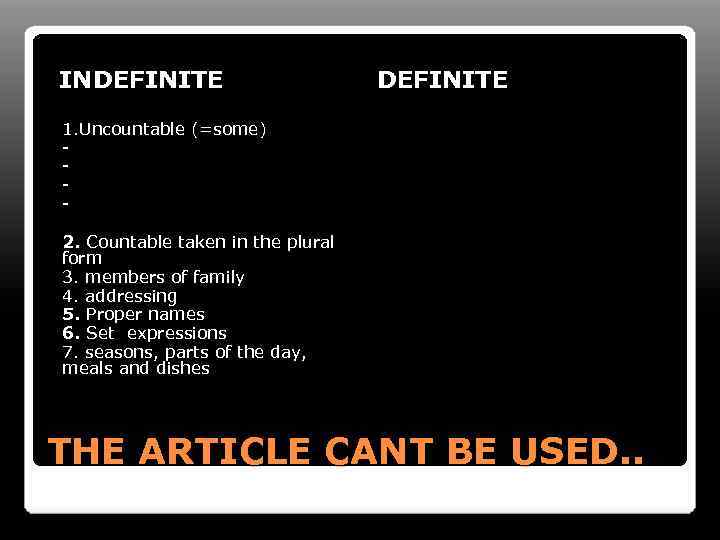 INDEFINITE 1. Uncountable (=some) 2. Countable taken in the plural form 3. members of family 4. addressing 5. Proper names 6. Set expressions 7. seasons, parts of the day, meals and dishes THE ARTICLE CANT BE USED. .
 The points for today’s discussion 5. Which common nouns can the indefinite definite article be used 6. Which ways can the articles be used in some syntactical relations. 7. The use of the articles modified by specific adjectives, pronouns or numerals?
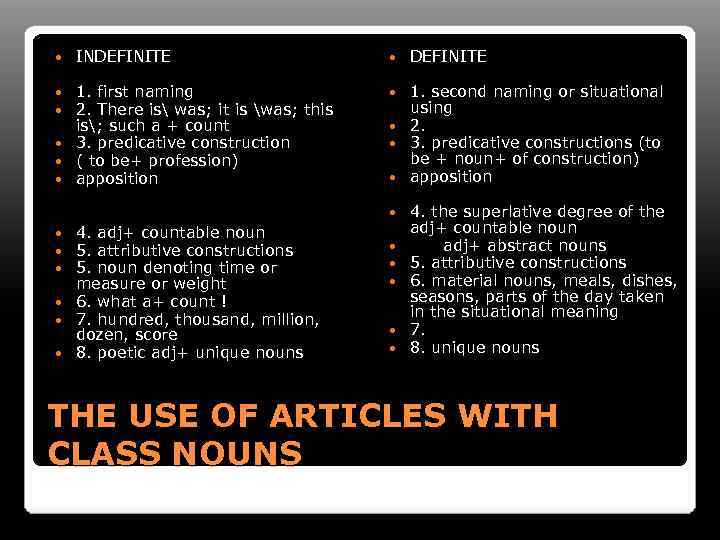 INDEFINITE 1. first naming 2. There is was; it is was; this is; such a + count 3. predicative construction ( to be+ profession) apposition 1. second naming or situational using 2. 3. predicative constructions (to be + noun+ of construction) apposition 4. adj+ countable noun 5. attributive constructions 5. noun denoting time or measure or weight 6. what a+ count ! 7. hundred, thousand, million, dozen, score 8. poetic adj+ unique nouns DEFINITE 4. the superlative degree of the adj+ countable noun adj+ abstract nouns 5. attributive constructions 6. material nouns, meals, dishes, seasons, parts of the day taken in the situational meaning 7. 8. unique nouns THE USE OF ARTICLES WITH CLASS NOUNS
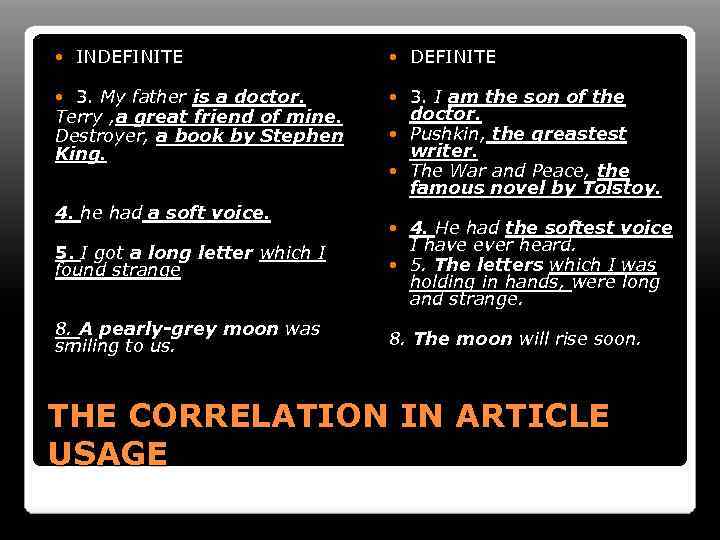 INDEFINITE 3. My father is a doctor. Terry , a great friend of mine. Destroyer, a book by Stephen King. 4. he had a soft voice. DEFINITE 3. I am the son of the doctor. Pushkin, the greastest writer. The War and Peace, the famous novel by Tolstoy. 5. I got a long letter which I found strange 4. He had the softest voice I have ever heard. 5. The letters which I was holding in hands, were long and strange. 8. A pearly-grey moon was smiling to us. 8. The moon will rise soon. THE CORRELATION IN ARTICLE USAGE
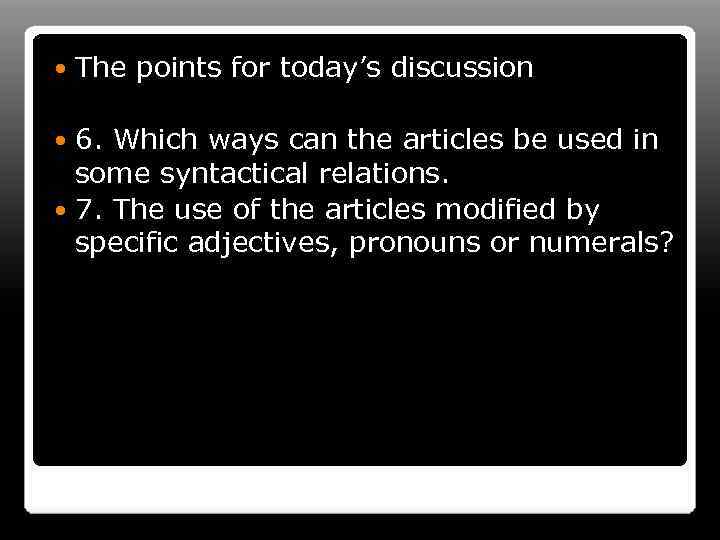 The points for today’s discussion 6. Which ways can the articles be used in some syntactical relations. 7. The use of the articles modified by specific adjectives, pronouns or numerals?
 Which ways can the articles be used in some syntactical relations? ?
 SURE THAT YOU WANT TO KEEP THIS SILENCE? ?
 The points for today’s discussion 7. The use of the articles modified by specific adjectives, pronouns or numerals?
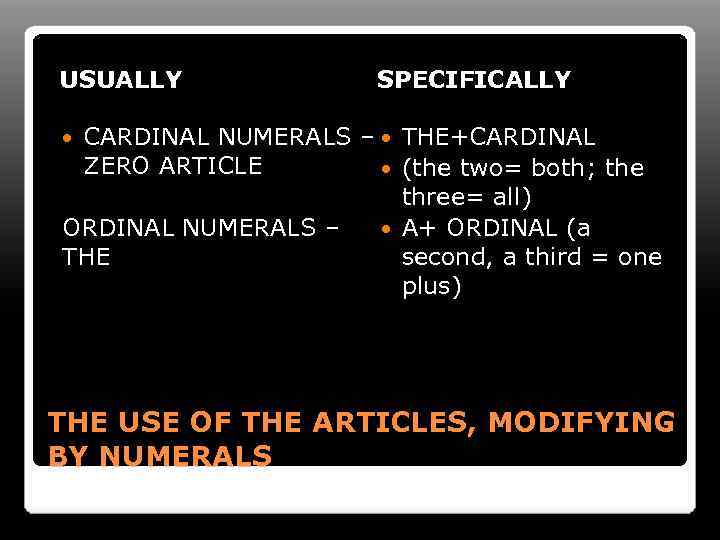 USUALLY SPECIFICALLY CARDINAL NUMERALS – THE+CARDINAL ZERO ARTICLE (the two= both; the three= all) ORDINAL NUMERALS – A+ ORDINAL (a THE second, a third = one plus) THE USE OF THE ARTICLES, MODIFYING BY NUMERALS
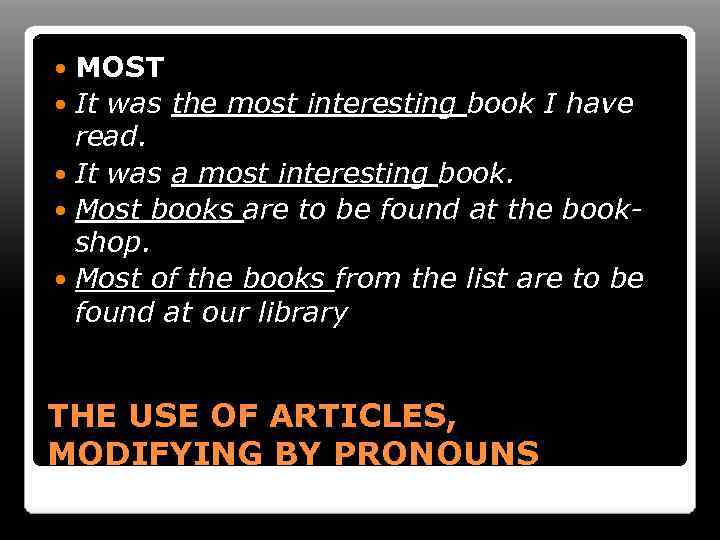 MOST It was the most interesting book I have read. It was a most interesting book. Most books are to be found at the bookshop. Most of the books from the list are to be found at our library THE USE OF ARTICLES, MODIFYING BY PRONOUNS
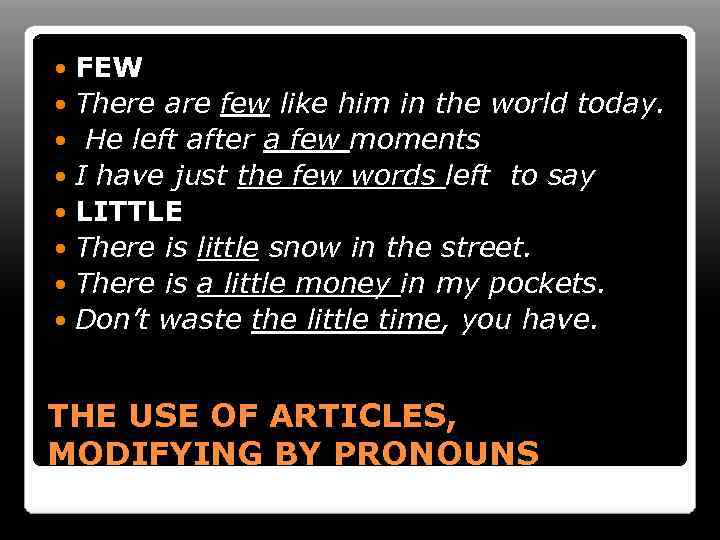 FEW There are few like him in the world today. He left after a few moments I have just the few words left to say LITTLE There is little snow in the street. There is a little money in my pockets. Don’t waste the little time, you have. THE USE OF ARTICLES, MODIFYING BY PRONOUNS
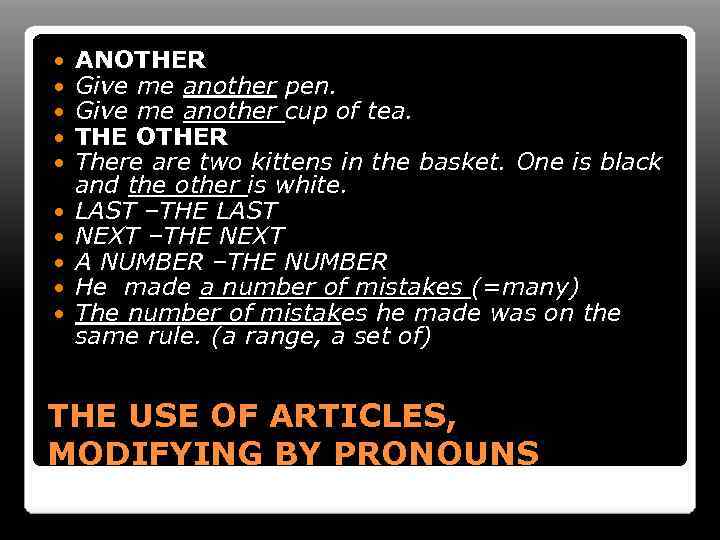 ANOTHER Give me another pen. Give me another cup of tea. THE OTHER There are two kittens in the basket. One is black and the other is white. LAST –THE LAST NEXT –THE NEXT A NUMBER –THE NUMBER He made a number of mistakes (=many) The number of mistakes he made was on the same rule. (a range, a set of) THE USE OF ARTICLES, MODIFYING BY PRONOUNS
 THANKS, SWEETIES, YOU ARE THE BEST!!!!