 Скачать презентацию the art of english poetry 1589 by
English Renaissance Poetry.pptx
- Количество слайдов: 31




* the art of english poetry (1589) by brothers puttenham: “a new companionship of court poets, whose chiefs thomas wyatt & count henry surrey were, arose in the ii half of henry viii’s reign. while travelling throughout italy they learned an elevated sweetness of metre & style of italian poetry. they thoroughly elaborated our rough & uncultivated poetry & put an end to its previous poor condition” • tottel’s miscellany or richard tottel's songs and sonnets written by the right honorable lord henry howard late earl of surrey and other (1557)
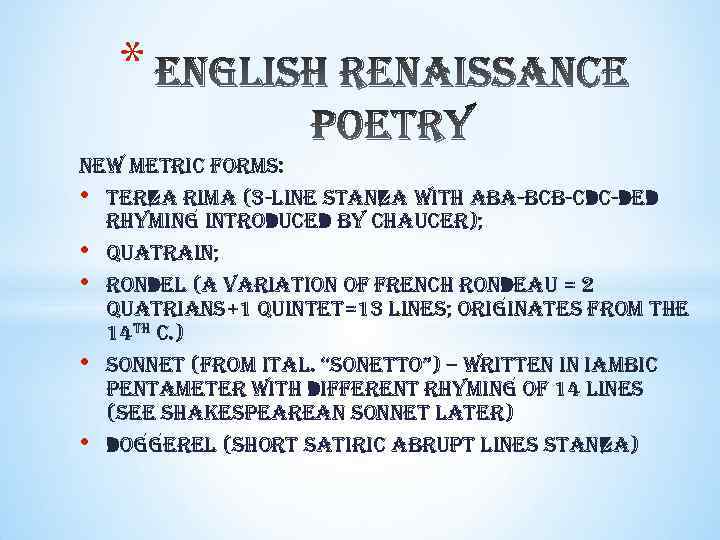
* new metric forms: • terza rima (3 -line stanza with aba-bcb-cdc-ded rhyming introduced by chaucer); • quatrain; • rondel (a variation of french rondeau = 2 quatrians+1 quintet=13 lines; originates from the 14 th c. ) • sonnet (from ital. “sonetto”) – written in iambic pentameter with different rhyming of 14 lines (see shakespearean sonnet later) • doggerel (short satiric abrupt lines stanza)
* new features of poetry: • • • harmonization of contrasts; usage of oxymorons; wit –a play of mind, words, or meanings; complex metaphor, usually philosophic; sonority, flexibility & plasticity;
* new themes of poetry: • • • spirit of citizenship; glorifying of an individual; earthly love that leads to eternal heaven exemplified by beatrice and laura;
* i period – erp (1490 s-1540 s) ii period – mrp (1550 s-1580 s) iii period – lrp (1590 s-1610 s)
![* • john skelton (1460 -1529): “[skelton] is so much more than the brilliant](https://present5.com/presentation/238159605_438722561/image-6.jpg "* • john skelton (1460 -1529): “[skelton] is so much more than the brilliant")
* • john skelton (1460 -1529): “[skelton] is so much more than the brilliant eccentric for which we are apt to mistake him. he is perhaps the most considerable poet between chaucer and spenser and comes at the point of intersection between the medieval and the humanist traditions. ” — maurice evans
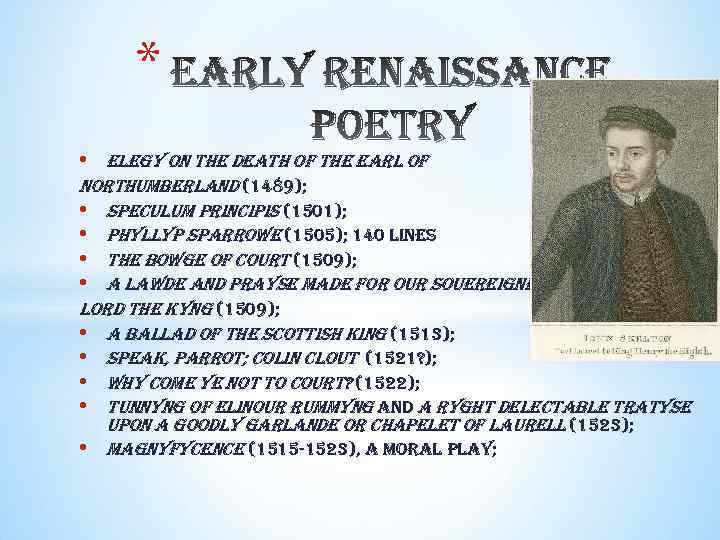
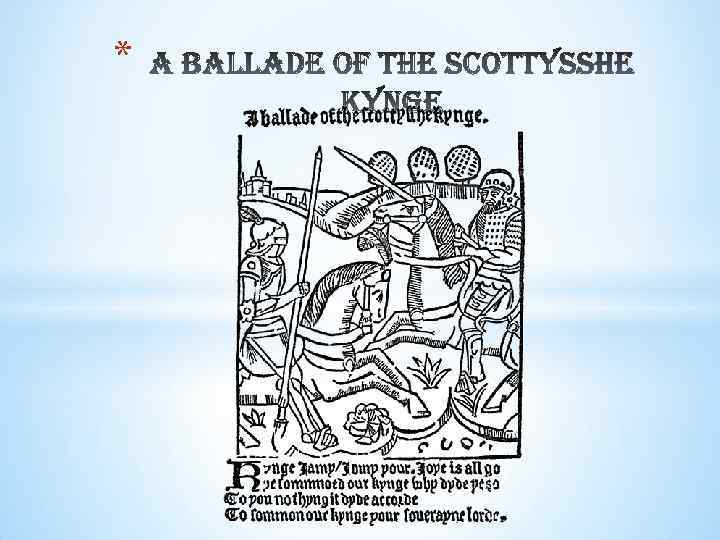
* • elegy on the death of the earl of northumberland (1489); • speculum principis (1501); • phyllyp sparrowe (1505); 140 lines • the bowge of court (1509); • a lawde and prayse made for our souereigne lord the kyng (1509); • a ballad of the scottish king (1513); • speak, parrot; colin clout (1521? ); • why come ye not to court? (1522); • tunnyng of elinour rummyng and a ryght delectable tratyse upon a goodly garlande or chapelet of laurell (1523); • magnyfycence (1515 -1523), a moral play;
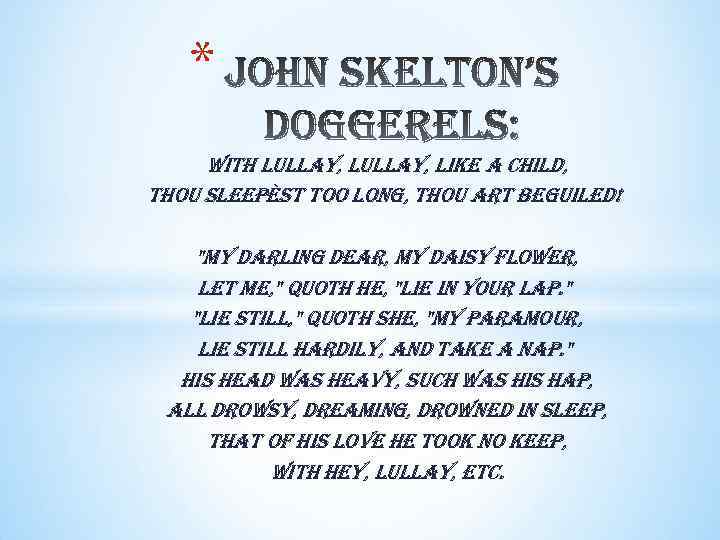
* with lullay, like a child, thou sleepèst too long, thou art beguiled! "my darling dear, my daisy flower, let me, " quoth he, "lie in your lap. " "lie still, " quoth she, "my paramour, lie still hardily, and take a nap. " his head was heavy, such was his hap, all drowsy, dreaming, drowned in sleep, that of his love he took no keep, with hey, lullay, etc.
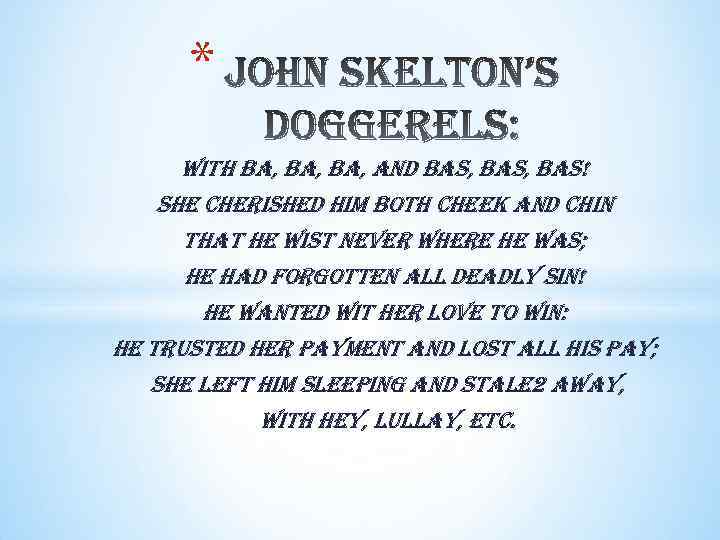
* with ba, ba, and bas, bas! she cherished him both cheek and chin that he wist never where he was; he had forgotten all deadly sin! he wanted wit her love to win: he trusted her payment and lost all his pay; she left him sleeping and stale 2 away, with hey, lullay, etc.
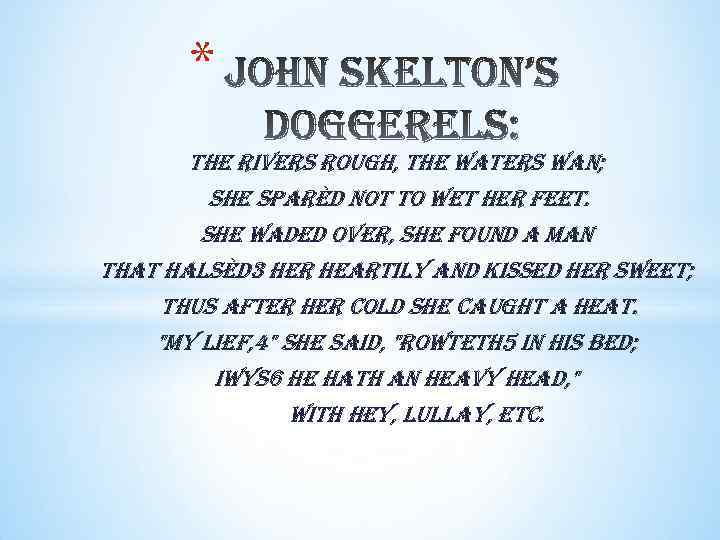
* the rivers rough, the waters wan; she sparèd not to wet her feet. she waded over, she found a man that halsèd 3 her heartily and kissed her sweet; thus after her cold she caught a heat. "my lief, 4" she said, "rowteth 5 in his bed; iwys 6 he hath an heavy head, " with hey, lullay, etc.
* what dreamest thou, drunkard, drowsy pate? thy lust and liking is from thee gone; thou blinkard blowboll 7, thou wakèst too late; behold thou liest, luggard, alone! well may thou sigh, well may thou groan, to deal with her so cowardly. ywis, pole-hatchet, 8 she blearèd thine eye!
*
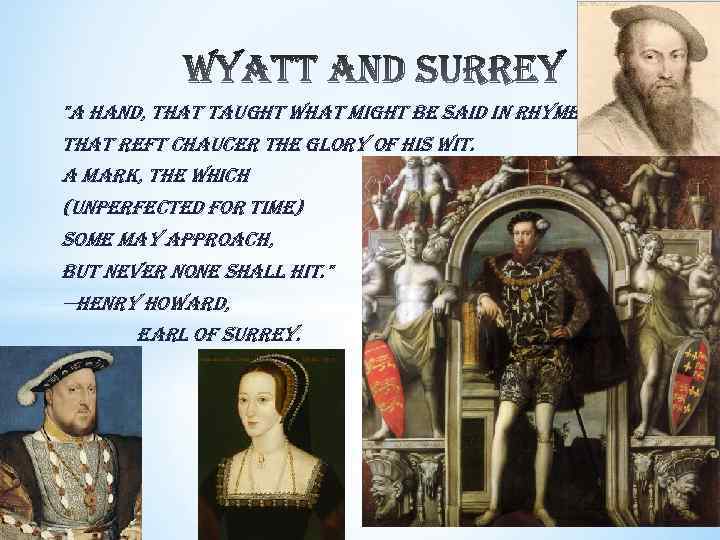
"a hand, that taught what might be said in rhyme; that reft chaucer the glory of his wit. a mark, the which (unperfected for time) some may approach, but never none shall hit. " —henry howard, earl of surrey.
*first imitated french odes and rondeaux; *indebtedness to petrarch; *10 of his 30 sonnets are translations; *using sonnet as a means of liberations of all the conventionalities’; *wrote innocentia veritas viat fides circumdederunt me inimici mei after execution of anne boleyn;
*the only life printed collection of sonnets was the court of venus ; *also wrote epigrams, terza rima satires; *certain psalms (1549), published postmortem; *wrote innocentia veritas viat fides circumdederunt me inimici mei after execution of anne boleyn;
The longe love, that in my thought I harber, And in my hart doth kepe his residence, Into my face preaseth with bold pretence, And there campeth, displaying his banner. She that me learns to love, and to suffer, And willes that my trust, and lustes negligence Be reined by reason, shame, and reverence, With his hardinesse, takes displeasure. Wherwith love to the hartes forest he fleeth, Leavyng his enterprise with paine and crye, And there him hideth and not appeareth. What may I do? when my maister feareth, But in the field with him to live and dye, For good is the life, endyng faithfully.
THE lively sparks that issue from those eyes, Against the which there vaileth no defence, Have pierced my heart, and done it none offence, With quaking pleasure more than once or twice. Was never man could any thing devise, Sunbeams to turn with so great vehemence To daze man's sight, as by their bright presence Dazed am I ; much like unto the guise Of one stricken with dint of lightning, Blind with the stroke, and cying 1 here and there : So call I for help, I not 2 when nor where, The pain of my fall patiently bearing : For straight after the blaze, as is no wonder, Of deadly noise hear I the fearful thunder.
UNSTABLE dream, according to the place, Be steadfast once, or else at least be true : By tasted sweetness make me not to rue The sudden loss of thy false fained grace. By good respect, in such a dangerous case, Thou broughtest not her into these tossing seas ; But madest my sprite to live my care t' encrease, My body in tempest her delight t'embrace. The body dead, the spirit had his desire ; Painless was th' one, the other in delight. Why then, alas, did it not keep it right, But thus return to leap in to the fire ; And where it was at wish, could not remain? Such mocks of dreams do turn to deadly pain.
MY heart I gave thee, not to do it pain, But to preserve, lo, it to thee was taken. I served thee, not that I should be forsaken ; But, that I should receive reward again, I was content thy servant to remain ; And not to be repayed after this fashion. Now, since in thee there is none other reason, Displease thee not, if that I do refrain. Unsatiate of my woe, and thy desire ; Assured by craft for to excuse thy fault : But, since it pleaseth thee to feign default, Farewell, I say, departing from the fire. For he that doth believe, bearing in hand, Plougheth in water, and soweth in the sand.
* reformed english sonnet to it final form; * introduced blank verse into english prosody in translation of virgil’s aeneid; * epitaph on sir thomas wyatt; * his poetry was full of “many things tasting of a noble birth, & worthy of a noble mind” according to sir philip sidney; * created an image of a renaissance lady – geraldine – in his sonnets (probably elizabeth fitz-gerald); * was immortalized by thomas nashe in the romance - the unfortunate traveller (1594);
*followed the samples of petrarch, ariosto, boiardo, chaucer, etc. ; *elegy upon death of richmond (1546);
THE sun hath twice brought forth his tender green, Twice clad the earth in lively lustiness ; Once have the winds the trees despoiled clean, And once again begins their cruelness ; Since I have hid under my breast the harm That never shall recover healthfulness. The winter's hurt recovers with the warm ; The parched green restored is with shade ; What warmth, alas ! may serve for to disarm The frozen heart, that mine in flame hath made ? What cold again is able to restore My fresh green years, that wither thus and fade? Alas! I see nothing hath hurt so sore But Time, in time, reduceth a return: In time my harm increaseth more and more, And seems to have my cure always in scorn. Strange kinds of death in life that I do try! At hand, to melt; far off in flame to burn.
LOVE, that liveth and reigneth in my thought, That built his seat within my captive breast ; Clad in the arms wherein with me he fought, Oft in my face he doth his banner rest. She, that taught me to love, and suffer pain ; My doubtful hope, and eke my hot desire With shamefaced cloak to shadow and restrain, Her smiling grace converteth straight to ire. And coward Love then to the heart apace Taketh his flight ; whereas he lurks, and plains His purpose lost, and dare not shew his face. For my Lord's guilt thus faultless bide I pains. Yet from my Lord shall not my foot remove : Sweet is his death, that takes his end by love.
*a myrroure for magistrates (reprinted many times btw. 1400 -1559); ii edition produced by thomas sacville in 1563; *historical and biographic poetry: michael drayton ‘s the tragicall legend of robert, duke of normandy (1596); the legend of great cromwel (1607); peirs gaveston, earle of cornwall. his life, death and fortune, the barons' wars (1603); poly-olbion (1613 -1622); samuel daniel ‘s romance the complaint of rosamond (1592); the first fowre books of the civil wars between the two houses of lancaster and yorke (1595)
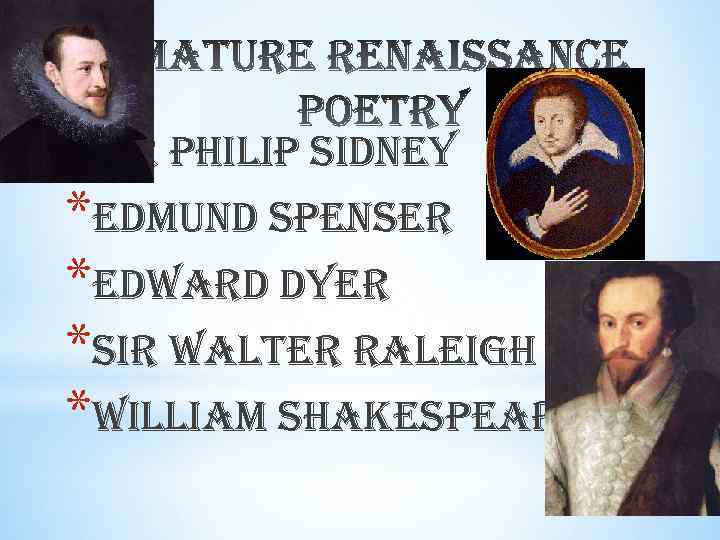
*sir philip sidney *edmund spenser *edward dyer *sir walter raleigh *william shakespeare

*sources: petrarch, wyatt, surrey, “the pleiade”’s sonnets (ronsard, du bellay, etc. ) *astrophel and stella (ab. 1580 -1584), a collection of 108 sonnets; *creation of “areopagus” with spenser, dyer, etc. (c. 1580); *defence of poesy (1583, pub. in 1595) in response to stephen gosson’s attack: “all forms of art should have as their object the phenomena of nature” *the countess of pembroke's arcadia (1580, p. in 1590), a pastoral romance dedicated to his sister
*pastoral romance – a new generic form, invented by italian authors, which mixed pastoral poems with a fictional narrative in prose, originating from ancient greek samples like e. g. daphnis and chloe; *the oldest in europe - ameto by boccaccio (1340), a mixture of a poem & a dramatic work; fused ancient greek & christian elements; *jacopo sannazzaro's arcadia (1504); *first pastorals in english were the eclogues (c. 1515) of alexander barclay;
*rosalynde, or euphues golden legacy by thomas lodge; *menaphon by robert greene ; *many dramatic imitations in the oeuvre of “university wits”, william shakespeare and others
influences: 1) platonism of marsilio ficino and pico della mirandola; 2) italian poetry; 3) wyatt & surrey’s oeuvre; 4) french poems, esp. pastorals; 5) chaucer; 6) homer and virgil works: 1) early lost comedies and poems; 2) amoretti & epithalamion (p. in 1595), a collection of sonnets dedicated to his future wife; 3) hymnes in honour of love & beautie (p. in 1596 with other hymns);
works: 4) the shepheardes calender (1579), a pastoral poem in 12 eclogues based on the translation of french calendrier des bergers; 5) colin clout's come home againe (1595); 6) a view of the state of ireland (wr. in 1596, p. 1633); 7) the faerie Queene. disposed into 12 books fashioning Xii morall virtues (1579 - 1599), a pastoral allegoric poem which wasn’t finished, there only 6 books & the beginning of book vii (piety, moderation, chestity, friendship, justice, education) out of 24 planned. introduction to sir walter raleigh.
the spenserian stanza: *ababbcbcc *9 lines (8 in iambic pentametre & the 9 th in alexandrine) *used by thompson, keats, shelley, byron etc. ;
Скачать презентацию the art of english poetry 1589 by
English Renaissance Poetry.pptx