


 Скачать презентацию The Application of Statistical Data in City Research
41c428ff017dc979508fb8453d87f9ca.ppt
- Количество слайдов: 30
 The Application of Statistical Data in City Research Lv Fengyong Institute of Finance & Trade Economics Chinese Academy of Social Sciences(CASS)
 Part One Indictor System of Global Urban Competitiveness
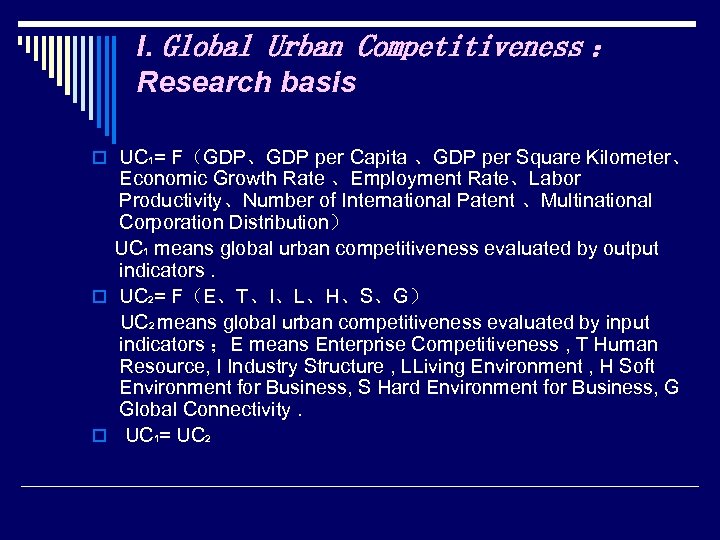 I. Global Urban Competitiveness : Research basis o UC 1= F(GDP、GDP per Capita 、GDP per Square Kilometer、 Economic Growth Rate 、Employment Rate、Labor Productivity、Number of International Patent 、Multinational Corporation Distribution) UC 1 means global urban competitiveness evaluated by output indicators. o UC 2= F(E、T、I、L、H、S、G) UC 2 means global urban competitiveness evaluated by input indicators ;E means Enterprise Competitiveness , T Human Resource, I Industry Structure , LLiving Environment , H Soft Environment for Business, S Hard Environment for Business, G Global Connectivity. o UC 1= UC 2
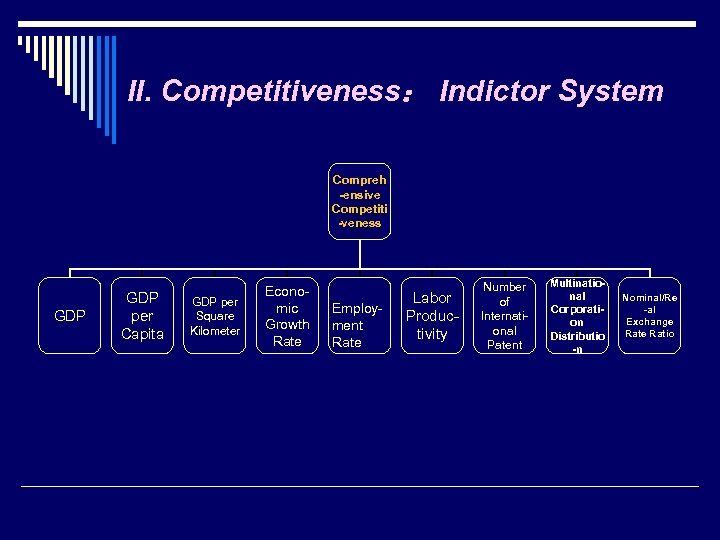 II. Competitiveness: Indictor System Compreh -ensive Competiti -veness GDP per Capita GDP per Square Kilometer Economic Growth Rate Employment Rate Labor Productivity Number of International Patent Multinational Corporation Distributio -n Nominal/Re -al Exchange Ratio
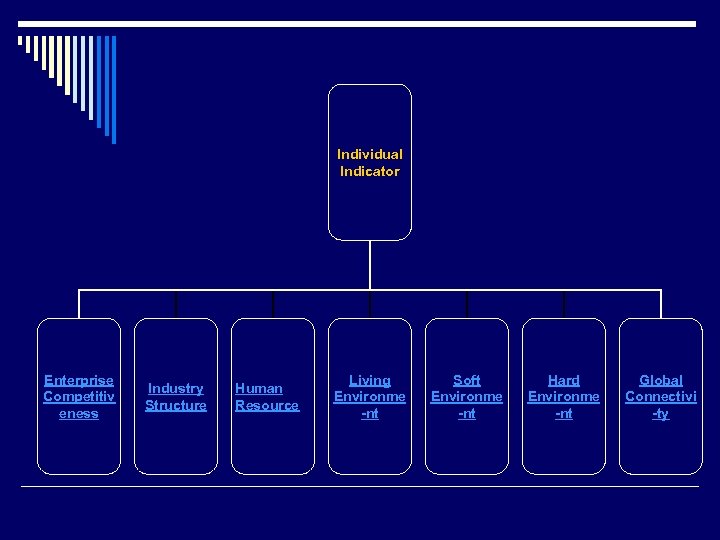 Individual Indicator Enterprise Competitiv eness Industry Structure Human Resource Living Environme -nt Soft Environme -nt Hard Environme -nt Global Connectivi -ty
 Part Two Global Urban Competitiveness : Sample Cities
 I. 500 Sample Cities for General Analysis Scope:Covering 5 continents, 130 countries and regions Choosing Criteria:city population and GDP per capita as the main Criteria, and then the historical and geographical importance considered , in addition, the availability and accuracy statistical data considered also.
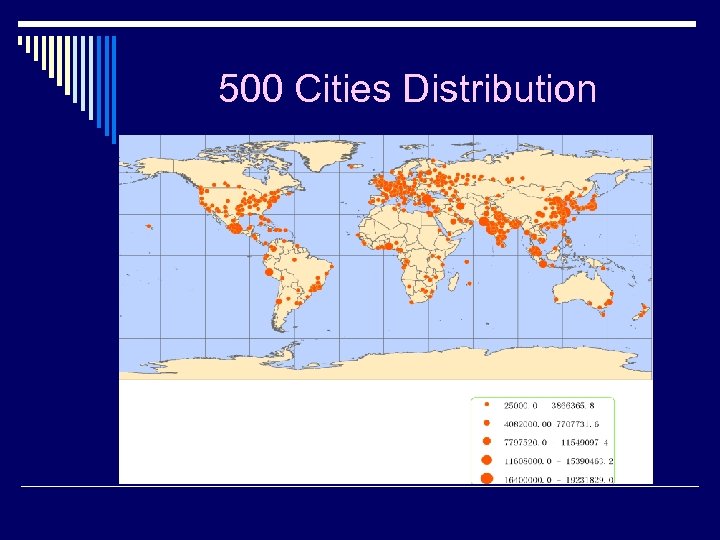 500 Cities Distribution
 II. 150 Sample Cities for Detailed Analysis Representative:Covering 5 continents、47 countries and regions, important cities distributed in North America, Europe, Asia and core cities in Latin America and Africa. Choosing Criteria: international influence, social and economic status in its country and region, being representative and typical, special research value , statistical data available, sample cities of other urban research work 。
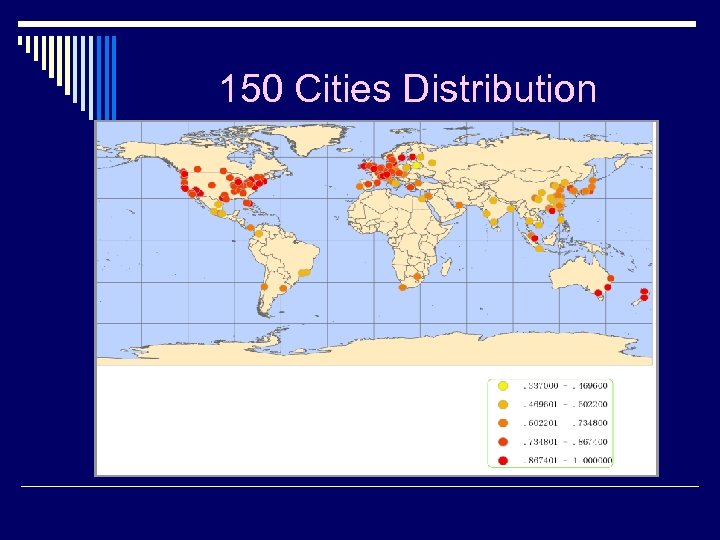 150 Cities Distribution
 Part Three Data source and Quality
 I. Data Source Some From: the statistical report and statistical yearbook published by official statistical institutions, other national organization, and international organization;the subject reports and survey data of international statistical institutions, international research institutes or companies (mainly 2005 data,some 2001 -2005 data) Other mainly From: :acquiring original data relevant to indicator on internet, and then processing them by some method. ( mainly 2007 data ,some 2004 -2007)
 II. Data Status o First, the city statistical data is not complete in many cities. o Second, the city statistical data is not accessible through internet web. o Third, the caliber of city statistical data is different. o Fourth, the city statistical data system is very different for many cities.
 First o 1. most have,but few not. Exp. GDP, average life expectation,labor population,water and electricity price. o 2. Few have,most not. mainly investigated data, exp. Living cost and quality by Mercy Corp.
 Second o Africa、West Asia and Southeast Asia
 Third o City population o City area o Labor population o Adult literacy o Crime rate
 Fourth o North America: both economic and social data are detailed o North Europe:social data detailed,but economic and industrial data not. o Asia:economic and industrial data detailed,but social data not.
 Part Four Process Method for Statistical Data
 I. Data Calculation and Evaluation 1. Direct calculation from variables exp. GDP, population, GDP per capita 2. Relational calculation from variables exp. UK GVA-GDP 3. Relevant estimation from variables exp. Some Africa cities GDP based on national GDP and other relevant data
 4. Direct estimation from experiences and knowledge 5. Substitution of relevant variable data of superior administrative region, exp. getting credit, effective exchange rate and difference of deposit and loan, the national technical infrastructure the Ratio of Local Revenue to the National Revenue, Index of Economic Liberalization, market supervision and the tax burden
 II. Data Marking Method o 1. Substitution Marking Method The representative multinational corporations in such industries as general manufacturing, commercial service industry, trade, retail service industry, finance, high-tech industry, etc. for the industry analysis o 2. Typical Samples Comparison Method The listed corporations for enterprise competitiveness analysis
 Part Five Advice for Improving City Statistical Data
 First, much effort should be made to establish the universal city statistical data system. Second, the caliber of city statistical data should be uniform. Third, city statistical data should be uploaded so as to be acquired through internet web easily.
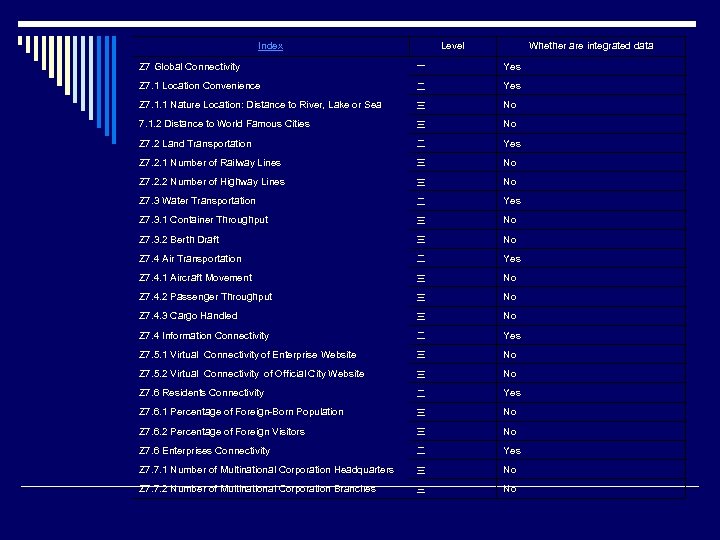 Index Level Whether are integrated data Z 7 Global Connectivity 一 Yes Z 7. 1 Location Convenience 二 Yes Z 7. 1. 1 Nature Location: Distance to River, Lake or Sea 三 No 7. 1. 2 Distance to World Famous Cities 三 No Z 7. 2 Land Transportation 二 Yes Z 7. 2. 1 Number of Railway Lines 三 No Z 7. 2. 2 Number of Highway Lines 三 No Z 7. 3 Water Transportation 二 Yes Z 7. 3. 1 Container Throughput 三 No Z 7. 3. 2 Berth Draft 三 No Z 7. 4 Air Transportation 二 Yes Z 7. 4. 1 Aircraft Movement 三 No Z 7. 4. 2 Passenger Throughput 三 No Z 7. 4. 3 Cargo Handled 三 No Z 7. 4 Information Connectivity 二 Yes Z 7. 5. 1 Virtual Connectivity of Enterprise Website 三 No Z 7. 5. 2 Virtual Connectivity of Official City Website 三 No Z 7. 6 Residents Connectivity 二 Yes Z 7. 6. 1 Percentage of Foreign-Born Population 三 No Z 7. 6. 2 Percentage of Foreign Visitors 三 No Z 7. 6 Enterprises Connectivity 二 Yes Z 7. 7. 1 Number of Multinational Corporation Headquarters 三 No Z 7. 7. 2 Number of Multinational Corporation Branches 三 No
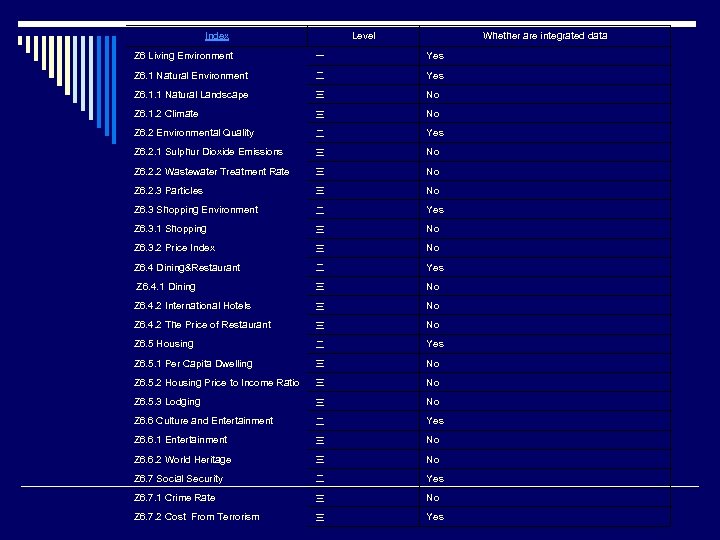 Index Level Whether are integrated data Z 6 Living Environment 一 Yes Z 6. 1 Natural Environment 二 Yes Z 6. 1. 1 Natural Landscape 三 No Z 6. 1. 2 Climate 三 No Z 6. 2 Environmental Quality 二 Yes Z 6. 2. 1 Sulphur Dioxide Emissions 三 No Z 6. 2. 2 Wastewater Treatment Rate 三 No Z 6. 2. 3 Particles 三 No Z 6. 3 Shopping Environment 二 Yes Z 6. 3. 1 Shopping 三 No Z 6. 3. 2 Price Index 三 No Z 6. 4 Dining&Restaurant 二 Yes Z 6. 4. 1 Dining 三 No Z 6. 4. 2 International Hotels 三 No Z 6. 4. 2 The Price of Restaurant 三 No Z 6. 5 Housing 二 Yes Z 6. 5. 1 Per Capita Dwelling 三 No Z 6. 5. 2 Housing Price to Income Ratio 三 No Z 6. 5. 3 Lodging 三 No Z 6. 6 Culture and Entertainment 二 Yes Z 6. 6. 1 Entertainment 三 No Z 6. 6. 2 World Heritage 三 No Z 6. 7 Social Security 二 Yes Z 6. 7. 1 Crime Rate 三 No Z 6. 7. 2 Cost From Terrorism 三 Yes
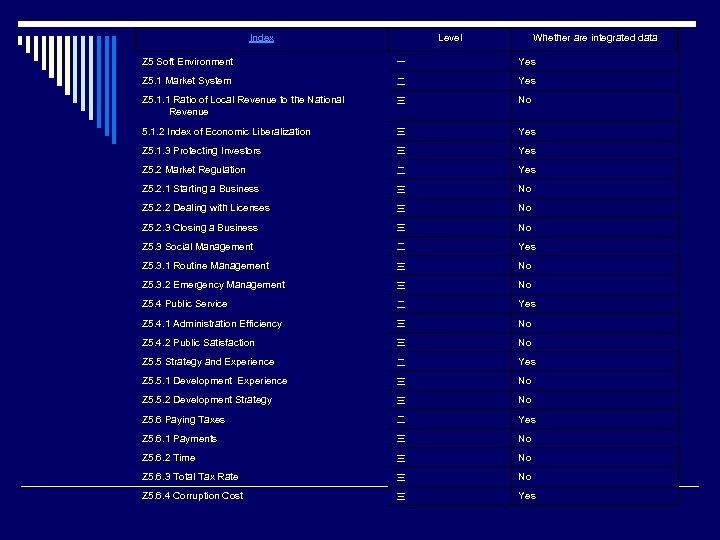 Index Level Whether are integrated data Z 5 Soft Environment 一 Yes Z 5. 1 Market System 二 Yes Z 5. 1. 1 Ratio of Local Revenue to the National Revenue 三 No 5. 1. 2 Index of Economic Liberalization 三 Yes Z 5. 1. 3 Protecting Investors 三 Yes Z 5. 2 Market Regulation 二 Yes Z 5. 2. 1 Starting a Business 三 No Z 5. 2. 2 Dealing with Licenses 三 No Z 5. 2. 3 Closing a Business 三 No Z 5. 3 Social Management 二 Yes Z 5. 3. 1 Routine Management 三 No Z 5. 3. 2 Emergency Management 三 No Z 5. 4 Public Service 二 Yes Z 5. 4. 1 Administration Efficiency 三 No Z 5. 4. 2 Public Satisfaction 三 No Z 5. 5 Strategy and Experience 二 Yes Z 5. 5. 1 Development Experience 三 No Z 5. 5. 2 Development Strategy 三 No Z 5. 6 Paying Taxes 二 Yes Z 5. 6. 1 Payments 三 No Z 5. 6. 2 Time 三 No Z 5. 6. 3 Total Tax Rate 三 No Z 5. 6. 4 Corruption Cost 三 Yes
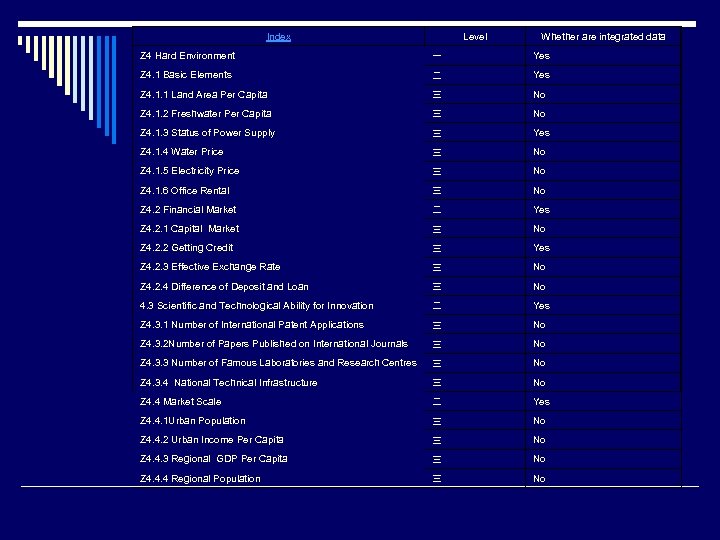 Index Level Whether are integrated data Z 4 Hard Environment 一 Yes Z 4. 1 Basic Elements 二 Yes Z 4. 1. 1 Land Area Per Capita 三 No Z 4. 1. 2 Freshwater Per Capita 三 No Z 4. 1. 3 Status of Power Supply 三 Yes Z 4. 1. 4 Water Price 三 No Z 4. 1. 5 Electricity Price 三 No Z 4. 1. 6 Office Rental 三 No Z 4. 2 Financial Market 二 Yes Z 4. 2. 1 Capital Market 三 No Z 4. 2. 2 Getting Credit 三 Yes Z 4. 2. 3 Effective Exchange Rate 三 No Z 4. 2. 4 Difference of Deposit and Loan 三 No 4. 3 Scientific and Technological Ability for Innovation 二 Yes Z 4. 3. 1 Number of International Patent Applications 三 No Z 4. 3. 2 Number of Papers Published on International Journals 三 No Z 4. 3. 3 Number of Famous Laboratories and Research Centres 三 No Z 4. 3. 4 National Technical Infrastructure 三 No Z 4. 4 Market Scale 二 Yes Z 4. 4. 1 Urban Population 三 No Z 4. 4. 2 Urban Income Per Capita 三 No Z 4. 4. 3 Regional GDP Per Capita 三 No Z 4. 4. 4 Regional Population 三 No
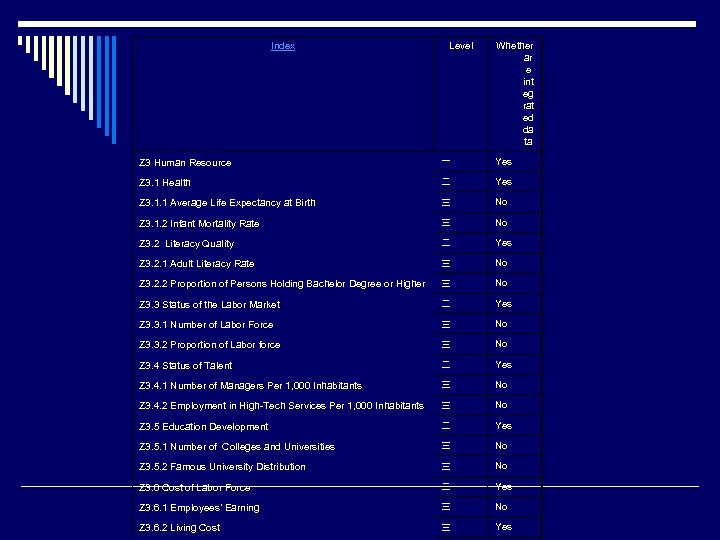 Index Level Whether ar e int eg rat ed da ta Z 3 Human Resource 一 Yes Z 3. 1 Health 二 Yes Z 3. 1. 1 Average Life Expectancy at Birth 三 No Z 3. 1. 2 Infant Mortality Rate 三 No Z 3. 2 Literacy Quality 二 Yes Z 3. 2. 1 Adult Literacy Rate 三 No Z 3. 2. 2 Proportion of Persons Holding Bachelor Degree or Higher 三 No Z 3. 3 Status of the Labor Market 二 Yes Z 3. 3. 1 Number of Labor Force 三 No Z 3. 3. 2 Proportion of Labor force 三 No Z 3. 4 Status of Talent 二 Yes Z 3. 4. 1 Number of Managers Per 1, 000 Inhabitants 三 No Z 3. 4. 2 Employment in High-Tech Services Per 1, 000 Inhabitants 三 No Z 3. 5 Education Development 二 Yes Z 3. 5. 1 Number of Colleges and Universities 三 No Z 3. 5. 2 Famous University Distribution 三 No Z 3. 6 Cost of Labor Force 二 Yes Z 3. 6. 1 Employees’ Earning 三 No Z 3. 6. 2 Living Cost 三 Yes
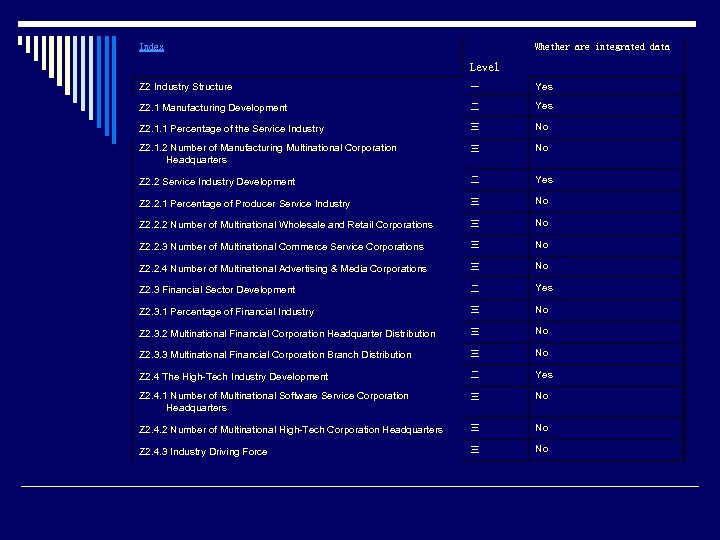 Index Whether are integrated data Level Z 2 Industry Structure 一 Yes Z 2. 1 Manufacturing Development 二 Yes Z 2. 1. 1 Percentage of the Service Industry 三 No Z 2. 1. 2 Number of Manufacturing Multinational Corporation Headquarters 三 No Z 2. 2 Service Industry Development 二 Yes Z 2. 2. 1 Percentage of Producer Service Industry 三 No Z 2. 2. 2 Number of Multinational Wholesale and Retail Corporations 三 No Z 2. 2. 3 Number of Multinational Commerce Service Corporations 三 No Z 2. 2. 4 Number of Multinational Advertising & Media Corporations 三 No Z 2. 3 Financial Sector Development 二 Yes Z 2. 3. 1 Percentage of Financial Industry 三 No Z 2. 3. 2 Multinational Financial Corporation Headquarter Distribution 三 No Z 2. 3. 3 Multinational Financial Corporation Branch Distribution 三 No Z 2. 4 The High-Tech Industry Development 二 Yes Z 2. 4. 1 Number of Multinational Software Service Corporation Headquarters 三 No Z 2. 4. 2 Number of Multinational High-Tech Corporation Headquarters 三 No Z 2. 4. 3 Industry Driving Force 三 No
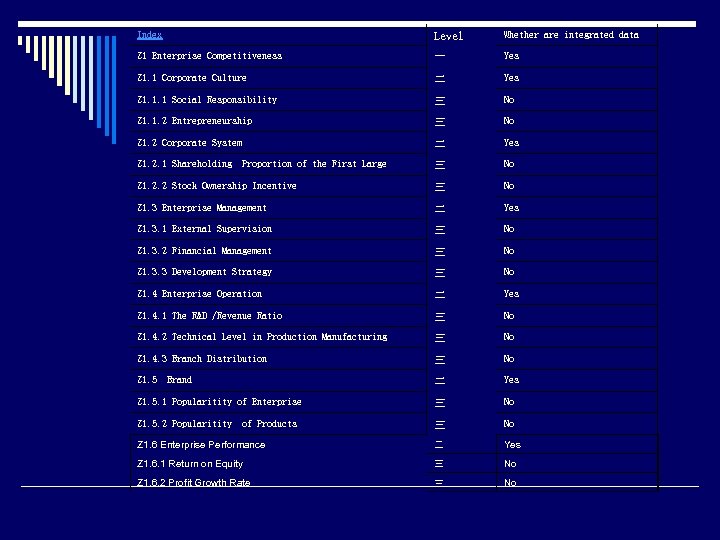 Index Level Whether are integrated data Z 1 Enterprise Competitiveness 一 Yes Z 1. 1 Corporate Culture 二 Yes Z 1. 1. 1 Social Responsibility 三 No Z 1. 1. 2 Entrepreneurship 三 No Z 1. 2 Corporate System 二 Yes Z 1. 2. 1 Shareholding 三 No Z 1. 2. 2 Stock Ownership Incentive 三 No Z 1. 3 Enterprise Management 二 Yes Z 1. 3. 1 External Supervision 三 No Z 1. 3. 2 Financial Management 三 No Z 1. 3. 3 Development Strategy 三 No Z 1. 4 Enterprise Operation 二 Yes Z 1. 4. 1 The R&D /Revenue Ratio 三 No Z 1. 4. 2 Technical Level in Production Manufacturing 三 No Z 1. 4. 3 Branch Distribution 三 No Z 1. 5 二 Yes Z 1. 5. 1 Popularitity of Enterprise 三 No Z 1. 5. 2 Popularitity 三 No Z 1. 6 Enterprise Performance 二 Yes Z 1. 6. 1 Return on Equity 三 No Z 1. 6. 2 Profit Growth Rate 三 No Proportion of the First Large Brand of Products