 Скачать презентацию The Anatomy of the Grid Enabling Scalable Virtual
c01a509c60c4703a0f589fe09ca064f6.ppt
- Количество слайдов: 36



The Anatomy of the Grid Enabling Scalable Virtual Organizations David S. Angulo Ian Foster Dept. of Computer Science Mathematics & Computer Science Division The University of Chicago Argonne National Laboratory and Mathematics & Computer Science Division Dept. of Computer Science Argonne National Laboratory The University of Chicago http: //www. cs. uchicago. edu/~dangulo http: //www. mcs. anl. gov/~foster 2 nd US-Hungarian Workshop on Cluster and Grid Computing, February 6, 2002
Partial Acknowledgements l Globus Toolkit TM – R&D involves > many fine scientists & engineers at ANL/Uof. C, USC/ISI, and elsewhere (see www. globus. org) – Led by > Ian Foster @ Argonne/Uof. C > Carl Kesselman @ USC/ISI l Open Grid Services Architecture work performed by – – l l Ian Foster, Globus Co-PI @ Argonne/Uof. C Carl Kesselman, Globus Co-PI @ USC/ISI Steve Tuecke, Globus Toolkit Architect @ANL Jeff Nick, Steve Graham, Jeff Frey @ IBM Strong collaborations with many outstanding EU, UK, US Grid projects Support from DOE, NASA, NSF, Microsoft, IBM dangulo@cs. uchicago. edu University of Chicago
Grid Computing dangulo@cs. uchicago. edu University of Chicago
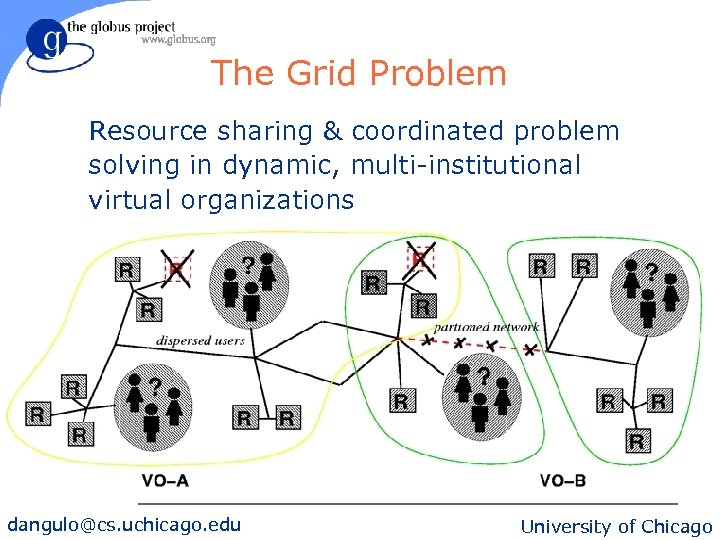
The Grid Problem Resource sharing & coordinated problem solving in dynamic, multi-institutional virtual organizations dangulo@cs. uchicago. edu University of Chicago
Why Grids? l l l A biochemist exploits 10, 000 computers to screen 100, 000 compounds in an hour 1, 000 physicists worldwide pool resources for petaflop analyses of petabytes of data Civil engineers collaborate to design, execute, & analyze shake table experiments Climate scientists visualize, annotate, & analyze terabyte simulation datasets A home user invokes architectural design functions at an application service provider – An application service provider purchases cycles from compute cycle providers dangulo@cs. uchicago. edu University of Chicago
Elements of the Problem l Resource sharing – Computers, storage, sensors, networks, … – Sharing always conditional: issues of trust, policy, payment, … l Coordinated problem solving – Beyond client-server: distributed data analysis, computation, … l Dynamic, multi-institutional virtual orgs – Community overlays on classic org structures – Large or small, static or dynamic dangulo@cs. uchicago. edu University of Chicago
Grids: Why Now? l l l Moore’s law improvements in computing produce highly functional end systems The Internet and burgeoning wired and wireless provide universal connectivity Network exponentials produce dramatic changes in geometry and geography dangulo@cs. uchicago. edu University of Chicago
Grids: Why Now? l l l Moore’s law improvements in computing produce highly functional endsystems The Internet and burgeoning wired and wireless provide universal connectivity Network exponentials produce dramatic changes in geometry and geography – 9 -month doubling: double Moore’s law! – 1986 -2001: x 340, 000; 2001 -2010: x 4000? dangulo@cs. uchicago. edu University of Chicago
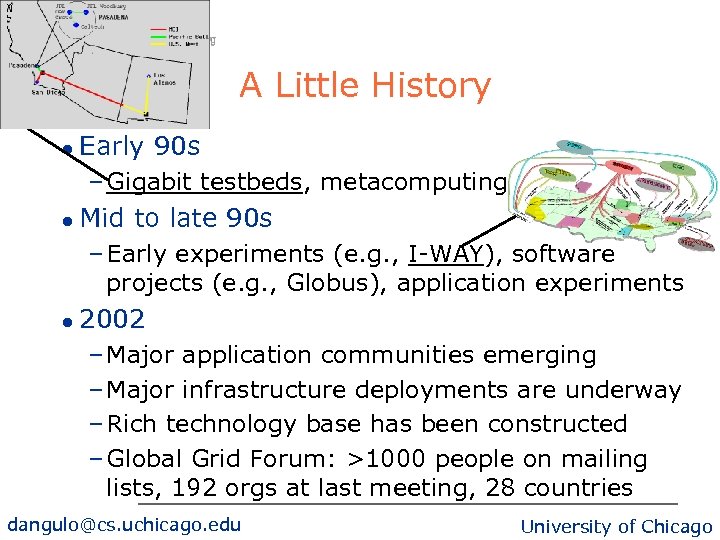
A Little History l Early 90 s – Gigabit testbeds, metacomputing l Mid to late 90 s – Early experiments (e. g. , I-WAY), software projects (e. g. , Globus), application experiments l 2002 – Major application communities emerging – Major infrastructure deployments are underway – Rich technology base has been constructed – Global Grid Forum: >1000 people on mailing lists, 192 orgs at last meeting, 28 countries dangulo@cs. uchicago. edu University of Chicago
The Grid World: Current Status l Dozens of major Grid projects in scientific & technical computing/research & education – Deployment, application, technology l Considerable consensus on key concepts and technologies – Globus Toolkit™ has emerged as de facto standard for major protocols & services l Global Grid Forum has emerged as a significant force – And first “Grid” proposals at IETF dangulo@cs. uchicago. edu University of Chicago
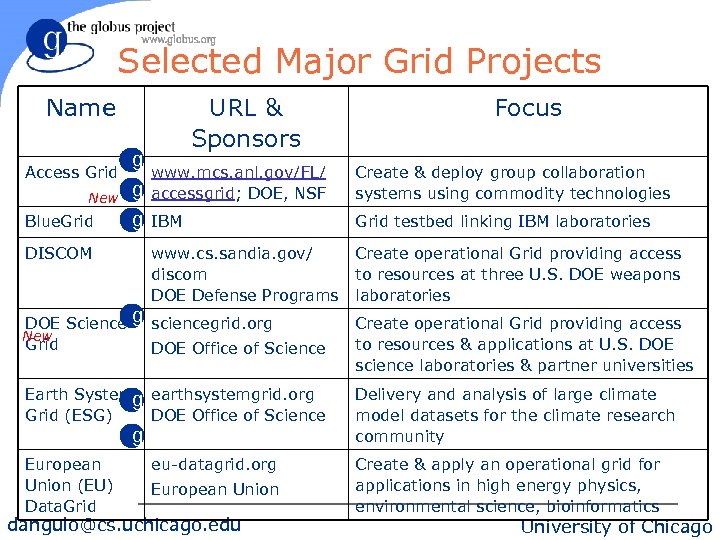
Selected Major Grid Projects Name Access Grid New Blue. Grid g g g DISCOM DOE Science New Grid g URL & Sponsors Focus www. mcs. anl. gov/FL/ accessgrid; DOE, NSF Create & deploy group collaboration systems using commodity technologies IBM Grid testbed linking IBM laboratories www. cs. sandia. gov/ discom DOE Defense Programs Create operational Grid providing access to resources at three U. S. DOE weapons laboratories sciencegrid. org Create operational Grid providing access to resources & applications at U. S. DOE science laboratories & partner universities DOE Office of Science Earth Systemg earthsystemgrid. org Grid (ESG) DOE Office of Science Delivery and analysis of large climate model datasets for the climate research community European Union (EU) Data. Grid Create & apply an operational grid for applications in high energy physics, environmental science, bioinformatics g eu-datagrid. org European Union dangulo@cs. uchicago. edu University of Chicago
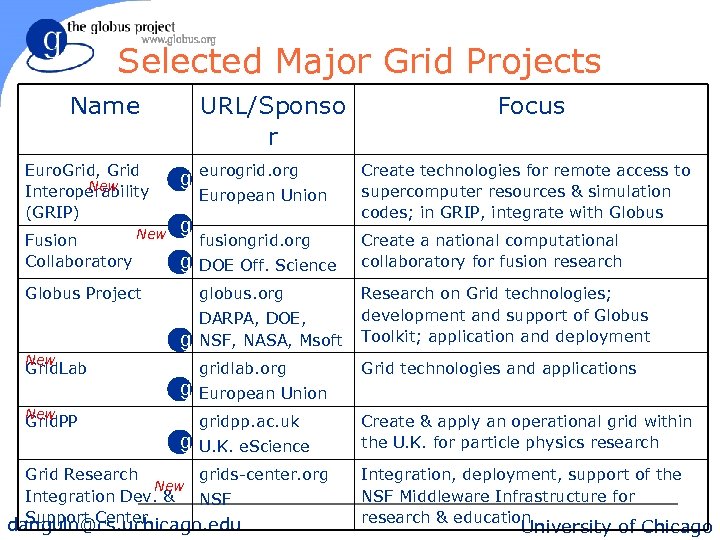
Selected Major Grid Projects Name Euro. Grid, Grid New Interoperability (GRIP) Fusion Collaboratory New URL/Sponso r g g g Globus Project New Grid. PP European Union fusiongrid. org DOE Off. Science globus. org g Grid. Lab eurogrid. org g g Focus Create technologies for remote access to supercomputer resources & simulation codes; in GRIP, integrate with Globus Create a national computational collaboratory for fusion research DARPA, DOE, NSF, NASA, Msoft Research on Grid technologies; development and support of Globus Toolkit; application and deployment gridlab. org Grid technologies and applications European Union gridpp. ac. uk U. K. e. Science Grid Research grids-center. org New Integration Dev. & NSF Support Center dangulo@cs. uchicago. edu Create & apply an operational grid within the U. K. for particle physics research Integration, deployment, support of the NSF Middleware Infrastructure for research & education University of Chicago
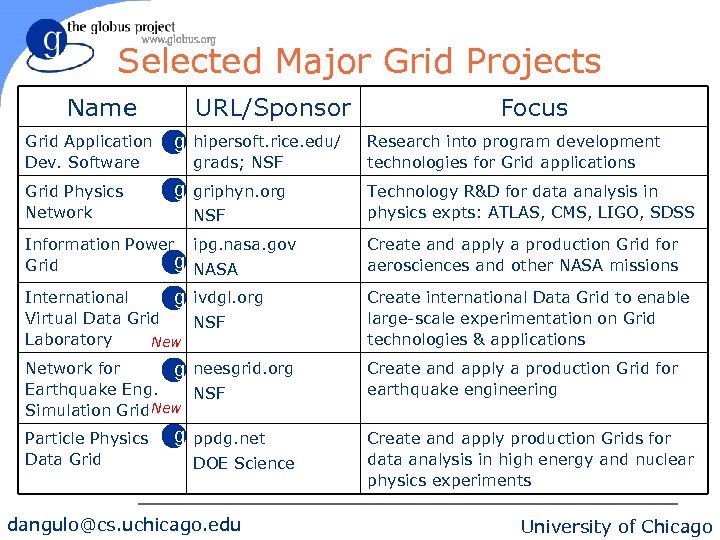
Selected Major Grid Projects Name URL/Sponsor Focus Grid Application Dev. Software g hipersoft. rice. edu/ grads; NSF Research into program development technologies for Grid applications Grid Physics Network g griphyn. org Technology R&D for data analysis in physics expts: ATLAS, CMS, LIGO, SDSS NSF Information Power ipg. nasa. gov g NASA Grid Create and apply a production Grid for aerosciences and other NASA missions International g ivdgl. org Virtual Data Grid NSF Laboratory New Create international Data Grid to enable large-scale experimentation on Grid technologies & applications Network for g neesgrid. org Earthquake Eng. NSF Simulation Grid New Create and apply a production Grid for earthquake engineering Particle Physics Data Grid g ppdg. net DOE Science dangulo@cs. uchicago. edu Create and apply production Grids for data analysis in high energy and nuclear physics experiments University of Chicago
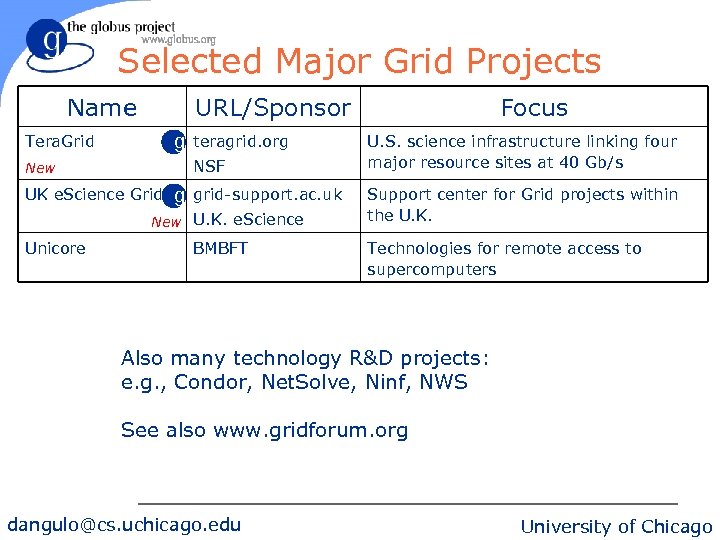
Selected Major Grid Projects Name URL/Sponsor g Tera. Grid teragrid. org NSF New UK e. Science Grid g grid-support. ac. uk New U. K. e. Science Unicore BMBFT Focus U. S. science infrastructure linking four major resource sites at 40 Gb/s Support center for Grid projects within the U. K. Technologies for remote access to supercomputers Also many technology R&D projects: e. g. , Condor, Net. Solve, Ninf, NWS See also www. gridforum. org dangulo@cs. uchicago. edu University of Chicago
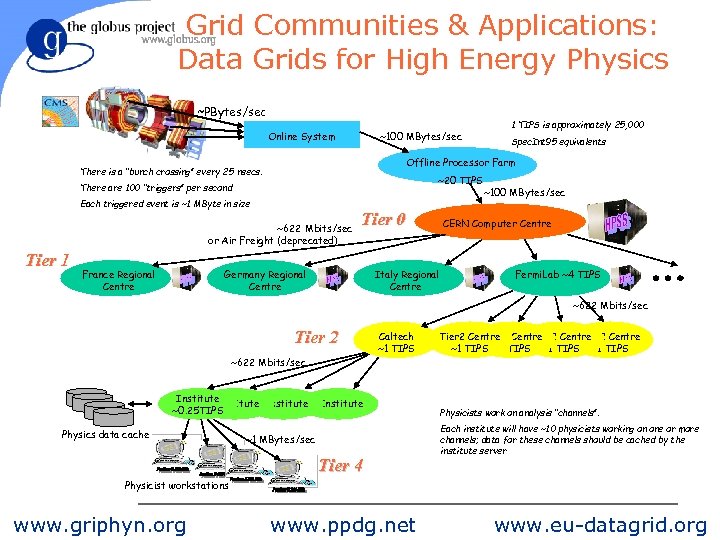
Grid Communities & Applications: Data Grids for High Energy Physics ~PBytes/sec Online System ~100 MBytes/sec ~20 TIPS There are 100 “triggers” per second Each triggered event is ~1 MByte in size ~622 Mbits/sec or Air Freight (deprecated) France Regional Centre Spec. Int 95 equivalents Offline Processor Farm There is a “bunch crossing” every 25 nsecs. Tier 1 1 TIPS is approximately 25, 000 Tier 0 Germany Regional Centre Italy Regional Centre ~100 MBytes/sec CERN Computer Centre Fermi. Lab ~4 TIPS ~622 Mbits/sec Tier 2 ~622 Mbits/sec Institute ~0. 25 TIPS Physics data cache Caltech ~1 TIPS Institute ~1 MBytes/sec Tier 4 Tier 2 Centre Tier 2 Centre ~1 TIPS Physicists work on analysis “channels”. Each institute will have ~10 physicists working on one or more channels; data for these channels should be cached by the institute server Physicist workstations dangulo@cs. uchicago. edu www. griphyn. org www. ppdg. net www. eu-datagrid. org University of Chicago
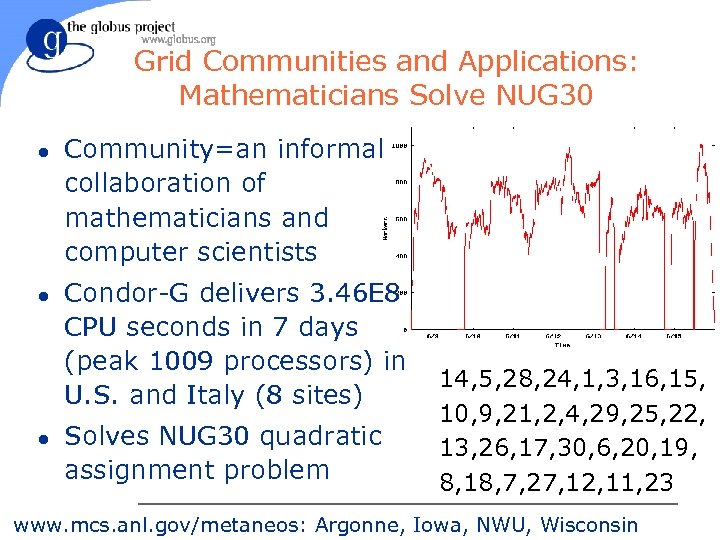
Grid Communities and Applications: Mathematicians Solve NUG 30 l l l Community=an informal collaboration of mathematicians and computer scientists Condor-G delivers 3. 46 E 8 CPU seconds in 7 days (peak 1009 processors) in U. S. and Italy (8 sites) Solves NUG 30 quadratic assignment problem 14, 5, 28, 24, 1, 3, 16, 15, 10, 9, 21, 2, 4, 29, 25, 22, 13, 26, 17, 30, 6, 20, 19, 8, 18, 7, 27, 12, 11, 23 dangulo@cs. uchicago. edu www. mcs. anl. gov/metaneos: Argonne, Iowa, NWU, Wisconsin Chicago University of
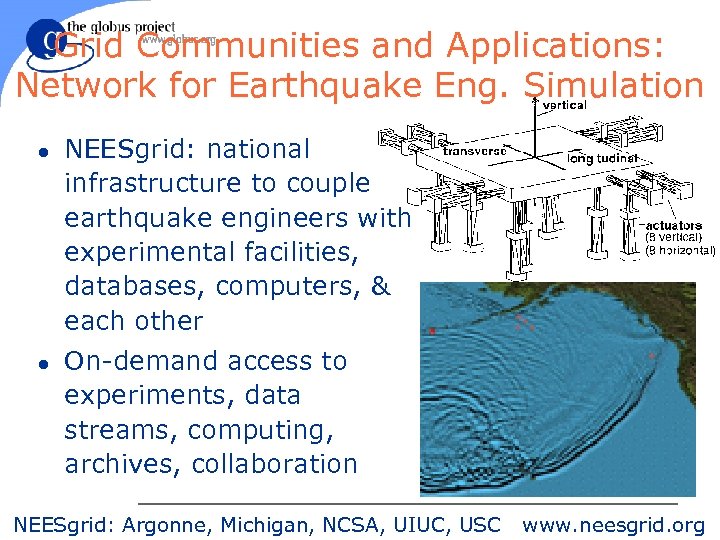
Grid Communities and Applications: Network for Earthquake Eng. Simulation l l NEESgrid: national infrastructure to couple earthquake engineers with experimental facilities, databases, computers, & each other On-demand access to experiments, data streams, computing, archives, collaboration dangulo@cs. uchicago. edu NEESgrid: Argonne, Michigan, NCSA, UIUC, USC www. neesgrid. org University of Chicago
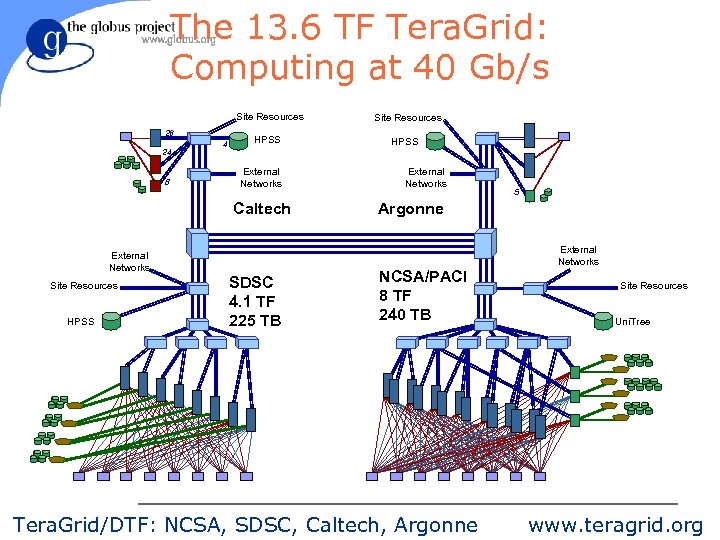
The 13. 6 TF Tera. Grid: Computing at 40 Gb/s Site Resources 26 24 8 4 HPSS External Networks Caltech External Networks Site Resources HPSS SDSC 4. 1 TF 225 TB Site Resources HPSS External Networks 5 Argonne NCSA/PACI 8 TF 240 TB dangulo@cs. uchicago. edu Tera. Grid/DTF: NCSA, SDSC, Caltech, Argonne External Networks Site Resources Uni. Tree www. teragrid. org University of Chicago
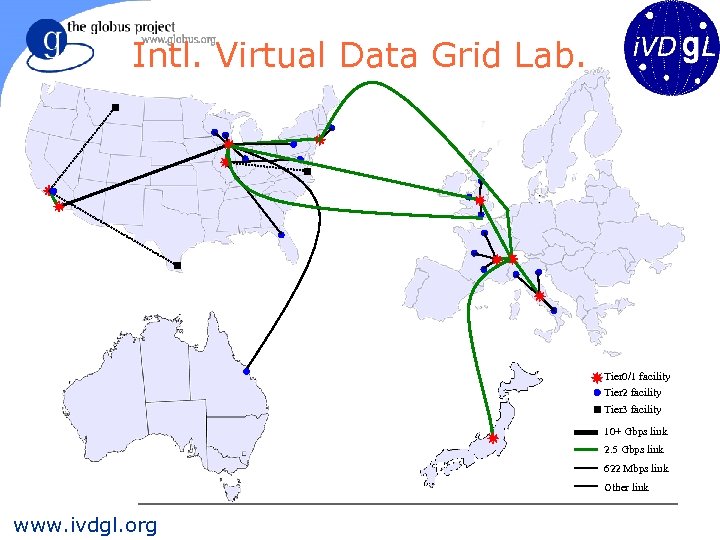
Intl. Virtual Data Grid Lab. Tier 0/1 facility Tier 2 facility Tier 3 facility 10+ Gbps link 2. 5 Gbps link 622 Mbps link Other link dangulo@cs. uchicago. edu www. ivdgl. org University of Chicago
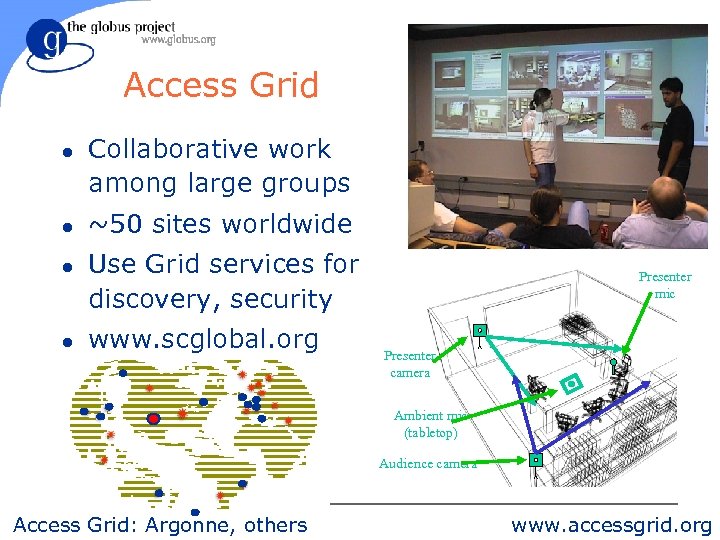
Access Grid l l Collaborative work among large groups ~50 sites worldwide Use Grid services for discovery, security www. scglobal. org Presenter mic Presenter camera Ambient mic (tabletop) Audience camera dangulo@cs. uchicago. edu others Access Grid: Argonne, www. accessgrid. org University of Chicago
Grid Architecture & Globus Toolkit™ l The question: – What is needed for resource sharing & coordinated problem solving in dynamic virtual organizations (VOs)? l The answer: – Major issues identified: membership, resource discovery & access, …, … – Grid architecture captures core elements, emphasizing pre-eminent role of protocols – Globus Toolkit™ has emerged as de facto standard for major protocols & services dangulo@cs. uchicago. edu University of Chicago
The Critical Role of Protocols l Need for interoperability when different groups want to share resources – E. g. , IP lets me talk to your computer, but how do we establish & maintain sharing? – How do I discover, authenticate, authorize, describe what I want to do, etc. ? l Need for shared infrastructure services to avoid repeated development, installation, e. g. – One port/service for remote access to computing, not one per tool/application – X. 509 enables sharing of Certificate Authorities dangulo@cs. uchicago. edu University of Chicago
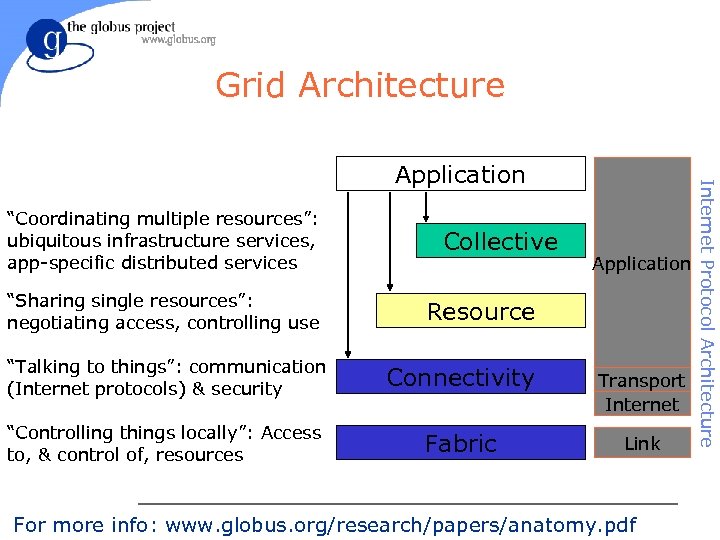
Grid Architecture “Coordinating multiple resources”: ubiquitous infrastructure services, app-specific distributed services “Sharing single resources”: negotiating access, controlling use Collective Application Resource “Talking to things”: communication (Internet protocols) & security Connectivity Transport Internet “Controlling things locally”: Access to, & control of, resources Fabric Link Internet Protocol Architecture Application dangulo@cs. uchicago. edu For more info: www. globus. org/research/papers/anatomy. pdf Chicago University of
Globus Project and Toolkit l Globus Project™ – R&D project at ANL, U. Chicago, USC/ISI – Emphasis on identifying and defining core protocols and services – O(40) researchers & developers l Globus Toolkit™ – A major product of the Globus Project – Open source software: reference implementation of core protocols & services – Growing open source developer community dangulo@cs. uchicago. edu University of Chicago
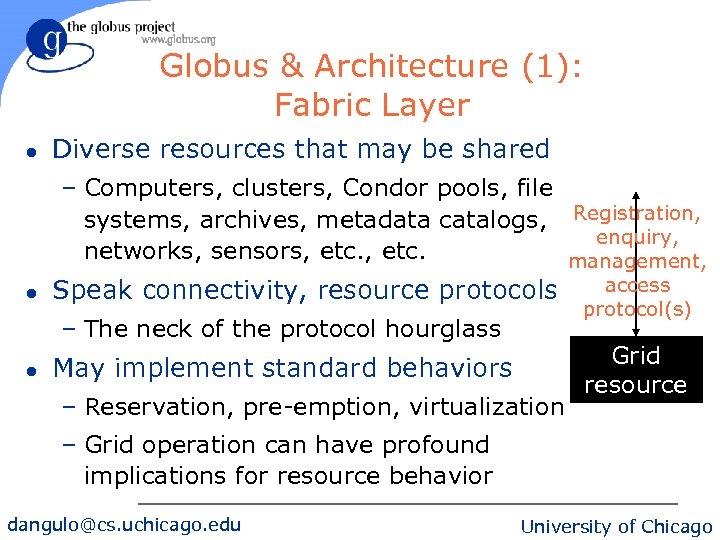
Globus & Architecture (1): Fabric Layer l Diverse resources that may be shared – Computers, clusters, Condor pools, file systems, archives, metadata catalogs, Registration, enquiry, networks, sensors, etc. management, l Speak connectivity, resource protocols – The neck of the protocol hourglass l May implement standard behaviors – Reservation, pre-emption, virtualization access protocol(s) Grid resource – Grid operation can have profound implications for resource behavior dangulo@cs. uchicago. edu University of Chicago
Globus & Architecture (2): Connectivity Layer Protocols & Services l Communication – Internet protocols: IP, DNS, routing, etc. l Security: Grid Security Infrastructure (GSI) – Uniform authentication & authorization mechanisms in multi-institutional setting – Single sign-on, delegation, identity mapping – Public key technology, SSL, X. 509, GSS-API (several Internet drafts document extensions) – Supporting infrastructure: Certificate Authorities, key management, etc. dangulo@cs. uchicago. edu University of Chicago
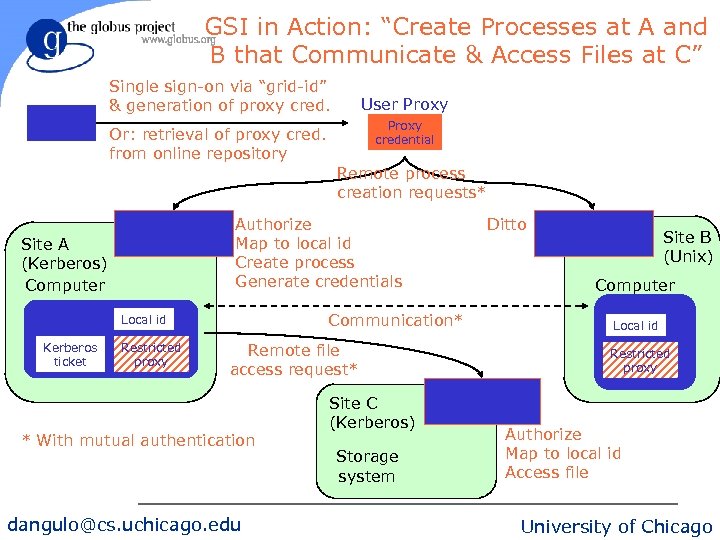
GSI in Action: “Create Processes at A and B that Communicate & Access Files at C” User Single sign-on via “grid-id” & generation of proxy cred. User Proxy credential Or: retrieval of proxy cred. from online repository Remote process creation requests* GSI-enabled Authorize GRAM server Map to local id Site A Create process (Kerberos) Generate credentials Computer Process Kerberos ticket Communication* Local id Restricted proxy Ditto Remote file access request* * With mutual authentication dangulo@cs. uchicago. edu Site C (Kerberos) Storage system GSI-enabled GRAM server Site B (Unix) Computer Process Local id Restricted proxy GSI-enabled FTP server Authorize Map to local id Access file University of Chicago
Globus & Architecture (3): Resource Layer Protocols & Services l Resource management: GRAM – Remote allocation, reservation, monitoring, control of [compute] resources l Data access: Grid. FTP – High-performance data access & transport l Information: MDS (GRRP, GRIP) – Access to structure & state information l l & others emerging: database access, code repository access, accounting, … All integrated with GSI dangulo@cs. uchicago. edu University of Chicago
GRAM Resource Management Protocol l Grid Resource Allocation & Management – Allocation, monitoring, control of computations – Secure remote access to diverse schedulers l Current evolution – Immediate and advance reservation – Multiple resource types: manage anything – Recoverable requests, timeout, etc. – Evolve to Web Services – Policy evaluation points for restricted proxies dangulo@cs. uchicago. edu Tuecke, others Karl Czajkowski, Steve University of Chicago
Data Access & Transfer l l Grid. FTP: extended version of popular FTP protocol for Grid data access and transfer Secure, efficient, reliable, flexible, extensible, parallel, concurrent, e. g. : – Third-party data transfers, partial file transfers – Parallelism, striping (e. g. , on PVFS) – Reliable, recoverable data transfers l Reference implementations – Existing clients and servers: wuftpd, nicftp – Flexible, extensible libraries dangulo@cs. uchicago. edu John Bresnahan, Steve Tuecke, others Chicago Bill Allcock, Joe Bester, University of
Grid Services Architecture (4): Collective Layer Protocols & Services l Community membership & policy – E. g. , Community Authorization Service l Index/metadirectory/ brokering services – E. g. , Globus GIIS, Condor Matchmaker l Replica management and replica selection – Optimize aggregate data access performance l Co-reservation and co-allocation services – End-to-end performance l Middle tier services – My. Proxy credential repository, portal services dangulo@cs. uchicago. edu University of Chicago
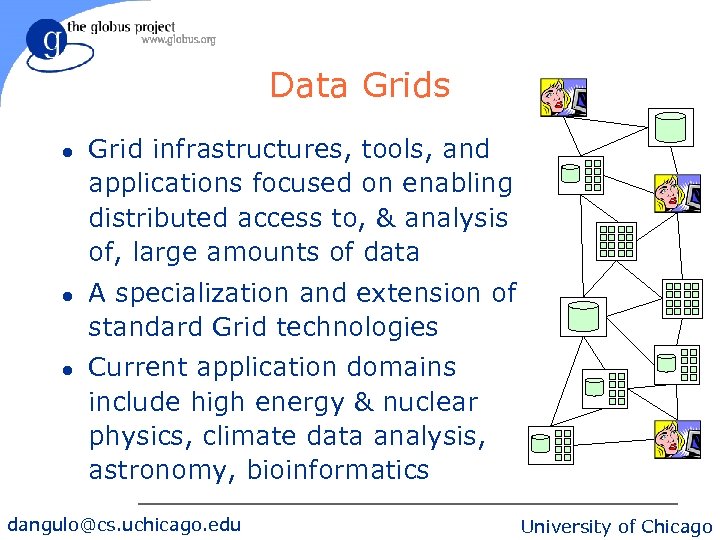
Data Grids l l l Grid infrastructures, tools, and applications focused on enabling distributed access to, & analysis of, large amounts of data A specialization and extension of standard Grid technologies Current application domains include high energy & nuclear physics, climate data analysis, astronomy, bioinformatics dangulo@cs. uchicago. edu University of Chicago
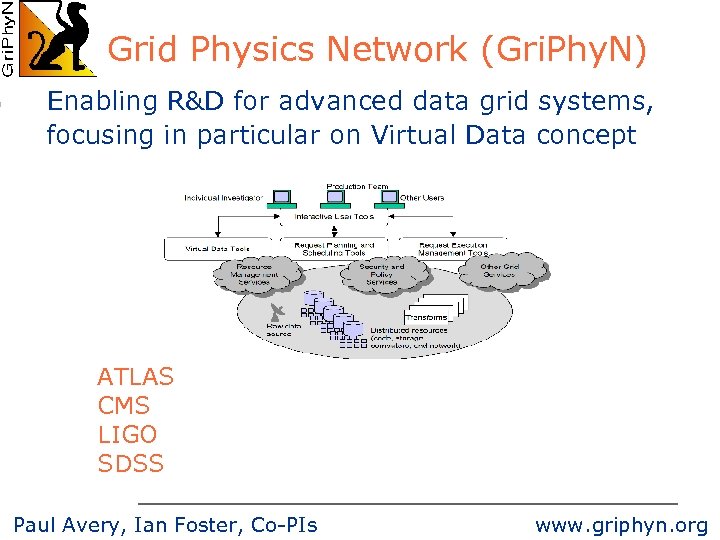
Grid Physics Network (Gri. Phy. N) Enabling R&D for advanced data grid systems, focusing in particular on Virtual Data concept ATLAS CMS LIGO SDSS dangulo@cs. uchicago. edu Co-PIs Paul Avery, Ian Foster, www. griphyn. org University of Chicago
Future Directions l Initial exploration (1996 -1999; Globus 1. 0) – Extensive appln experiments; core protocols l Data Grids (1999 -? ? ; Globus 2. 0+) – Large-scale data management and analysis l Open Grid Services Architecture (2001 -? ? , Globus 3. 0) – Integration w/ Web services, hosting envs. – Integration with databases – Integrated set of higher-level services l Scalable systems (2003 -? ? ) – Sensors, wireless, ubiquitous computing dangulo@cs. uchicago. edu University of Chicago
Summary l l l The Grid problem: Resource sharing & coordinated problem solving in dynamic, multi-institutional virtual organizations Grid architecture: Protocol, service definition for interoperability & resource sharing Globus Toolkit™ a source of protocol and API definitions—and reference implementations – And many projects applying Grid concepts (& Globus technologies) to important problems l Timely to start applying technologies to industrial problems, within & outside STC dangulo@cs. uchicago. edu University of Chicago
For More Information l The Globus Project™ – www. globus. org l Global Grid Forum – www. gridforum. org l Grid architecture – www. globus. org/research /papers/anatomy. pdf l Open Grid Services Architecture (soon) – www. globus. org/research /papers/ogsa. pdf – www. globus. org/research /papers/gsspec. pdf dangulo@cs. uchicago. edu University of Chicago
Скачать презентацию The Anatomy of the Grid Enabling Scalable Virtual
c01a509c60c4703a0f589fe09ca064f6.ppt