


 Скачать презентацию THE ANALYSIS OF THE QUESTIONNAIRE ON ECOLOGICAL AWARENESS
14169452a449492118f04bf30134278a.ppt
- Количество слайдов: 20
 THE ANALYSIS OF THE QUESTIONNAIRE ON ECOLOGICAL AWARENESS DONE WITHIN THE FRAMEWORK OF COMENIUS MULTILATERAL SCHOOL PARTNERSHIP „CARE FOR OUR CLIMATE”
 The aim of the questionnaire was to evaluate the ecological awareness of our students. It was conducted in October 2010 among 100 students of our school – the coordinators of the project in particular classes and the students from class 2 C, 2 D and 1 C. The questions referred to the knowledge of the problem of global warming, waste separation, water and energy saving, reasonable shopping, adequate nourishment and using different means of transport.
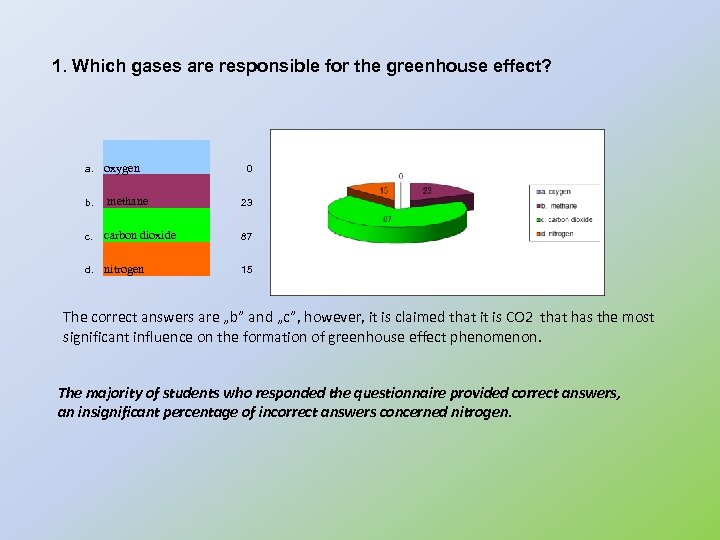 1. Which gases are responsible for the greenhouse effect? a. oxygen b. methane 23 c. carbon dioxide 87 d. nitrogen 15 0 The correct answers are „b” and „c”, however, it is claimed that it is CO 2 that has the most significant influence on the formation of greenhouse effect phenomenon. The majority of students who responded the questionnaire provided correct answers, an insignificant percentage of incorrect answers concerned nitrogen.
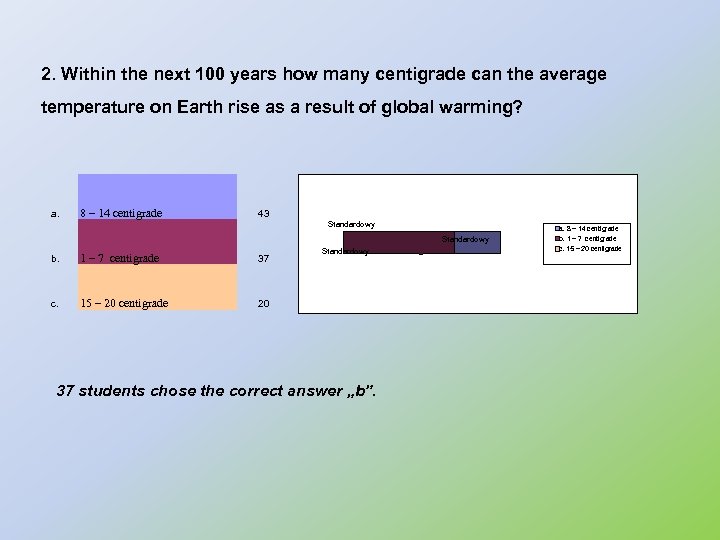 2. Within the next 100 years how many centigrade can the average temperature on Earth rise as a result of global warming? a. 8 – 14 centigrade 43 Standardowy a. 8 – 14 centigrade Standardowy b. 1 – 7 centigrade 37 c. 15 – 20 centigrade Standardowy 20 37 students chose the correct answer „b”. b. 1 – 7 centigrade c. 15 – 20 centigrade
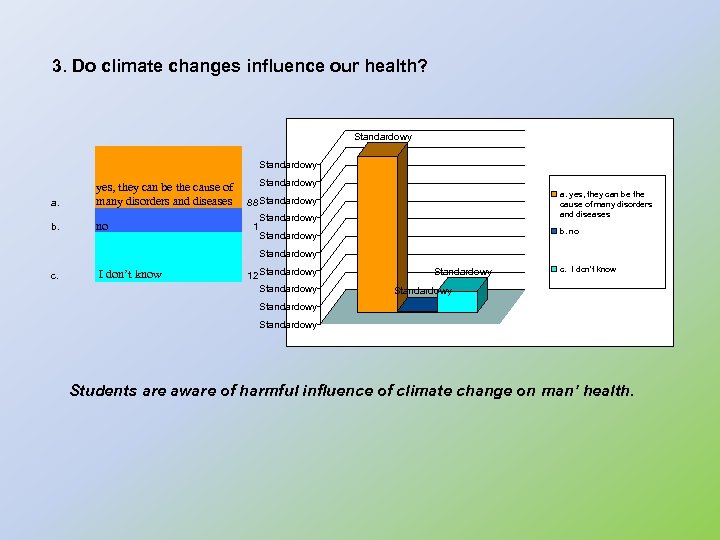 3. Do climate changes influence our health? Standardowy a. yes, they can be the cause of many disorders and diseases b. no Standardowy a. yes, they can be the cause of many disorders and diseases 88 Standardowy 1 Standardowy b. no Standardowy c. I don’t know 12 Standardowy c. I don’t know Standardowy Students are aware of harmful influence of climate change on man’ health.
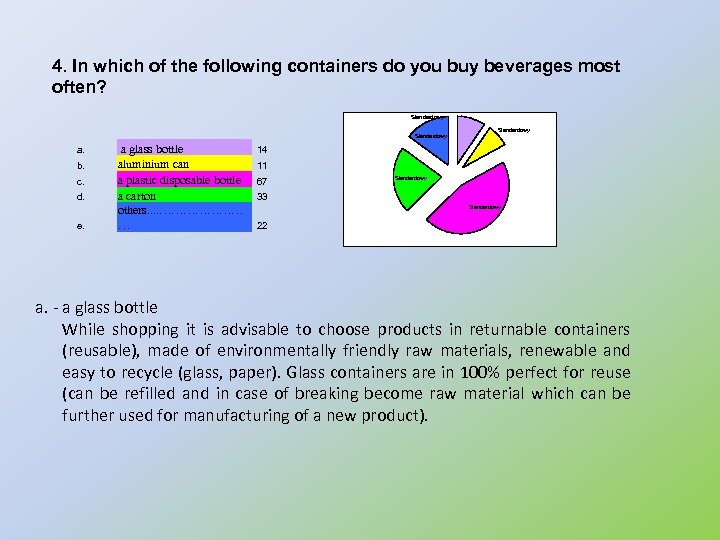 4. In which of the following containers do you buy beverages most often? Standardowy a. b. c. d. e. a glass bottle aluminium can a plastic disposable bottle a carton others. . ………………… … Standardowy 14 11 67 Standardowy 33 Standardowy 22 a. - a glass bottle While shopping it is advisable to choose products in returnable containers (reusable), made of environmentally friendly raw materials, renewable and easy to recycle (glass, paper). Glass containers are in 100% perfect for reuse (can be refilled and in case of breaking become raw material which can be further used for manufacturing of a new product).
 b. - aluminium can It can be recycled with waste material and energy recovery. Manufacturing aluminium form scrap metal allows us save 95% of energy which is needed to produce the same metal from bauxite ore. The amount of water and air contamination which is created during the process of scrap metal recovery is also over 95% lower. c. - a plastic disposable bottle A plastic bottle takes a long time to decompose in natural environment. d. - a carton Multilayer packaging containing some synthetic. It is better than plastic disposable bottles. The questionnaire results show that beverages in the cheapest containers are most commonly bought by students
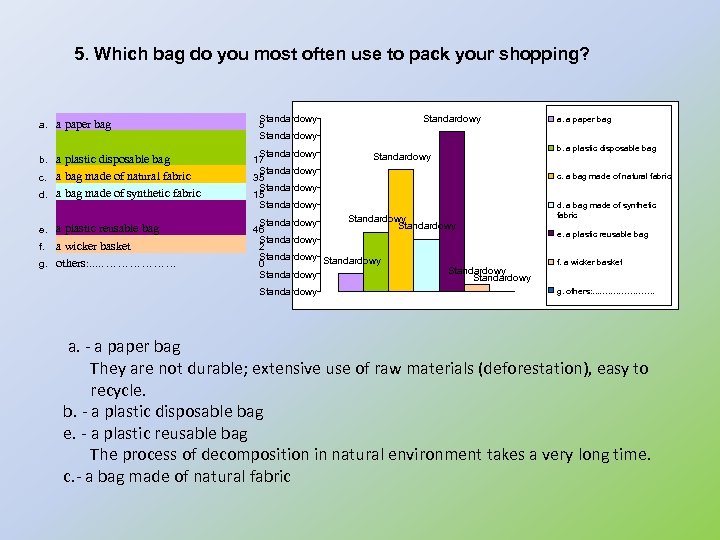 5. Which bag do you most often use to pack your shopping? a. a paper bag a plastic disposable bag c. a bag made of natural fabric d. a bag made of synthetic fabric b. a plastic reusable bag f. a wicker basket g. others: . . ………………. e. Standardowy 5 Standardowy 17 Standardowy 35 Standardowy 15 Standardowy Standardowy 46 Standardowy 2 Standardowy 0 Standardowy a. a paper bag b. a plastic disposable bag c. a bag made of natural fabric d. a bag made of synthetic fabric e. a plastic reusable bag f. a wicker basket g. others: . . ………………. a. - a paper bag They are not durable; extensive use of raw materials (deforestation), easy to recycle. b. - a plastic disposable bag e. - a plastic reusable bag The process of decomposition in natural environment takes a very long time. c. - a bag made of natural fabric
 f. - a wicker basket It is natural, durable, reusable, entirely renewable. d. - a bag made of synthetic fabric A synthetic with a long period of decomposition, durable in use. Most of the students pack their shopping in natural or plastic reusable bags.
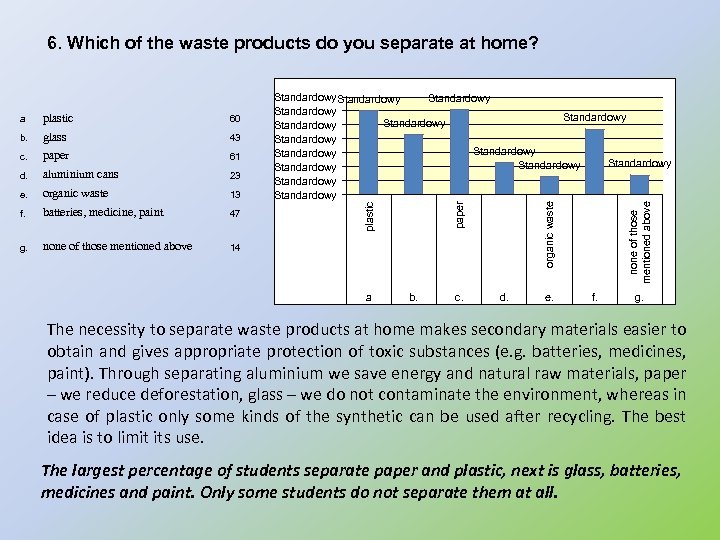 6. Which of the waste products do you separate at home? glass 43 c. paper 61 d. aluminium cans 23 e. organic waste 13 f. batteries, medicine, paint 47 g. none of those mentioned above 14 Standardowy a b. c. d. e. none of those mentioned above b. organic waste 60 paper plastic a Standardowy Standardowy Standardowy Standardowy f. g. The necessity to separate waste products at home makes secondary materials easier to obtain and gives appropriate protection of toxic substances (e. g. batteries, medicines, paint). Through separating aluminium we save energy and natural raw materials, paper – we reduce deforestation, glass – we do not contaminate the environment, whereas in case of plastic only some kinds of the synthetic can be used after recycling. The best idea is to limit its use. The largest percentage of students separate paper and plastic, next is glass, batteries, medicines and paint. Only some students do not separate them at all.
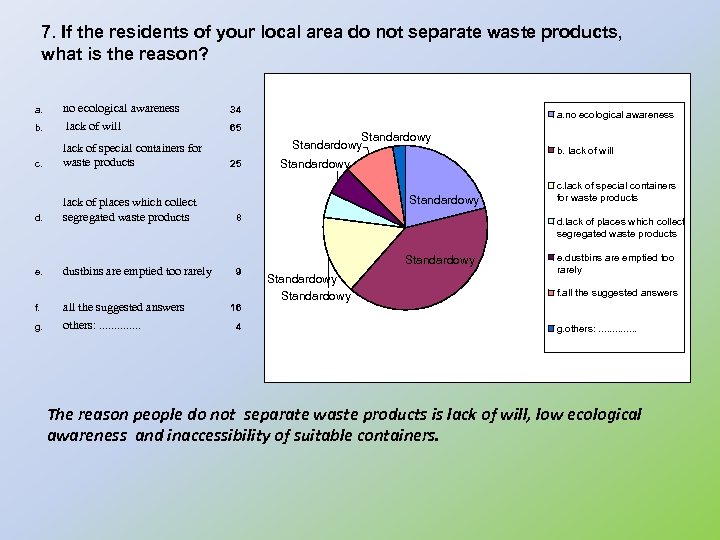 7. If the residents of your local area do not separate waste products, what is the reason? a. no ecological awareness 34 b. lack of will 65 c. lack of special containers for waste products 25 a. no ecological awareness Standardowy d. lack of places which collect segregated waste products 8 e. dustbins are emptied too rarely 9 f. all the suggested answers g. others: . . . 16 4 b. lack of will Standardowy c. lack of special containers for waste products d. lack of places which collect segregated waste products Standardowy e. dustbins are emptied too rarely f. all the suggested answers g. others: . . . The reason people do not separate waste products is lack of will, low ecological awareness and inaccessibility of suitable containers.
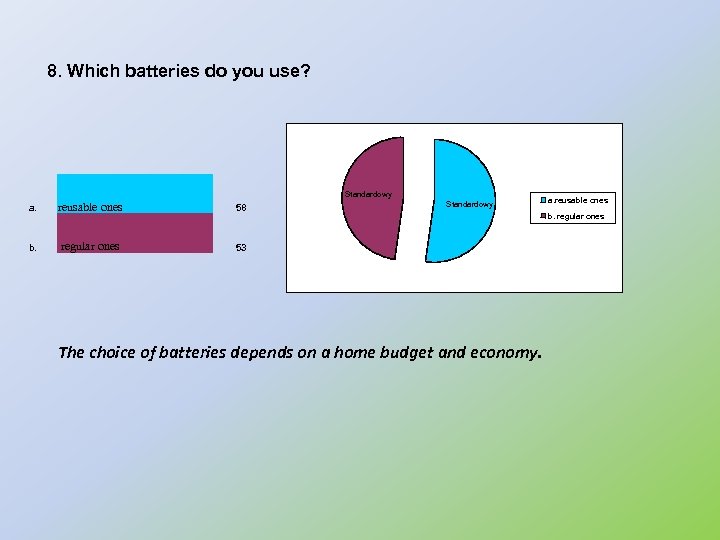 8. Which batteries do you use? Standardowy a. reusable ones 58 b. regular ones Standardowy 53 The choice of batteries depends on a home budget and economy. a. reusable ones b. regular ones
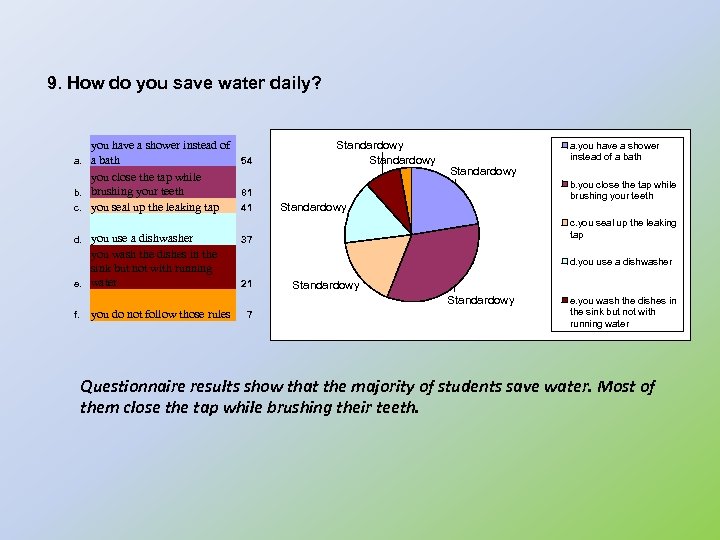 9. How do you save water daily? you have a shower instead of a. a bath 54 you close the tap while b. brushing your teeth 81 c. you seal up the leaking tap 41 you use a dishwasher you wash the dishes in the sink but not with running e. water d. Standardowy a. you have a shower instead of a bath Standardowy b. you close the tap while brushing your teeth Standardowy c. you seal up the leaking tap 37 d. you use a dishwasher 21 Standardowy f. you do not follow those rules 7 e. you wash the dishes in the sink but not with running water Questionnaire results show that the majority of students save water. Most of them close the tap while brushing their teeth.
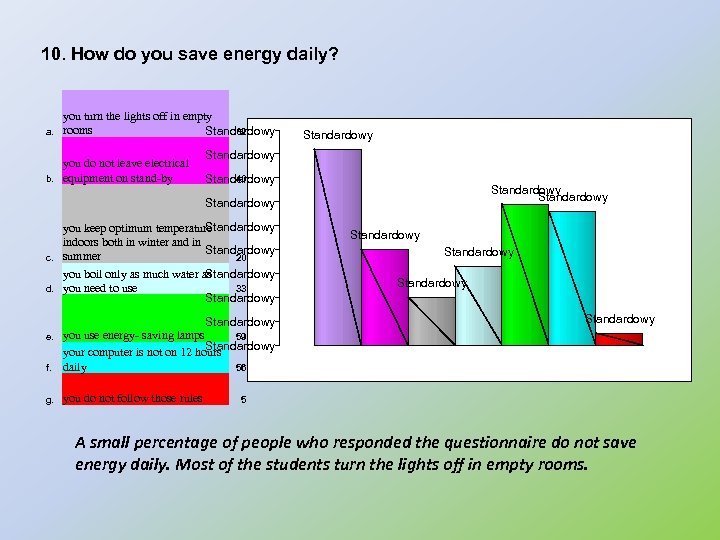 10. How do you save energy daily? a. you turn the lights off in empty rooms Standardowy 82 you do not leave electrical b. equipment on stand-by Standardowy 40 Standardowy Standardowy you keep optimum temperature indoors both in winter and in Standardowy c. summer 20 you boil only as much water as Standardowy you need to use d. 33 Standardowy Standardowy you use energy- saving lamps 59 Standardowy your computer is not on 12 hours f. daily 56 e. g. you do not follow those rules 5 A small percentage of people who responded the questionnaire do not save energy daily. Most of the students turn the lights off in empty rooms.
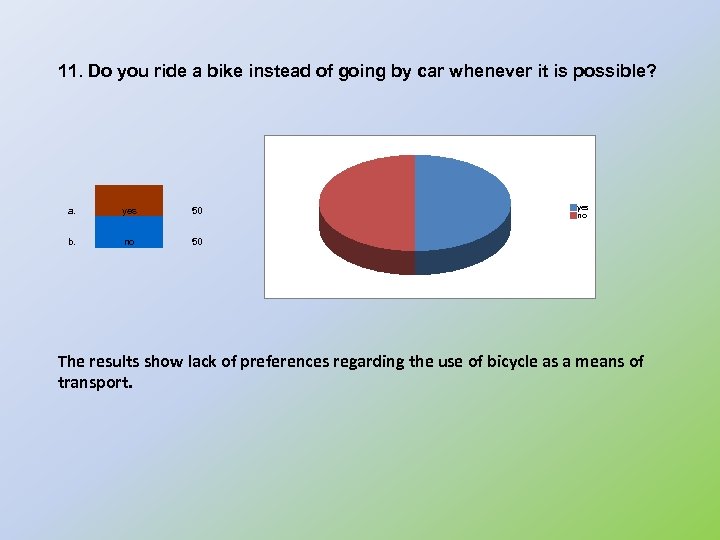 11. Do you ride a bike instead of going by car whenever it is possible? a. yes 50 b. no yes no 50 The results show lack of preferences regarding the use of bicycle as a means of transport.
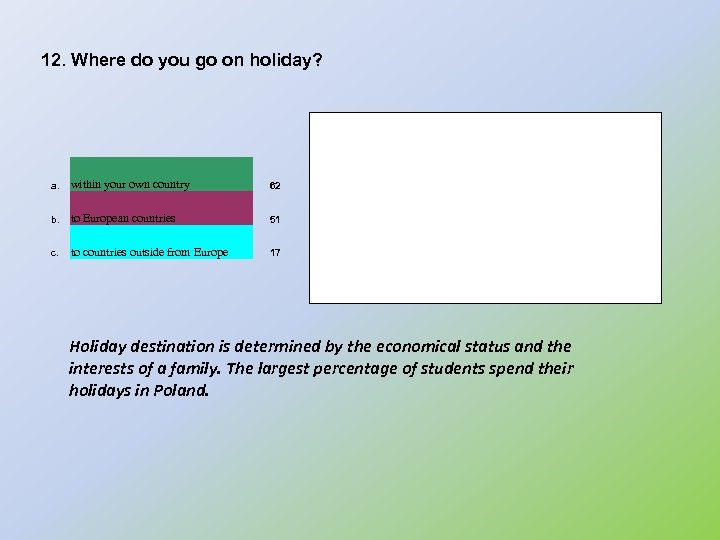 12. Where do you go on holiday? a. within your own country 62 b. to European countries 51 c. to countries outside from Europe 17 Holiday destination is determined by the economical status and the interests of a family. The largest percentage of students spend their holidays in Poland.
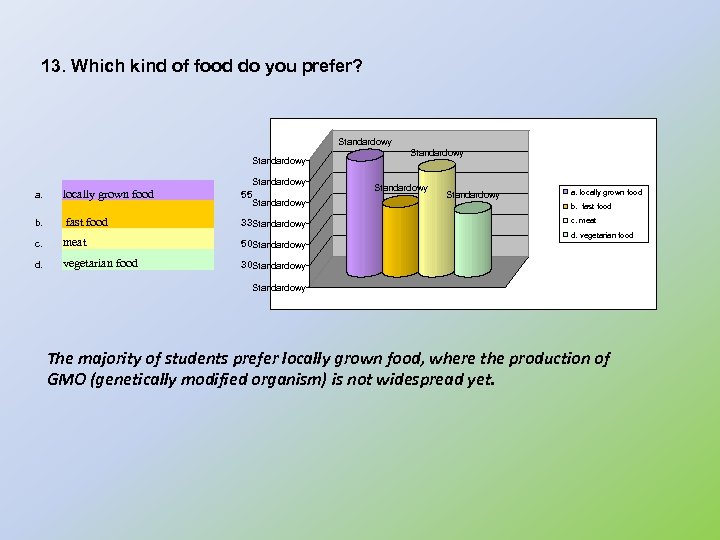 13. Which kind of food do you prefer? Standardowy a. locally grown food 55 Standardowy b. fast food 33 Standardowy c. meat 50 Standardowy d. vegetarian food Standardowy a. locally grown food b. fast food 30 Standardowy c. meat d. vegetarian food Standardowy The majority of students prefer locally grown food, where the production of GMO (genetically modified organism) is not widespread yet.
 CONCLUSIONS The questionnaire indicates quite significant level of ecological awareness among teenagers. Almost all of the people who answered it separate waste products daily , save energy , water and take care of natural environment. The answers showing lack of proecological attitude are result of insufficient economical motivation and in some cases laziness. To raise people's awareness to higher level we will continue students' projects through cooperation with inhabitants, representatives of industrial plants, local government or institutions connected with environment protection. Moreover we will still carry on with ecological campaigns motivating inhabitants to separate waste products. We will come out with request to proper authorities to increase the number of containers for different waste products.
 The questionnaire prepared by: Aleksandra Kiedrowska – kl. IIIc Monika Chmiel Anna Machowicz Mariusz Musiał Małgorzata Nizioł
 THANK YOU FOR WATCHING OUR PRESENTATION