 Скачать презентацию The analysis of different concepts Done by Karateva
The analysis of different concepts zhuzya.pptx
- Количество слайдов: 14




The analysis of different concepts Done by: Karateva Zhuldyz 403 group

The plan of PW: The meaning of concept (etymology) The idioms with these words The proverbs with these words The project work includes – concept of “LUCK, the concept of “number 13”
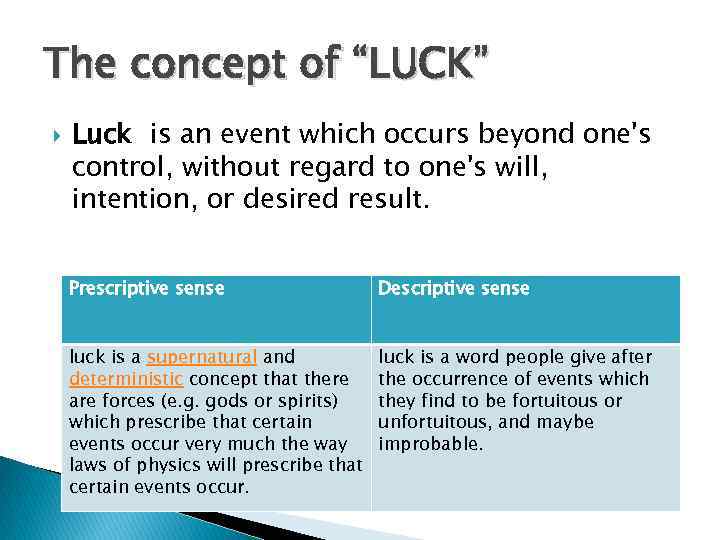
The concept of “LUCK” Luck is an event which occurs beyond one's control, without regard to one's will, intention, or desired result. Prescriptive sense Descriptive sense luck is a supernatural and deterministic concept that there are forces (e. g. gods or spirits) which prescribe that certain events occur very much the way laws of physics will prescribe that certain events occur. luck is a word people give after the occurrence of events which they find to be fortuitous or unfortuitous, and maybe improbable.
The concept of “LUCK” The etymology of concept: The English noun luck appears comparatively late, during the 1480 s, as a loan from Low German (Dutch or Frisian) luk, a short form of gelucke. Compare to old Slavic word lukyj (лукый) - appointed by destiny and old Russian luchaj (лучаи) - destiny, fortune. Luck is a way of understanding a personal chance event. Luck has three aspects which make it distinct from chance or probability.
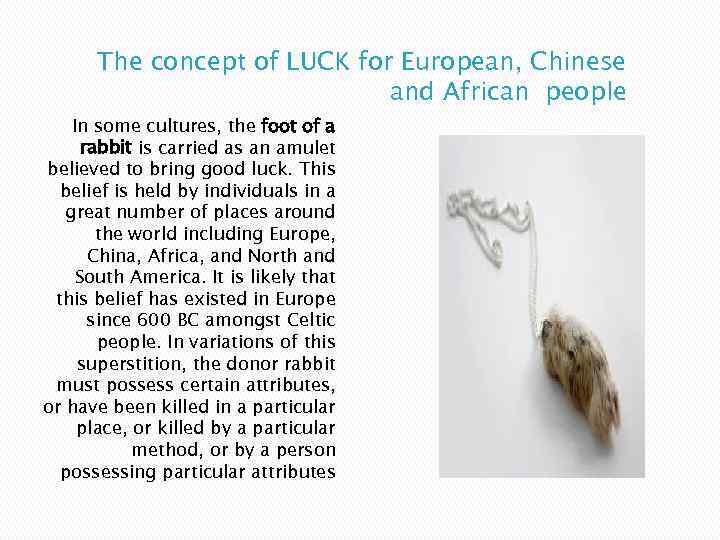
The concept of LUCK for European, Chinese and African people In some cultures, the foot of a rabbit is carried as an amulet believed to bring good luck. This belief is held by individuals in a great number of places around the world including Europe, China, Africa, and North and South America. It is likely that this belief has existed in Europe since 600 BC amongst Celtic people. In variations of this superstition, the donor rabbit must possess certain attributes, or have been killed in a particular place, or killed by a particular method, or by a person possessing particular attributes
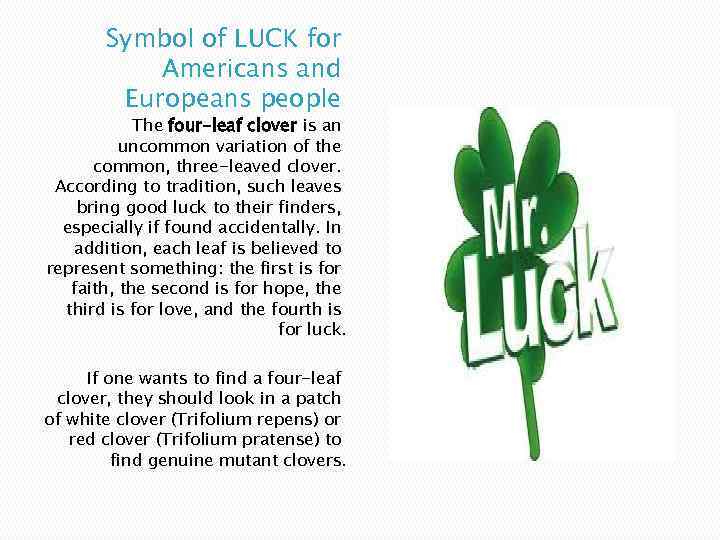
Symbol of LUCK for Americans and Europeans people The four-leaf clover is an uncommon variation of the common, three-leaved clover. According to tradition, such leaves bring good luck to their finders, especially if found accidentally. In addition, each leaf is believed to represent something: the first is for faith, the second is for hope, the third is for love, and the fourth is for luck. If one wants to find a four-leaf clover, they should look in a patch of white clover (Trifolium repens) or red clover (Trifolium pratense) to find genuine mutant clovers.
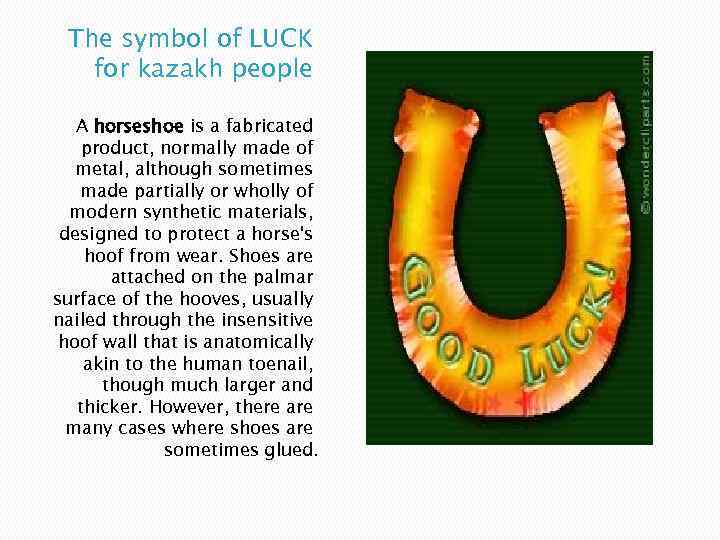
The symbol of LUCK for kazakh people A horseshoe is a fabricated product, normally made of metal, although sometimes made partially or wholly of modern synthetic materials, designed to protect a horse's hoof from wear. Shoes are attached on the palmar surface of the hooves, usually nailed through the insensitive hoof wall that is anatomically akin to the human toenail, though much larger and thicker. However, there are many cases where shoes are sometimes glued.
The proverbs of “LUCK” “Cowards have no luck. ” (in German) “Fools for luck. ” (in German) “Getting two birds with one stone. ” (in Japan) “Good luck or a tragedy may come unexpectedly” (in Japan) Жолы болар жігіттің жеңгесі шығар алдынан. Басына бақ қонсын.
The idioms of “LUCK” luck of the draw it is the result of pure chance, with no possibility of choice. Ex: The samples distributed varied in size and value; it was the luck of the draw. pot luck If you take pot luck, you accept whatever is available without knowing what it will be like. you can thank your lucky stars Being lucky you have to be good to be lucky People with ability cause their own good luck
The concept of “number 13” The meaning of 13 13 (thirteen /θɜrˈtiːn/) is the natural number after 12 and before 14. It is the smallest number with eight letters in its name spelled out in English. In speech, the numbers 13 and 30 are often confused. When carefully enunciated, they differ in which syllable is stressed.
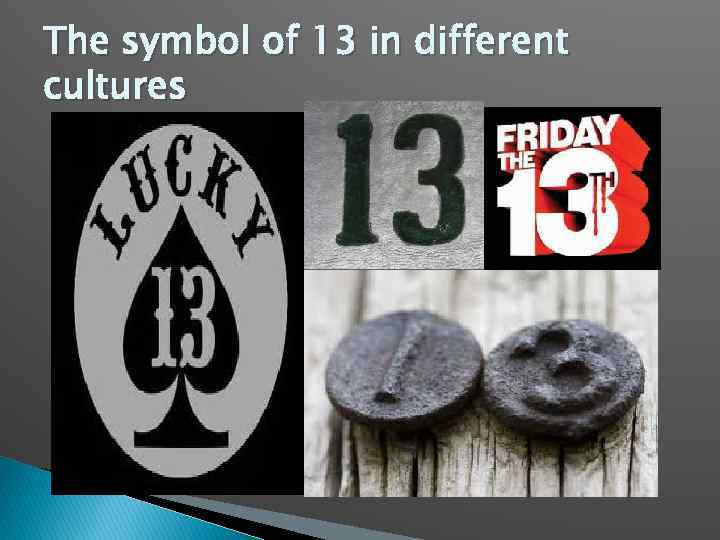
The symbol of 13 in different cultures
Lucky and Unlucky 13 In Italy, 13 is also considered a lucky number, although in Campania the expression 'tredici' (meaning 13) is said when one considers their luck to have turned for the worse. In central Asian countries, 13 is lucky number, which brings success and happiness.
The number 13 is considered an unlucky number in some countries. Charles Stewart Parnell had an irrational fear of the number thirteen. The end of the Mayan calendar's 13 th Baktun was superstitiously feared as a harbinger of the apocalyptic 2012 phenomenon. Fear of the number 13 has a specifically recognized phobia, Triskaidekaphobia, a word coined in 1911. The superstitious sufferers of triskaidekaphobia try to avoid bad luck by keeping away from anything numbered or labelled thirteen. As a result, companies and manufacturers use another way of numbering or labeling to avoid the number, with hotels and tall buildings being conspicuous examples (thirteenth floor). It's also considered unlucky to have thirteen guests at a table. Friday the 13 th has been considered the unluckiest day of the month. The Code of Hammurabi consists of 282 laws, but does not have law number 13.
Proverbs about 13 13 –те отау иесі. Он екі айда он үш той.
Скачать презентацию The analysis of different concepts Done by Karateva
The analysis of different concepts zhuzya.pptx