


 Скачать презентацию The American Revolution created an independent nation It
955bb1056eda972bd021b4eee26abd3c.ppt
- Количество слайдов: 25
 The American Revolution created an independent nation. It also established the ideals of the American people ~ freedom, equality, the general welfare, and the Constitution.
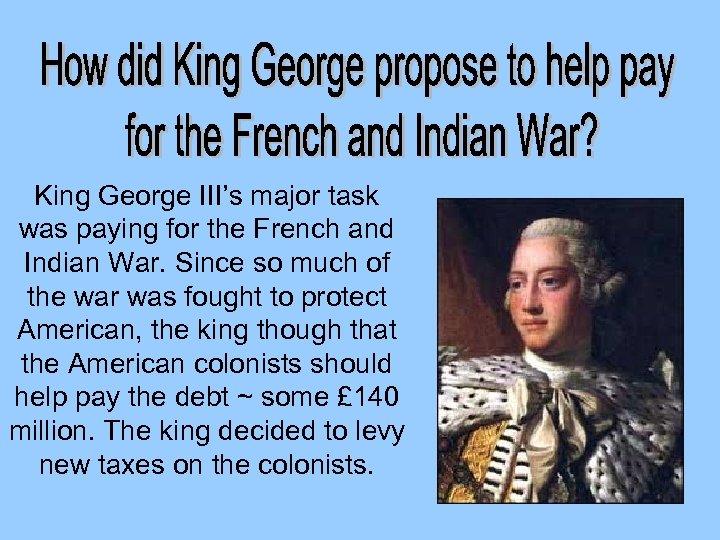 King George III’s major task was paying for the French and Indian War. Since so much of the war was fought to protect American, the king though that the American colonists should help pay the debt ~ some £ 140 million. The king decided to levy new taxes on the colonists.
 In America, society was very different from England. People were allowed to be more open and could be themselves in a more democratic way. They also knew the king was 3, 000 miles away and that made it difficult for England to govern them. They were given charters by Great Britain to establish these colonies in certain areas of America, but they were also guaranteed rights as Englishmen.
 Growing Conflict • The distance between America and Great Britain made it difficult for Great Britain to enforce British law. • As the colonies got older, they became more independent and wanted to be self governed without a lot of interference from Great Britain. • However, Great Britain needed to maintain control of these colonies in order to gain wealth and more power in Europe (mercantilism). • The colonies did not believe that Great Britain was adequately protecting them from the Spanish, French, or Native Americans. • Because Great Britain had acquired more land during the French and Indian War, they had a larger military presence in America. By having more troops in America, Great Britain had gained more control that the colonists did not like. The colonists saw it as an act of tyranny. • Since Great Britain believed the colonists should help pay off the war debt and were asking for more protection, they believed the colonists should pay more money to the British government. Eventually, this led to many conflicts including the American Revolution.
 Formal Acts • Navigation Acts – required colonists to use only British owned ships and crews for exporting goods – certain colonists’ goods could only be shipped to England. These goods included tobacco, rice, and indigo – goods imported by the colonies had to be shipped to England first. – Colonists’ reaction: smuggled goods into and out of other countries.
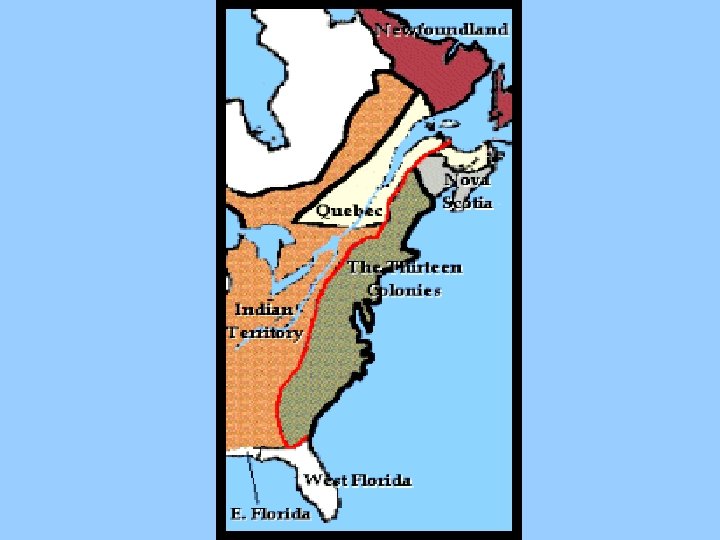
 Formal Acts • The Proclamation of 1763 – prohibited colonies from expanding beyond the Appalachian Mountains – passed in an effort to keep colonists from moving into more Native American territories which could spark war and would require more British – As a result, more friction was created between Great Britain and the colonies.
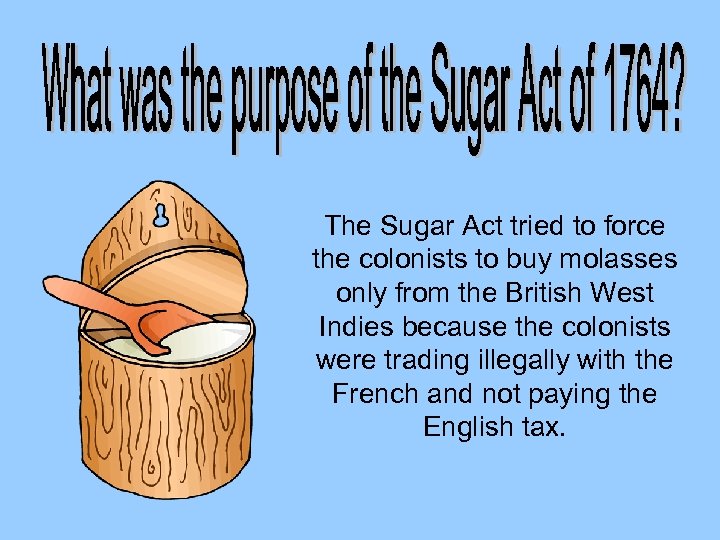 The Sugar Act tried to force the colonists to buy molasses only from the British West Indies because the colonists were trading illegally with the French and not paying the English tax.
 Because the Sugar Act did not raise enough money to pay for the war, in 1765 the Stamp Act was proposed. It required that newspapers and legal papers such as deeds and wills be stamped.
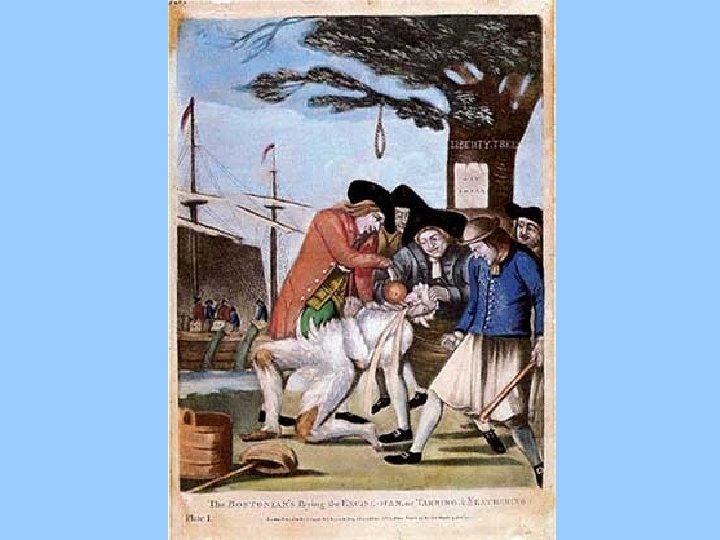
 • The colonists responded to this act by holding the Stamp Act Congress where they met and agreed to fight the tax • adopted a nonimportation agreement stating they would not accept imports from Great Britain until the tax was repealed. • South Carolina sent John Rutledge, Thomas Lynch, and Christopher Gadsden to the Stamp Act Congress. • In Charleston, Christopher Gadsden led a group who called themselves the Sons of Liberty. • In reaction to the Stamp Act, they harassed anyone suspected of supporting the act. They also hung and burned effigies of tax collectors and even tarred and feathered them on the town square.
 Quartering Act • forced colonists to provide room and board to British troops in America at their own expense. • Several colonies, including South Carolina, refused to obey the law. Some colonies were treated very harshly, but South Carolina was not punished for disobeying this law. Townshend Acts • tax on any glass, lead, paint, paper, or tea imported to the colonists • colonists reacted by passing another nonimportation agreement • In South Carolina, merchants who violated this agreement were boycotted. • The Sons of Liberty attacked anyone who bought any of these imports and paid the tax. • In response, Great Britain repealed the tax on all of the goods except tea.
 Tea Act. • gave the East Indian Tea Company a monopoly on tea trade in America • Colonists decided that they were not going to allow the ships carrying tea from this company into their ports. • In Boston, colonists dressed as Native Americans, boarded the ships, and dumped the tea into the harbor (The Boston Tea Party). • In Charleston and Georgetown, smaller tea parties were held even though the governor was able to get most of the tea delivered to the Exchange Building. • As a result of the colonists’ reactions, the Intolerable Acts were passed as a form of punishment.
 Intolerable Acts • were passed as a response to the “tea parties. ” • closed Boston harbor, changed the Massachusetts government, and caused some royal officials charged with crimes had to stand trial in England. • Closing the harbor in Boston could have shut down the colony and caused people to starve to death, but several colonies assisted them during this trying time. • South Carolina sent 200 barrels of rice to help feed the colonists. • This was the last set of laws passed before the American Revolution began.
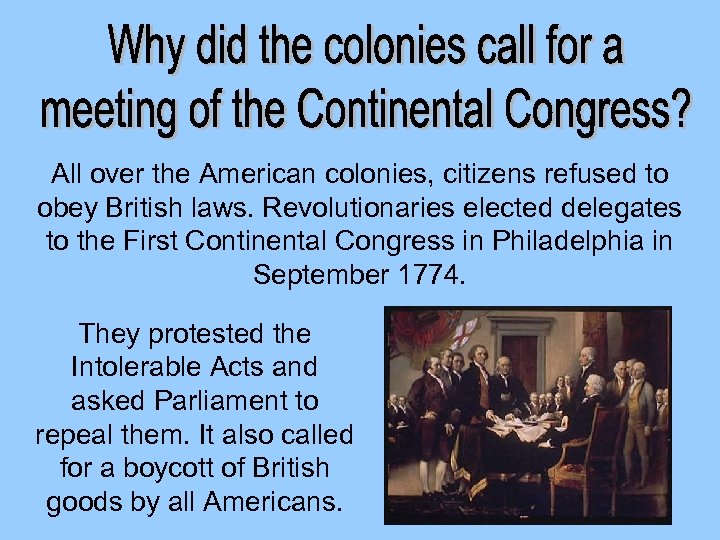 All over the American colonies, citizens refused to obey British laws. Revolutionaries elected delegates to the First Continental Congress in Philadelphia in September 1774. They protested the Intolerable Acts and asked Parliament to repeal them. It also called for a boycott of British goods by all Americans.
 • Edward Rutledge, Thomas Lynch, Jr. , Thomas Heyward, and Arthur Middleton were the four South Carolina signers of the Declaration of Independence. • None of them really wanted independence from Great Britain. Rutledge asked for a three week recess from the Congress so that the delegations could consult with their state legislatures. • On July 1, 1776, the South Carolina delegates voted against independence. Rutledge asked for a second vote the next day and all but one state voted for independence. • New York did not cast a vote. • Rutledge changed his vote because he wanted the vote to be unanimous
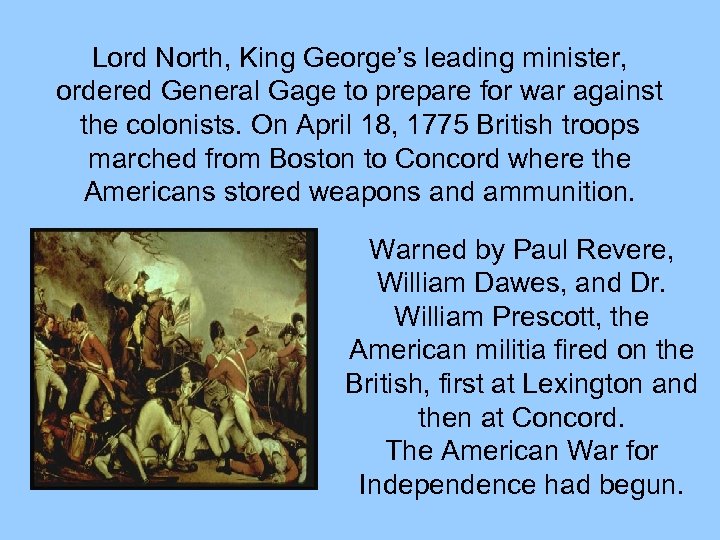 Lord North, King George’s leading minister, ordered General Gage to prepare for war against the colonists. On April 18, 1775 British troops marched from Boston to Concord where the Americans stored weapons and ammunition. Warned by Paul Revere, William Dawes, and Dr. William Prescott, the American militia fired on the British, first at Lexington and then at Concord. The American War for Independence had begun.
 South Carolinians did not feel the impact of the new taxes at once. The Sugar Act only taxed imports not goods grown in the colony. Greater ill was caused by the election dispute between Governor Thomas Boone an the Commons House of Assembly. The governor would not give Christopher Gadden the oath of office for the Commons House because the parish wardens did not take the proper oath and filled out the report of the votes incorrectly.
 The Commons House attacked the governor for not putting Gadden in office and said the right of the people to have a legislature was one of the basic “rights of Englishmen” and so was the right to seat its own members. Boone went to England to give his side of the appeal to the Board of Trade. He never returned to South Carolina. The Commons House was thrilled.
 The Stamp Act was opposed by South Carolinians. They sent delegates to the Stamp Act Congress. In Charles Town a group formed the Sons of Liberty. They built a gallows where they hung an effigy of a stamp collector. It was later burned. Lieutenant Governor Bull secretly hid the stamps at Fort Johnson and let the ships leave the harbor without the proper stamps. Later William Penn warned SC about the Declaratory Act and that Britain still asserted and maintained the absolute dominion over the colonies.
 When John Wilkes, the mayor of London, opposed George III’s effort to increase royal power. He was put in prison. Christopher Gadden took up his cause and the Common House voted to send money for Wilkes’ defense. It was ruled that they could not send money from the tax funds without the consent of the governor and his council. The Common House would not support the royal governors so the governors ruled without them.
 Just at the Boston Tea Party was planned in Boston, the H. M. S. London arrived in Charles Town harbor with 257 chests of tea. South Carolinians boycotted all English goods. The tea was moved to the basement of the Exchange. It stayed there until 1776 when it was sold to arm the Patriot forces.