


 Скачать презентацию THE AMERICAN PEOPLE CREATING A NATION AND A
754085ea853b3d2bf0d362f3ce915dd9.ppt
- Количество слайдов: 39
 THE AMERICAN PEOPLE CREATING A NATION AND A SOCIETY NASH JEFFREY HOWE FREDERICK DAVIS WINKLER MIRES PESTANA 7 th Edition Chapter 21: The Progressives Confront Industrial Capitalism Pearson Education, Inc, publishing as Longman © 2006
 THE SOCIAL JUSTICE MOVEMENT l Progressive movement was actually a number of movements focusing on problems created by a rapidly expanding urban and industrial world. – – – l Middle class reformers sought to humanize the modern city Others were concerned with the conditions of work and the rights of labor Still others pressed for changes in the political system to make it more responsive to the people Progressivism had roots in the 1890 s
 THE PROGRESSIVE MOVEMENT IN GLOBAL CONTEXT l l Most progressives saw their movement in a global context with a focus on the Atlantic world U. S. lagged behind much of the industrialized world in passing social legislation
 THE PROGRESSIVE WORLD VIEW l l Progressives were influenced primarily by the ideas of the Darwinian revolution, specifically the idea that the world was constantly in transition Saw environment as more important than heredity – l Believed some groups could be molded and changed more easily than others (such as blacks) Progressivism was the first modern reform movement – – Sought to bring order and efficiency though elements of nostalgia pervaded the movement Leaders were almost always middle class and tried to impart their values on workers and immigrants Often seemed more interested in control than reform Were part of a statistics minded generation and were optimistic about human nature and the potential for change
 THE MUCKRAKERS l Muckrakers were writers who exposed corruption and other social evils – l Product of journalistic revolution of 1890 s Among the many muckrakers: – – – Lincoln Steffens, The Shame of the Cities Ida Tarbell, revealed ruthlessness of John D. Rockefeller and Standard Oil David Graham Phillips, The Treason of the Senate Robert Hunter, Poverty Frank Norris, The Octopus Upton Sinclair, The Jungle
 CHILD LABOR l Reformers were outraged by child labor and gathered statistics, took photographs and used the evidence to push for legislation at the local and then the national level – – l National Child Labor Committee, headquartered in New York, drew up a model state child labor law and encouraged state and city campaigns – – l Florence Kelley First success was in Illinois though several years after legislation was passed the state supreme court ruled it unconstitutional Two-thirds of states passed some form of the law but most had major loopholes 1912 Convinced Congress to establish a children’s bureau in the Department of Labor What really reduced the number of children working were compulsory school attendance laws Europeans were much more effective at passing child protection legislation Reformers organized juvenile courts to protect children yet they often deprived them of their rights
 WORKING WOMEN AND WOMAN SUFFRAGE l In Muller v Oregon (1908), the Supreme Court upheld an Oregon law limiting the workday of women in factories and laundries to 10 hours. – – l Social justice progressives also campaigned for woman suffrage – – – l Most states then passed protective legislation for women though most companies found loopholes While arguments that women were weaker than men resulted in protective legislation, it would eventually be used to enforce gender segregation of the workforce Initially at the state level with the greatest success initially in western states Women in the United States were in touch with women around the world in the fight for political rights though the U. S. lagged behind other countries Process slowed in US by difficulty of amending the Constitution and the need to fight the battle in one state at a time Movement for birth control was more controversial – – Margaret Sanger was one of the founders of the modern birth control movement She founded the American Birth Control League in 1921 and it became the Planned Parenthood Federation in 1942
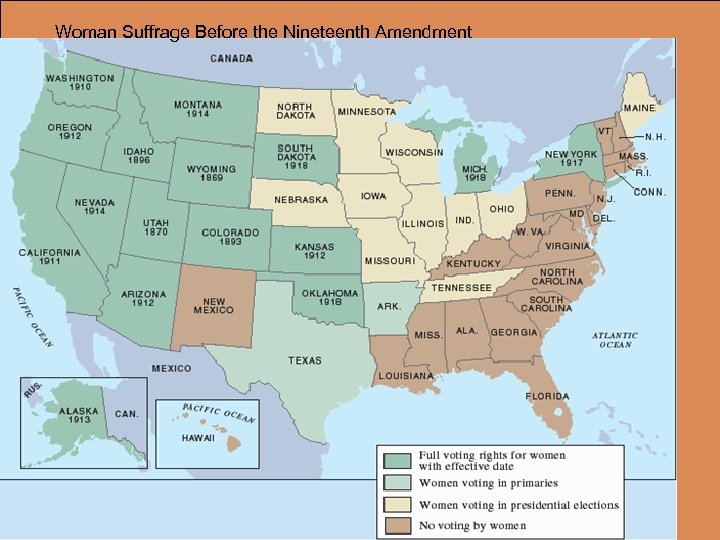 Woman Suffrage Before the Nineteenth Amendment
 REFORMING HOME AND SCHOOL l Reformers believed that better housing and education could transform the lives of the poor and create a better world – – – l l Jacob Riis How the Other Half Lives (1890) Worked for the passage of tenement house laws, laws that set fire codes and other regulations that were generally evaded 1910 organized the National Housing Association Charlotte Perkins Gilman sketched an alternative to the traditional woman’s sphere that advocated shared facilities Progressives also stressed better schools that favored flexibility and change especially as promoted by John Dewey – – – Moveable seats became one of the symbols of the progressive education movement Insisted that schools be child centered not subject oriented Schools should become instruments for social reform
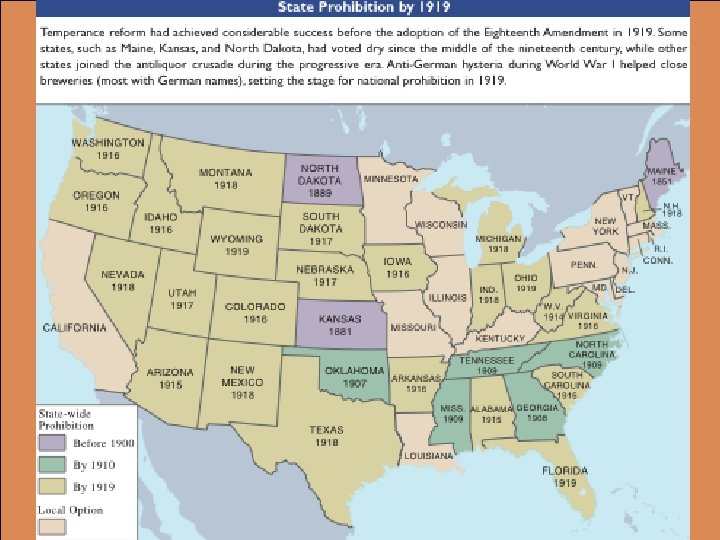
 CRUSADES AGAINST SALOONS, THEATERS AND PROSTITUTION l Most social justice progressives opposed the sale of alcohol, some because it was a sin but many more because they saw it as part of the process of reforming the city and conserving human resources – – l Seven states passed temperance laws between 1906 and 1912 December 22, 1917 Congress sent to the states for ratification a constitutional amendment prohibiting the sale, manufacture and import of intoxicating liquor Progressives also saw the urban dancehall and movie theaters as threats to the morals and well-being of young people, especially young women – – Movies did not begin to attract a middle class audience until WWI Reformers objected to content of films and to location of theaters and their dark interiors
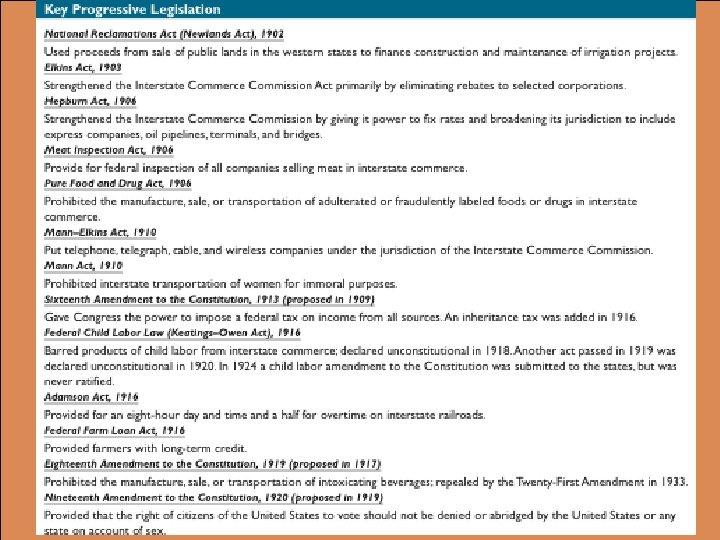
 CRUSADES AGAINST SALOONS, THEATERS AND PROSTITUTION l Reformers saw prostitution as the worst evil and got many cities to appoint vice commissions and elaborate studies of prostitution – – Some blamed inferior people but many stressed environmental causes Also considered economic causes of prostitution but did little to end it or to address its roots in poverty Mann Act of 1910 prohibited the interstate transport of women for immoral purposes Persuaded several states to raise the age of consent for women and in 20 states made the Wassermann test for syphilis mandatory for both men and women before a marriage license could be issued
 THE WORKER IN THE PROGRESSIVE ERA l l Progressives sought protective legislation, unemployment insurance, and workers’ compensation Supported labor’s right to organize but opposed the strike as a weapon against management
 THE CHANGING NATURE OF INDUSTRIAL LABOR l Factory life was dominated by the clock, the bell tower and the boss but workers continued to resist – l l l In some industries, introduction of new machines revolutionized work and eliminated highly skilled jobs The principles of scientific management (centralized planning, systemic analysis of each job, detailed instructions to and close supervision of each worker, incentive wage system to encourage workers to work harder and faster), as championed by Frederick Taylor, also changed the nature of work The AFL had 2 million members by 1914 as its stress on “pure and simple unionism” appealed to coal miners, railroad workers and building trades – l One-third of American workers stayed at their jobs less than one year After a short period of cooperation, labor unions were defeated in a number of strikes and the National Association of Manufacturers (NAM) launched an aggressive counterattack, often backed by the courts Most social justice progressives spent more time on protective legislation than on supporting organized labor – – They were especially interested in helping working women Women’s Trade Union League, founded in 1903, forced the AFL to pay more attention to women, helped out in time of strikes, and publicized the plight of working women.
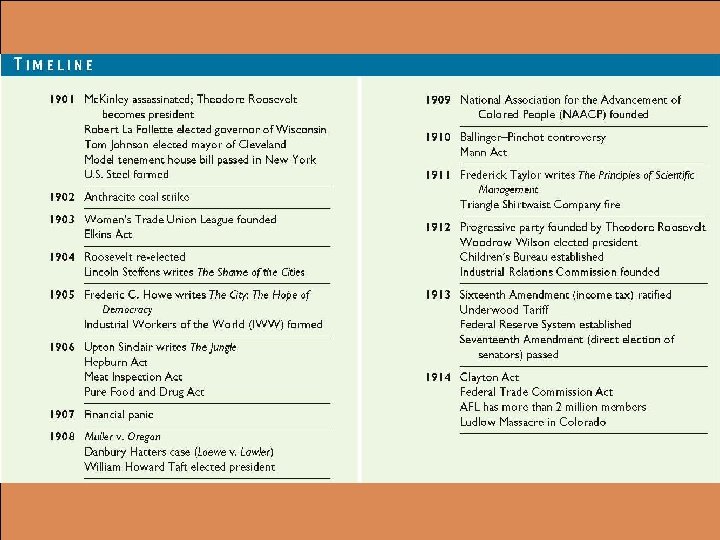
 GARMENT WORKERS AND THE TRIANGLE FIRE l Thousands of women, mainly Jewish and Italian between the ages of 16 to 25, worked 6 days a week in the garment industry – – l By first decade of 20 th century, many operations were centralized in large loft buildings in lower Manhattan Conditions were terrible for the women 1909 workers went on strike to protest and were supported by the International Ladies’ Garment Workers Union (ILGWU) and the Women’s Trade Union League – Went on general strike in November and won recognition for their union and some improvements in the factories
 GARMENT WORKERS AND THE TRIANGLE FIRE l 25 March 1911 a fire broke out in the Triangle Shirtwaist Company where workers were locked in and there were no fire escapes – – l l More than 100 died in the flames while forty-six women jumped to their deaths State legislature appointed a commission to investigate working conditions which resulted in state legislation limiting the work of women to 54 hours a week, prohibiting labor by children under the age of 14, and improving safety regulations in the factories The federal Industrial Relations Commission was created in 1912 to study the causes of industrial unrest and violence Miners struck in 1913 against the Colorado Fuel and Iron Industry near Ludlow, Colorado, for an 8 hour day, better safety precautions and the removal of armed guards – – The company refused to negotiate and the strike turned violent resulting in the deaths of 11 children and 2 women The Commission, which investigated it, decided that violent class conflict could be avoided only by using armed guards and detectives, by restricting monopoly, by protecting the right of the workers to organize, and by redistributing wealth through taxation
 RADICAL LABOR l 1905: Industrial Workers of the World (IWW) was formed in Chicago and welcomed all workers regardless of skill, color or gender – – Big Bill Haywood dominated the movement Had the most success organizing itinerant lumbermen and migratory workers in the Northwest Remained a small organization troubled by internal problems Immigrants often did not join in
 REFORM IN THE CITIES AND STATES l l Progressivism in the cities and states had roots in the depression and discontent of the 1890 s Professional and business classes were often the leaders – Wanted to bring order out of chaos and to modernize the city and state
 MUNICIPAL REFORMERS l The continued growth of the cities in America caused a wide range of social problems as did the presence of large numbers of immigrants which worried reformers – l l Municipal reform was chiefly concerned with making the operation and administration of the city as efficient as possible through innovative adaptations of business management techniques to government The chief aim of municipal reform was to make the city more organized and efficient for the business and professional classes who were to control its workings – – l l The inclusion of large populations of immigrants was the important difference between American and European cities and made reform attempts difficult Tried to limit the power of the city bosses In some places replaced mayor and council with a nonpartisan commission of administrators and in others hired a city manager Many cities set out to bring culture and beauty to their centers but generally aimed it at the middle and upper classes Social justice progressives were more concerned with neighborhood parks and playgrounds – Many progressives had an ambivalent attitude toward the city
 REFORM IN THE STATES l l l The American federalist system of government gave the actions of reform by the states an important place in the country’s overall growth 1913: passage of 17 th Amendment providing for the direct election of U. S. senators Much progressive state legislation promoted order and efficiency but many passed social justice measures as well – l By 1917, 37 states had passed workers’ compensation laws and 28 states had set maximum hours for women working in industry Progressive movement improved government and made it more responsible to the people though results were often mixed
 THEODORE ROOSEVELT AND THE SQUARE DEAL l l President William Mc. Kinley was shot in Buffalo, New York, on 6 September 1901 and died 8 days later making Theodore Roosevelt president Emergence of a national industrial economy had spawned conditions that demanded national solutions – – – Progressives at the national level turned their attention to the workings of the economic system Scrutinized operation and organization of the railroads and other corporations Examined threats to the natural environment Reviewed the quality of product of American industry Vastly expanded the power of the national government
 A STRONG AND CONTROVERSIAL PRESIDENT l Roosevelt considered the presidency to be a “bully pulpit” – – – Personality and humor made him a good subject for the new mass-market newspapers and magazines Was strongest president since Lincoln Revitalized the executive branch, reorganized the army command structure, modernized the consular service Established the Bureau of Corporations, appointed independent commissions staffed with experts and enlisted talented and well-trained men to work for the government Re-elected in 1904, running on a platform of a “Square Deal”
 DEALING WITH THE TRUSTS l One of Roosevelt’s first actions was to attempt to control large industrial corporations that were constantly consolidating, growing bigger and more powerful – – l Directed the justice department to prosecute some of the largest corporations in the country under the Sherman Anti-Trust Act – l l l Between 1897 and 1904, 4227 companies combined to form 257 large corporations US Steel, formed in 1901, was the first billion dollar corporation Increased role of federal government as regulator and caused some large companies to diversify Roosevelt steered the Elkins Act—eliminating the use of rebates by railroads— through Congress in 1903 and the Hepburn Act—broadened the power of the ICC and gave it the right to investigate and enforce rates—in 1906 Roosevelt saw his role as mediator and regulator When coal mine owners refused to talk to striking anthracite coal miners in 1902, Roosevelt appointed a commission that included representatives of the union as well as the community – Miners went back to work with a 10 percent raise, back pay, and a nine-hour day but the agreement did not recognize the union
 MEAT INSPECTION AND PURE FOOD AND DRUGS l Roosevelt’s first major reform began in response to Upton Sinclair’s novel, The Jungle, exposing the Chicago meatpacking industry – – l Roosevelt ordered a study of the meatpacking industry and used the report to pressure Congress and the meatpackers to accept a legislation Led to a Meat Inspection Act of 1906 that restored the country’s faith in the industry and increased its profits The Pure Food and Drug Act (1906) corrected some of the worst abuses in American industry
 CONSERVATION l l l Roosevelt tripled the land set aside for national forests, bringing the total to more than 150 million acres 1902 Congress passed the Newlands Act (National Reclamation Act) which set aside the proceeds from the sale of public land in 16 western states to pay for the construction of irrigation projects in those states Worked to increase public awareness of the limited amount of resources in America – l Appointed a National Conservation Commission, under Gifford Pinchot, charged with making an inventory of the natural resources in the country Pinchot supported selective logging, fire control, and limited grazing on public lands, which pleased many in the timber and cattle industry – – – Policies angered followers of John Muir, who had founded the Sierra Club in 1862, who believed passionately in preserving the land in a wilderness state At the turn of the century many Americans joined a “back to nature” movement that involved outdoor activities while children joined Boy Scouts (1910) and Camp Fire Girls (1912) Controversy over the Hetch-Hetchy dam pitted Pinchot, who won, against Muir
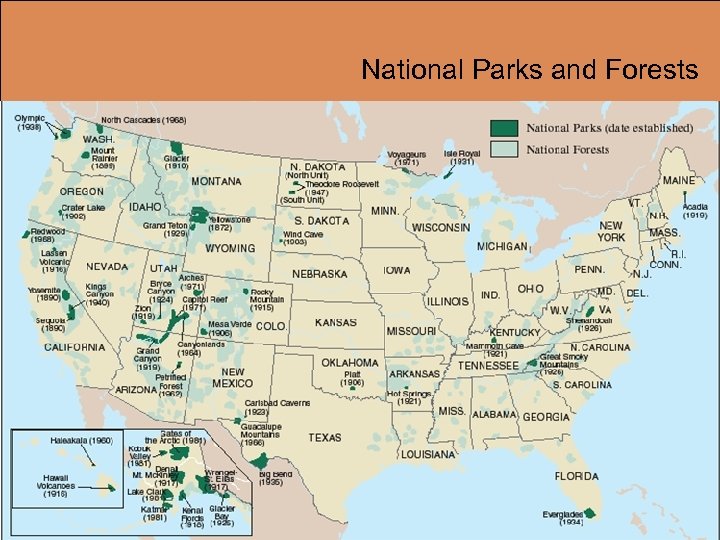 National Parks and Forests
 PROGRESSIVISM FOR WHITES ONLY l Roosevelt thought in stereotypical racial terms which were supported by the scientific evidence of the time – l l While Roosevelt made gestures to the black community, he could also be insensitive to their needs and views including dishonorably discharging 167 black soldiers after a riot in Brownsville, Texas Progressive era coincided with time of greatest segregation in the South and southern progressivism aimed to keep blacks outside the political process The National Association for the Advancement of Colored People was founded in 1909 by white social justice progressives and black leaders – – William Monroe Trotter used his newspaper to oppose Booker T. Washington’s policy of accommodation Ida B. Wells campaigned against lynching, organized a women’s club for blacks and founded the Negro Fellowship League W. E. B. Du. Bois who argued for the best education possible for blacks and launched the Niagara movement (1905) to protest the condition of blacks In 1910, the Niagara movement joined with the NAACP
 WILLIAM HOWARD TAFT l l l After two terms, Roosevelt chose William Howard Taft as his successor and left to go big game hunting in Africa Taft instituted more suits against monopolies than Roosevelt had, supported the 8 hour workday and legislation making mining safer, urged the passage of the Mann-Elkins Act, authorized the first tax on corporate profits, encouraged the process that led to the passage of the Sixteenth Amendment which authorized a federal income tax Lacked Roosevelt’s style and infuriated Roosevelt when he fired Gifford Pinchot for attacking the secretary of the interior for giving away coal lands in Alaska
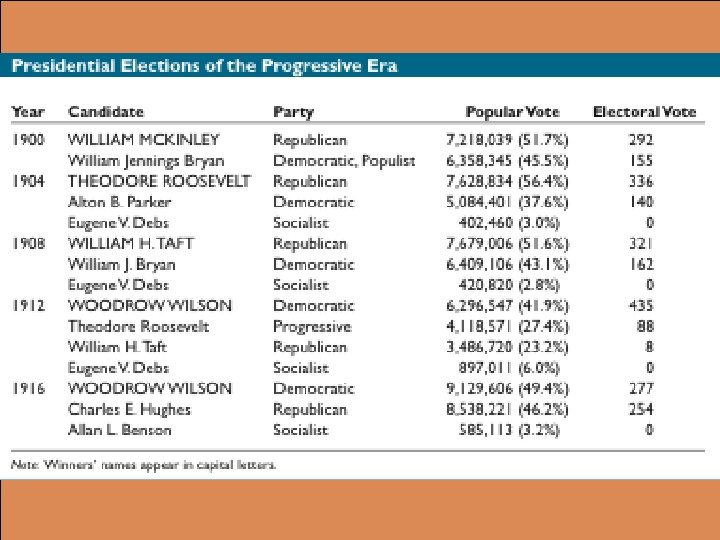
 THE ELECTION OF 1912 l l Woodrow Wilson won the Democratic nomination Taft captured the Republican nomination causing Roosevelt to walk out of the convention and form a new political party, the Progressive party – – – l Election became a contest between Roosevelt and Wilson – – – l l Party was supported by social workers and social justice progressives Endorsed 8 -hour day; six-day week; abolition of child labor under 16; federal system of accident, old age and unemployment insurance; endorsed woman suffrage Suffered from internal divisions including whether to seat black southern delegates Roosevelt espoused “New Nationalism” and the increase of power in the federal government Wilson espoused the “New Freedom” and the need for limited government and open competition There were many areas of agreement however The fourth candidate was Socialist Eugene V. Debs who argued for fundamental change and polled almost 900, 000 votes Wilson won the election
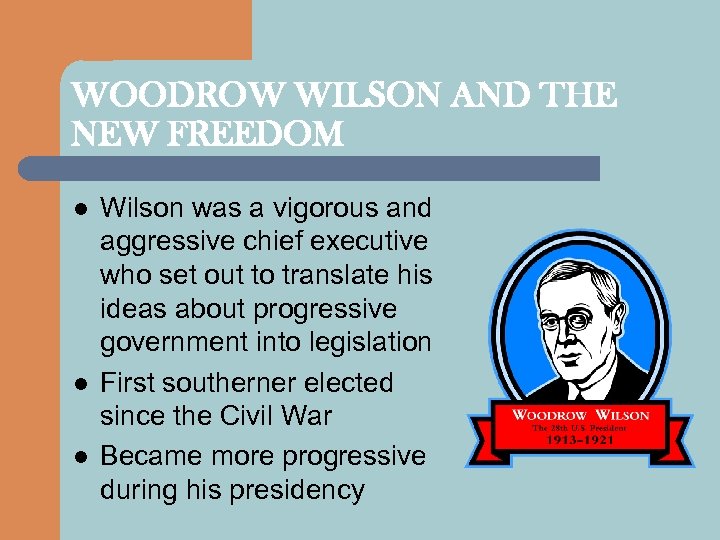 WOODROW WILSON AND THE NEW FREEDOM l l l Wilson was a vigorous and aggressive chief executive who set out to translate his ideas about progressive government into legislation First southerner elected since the Civil War Became more progressive during his presidency
 TARIFF AND BANKING REFORM l Wilson was extremely successful in getting Congress to pass his legislative agenda at the beginning of his administration – l Recommended reducing the national tariff to eliminate favoritism, freeing the banking system from Wall Street control, and restoring competition in industry – l l First president to appear in person before Congress since Thomas Jefferson refused to go 1913 Underwood Tariff reduced tariffs on hundreds of items and included a modest 1% income tax on incomes over $4000 A compromise bill to retool the banking system the creation of the Federal Reserve System and created a flexible currency Failed to support a bill that would have provided long-term rural credit financed by the federal government, opposed woman suffrage, failed to support an anti-child labor bill and ordered the segregation of blacks in several federal departments
 MOVING CLOSER TO A NEW NATIONALISM l In response to ongoing need to police the affairs of big business, Wilson submitted the Clayton Act to Congress in 1914 and endorsed the Federal Trade Commission embedded with enough power to curtail companies guilty of restricting competition – l l l Clayton Act prohibited a number of unfair trading practices, outlawed the interlocking directorate, made it illegal for corporations to purchase stock in other corporations if doing so tended to reduce the competition Neither Wilson nor Roosevelt satisfied the demands of advanced progressives since they spent most of their time trying to regulate economic power rather than promoting social justice Progressive presidents reasserted presidential authority, modernized the executive branch, and began the creation of the federal bureaucracy The expert, the commission, the statistical survey and the increased power of the executive branch were all legacies of the progressive era
 DISCOVERING U. S. HISTORY ONLINE How the Other Half Lives: Studies Among the Tenements of New York http: //www. cis. yale. edu/amstud/inforev/riis/title. html l Turn-of-the-Century America, 1880 -1920 http: //memory. loc. gov/ammem/detroit/dethome. html l American Sweatshops http: //www. americanhistory. si. edu/sweatshops/ l The Triangle Factory Fire http: //www. ilr. cornell. edu/trianglefire/ l The Westinghouse World http: //www. memory. loc. gov/ammem/papr/westgorg. html l The Trial of Bill Haywood http: //www. law. umkc. edu/faculty/projects/ftrials/haywood. htm l
 DISCOVERING U. S. HISTORY ONLINE Memories of the Industrial Workers of the World (IWW) http: //www. geocities. com/Capitol. Hill/5202/rebelgirl. html l IWW Historical Reclamation Project http: //parsons. iww. org/~iw/info/books l Arts and Crafts Archives http: //www. arts-crafts. com/archive. shtml l The Evolution of the Conservation Movement, 1850 -1920 http: //www. memory. loc. gov/ammem/amrvhtml/conshome. html l America 1900 http: //www. pbs. org/wgbh/amex/1900/ l Chicago in 1900 http: //www. chipublib. org/004 chicago/1900/intro. html l
 DISCOVERING U. S. HISTORY ONLINE The Anthracite Coal Strike, 1902 http: //history. osu. edu/projects/coal/1902 anthracitestrike/ l The Wright Brothers in Photographs http: //www. libraries. wright. edu/special/wright_brothers/dmc. html l Theodore Roosevelt Association http: //www. theodoreroosevelt. org/ l Theodore Roosevelt http: //www. potus. com/troosevelt. html l William Howard Taft http: //www. potus. com/whtaft. html l Woodrow Wilson http: //www. potus. com/wwilson. html l