


 Скачать презентацию THE AMERICAN PEOPLE CREATING A NATION AND A
734a28fca2f8ff690aac0ef890e7e33d.ppt
- Количество слайдов: 35
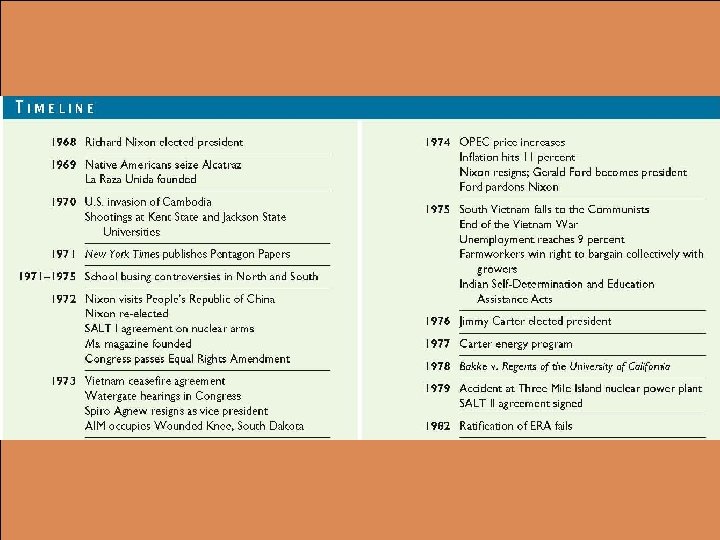
 THE AMERICAN PEOPLE CREATING A NATION AND A SOCIETY NASH JEFFREY HOWE FREDERICK DAVIS WINKLER MIRES PESTANA 7 th Edition Chapter 29: Disorder and Discontent, 1969 -1980 Pearson Education, Inc, publishing as Longman © 2006
 THE DECLINE OF LIBERALISM l After 8 years of Democratic rule, many Americans were frustrated with the liberal approach – – – As Vietnam polarized the country, critics argued the government was trying to do too much Nixon resolved to scale down the commitment to social change Wanted to pay more attention to the needs of white, middle-class Americans
 RICHARD NIXON AND HIS TEAM l Nixon was a private man, uncomfortable around people but aware of the role of image – – l l Appeared as the defender of American morality Wanted to decentralize social policy though did believe presidency should be the engine of the political system When the Democratic Congress allocated money for programs he opposed, Nixon impounded the funds Cabinet appointees were white, male Republicans whom Nixon often bypassed to work with non-cabinet people including Arthur Burns, Daniel Patrick Moynihan and Henry Kissinger – – – Chief of Staff, H. R. Haldeman Chief domestic adviser, John Ehrlichman Attorney General, John Mitchell
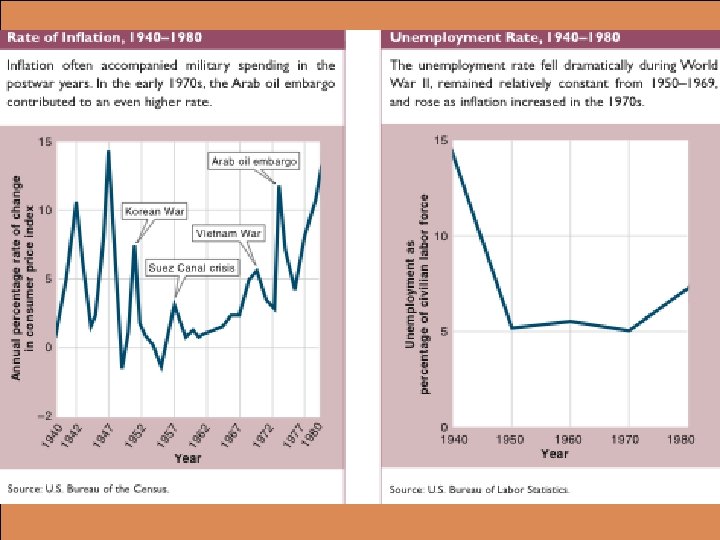
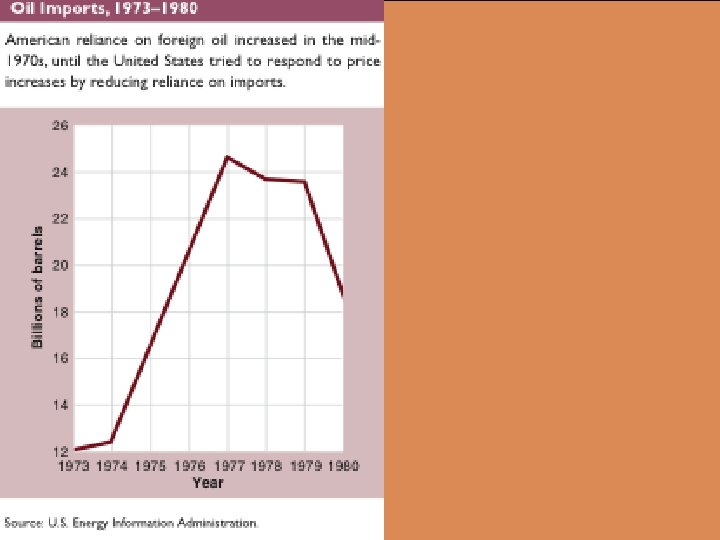
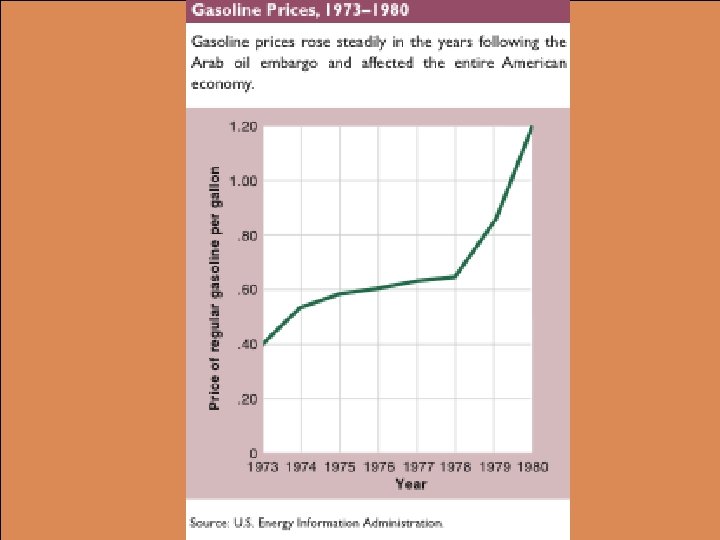
 THE REPUBLICAN AGENDA AT HOME l Nixon was willing to use economic tools to maintain fiscal stability – – l l To fight rising inflation, Nixon reduced government spending and pressured the Federal Reserve Board to raise interest rates There was a mild recession in 1960 -1970 and inflation continued to rise Nixon imposed wage and price controls and used monetary and fiscal policies to stimulate the economy After his 1972 election, he lifted the wage and price controls and inflation resumed Administration made a large wheat sale to the Russians in 1972 which left insufficient grain for the American market and caused grain prices to shoot up In the aftermath of the Six-Day War, the Organization of Petroleum Exporting Countries (OPEC) slowly raised prices in the 1970 s – – The Yom Kippur War in 1973 featured a surprise attack on Israel by Egypt, Syria, Iraq and Jordan though the Israelis quickly regained ground after initial Arab success and the war ended after several weeks with a cease fire In the middle of the war, Saudi Arabia imposed an embargo on U. S. while other OPEC nation’s simply quadrupled their prices Since the US relied on imports for one-third of its energy needs, Americans faced shortages and skyrocketing prices that affected all aspects of American life Spiraling inflation caused consumers to cut back on their purchases leading to a recession
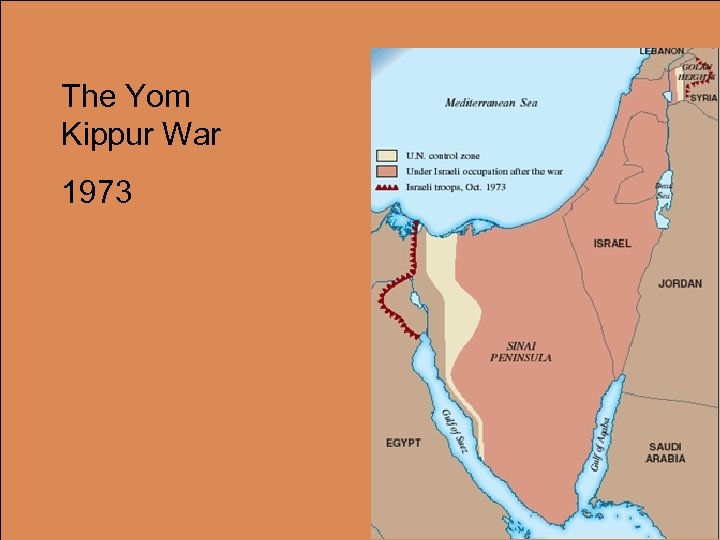 The Yom Kippur War 1973
 THE REPUBLICAN AGENDA AT HOME l As economic growth and stability eluded the nation, Nixon tried to reorganize rapidly expanding and expensive welfare programs – – l Family Assistance Plan, which would have guaranteed a minimum yearly stipend of $1000 to a family of four with food stamps providing an additional $800, died in the Senate Tried to restore “law and order” by denouncing disruptive elements and appealing to blue-collar youth and launching a campaign on crime often waged at the expense of individuals’ constitutional rights Nixon also nominated four justices to the Supreme Court including Warren Burger, a moderate, as chief justice and more partisan selections that met serious opposition – – The more conservative court narrowed defendant’s rights, slowed liberalization of pornography laws, and ruled that journalists did not have the right to refuse to answer questions for a grand jury Surprisingly, in the 1973 Roe v. Wade decision, the court legalized abortion
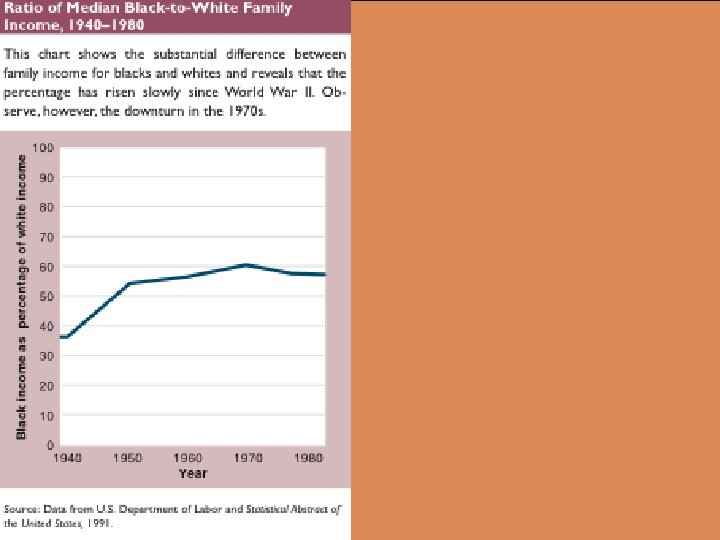
 CONTINUING CONFRONTATION IN CIVIL RIGHTS l Nixon was less sympathetic to the cause of civil rights than his Democratic predecessors – – – l Nixon felt that any effort to woo the black electorate in the South was a waste of his time Moved to reduce appropriations for fair housing enforcement then tried to block the extension of the Voting Rights Act of 1965 Nixon supported efforts to suspend federal desegregation of public schools and denounced a Supreme Court decision that prevented the effort After a 1971 Supreme Court ruling that district courts had a broad authority to order desegregation, Nixon denounced busing of Black students into white school districts – – De Facto segregation was present in the North and Court decisions soon required them to integrate their schools as well leading to resistance, especially in Boston Many whites responded by fleeing the city or sending their children to private school Republicans managed to slow down the desegregation movement though integration in post secondary schools came easier as federal affirmative action guidelines helped A 1978 Supreme Court decision allowed “consideration” of race but not quotas
 THE ONGOING EFFORT IN VIETNAM l l The war in Vietnam continued into the 1970 s despite Nixon’s supposed plan to end the war Once in office, Nixon sought to bring American troops home as a way of defusing opposition to the struggle though he still wanted to avoid losing the war
 VIETNAMIZATION—BRINGING THE SOLDIERS HOME l The Nixon Doctrine, asserted the United States would aid friends and allies but would not undertake the full burden of troop defense – – – l Known as Vietnamization, this was Nixon’s plan to bring American soldiers home from the Vietnam war by gradually replacing American forces with Vietnamese troops Between 1968 and 1972, American troop strength dropped from 543, 000 to 39, 000 U. S. launched ferocious air attacks on North Vietnam which led war protests to multiply in 1969 and 1970 In November 1969, as a massive protest demonstration took place in Washington, DC, stories surfaced of a massacre of civilians the year before in My Lai
 WIDENING THE WAR l Realizing that the Vietnamese relied on supplies funneled through Cambodia, Nixon announced in mid 1970 that American and Vietnamese troops were invading the country – l Brought renewed demonstrations on college campuses that led to the deaths of four students at Kent State in Ohio and two students at Jackson State University in Mississippi In 1971, the New York Times began publishing a secret Defense Department account of American involvement in Vietnam known as the Pentagon Papers which had been leaked by Daniel Ellsburg – Nixon administration tried to block publication
 THE END OF THE WAR AND DÉTENTE l Negotiations dragged on past the election of 1972 as South Vietnam balked at the proposed settlement causing Nixon to launch a massive bombing campaign against the North and mining their harbors – – l Disillusionment with the war undermined assumptions about America’s role in world affairs – – – l l Lost 58, 000 men with far more wounded and maimed Blacks and Chicanos were disproportionately represented in combat units and consequently suffered greater numbers of deaths and injuries War cost over $150 billion Nixon established relations with the People’s Republic of China by visiting in February 1972 Nixon also visited the Soviet Union in May 1972 and signed the first Strategic Arms Limitation Treaty (SALT I) which included a five-year agreement setting ceilings on intercontinental and other ballistic missiles and an antiballistic missile treaty restricting the number of systems each nation could develop and deploy – l A cease fire was finally signed in early 1973 Conflict lingered until 1975 when the North Vietnamese consolidated their hold on the entire country despite a last minute call from then president Gerald Ford for $1 billion in aid (Congress refused) Also agreed to cooperate in space and end long standing restrictions on trade Henry Kissinger engaged in shuttle diplomacy in the Middle East to help arrange the cease fire in the Yom Kippur War and then working to establish better relations with Arab nations
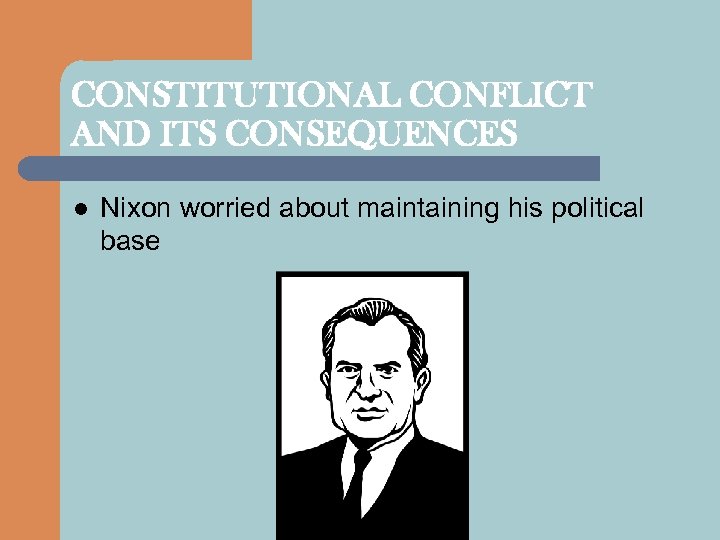 CONSTITUTIONAL CONFLICT AND ITS CONSEQUENCES l Nixon worried about maintaining his political base
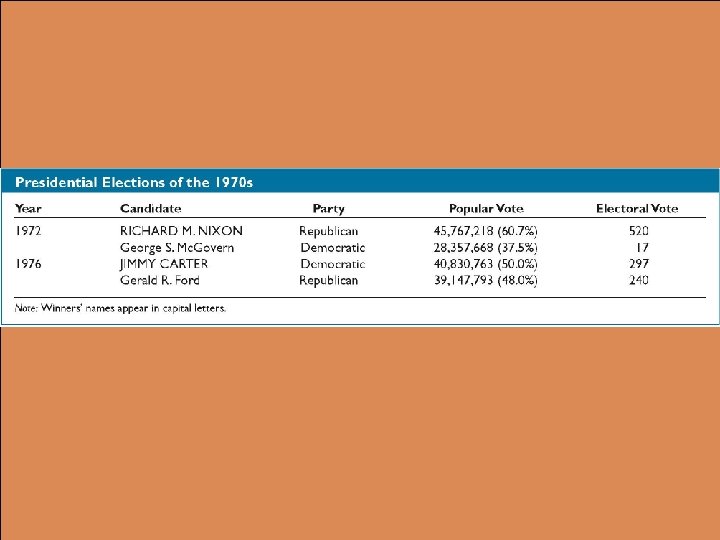
 THE WATERGATE AFFAIR l Charles Colson, John Dean, E. Howard Hunt and G. Gordon Liddy all worked on ways to undermine Nixon’s political opponents – l Early in 1972, Nixon’s aides proposed an elaborate scheme to wiretap various leaders of the Democratic Party and to disrupt their nominating convention – – l Committee to Re-Elect the President, headed by Mitchell, launched a major fundraising campaign and used much of the money to finance dirty tricks Mitchell authorized the wiretapping of Democratic National Headquarters which occurred on 16 June 1972 The wiretappers were arrested and the Nixon administration moved to block efforts to investigate the crime while members of the administration perjured themselves in court Nixon easily won the 1972 election and the Watergate burglars were convicted and sent to jail – – Bob Woodward and Carl Bernstein continued the investigation and uncovered others who were involved Senate Select Committee on Presidential Campaign Activities undertook its own investigation and one of the burglars testified that the White House had been involved
 THE WATERGATE AFFAIR l l Faced with growing investigations, Nixon released Haldeman and Ehrlichman In May 1973 Congress began televised hearings – – – – John Dean testified that Nixon knew about the cover-up and others testified to a host of illegal activities An aide disclosed that Nixon had a secret taping system in the Oval Office Nixon appointed Archibald Cox as special prosecutor but when Cox asked for the tapes, he fired him Nixon’s popularity plummeted and the House Judiciary Committee began to debate impeachment in July 1974, deciding to impeach the president on the grounds of obstruction of justice, abuse of power and refusal to obey a congressional subpoena to turn over his tapes On August 5, Nixon turned over the tapes in accord with a Supreme Court ruling On 9 August 1974, Richard Nixon resigned from office The Watergate Affair helped further undermine trust in the presidency and a decrease in political participation
 GERALD FORD: CARETAKER PRESIDENT l Gerald Ford became president upon the resignation of Richard Nixon, having become vice president when Spiro Agnew resigned in disgrace for accepting bribes – – – Ford emphasized conciliation and compromise and promised to cooperate with Congress and with American citizens He then pardoned Nixon Inflation and unemployment both continued to rise and the GNP declined Ford finally introduced a tight money policy that led to the most severe recession since the Great Depression Congress pushed for an anti-recession spending program so Ford endorsed a major tax cut along with higher unemployment benefits
 THE CARTER INTERLUDE l In 1976, Ford faced Democratic candidate Jimmy Carter – – – l l l In economics, Carter first allowed deficit spending but when deficits climbed too high he cut spending, hurting social programs without solving economic programs Carter’s energy program met with ridicule and bogged down in Congress and he alienated liberals by launching deregulation One area of success was Carter’s brokering of an agreement between Israel and Egypt in September 1978 that led to a formal peace agreement the following March – l Carter stood for honesty, home-spun virtue and a reduction of presidential powers and portrayed himself as a Washington outsider Carter won, bringing together many of the traditional elements of the Democratic party Unfortunately he tended to respond to problems in a haphazard way and never seemed to have a legislative agenda US sent aid to Egypt even as the Soviet Union stepped in as a major supplier of the PLO Carter had a passionate commitment to human rights which seemed to clash with some of his policy decisions
 THE CONTINUING QUEST FOR SOCIAL REFORM l l A struggle for social reform added to the turbulence of the 1970 s Black struggle for civil rights helped spark a women’s movement – This movement, like those of Native Americans and Latinos, employed a confrontational approach
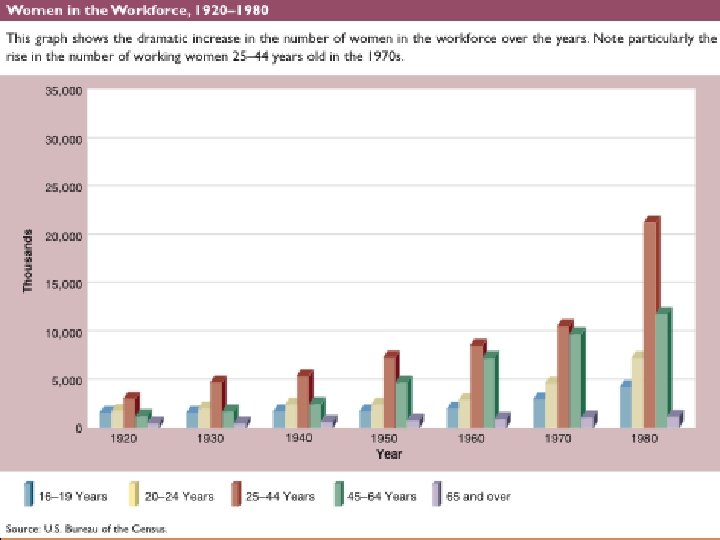
 ATTACKING THE FEMININE MYSTIQUE l l In the 1950 s and 1960 s, increasing numbers of married women joined the workforce and more young women attended college The women’s movement depended on reform legislation to help end gender discrimination – l In 1966 the National Organization of Women (NOW) was founded to help women achieve full pay, equal opportunity and an egalitarian form of marriage – l l Title VII of the 1964 Civil Rights bill actually had a provision prohibiting discrimination on the basis of sex Radical women felt NOW was not doing enough and set out to show women their oppression through protests at Miss America among other activities Women’s jobs and goals shifted even as Title IX of the Education Amendment of 1972 made easier the admission of women to college and changed the nature of intercollegiate athletics A flurry of publications spread the principles of the women’s movement The combined women’s movement pushed for adoption of an Equal Rights Amendment, but the required 38 states for ratification could not be achieved Black women viewed the movement with ambivalence while other women felt the women’s movement was contemptuous of women who stayed home
 LATINO MOBILIZATION l Latinos became more vocal and confrontational as their numbers increased in the postwar years – l Chicanos took the lead in protesting, becoming more politically active in the 1960 s and 1970 s though more important was direct action championed by people like César Chávez, founder of the United Farm Workers – – – l Median household income remained less than three-fourths that of Anglos and inferior education and political weakness reinforced social and cultural separation Latina women played an important part in the organizing effort Chávez took on grape growers by striking and encouraging a national boycott ending is success and leading to similar actions against other products harvested by exploited labor In 1975, California required growers to bargain collectively with elected representatives of the farm workers In the West and Southwest, Mexican American studies programs flourished
 LATINO MOBILIZATION l Beginning in 1968, Mexican American students began to protest conditions in secondary schools that were overcrowded and rundown with a 50 percent drop out rate – l Young Citizens for Community Action adopted a paramilitary stance and evolved into a defensive patrol, known as Young Chicanos for Community Action (Brown Berets) with chapters throughout the Midwest and Southwest – – – l l Walkouts led to Latino teachers, counselors and courses as well as better facilities La Raza Unida which promoted Mexican American candidates for political office La Alianza Federal de Mercedes Crusade for Justice Latinos especially protested the Vietnam War Nixon courted the Latino vote through political positions, government jobs and promises of better programs
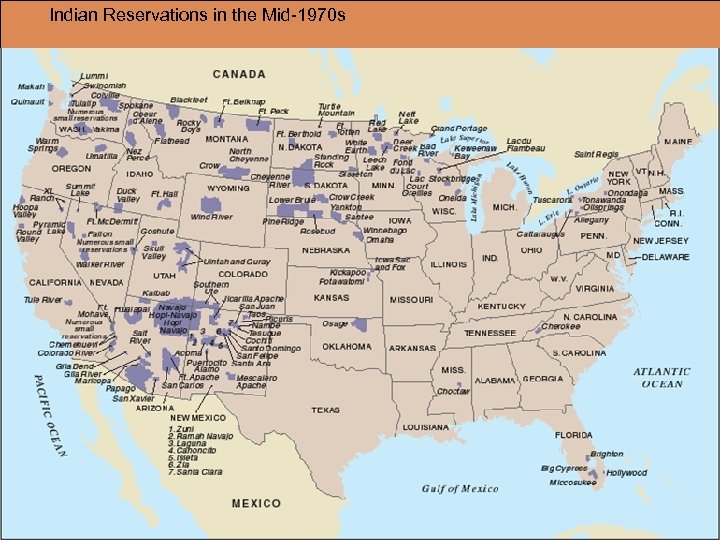
 NATIVE AMERICAN PROTEST l l Growing numbers of Native Americans gave them greater visibility and political clout 1961, several hundred Native Americans asked the government for the right to help make decisions about programs and budgets for the tribes – l Indians in the late 1960 s and 1970 s successfully promoted their own values and designs – – – l l National Indian Youth Council aimed at reestablishing national pride Indian fashions became more common, museums and galleries displayed Indian art and Indian jewelry found a new market The larger culture came to appreciate important work by Native Americans even as popular films provided sympathetic portrayals of Indian history Indian studies programs developed in colleges and universities Indians tried to protect what was left of their tribal lands Native American leaders found that lawsuits charging violations of treaty rights could give them powerful leverage – Also protested assaults on their water and fishing rights
 NATIVE AMERICAN PROTEST l Urban activism became visible in 1968 with the founding of the American Indian Movement (AIM) in Minneapolis – l November 1969, Indians seized Alcatraz Island to protest the practices of the Bureau of Indian Affairs – – l l 1972 Broken Treaties Caravan to Washington DC resulted in the occupation of the BIA 1973 AIM occupied Wounded Knee leading to an armed confrontation with federal officials Indians devoted increasing attention to providing education and developing legal skills – l Got Office of Economic Opportunity funds channeled to Indian controlled organizations and established patrols to protect drunken Indians from police harassment Many tribal communities founded their own colleges Outcry against termination led JFK and Johnson to steer a middle course and to bolster reservation economies and raise standards of living by persuading private industries to locate on reservations and promoting the leasing of reservation land to energy and development corporation 1975 Congress passed the Indian Self Determination Act and an Education Assistance Act
 Indian Reservations in the Mid-1970 s
 GAY AND LESBIAN RIGHTS l l A nightlong riot in 1969, in response to a police raid on the Stonewall Inn, a homosexual bar in Greenwich Village, New York, helped spark a new consciousness and a movement for gay rights Throughout the 1970 s, homosexuals successfully fought the most blatant forms of discrimination – – – In 1973, the American Psychiatric Association ruled that homosexuality should no longer be classified as a mental illness 1975 the US Civil Service Commission lifted its ban on employment of homosexuals Both men and women became more open about their sexual preferences and a separate lesbian movement developed
 ENVIRONMENTAL AND CONSUMER AGITATION l l Modern environmental movement stemmed from postwar yearnings for a better quality of life In 1969, Americans learned that thermal pollution from nuclear power plants was killing fish – – A massive oil spill off the coast of California wiped out most of the marine life in the area Concern about the environment increased as people learned more about substances they had once taken for granted especially after the lethal effects of toxic chemicals at Love Canal were revealed in 1978 A few years later, attention focused on dioxin, while the nuclear accident at Three Mile Island in 1979 increased concern over possible environmental dangers of nuclear energy and led to formation of groups that campaigned against new plants In the West, environmentalists were concerned about water use
 ENVIRONMENTAL AND CONSUMER AGITATION l Activists produced legislation that halted the depletion of the country’s natural resources then pressuring legislative and administrative bodies to regulate polluters – l Initially these measures aimed at controlling the toxic by-products of the modern industrial order, then environmentalists broadened the effort to include occupational health and social justice issues – l Under Nixon, Congress passed the Clean Air Act, the Water Quality Improvement Act, the Resource Recovery Act and mandated the Environmental Protection Agency (EPA) to spearhead the effort to control abuses Endangered Species Act of 1973 led to a confrontation with Northwest loggers while the Sagebrush Rebellion demanded the government cede national landholdings to the states A consumer movement also emerged that aimed at protecting the interests of the purchasing public and making business more responsible to consumers – Ralph Nader led the movement having obtained the National Traffic and Motor Vehicle Safety Act in 1966
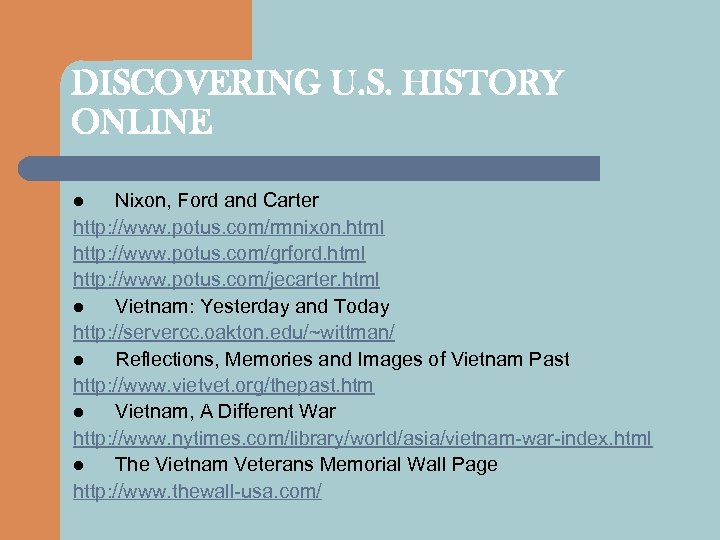 DISCOVERING U. S. HISTORY ONLINE Nixon, Ford and Carter http: //www. potus. com/rmnixon. html http: //www. potus. com/grford. html http: //www. potus. com/jecarter. html l Vietnam: Yesterday and Today http: //servercc. oakton. edu/~wittman/ l Reflections, Memories and Images of Vietnam Past http: //www. vietvet. org/thepast. htm l Vietnam, A Different War http: //www. nytimes. com/library/world/asia/vietnam-war-index. html l The Vietnam Veterans Memorial Wall Page http: //www. thewall-usa. com/ l
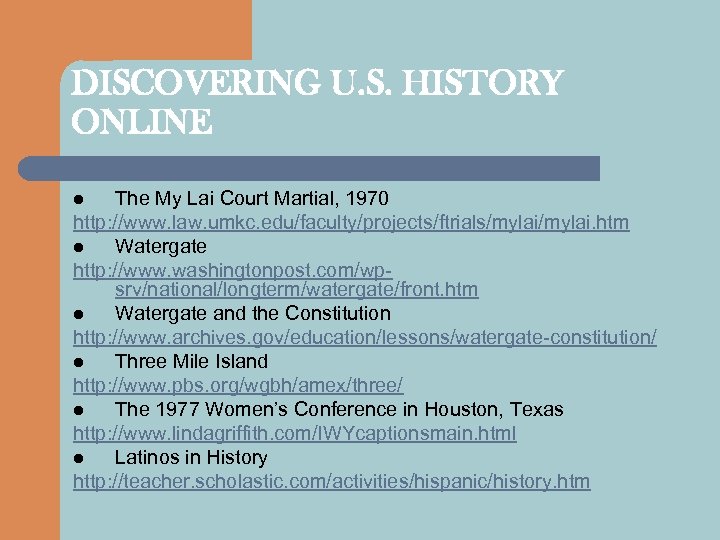 DISCOVERING U. S. HISTORY ONLINE The My Lai Court Martial, 1970 http: //www. law. umkc. edu/faculty/projects/ftrials/mylai. htm l Watergate http: //www. washingtonpost. com/wpsrv/national/longterm/watergate/front. htm l Watergate and the Constitution http: //www. archives. gov/education/lessons/watergate-constitution/ l Three Mile Island http: //www. pbs. org/wgbh/amex/three/ l The 1977 Women’s Conference in Houston, Texas http: //www. lindagriffith. com/IWYcaptionsmain. html l Latinos in History http: //teacher. scholastic. com/activities/hispanic/history. htm l