


 Скачать презентацию THE AMERICAN PEOPLE CREATING A NATION AND A
8b1083a992381f5ea171f4d1cdf12303.ppt
- Количество слайдов: 37
 THE AMERICAN PEOPLE CREATING A NATION AND A SOCIETY NASH JEFFREY HOWE FREDERICK DAVIS WINKLER MIRES PESTANA 7 th Edition Chapter 28: Reform and Rebellion in The Turbulent Sixties, 1960 -1969 Pearson Education, Inc, publishing as Longman © 2006
 JOHN F. KENNEDY: THE CAMELOT YEARS l Commitment to an American welfare state reached its high-water point in the 1960 s – l Democrats wanted to follow European and British social welfare examples and broaden the role of government John F. Kennedy announced the “New Frontier”
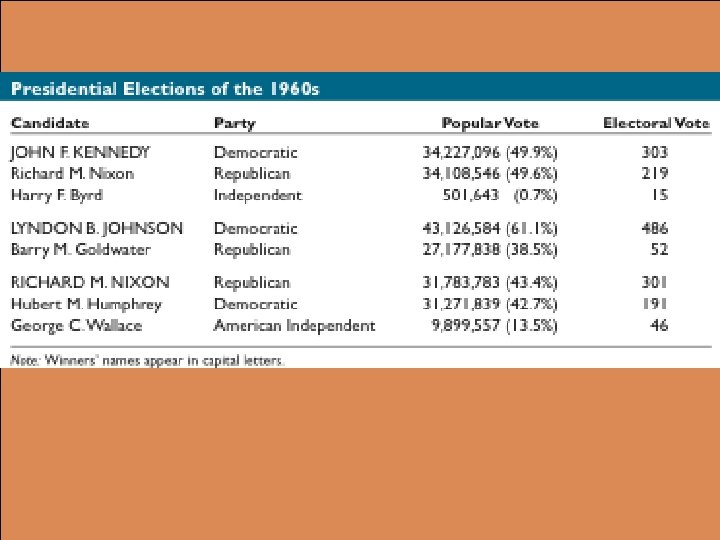
 THE ELECTION OF 1960 l Kennedy, who wanted the government to play a more active role, ran against Vice President Nixon – – l Although clearly more qualified than Kennedy, Nixon was outshone by Kennedy during the famous television debates Kennedy overcame large odds to become America’s first Catholic president Kennedy’s electoral margin of 303 to 219 concealed a triumph in the popular vote of only 120, 000 out of 68 million votes cast
 JFK l Kennedy represented youth, vigor, idealism and important change – – Eloquent speaker Believed in strong leadership Surrounded himself with talented people Looked especially glamorous due to his wife and the glittering social occasions they hosted
 THE NEW FRONTIER IN ACTION l Kennedy was committed to extending the welfare state and ending the recession by working with the business community and controlling price inflation – – l l Problem arose when the steel industry tried to raise prices unjustifiably as Kennedy saw it and pressed for action to get steel companies to capitulate Six weeks later, the stock market plunged and Kennedy began to consider Keynsian solutions calling, in 1963, for a $13. 5 billion corporate tax cut over three years Congress refused to pass the cut JFK also experienced resistance to his proposals to raise the minimum wage, provide federal aid for education, medical care for the elderly, housing subsidies, and urban renewal with only a pared down minimum wage making it through Congress Kennedy proposed the U. S. commit itself to putting a man on the moon before the end of the decade and Congress increased funding for the National Aeronautics and Space Administration (NASA) Kennedy established the Peace Corps, which sent young people overseas to help developing nations
 CIVIL RIGHTS AND KENNEDY’S RESPONSE l NAACP remained committed to overturning the legal basis for segregation – – – l Confrontations continued in the 1960 s – – – l Congress of Racial Equality (CORE), an inter-racial group established in 1942, promoted change through peaceful confrontation Southern Christian Leadership Conference (SCLC) was an organization of southern black clergy formed in the wake of the bus boycott in Alabama The Student Nonviolent Coordinating Committee (SNCC) was organized in 1960 and was more militant than other groups Sit in in Greensboro, North Carolina, in January 1960, spread to other cities Sit ins gave rise to freedom bus rides, organized by CORE and aided by SNCC, aimed at testing southern transportation facilities that had recently been desegregated Many whites joined the movement Civil rights movement accelerated in 1962 when James Meredith applied to all white University of Mississippi and the Supreme Court affirmed his right to attend though the Governor denied entry leading to a riot – Other governors were equally aggressive
 CIVIL RIGHTS AND KENNEDY’S RESPONSE l In 1963 Alabama became a national focus as southern officials reacted violently to peaceful civil rights protests and television viewers were horrified by the violence – – – l Kennedy did little though he did issue an executive order, in 1962, ending segregation in federally financed housing During the James Meredith confrontation, Kennedy had to send federal troops to restore order and guarantee Meredith’s right to attend the university Administration forced the desegregation of the University of Alabama and brokered a compromise that eased discrimination in Birmingham’s municipal facilities and hiring practices Kennedy finally spoke out in a national televised address calling the quest for equal rights a “moral issue” Hours after Kennedy spoke, civil rights activist Medgar Evars was murdered Kennedy sent Congress a new and stronger civil rights bill, outlawing segregation in public places, banning discrimination wherever federal money was involved and advancing the process of school integration – – Polls showed 63 percent of the nation supported his stand Black leaders arranged for a massive march on Washington in August 1963
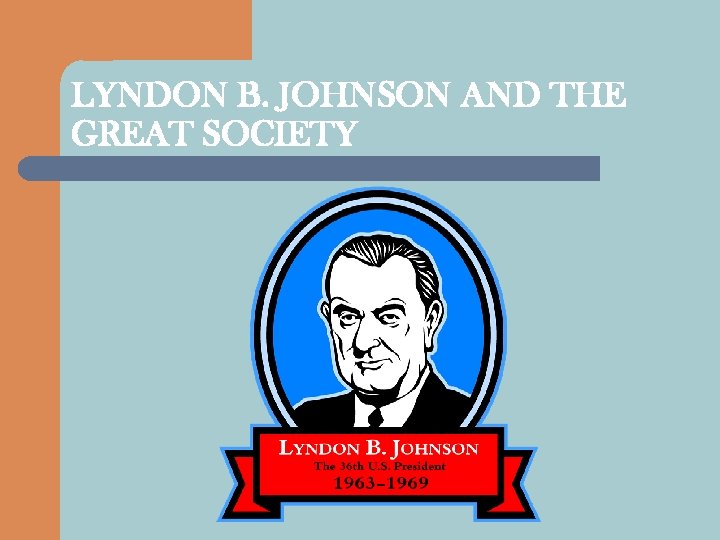 LYNDON B. JOHNSON AND THE GREAT SOCIETY
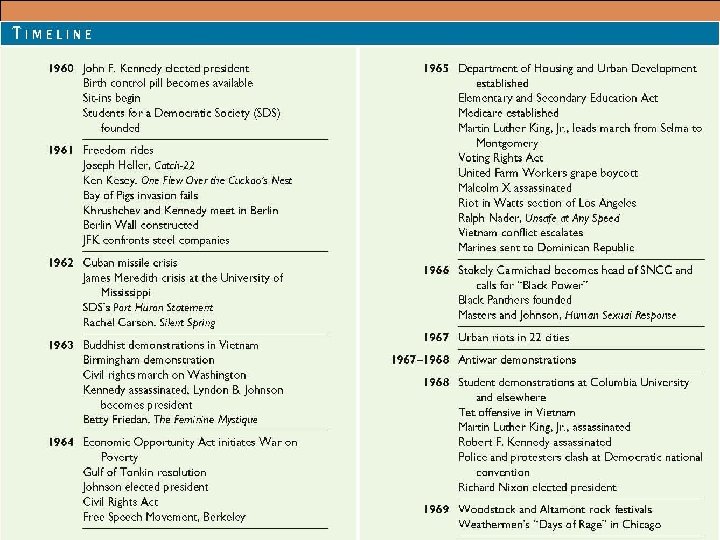
 CHANGE OF COMMAND l In November 1963, JFK was assassinated while visiting Texas and Lyndon Baines Johnson became president – Johnson was a more effective political leader than Kennedy
 LBJ l l An ambitious and effective politician, Johnson ran the Senate with tight control and agreed to become Kennedy’s vice presidential candidate when it was clear Kennedy had a good chance of winning Johnson felt stifled as vice president and uncomfortable with the Kennedy crowd – – Was determined to utilize Kennedy’s memory to achieve legislative success Was willing to wield presidential power aggressively and to use the media to shape public opinion
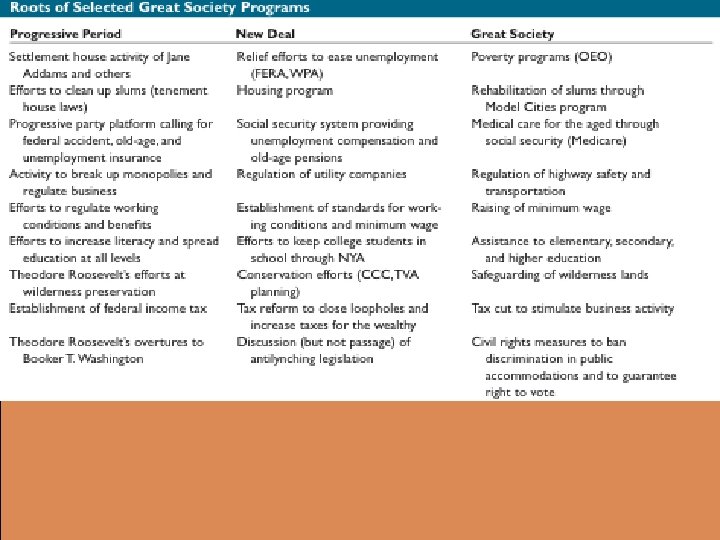
 THE GREAT SOCIETY IN ACTION l Lyndon Johnson had an expansive vision of the possibilities of reform – – l l Succeeded in pushing through Congress the most extensive reform program in American history Johnson pushed for measures JFK had been unable to get through Congress and called this program the “Great Society” Gained a landslide victory over Republican Barry Goldwater in 1964 and Democratic control over Congress Johnson launched a coordinated effort to get his bills through Congress While Civil Rights was central, Johnson pressed for other legislation such as a tax cut, which he received Johnson then pressed for an antipoverty program – – Economic Opportunity Act of 1964 created an Office of Equal Opportunity (OEO) to provide education and training through programs such as the Job Corps, VISTA, and Head Start Additional programs gave voice to the poor and to Native Americans
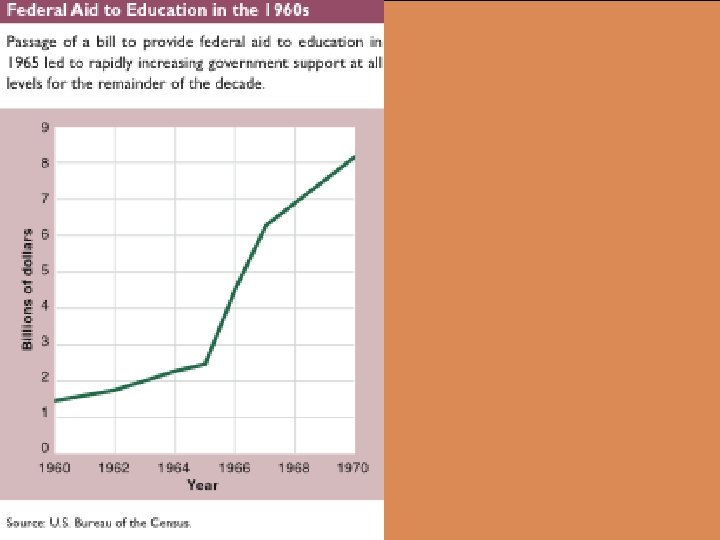
 THE GREAT SOCIETY IN ACTION l Proposed a medical assistance program tying the Medicare program to the social security system and limiting the program to the elderly – l l Johnson also managed to provide aid for elementary and secondary schools Johnson got Congress to pass a new housing act to give rent supplements to the poor and created a Cabinet Department of Housing and Urban Development – – l Federal government provided new forms of aid and moved further in funding higher education Congress provided artists and scholars with assistance through the National Endowment for the Arts and Humanities, created in 1965 Immigration Act of 1965 vastly increased the ceiling on immigration and opened the door to immigrants from Asia and Latin America – l New Medicaid program met the needs of those on welfare and other groups who could not afford private insurance New stream of immigration (some 350, 000 per year) made the country more diverse than it had been since the early 20 th century Rachel Carson’s 1962 book Silent Spring alerted the country to vast environmental degradation – – National Wilderness Preservation Act of 1964 set aside 9. 1 million acres of wilderness and Congress passed other measures to limit air and water pollution Lady Bird Johnson led a beautification campaign
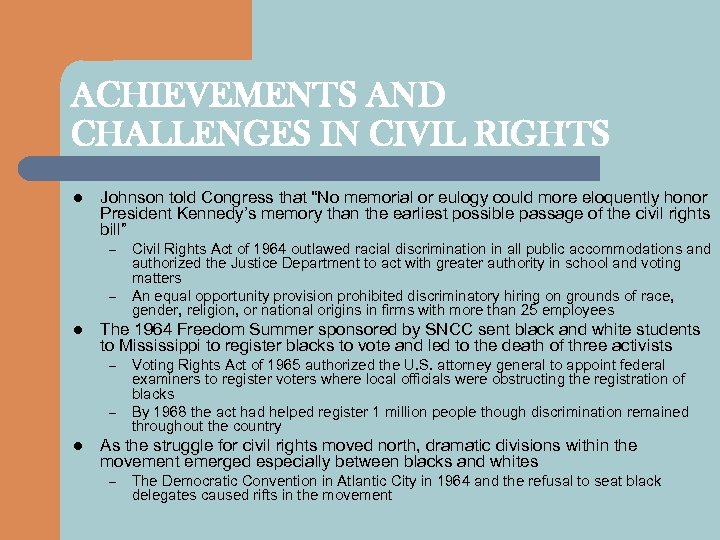 ACHIEVEMENTS AND CHALLENGES IN CIVIL RIGHTS l Johnson told Congress that “No memorial or eulogy could more eloquently honor President Kennedy’s memory than the earliest possible passage of the civil rights bill” – – l The 1964 Freedom Summer sponsored by SNCC sent black and white students to Mississippi to register blacks to vote and led to the death of three activists – – l Civil Rights Act of 1964 outlawed racial discrimination in all public accommodations and authorized the Justice Department to act with greater authority in school and voting matters An equal opportunity provision prohibited discriminatory hiring on grounds of race, gender, religion, or national origins in firms with more than 25 employees Voting Rights Act of 1965 authorized the U. S. attorney general to appoint federal examiners to register voters where local officials were obstructing the registration of blacks By 1968 the act had helped register 1 million people though discrimination remained throughout the country As the struggle for civil rights moved north, dramatic divisions within the movement emerged especially between blacks and whites – The Democratic Convention in Atlantic City in 1964 and the refusal to seat black delegates caused rifts in the movement
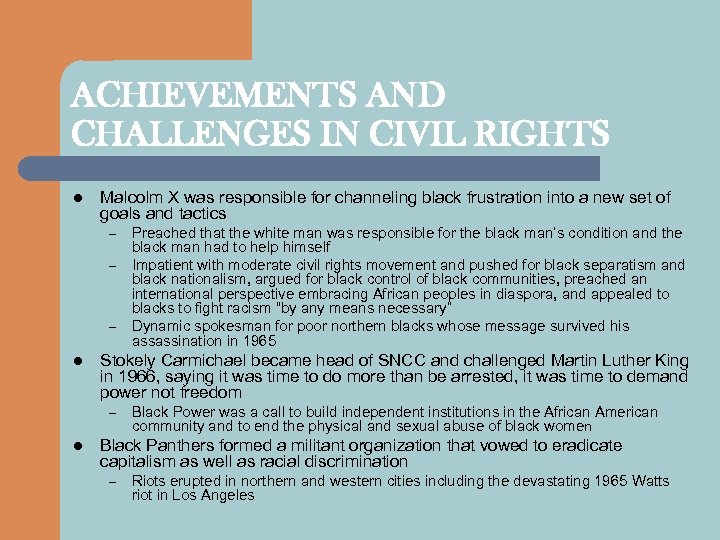 ACHIEVEMENTS AND CHALLENGES IN CIVIL RIGHTS l Malcolm X was responsible for channeling black frustration into a new set of goals and tactics – – – l Stokely Carmichael became head of SNCC and challenged Martin Luther King in 1966, saying it was time to do more than be arrested, it was time to demand power not freedom – l Preached that the white man was responsible for the black man’s condition and the black man had to help himself Impatient with moderate civil rights movement and pushed for black separatism and black nationalism, argued for black control of black communities, preached an international perspective embracing African peoples in diaspora, and appealed to blacks to fight racism “by any means necessary” Dynamic spokesman for poor northern blacks whose message survived his assassination in 1965 Black Power was a call to build independent institutions in the African American community and to end the physical and sexual abuse of black women Black Panthers formed a militant organization that vowed to eradicate capitalism as well as racial discrimination – Riots erupted in northern and western cities including the devastating 1965 Watts riot in Los Angeles
 A SYMPATHETIC SUPREME COURT l With the addition of four liberal justices under JFK and Johnson, the Supreme Court supported and promoted the liberal agenda under the leadership of chief justice Warren Burger – – – Gideon v. Wainwright (1963): poor defendants in serious cases had the right to free legal counsel Escobedo v. Illinois (1964): suspect has to be given access to an attorney during questioning Miranda v. Arizona (1966): offenders had to be warned that statements extracted by the police could be used against them and they had the right to remain silent Baker v. Carr (1962): opened the way to reapportionment of the state legislative bodies according to the standard of “one person, one vote” which helped break the political control of lightly populated rural districts in many state assemblies and made the House of Representatives much more responsive to urban and suburban issues. Court ruled that prayer could not be required in public schools and that obscenity laws could no longer restrict allegedly pornographic material that might have some “redeeming social value”
 THE GREAT SOCIETY UNDER ATTACK l Although working as planned for a few years, many of the Great Society’s goals were too ambitious or prepared in haste with massive sums of money seemingly disappearing with little results – l Factionalism was also a problem and criticism of the Great Society came from across the political spectrum The American involvement with the Vietnam War dealt the Great Society a crippling blow as efforts to maintain the war and the Great Society produced serious inflation – – – As war spending increased, the productive system of the country could not keep up with demand Johnson refused to raise taxes Congress eventually slashed Great Society programs
 CONTINUING CONFRONTATIONS WITH COMMUNISTS l JFK and Johnson were both aggressive cold warriors whose commitment to stopping the spread of communism kept the nation locked in the same bitter conflict that had dominated politics in the 1950 s
 THE BAY OF PIGS FIASCO AND ITS CONSEQUENCES l Just before Kennedy assumed office, the U. S. broke diplomatic relations with Cuba even as the CIA was training anti-Castro exiles to invade Cuba at the Bay of Pigs which was supposed to lead to an uprising of the Cuban people – – – l Kennedy approved the plan and the invasion occurred on April 17, 1961 Early air strike failed to destroy Cuban airpower and Kennedy refused American planes for air cover The invaders were captured and the Cuban people supported Castro Following a hostile meeting with Khrushchev in Vienna in June 1961, Kennedy asked Congress for $3 billion more in defense appropriations, for more personnel in the armed forces and for funds for a civil defense fall-out shelter program – USSR responded by erecting a wall between East and West Berlin, in part because East Germany had been losing millions of people to the West through the city
 THE CUBAN MISSLE FACE-OFF l In the wake of the Bay of Pigs, Fidel Castro sought and received Soviet assistance – – l Aerial photographs in October 1962 revealed that the USSR had begun to place “offensive” missiles on Cuban soil though the missiles did not change the strategic balance significantly Members of Excomm discussed various options while Kennedy went on nationwide television to tell the American people about the missiles and to demand their removal, announcing he was imposing a naval quarantine around Cuba to prevent Soviet ships from bringing in additional missiles Khrushchev called the Soviet ships back and sent a letter promising to remove the missiles if the US lifted the quarantine and promised to stay out of Cuba Second letter, which Kennedy decided to ignore, also demanded the removal of American missiles in Turkey Initially, Kennedy looked like a hero though critics later charged the crisis had been unnecessary – – A Soviet-American hotline was installed to avoid similar episodes in the future USSR was determined to increase its nuclear arsenal
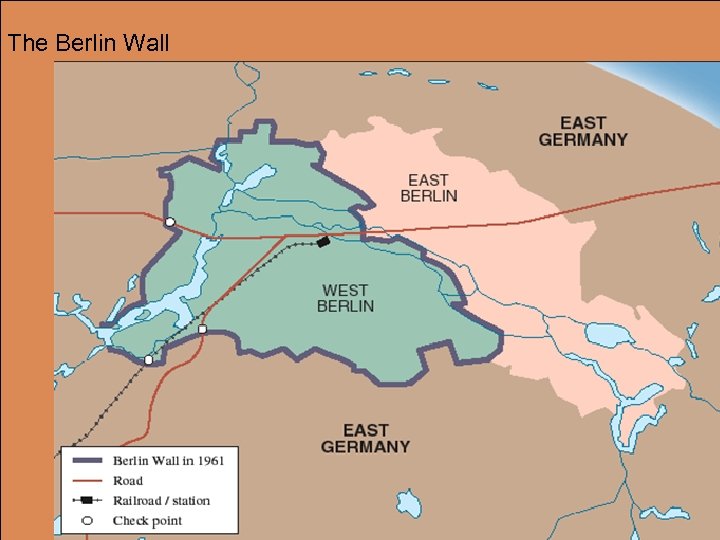 The Berlin Wall
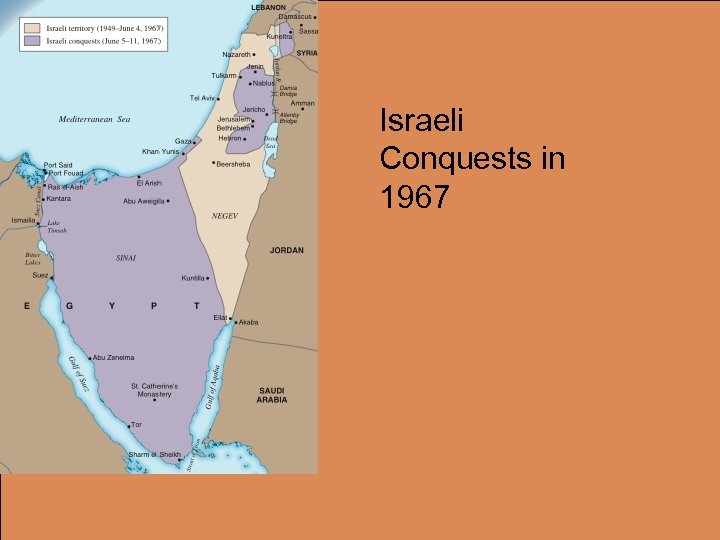 Israeli Conquests in 1967
 CONFRONTATION AND CONTAINMENT UNDER JOHNSON l Johnson also believed aggressors had to be stopped before they committed more aggression – l l Believed in domino theory In 1965, Johnson dispatched more than 20, 000 troops to the Dominican Republic, hurting his credibility In 1967, Israel defeated Egypt in the Six-Day War and seized the West Bank and Jerusalem, the Golan Heights and the Sinai Peninsula – US pushed for a quick end to the fighting to maintain regional equilibrium and uninterrupted supplies of oil
 WAR IN VIETNAM AND TURMOIL AT HOME l Commitment to stopping the spread of communism led to massive American involvement in Vietnam
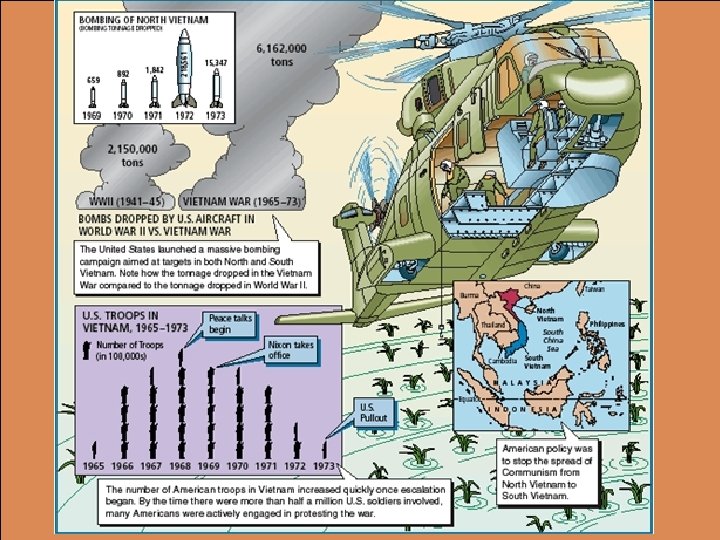
 ESCALATION IN VIETNAM l Kennedy’s commitment to theory of containment led him to escalate the war in Vietnam with thousands of additional “advisers” – – l l l Yet the Catholic Diem had little support and Buddhist monks were immolating themselves to protest his policies With the approval of the U. S. , South Vietnamese military leaders overthrew and assassinated Diem and his brother Kennedy’s reluctance to withdraw in the face of a losing war plagued LBJ Guerillas, known as the Viet Cong or National Liberation Front, gained ground with aid from the north In August 1964, after North Vietnamese torpedo boats supposedly attacked American ships in international waters, Johnson got Congress to approve a resolution authorizing him to “take all necessary measures to repel any armed attack against the forces of the United States and to prevent further aggression” – – – Known as the Gulf of Tonkin Resolution, this led to military escalation in February 1965 after an attack on a US base at Pleiku Johnson ordered the bombing of North Vietnam A few months later he sent American ground troops in with 184, 000 in Vietnam by the end of 1965, 385, 000 in 1966, 485, 000 in 1967 and 543, 000 by 1968 Johnson feared the loss of both American power and prestige if he pulled out A semi-effective government under Nguyen Van Thieu and Nguyen Cao Ky was established, saturation bombing of the North continued as well as the bombing of large areas of the South
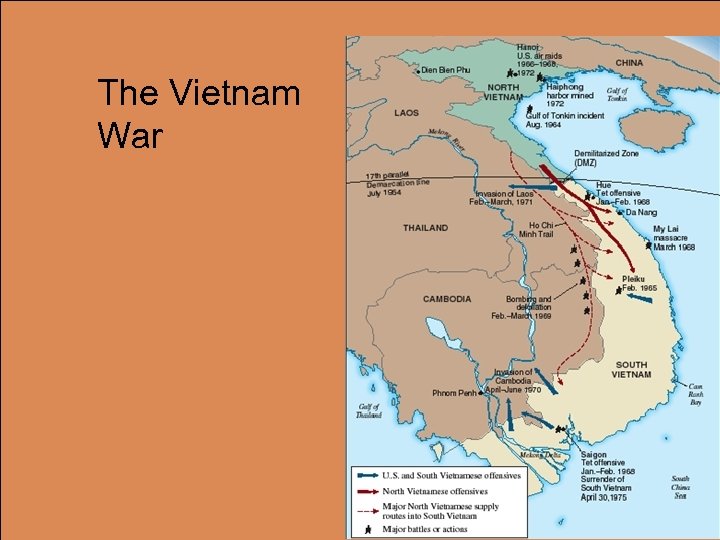 The Vietnam War
 STUDENT ACTIVISM AND ANTIWAR PROTEST l As Americans began to protest their lengthy involvement in the Vietnam War, college students emerged as the strongest voice – – l Protest against escalation in Vietnam fueled and refocused the youth movement – – l The first antiwar teach-in took place in March 1965 at the University of Michigan and was quickly followed by others Muhammad Ali refused to be drafted and radical activists worked against the draft, attacked ROTC units and sought to discredit firms that produced the destructive tools of war Women Strike for Peace Some 300, 000 people marched in protest in New York City, 1967 while 100, 000 tried to close the Pentagon Working class and middle class Americans began to sour on the war at the time of the Tet Offensive in January 1968 when the North Vietnamese mounted attacks in South Vietnam against most major cities, even occupying the US embassy – l Out of disillusionment with the gap between rhetoric and reality grew the radical spirit of the New Left and groups such as the Students for a Democratic Society (1960) which issued the Port Huron Statement in 1962 In 1964, students at Berkeley launched the Free Speech Movement which was basically a plea for traditional liberal reform Won a psychological victory as the attacks appeared on television and undermined American confidence about why they were in Vietnam In 1968, 221 major demonstrations were staged at more than 100 institutions of higher learning – American student protests were part of a worldwide wave of student activism
 THE COUNTERCULTURE l In the 1960 s, young people seemed to lose faith in the American system – l A generation of young women with access to “the pill” helped separate sex from family life and as access increased, more Americans of all classes began to explore their sexuality – l Arts reflected the sexual revolution Hallucinogenic drugs became part of the counterculture – l Hippies: men let their hair grow and grew beards, both sexes wore jeans and muslin shirts and valued spontaneity, often rejecting traditional marriage in favor of communal living Drug use, especially marijuana, permeated all levels of society Music became intimately connected with these cultural changes – Rock festivals became popular in the 1960 s with 400, 000 attending Woodstock in 1969
 THE AGE OF ASSASSINATION l l On April 4, 1968, Martin Luther King, Jr. was assassinated in Memphis, Tennessee, sparking a wave of violence throughout the US Several months later, after victory in the Democratic primary in California, Robert Kennedy was assassinated
 THE CHAOTIC ELECTION OF 1968 l Turbulent Democratic convention in Chicago undermined any hopes of victory in the election – – l l Governor George Wallace of Alabama launched a third party candidacy Republicans nominated Nixon who called on the “Silent Majority” for support and condemned the Great Society – l Mayor Daley urged police to clear out protestors resulting in violent clashes that were televised Since Johnson had refused to run again, his vice president Hubert Humphrey received the nomination Left attacks on the Left to his running mate Spiro Agnew Nixon received 43 percent of the vote while Humphrey got 42 percent but Nixon captured the electoral college
 CONTINUING PROTEST l In October 1969, the Weathermen, a militant fringe group of SDS, rampaged through the streets of Chicago
 DISCOVERING U. S. HISTORY ONLINE John Fitzgerald Kennedy http: //www. potus. com/jfkennedy. html l The Kennedy Assassination http: //mcadams. posc. mu. edu/home. htm l Lyndon Baines Johnson http: //www. potus. com/lbjohnson. html l Voices of the Civil Rights Era http: //www. voicesofcivilrights. org/ l Martin Luther King, Jr. Papers Project http: //www. stanford. edu/group/King/ l Civil Rights Timeline http: //www. infoplease. com/spot/civilrightstimeline 1. html l Cold War Policies http: //history. acusd. edu/gen/20 th/coldwar 0. html l
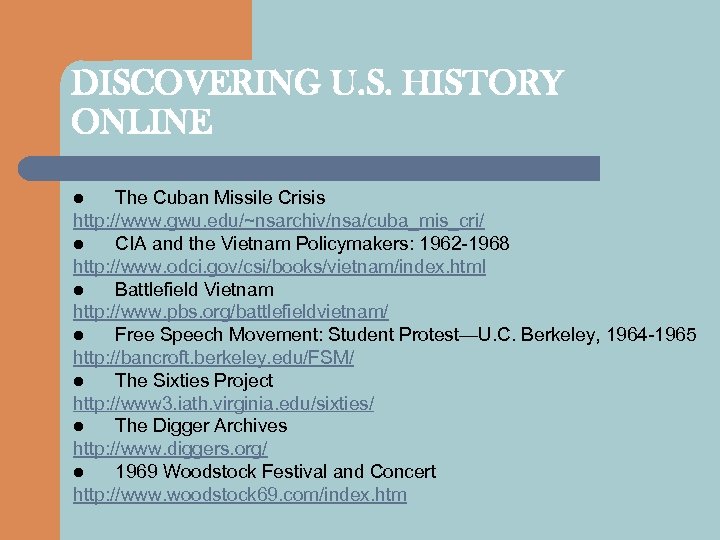 DISCOVERING U. S. HISTORY ONLINE The Cuban Missile Crisis http: //www. gwu. edu/~nsarchiv/nsa/cuba_mis_cri/ l CIA and the Vietnam Policymakers: 1962 -1968 http: //www. odci. gov/csi/books/vietnam/index. html l Battlefield Vietnam http: //www. pbs. org/battlefieldvietnam/ l Free Speech Movement: Student Protest—U. C. Berkeley, 1964 -1965 http: //bancroft. berkeley. edu/FSM/ l The Sixties Project http: //www 3. iath. virginia. edu/sixties/ l The Digger Archives http: //www. diggers. org/ l 1969 Woodstock Festival and Concert http: //www. woodstock 69. com/index. htm l