


 Скачать презентацию The American economic core area North America dr
fe8f2e9d8cb9fcc6dba763e8f731215d.ppt
- Количество слайдов: 30
 The American economic core area: North America dr. Jeney László Senior lecturer jeney@elte. hu Economic Geography I. International Business bachelor study programme (BA) Spring term 2015/2016. CUB Centre of Economic Geography and Futures Studies
 Concept and divisions of America
 Concept and discovery of America, its main features n Name: – Amerigo Vespucci (female version of the name: America) – New World n Discovery: – – – n n n 30– 40 thousand years ago: from Asia (ancestors of Red Indians) 10 thousand years ago: Patagonia was reached Viking fishermen 1492. : Columbus (did not know, it was America) 1497. : John Cabot (North America) Area: 42 mn km 2 (28%) (WR 2. ) Population: 870 mn (14%) A single or a dual continent? – Physical Geography: joining of two continents – Human Geography: division of one continent into two parts after colonisation
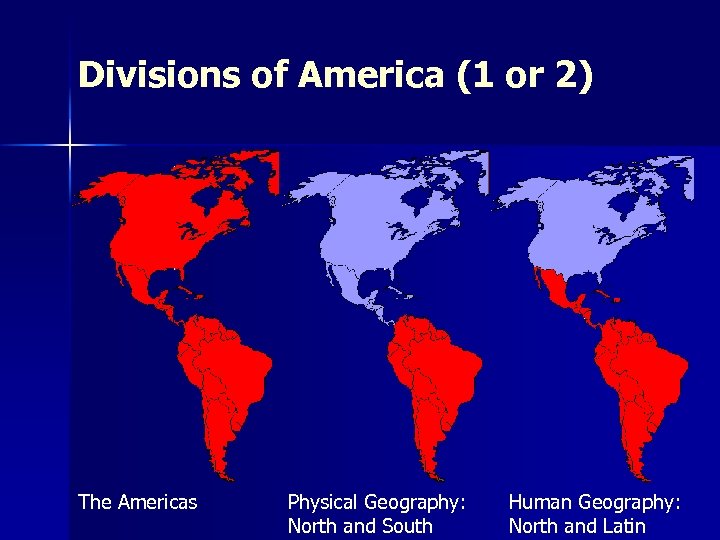 Divisions of America (1 or 2) The Americas Physical Geography: North and South Human Geography: North and Latin
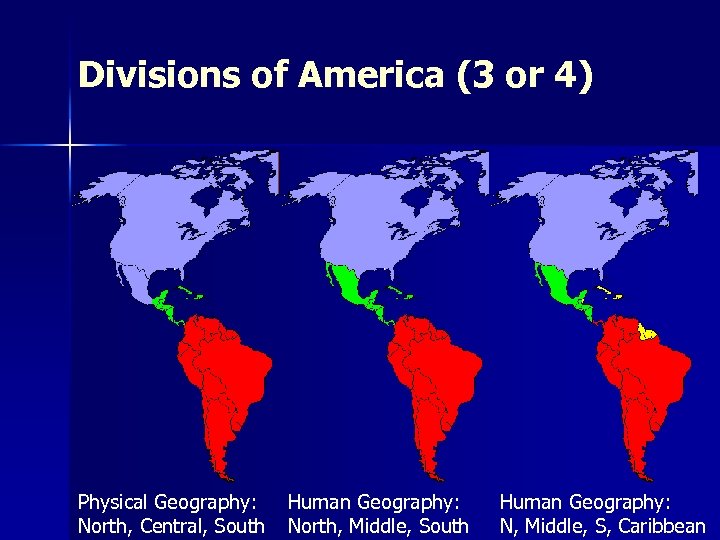 Divisions of America (3 or 4) Physical Geography: North, Central, South Human Geography: North, Middle, South Human Geography: N, Middle, S, Caribbean
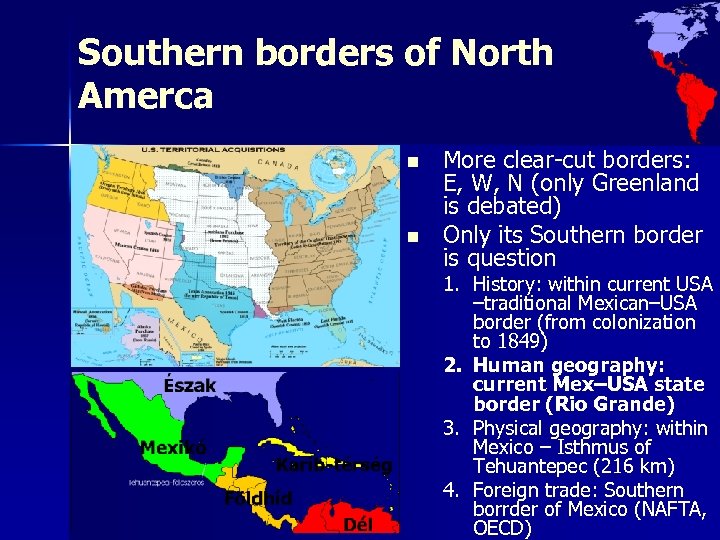 Southern borders of North Amerca n n More clear-cut borders: E, W, N (only Greenland is debated) Only its Southern border is question 1. History: within current USA –traditional Mexican–USA border (from colonization to 1849) 2. Human geography: current Mex–USA state border (Rio Grande) 3. Physical geography: within Mexico – Isthmus of Tehuantepec (216 km) 4. Foreign trade: Southern borrder of Mexico (NAFTA, OECD)
 Evolution of the North American economic pole of the World
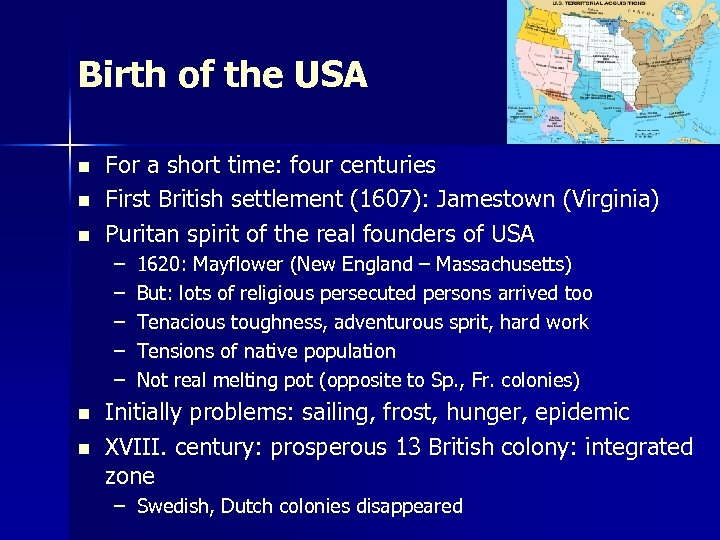 Birth of the USA n n n For a short time: four centuries First British settlement (1607): Jamestown (Virginia) Puritan spirit of the real founders of USA – – – n n 1620: Mayflower (New England – Massachusetts) But: lots of religious persecuted persons arrived too Tenacious toughness, adventurous sprit, hard work Tensions of native population Not real melting pot (opposite to Sp. , Fr. colonies) Initially problems: sailing, frost, hunger, epidemic XVIII. century: prosperous 13 British colony: integrated zone – Swedish, Dutch colonies disappeared
 Commercial Farming Base n Combination of: – Natural resources (climate, land, soils, water) – Economic factors n led to specialization – – Midwest: grain-livestock area Mississippi Delta: cotton area Great Plains: feedlots California (irrigated lands): grape (most productive vineyards) orange – Drier, higher parts of the West: low productivity grazing land
 Manufacturing becomes central n Early 1800 s – East Coast: Southern New England, New Jersey, Eastern Pennsylvania – Manufacturing developed from local crafts (pottery, smithing) – Under family ownership – Based mainly on water mill power – Produced: metal, leather goods, textiles n Required new transportation facilities – – – Financed by federal investments By 1860: railroad reached Chicago from East Coast construction basis of iron industry expansion Coal, iron steel production (Pittsburgh) Inland emerged from the East Coast (closely to the raw materials + as US settled newer markets)
 Manufacturing from 1860 to the World War II n Value from manufactured goods > commercial farm products – Agriculture become industrialized n Till 1950 s: manufacturing: primary engine fuelling the expansion of the US economy – Consumer goods, transportation vehicles (cars, trucks, airplanes) n Traditional developed Manufacturing Belt: New York, Chicago, Detroit
 Key economic industries after World War II n Wider geographic diffusion of manufacturing industries: West Coast, Southern US too – Distributing electricity to rural areas – Interstate highways – Airline routes n n Later: goal to satisfy more market needs (Latin America and Asia) Products became more technologically sophisticated – High-tech goods: Silicon Valley of California, Boston, Washington n n US companies become multinational Service industries: financial, computer services, publishing Tourism: 54 mn visitors to USA, 64 mn American abroad World’s most developed country economic prosperity, political influence Largest GNI (ppp): WR 1 (however: fluctuating growth)
 Regional policies n n n After Civil War: poverty in Southern Appalachia: hill farms on small plots of eroded lands extremely poor World crisis 1933: Tennessee Valley Authority (TVA) – To stimulate economic growth in lagging regions – However dominant US policies: against government-funded regional aid – Economic and population growth, but environmental degradation n 1960 s: Appalachian region: poorest – 1965: Appalachian Regional Commission (ARC): financial aid packages – 1980 s: Ronald Reagan reduced ARC’s funding and effectiveness n n Rural problems Metropolises: increasing dominance in economic and social life
 Canada n n n Natural resources: diamond, irons, timber and other minerals Follows US, but with a time lag Industrialization from the World War II – Import substitution industries: aluminium, vehicles, consumer goods production – Hamilton: steelmaking center – Montréal, Toronto, Vancouver: financial services, commercial enterprises n n GNI ≈ EU members, but not equals with US NAFTA: increased US investment
 The North American economic integration: NAFTA
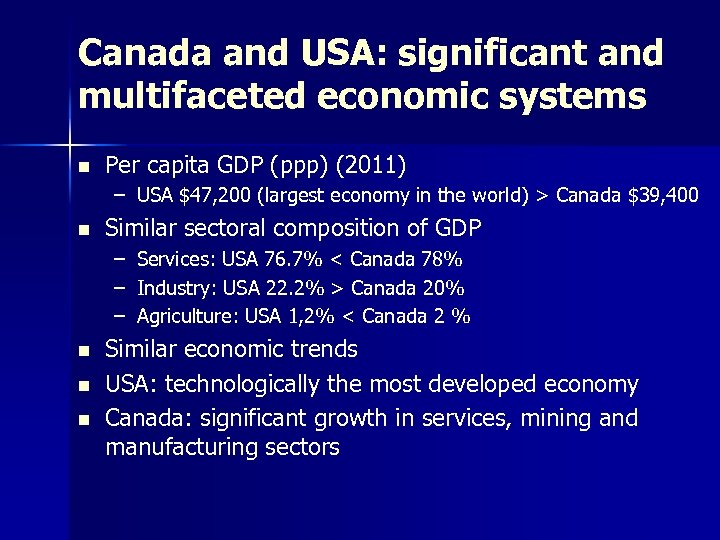 Canada and USA: significant and multifaceted economic systems n Per capita GDP (ppp) (2011) – USA $47, 200 (largest economy in the world) > Canada $39, 400 n Similar sectoral composition of GDP – Services: USA 76. 7% < Canada 78% – Industry: USA 22. 2% > Canada 20% – Agriculture: USA 1, 2% < Canada 2 % n n n Similar economic trends USA: technologically the most developed economy Canada: significant growth in services, mining and manufacturing sectors
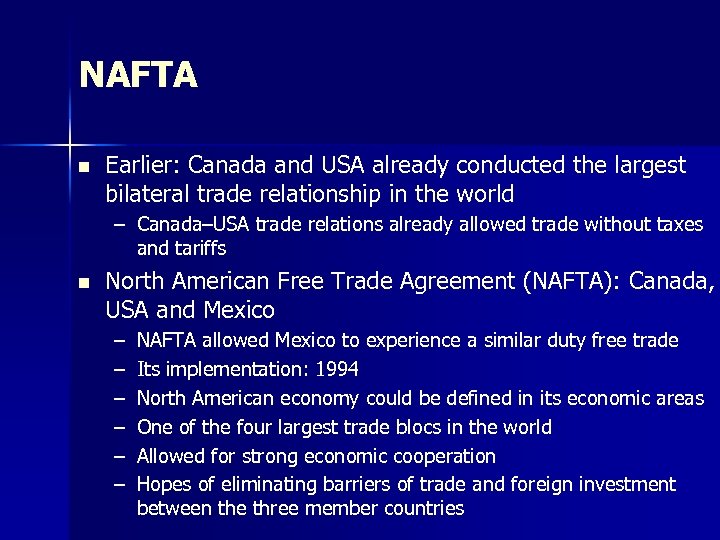 NAFTA n Earlier: Canada and USA already conducted the largest bilateral trade relationship in the world – Canada–USA trade relations already allowed trade without taxes and tariffs n North American Free Trade Agreement (NAFTA): Canada, USA and Mexico – – – NAFTA allowed Mexico to experience a similar duty free trade Its implementation: 1994 North American economy could be defined in its economic areas One of the four largest trade blocs in the world Allowed for strong economic cooperation Hopes of eliminating barriers of trade and foreign investment between the three member countries
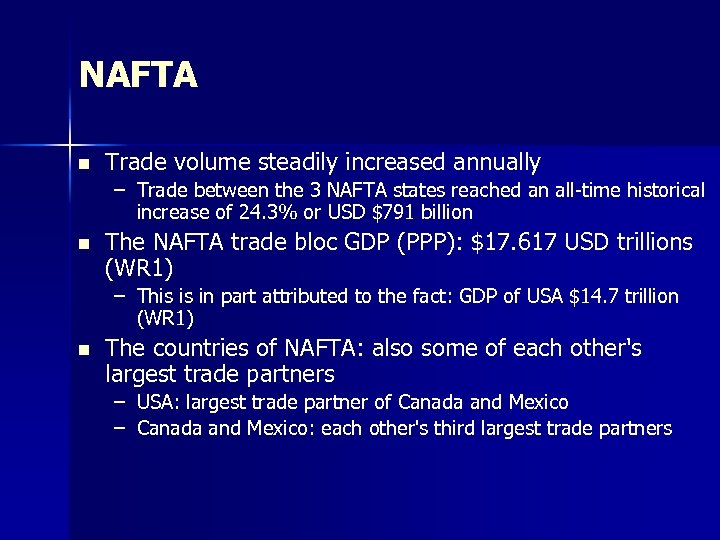 NAFTA n Trade volume steadily increased annually – Trade between the 3 NAFTA states reached an all-time historical increase of 24. 3% or USD $791 billion n The NAFTA trade bloc GDP (PPP): $17. 617 USD trillions (WR 1) – This is in part attributed to the fact: GDP of USA $14. 7 trillion (WR 1) n The countries of NAFTA: also some of each other's largest trade partners – USA: largest trade partner of Canada and Mexico – Canada and Mexico: each other's third largest trade partners
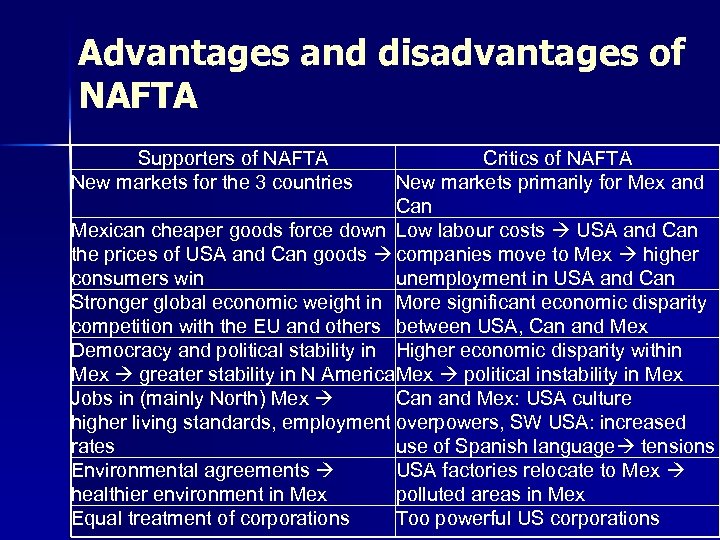 Advantages and disadvantages of NAFTA Supporters of NAFTA New markets for the 3 countries Critics of NAFTA New markets primarily for Mex and Can Mexican cheaper goods force down Low labour costs USA and Can the prices of USA and Can goods companies move to Mex higher consumers win unemployment in USA and Can Stronger global economic weight in More significant economic disparity competition with the EU and others between USA, Can and Mex Democracy and political stability in Higher economic disparity within Mex greater stability in N America Mex political instability in Mex Jobs in (mainly North) Mex Can and Mex: USA culture higher living standards, employment overpowers, SW USA: increased use of Spanish language tensions rates Environmental agreements USA factories relocate to Mex healthier environment in Mex polluted areas in Mex Equal treatment of corporations Too powerful US corporations
 Participation of USA in intercontinental trade blocs n Trade agreements – Transatlantic Free Trade Area: with EU – US – Middle East Free Trade Area: with numerous Middle Eastern countries – Trans-Pacific Strategic Economic Partnership: with Southeast Asian nations, Australia and New Zealand
 North American metropolization
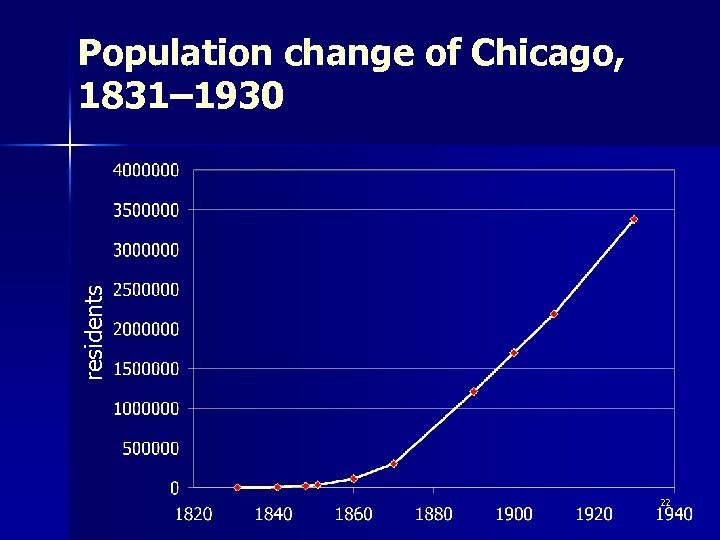 residents Population change of Chicago, 1831– 1930 22
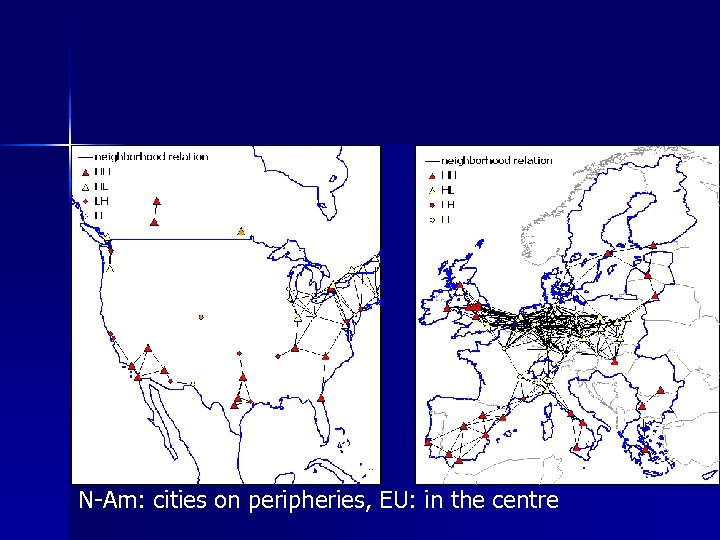 N-Am: cities on peripheries, EU: in the centre
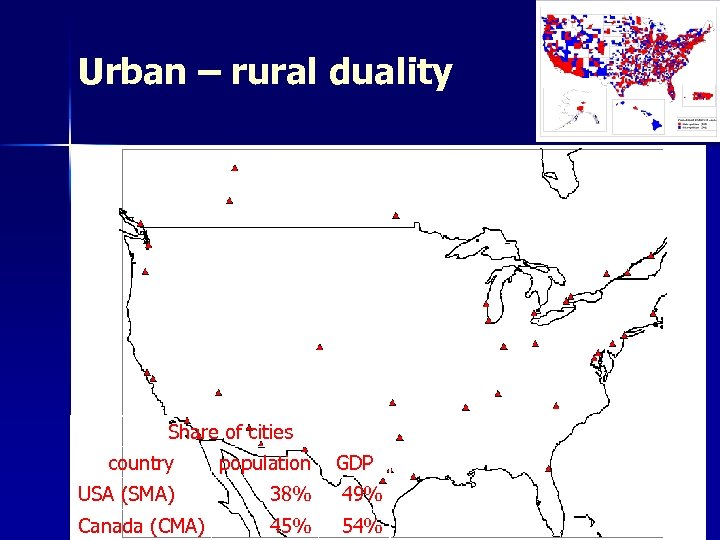 Urban – rural duality Share of cities country population GDP USA (SMA) 38% 49% Canada (CMA) 45% 54%
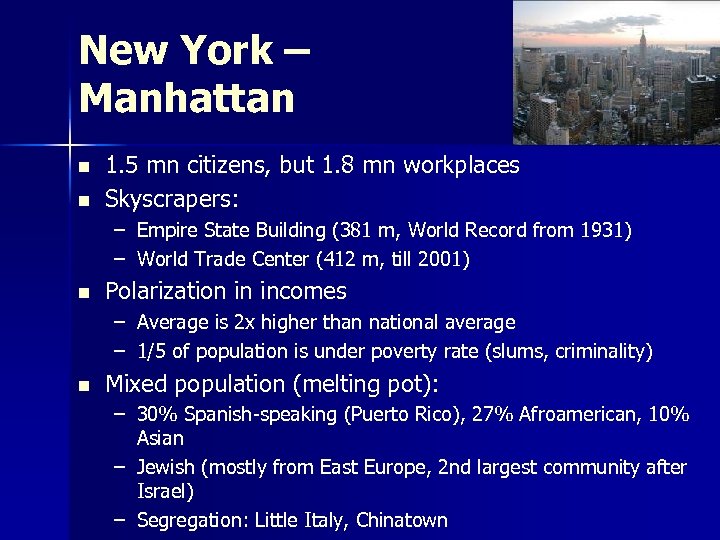 New York – Manhattan n n 1. 5 mn citizens, but 1. 8 mn workplaces Skyscrapers: – Empire State Building (381 m, World Record from 1931) – World Trade Center (412 m, till 2001) n Polarization in incomes – Average is 2 x higher than national average – 1/5 of population is under poverty rate (slums, criminality) n Mixed population (melting pot): – 30% Spanish-speaking (Puerto Rico), 27% Afroamerican, 10% Asian – Jewish (mostly from East Europe, 2 nd largest community after Israel) – Segregation: Little Italy, Chinatown
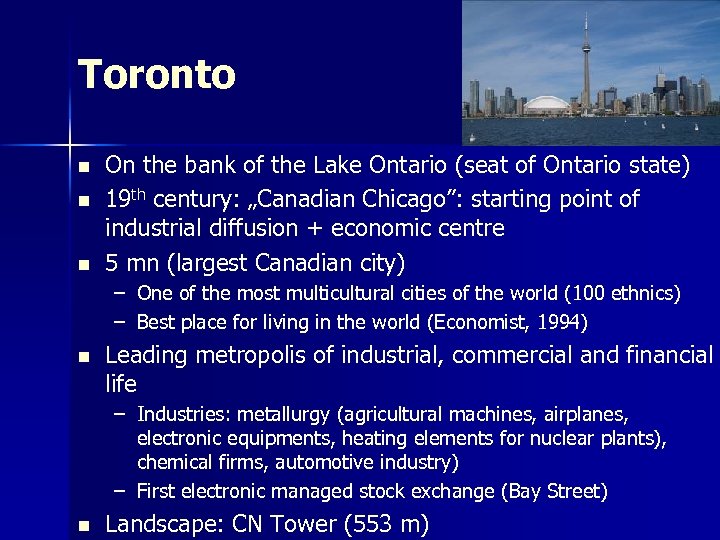 Toronto n n n On the bank of the Lake Ontario (seat of Ontario state) 19 th century: „Canadian Chicago”: starting point of industrial diffusion + economic centre 5 mn (largest Canadian city) – One of the most multicultural cities of the world (100 ethnics) – Best place for living in the world (Economist, 1994) n Leading metropolis of industrial, commercial and financial life – Industries: metallurgy (agricultural machines, airplanes, electronic equipments, heating elements for nuclear plants), chemical firms, automotive industry) – First electronic managed stock exchange (Bay Street) n Landscape: CN Tower (553 m)
 Urban Landscapes based on studies of Chicago (1900 to 1950)
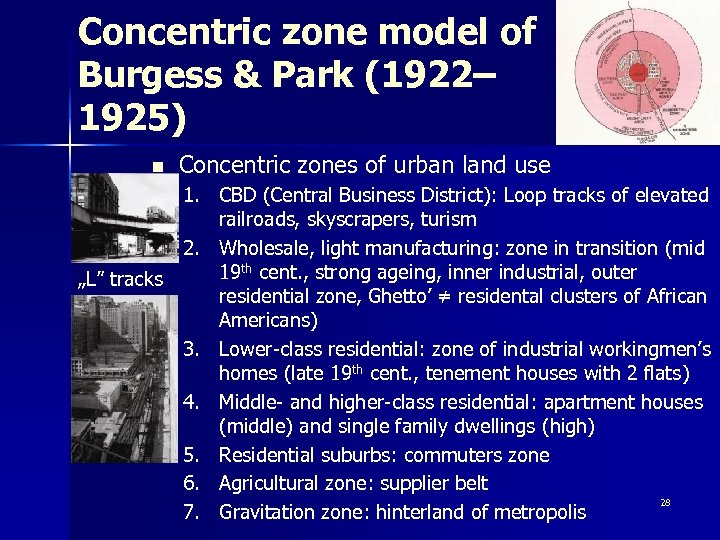 Concentric zone model of Burgess & Park (1922– 1925) n Concentric zones of urban land use 1. CBD (Central Business District): Loop tracks of elevated railroads, skyscrapers, turism 2. Wholesale, light manufacturing: zone in transition (mid 19 th cent. , strong ageing, inner industrial, outer „L” tracks residential zone‚ Ghetto’ ≠ residental clusters of African Americans) 3. Lower-class residential: zone of industrial workingmen’s homes (late 19 th cent. , tenement houses with 2 flats) 4. Middle- and higher-class residential: apartment houses (middle) and single family dwellings (high) 5. Residential suburbs: commuters zone 6. Agricultural zone: supplier belt 28 7. Gravitation zone: hinterland of metropolis
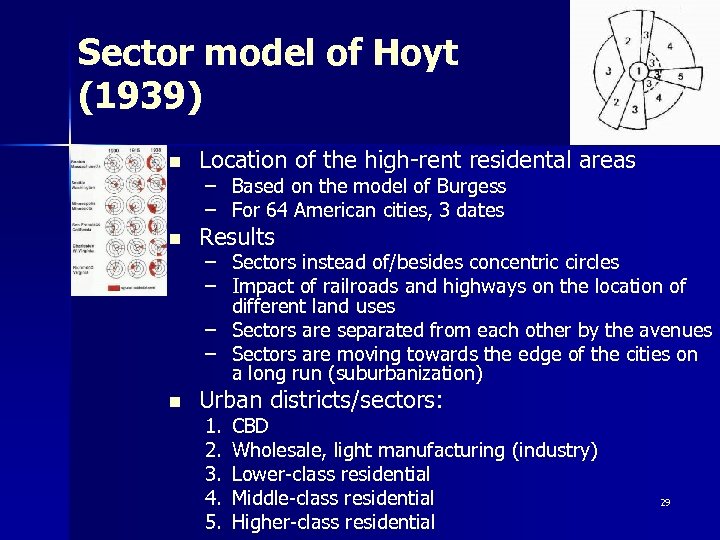 Sector model of Hoyt (1939) n Location of the high-rent residental areas n Results n Urban districts/sectors: – Based on the model of Burgess – For 64 American cities, 3 dates – Sectors instead of/besides concentric circles – Impact of railroads and highways on the location of different land uses – Sectors are separated from each other by the avenues – Sectors are moving towards the edge of the cities on a long run (suburbanization) 1. 2. 3. 4. 5. CBD Wholesale, light manufacturing (industry) Lower-class residential Middle-class residential Higher-class residential 29
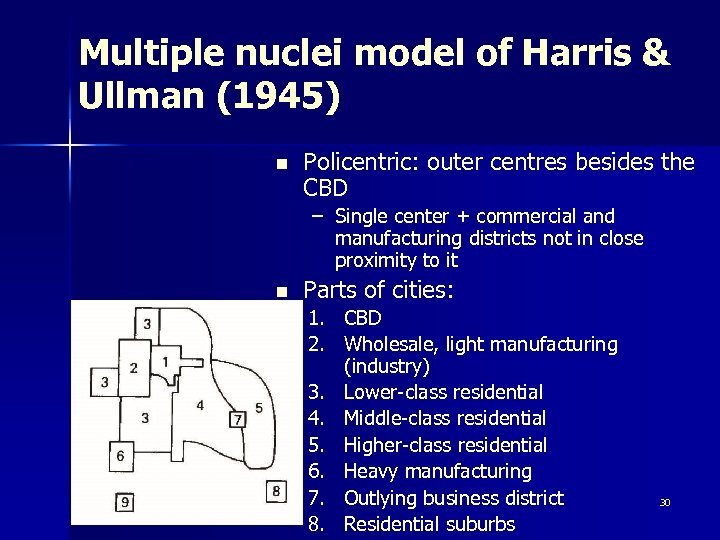 Multiple nuclei model of Harris & Ullman (1945) n Policentric: outer centres besides the CBD – Single center + commercial and manufacturing districts not in close proximity to it n Parts of cities: 1. CBD 2. Wholesale, light manufacturing (industry) 3. Lower-class residential 4. Middle-class residential 5. Higher-class residential 6. Heavy manufacturing 7. Outlying business district 8. Residential suburbs 30