


 Скачать презентацию The Allied Victory Chapter 16 Section 4
1b7f73d6e3d1890ffaff4e2ea3dd41e4.ppt
- Количество слайдов: 37
 The Allied Victory Chapter 16 Section 4
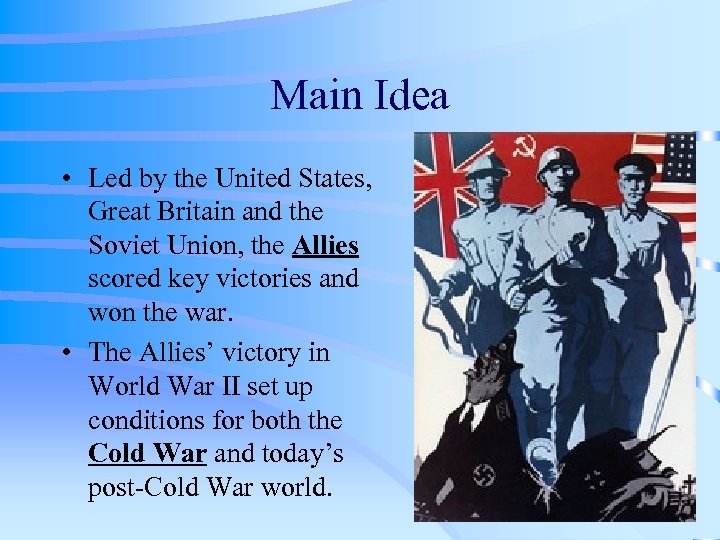 Main Idea • Led by the United States, Great Britain and the Soviet Union, the Allies scored key victories and won the war. • The Allies’ victory in World War II set up conditions for both the Cold War and today’s post-Cold War world.
 Introduction • Right after Pearl Harbor, Churchill and FDR met to discuss a joint war policy. • Stalin had asked his allies to relieve German pressure on his armies in the east. • We wanted them to open a second front on the west. • What problem would this cause for Germany? • TWO FRONT WAR • FDR eventually agreed.
 The Tide Turns on Two Fronts • Churchill wanted the U. S. and Great Britain to first strike in North Africa and southern Europe. • Stalin was mad because he wanted them to open a front in France. • Stalin was left to fight the Germans alone. • U. S. and Britain helped with supplies.
 The North African Campaign • General Rommel (Desert Fox) was stationed in North Africa. • Britain sent Gen. Bernard Montgomery to command the British troops in Egypt. • When Monty arrived, they could not get around the German troops at El Alamein. • Decision? • Massive frontal attack • Germany is caught off guard and Rommel’s troops fell back.
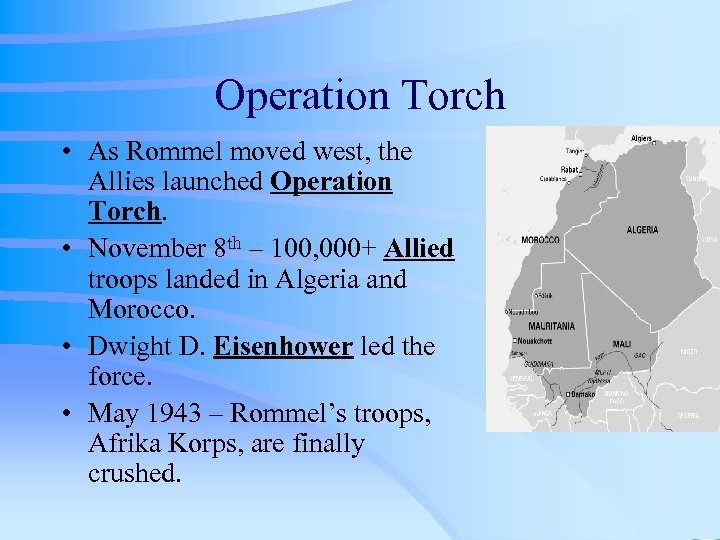 Operation Torch • As Rommel moved west, the Allies launched Operation Torch. • November 8 th – 100, 000+ Allied troops landed in Algeria and Morocco. • Dwight D. Eisenhower led the force. • May 1943 – Rommel’s troops, Afrika Korps, are finally crushed.
 The Battle for Stalingrad • German armies were also having a difficult time in the Soviet Union. • The Battle of Stalingrad began on August 23, 1942. • The Luftwaffe, once again, went on night bombing raids. • Stalin told his army to defend the city until the death.
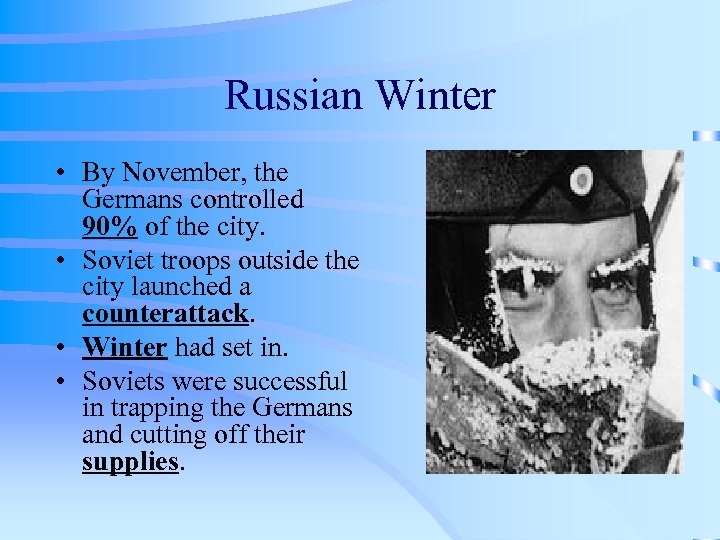 Russian Winter • By November, the Germans controlled 90% of the city. • Soviet troops outside the city launched a counterattack. • Winter had set in. • Soviets were successful in trapping the Germans and cutting off their supplies.
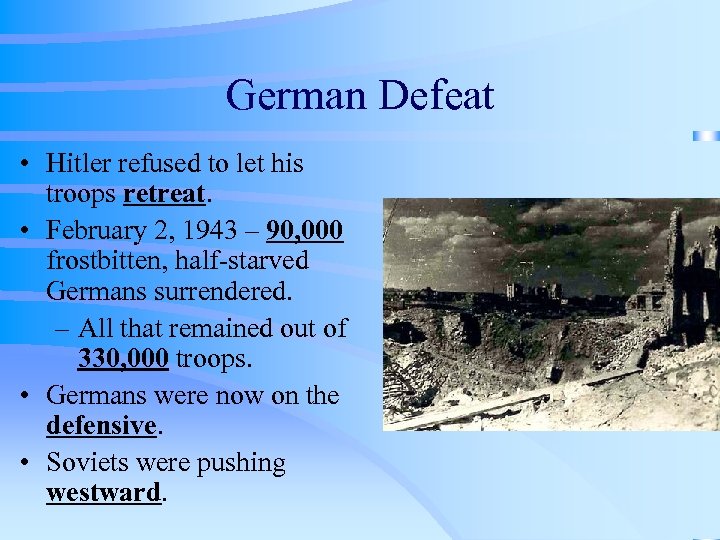 German Defeat • Hitler refused to let his troops retreat. • February 2, 1943 – 90, 000 frostbitten, half-starved Germans surrendered. – All that remained out of 330, 000 troops. • Germans were now on the defensive. • Soviets were pushing westward.
 The Invasion of Italy • Stalin continued to urge Britain and the U. S. to invade France. • FDR and Churchill decided to capture Italy first. • Capture Sicily. • This conquest removed Mussolini from power. • Mussolini was arrested in July. • In September, Italy surrendered. • Germans take control of northern Italy and put Mussolini back in control.
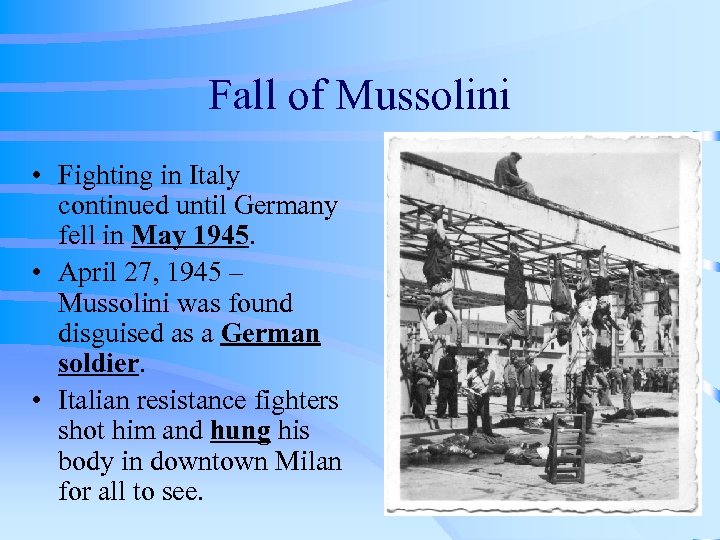 Fall of Mussolini • Fighting in Italy continued until Germany fell in May 1945. • April 27, 1945 – Mussolini was found disguised as a German soldier. • Italian resistance fighters shot him and hung his body in downtown Milan for all to see.
 The Allied Home Fronts • Allies had great support at home. • People endured extreme hardships in wartorn countries, like the Soviet Union and Great Britain. • U. S. was not bombed, with the exception of Hawaii. • Americans produced the weapons and equipment that would help win the war.
 Mobilizing for War • Defeating the Axis powers required mobilizing for total war. • In the U. S. , factories converted their peacetime operations to wartime production. – Machine guns to boots • Automobile factories produced tanks. • 17 – 18 million Americans had jobs in war industries.
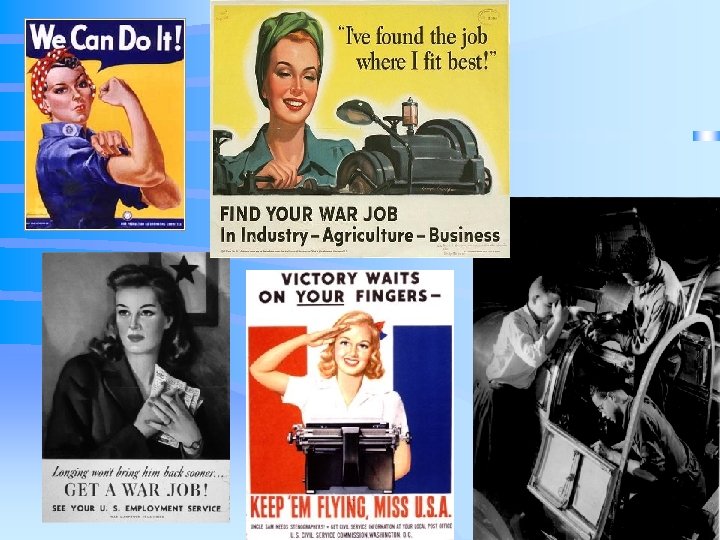
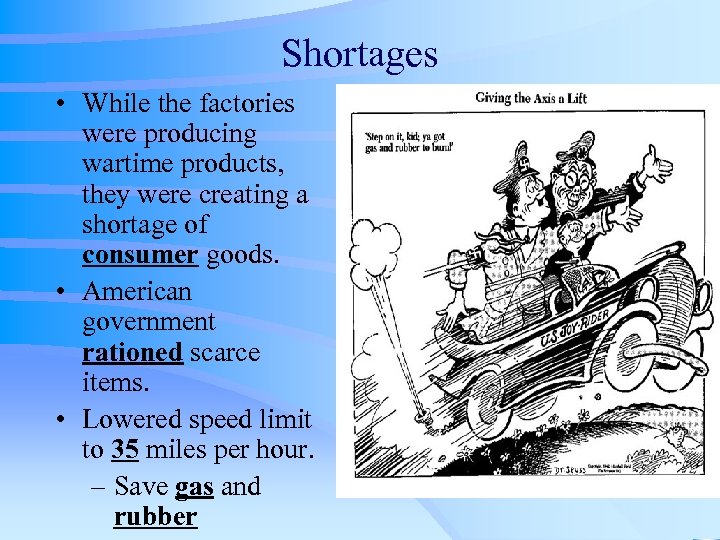 Shortages • While the factories were producing wartime products, they were creating a shortage of consumer goods. • American government rationed scarce items. • Lowered speed limit to 35 miles per hour. – Save gas and rubber
 Propaganda • Allied governments created highly effective propaganda campaigns. – Effort to inspire their people to greater efforts. • A Moscow child collected enough scrap metal for 14, 000 shells. • One Russian family gave up their life savings to buy a tank for the army.
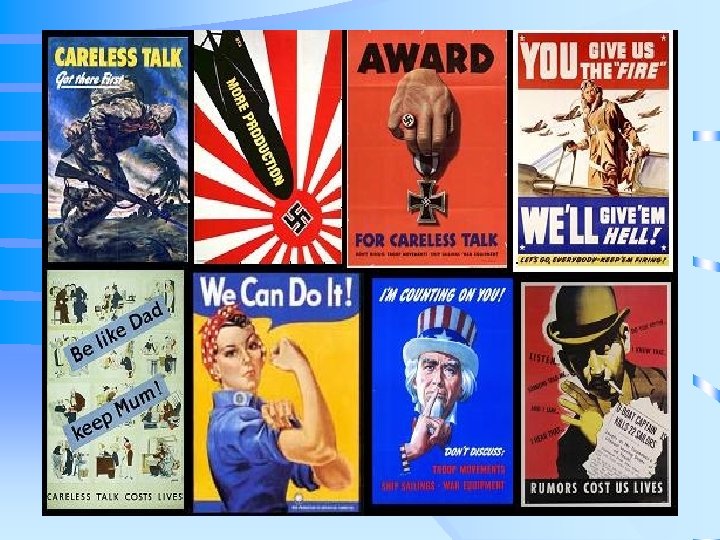
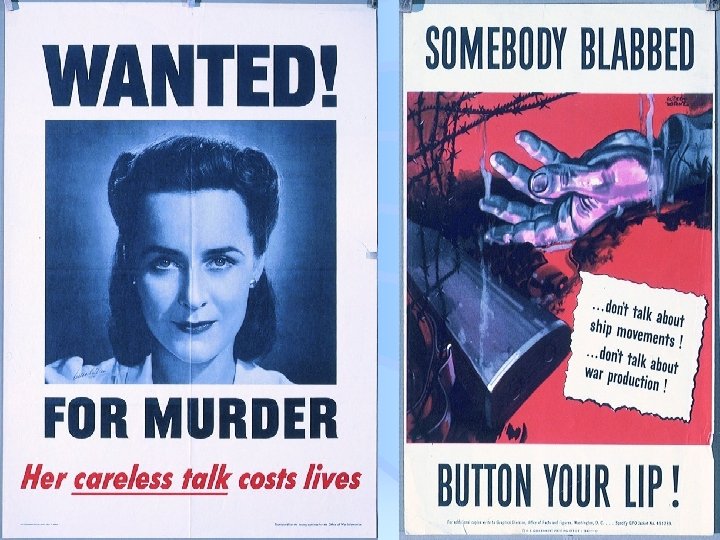
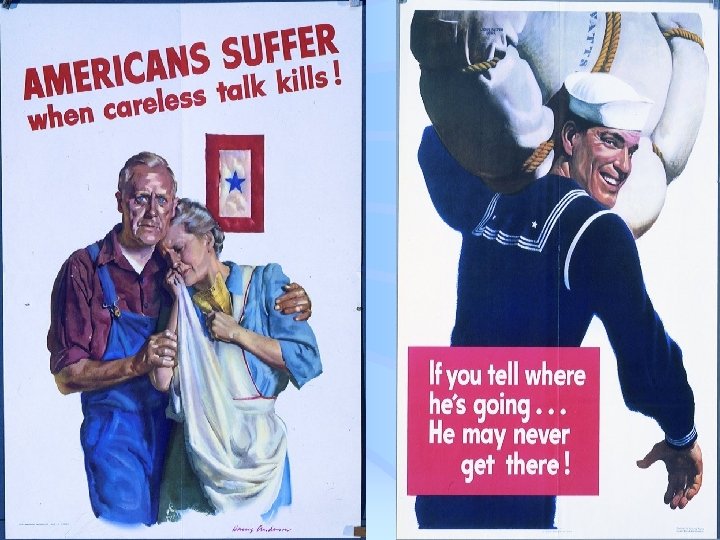
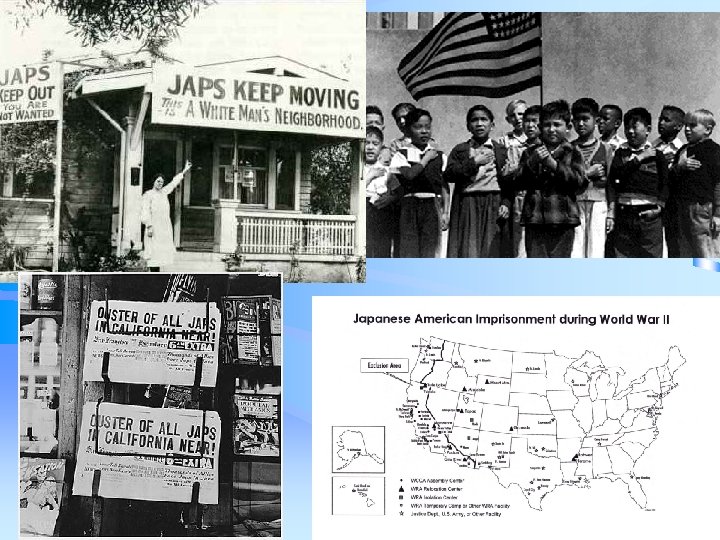
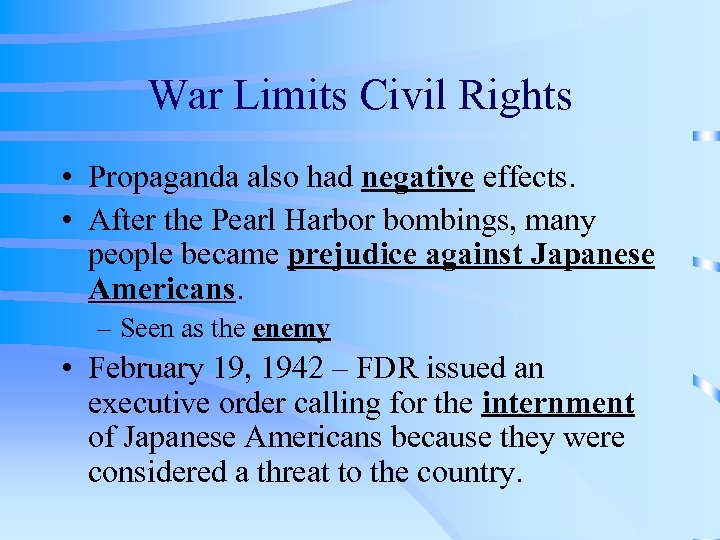 War Limits Civil Rights • Propaganda also had negative effects. • After the Pearl Harbor bombings, many people became prejudice against Japanese Americans. – Seen as the enemy • February 19, 1942 – FDR issued an executive order calling for the internment of Japanese Americans because they were considered a threat to the country.
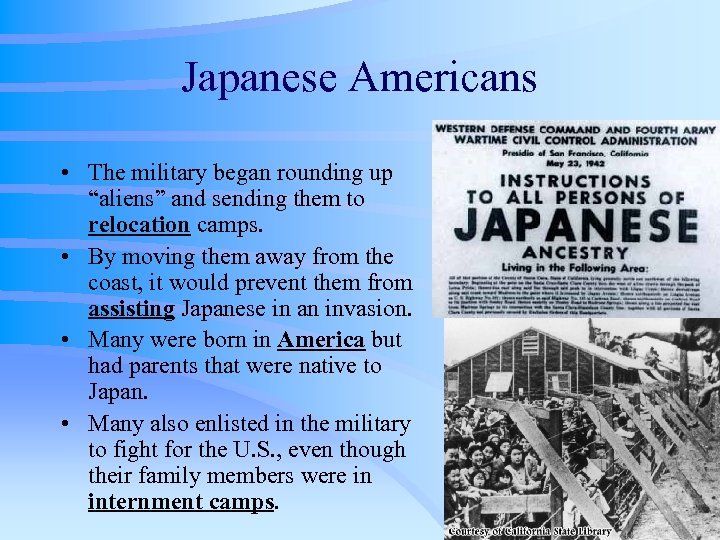 Japanese Americans • The military began rounding up “aliens” and sending them to relocation camps. • By moving them away from the coast, it would prevent them from assisting Japanese in an invasion. • Many were born in America but had parents that were native to Japan. • Many also enlisted in the military to fight for the U. S. , even though their family members were in internment camps.
 Victory in Europe • 1943 – The Allies began secretly building an invasion force in Great Britain. • Their plan was to launch an attack on German-held France across the English Channel.
 The D-Day Invasion • May 1944 – the invasion force was ready. • Thousands of planes, ships, tanks, landing craft and 3+ million troops awaited the order to attack. • Eisenhower planned to attack on the coast of Normandy (NW France). • Germany knew an attack was coming but didn’t know when or where. • Allies set up a dummy army to keep Hitler guessing.
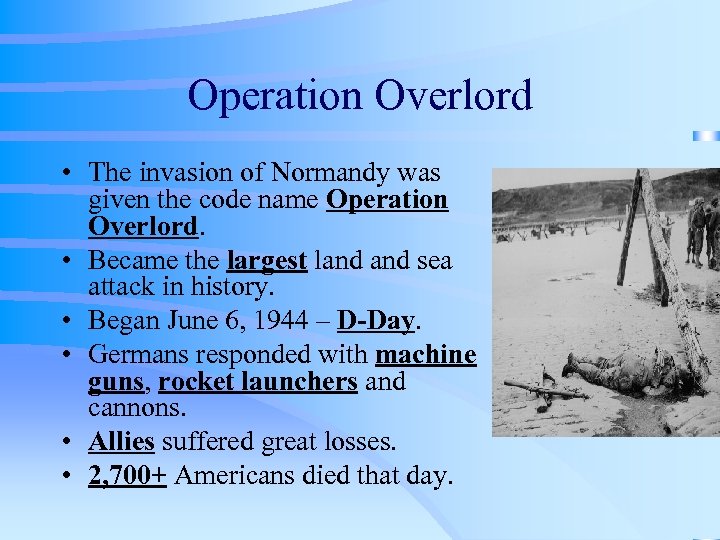 Operation Overlord • The invasion of Normandy was given the code name Operation Overlord. • Became the largest land sea attack in history. • Began June 6, 1944 – D-Day. • Germans responded with machine guns, rocket launchers and cannons. • Allies suffered great losses. • 2, 700+ Americans died that day.
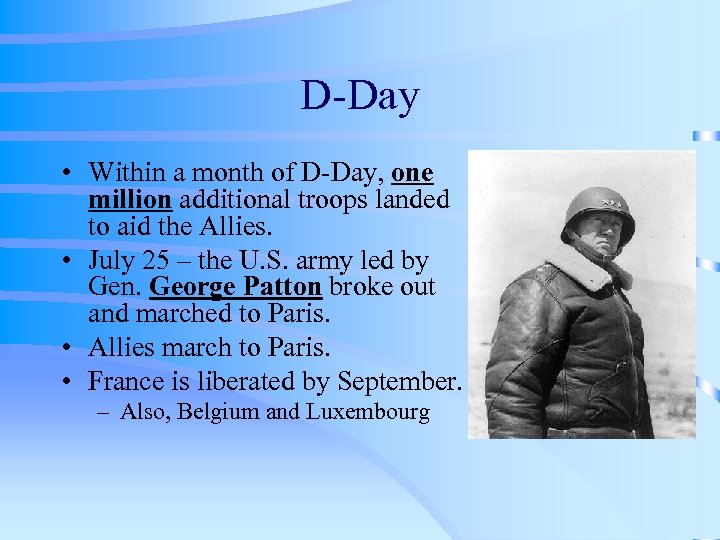 D-Day • Within a month of D-Day, one million additional troops landed to aid the Allies. • July 25 – the U. S. army led by Gen. George Patton broke out and marched to Paris. • Allies march to Paris. • France is liberated by September. – Also, Belgium and Luxembourg
 The Battle of the Bulge • Allied forces moved toward Germany from the west, and the Soviet Union advanced from the east. • Hitler now faced a war on two fronts. • He counterattacks the west. • December 16 th – Germans push into Allied lines. – Battle of the Bulge • Allies fight back and Germans are forced to retreat.
 Germany’s Unconditional Surrender • After the Battle of the Bulge, the war in Europe rapidly drew to a close. • Allies move across the Rhine River into Germany. • With three million soldiers coming from the west and six million Soviets coming from the east, Berlin was in trouble. • By April 25, 1945, Germany’s capital was under fire.
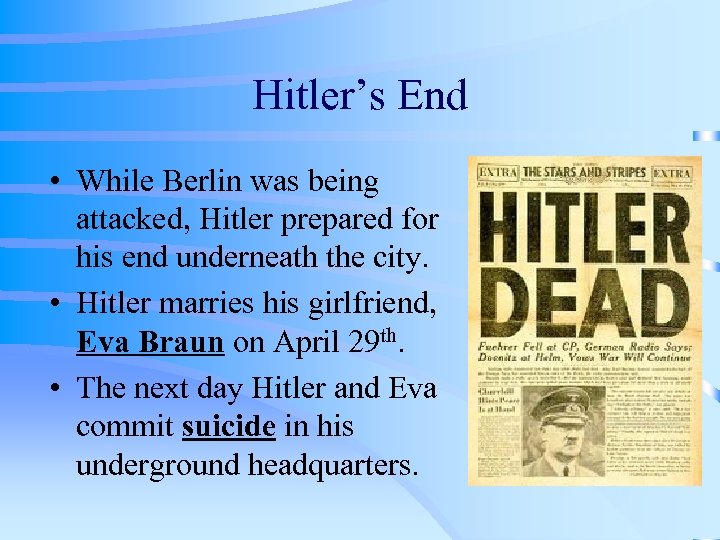 Hitler’s End • While Berlin was being attacked, Hitler prepared for his end underneath the city. • Hitler marries his girlfriend, Eva Braun on April 29 th. • The next day Hitler and Eva commit suicide in his underground headquarters.
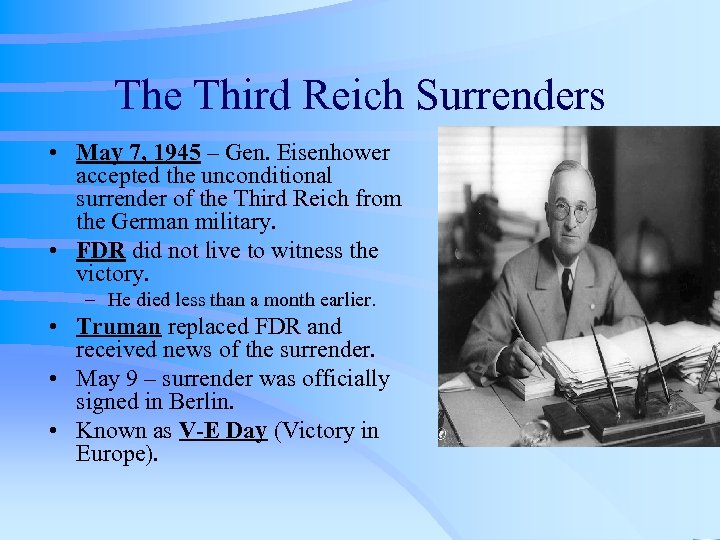 The Third Reich Surrenders • May 7, 1945 – Gen. Eisenhower accepted the unconditional surrender of the Third Reich from the German military. • FDR did not live to witness the victory. – He died less than a month earlier. • Truman replaced FDR and received news of the surrender. • May 9 – surrender was officially signed in Berlin. • Known as V-E Day (Victory in Europe).
 Victory in the Pacific • The war in Europe was over, but the Allies were still fighting in the Pacific. • Japanese advances had been stopped with the Allied victory at Guadalcanal. • For the rest of the war, the Japanese retreated before the counterattack of the Allied powers.
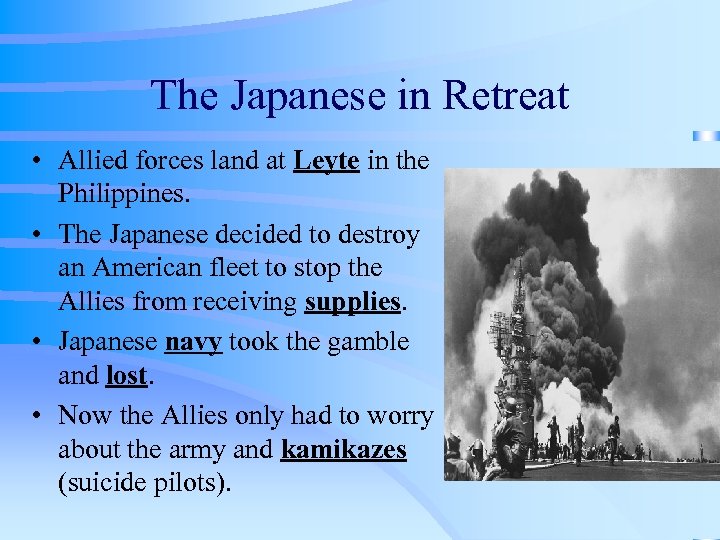 The Japanese in Retreat • Allied forces land at Leyte in the Philippines. • The Japanese decided to destroy an American fleet to stop the Allies from receiving supplies. • Japanese navy took the gamble and lost. • Now the Allies only had to worry about the army and kamikazes (suicide pilots).
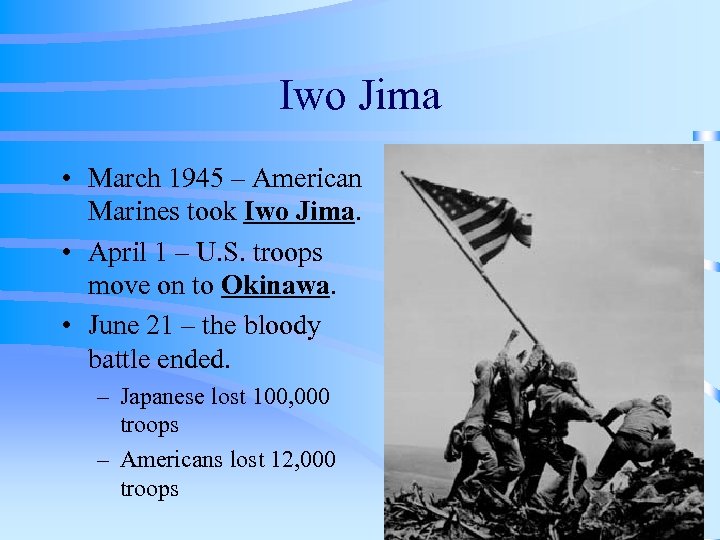 Iwo Jima • March 1945 – American Marines took Iwo Jima. • April 1 – U. S. troops move on to Okinawa. • June 21 – the bloody battle ended. – Japanese lost 100, 000 troops – Americans lost 12, 000 troops
 The Japanese Surrender • Allies now move on to Japan. • Truman had been advised that the attack may cost 500, 000 lives. • Should he drop the atomic bomb in order to save American lives? • Many people felt that the A-bomb would bring the war to the quickest possible end.
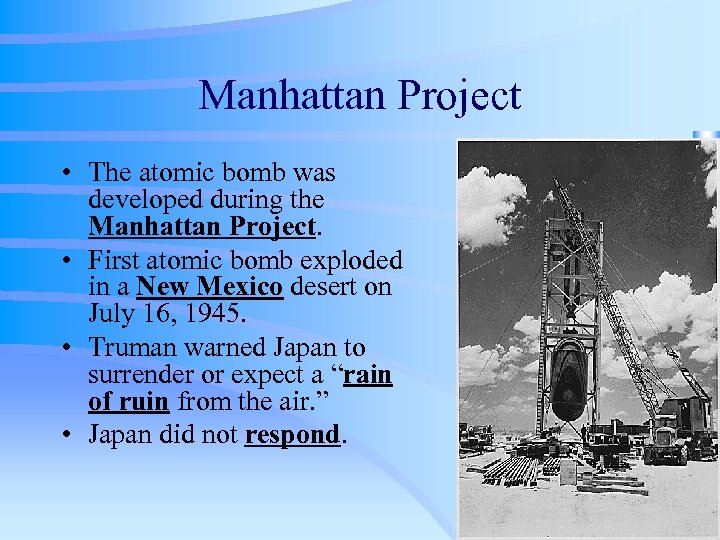 Manhattan Project • The atomic bomb was developed during the Manhattan Project. • First atomic bomb exploded in a New Mexico desert on July 16, 1945. • Truman warned Japan to surrender or expect a “rain of ruin from the air. ” • Japan did not respond.
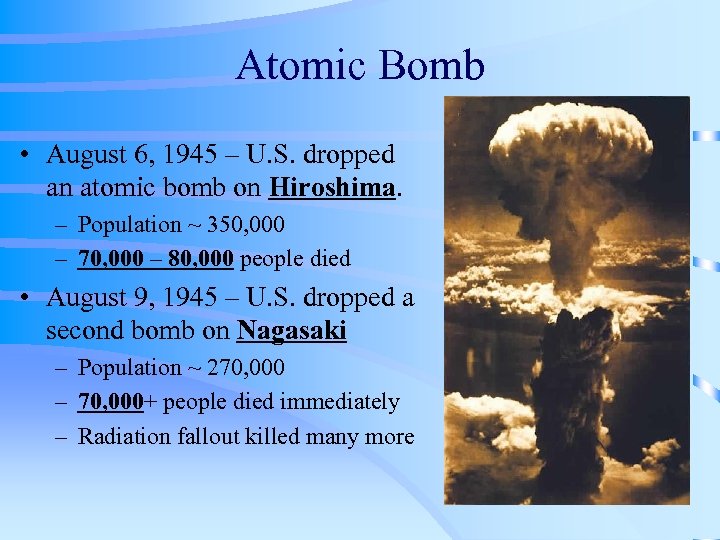 Atomic Bomb • August 6, 1945 – U. S. dropped an atomic bomb on Hiroshima. – Population ~ 350, 000 – 70, 000 – 80, 000 people died • August 9, 1945 – U. S. dropped a second bomb on Nagasaki – Population ~ 270, 000 – 70, 000+ people died immediately – Radiation fallout killed many more
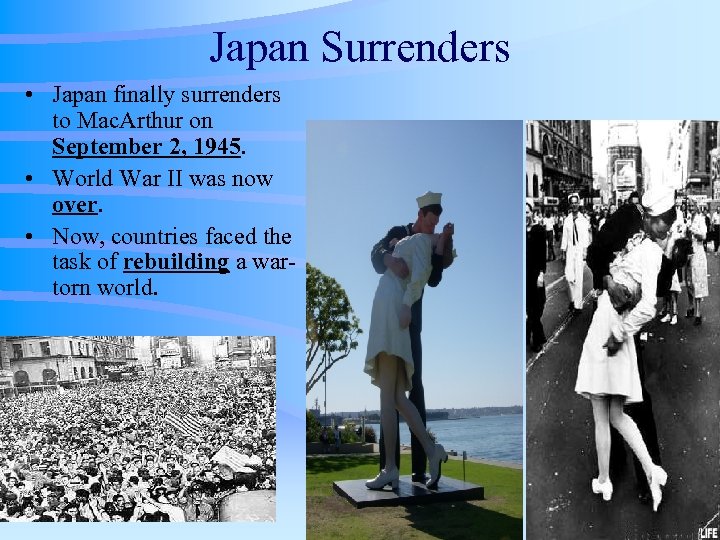 Japan Surrenders • Japan finally surrenders to Mac. Arthur on September 2, 1945. • World War II was now over. • Now, countries faced the task of rebuilding a wartorn world.