 Скачать презентацию The Alexander von Humboldt Foundation Connecting excellent researchers
ad4e47f92f3a656c45276618c5b4778f.ppt
- Количество слайдов: 39



The Alexander von Humboldt Foundation Connecting excellent researchers worldwide Dr. Daniela Kneissl Head of Division Africa, Middle East
Subjects of presentation ● The Alexander von Humboldt Foundation Facts and Figures ● Research Location Germany – Why should you go there? ● Our portfolio – Sponsorship Opportunities offered by the Alexander von Humboldt Foundation ● Once a Humboldtian, always a Humboldtian: Alumni sponsorship instruments ● Finding a scientific host in Germany ● The Humboldt Network – the added value of our sponsorship
The Alexander von Humboldt Foundation Facts and Figures
Core activity of the Humboldt Foundation ● We grant annually about 600 research fellowships and 100 research awards to highly qualified researchers (Ph. D-holders) from all over the world ● We enable them to spend extended research stays in Germany and to work with German colleagues ● We offer life long sponsorship options for our Alumni (“Once a Humboldtian, always a Humboldtian”) ● Sponsorship of people, not projects
Humboldt Foundation and DAAD Sharing the academic market ● The Humboldt Foundation sponsors Ph. D holders (outgoing programmes) ● The German Academic Exchange Service (DAAD) sponsors BA/MA/doctoral students (outgoing and in-country programmes) Office in Nairobi: nairobi. daad. de
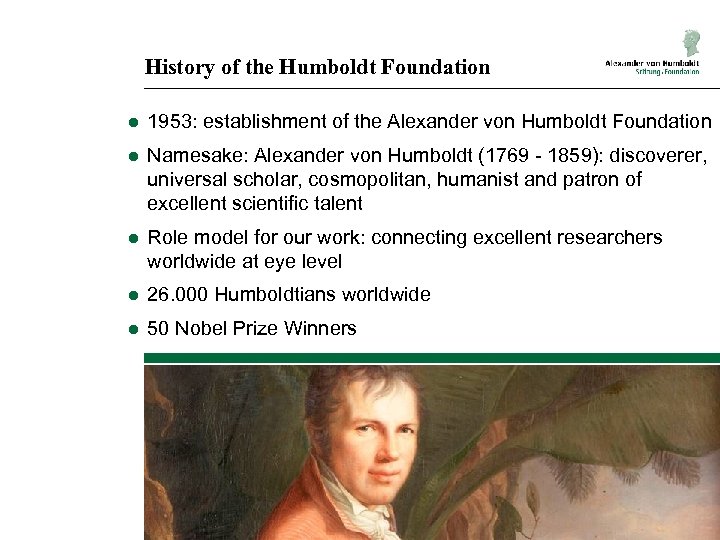
History of the Humboldt Foundation ● 1953: establishment of the Alexander von Humboldt Foundation ● Namesake: Alexander von Humboldt (1769 - 1859): discoverer, universal scholar, cosmopolitan, humanist and patron of excellent scientific talent ● Role model for our work: connecting excellent researchers worldwide at eye level ● 26. 000 Humboldtians worldwide ● 50 Nobel Prize Winners
Equal opportunities for female academics ● Sponsoring of women correlates with age, career stage and geographical origin ● Research fellowship programmes: average of 30% (2010 -2014), comparable success rates of women and men ● measures supplementing standard sponsorship opportunities: fellowship extension or interruption, allowances, targeted counselling Goal: Increasing number of female academics among sponsored
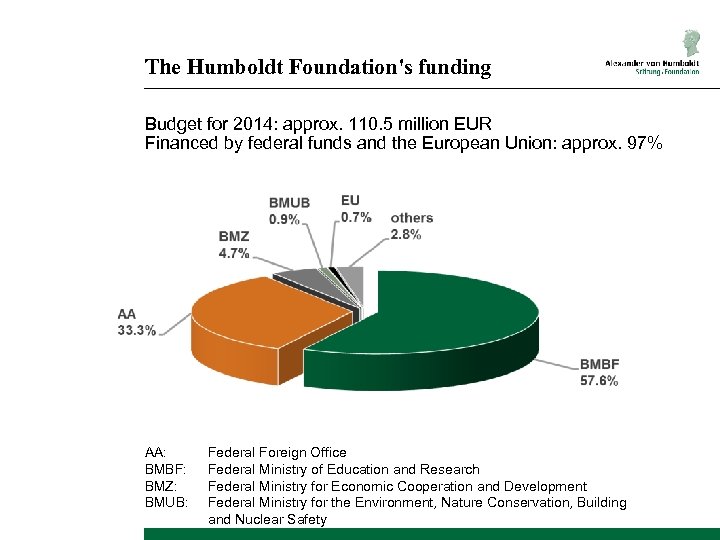
The Humboldt Foundation's funding Budget for 2014: approx. 110. 5 million EUR Financed by federal funds and the European Union: approx. 97% AA: BMBF: BMZ: BMUB: Federal Foreign Office Federal Ministry of Education and Research Federal Ministry for Economic Cooperation and Development Federal Ministry for the Environment, Nature Conservation, Building and Nuclear Safety
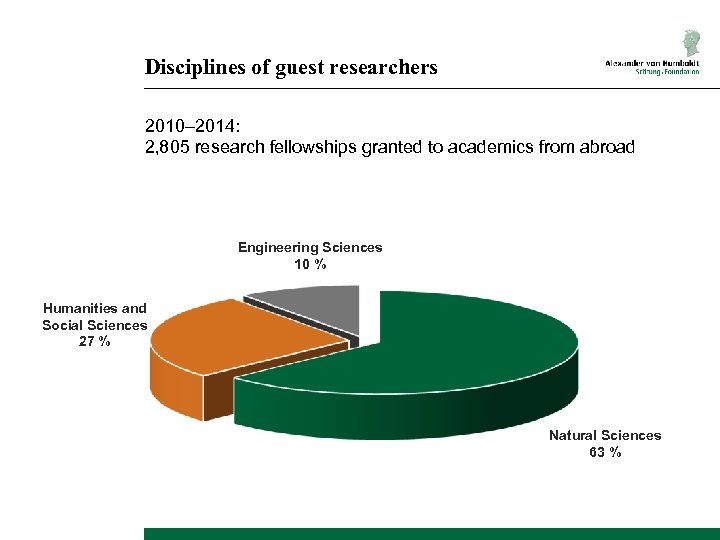
Disciplines of guest researchers 2010– 2014: 2, 805 research fellowships granted to academics from abroad Engineering Sciences 10 % Humanities and Social Sciences 27 % Natural Sciences 63 %
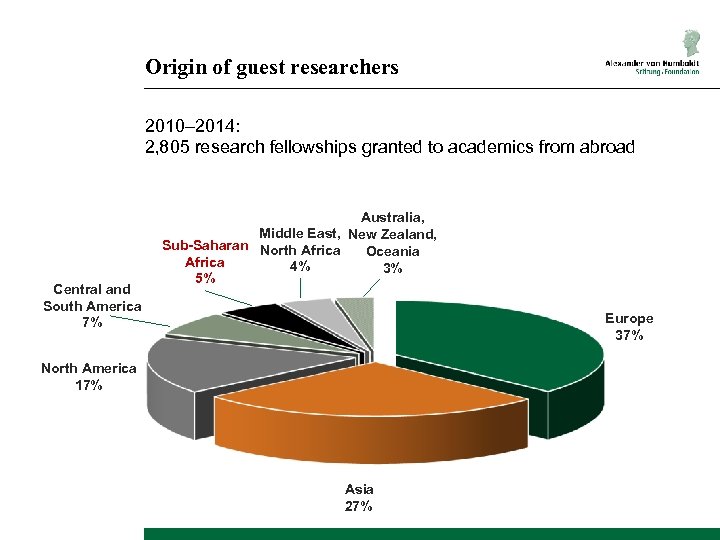
Origin of guest researchers 2010– 2014: 2, 805 research fellowships granted to academics from abroad Central and South America 7% Australia, Middle East, New Zealand, Sub-Saharan North Africa Oceania Africa 4% 3% 5% Europe 37% North America 17% Asia 27%
Current figures for Sub-Saharan Africa and Kenya ● Sub-Saharan Africa 2010 to 2014: 391 applications, 131 Research fellowships granted (Success rate: 30%, worldwide: 28, 5%) ● Kenya: 20 applications, 5 Research fellowships granted (Success rate: 25%) ● Our conclusion: We do not reach enough excellent possible candidates in Kenya ● Our goal: Attracting more highly qualified researchers (women and men) from Kenya ● Essential step: Cooperation with strong partners (e. g. Mo. Us with NACOSTI, ICIPE, TWAS)
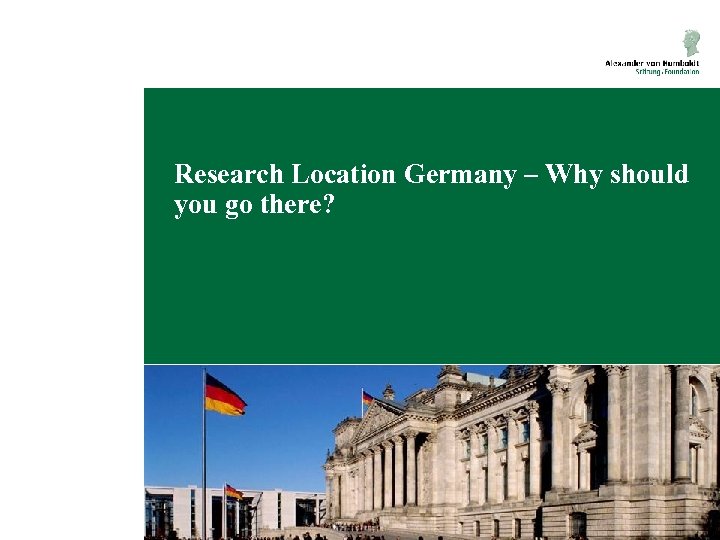
Research Location Germany – Why should you go there?
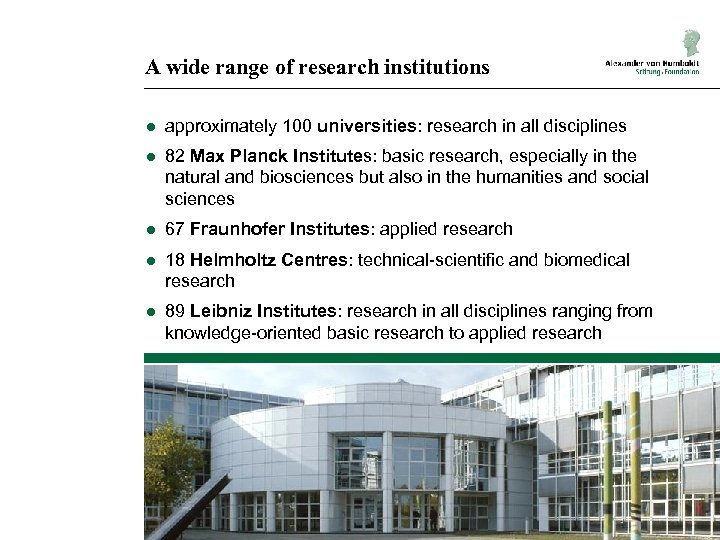
A wide range of research institutions ● approximately 100 universities: research in all disciplines ● 82 Max Planck Institutes: basic research, especially in the natural and biosciences but also in the humanities and social sciences ● 67 Fraunhofer Institutes: applied research ● 18 Helmholtz Centres: technical-scientific and biomedical research ● 89 Leibniz Institutes: research in all disciplines ranging from knowledge-oriented basic research to applied research
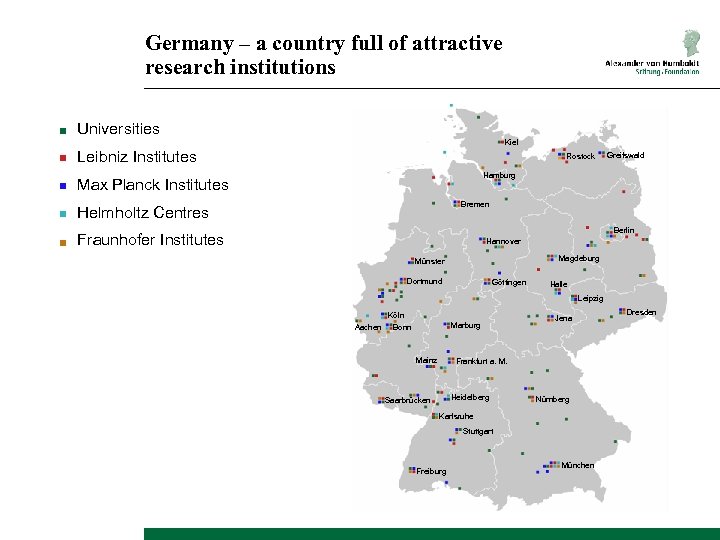
Germany – a country full of attractive research institutions Universities Kiel Leibniz Institutes Rostock Greifswald Hamburg Max Planck Institutes Bremen Helmholtz Centres Berlin Fraunhofer Institutes Hannover Magdeburg Münster Dortmund Göttingen Halle Leipzig Köln Aachen Bonn Marburg Mainz Jena Frankfurt a. M. Heidelberg Saarbrücken Nürnberg Karlsruhe Stuttgart Freiburg München Dresden
Our programme portfolio – Sponsorship Opportunities offered by the Humboldt Foundation
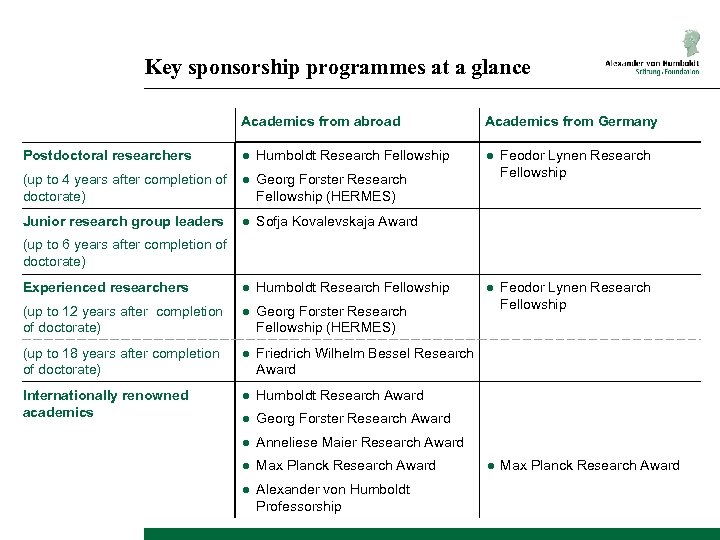
Key sponsorship programmes at a glance Academics from abroad Academics from Germany Postdoctoral researchers ● Humboldt Research Fellowship (up to 4 years after completion of doctorate) ● Georg Forster Research Fellowship (HERMES) ● Feodor Lynen Research Fellowship Junior research group leaders ● Sofja Kovalevskaja Award (up to 6 years after completion of doctorate) Experienced researchers ● Humboldt Research Fellowship (up to 12 years after completion of doctorate) ● Georg Forster Research Fellowship (HERMES) (up to 18 years after completion of doctorate) ● Friedrich Wilhelm Bessel Research Award Internationally renowned academics ● Feodor Lynen Research Fellowship ● Humboldt Research Award ● Georg Forster Research Award ● Anneliese Maier Research Award ● Max Planck Research Award ● Alexander von Humboldt Professorship ● Max Planck Research Award
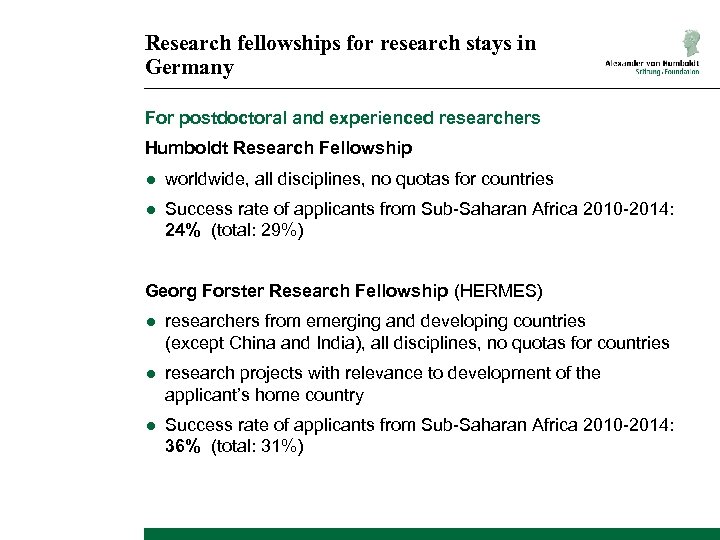
Research fellowships for research stays in Germany For postdoctoral and experienced researchers Humboldt Research Fellowship ● worldwide, all disciplines, no quotas for countries ● Success rate of applicants from Sub-Saharan Africa 2010 -2014: 24% (total: 29%) Georg Forster Research Fellowship (HERMES) ● researchers from emerging and developing countries (except China and India), all disciplines, no quotas for countries ● research projects with relevance to development of the applicant’s home country ● Success rate of applicants from Sub-Saharan Africa 2010 -2014: 36% (total: 31%)
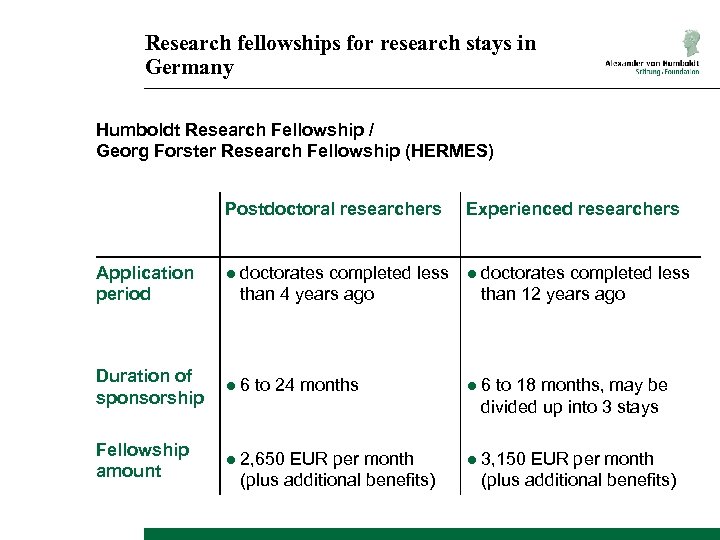
Research fellowships for research stays in Germany Humboldt Research Fellowship / Georg Forster Research Fellowship (HERMES) Postdoctoral researchers Experienced researchers Application period ● doctorates completed less than 4 years ago than 12 years ago Duration of sponsorship ● 6 to 24 months ● 6 to 18 months, may be divided up into 3 stays Fellowship amount ● 2, 650 EUR per month (plus additional benefits) ● 3, 150 EUR per month (plus additional benefits)
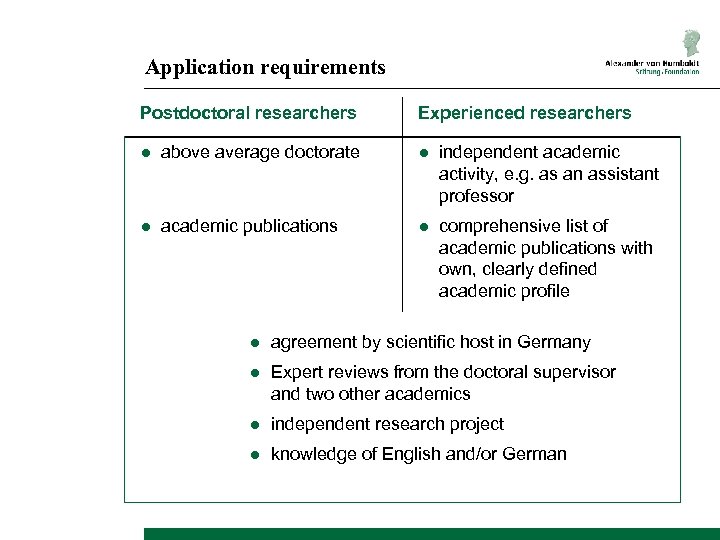
Application requirements Postdoctoral researchers Experienced researchers ● above average doctorate ● independent academic activity, e. g. as an assistant professor ● academic publications ● comprehensive list of academic publications with own, clearly defined academic profile ● agreement by academic host ● agreement by scientific host in Germany ● Expert reviews from the ● Expert reviews doctoral supervisor and two from the doctoral supervisor two doctoral supervisor and other academics two other academics other ● independent research project ● knowledge of Englishknowledge of English and/or ● and/or German
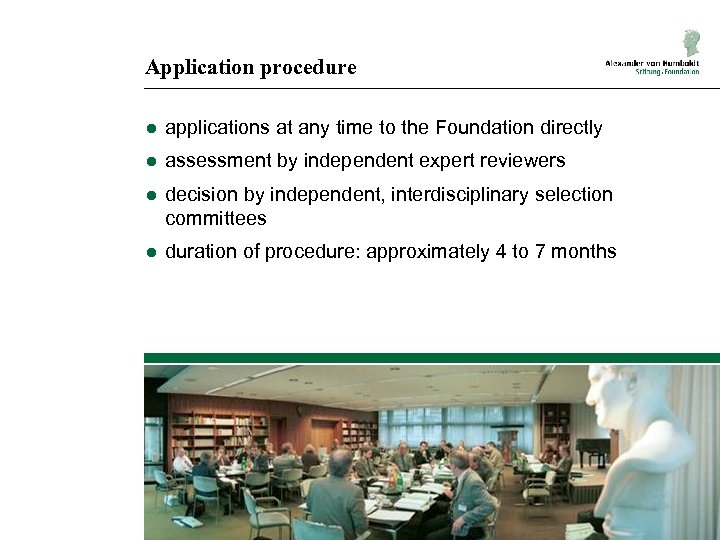
Application procedure ● applications at any time to the Foundation directly ● assessment by independent expert reviewers ● decision by independent, interdisciplinary selection committees ● duration of procedure: approximately 4 to 7 months
Application procedure Criteria for assessing eligibility: ● Academic record and academic performance to date (determination, academic productivity, mobility experienced researchers: breadth of research activities) ● Quality of publications (originality, degree of innovation) ● Originality and innovation potential of the suggested research outline (significance for the discipline, choice of academic methods, clear focus and feasibility) ● The applicant’s future academic potential The selection committee will always take into consideration the “whole picture” – > People, not projects
Benefits provided ● Travel lump sum ● Mobility allowance, subsidies towards health and liability assurances ● Language courses (e. g. intensive language course of 2 or 4 months in Germany) ● Benefits for accompanying families ● Allowance for research costs for the host institute ● Possibility of Europe research stay
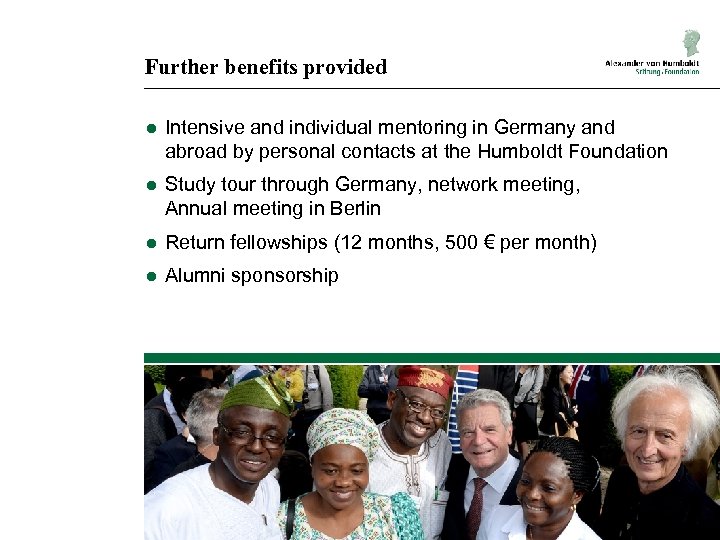
Further benefits provided ● Intensive and individual mentoring in Germany and abroad by personal contacts at the Humboldt Foundation ● Study tour through Germany, network meeting, Annual meeting in Berlin ● Return fellowships (12 months, 500 € per month) ● Alumni sponsorship

Once a Humboldtian, always a Humboldtian: Alumni sponsorship instruments
Alumni sponsorhip instruments I Coming back to Germany (3 years after your first research stay) ● Short visits up to 30 days - e. g. for active participation (lecture, posters, etc. ) in international congresses in Germany, for lecture tours or short working visits to research institutes in Germany. - Daily allowance, reimbursement of conference fees ● Renewed research stays for up to 3 months - for continuing or completing work started during first research stay in Germany or initiation of new joint research projects with colleagues in Germany, free choice of academic host - Monthly fellowship amount, support for accompanying family
Alumni Sponsorship Instruments II Support for alumni in their home countries ● Invitation of professors from Germany for short research stays at the home institution of Humboldtian ● Book donations ● Equipment subsidies (up to 20, 000 EUR) ● Humboldt Kollegs (up to 40, 000 EUR)
Alumni Sponsorship Instruments III Support for cooperative projects ● Research group linkage programme „Institutional“ partnership between a Humboldtian and a German partner for working on a joint research project Goals: - building of sustainble scientific partnerships - integration of junior researchers Funding of up to 55. 000 €, up to 3 years, to be spent on: • academic auxiliary staff • equipment (for the partner institute outside Germany) • conferences • reciprocal research visits • publications and consumables
Finding a scientific host in Germany
Finding a scientific host in Germany ● Search interesting publications ● Ask colleagues with contacts in Germany (e. g. Humboldtians at your institute) ● Search the Humboldt Foundation’s Network Online - Network Online can be used to locate Humboldtians’ host institutes - searches can be filtered by subject area, location or keyword humboldt-foundation. de -> Humboldt Network -> Searching the network ● Search via the DAAD and DFG “Research Explorer” - The Research Explorer contains over 23, 000 institutes at German universities and non-university research institutions, searchable by geographic location, subject and other structural criteria. www. research-explorer. de
Finding a scientific host in Germany Checklist for establishing a contact via E-Mail: ● How can I introduce myself very shortly? ● What is the core of my research interest? ● Why do I want to work with that particular person? ● Who has recommended the person I write to, or: How did I find out about the work of the academic I am contacting? ● Which funding organisation and which programme do I suggest?
Finding a scientific host in Germany Further practical hints ● Add a very short research outline (1 page) and your updated CV ● Be clear and short: Professors usually get more than 100 E-Mails each day! ● Do not send the same not personalized E-Mail to dozens of academics! ● If you don’t get an answer within a fortnight, send a short reminder – some people only answer if they are asked twice…
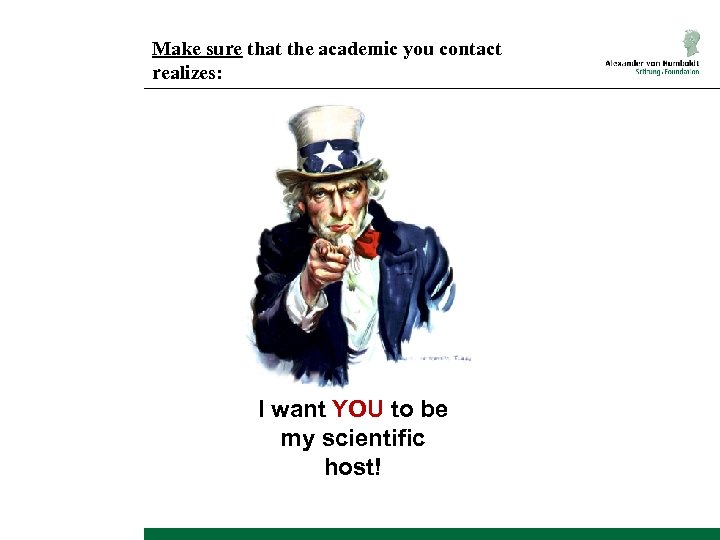
Make sure that the academic you contact realizes: I want YOU to be my scientific host!
Finding a scientific host in Germany Goal! You’ve got a positive answer! Now you should: ● Make good use of his/her expertise for further elaborating your research outline ● Enrich your knowledge about the research institution of your potential scientific host ● Take your time for carefully preparing your application and all the documents needed
The Humboldt Network – the added value of our sponsorship
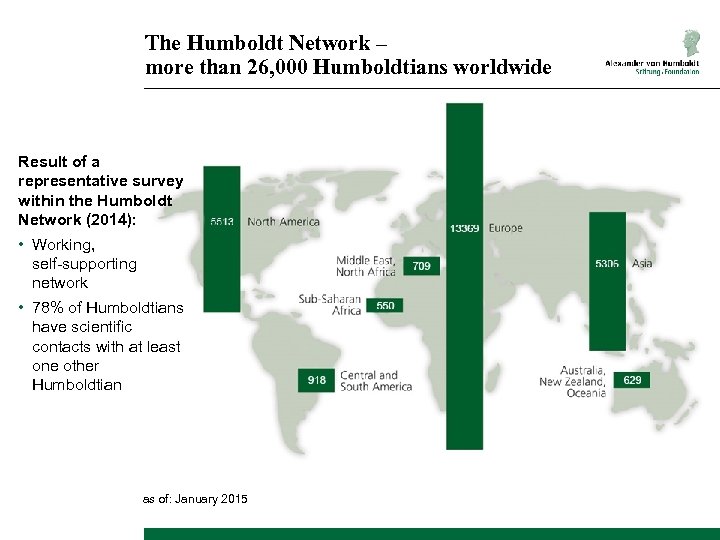
The Humboldt Network – more than 26, 000 Humboldtians worldwide Result of a representative survey within the Humboldt Network (2014): • Working, self-supporting network • 78% of Humboldtians have scientific contacts with at least one other Humboldtian as of: January 2015
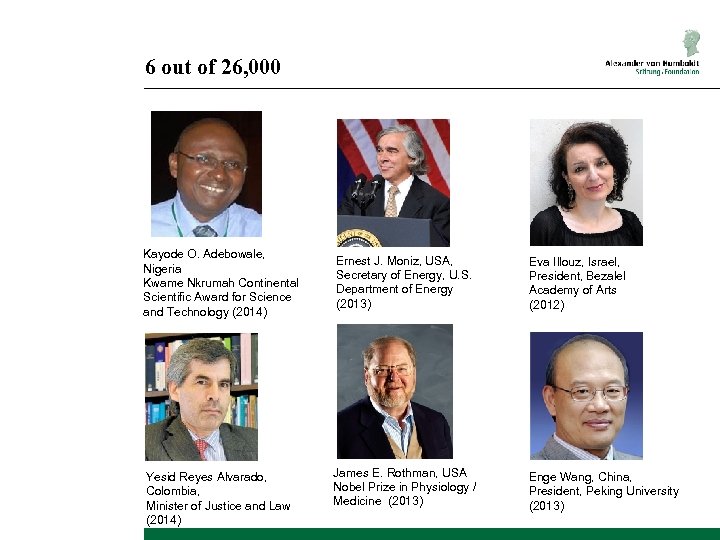
6 out of 26, 000 Kayode O. Adebowale, Nigeria Kwame Nkrumah Continental Scientific Award for Science and Technology (2014) Yesid Reyes Alvarado, Colombia, Minister of Justice and Law (2014) Ernest J. Moniz, USA, Secretary of Energy, U. S. Department of Energy (2013) Eva Illouz, Israel, President, Bezalel Academy of Arts (2012) James E. Rothman, USA Nobel Prize in Physiology / Medicine (2013) Enge Wang, China, President, Peking University (2013)
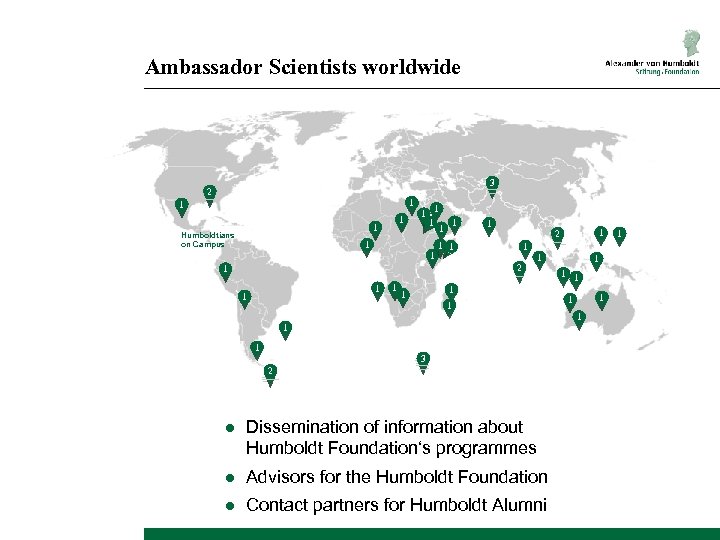
Ambassador Scientists worldwide 3 2 1 1 Humboldtians on Campus 1 1 1 1 1 2 1 1 1 1 1 2 1 1 3 2 ● Dissemination of information about Humboldt Foundation‘s programmes ● Advisors for the Humboldt Foundation ● Contact partners for Humboldt Alumni 1
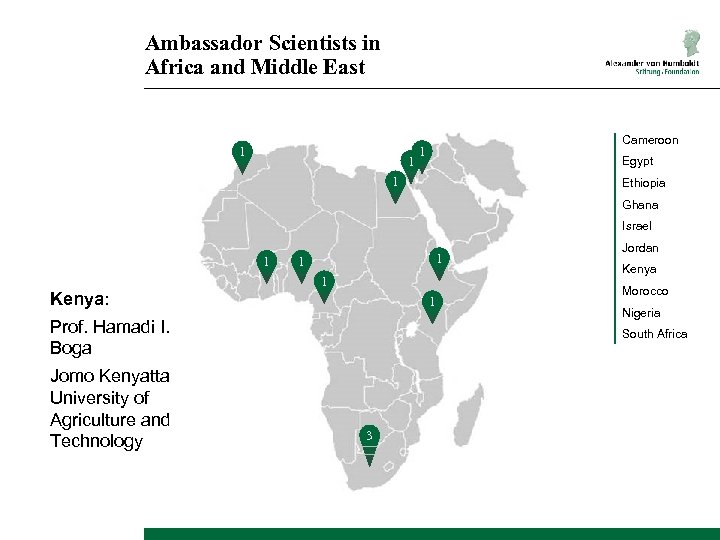
Ambassador Scientists in Africa and Middle East 1 1 Cameroon 1 Egypt 1 Ethiopia Ghana Israel 1 Kenya: 1 1 Prof. Hamadi I. Boga Jomo Kenyatta University of Agriculture and Technology Jordan Kenya Morocco Nigeria South Africa 3
Contact The Alexander von Humboldt Foundation is available to answer your questions at any time: info@avh. de www. humboldt-foundation. de Jean-Paul-Straße 12 53173 Bonn Germany Tel: +49 228 833 -0 Fax: +49 228 833 -199
Скачать презентацию The Alexander von Humboldt Foundation Connecting excellent researchers
ad4e47f92f3a656c45276618c5b4778f.ppt