 Скачать презентацию The Agile Difference for SCM Robert Cowham
ca8ff73fa8fa462f974044d80b0a3c26.ppt
- Количество слайдов: 31



The Agile Difference for SCM Robert Cowham & Brad Appleton 12 -Oct-2004
Contents l l l What is Agility? Standard SCM Introducing Agile and the SCM Implications Areas for Concern Case Study Summary 12 -Oct-2004 The Agile Difference for SCM © Brad Appleton, Robert Cowham 2
What is Agility? l The ability to both create and respond to change in order to profit in a turbulent business environment. l What is new about agile methods is not the practices they use, but their recognition of people as the primary drivers of project success, coupled with an intense focus on effectiveness and maneuverability. -- James Highsmith, Agile Software Development Ecosystems 12 -Oct-2004 The Agile Difference for SCM © Brad Appleton, Robert Cowham 3
Implications of Change l “Requirements changes late in the lifecycle are competitive advantage, IF you can act on them!” – Mary Poppendieck “Change is not the enemy – stagnation is! Don’t try to prevent change! Plan for it!” 12 -Oct-2004 The Agile Difference for SCM © Brad Appleton, Robert Cowham 4
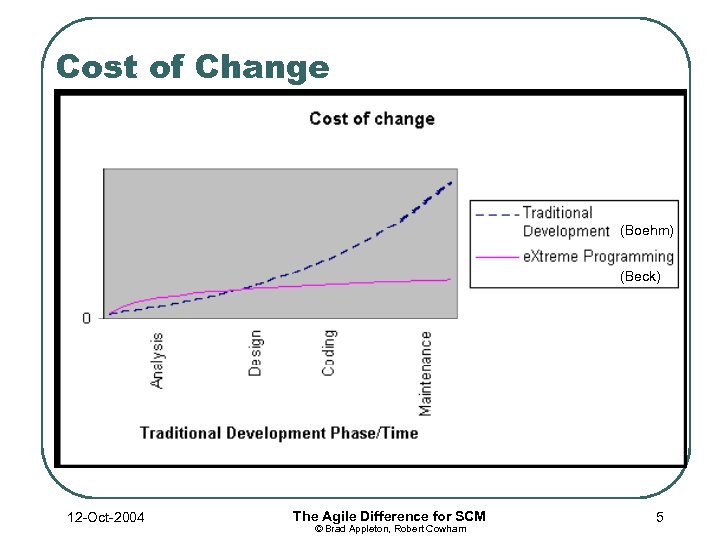
Cost of Change (Boehm) (Beck) 12 -Oct-2004 The Agile Difference for SCM © Brad Appleton, Robert Cowham 5
Achieving Agility Responding quickly & effectively to change requires minimizing: l l The cost of knowledge-transfer The cost of knowledge capture (documents!) The time between making a decision, and exploring its results to learn the consequences of implementing it Close collaboration and frequent iteration are critical for success! 12 -Oct-2004 The Agile Difference for SCM © Brad Appleton, Robert Cowham 6
Four Principles of Lean Thinking 1. Add nothing but value – (Eliminate Waste) 2. Center on the people who add value 3. Let Customers “Pull” Value – (Delay Commitment, Deliver Fast) 4. Optimize the Value Stream – (Optimize Across Organizations) Source: Mary & Tom Poppendieck, http: //www. poppendieck. com 12 -Oct-2004 The Agile Difference for SCM © Brad Appleton, Robert Cowham 7
Seven “Wastes” of Software Development 1. Extra/Unused features (Overproduction) 2. Partially developed work not released to production (Inventory) 3. Intermediate/unused artifacts (Extra Processing) 4. Seeking Information (Motion) 5. Escaped defects not caught by tests/reviews (Defects) 6. Waiting (including Customer Waiting) 7. Handoffs (Transportation) Source: Mary & Tom Poppendieck, http: //www. poppendieck. com 12 -Oct-2004 The Agile Difference for SCM © Brad Appleton, Robert Cowham 8
What is SCM? (Traditional View) l l l Configuration Identification Configuration Control Status Accounting Audit & Review Build & Release Management Process Management, etc 12 -Oct-2004 The Agile Difference for SCM © Brad Appleton, Robert Cowham 9
What is Agile SCM? The pragmatic application of l sound CM principles & practices l in accordance with Agile Values l using Lean Thinking to serve the needs of the Business! 12 -Oct-2004 The Agile Difference for SCM © Brad Appleton, Robert Cowham 10
Introducing Agility (into development) 12 -Oct-2004
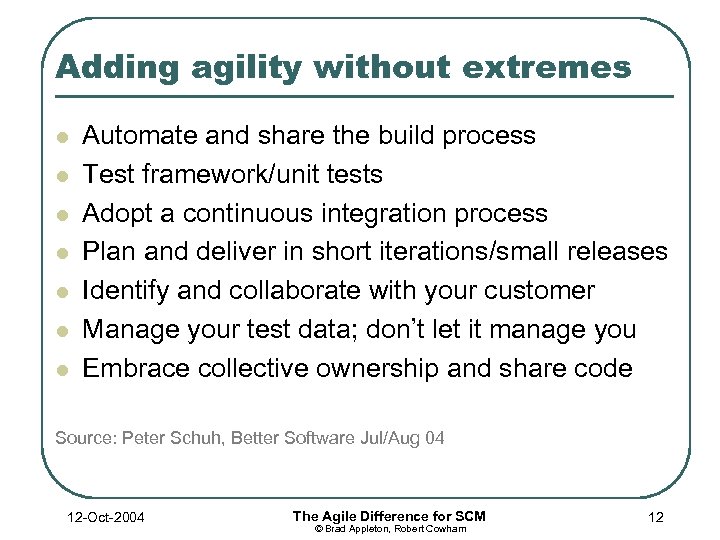
Adding agility without extremes l l l l Automate and share the build process Test framework/unit tests Adopt a continuous integration process Plan and deliver in short iterations/small releases Identify and collaborate with your customer Manage your test data; don’t let it manage you Embrace collective ownership and share code Source: Peter Schuh, Better Software Jul/Aug 04 12 -Oct-2004 The Agile Difference for SCM © Brad Appleton, Robert Cowham 12
Automate & Share Build Process l l l Automate repetitive and mundane tasks Saves chasing compilation/convergence issues Reduces dependencies and bottlenecks 12 -Oct-2004 The Agile Difference for SCM © Brad Appleton, Robert Cowham 13
SCM is a “whole team” responsibility l SCM and development must closely collaborate toward the shared goal of successfully meeting a project’s business and technical objectives • l SCM is part of every team member’s day-to-day tasks and activities: • • l Remove “Great Walls of Ire” between SCM & developers! Integrate/build/test in sandbox before check-in If the build breaks, the whole team takes ownership Everyone understands and appreciates the needs of both development and SCM because they experience the needs and benefits of both every day 12 -Oct-2004 The Agile Difference for SCM © Brad Appleton, Robert Cowham 14
Concerns Agile vs. Traditional SCM 12 -Oct-2004
Coordination and Automation SCM tools & practices/processes cannot hinder development or they won’t get used! • • • l l Add nothing but value Minimize Artifacts Eliminate Waste Tools and processes need to be simple, pragmatic, and enhance communication and coordination or reduce rework. Tracking systems and version control tools should not interrupt “flow” by causing a “wait” for tools to collect data or complete lengthy operations. 12 -Oct-2004 The Agile Difference for SCM © Brad Appleton, Robert Cowham 16
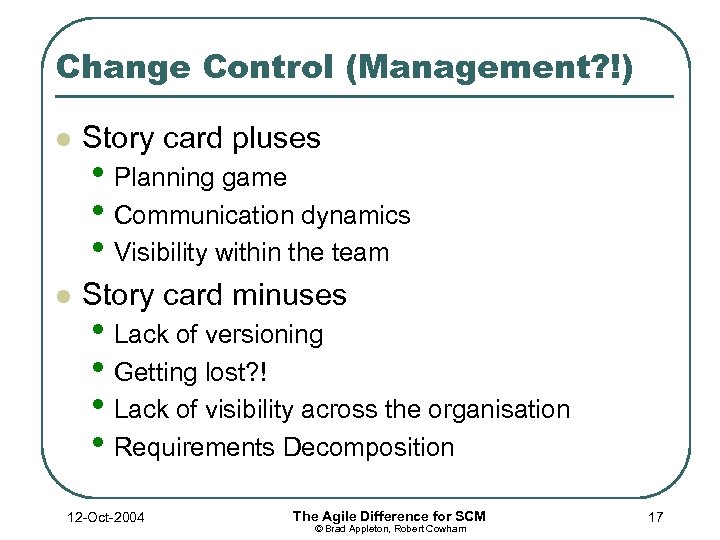
Change Control (Management? !) l Story card pluses l Story card minuses • Planning game • Communication dynamics • Visibility within the team • Lack of versioning • Getting lost? ! • Lack of visibility across the organisation • Requirements Decomposition 12 -Oct-2004 The Agile Difference for SCM © Brad Appleton, Robert Cowham 17
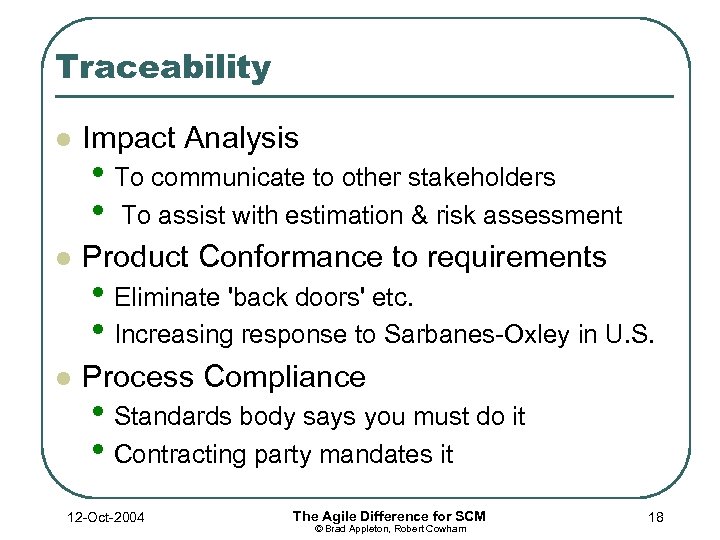
Traceability l Impact Analysis l Product Conformance to requirements l Process Compliance • To communicate to other stakeholders • To assist with estimation & risk assessment • Eliminate 'back doors' etc. • Increasing response to Sarbanes-Oxley in U. S. • Standards body says you must do it • Contracting party mandates it 12 -Oct-2004 The Agile Difference for SCM © Brad Appleton, Robert Cowham 18
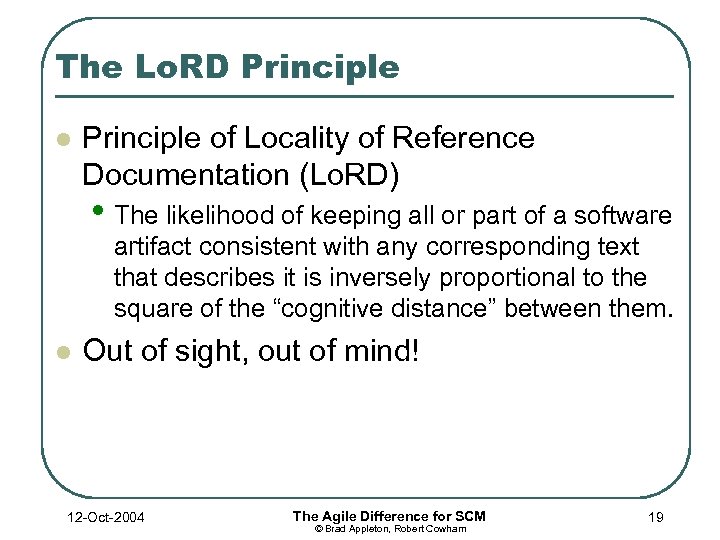
The Lo. RD Principle l Principle of Locality of Reference Documentation (Lo. RD) • The likelihood of keeping all or part of a software artifact consistent with any corresponding text that describes it is inversely proportional to the square of the “cognitive distance” between them. l Out of sight, out of mind! 12 -Oct-2004 The Agile Difference for SCM © Brad Appleton, Robert Cowham 19
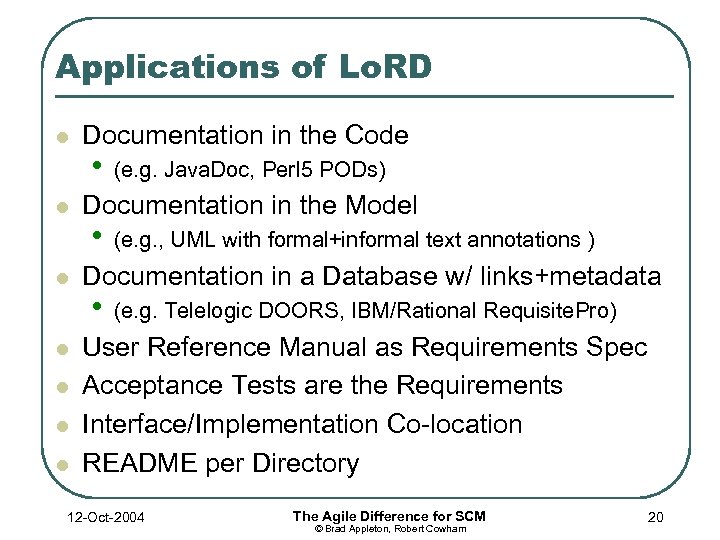
Applications of Lo. RD l l l l Documentation in the Code • (e. g. Java. Doc, Perl 5 PODs) Documentation in the Model • (e. g. , UML with formal+informal text annotations ) Documentation in a Database w/ links+metadata • (e. g. Telelogic DOORS, IBM/Rational Requisite. Pro) User Reference Manual as Requirements Spec Acceptance Tests are the Requirements Interface/Implementation Co-location README per Directory 12 -Oct-2004 The Agile Difference for SCM © Brad Appleton, Robert Cowham 20
Case Study 12 -Oct-2004
WDS Global l Integrated Service Framework to the wireless industry: • l l l Nokia, Vodaphone, AT&T Wireless, Singatel, Telstra, Siemens Web based services, mainly java 25 developers: Seattle, Poole & Singapore Transitioned to XP 2½ years ago Daily handovers via conference call Story card planning Migrated from CVS 12 -Oct-2004 The Agile Difference for SCM © Brad Appleton, Robert Cowham 22
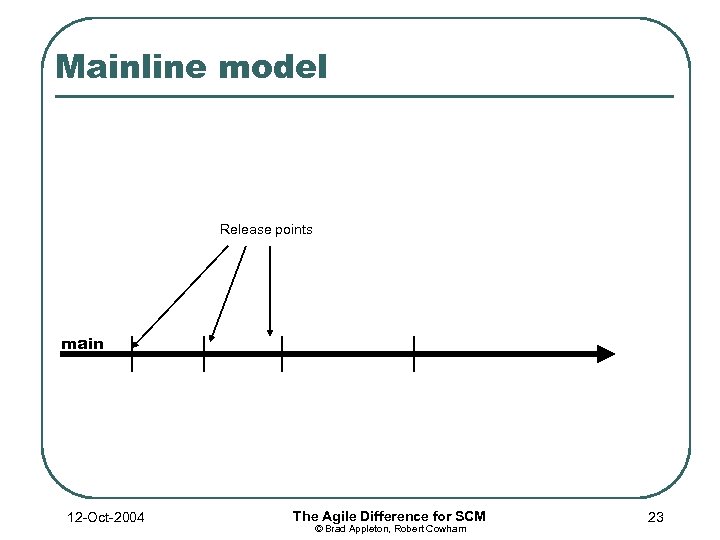
Mainline model Release points main 12 -Oct-2004 The Agile Difference for SCM © Brad Appleton, Robert Cowham 23
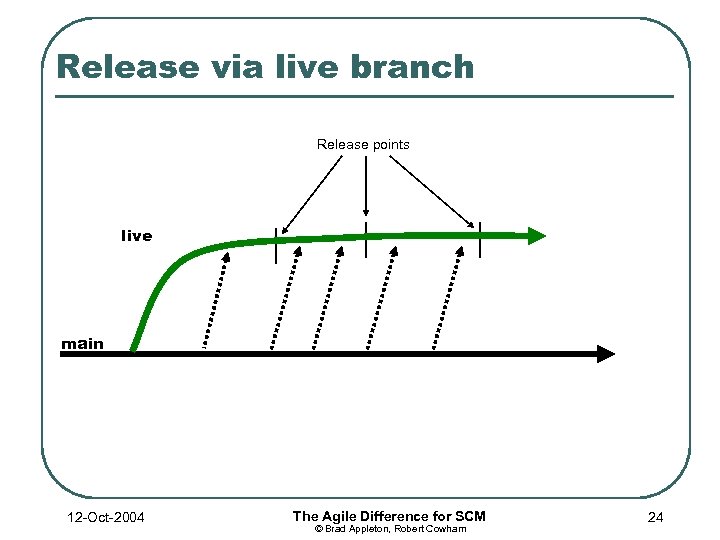
Release via live branch Release points live main 12 -Oct-2004 The Agile Difference for SCM © Brad Appleton, Robert Cowham 24
WDS Global Experiences l Working well l Multi-site fine Still use only story cards – from Product Backlog spreadsheets l • Visibility dramatically better 12 -Oct-2004 The Agile Difference for SCM © Brad Appleton, Robert Cowham 25
Summary 12 -Oct-2004
Agile SCM is not… l l l A hackers charter! About throwing out good SCM principles and practices Losing control 12 -Oct-2004 The Agile Difference for SCM © Brad Appleton, Robert Cowham 27
Agile SCM requirements An Agile SCM solution should: l Serve its practitioners and not vice-versa! l Unite SCM and developers l Respond to change vs. prevent changes Track, guide/facilitate & coordinate vs. control Be transparent and “frictionless” l l • while still serving the needs of the business • collaboration • automation & process-enactment 12 -Oct-2004 The Agile Difference for SCM © Brad Appleton, Robert Cowham 28
Becoming More Agile l l Introduce One Practice Adapt Evaluate Repeat! And hopefully reap the rewards! 12 -Oct-2004 The Agile Difference for SCM © Brad Appleton, Robert Cowham 29
Resources 12 -Oct-2004
Other Agile/SCM References l l l Software Configuration Management Patterns, Stephen Berczuk and Brad Appleton Configuration Management Principles and Practice, Anne Mette Jonassen Hass Software Configuration Management Strategies and Rational Clear. Case, Brian White Requirements by Collaboration, Ellen Gottesdiener Lean Software Development, Mary & Tom Poppendieck The Laws of Software Process, Phillip G. Armour Agile Software Development Ecosystems, James Highsmith Agile Software Development, Alistair Cockburn Domain Driven Design, Eric Evans Refactoring: Improving the Design of Existing Code, Martin Fowler Addison-Wesley’s XP Series of Books 12 -Oct-2004 The Agile Difference for SCM © Brad Appleton, Robert Cowham 31
Скачать презентацию The Agile Difference for SCM Robert Cowham
ca8ff73fa8fa462f974044d80b0a3c26.ppt