

The Age of Reason in America The

























 Скачать презентацию The Age of Reason in America The
Амер лит Просв2 2016.ppt
- Количество слайдов: 100
The Age of Reason in America
The Age of Reason, or the Enlightenment, began in Europe with the rationalist philosophers and scientists of the 17 th century.
Rationalism is the belief that people can arrive at truth by reason rather than relying on the authority of the past, on religious faith, or intuition.
The emergence of modern science and the scientific method had much to do with this new emphasis and reason and free inquiry.
• Discoveries made by physical scientists and mathematicians were changing the ways people viewed the universe.
Scientific investigation seemed to show that the universe was organized according to certain unchanging laws, and that people could discover those laws through the use of their reason.
The Puritans saw God as actively and mysteriously involved in the workings of the universe; the rationalists saw God differently.
Sir Issac Newton (1642 -1727), who discovered the laws of gravity, compared God to a clockmaker who, having created the perfect mechanism of this universe, then left His creation to run on its own.
According to this view, God would not interfere with the operation of this perfect mechanism, and it made no sense to ask Him to do so.
God’s special gift to humanity was reason – the ability to think in an ordered, logical manner. As the French philosopher and mathematician, Rene Descartes affirmed in the opening sentence of his work Discourse on Method (1637): “I think, therefore, I am. ”
• This gift of reason enabled people to discover both scientific and spiritual truth. • In the rationalist view, all human beings were born with an innate ethical sense, and all had the ability to regulate and improve their own lives.
The theoretical background for the Age of Reason, then took shape in Europe in the work of such figures as Descartes, Newton, and John Locke.
• In America pragmatism was characterized by an interest in the public welfare and a willingness to experiment, to try things out, no matter what the authorities might say.
• The Age of Reason in America combined common sense with ideas from European thinkers. The American reading public displayed great interest in the works of English scientists, philosophers and writers, Newton, Swift, Locke and others. The writers of the French Enlightenment, Voltaire, Russeau
From this mixture of ideas and outlooks came much of the triumph of 18 th-century American life: the inventive and curious minds of Benjamin Franklin and Thomas Jefferson, the drive to improve living conditions, forms of government, and individual minds;
and the thinking behind the important statement “We hold these truths to be self-evident” (The Declaration of Independence, Thomas Jefferson).
In the 1770 s of the 18 th century the English colonies rebelled against their parental colony. The War for Independence lasted for 8 years (1776 -1783) and ended in the formation of a Federative Bourgeois Democratic Republic – the USA.
This event of epoch-making significance had been pre-determined by the whole course of historical development of the colonial America.
The spiritual life in the colonies during that period was influenced by the bourgeois Enlightenment – a movement supported by all progressive forces of the country
which opposed themselves to the old colonial order and religious obscurantism.
The representatives of the Enlightenment set themselves the task of disseminating knowledge among the people and advocating revolutionary ideas. They also participate in the War of Independence.
American Enlightenment dealt a decisive blow upon the puritan traditions and brought to life secular education and literature.
At the initial period the spread of ideas of the Enlightenment was largely due to journalism.
In the 18 th century the most interesting writing was done by the Founding Fathers, who led the Revolution of 1775 -1783
and who wrote the Constitution of 1789. They were philosophers and also wrote political pamphlets.
Benjamin Franklin (1706 -1790) The writings of Benjamin Franklin show the Enlightenment spirit in America.
Franklin was the first and greatest of American enlighteners. He wrote a great deal. Almost all of his important works are short.
Franklin was born in Boston. He attended school only for one year and educated himself by reading extensively.
At the age of 12 he became an apprentice in the printing house belonging to his elder brother, James Franklin,
who published the Boston Gazette.
In 1723 Franklin moved to Philadelphia after a quarrel with his brother.
He entered the printing shop of Samuel Keimer. Franklin was sent to London.
He stayed in London working for a London Printing House.
He wrote A Dissertation on Liberty and Necessity, Pleasure and Pain (1725)
He returned to Philadelphia, established his own press and issued The Pensylvania Gazette in 1730 s
It was his own great achievement
He constantly worked to develop his own skills, he created himself.
He founded a society of young artisans, apprentices and traders, called “Junta”, the “Junta” club.
The aim of this society was self-education and dissemination of knowledge. The “Junta” later developed into the American Philosophical Society.
His idea – to do good to people He became a leader in philanthropic, scientific, and political affairs
During 25 years, beginning from 1732, Franklin published his famous Poor Richard’s Almanac
which contained information on meteorology and agriculture alongside with stories, fables, proverbs.
The Almanac greatly contributed to the cause of the Enlightenment in America.
Franklin never left off his self-education. He read extensively, studied foreign languages and engaged in research work in physics.
In 1751 -1752 he made his experiments on atmospheric electricity which brought him world renown. Franklin also participated in various public activities.
He organized a library and hospital in Philadelphia.
He became a prominent public man in the country, and prior to the war was given high posts in the colonial government.
In 1757 he went to London as the representative of the American colonies.
During his life in England he made acquaintance of Adam Smith and many other men of note.
Taking the advantage of his official post Franklin protested against the measures directed by England against the American colonies.
Back to America, in 1775, Franklin took part in the revolutionary events.
As a congressman he entered the committee which was to draw up the DECLARATION OF INDEPENDENCE
As a writer Franklin is remembered for his essays on a variety of subjects and his Autobiography (1771 - 1790).
2 parts Buildungsroman
The First part (1771) Is an entertaining description of his own life up to his early manhood
The Second part (1784) presents thoughts of a mature man. His style is serious. He writes about his contribution to America
and to American history He writes about himself “For the Improvement of Others” This autobiography of the Father of the Yankees is of great value.
Most of his works were printed in his own almanac and should be regarded as a valuable contribution to the cause of the American Enlightenment.
In his works Franklin raises his voice against monarchy, slavery, racial discrimination and extermination of the Indians.
Some of his political essays bear a marked satirical character and are directed against the British government.
He was involved in democratic activities and his broad-minded genius found appreciation.
Thomas Paine 1737 – 1809
The time shortly before and during the War for Independence embraces the activities of Thomas Paine.
He is one of the most popular men of the Age of Reason and the most persuasive writer of the American Revolution.
He came from an unlikely background. He was born in England
and he was the poorly educated son of a corset maker.
• He spent his 37 years of life drifting through a number of occupations: corset maker, grocer, tobacconist, school teacher,
and a government employee who examined goods and levied taxes on them.
In 1774, Paine was dismissed for attempting to organize the employees in demand for higher wages which was an unusual activity in those days.
Like many others he came to America to make a new start.
With a letter of introduction from Ben Franklin, whom he met in London, Paine went to Philadelphia, where he worked as a journalist.
In the disagreement between England the Colonies, he instantly identified with the cause of the underdog.
In January of 1776, he published the most important pamphlet in support of American independence: Common Sense.
In this 47 -page pamphlet, Paine denounced King George III as a “royal brute” and asserted that a continent should not remain tied to an island.
The pamphlet sold half a million copies – in a country whose total population was roughly two and a quarter million.
In 1776 Paine joined the Continental Army as it retreated across New Jersey to Philadelphia.
During the journey he began writing a series of 16 pamphlets called The American Crisis.
In these, he commented on the course of the war and urged his countrymen not to give up the fight.
The first of these pamphlets was read to Washington’s troops in December 1776, a few days before the recrossed the Delaware River to attack Trenton.
After the Revolution Paine lived peacefully in New York and New Jersey until 1787 when he returned to Europe. There he became involved once more in radical revolutionary politics.
Revolutionary times were over in America but they were beginning in Europe. On July 14, 1789, the French Revolution began in Paris with the storming of the Bastille by angry men led by Paine, who considered himself a citizen of the world, soon found a platform for his ideas.
In France he composed The Rights of Man, a reply to the English statesman Edmund Burke’s condemnation of the French Revolution.
The Rights of Man was an impassioned defense of republican government and a call to the English people to overthrow their king.
Although he was outside the country, Paine was tried for treason and outlawed from England. He was safe in France from English law.
He was briefly celebrated as a hero of the French Revolution.
Soon he was imprisoned for being a citizen of an enemy nation (England). James Monroe, the American minister to France at that time,
secured Paine’s release in 1794 by insisting that Paine was an American citizen
The first part of the last great work, The Age of Reason, appeared in 1794. The second part was published two years later.
The Age of Reason was Paine’s statement of belief and an explanation of the principles of deism.
The book was controversial in America where it was not fully understood and was thought to be atheistic.
When the author of the book finally returned to America in 1802 he found himself an outcast.
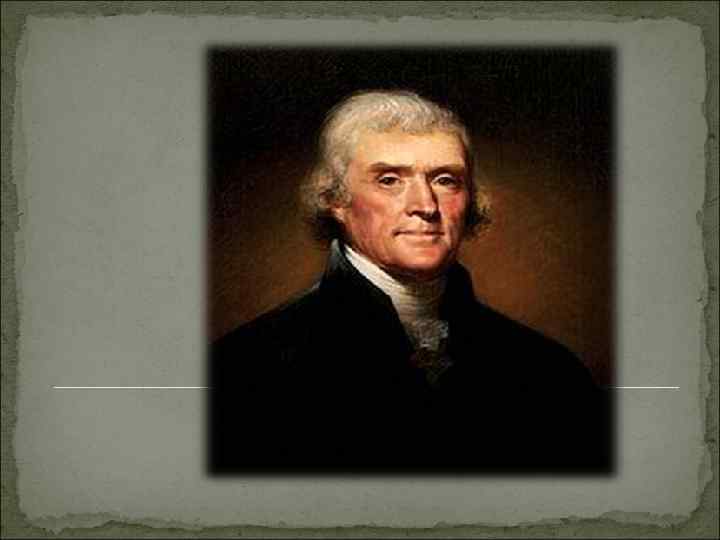
Thomas Jefferson
In office March 4, 1801 – March 4, 1809 Preceded by John Adams Succeeded by James Madison
Thomas Jefferson was the third President of the United States (1801– 1809) and the principal author of the Declaration of Independence (1776).
The chief author of the Declaration of Independence – was an important writer.
He was an influential Founding Father. Jefferson envisioned America as a great "Empire of Liberty" that would promote republicanism. Thomas Jefferson was the third President of the United States (1801– 1809) and the principal author of the Declaration of Independence (1776). The chief author of the Declaration of Independence – was an important writer.
He was an influential Founding Father. Jefferson envisioned America as a great "Empire of Liberty" that would promote republicanism.
Thomas Jefferson was born on April 13, 1743 in a family closely related to some of the most prominent individuals in Virginia. He was the third of ten children.
• Jefferson's father was Peter Jefferson, a planter and surveyor in Albemarle County.