


 Скачать презентацию The Affluent Society Chapter 28 A New
3c938f078f2ca0a635b4d98fe9de385a.ppt
- Количество слайдов: 53
 The Affluent Society Chapter 28
 A New Affluence in the USA was the only nation in WWII that was NOT bombed during the war US economy benefited greatly from wartime contracts Emerged from the war economically strong and prosperous Became the leader of the “free world, ” major post-war decision-maker Western states especially benefited
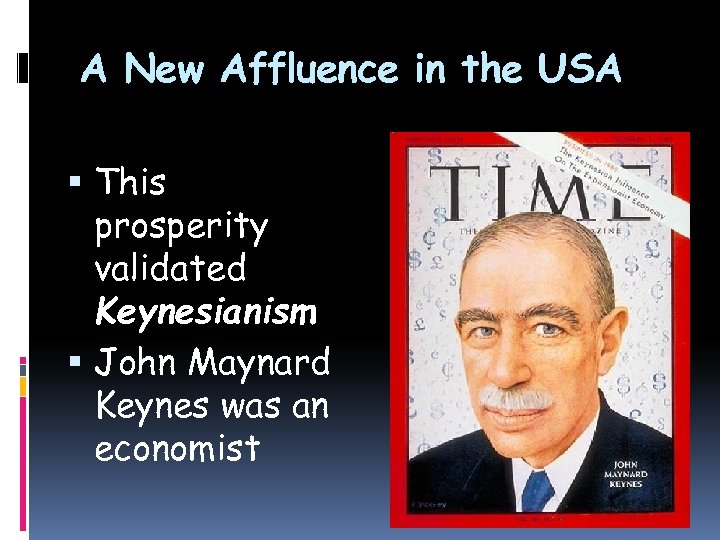 A New Affluence in the USA This prosperity validated Keynesianism John Maynard Keynes was an economist
 A New Affluence in the USA Keynesian economics argues that private sector decisions sometimes lead to inefficient macroeconomic outcomes These outcomes require active policy responses by the public sector
 A New Affluence in the USA Active government policy responses are particularly in the area of monetary policy actions by the central bank, and fiscal policy actions by the government The goal is to stabilize output over the business cycle
 A New Affluence in the USA The theories forming the basis of Keynesian economics were first presented in The General Theory of Employment, Interest and Money, published in 1936 The interpretations of Keynes are contentious Several schools of thought claim his legacy
 A New Affluence in the USA Keynesian economics advocates a mixed economy — predominantly private sector, but with a significant role of government and public sector It served as the economic model during the later part of the Great Depression, World War II, and the post -war economic expansion (1945– 1973)
 A New Affluence in the USA Labor unions shared in the prosperity, often cooperated more with industry (nicknamed “postwar contract”) AFL and CIO merged in 1955 Less-active unions (especially Teamsters) suffered from corruption
 A New Affluence in the USA Prosperity led to many new inventions Medical (antibiotics, new surgery techniques, polio vaccine) Also to awareness of the dangers of pesticides, and the start of an environmentalist awareness “Silent Spring” (1962) by Rachel Carson
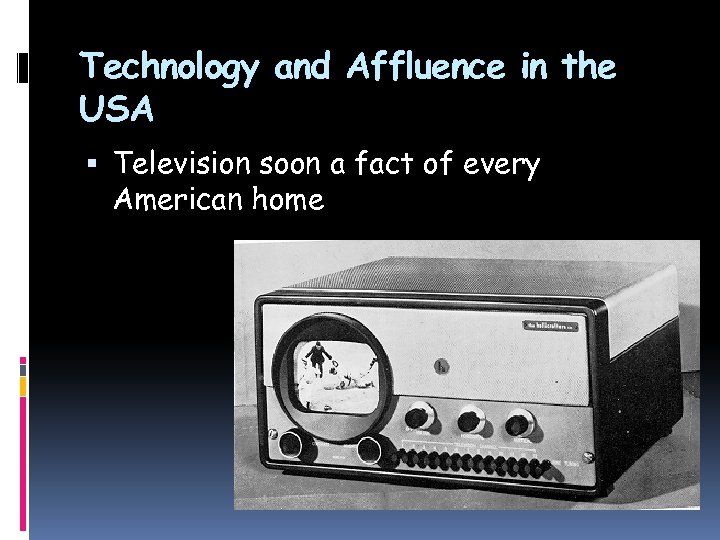 Technology and Affluence in the USA Television soon a fact of every American home
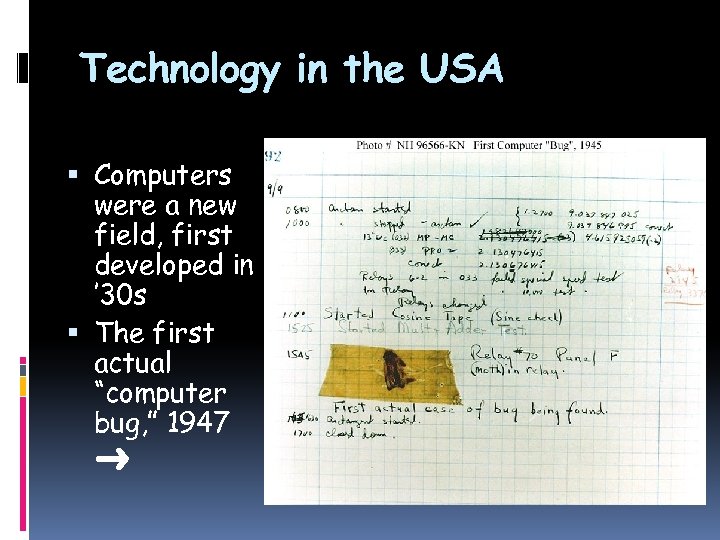 Technology in the USA Computers were a new field, first developed in ’ 30 s The first actual “computer bug, ” 1947 ➜
 Technology in the USA Weapons technologies boomed The US and USSR were locked in “arms race” to outdo each other MAD (“Mutually Assured Destruction”) All of this created unprecedented new jobs for Americans
 Technology in the USA In October, 1957, the USSR successfully launched an artificial satellite into earth orbit “Sputnik I” The “Space Race” began in earnest
 Technology in the USA US had also been working on a “space program” for some time Many of the US rocket scientists had formerly worked for Nazi Germany developing rockets during WWII The USSR also had some former Nazis working in their space program as well
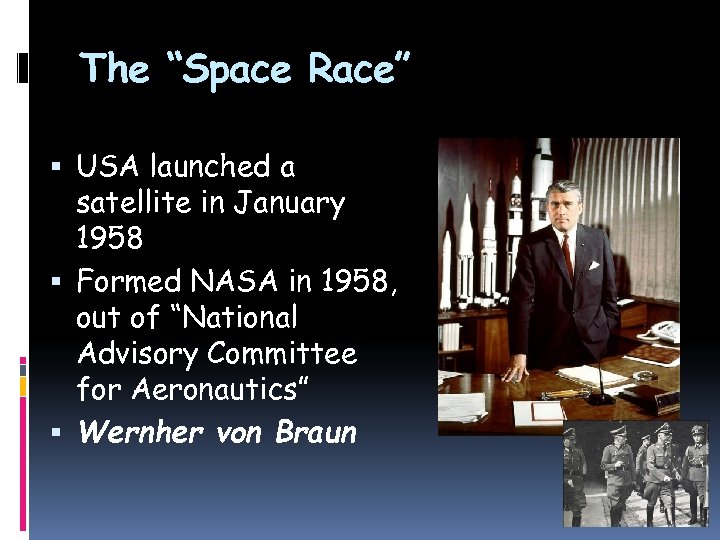 The “Space Race” USA launched a satellite in January 1958 Formed NASA in 1958, out of “National Advisory Committee for Aeronautics” Wernher von Braun
 Education and The “Space Race” American schools, urged by President Eisenhower, renewed science education In 1961, JFK committed the US to putting a man on the moon and returning him safely to Earth before the end of the decade
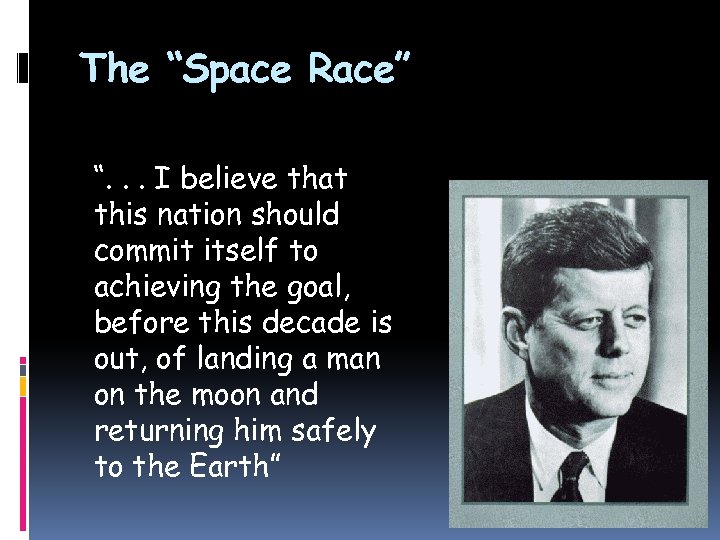 The “Space Race” “. . . I believe that this nation should commit itself to achieving the goal, before this decade is out, of landing a man on the moon and returning him safely to the Earth”
 The “Space Race” “No single space project in this period will be more impressive to mankind, or more important for the long-range exploration of space; and none will be so difficult or expensive to accomplish”
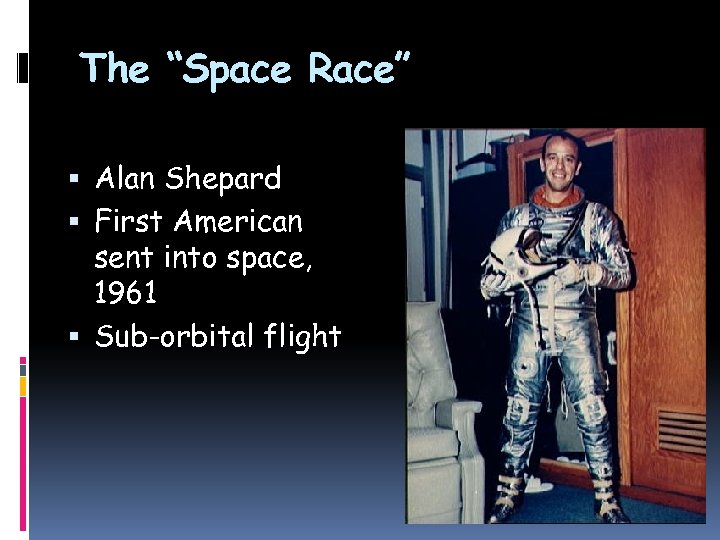 The “Space Race” Alan Shepard First American sent into space, 1961 Sub-orbital flight
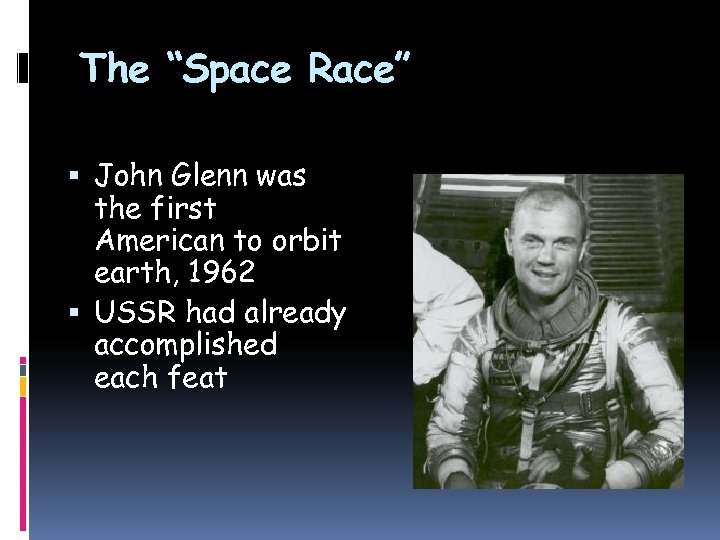 The “Space Race” John Glenn was the first American to orbit earth, 1962 USSR had already accomplished each feat
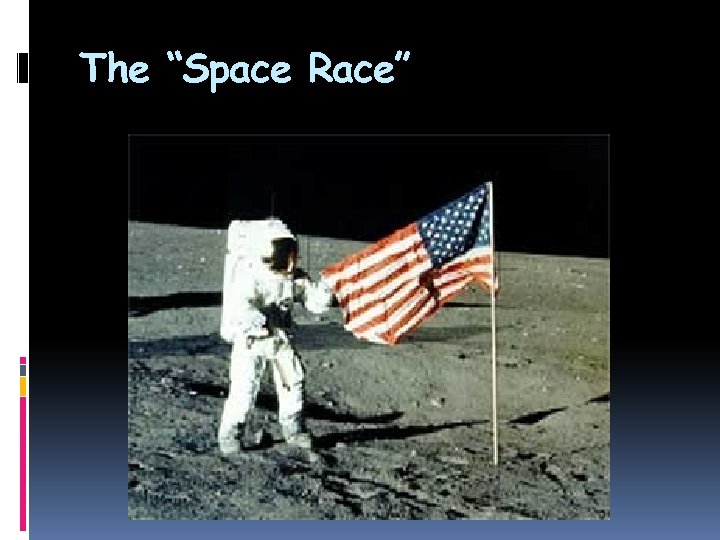
 The “Space Race” Mercury, Gemini, and finally Apollo programs of late 1960 s set in place by JFK to put an American on the moon and return him safely to Earth by the end of the decade Goal was achieved July 1969 USA “first” to land a manned spacecraft on the moon
 The “Space Race”
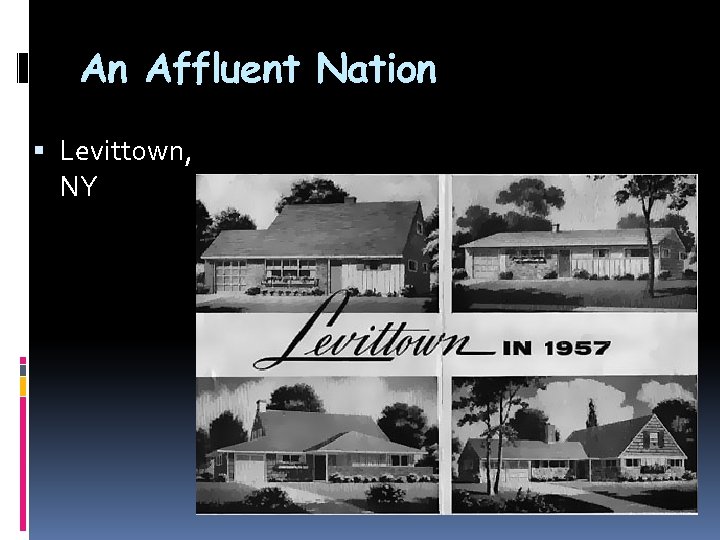
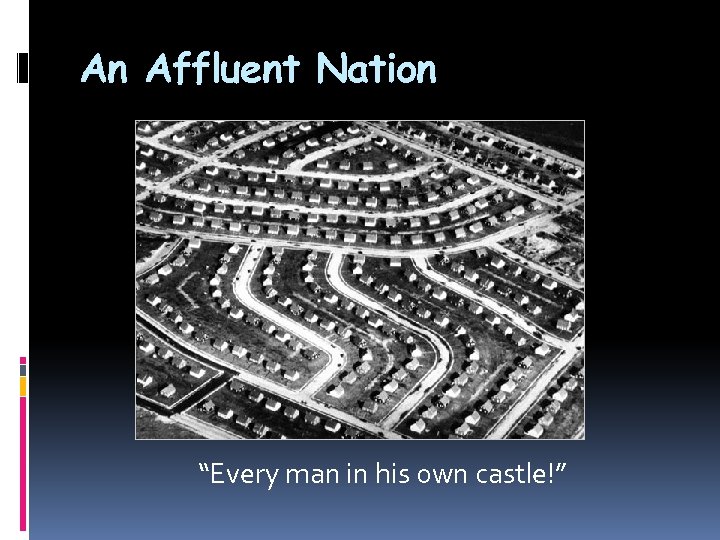
 An Affluent Nation Prosperity led Americans to new expectations of middle class life Levittowns – mass-produced housing that made home ownership more available “Cookie Cutters” -- “Little Boxes” Mass move to suburbs Automobile ownership more widespread
 An Affluent Nation Levittown, NY
 An Affluent Nation “Every man in his own castle!”
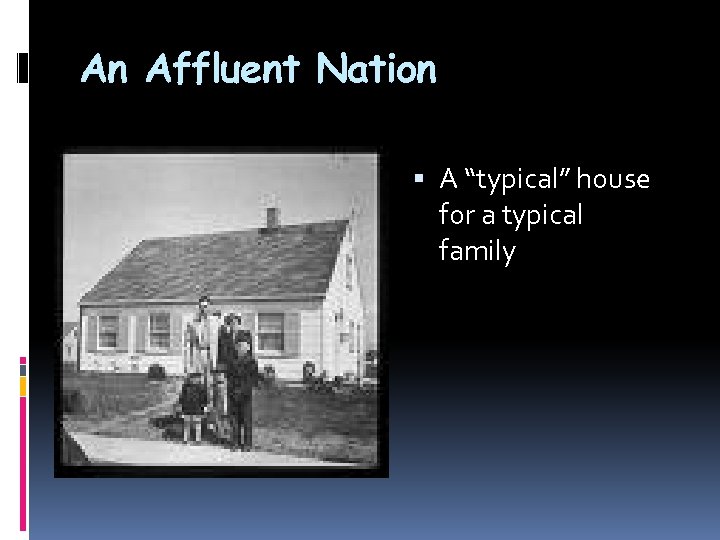 An Affluent Nation A “typical” house for a typical family
 The Television Age Television programming reflected ideals of the Cold War Traditional family, personal affluence Unintended consequence: began to create a sense of alienation in less affluent Americans who saw middle class life on TV, but could not attain it
 The “Beats” Others protested what they saw as a society that was too organized and restrictive Protest among young intellectuals who called themselves “Beats” Wrote about how the affluence could also be oppressive
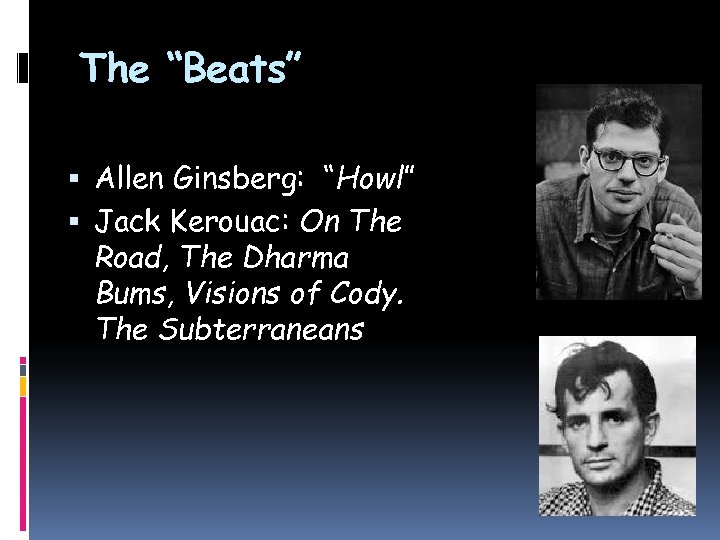 The “Beats” Allen Ginsberg: “Howl” Jack Kerouac: On The Road, The Dharma Bums, Visions of Cody. The Subterraneans
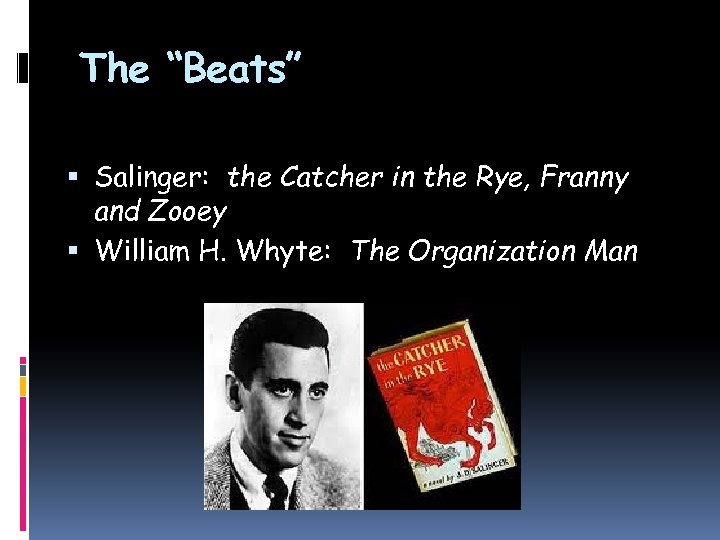 The “Beats” Salinger: the Catcher in the Rye, Franny and Zooey William H. Whyte: The Organization Man
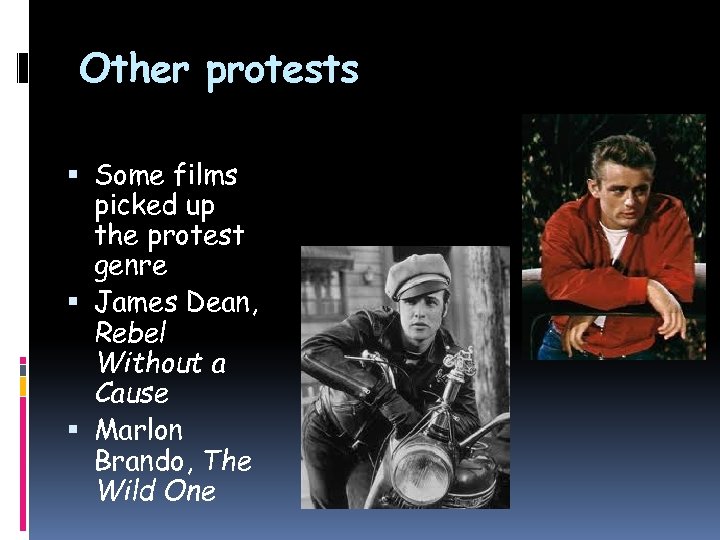 Other protests Some films picked up the protest genre James Dean, Rebel Without a Cause Marlon Brando, The Wild One
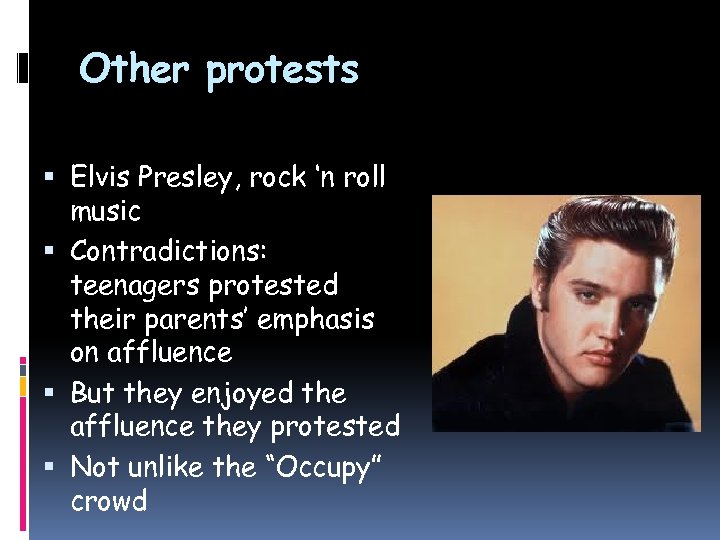 Other protests Elvis Presley, rock ‘n roll music Contradictions: teenagers protested their parents’ emphasis on affluence But they enjoyed the affluence they protested Not unlike the “Occupy” crowd
 The Civil Rights Movement Michael Harrington, The Other America (1962) Book pointed out how many Americans did not share in prosperity Migrant workers, sharecroppers, black Americans in inner cities Black Like Me (1961), John Howard Griffin
 The Civil Rights Movement In 1954, the Supreme Court issued the decision in Brown v. Board of Education of Topeka, Kansas Brown overturned Plessy v. Ferguson (1896) Plessy had established the “separate but equal” standard for segregated public accommodations
 The Civil Rights Movement New order: all government funded institutions must be desegregated with “all due speed” Followed up with another order the next year “All due speed” ended up being as much as ten years, or more
 The Civil Rights Movement Eisenhower hesitated to enforce desegregation too vigorously Country “not ready yet” Meanwhile, black leadership forming to exert “massive resistance” to segregation Equal pressure began to form by “White Citizens Councils” (successor to the KKK)
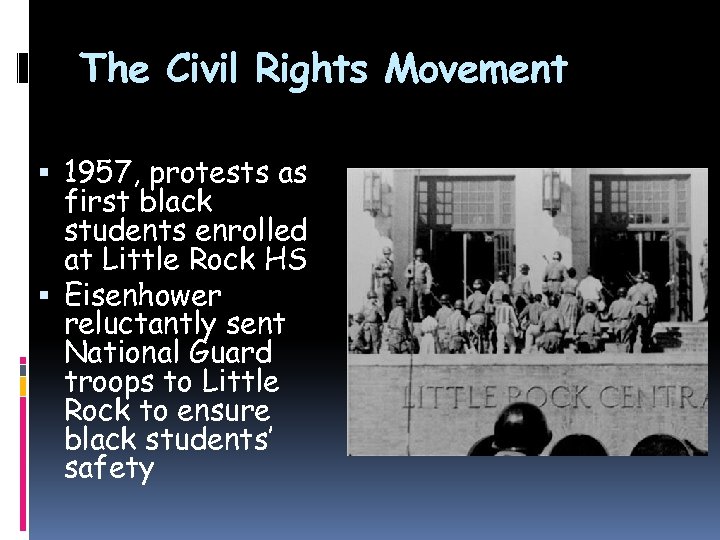 The Civil Rights Movement 1957, protests as first black students enrolled at Little Rock HS Eisenhower reluctantly sent National Guard troops to Little Rock to ensure black students’ safety
 The Civil Rights Movement In Montgomery, Alabama, Rosa Parks was arrested for refusing to stand up to give up her seat to a white man on a city bus There had been other such cases, but this one became a symbol Bus boycott led by Rev. Martin Luther King, Jr.
 The Civil Rights Movement at first was characterized by non-violence Influence of Mohandas Gandhi Much of white middle class (and US government officials) claimed the movement was communist-influenced USSR propaganda frequently pointed out poor situation of black Americans as one of the “evils of capitalism”
 Eisenhower’s America Emphasis on “what was good for business” “What’s good for General Motors is good for the USA” Emphasis on containing communism, supporting democracies that supported the USA Ignored Mc. Carthyism, which eventually self-destructed
 Eisenhower’s America Secretary of State John Foster Dulles crafted foreign policy of confrontation with communism Called “brinkmanship” – Push USSR to brink of war, if necessary Underlying idea: nuclear war so frightening a prospect that neither power would go that far, but push to edge anyway as power tactic
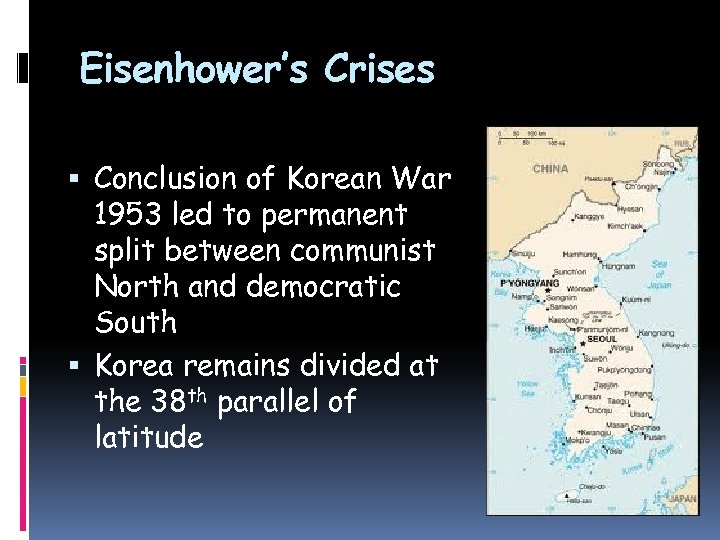 Eisenhower’s Crises Conclusion of Korean War 1953 led to permanent split between communist North and democratic South Korea remains divided at the 38 th parallel of latitude
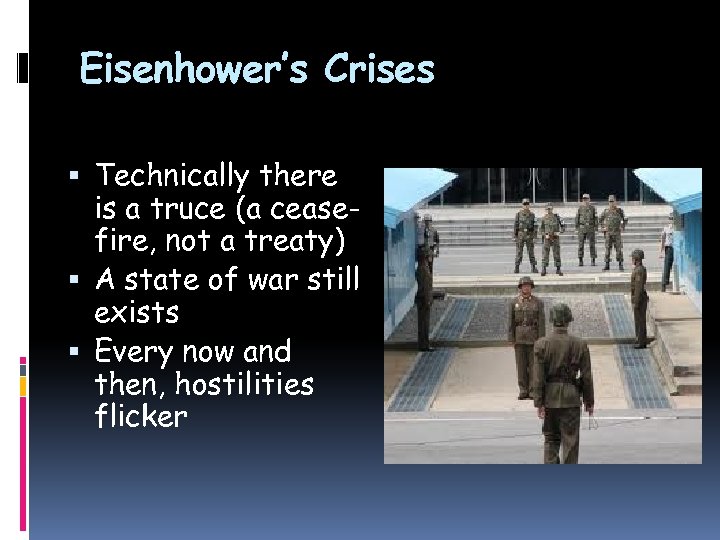 Eisenhower’s Crises Technically there is a truce (a ceasefire, not a treaty) A state of war still exists Every now and then, hostilities flicker
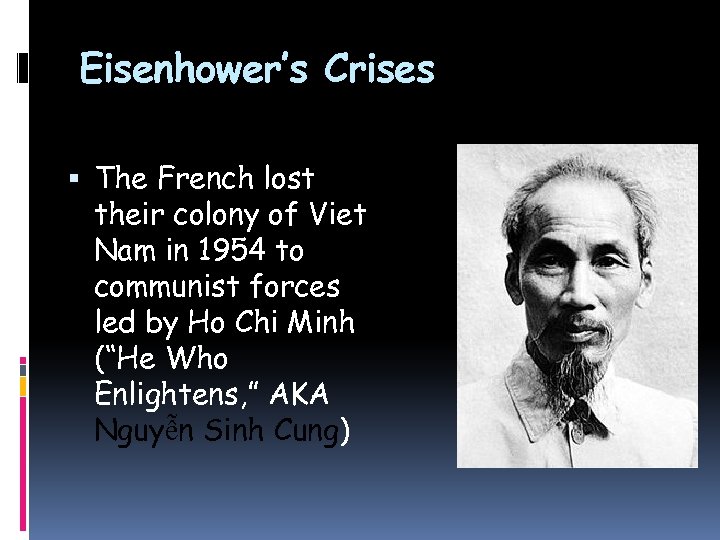 Eisenhower’s Crises The French lost their colony of Viet Nam in 1954 to communist forces led by Ho Chi Minh (“He Who Enlightens, ” AKA Nguyễn Sinh Cung)
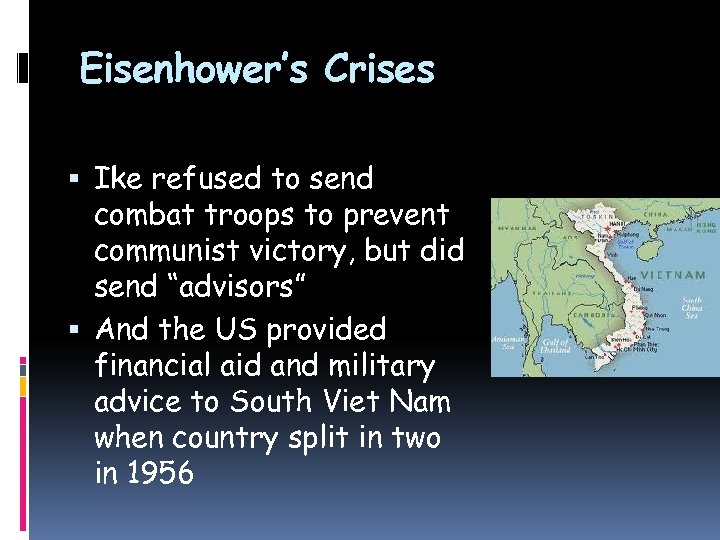 Eisenhower’s Crises Ike refused to send combat troops to prevent communist victory, but did send “advisors” And the US provided financial aid and military advice to South Viet Nam when country split in two in 1956
 Eisenhower’s Crises The state of Israel was created by the UN in 1948 as a homeland for displaced Jews of Europe “Palestine” (then administered by Great Britain under a League of Nations mandate) was partitioned The state of Israel was founded, and was immediately attacked by neighboring Arab countries
 Eisenhower’s Crises Eisenhower’s foreign policy was unwavering in its support of Israel Saw Israel as an essential democratic ally in Middle East And as a buffer against communist influences there
 Eisenhower’s Crises USSR under Josef Stalin continued to absorb former Nazi captive nations of Eastern Europe Winston Churchill spoke at Westminster College in Fulton, Missouri in 1946 “From Stettin in the Baltic to Trieste in the Adriatic an "iron curtain" has descended across the continent. . . “
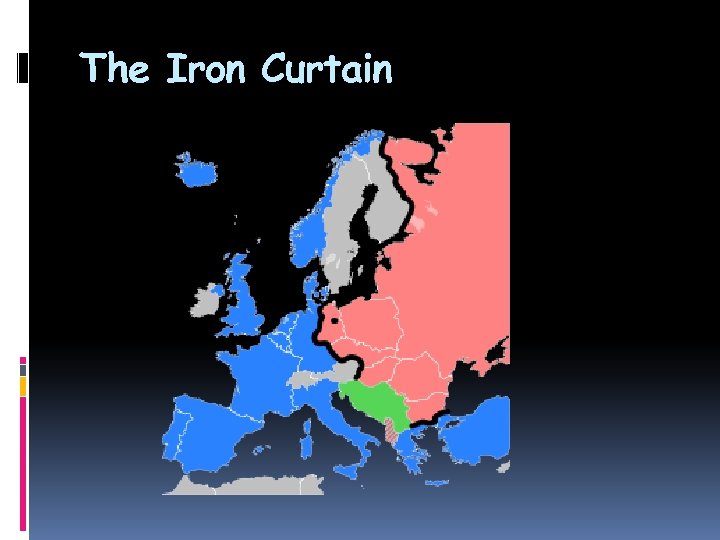 The Iron Curtain
 Eisenhower’s Crises 1960 embarrassment: Ike had publicly denied any US spying on USSR On the eve of a “summit” meeting between Ike and USSR premier Nikita Khrushchev. . .
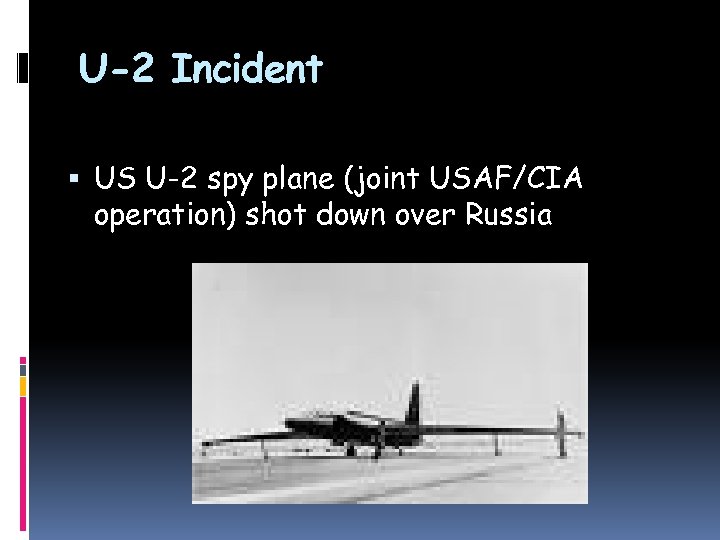 U-2 Incident US U-2 spy plane (joint USAF/CIA operation) shot down over Russia
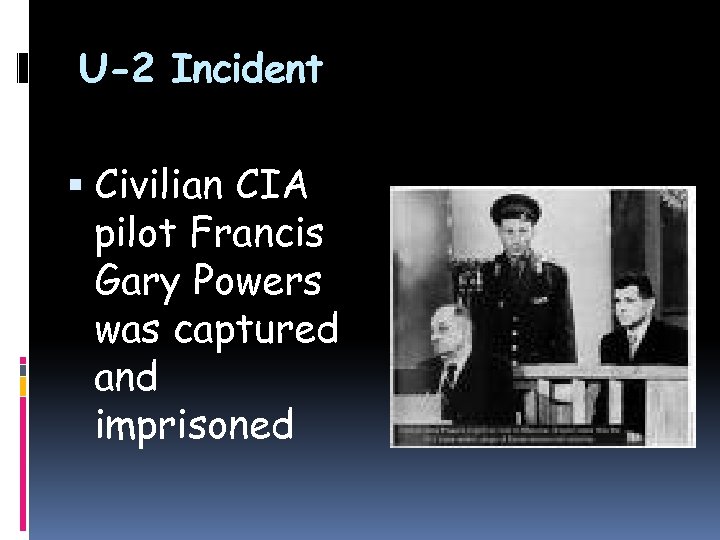 U-2 Incident Civilian CIA pilot Francis Gary Powers was captured and imprisoned
 U-2 Incident Powers was later exchanged for Soviet KGB Colonel Vilyam Fisher (aka Rudolf Abel) Fisher/Abel was a Soviet colonel who was caught by the FBI and imprisoned for espionage Cold War tensions escalated