


 Скачать презентацию The Affect of Application Volume and Deposition Aids
f11c31eb9eecf5f68b3d00b73a08545b.ppt
- Количество слайдов: 17
 The Affect of Application Volume and Deposition Aids on Droplet Spectrum and Deposition for Aerial Applications Presented at ASAE/NAAA Technical Session 38 th Annual NAAA Convention Silver Legacy Hotel and Casino Dec. 6, 2004 Robert E. Wolf Biological and Agricultural Engineering Paper # AA 04 -006
 Objective: The objective of this study was to evaluate the affect of deposition aids and application volume on droplet spectrum and canopy penetration for a fixed wing aerial application.
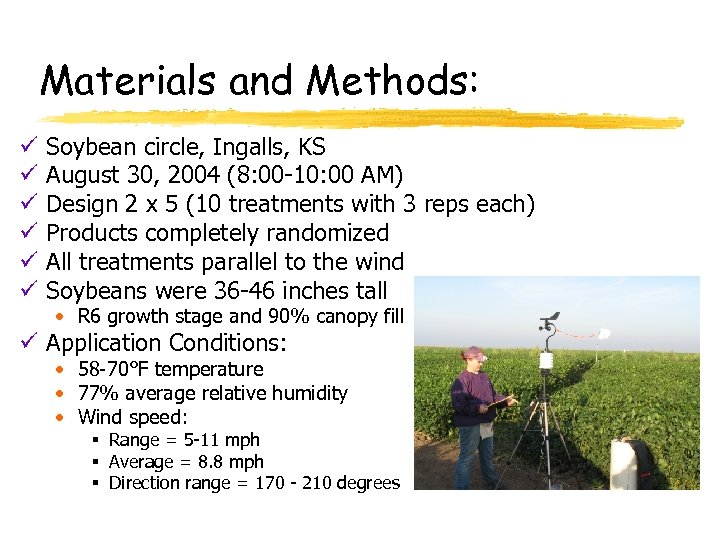 Materials and Methods: ü ü ü Soybean circle, Ingalls, KS August 30, 2004 (8: 00 -10: 00 AM) Design 2 x 5 (10 treatments with 3 reps each) Products completely randomized All treatments parallel to the wind Soybeans were 36 -46 inches tall • R 6 growth stage and 90% canopy fill ü Application Conditions: • 58 -70°F temperature • 77% average relative humidity • Wind speed: § Range = 5 -11 mph § Average = 8. 8 mph § Direction range = 170 - 210 degrees
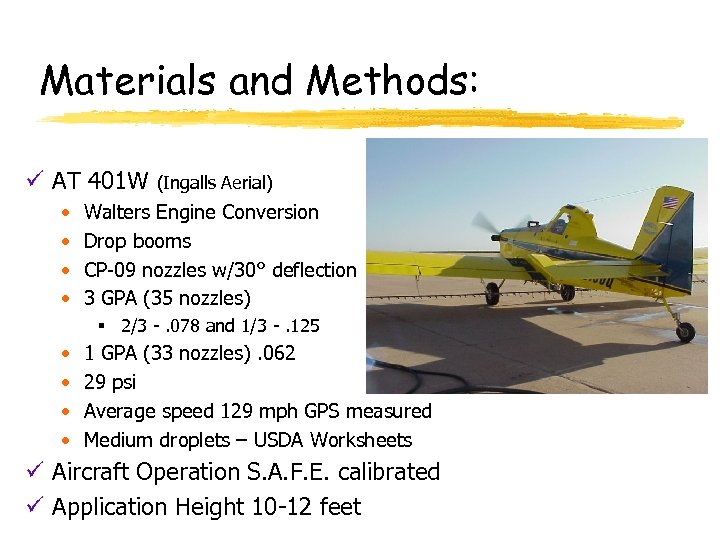 Materials and Methods: ü AT 401 W • • (Ingalls Aerial) Walters Engine Conversion Drop booms CP-09 nozzles w/30° deflection 3 GPA (35 nozzles) § 2/3 -. 078 and 1/3 -. 125 • • 1 GPA (33 nozzles). 062 29 psi Average speed 129 mph GPS measured Medium droplets – USDA Worksheets ü Aircraft Operation S. A. F. E. calibrated ü Application Height 10 -12 feet
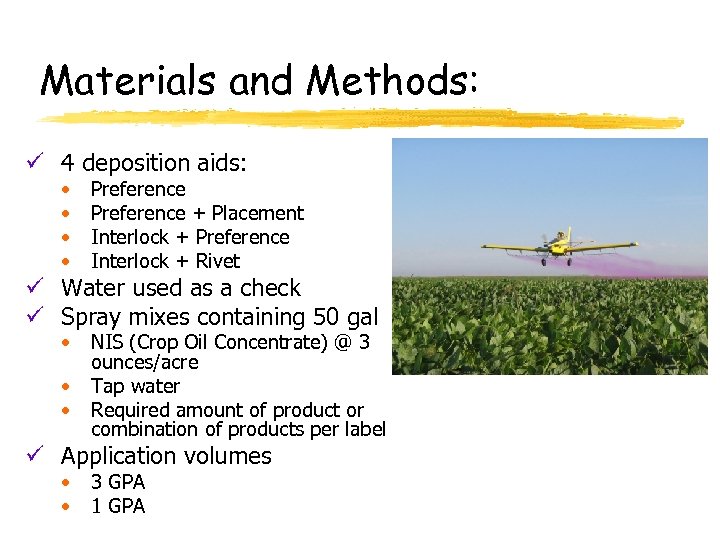 Materials and Methods: ü 4 deposition aids: • • Preference + Placement Interlock + Preference Interlock + Rivet • NIS (Crop Oil Concentrate) @ 3 ounces/acre Tap water Required amount of product or combination of products per label ü Water used as a check ü Spray mixes containing 50 gal • • ü Application volumes • • 3 GPA 1 GPA
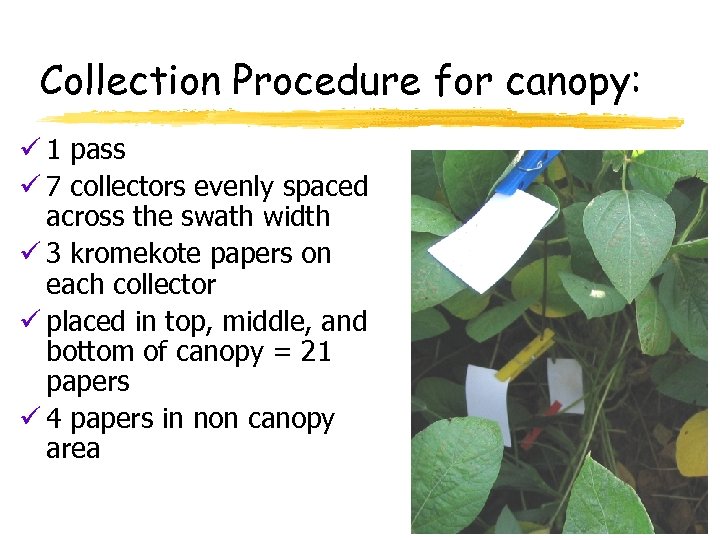 Collection Procedure for canopy: ü 1 pass ü 7 collectors evenly spaced across the swath width ü 3 kromekote papers on each collector ü placed in top, middle, and bottom of canopy = 21 papers ü 4 papers in non canopy area
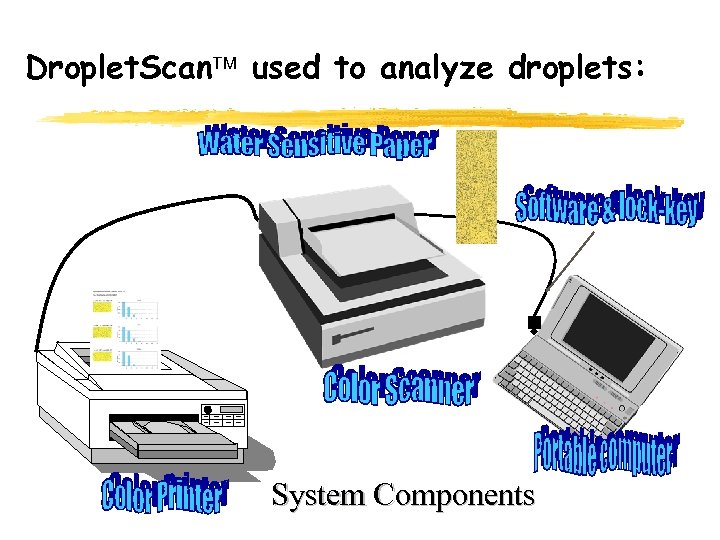 Droplet. Scan used to analyze droplets: System Components
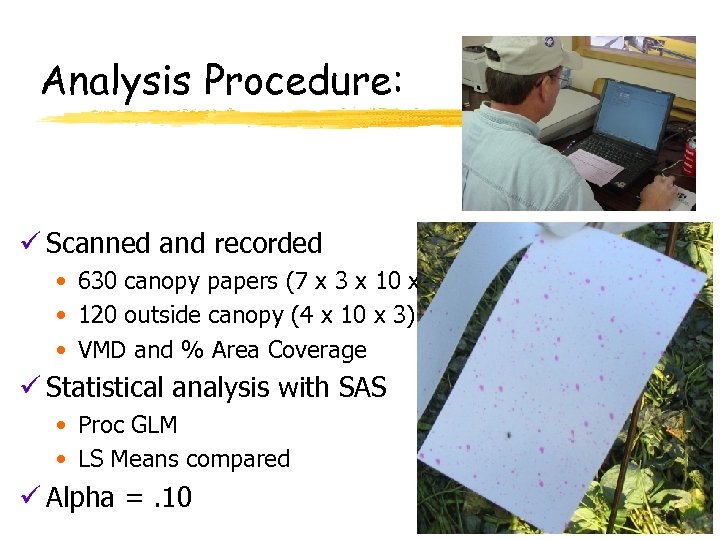 Analysis Procedure: ü Scanned and recorded • 630 canopy papers (7 x 3 x 10 x 3) • 120 outside canopy (4 x 10 x 3) • VMD and % Area Coverage ü Statistical analysis with SAS • Proc GLM • LS Means compared ü Alpha =. 10
 Results and Discussion: ü Comparison of locations in canopy ü Comparison of application volume ü Assessment of Droplet Spectra ü Comparison of products
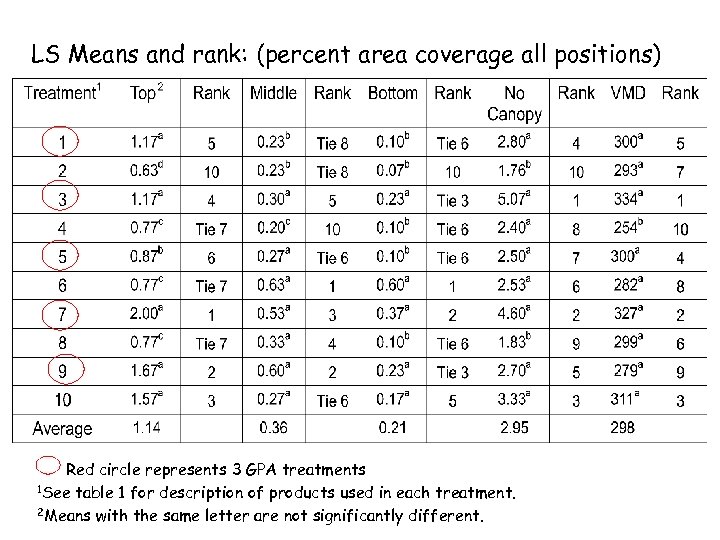 LS Means and rank: (percent area coverage all positions) Red circle represents 3 GPA treatments 1 See table 1 for description of products used in each treatment. 2 Means with the same letter are not significantly different.
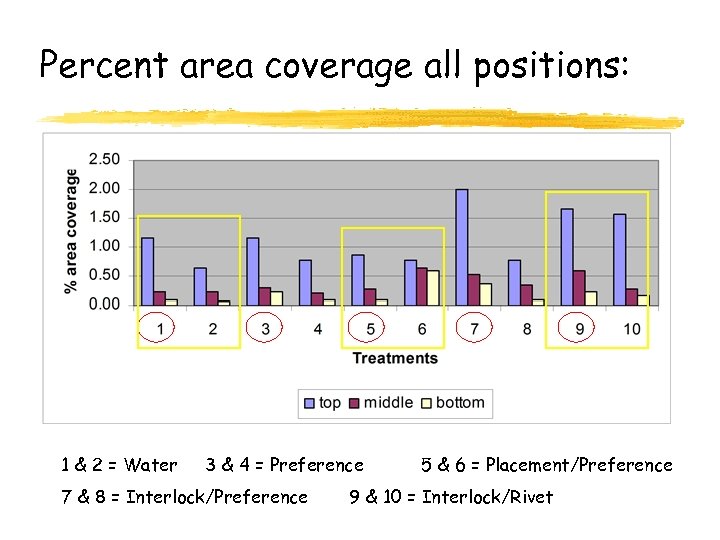 Percent area coverage all positions: 1 & 2 = Water 3 & 4 = Preference 7 & 8 = Interlock/Preference 5 & 6 = Placement/Preference 9 & 10 = Interlock/Rivet
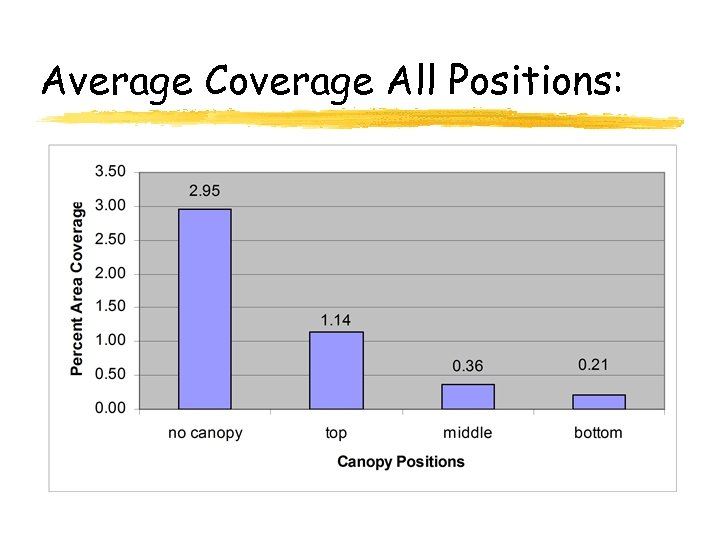 Average Coverage All Positions:
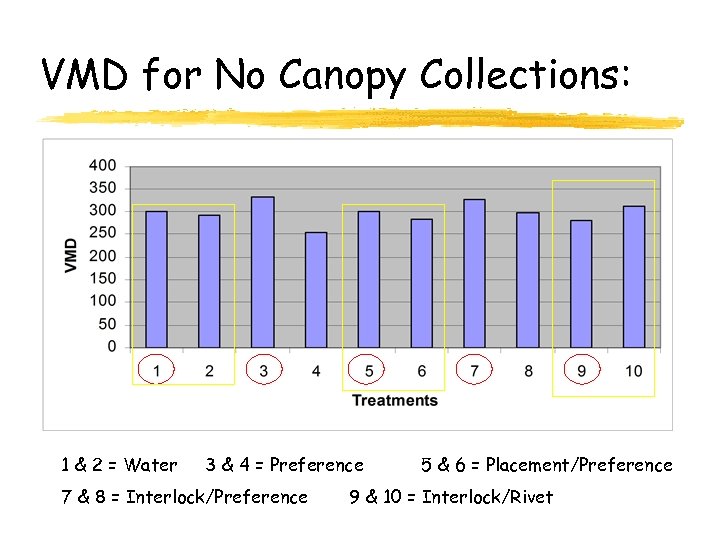 VMD for No Canopy Collections: 1 & 2 = Water 3 & 4 = Preference 7 & 8 = Interlock/Preference 5 & 6 = Placement/Preference 9 & 10 = Interlock/Rivet
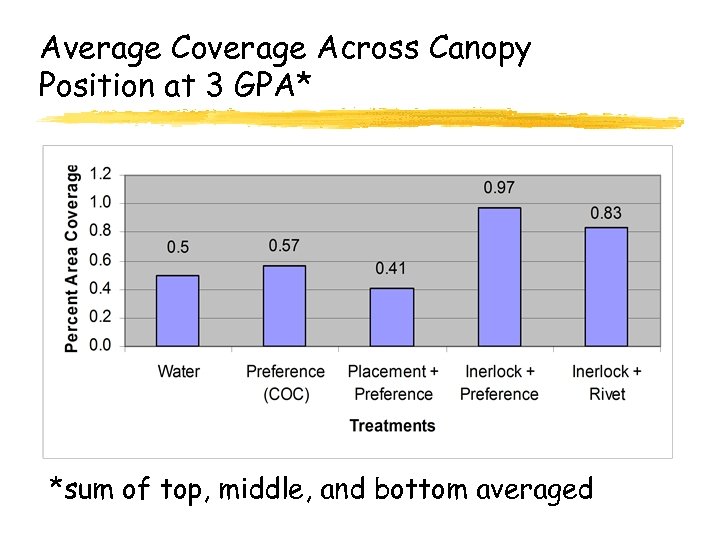 Average Coverage Across Canopy Position at 3 GPA* *sum of top, middle, and bottom averaged
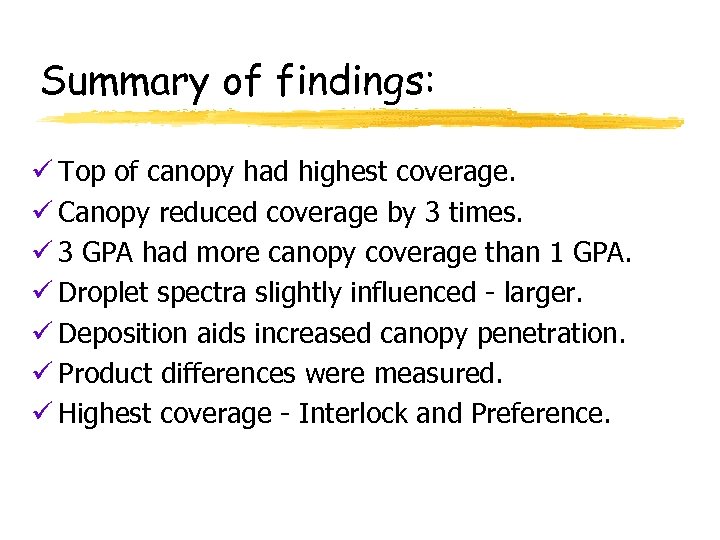 Summary of findings: ü Top of canopy had highest coverage. ü Canopy reduced coverage by 3 times. ü 3 GPA had more canopy coverage than 1 GPA. ü Droplet spectra slightly influenced - larger. ü Deposition aids increased canopy penetration. ü Product differences were measured. ü Highest coverage - Interlock and Preference.
 Acknowledgements: • • Agriliance Ingalls Aerial Tom Miller Brian Oyler
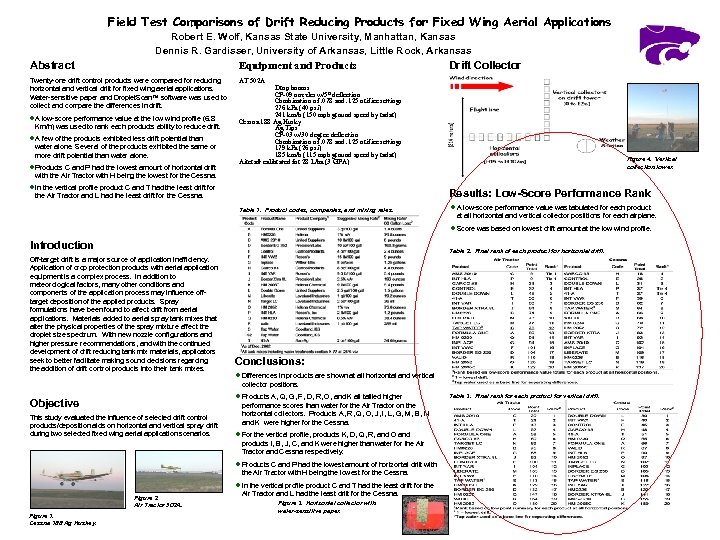 Field Test Comparisons of Drift Reducing Products for Fixed Wing Aerial Applications Robert E. Wolf, Kansas State University, Manhattan, Kansas Dennis R. Gardisser, University of Arkansas, Little Rock, Arkansas Abstract Equipment and Products Twenty-one drift control products were compared for reducing horizontal and vertical drift for fixed wing aerial applications. Water-sensitive paper and Droplet. Scan™ software was used to collect and compare the differences in drift. AT 502 A l A low-score performance value at the low wind profile (6. 8 Km/h) was used to rank each products ability to reduce drift. l A few of the products exhibited less drift potential than water alone. Several of the products exhibited the same or more drift potential than water alone. l Products C and P had the lowest amount of horizontal drift Drift Collector Drop booms CP-09 nozzles w/5° deflection Combination of. 078 and. 125 orifice settings 276 k. Pa (40 psi) 241 km/h (150 mph ground speed by radar) Cessna 188 Ag Husky Ag Tips CP-03 w/30 degree deflection Combination of. 078 and. 125 orifice settings 179 k. Pa (26 psi) 185 km/h (115 mph ground speed by radar) Aircraft calibrated for 28 L/ha (3 GPA) Figure 4. Vertical collection tower. with the Air Tractor with H being the lowest for the Cessna. l In the vertical profile product C and T had the least drift for Results: Low-Score Performance Rank the Air Tractor and L had the least drift for the Cessna. Table 1. Product codes, companies, and mixing rates. l A low-score performance value was tabulated for each product at all horizontal and vertical collector postitions for each airplane. l Score was based on lowest drift amount at the low wind profile. Introduction Table 2. Final rank of each product for horizontal drift. Off-target drift is a major source of application inefficiency. Application of crop protection products with aerial application equipment is a complex process. In addition to meteorological factors, many other conditions and components of the application process may influence offtarget deposition of the applied products. Spray formulations have been found to affect drift from aerial applications. Materials added to aerial spray tank mixes that alter the physical properties of the spray mixture affect the droplet size spectrum. With new nozzle configurations and higher pressure recommendations, and with the continued development of drift reducing tank mix materials, applicators seek to better facilitate making sound decisions regarding the addition of drift control products into their tank mixes. Conclusions: l Differences in products are shown at all horizontal and vertical collector positions. l Products A, Q, G, F, D, R, O, and K all tallied higher Objective This study evaluated the influence of selected drift control products/deposition aids on horizontal and vertical spray drift during two selected fixed wing aerial application scenarios. performance scores than water for the Air Tractor on the horizontal collectors. Products A, R, Q, O, J, I, L, G, M, B, N and K were higher for the Cessna. l For the vertical profile, products K, D, Q, R, and O and products I, B, J, C, and K were higher than water for the Air Tractor and Cessna respectively. l Products C and P had the lowest amount of horizontal drift with the Air Tractor with H being the lowest for the Cessna. l In the vertical profile product C and T had the least drift for the Figure 2. Air Tractor 502 A. Figure 1. Cessna 188 Ag Huskey. Air Tractor and L had the least drift for the Cessna. Figure 3. Horizontal collector with water-sensitive paper. Table 3. Final rank for each product for vertical drift.