


 Скачать презентацию The AESKOPP System and the Steps of Selling
5cca9c4fd9e1f244919eb2cd857cc7a1.ppt
- Количество слайдов: 25
 The AESKOPP System and the Steps of Selling 1 3/18/2018
 Old Paradigms of Selling • Don’t work because: – Today’s media buyers are more sensitive to traditional sales techniques, manipulation and tricks. – Today’s buyers have a multitude of complex alternatives they can buy. • They need help making decisions. • They will let you help them only if they trust you. • They need solutions to complex problems. – Procurement departments and consultants make selling harder, more commodity oriented. – Solutions, insight and Big-Idea selling is a diagnose- and -deliver model, not and “tell and sell” one. 3/18/2018 2
 Old Paradigms of Selling • Don’t work because: – Your competitors provide buyers with more choices, and they don’t have to deal with anyone who doesn’t give them insights, new solutions, satisfy their personal needs, who they don’t like or who they don’t trust. – Competitors are providing solutions, too, at reduced prices. – So, you have to be better and smarter at creating value and taking control of the conversation. • Teaching, Tailoring, and Taking Control 3/18/2018 3
 The New Paradigm • The customer is not the opponent – not someone to be overcome or beaten. • The customer is a partner who needs: – – – – 3/18/2018 A trusting relationship Insights Solutions Big Ideas Business and personal needs and wants met Concerns addressed A win-win, fair agreement To get started before a competitor does 4
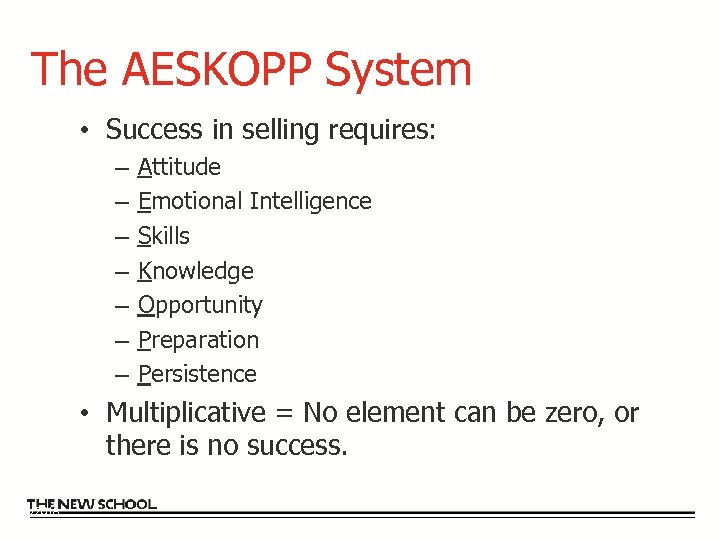 The AESKOPP System • Success in selling requires: – – – – Attitude Emotional Intelligence Skills Knowledge Opportunity Preparation Persistence • Multiplicative = No element can be zero, or there is no success. 3/18/2018 5
 Solution Selling Is Need. Satisfaction Selling • Relationship Rule#1 (The New Golden Rule): “Do unto others as they would have others do unto them. ” • Uncover and define problems (challenges) and needs. – Business problems (rational, often ill-defined – where your insights come in) – Personal needs (emotional, unconscious) 3/18/2018 6
 How To Recognize Needs • Relationship Rule #2: “People like and trust people exactly like themselves. ” – Get people to like and trust you by being as similar as you can and they will open up and tell you who they are. – Then you can position your proposal according to the needs, focus and decision style you uncover. • Needs = See List of Human Needs • Focus = Promotion or Prevention • Decision style = Male vs. Female – You can’t uncover needs in one conversation, it usually takes a little time to understand someone’s complex needs. 3/18/2018 7
 Understand Personal/Emotional Needs • You must understand prospects personal/emotional needs, focus and decision style so you can position your features, advantages, and benefits accordingly. – Which would you prefer: • Trying to sell something to (help) a total stranger? • Trying to sell something to (help) a friend who you know intimately? 3/18/2018 8
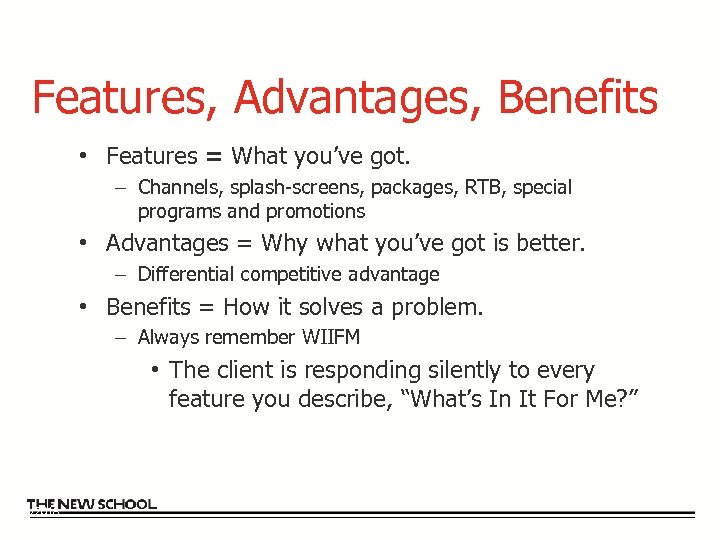 Features, Advantages, Benefits • Features = What you’ve got. – Channels, splash-screens, packages, RTB, special programs and promotions • Advantages = Why what you’ve got is better. – Differential competitive advantage • Benefits = How it solves a problem. – Always remember WIIFM • The client is responding silently to every feature you describe, “What’s In It For Me? ” 3/18/2018 9
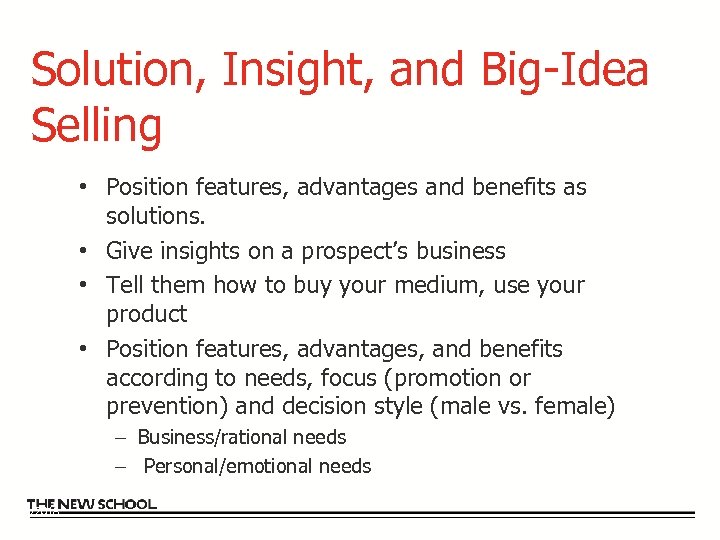 Solution, Insight, and Big-Idea Selling • Position features, advantages and benefits as solutions. • Give insights on a prospect’s business • Tell them how to buy your medium, use your product • Position features, advantages, and benefits according to needs, focus (promotion or prevention) and decision style (male vs. female) – Business/rational needs – Personal/emotional needs 3/18/2018 10
 Solution Selling • Relationship Rule #3: “People don’t care how much you know until they know how much you care. ” • The best way to let people know how much you care is to listen. 3/18/2018 11
 Solution Selling • Position features, advantages and benefits positively as solutions to advertising and marketing problems. • Don’t knock the competition. – You can’t sell what they don’t have. – You can only sell the features, advantages and benefits you have. 3/18/2018 12
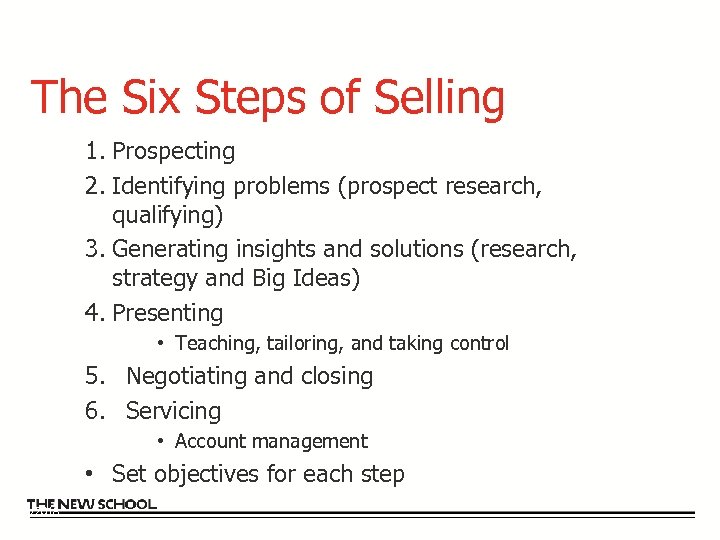 The Six Steps of Selling 1. Prospecting 2. Identifying problems (prospect research, qualifying) 3. Generating insights and solutions (research, strategy and Big Ideas) 4. Presenting • Teaching, tailoring, and taking control 5. Negotiating and closing 6. Servicing • Account management • Set objectives for each step 3/18/2018 13
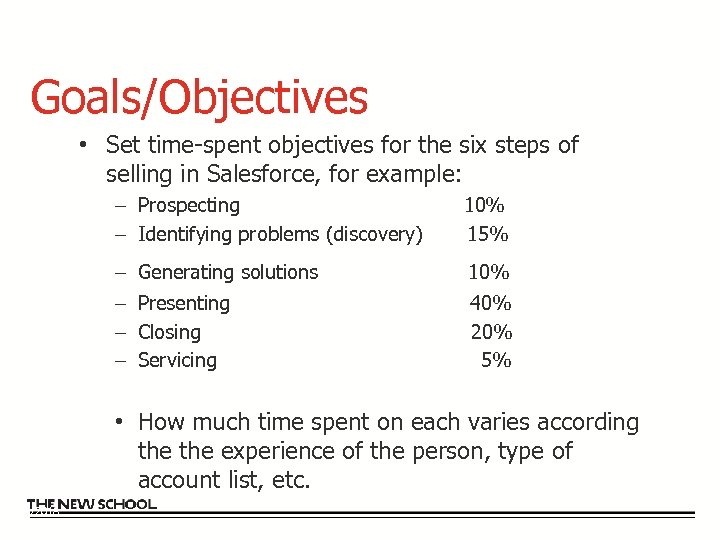 Goals/Objectives • Set time-spent objectives for the six steps of selling in Salesforce, for example: – Prospecting – Identifying problems (discovery) – – 10% 15% Generating solutions 10% Presenting Closing Servicing 40% 20% 5% • How much time spent on each varies according the experience of the person, type of account list, etc. 3/18/2018 14
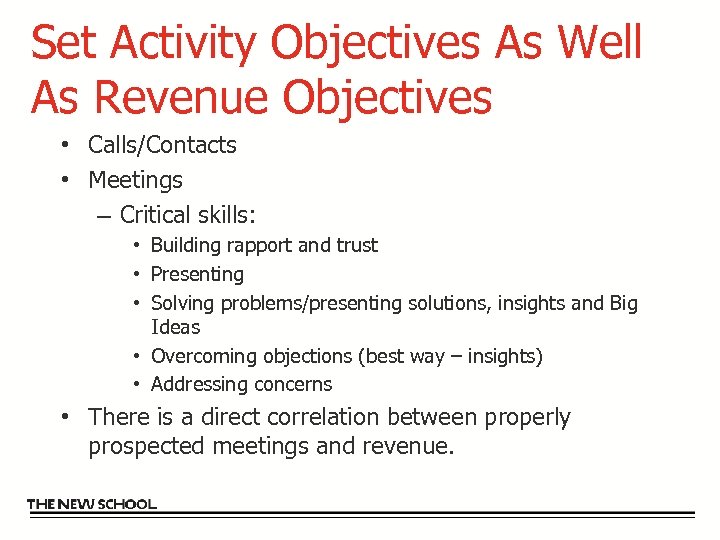 Set Activity Objectives As Well As Revenue Objectives • Calls/Contacts • Meetings – Critical skills: • Building rapport and trust • Presenting • Solving problems/presenting solutions, insights and Big Ideas • Overcoming objections (best way – insights) • Addressing concerns • There is a direct correlation between properly prospected meetings and revenue.
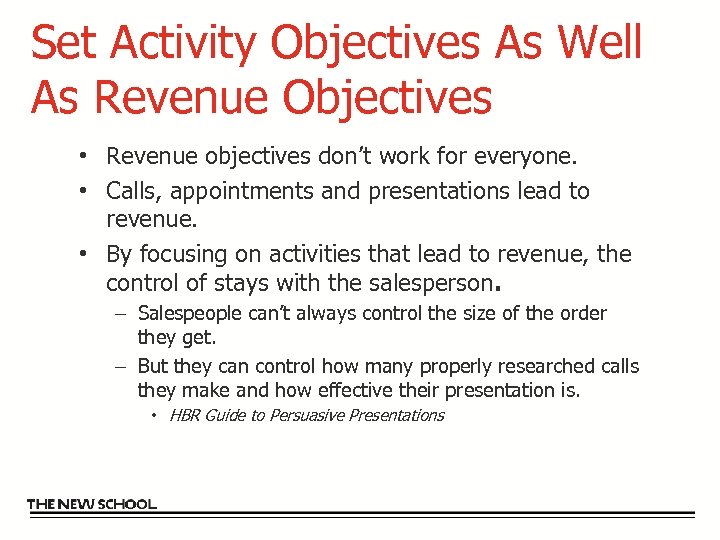 Set Activity Objectives As Well As Revenue Objectives • Revenue objectives don’t work for everyone. • Calls, appointments and presentations lead to revenue. • By focusing on activities that lead to revenue, the control of stays with the salesperson. – Salespeople can’t always control the size of the order they get. – But they can control how many properly researched calls they make and how effective their presentation is. • HBR Guide to Persuasive Presentations
 Set Activity Goals As Well As Revenue Goals • There must be a well-organized system in Salesforce for tracking and reporting on calls, meetings, presentations, opportunities, sales and revenue. – Must have details on why opportunities were won or lost. • No recriminations or blame – Must have an honest pipeline. • Predictable Revenue 3/18/2018 17
 Prospecting: Creating Opportunities • Developing new business: finding prospects who have advertising and marketing problems (“challenges”) – No one is completely satisfied with their advertising. – Big Ideas – Insights on how to buy • Especially social media and mobile 3/18/2018 18
 Identifying Problems (Research and Qualifying) • Prospect research requires solid detective work. Marketing/research department/function. Information is power. Qualifying (right fit, can you help? ) The more information you get, the more problems, the more dissatisfaction you uncover, the more objections and concerns you uncover, the more precise and helpful your solutions will be. – Research has to be conducted pre-call. People don’t have time to tell you their goals, strategies, etc. – – 3/18/2018 19
 Generating Solutions and Presenting • Generating solutions is the process of preparation. – Matching opportunities in your medium to prospects’ problems (challenges) based on your insights. – Framing your benefits according to business and personal needs. 3/18/2018 20
 Presenting • Presenting: – Confidence is everything. – Confidence is an attitude, which you control: • • • Optimism Positive objectives (winning, not avoiding a loss) Visualization Mental rehearsal Do the right thing (honesty)
 Negotiating and Closing • Don’t negotiate until you’ve created value. • The goal of negotiating is to close. • Closing – – 3/18/2018 Help buyers make the right decision. Create a sense of urgency. Once you reach an agreement, get out! Don’t be around when buyer’s remorse sets in. 22
 – Be careful about trying to close too aggressively. – You can create a sense of urgency, but the timetable has to be theirs. • Too much pressure can kill a prospective sale. – High pressure raises suspicion. – People want to buy, they don’t like being “sold”or “closed. ” 3/18/2018 23
 Servicing (Account Management) • You are the unique competitive advantage. • Set servicing and business-increase goals. 3/18/2018 24
 Partnerships Are the Ultimate Goal of Selling • Remember, the purpose of selling is to get results for customers. • And building a customer into a partner is the ultimate goal. – A partnership is a when both sides benefit mutually and grow each other’s businesses. 3/18/2018 25