


 Скачать презентацию The Advanced Technology Solar Telescope Status Summary Steve
cbc78c72488653e534b32fedc5a72b5d.ppt
- Количество слайдов: 26
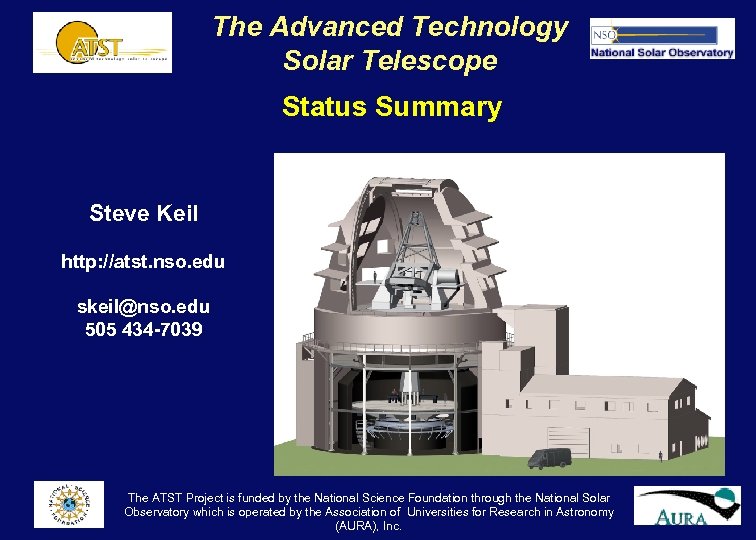 The Advanced Technology Solar Telescope Status Summary Steve Keil http: //atst. nso. edu skeil@nso. edu 505 434 -7039 The ATST Project is funded by the National Science Foundation through the National Solar Observatory which is operated by the Association of Universities for Research in Astronomy (AURA), Inc.
 ATST US Collaboration • PI – National Solar Observatory • • Stephen Keil, Thomas Rimmele, Christoph Keller, NSO Staff Co-PIs – HAO • Michael Knölker, Steve Tomczyk, Dave Elmore, Phil Judge, Tim Brown – – – University of Hawaii • Jeff Kuhn; Haosheng Lin, Roy Coulter University of Chicago • Bob Rosner, Fausto Cattaneo New Jersey Institute of Technology • Phil Goode; Carsten Denker, Haimin Wang
 Science Working Group Ayres, T. U of Colorado Palle, Pere. IAC, Spain Berger, T. Lockheed Martin Rimmele, Thomas (Chair) Cattaneo, F. U. of Chicago Sigwarth, Michael KIS, Germany Cauzzi, Gianna Arcetri, Italy Smaldone, L. U. Naples, Italy Collados-Vera, M. IAC, Spain Socas-Navarro, Hector Deforest, Craig SWRI Stein, Robert F. U. of Michigan Gary, G. Allen NASA/MSFC Stenflo, Jan ETH Switzerland Jennings, Donald E. NASA/GSFC Tomczyk, Steve HAO Judge, Philip G. Van Ballegooijen, Adriaan HAO Keller, Christoph U. NSO Kuhn, Jeffrey R. If. A, U of Hawaii Leka, K. D. Colorado Research Lin, Haosheng If. A, U of Hawaii Lites, Bruce W. HAO Wang, Haimin NSO HAO Cf. A Harvard BBSO/NJIT
 Site Survey Working Group • Jacques Beckers – • Tim Brown High Altitude Observatory (Chair) • Manolo Collados-Vera – Instituto de Astrofisica de Canarias • Carsten Denker – New Jersey Institute of Technology • Frank Hill – National Solar Observatory • Jeff Kuhn – U. Hawaii - Institute of Astronomy • Matt Penn – National Solar Observatory • Hector Socas-Navarro – • Dirk Soltau • Kim Streander – – U. Chicago High Altitude Observatory Kiepenheuer-Institut fuer Sonnenphysik – High Altitude Observatory
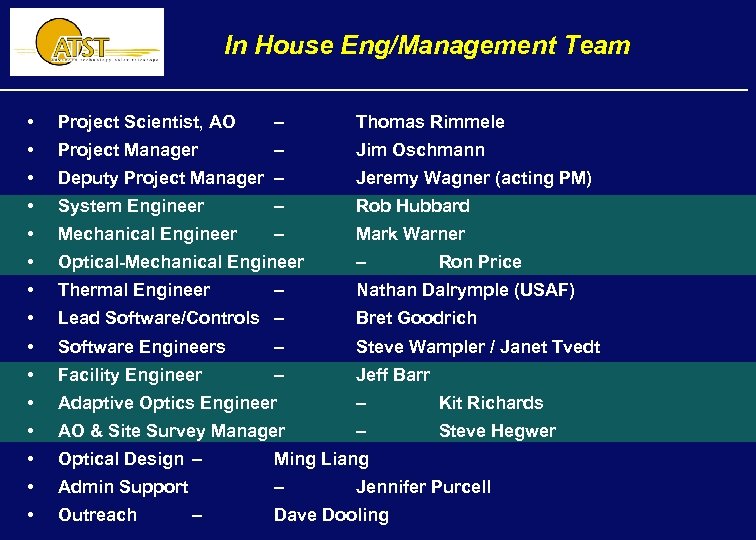 In House Eng/Management Team • Project Scientist, AO – Thomas Rimmele • Project Manager – Jim Oschmann • Deputy Project Manager – Jeremy Wagner (acting PM) • System Engineer – Rob Hubbard • Mechanical Engineer – Mark Warner • Optical-Mechanical Engineer – • Thermal Engineer Nathan Dalrymple (USAF) • Lead Software/Controls – Bret Goodrich • Software Engineers – Steve Wampler / Janet Tvedt • Facility Engineer – Jeff Barr • Adaptive Optics Engineer – Kit Richards • AO & Site Survey Manager – Steve Hegwer • Optical Design – Ming Liang • Admin Support – • Outreach – – Ron Price Jennifer Purcell Dave Dooling
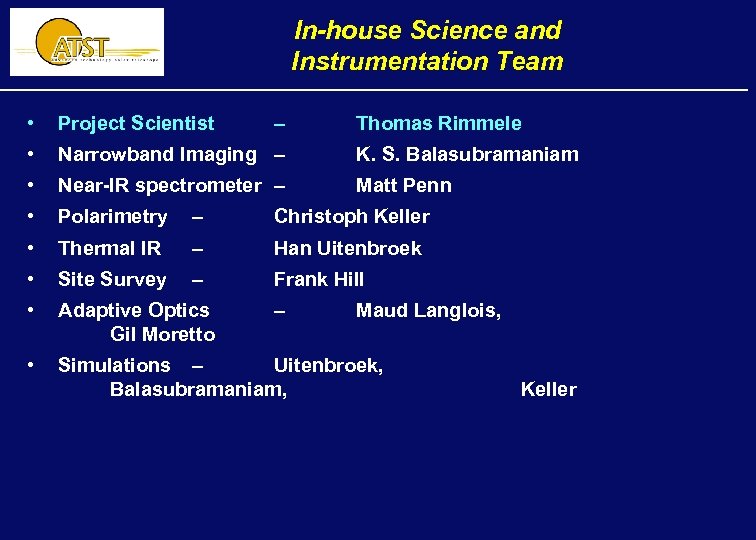 In-house Science and Instrumentation Team • Project Scientist • Narrowband Imaging – K. S. Balasubramaniam • Near-IR spectrometer – Matt Penn • Polarimetry – Christoph Keller • Thermal IR – Han Uitenbroek • Site Survey – Frank Hill • Adaptive Optics Gil Moretto • Simulations – Uitenbroek, Balasubramaniam, – – Thomas Rimmele Maud Langlois, Keller
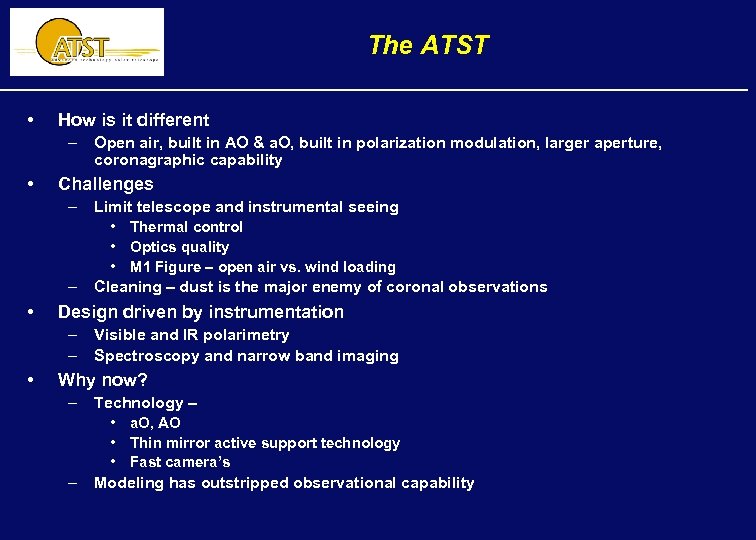 The ATST • How is it different – • Challenges – – • Limit telescope and instrumental seeing • Thermal control • Optics quality • M 1 Figure – open air vs. wind loading Cleaning – dust is the major enemy of coronal observations Design driven by instrumentation – – • Open air, built in AO & a. O, built in polarization modulation, larger aperture, coronagraphic capability Visible and IR polarimetry Spectroscopy and narrow band imaging Why now? – – Technology – • a. O, AO • Thin mirror active support technology • Fast camera’s Modeling has outstripped observational capability
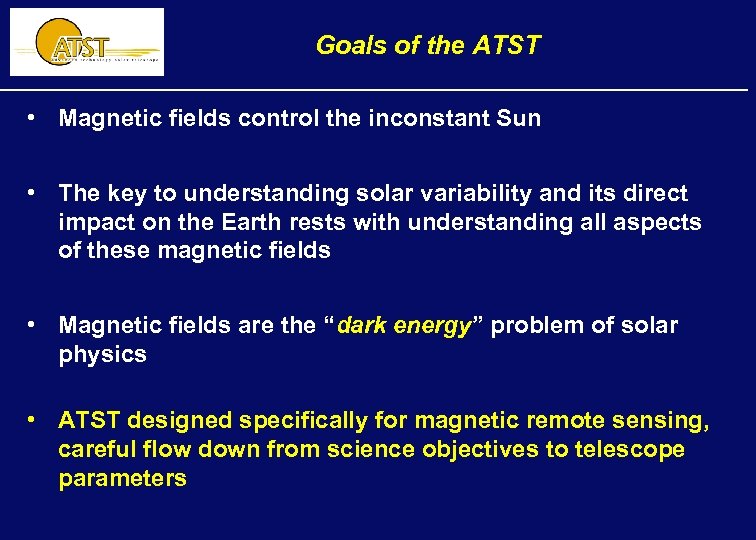 Goals of the ATST • Magnetic fields control the inconstant Sun • The key to understanding solar variability and its direct impact on the Earth rests with understanding all aspects of these magnetic fields • Magnetic fields are the “dark energy” problem of solar physics • ATST designed specifically for magnetic remote sensing, careful flow down from science objectives to telescope parameters
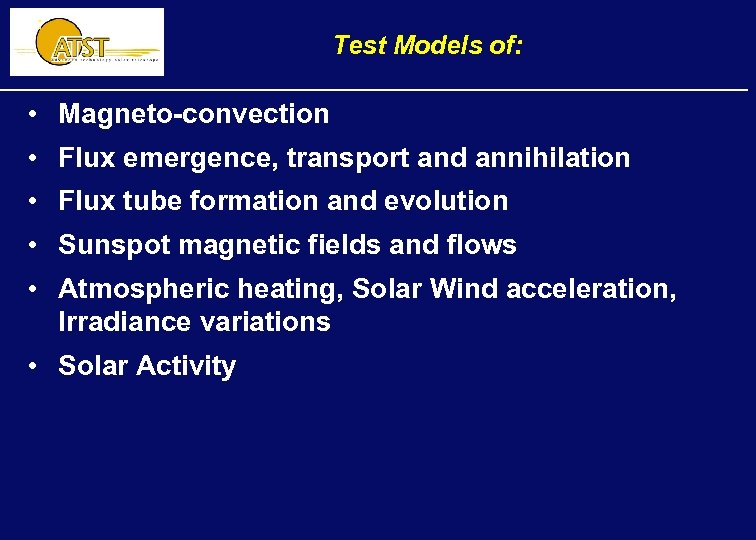 : Test Models of: • Magneto-convection • Flux emergence, transport and annihilation • Flux tube formation and evolution • Sunspot magnetic fields and flows • Atmospheric heating, Solar Wind acceleration, Irradiance variations • Solar Activity
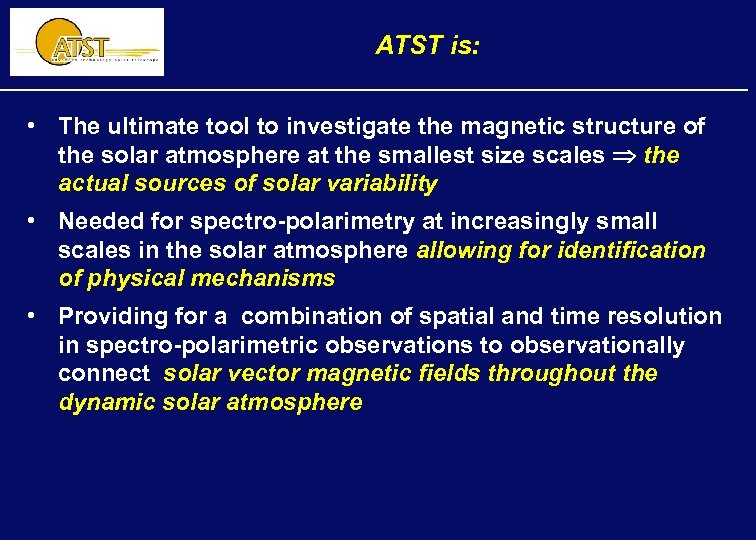 ATST is: • The ultimate tool to investigate the magnetic structure of the solar atmosphere at the smallest size scales the actual sources of solar variability • Needed for spectro-polarimetry at increasingly small scales in the solar atmosphere allowing for identification of physical mechanisms • Providing for a combination of spatial and time resolution in spectro-polarimetric observations to observationally connect solar vector magnetic fields throughout the dynamic solar atmosphere
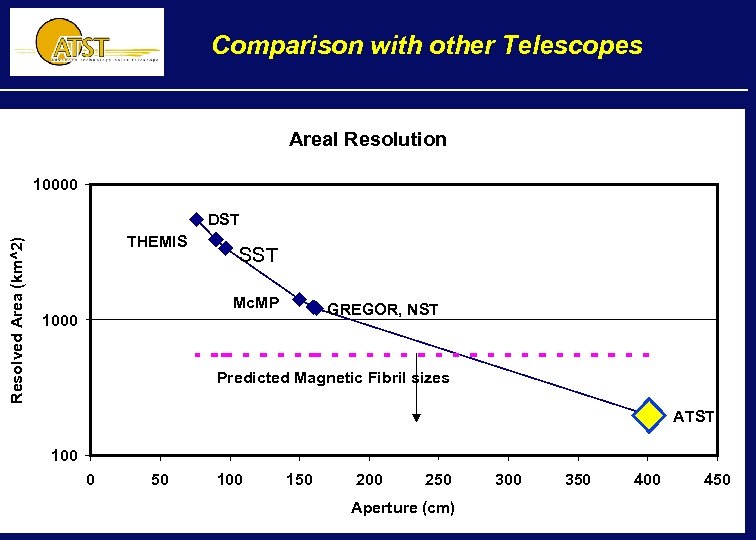 Comparison with other Telescopes Areal Resolution 10000 Resolved Area (km^2) DST THEMIS SST Mc. MP GREGOR, NST 1000 Predicted Magnetic Fibril sizes ATST 100 0 50 100 150 200 250 Aperture (cm) 300 350 400 450
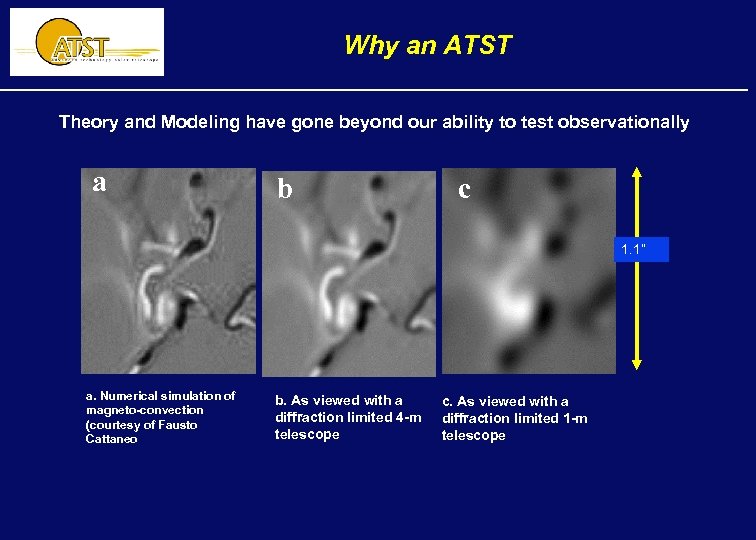 Why an ATST Theory and Modeling have gone beyond our ability to test observationally a (Part V b c 1. 1” a. Numerical simulation of magneto-convection (courtesy of Fausto Cattaneo b. As viewed with a diffraction limited 4 -m telescope c. As viewed with a diffraction limited 1 -m telescope
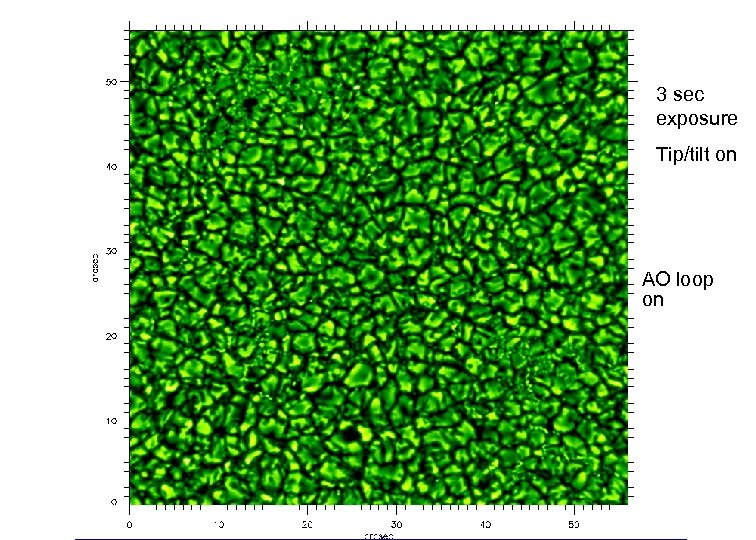 3 sec exposure Tip/tilt on AO loop on off
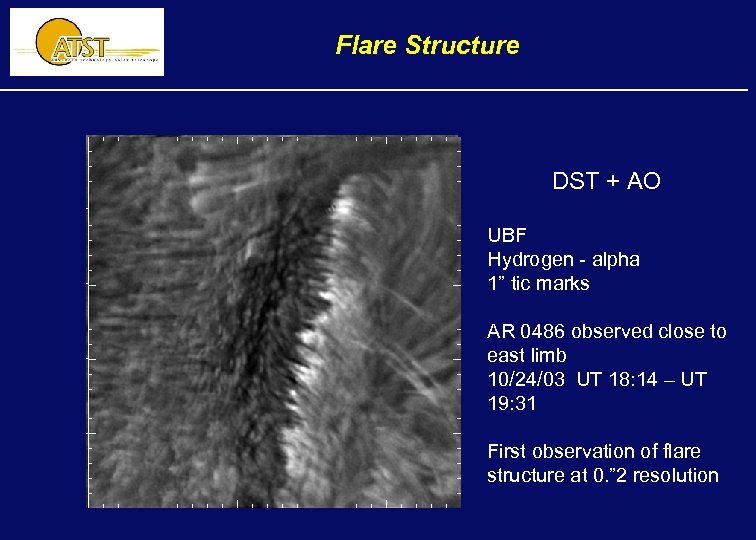 Flare Structure DST + AO UBF Hydrogen - alpha 1” tic marks AR 0486 observed close to east limb 10/24/03 UT 18: 14 – UT 19: 31 First observation of flare structure at 0. ” 2 resolution
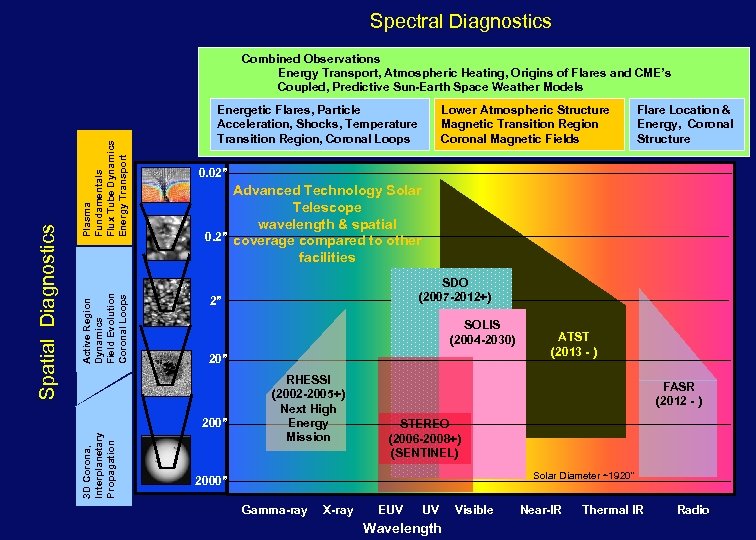 Spectral Diagnostics Plasma Fundamentals Flux Tube Dynamics Energy Transport Active Region Dynamics Field Evolution Coronal Loops Energetic Flares, Particle Acceleration, Shocks, Temperature Transition Region, Coronal Loops Lower Atmospheric Structure Magnetic Transition Region Coronal Magnetic Fields Flare Location & Energy, Coronal Structure 0. 02” Advanced Technology Solar Telescope wavelength & spatial 0. 2” coverage compared to other facilities SDO (2007 -2012+) 2” SOLIS (2004 -2030) 20” 200” 3 D Corona, Interplanetary Propagation Spatial Diagnostics Combined Observations Energy Transport, Atmospheric Heating, Origins of Flares and CME’s Coupled, Predictive Sun-Earth Space Weather Models RHESSI (2002 -2005+) Next High Energy Mission ATST (2013 - ) FASR (2012 - ) STEREO (2006 -2008+) (SENTINEL) Solar Diameter ~1920” 2000” Gamma-ray X-ray EUV UV Wavelength Visible Near-IR Thermal IR Radio
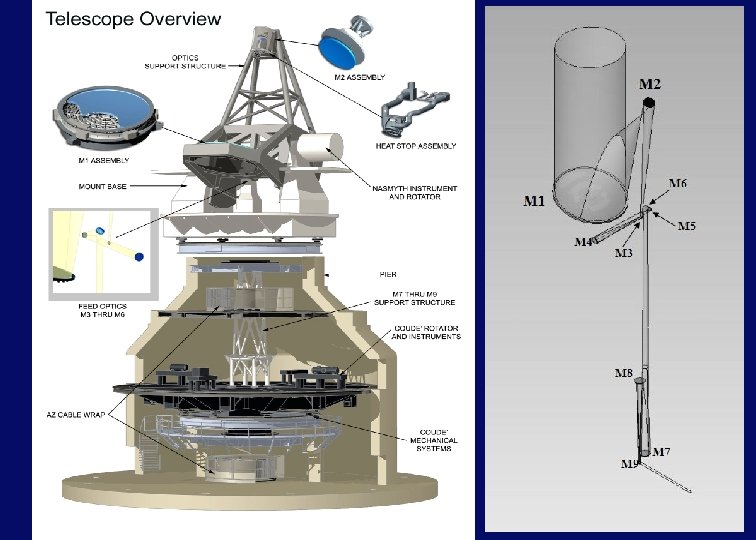
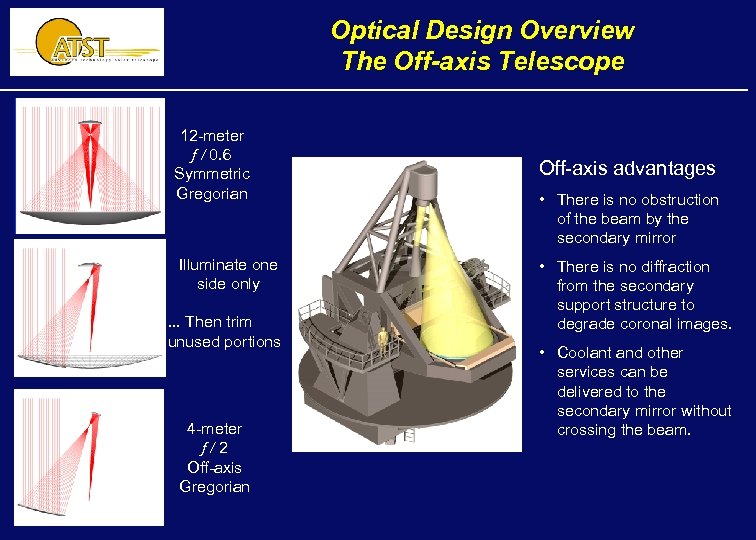 Optical Design Overview The Off-axis Telescope 12 -meter f / 0. 6 Symmetric Gregorian Illuminate one side only. . . Then trim unused portions 4 -meter f/2 Off-axis Gregorian Off-axis advantages • There is no obstruction of the beam by the secondary mirror • There is no diffraction from the secondary support structure to degrade coronal images. • Coolant and other services can be delivered to the secondary mirror without crossing the beam.
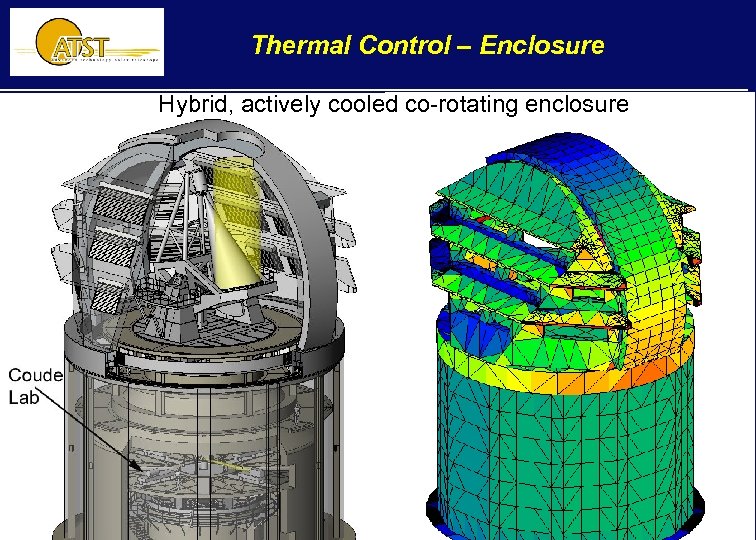 Thermal Control – Enclosure Hybrid, actively cooled co-rotating enclosure
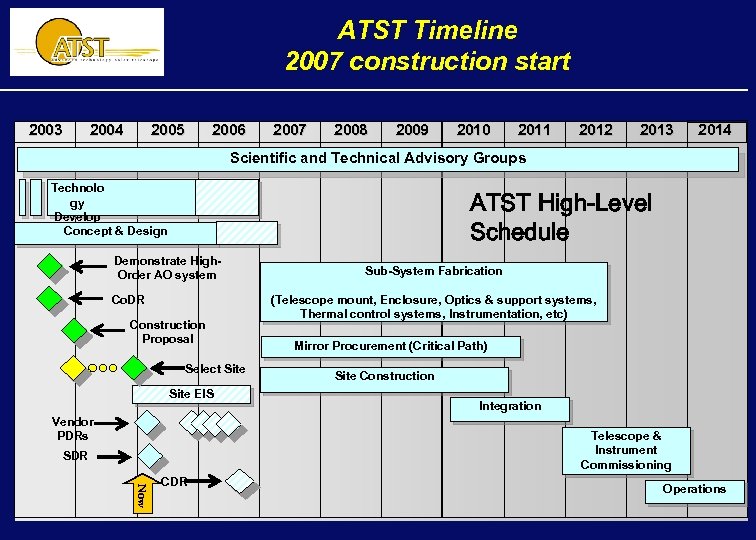 ATST Timeline 2007 construction start 2003 2004 2005 2006 2007 2008 2009 2010 2011 2012 2013 2014 Scientific and Technical Advisory Groups Technolo gy Develop Concept & Design ment ATST High-Level Schedule Demonstrate High. Order AO system Co. DR Construction Proposal Select Site EIS Vendor PDRs Sub-System Fabrication (Telescope mount, Enclosure, Optics & support systems, Thermal control systems, Instrumentation, etc) Mirror Procurement (Critical Path) Site Construction Integration Telescope & Instrument Commissioning SDR Now CDR Operations
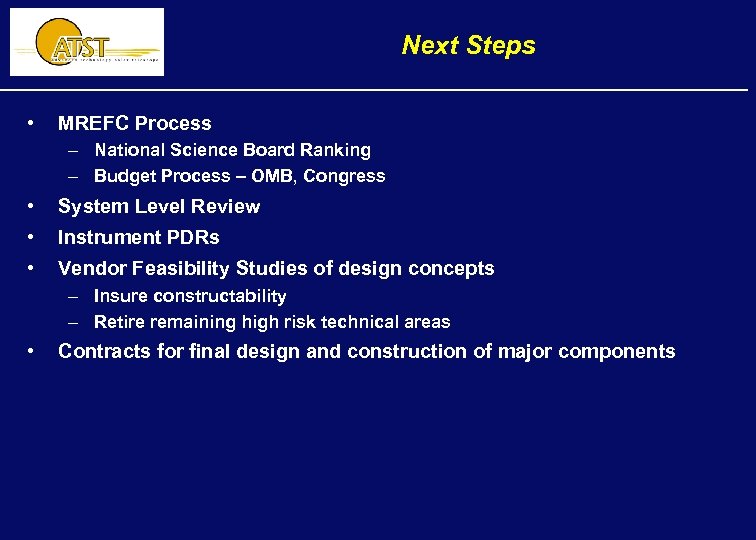 Next Steps • MREFC Process – National Science Board Ranking – Budget Process – OMB, Congress • System Level Review • Instrument PDRs • Vendor Feasibility Studies of design concepts – Insure constructability – Retire remaining high risk technical areas • Contracts for final design and construction of major components
 Partnerships • International support and interest – Italy • Letter of support received • Science, adaptive optics subsystems, post-focus instruments – Spain • Letter of support received • Science, polarization expertise – Germany • MOU signed • Proposal to German Government in June • Director of KIS – Potential of $10 M independent of site – Switzerland • Near UV instrumentation
 Partnerships • Air Force – AFOSR • Purchase and Polish Mirror • Recoating facility on Haleakala • Potential support for instruments at university partners • Collocation of AF staff and participation in operations – Military Construction Fund (AFOSR, AFRL pursuing) – Tracking (ACOS) – Space Debris (DARPA, white paper this spring) • NASA – Thermal-IR instrumentation – Visible tunable filter
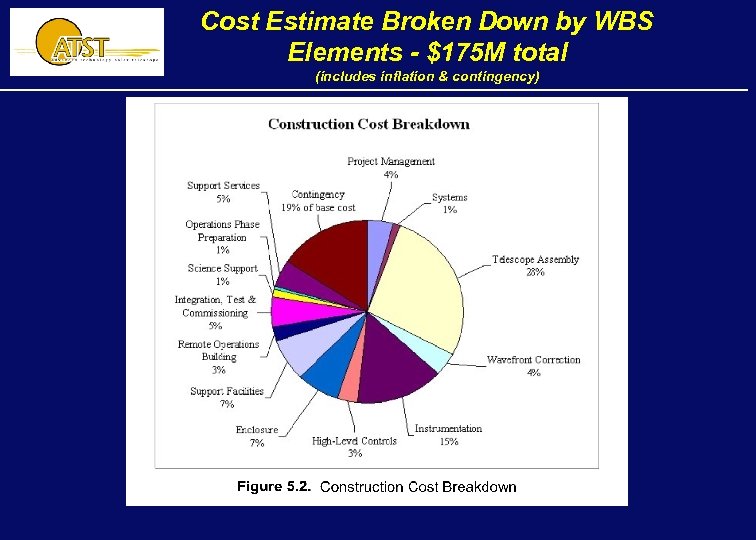 Cost Estimate Broken Down by WBS Elements - $175 M total (includes inflation & contingency)
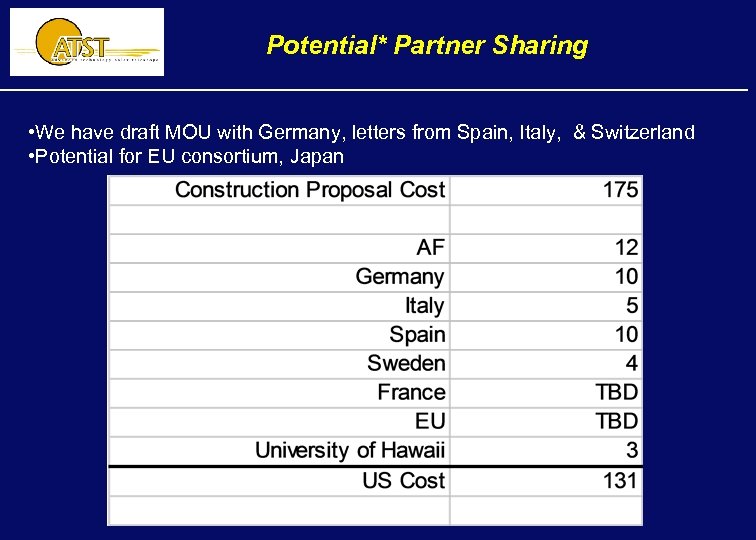 Potential* Partner Sharing • We have draft MOU with Germany, letters from Spain, Italy, & Switzerland • Potential for EU consortium, Japan
 Summary • The 4 m ATST is essential to solve many outstanding problems in solar astronomy & astrophysics. Substantial vs. incremental progress! • These problems are highly relevant to humankind!! – Sun-Climate, Sun-Space Weather, Sun-Laboratory Plasma, Sun -Cosmic Magnetic Fields • ATST with its cutting edge instrumentation will provides us with a powerful tool solve the mysteries of solar magnetism. • New diagnostics tools (e. g. IR) and new technology (e. g. AO) are at hand. • Complementary role of ATST and Space Missions – coordination is essential.
 Contact Information Stephen L. Keil, NSO Director skeil@nso. edu 1 -505 -434 -7039 Thomas Rimmele, Project Scientist, 1 -505 -434 -7022 Jeremy Wagner, Project Manager, 1 -520 -318 -8249 Frank Hill, Site Survey Operations & Data, 1 -520 -318 -8138 For More Information see: http: //atst. nso. edu