


 Скачать презентацию The ADDRESS conceptual architecture ADDRESS INTERNATIONAL WORKSHOP ACTIVE
27a94749032e42b1de7a6e98bd955f89.ppt
- Количество слайдов: 18
 The ADDRESS conceptual architecture ADDRESS INTERNATIONAL WORKSHOP ACTIVE DEMAND: THE FUTURE OF ELECTRICITY Regine Belhomme, EDF SA Paris, June 9 th 2010 vision The research leading to these results has received funding from the European Community's Seventh Framework Programme (FP 7/2007 -2013) under grant agreement n° 207643
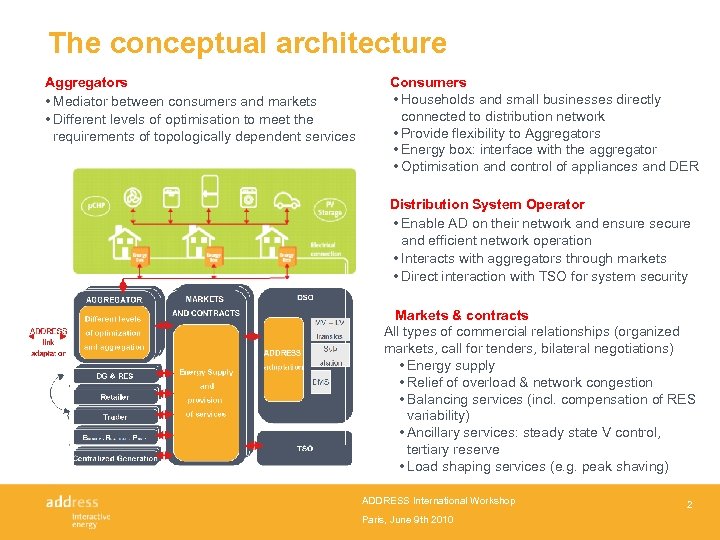 The conceptual architecture Aggregators • Mediator between consumers and markets • Different levels of optimisation to meet the requirements of topologically dependent services Consumers • Households and small businesses directly connected to distribution network • Provide flexibility to Aggregators • Energy box: interface with the aggregator • Optimisation and control of appliances and DER Distribution System Operator • Enable AD on their network and ensure secure and efficient network operation • Interacts with aggregators through markets • Direct interaction with TSO for system security Markets & contracts All types of commercial relationships (organized markets, call for tenders, bilateral negotiations) • Energy supply • Relief of overload & network congestion • Balancing services (incl. compensation of RES variability) • Ancillary services: steady state V control, tertiary reserve • Load shaping services (e. g. peak shaving) ADDRESS International Workshop Paris, June 9 th 2010 2
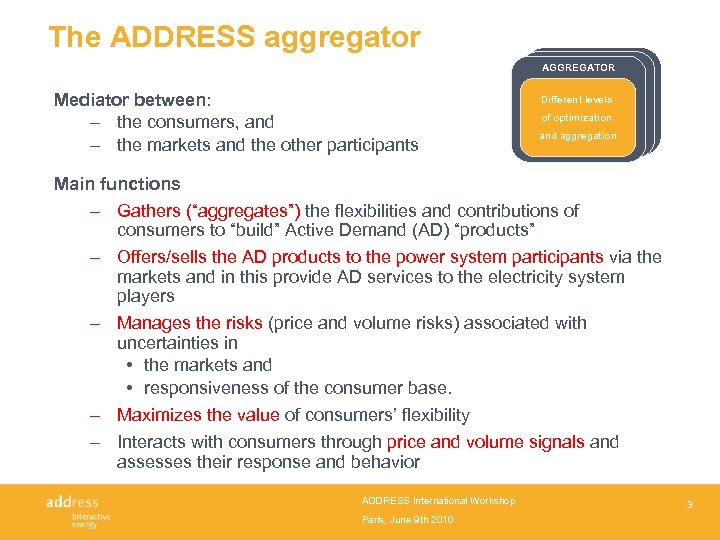 The ADDRESS aggregator AGGREGATOR Mediator between: – the consumers, and – the markets and the other participants Different levels of optimization and aggregation Main functions – Gathers (“aggregates”) the flexibilities and contributions of consumers to “build” Active Demand (AD) “products” – Offers/sells the AD products to the power system participants via the markets and in this provide AD services to the electricity system players – Manages the risks (price and volume risks) associated with uncertainties in • the markets and • responsiveness of the consumer base. – Maximizes the value of consumers’ flexibility – Interacts with consumers through price and volume signals and assesses their response and behavior ADDRESS International Workshop Paris, June 9 th 2010 3
 The project main concepts Interaction based on real-time price and volume (mainly P) signals – Real-time = 15 to 30 min ahead or longer – Modulated by geographical / topological information – Direct load control by DSO will be not considered – Emergency situations are not considered “Demand” approach – Services “requested” through appropriate price and/or volume signal mechanisms and provided on a voluntary and contractual basis – Deployment of appropriate technologies at consumers’ premises – Accompanying measures for societal and behavioural aspects Distributed intelligence and local optimisation – Topologically-dependant services – Participants optimise real-time response according to the real-time signals Put the “right amount” of intelligence at the “right place” ADDRESS International Workshop Paris, June 9 th 2010 4
 The system participants Archetypes of electricity system players to which AD services could be provided – Regulated players: DSOs and TSOs – Deregulated players: • • • Producers: central producers, decentralised electricity producers, producers with regulated tariff and obligations (reserve, volume, curtailment, etc. ) Intermediaries: retailers, production aggregators, energy traders, electricity brokers, Balancing Responsible Parties (BRPs), Consumers: large consumers Study of the players’ expectations with respect to AD for each player: – Role and main functions in the system – Main stakes and contextual constraints – Short-term and long-term needs generated by the stakes – How can AD meet these needs è identification of possible services provided by AD and basic requirements ADDRESS International Workshop Paris, June 9 th 2010 5
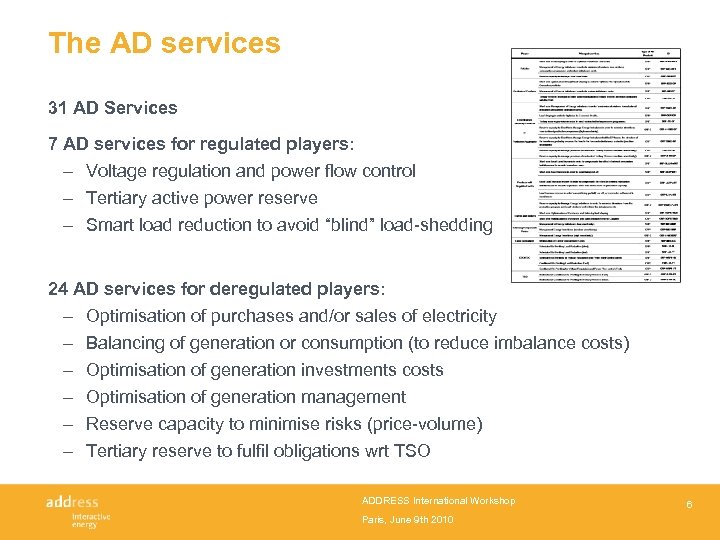 The AD services 31 AD Services 7 AD services for regulated players: – Voltage regulation and power flow control – Tertiary active power reserve – Smart load reduction to avoid “blind” load-shedding 24 AD services for deregulated players: – Optimisation of purchases and/or sales of electricity – Balancing of generation or consumption (to reduce imbalance costs) – Optimisation of generation investments costs – Optimisation of generation management – Reserve capacity to minimise risks (price-volume) – Tertiary reserve to fulfil obligations wrt TSO ADDRESS International Workshop Paris, June 9 th 2010 6
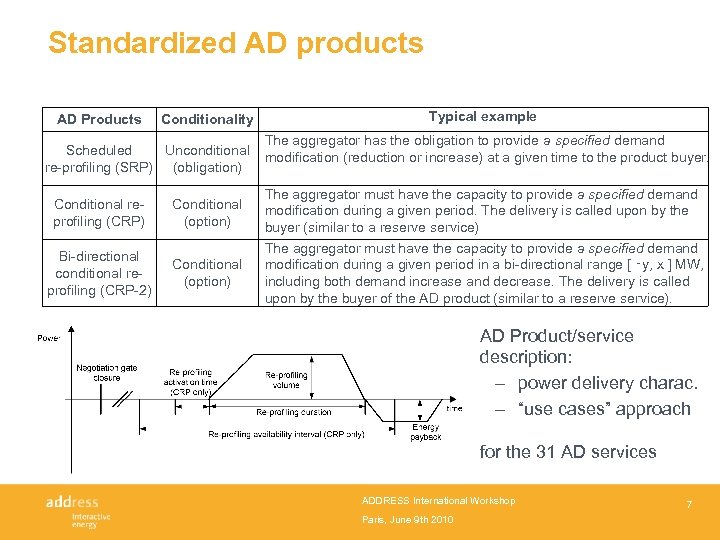 Standardized AD products AD Products Conditionality Scheduled Unconditional re-profiling (SRP) (obligation) Conditional reprofiling (CRP) Conditional (option) Bi-directional conditional reprofiling (CRP-2) Conditional (option) Typical example The aggregator has the obligation to provide a specified demand modification (reduction or increase) at a given time to the product buyer. The aggregator must have the capacity to provide a specified demand modification during a given period. The delivery is called upon by the buyer (similar to a reserve service) The aggregator must have the capacity to provide a specified demand modification during a given period in a bi-directional range [ ‑y, x ] MW, including both demand increase and decrease. The delivery is called upon by the buyer of the AD product (similar to a reserve service). AD Product/service description: – power delivery charac. – “use cases” approach for the 31 AD services ADDRESS International Workshop Paris, June 9 th 2010 7
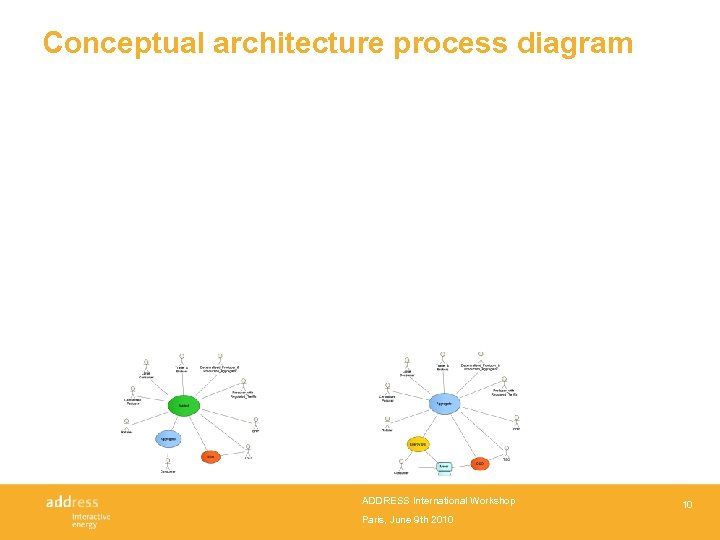
 Example of AD service provision (1/2) SRP product for the retailer: – short term load shaping to optimise purchases and sales Day ahead, the retailer optimises purchases and sales – This optimisation determines the price and volume of energy to trade on the wholesale market – The retailer could buy a load shaping service provided by Active Demand to facilitate this optimisation by modulating its wholesale energy trading volume or by benefiting from time arbitrage This service provision is illustrated in the following use case description ADDRESS International Workshop Paris, June 9 th 2010 8
 Example of AD service provision (2/2) ADDRESS International Workshop Paris, June 9 th 2010 9
 Conceptual architecture process diagram ADDRESS International Workshop Paris, June 9 th 2010 10
 Available on http: //www. addressfp 7. org ADDRESS International Workshop Paris, June 9 th 2010 11
 THANK YOU The research leading to these results has received funding from the European Community's Seventh Framework Programme (FP 7/2007 -2013) under grant agreement n° 207643
 Annex If needed. . . active demand The research leading to these results has received funding from the European Community's Seventh Framework Programme (FP 7/2007 -2013) under grant agreement n° 207643
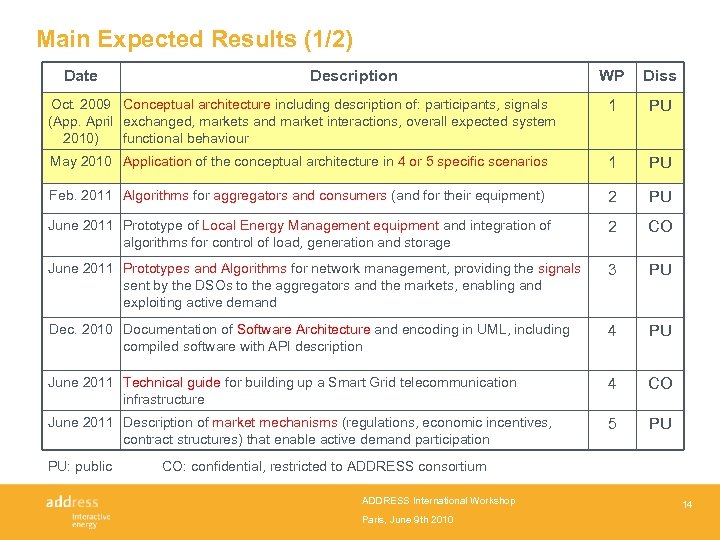 Main Expected Results (1/2) Date WP Diss Oct. 2009 Conceptual architecture including description of: participants, signals (App. April exchanged, markets and market interactions, overall expected system 2010) functional behaviour 1 PU May 2010 Application of the conceptual architecture in 4 or 5 specific scenarios 1 PU Feb. 2011 Algorithms for aggregators and consumers (and for their equipment) 2 PU June 2011 Prototype of Local Energy Management equipment and integration of algorithms for control of load, generation and storage 2 CO June 2011 Prototypes and Algorithms for network management, providing the signals sent by the DSOs to the aggregators and the markets, enabling and exploiting active demand 3 PU Dec. 2010 Documentation of Software Architecture and encoding in UML, including compiled software with API description 4 PU June 2011 Technical guide for building up a Smart Grid telecommunication infrastructure 4 CO June 2011 Description of market mechanisms (regulations, economic incentives, contract structures) that enable active demand participation 5 PU PU: public Description CO: confidential, restricted to ADDRESS consortium ADDRESS International Workshop Paris, June 9 th 2010 14
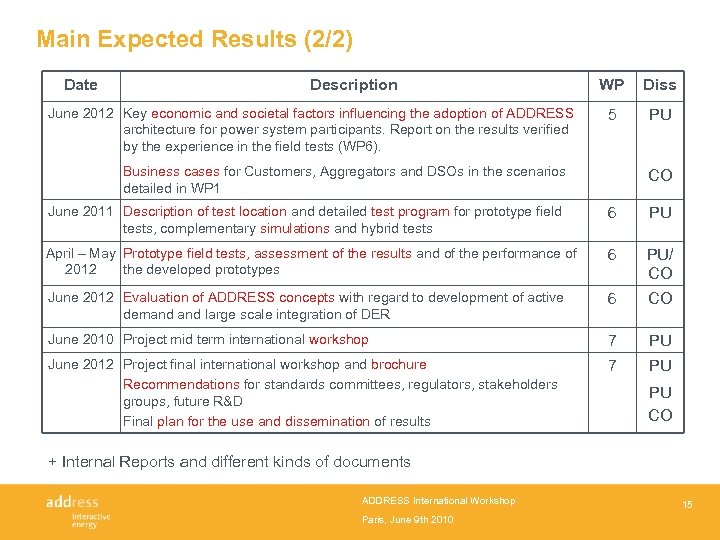 Main Expected Results (2/2) Date Description June 2012 Key economic and societal factors influencing the adoption of ADDRESS architecture for power system participants. Report on the results verified by the experience in the field tests (WP 6). WP Diss 5 PU Business cases for Customers, Aggregators and DSOs in the scenarios detailed in WP 1 CO June 2011 Description of test location and detailed test program for prototype field tests, complementary simulations and hybrid tests 6 PU April – May Prototype field tests, assessment of the results and of the performance of 2012 the developed prototypes 6 PU/ CO June 2012 Evaluation of ADDRESS concepts with regard to development of active demand large scale integration of DER 6 CO June 2010 Project mid term international workshop 7 PU June 2012 Project final international workshop and brochure Recommendations for standards committees, regulators, stakeholders groups, future R&D Final plan for the use and dissemination of results 7 PU PU CO + Internal Reports and different kinds of documents ADDRESS International Workshop Paris, June 9 th 2010 15
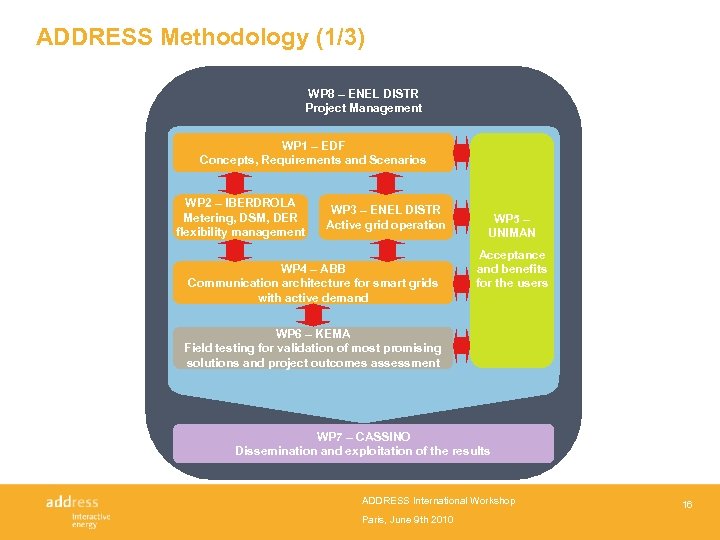 ADDRESS Methodology (1/3) WP 8 – ENEL DISTR Project Management WP 1 – EDF Concepts, Requirements and Scenarios WP 2 – IBERDROLA Metering, DSM, DER flexibility management WP 3 – ENEL DISTR Active grid operation WP 4 – ABB Communication architecture for smart grids with active demand WP 5 – UNIMAN Acceptance and benefits for the users WP 6 – KEMA Field testing for validation of most promising solutions and project outcomes assessment WP 7 – CASSINO Dissemination and exploitation of the results ADDRESS International Workshop Paris, June 9 th 2010 16
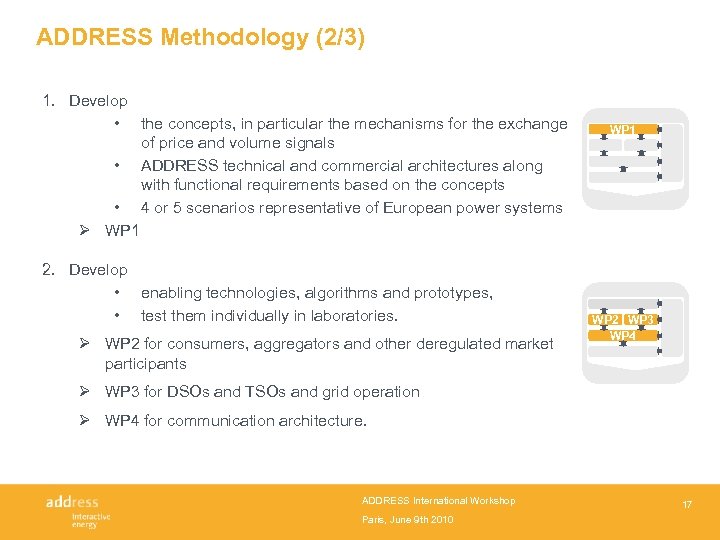 ADDRESS Methodology (2/3) 1. Develop • the concepts, in particular the mechanisms for the exchange of price and volume signals • ADDRESS technical and commercial architectures along with functional requirements based on the concepts • 4 or 5 scenarios representative of European power systems Ø WP 1 2. Develop • enabling technologies, algorithms and prototypes, • test them individually in laboratories. Ø WP 2 for consumers, aggregators and other deregulated market participants WP 1 WP 2 WP 3 WP 4 Ø WP 3 for DSOs and TSOs and grid operation Ø WP 4 for communication architecture. ADDRESS International Workshop Paris, June 9 th 2010 17
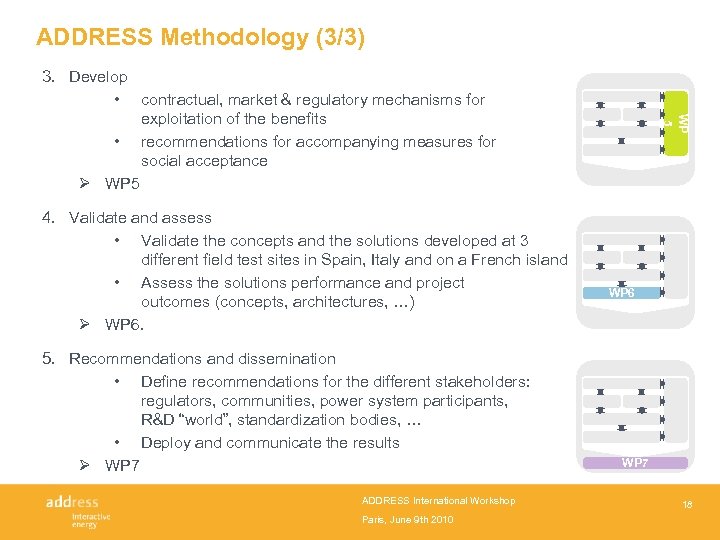 ADDRESS Methodology (3/3) 4. Validate and assess • Validate the concepts and the solutions developed at 3 different field test sites in Spain, Italy and on a French island • Assess the solutions performance and project outcomes (concepts, architectures, …) Ø WP 6. 5. Recommendations and dissemination • Define recommendations for the different stakeholders: regulators, communities, power system participants, R&D “world”, standardization bodies, … • Deploy and communicate the results Ø WP 7 ADDRESS International Workshop Paris, June 9 th 2010 WP 5 3. Develop • contractual, market & regulatory mechanisms for exploitation of the benefits • recommendations for accompanying measures for social acceptance Ø WP 5 WP 6 WP 7 18