


 Скачать презентацию The Accelerating Universe Why you should worry 2006
a4bcbe0be5e35da8af6df90696aa4720.ppt
- Количество слайдов: 56
 The Accelerating Universe: Why you should worry… 2006 Hoxton Lecture Christopher Stubbs Department of Physics Department of Astronomy Harvard University
 This is a remarkable time Our view of the Universe is shifting, yet again Sun-centered solar system Galactic structure Recognition of external galaxies Discovery of Expansion of the Universe Big Bang paradigm, inflation Dark Matter >> Luminous matter Discovery that the rate of cosmic expansion is increasing: The “Accelerating” Universe 2
 us prepostero Emergence of a Standard Cosmology Our geometrically flat Universe started in a hot big bang 13. 7 billion yrs ago. The evolution of the Universe is increasingly dominated by the phenomenology of the vacuum, the “Dark Energy”. Matter, mostly non-baryonic, is a minor component. “Dark matter” matters most. Luminous matter comprises a very small fraction of the mass of the Universe. 3
 It’s like living through a bad episode of Star Trek! Empty regions of space (vacuum) interact via a repulsive gravitational force. This effect will increasingly dominate, leading to all unbound galaxies eventually being unobservable Scientists at the interface between particle physics and gravity are in a more sophisticated state of confusion than ever before… 4
 An accelerating Universe: some things to worry about. . . Worry #1: What if the observations are wrong or misinterpreted? Worry #2: What if the observations are right!? Worry #3: What are the implications? Worry #4: Prospects for understanding the underlying physics? 5
 Reason to Worry #1: What if the observations are wrong? ! “Cosmologists are often in error, but seldom in doubt” Need a way to gauge our level of concern… 6
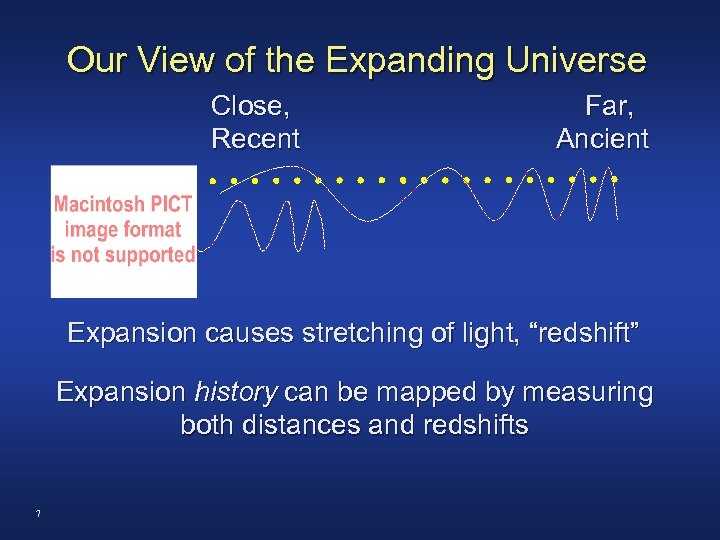 Our View of the Expanding Universe Close, Far, Recent Ancient Expansion causes stretching of light, “redshift” Expansion history can be mapped by measuring both distances and redshifts 7
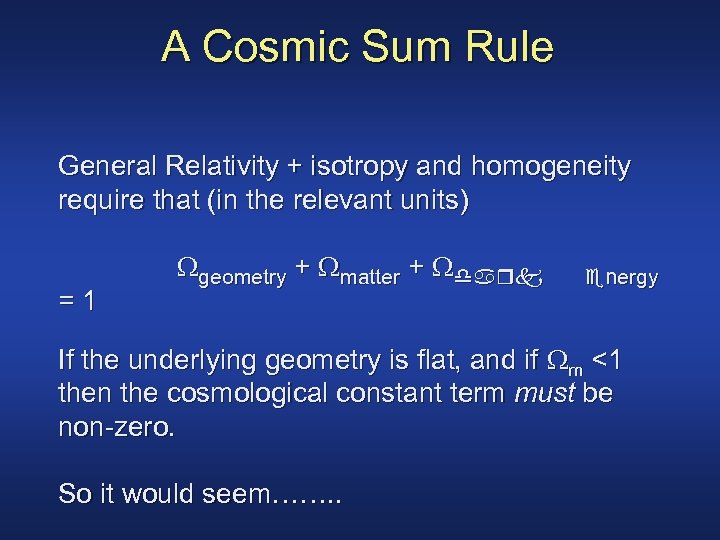 A Cosmic Sum Rule General Relativity + isotropy and homogeneity require that (in the relevant units) = 1 geometry + matter + nergy If the underlying geometry is flat, and if m <1 then the cosmological constant term must be non-zero. So it would seem……. .
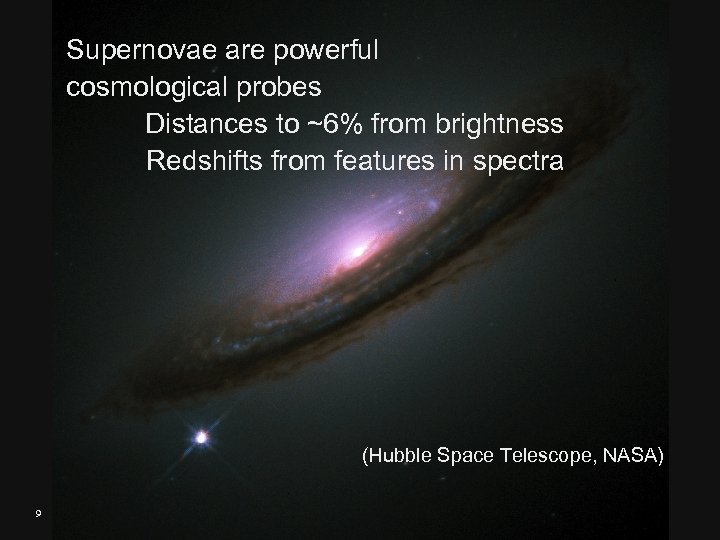 Supernovae are powerful cosmological probes Distances to ~6% from brightness Redshifts from features in spectra (Hubble Space Telescope, NASA) 9
 Schmidt et al, High-z SN Team 10
 Extinction by “gray” dust? Careful multicolor measurements, esp. in IR Exploit different z-dependence Look at SNe behind clusters of galaxies “Evolutionary” Effects? Use stellar populations of different ages as a proxy Selection differences in nearby vs. distant samples? Increase the sample of well-monitored Sne Calibrate detection efficiencies K-corrections, Galactic extinction, photometric zeropoints. . See Leibundgut, astro-ph/0003326 11
 The accelerating Universe scenario is supported by multiple independent lines of evidence • Lower bound on age, from stars • Inventories of cosmic matter content • Measurements of expansion history using supernovae • Primordial element abundances • Cosmic Microwave Background provides strong confirmation 12
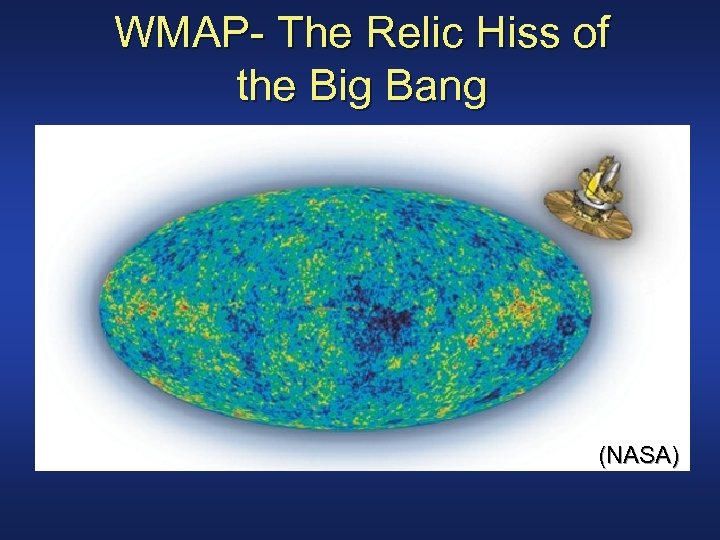 WMAP- The Relic Hiss of the Big Bang (NASA)
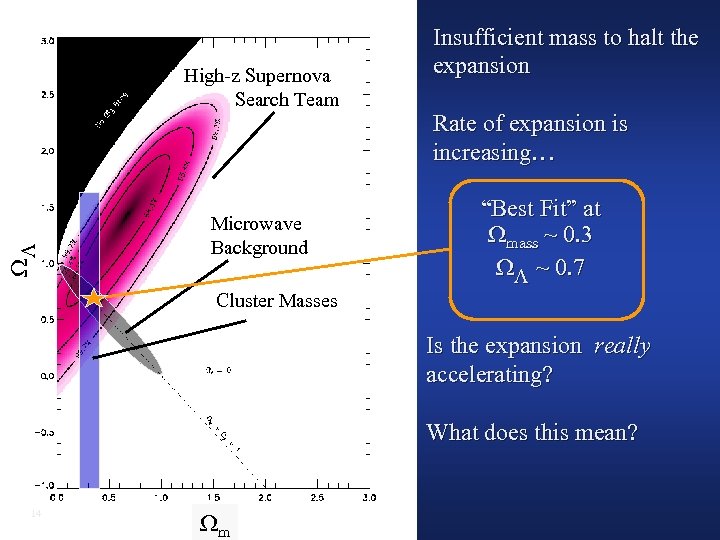 High-z Supernova Search Team Microwave Background Insufficient mass to halt the expansion Rate of expansion is increasing… “Best Fit” at mass ~ 0. 3 ~ 0. 7 Cluster Masses Is the expansion really accelerating? What does this mean? 14 m
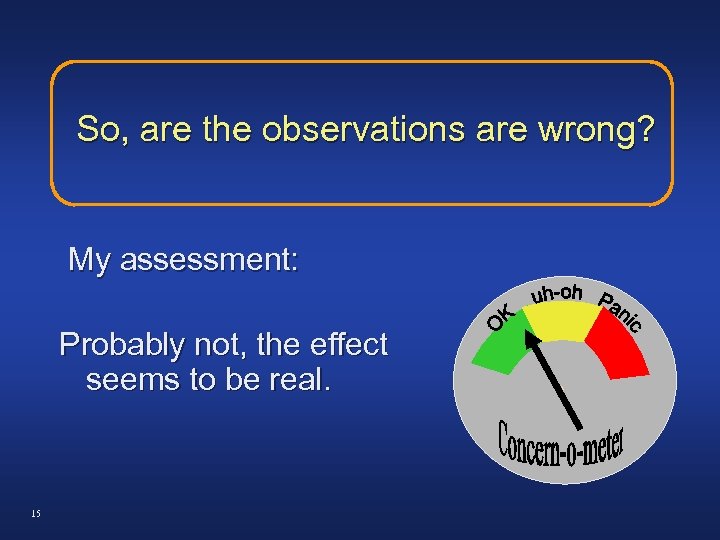 So, are the observations are wrong? My assessment: Probably not, the effect seems to be real. 15
 Reason to Worry #2: What if the observations are right? ! What’s responsible for what we see? 16
 Three philosophically distinct possibilities. . . • A “classical” cosmological constant, as envisioned by Einstein, residing in the gravitational sector. • A “Vacuum energy” effect, arising from quantum fluctuations in the vacuum, acting as a “source” term • Departure from GR on cosmological length scales Regardless, it’s evidence of new fundamental physics! 17
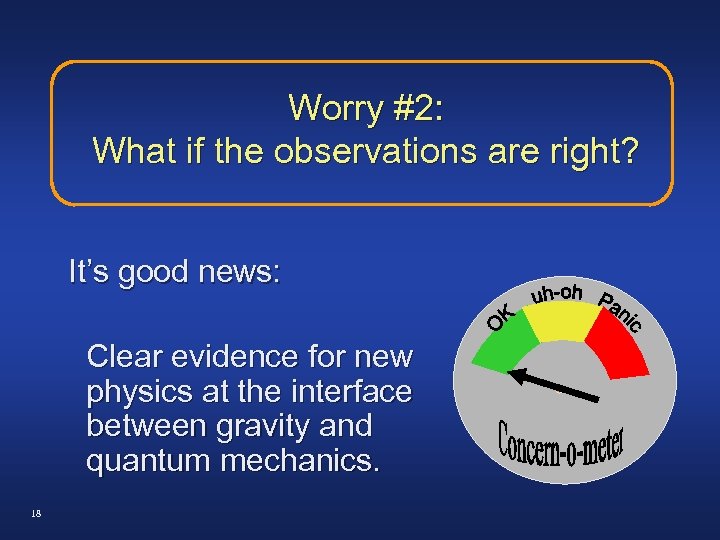 Worry #2: What if the observations are right? It’s good news: Clear evidence for new physics at the interface between gravity and quantum mechanics. 18
 Worry #3: What are the implications? If there is some Dark Energy permeating the Universe, what are the implications? 19
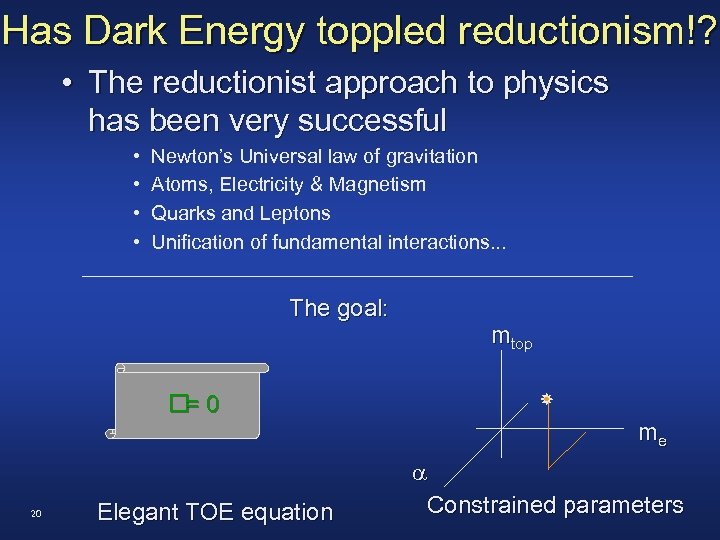 Has Dark Energy toppled reductionism!? • The reductionist approach to physics has been very successful • • Newton’s Universal law of gravitation Atoms, Electricity & Magnetism Quarks and Leptons Unification of fundamental interactions. . . The goal: mtop = 0 me 20 Elegant TOE equation Constrained parameters
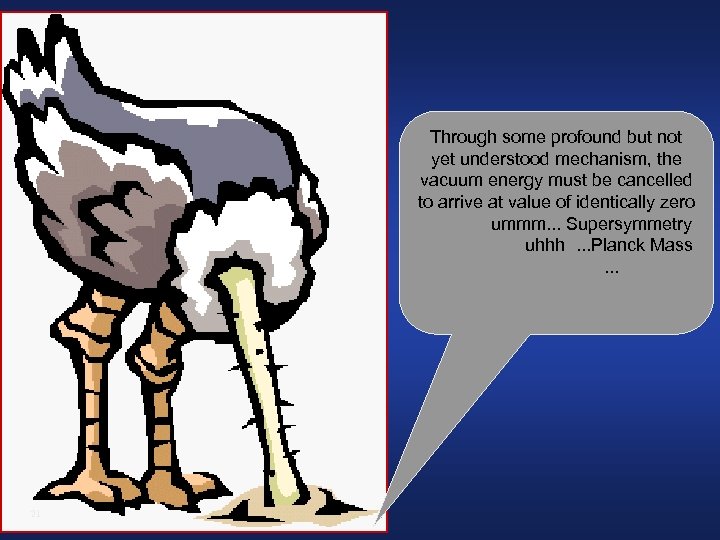 Through some profound but not yet understood mechanism, the vacuum energy must be cancelled to arrive at value of identically zero ummm. . . Supersymmetry uhhh . . . Planck Mass . . . 21
 Two possible “natural” values • Vacuum energy integrated up to Planck scale • Cancellation via tooth fairy: • But it’s measured to be around 0. 7! 22
 From string theory perspective. . . • Constraining =0 reduces number of candidate vacuum configurations (“landscapes”). • With non-zero , get of order 10500 landscapes, each with potentially different kinds of physics • What picks the one we inhabit? 23
 24
24
 The “selection effect” viewpoint • From all possible (presumably equally likely) sets of parameters and interaction strengths, only a small subset could produce heavy elements and evolve life. • This selection effect is what determines observables, such as me/mp, coupling strengths, etc, and not something deep and fundamental! Ouch. 25
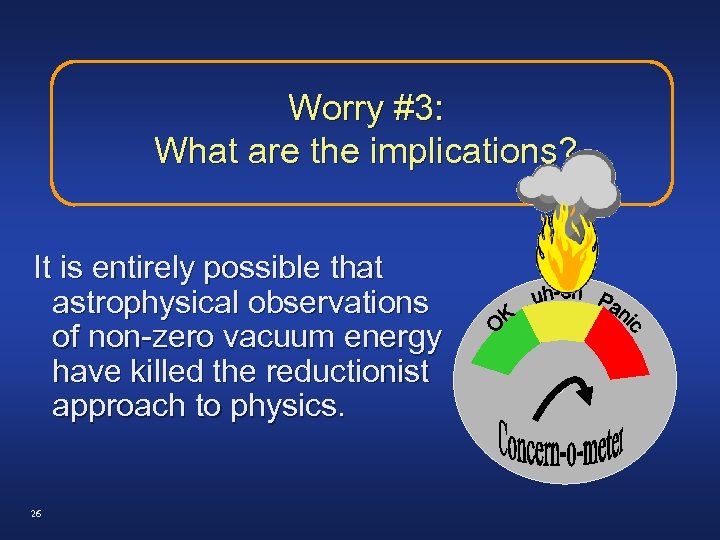 Worry #3: What are the implications? It is entirely possible that astrophysical observations of non-zero vacuum energy have killed the reductionist approach to physics. 26
 Worry #4: What are the prospects for figuring this out? Given the confusion over what’s going on here, how likely are we to figure it out? 27
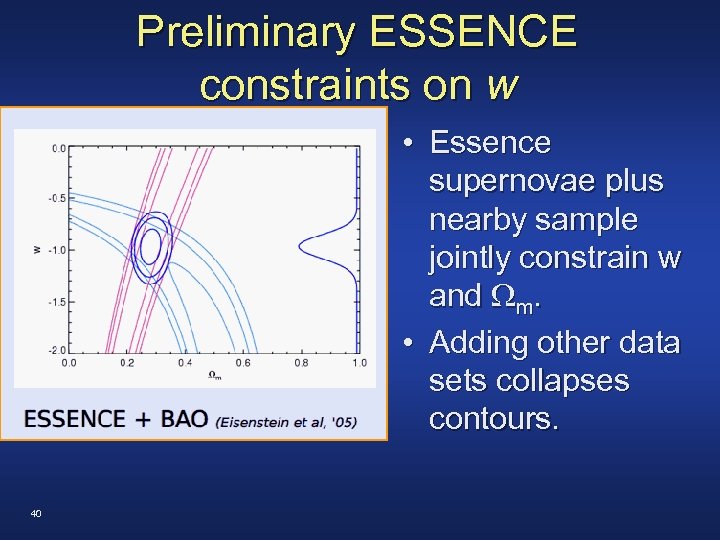
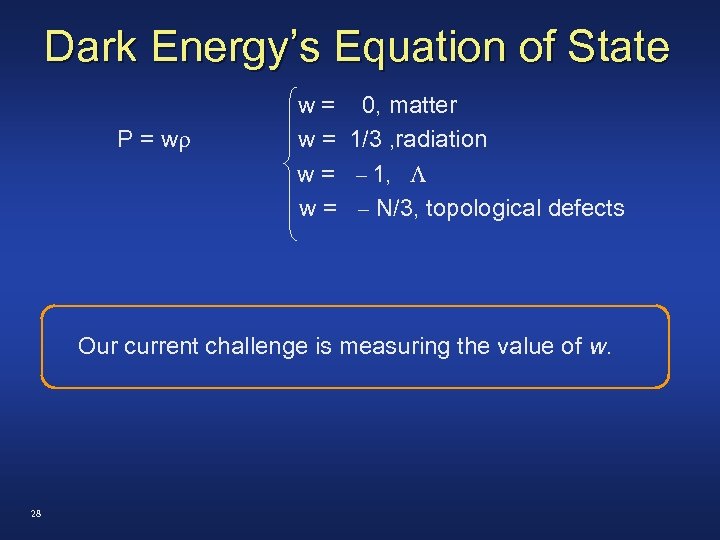 Dark Energy’s Equation of State w = 0, matter P = w w = 1/3 , radiation w = - 1, w = - N/3, topological defects Our current challenge is measuring the value of w. 28
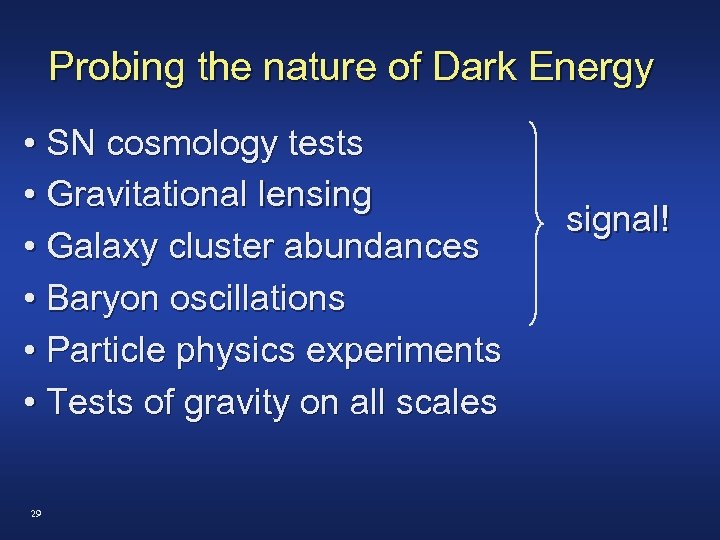 Probing the nature of Dark Energy • SN cosmology tests • Gravitational lensing • Galaxy cluster abundances • Baryon oscillations • Particle physics experiments • Tests of gravity on all scales 29 signal!
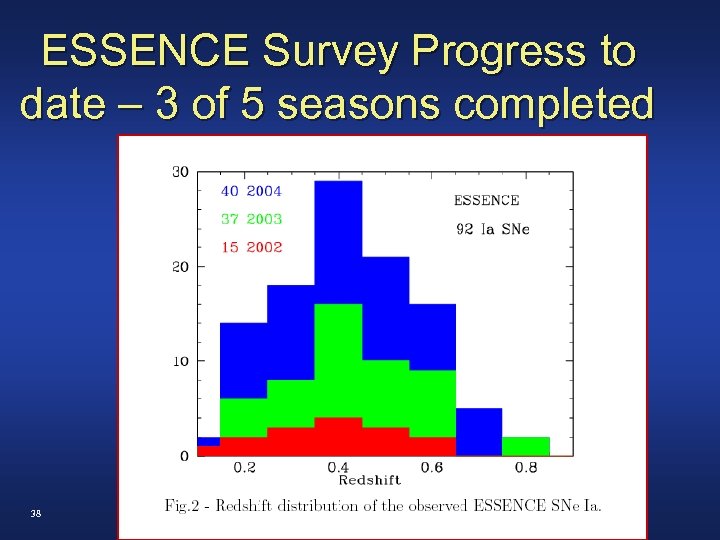
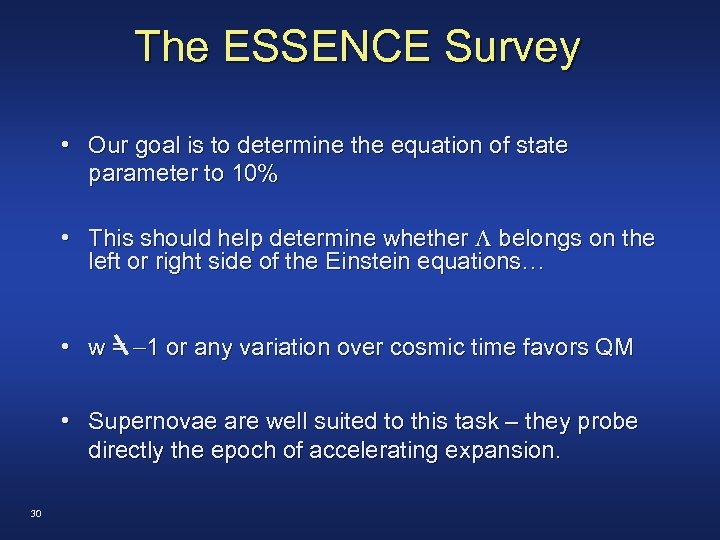 The ESSENCE Survey • Our goal is to determine the equation of state parameter to 10% • This should help determine whether belongs on the left or right side of the Einstein equations… • w = -1 or any variation over cosmic time favors QM • Supernovae are well suited to this task – they probe directly the epoch of accelerating expansion. 30
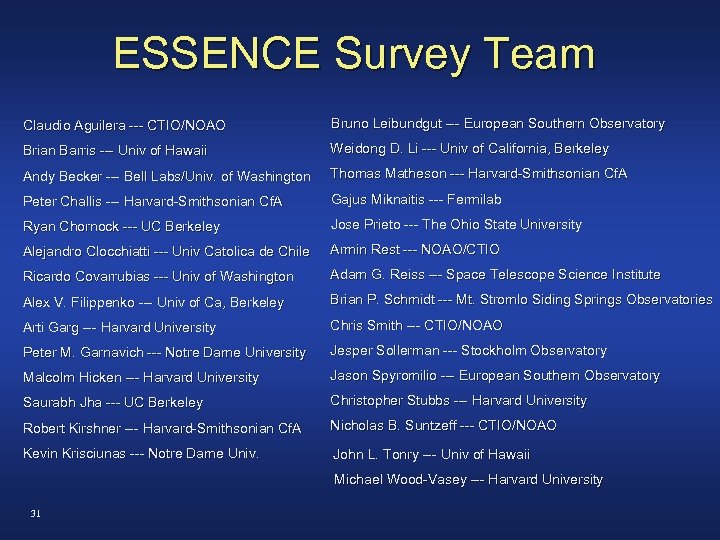 ESSENCE Survey Team Claudio Aguilera --- CTIO/NOAO Bruno Leibundgut --- European Southern Observatory Brian Barris --- Univ of Hawaii Weidong D. Li --- Univ of California, Berkeley Thomas Matheson --- Harvard-Smithsonian Cf. A Andy Becker --- Bell Labs/Univ. of Washington Peter Challis --- Harvard-Smithsonian Cf. A Gajus Miknaitis --- Fermilab Ryan Chornock --- UC Berkeley Jose Prieto --- The Ohio State University Alejandro Clocchiatti --- Univ Catolica de Chile Armin Rest --- NOAO/CTIO Ricardo Covarrubias --- Univ of Washington Adam G. Reiss --- Space Telescope Science Institute Alex V. Filippenko --- Univ of Ca, Berkeley Brian P. Schmidt --- Mt. Stromlo Siding Springs Observatories Arti Garg --- Harvard University Chris Smith --- CTIO/NOAO Peter M. Garnavich --- Notre Dame University Jesper Sollerman --- Stockholm Observatory Malcolm Hicken --- Harvard University Jason Spyromilio --- European Southern Observatory Saurabh Jha --- UC Berkeley Christopher Stubbs --- Harvard University Robert Kirshner --- Harvard-Smithsonian Cf. A Nicholas B. Suntzeff --- CTIO/NOAO Kevin Krisciunas --- Notre Dame Univ. John L. Tonry --- Univ of Hawaii Michael Wood-Vasey --- Harvard University 31
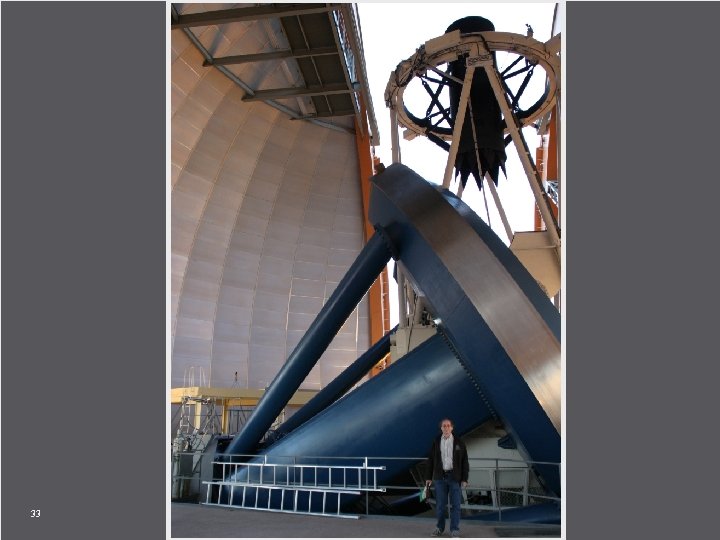
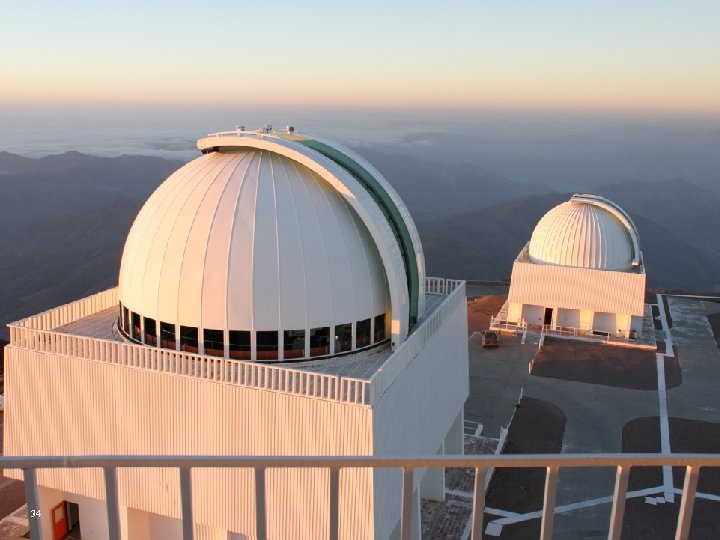
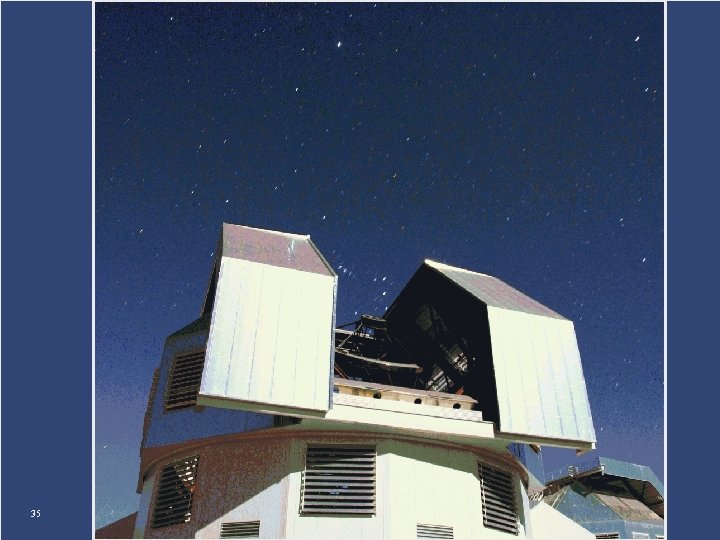
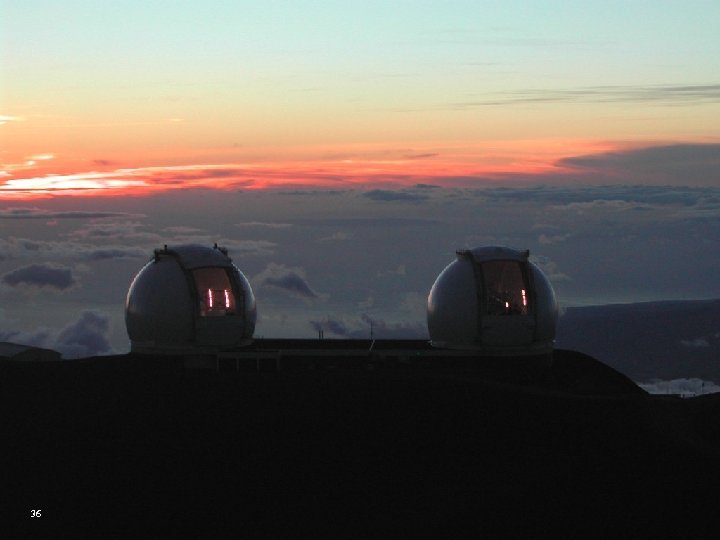
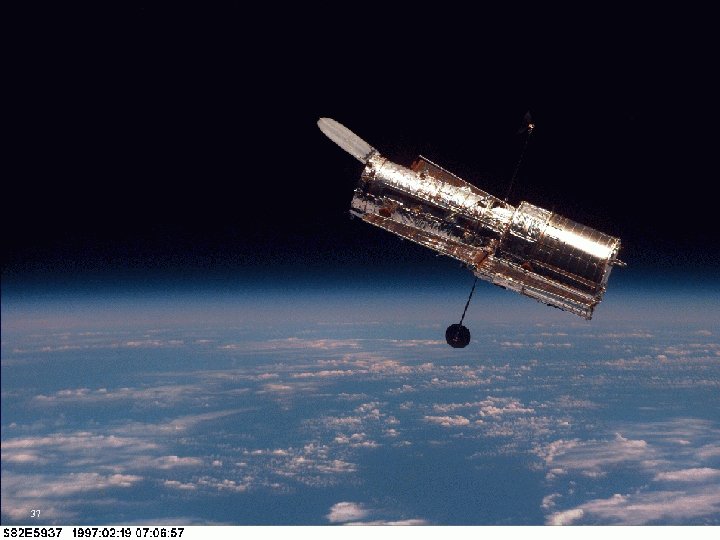
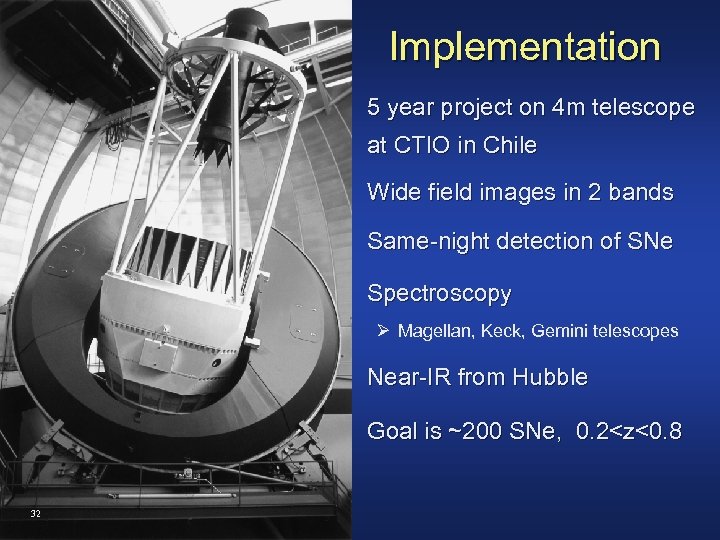 Implementation • 5 year project on 4 m telescope at CTIO in Chile • Wide field images in 2 bands • Same-night detection of SNe • Spectroscopy Ø Magellan, Keck, Gemini telescopes • Near-IR from Hubble • Goal is ~200 SNe, 0. 2
 33
33
 34
34
 35
35
 36
36
 37
37
 ESSENCE Survey Progress to date – 3 of 5 seasons completed 38
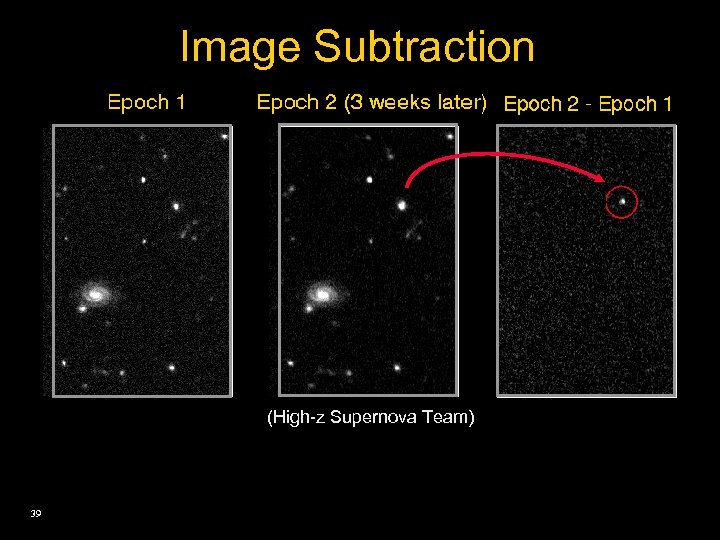 Image Subtraction (High-z Supernova Team) 39
 Preliminary ESSENCE constraints on w • Essence supernovae plus nearby sample jointly constrain w and m. • Adding other data sets collapses contours. 40
 Next-Generation Facilities Microwave background - Better angular resolution CMB maps Detection of clusters of galaxies vs. z Supernovae – Dedicated Dark Energy satellite mission Large Synoptic Survey Telescope (LSST) SNAP, Lawrence Berkeley Laboratory Weak Gravitational Lensing Both ground-based and space based Probing the foundations of gravity Equivalence principle Inverse square law LSST Corporation
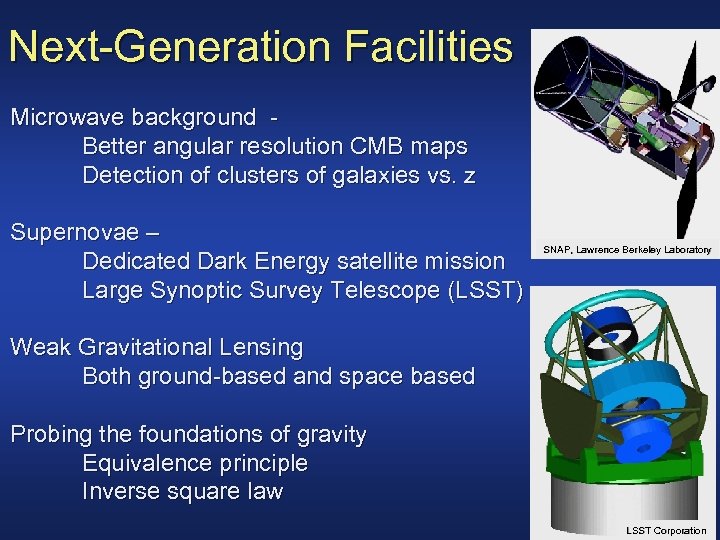
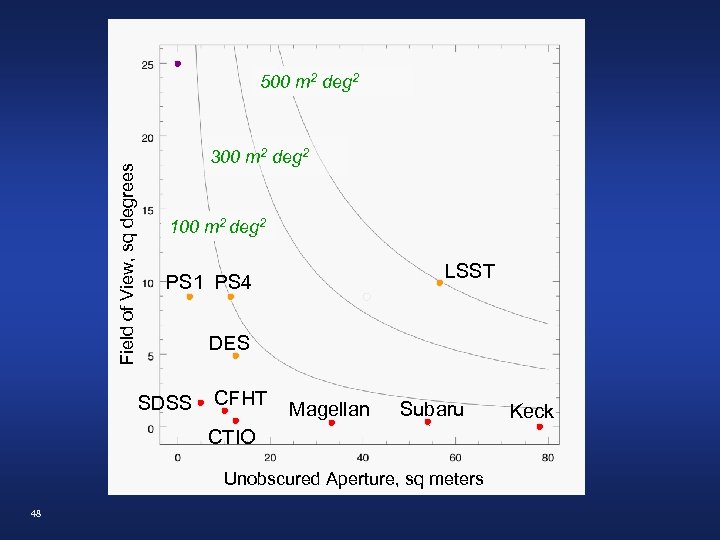
 What would an optimized ground-based facility look like? • • Large collecting area Wide field of view Real-time analysis of data Significant leap in figure-of-merit Area x Field of View 42
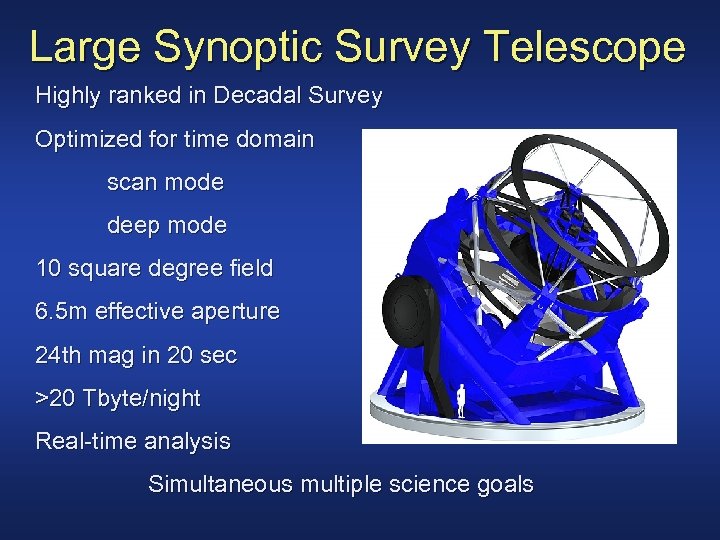 Large Synoptic Survey Telescope Highly ranked in Decadal Survey Optimized for time domain scan mode deep mode 10 square degree field 6. 5 m effective aperture 24 th mag in 20 sec >20 Tbyte/night Real-time analysis Simultaneous multiple science goals
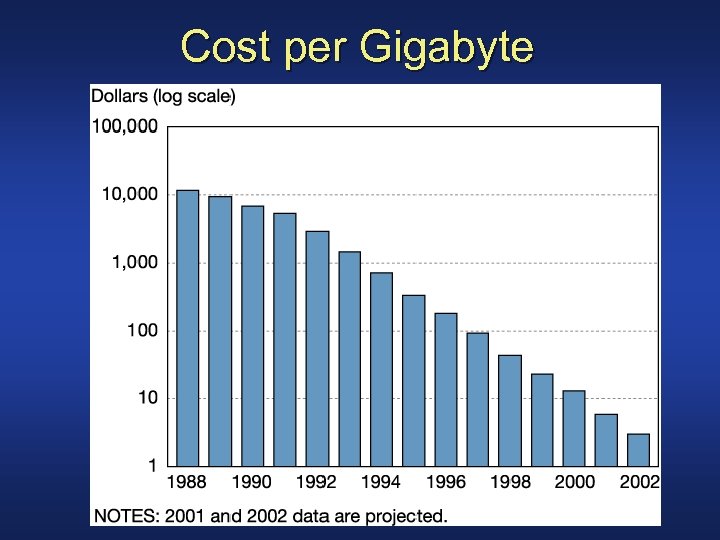
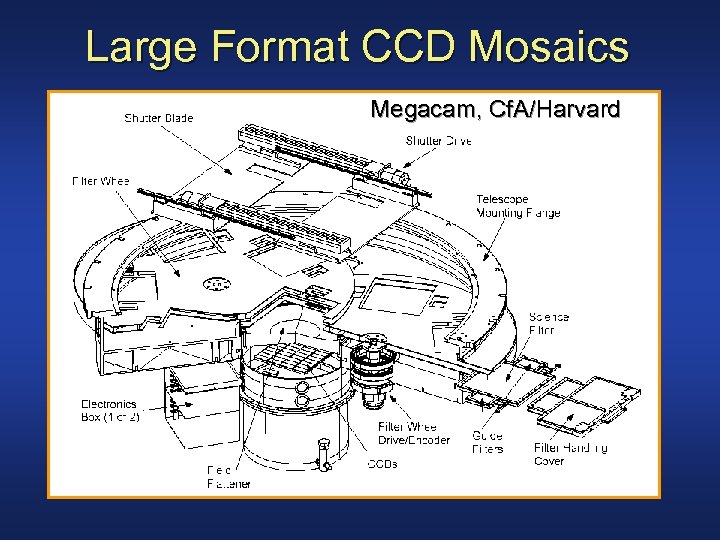
 LSST Merges 3 Enabling Technologies • Large Aperture Optics • Computing and Data Storage • High Efficiency Detectors 44
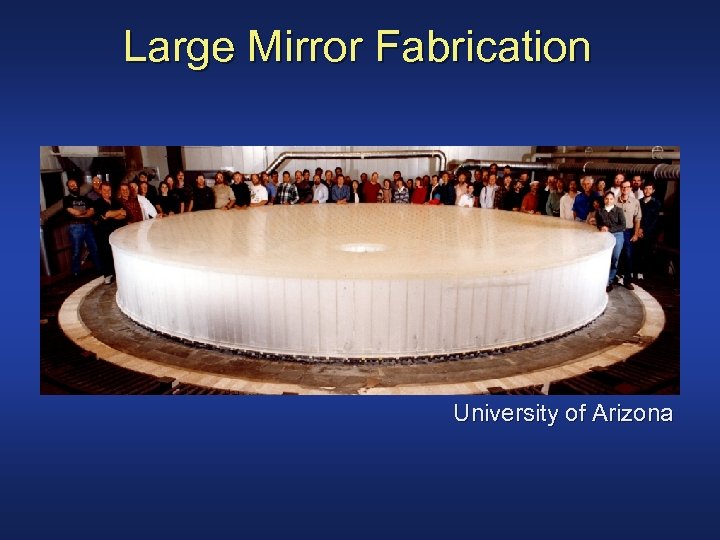 Large Mirror Fabrication University of Arizona
 Cost per Gigabyte
 Large Format CCD Mosaics Megacam, Cf. A/Harvard
 Field of View, sq degrees 500 m 2 deg 2 300 m 2 deg 2 100 m 2 deg 2 LSST PS 1 PS 4 DES SDSS CFHT Magellan Subaru CTIO Unobscured Aperture, sq meters 48 Keck
 49
49
 Near Earth Asteroids • • • Inventory of solar system is incomplete R=1 km asteroids are dinosaur killers R=300 m asteroids in ocean wipe out a coastline • Demanding project: requires mapping the sky down to 24 th every few days, individual exposures not to exceed ~20 sec. • LSST will detect NEAs to 300 m 50
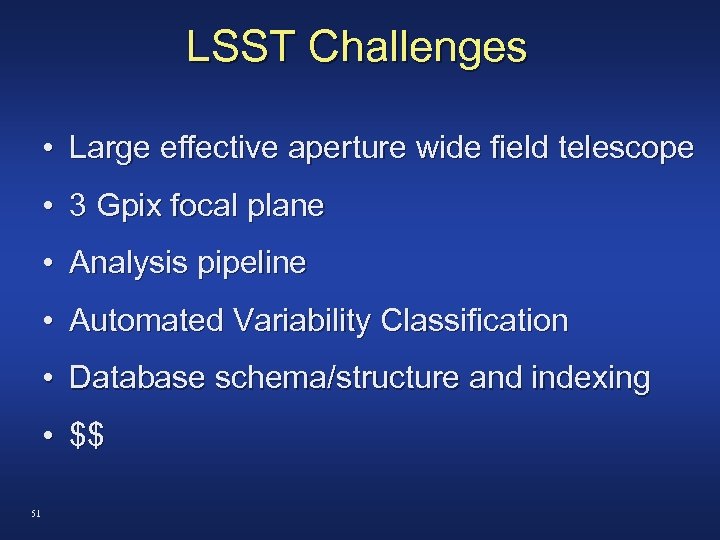 LSST Challenges • Large effective aperture wide field telescope • 3 Gpix focal plane • Analysis pipeline • Automated Variability Classification • Database schema/structure and indexing • $$ 51
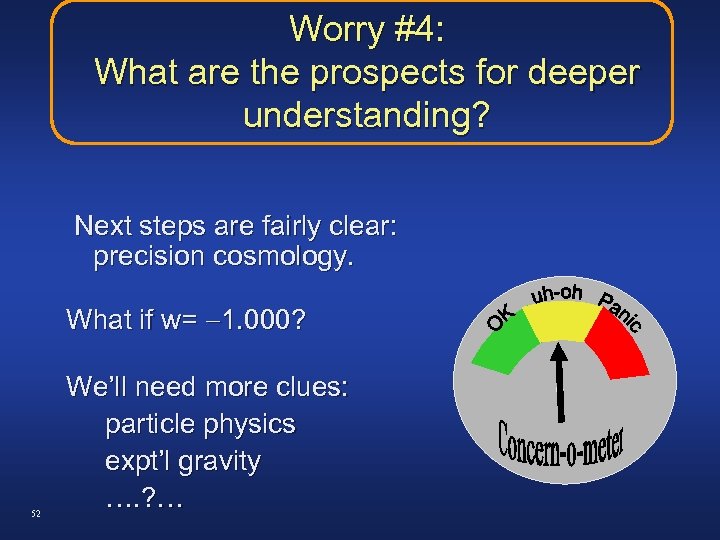 Worry #4: What are the prospects for deeper understanding? Next steps are fairly clear: precision cosmology. What if w= -1. 000? 52 We’ll need more clues: particle physics expt’l gravity …. ? …
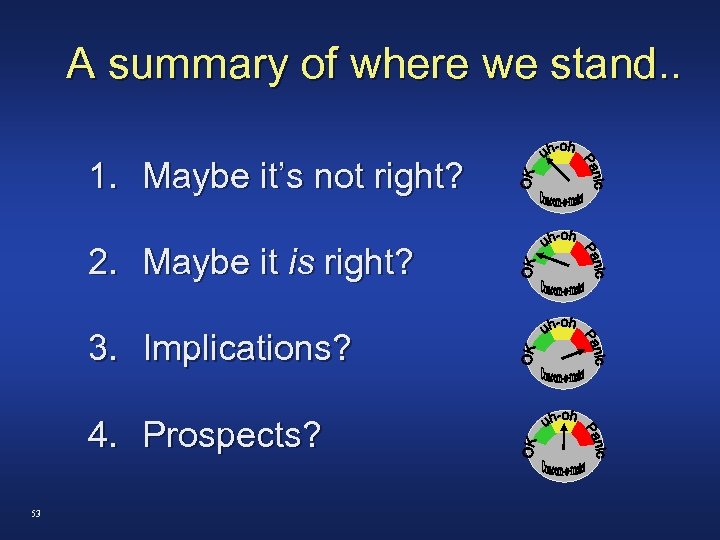 A summary of where we stand. . 1. Maybe it’s not right? 2. Maybe it is right? 3. Implications? 4. Prospects? 53
 Closing thoughts The Accelerating Universe poses a challenge to both theory and experiment/observation This problem sits squarely at an interface we don’t understand: the intersection between gravity and quantum mechanics Look for upcoming new results from 54 • • Supernova and galaxy cluster cosmology Gravitational lensing Large Hadron Collider (LHC) Tests of gravitation, on all scales
 55
55
 56
56