


 Скачать презентацию The 8 th Asia Pacific GAW Workshop
65f15cf508d774d4baaf6fe7683e68eb.ppt
- Количество слайдов: 17
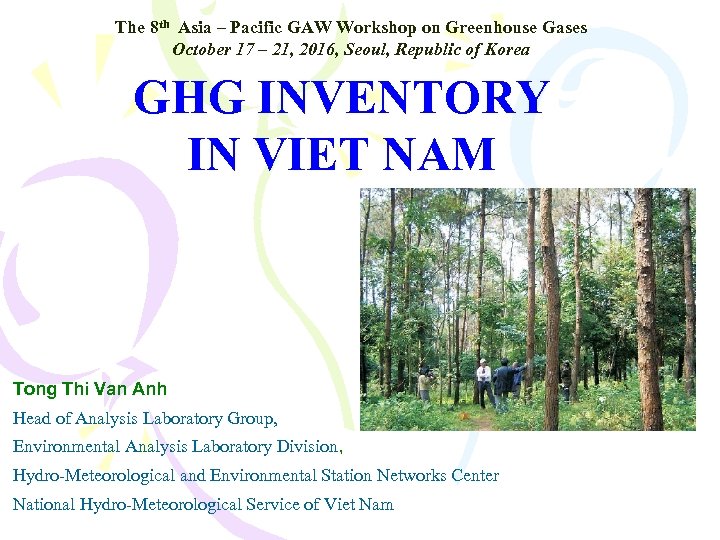 The 8 th Asia – Pacific GAW Workshop on Greenhouse Gases October 17 – 21, 2016, Seoul, Republic of Korea GHG INVENTORY IN VIET NAM Tong Thi Van Anh Head of Analysis Laboratory Group, Environmental Analysis Laboratory Division, Hydro-Meteorological and Environmental Station Networks Center National Hydro-Meteorological Service of Viet Nam
 General Information ü Vietnam signed United Nations Framework Convention on Climate Change (UNFCCC) on 11 June 1992 and ratified it on 16 November 1994. Viet Nam also signed Kyoto Protocol (KP) on 03 December 1998 and ratified it on 25 September 2002 ü Implementing commitments of the Non-Annex I Parties as stated in Article 4. 1 of UNFCCC, Vietnam is not required to reduce greenhouse gases (GHG) emission but to implement some common obligations, such as preparing its National Communications, carrying out GHG inventory, developing and assessing GHG mitigation and climate change adaptation options.
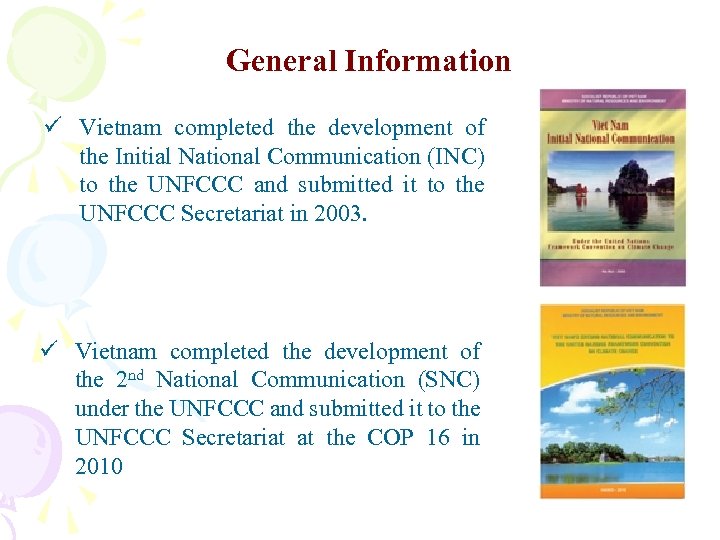 General Information ü Vietnam completed the development of the Initial National Communication (INC) to the UNFCCC and submitted it to the UNFCCC Secretariat in 2003. ü Vietnam completed the development of the 2 nd National Communication (SNC) under the UNFCCC and submitted it to the UNFCCC Secretariat at the COP 16 in 2010
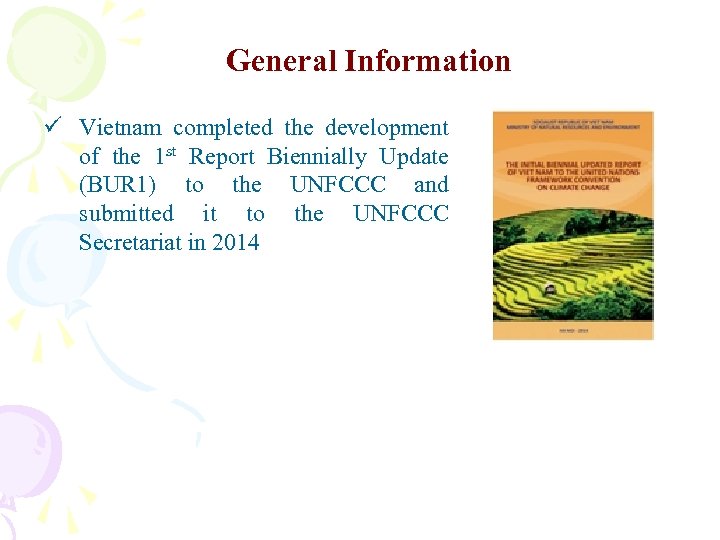 General Information ü Vietnam completed the development of the 1 st Report Biennially Update (BUR 1) to the UNFCCC and submitted it to the UNFCCC Secretariat in 2014
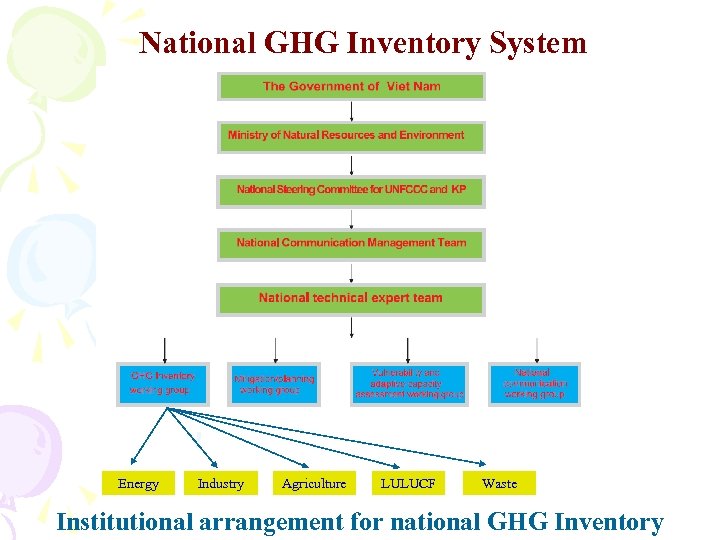 National GHG Inventory System Energy Industry Agriculture LULUCF Waste Institutional arrangement for national GHG Inventory
 Evaluate emission sources / main absorption ü Greenhouse gases mainly are CO 2, CH 4 and N 2 O ü Identified sources of emissions / absorption include: - Energy: from Industry / Construction, Transport, Electricity production and mining operations in the oil and gas. - Industrial Processes: from the production sub-sector of cement and steel production. - Agriculture: from rice cultivation, fermentation and agricultural land. - Land use change and Forestry (LULUCF): from forests and reserves change biomass, the soil, fallow land management and land use conversion. - Waste: from solid waste disposal.
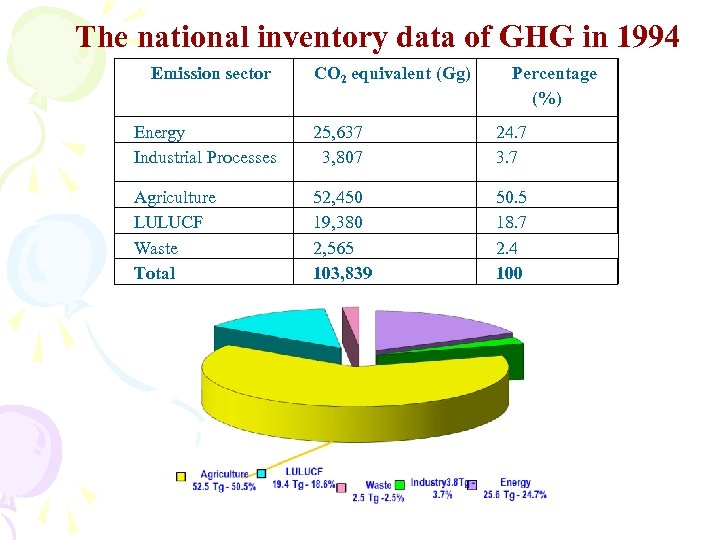 The national inventory data of GHG in 1994 Emission sector CO 2 equivalent (Gg) Percentage (%) Energy Industrial Processes 25, 637 3, 807 24. 7 3. 7 Agriculture LULUCF Waste Total 52, 450 19, 380 2, 565 103, 839 50. 5 18. 7 2. 4 100
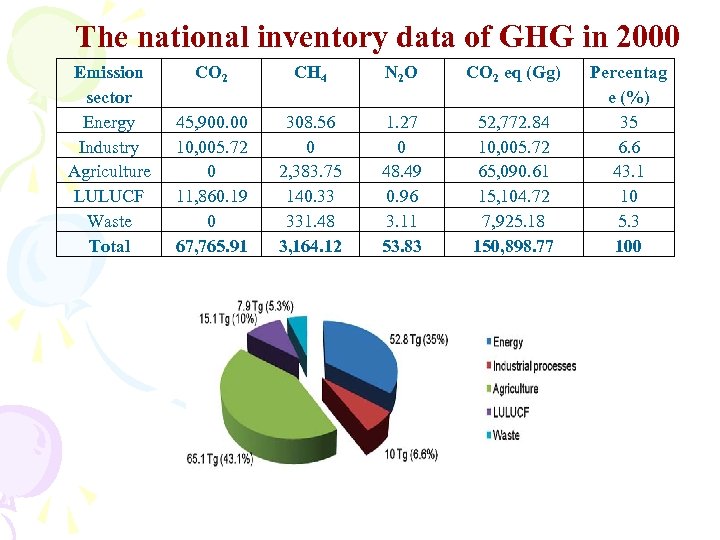 The national inventory data of GHG in 2000 Emission sector Energy Industry Agriculture LULUCF Waste Total CO 2 CH 4 N 2 O CO 2 eq (Gg) 45, 900. 00 10, 005. 72 0 11, 860. 19 0 67, 765. 91 308. 56 0 2, 383. 75 140. 33 331. 48 3, 164. 12 1. 27 0 48. 49 0. 96 3. 11 53. 83 52, 772. 84 10, 005. 72 65, 090. 61 15, 104. 72 7, 925. 18 150, 898. 77 Percentag e (%) 35 6. 6 43. 1 10 5. 3 100
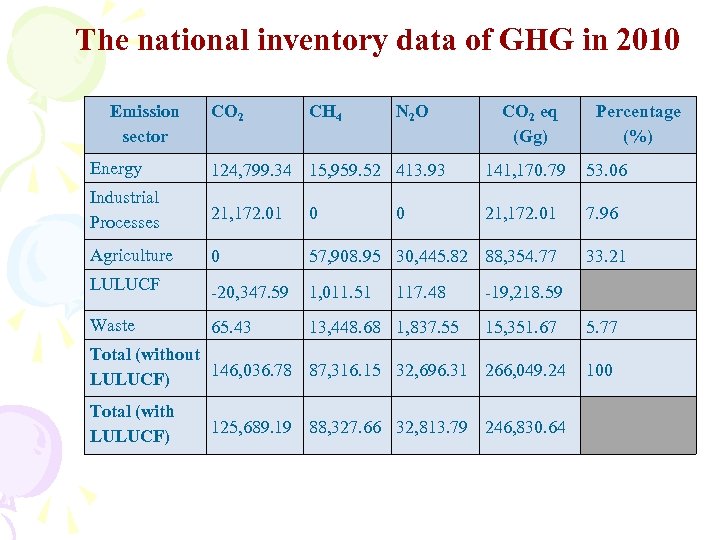 The national inventory data of GHG in 2010 Emission sector CO 2 CH 4 N 2 O CO 2 eq (Gg) Percentage (%) Energy 124, 799. 34 15, 959. 52 413. 93 141, 170. 79 53. 06 Industrial Processes 21, 172. 01 0 21, 172. 01 7. 96 Agriculture 0 57, 908. 95 30, 445. 82 88, 354. 77 LULUCF -20, 347. 59 1, 011. 51 Waste 65. 43 13, 448. 68 1, 837. 55 0 117. 48 -19, 218. 59 15, 351. 67 Total (without 146, 036. 78 87, 316. 15 32, 696. 31 266, 049. 24 LULUCF) Total (with LULUCF) 33. 21 125, 689. 19 88, 327. 66 32, 813. 79 246, 830. 64 5. 77 100
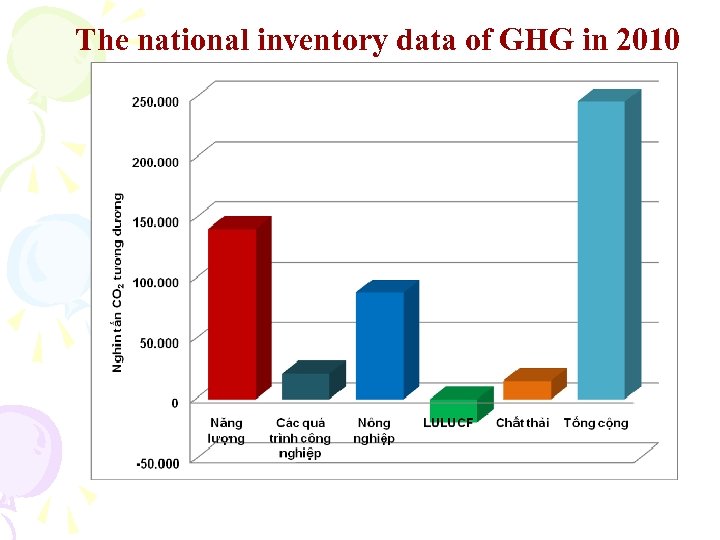 The national inventory data of GHG in 2010
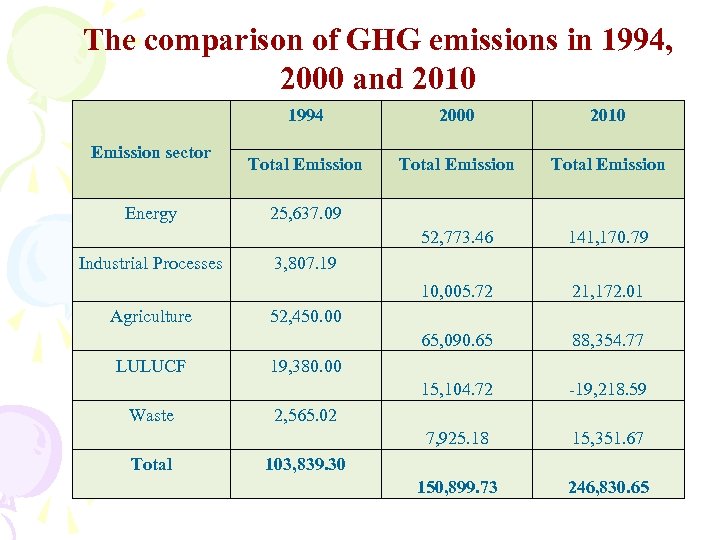 The comparison of GHG emissions in 1994, 2000 and 2010 1994 Waste Total 141, 170. 79 21, 172. 01 88, 354. 77 -19, 218. 59 7, 925. 18 LULUCF Total Emission 15, 104. 72 Agriculture Total Emission 65, 090. 65 Industrial Processes Total Emission 10, 005. 72 Energy 2010 52, 773. 46 Emission sector 2000 15, 351. 67 150, 899. 73 246, 830. 65 25, 637. 09 3, 807. 19 52, 450. 00 19, 380. 00 2, 565. 02 103, 839. 30
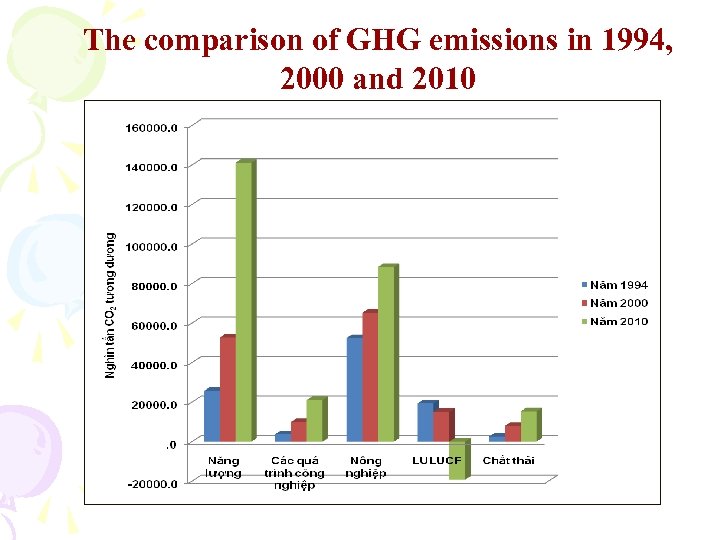 The comparison of GHG emissions in 1994, 2000 and 2010
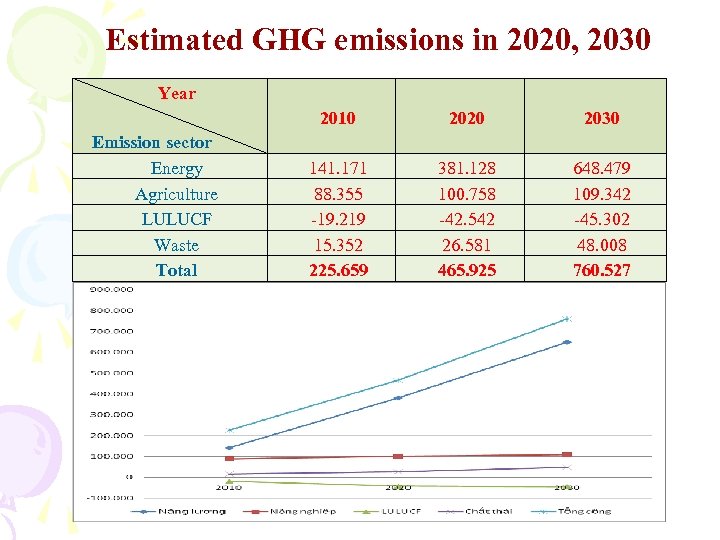 Estimated GHG emissions in 2020, 2030 Year Emission sector Energy Agriculture LULUCF Waste Total 2010 2020 2030 141. 171 88. 355 -19. 219 15. 352 225. 659 381. 128 100. 758 -42. 542 26. 581 465. 925 648. 479 109. 342 -45. 302 48. 008 760. 527
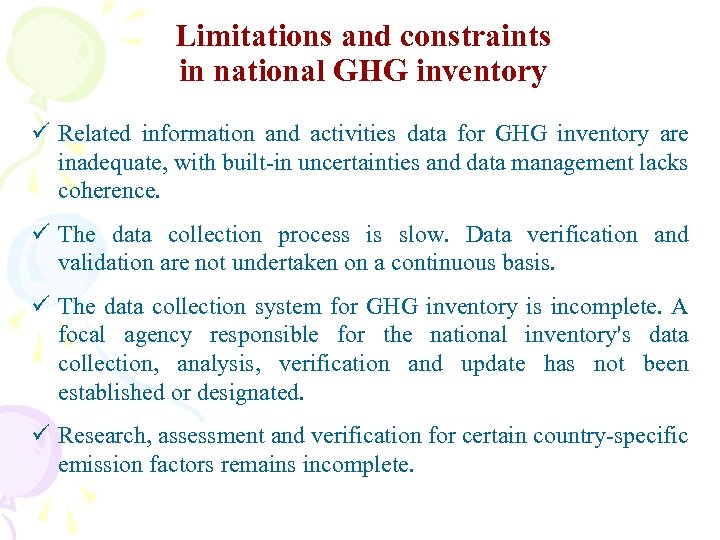 Limitations and constraints in national GHG inventory ü Related information and activities data for GHG inventory are inadequate, with built-in uncertainties and data management lacks coherence. ü The data collection process is slow. Data verification and validation are not undertaken on a continuous basis. ü The data collection system for GHG inventory is incomplete. A focal agency responsible for the national inventory's data collection, analysis, verification and update has not been established or designated. ü Research, assessment and verification for certain country-specific emission factors remains incomplete.
 Limitations and constraints in national GHG inventory ü A database supporting the inventory is not yet available. ü There is an inadequate pool of greenhouse gas inventory technical experts in the ministries and agencies. Inter-agency coordination remains to be desired.
 Improvement Plan ü National GHG inventories have been produced for a comparatively short time with limited resources and expertise. Emissions processes are pervasive and complex and, consequently, emissions estimation techniques and data sources for the Vietnam inventory are still inadequate, particularly in some sectors. ü It is needed to develop the National Program for improving GHG inventories. The improvements will turn on both the development of activity data and country emission factors. ü Train more young experts to involve in GHG inventory. ü Strengthen the cooperation between ministries and related agencies in the data collection. ü Establish a National GHG Inventory Office or agency.
 THANK YOU VERY MUCH FOR YOUR ATTENTION