


 Скачать презентацию The 6 th METRI-IAP workshop 23 -24 May
ef4379cf2c074234e43bbdd950b7079b.ppt
- Количество слайдов: 22
 The 6 th METRI-IAP workshop, 23 -24 May 2006 , Seogwipo, Jeju, Korea Enhanced Observing Period(KEOP) Young-Jean Choi, Jae-Cheol Nam, and Ki-Hoon Kim Forecast Research Laboratory Meteorological Research Institute(METRI)/KMA
 Contents q Objectives of KEOP q Ground observational system q Haenam super-sites for KEOP q IOP 2006 q Future plan q Summary Forecast Research Lab.
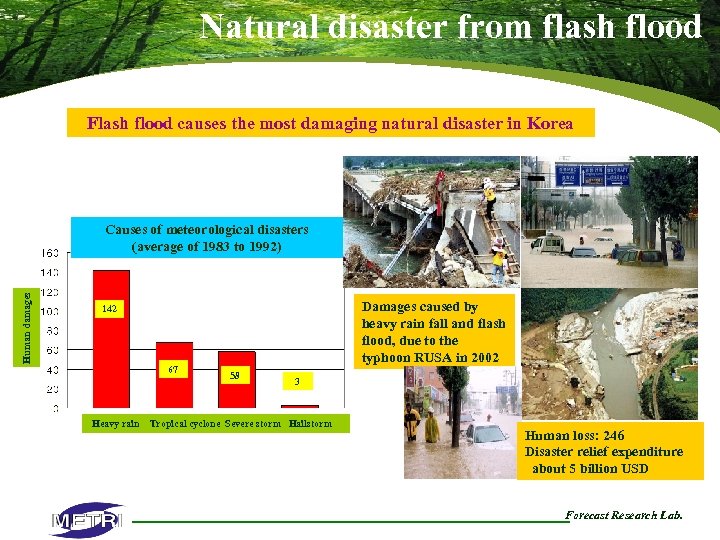 Natural disaster from flash flood Flash flood causes the most damaging natural disaster in Korea Human damages Causes of meteorological disasters (average of 1983 to 1992) Damages caused by heavy rain fall and flash flood, due to the typhoon RUSA in 2002 142 67 Heavy rain 58 3 Tropical cyclone Severe storm Hailstorm Human loss: 246 Disaster relief expenditure about 5 billion USD Forecast Research Lab.
 Objective of KEOP q Better understanding of dynamical structure and evolution of high-impact weather systems(mainly warm season precipitation episode) q Enhance the understanding of the land-atmosphere interaction and physics of cloud & precipitation. q Develop optimal observing strategies(targeting observation) related to data assimilation procedures. Forecast Research Lab.
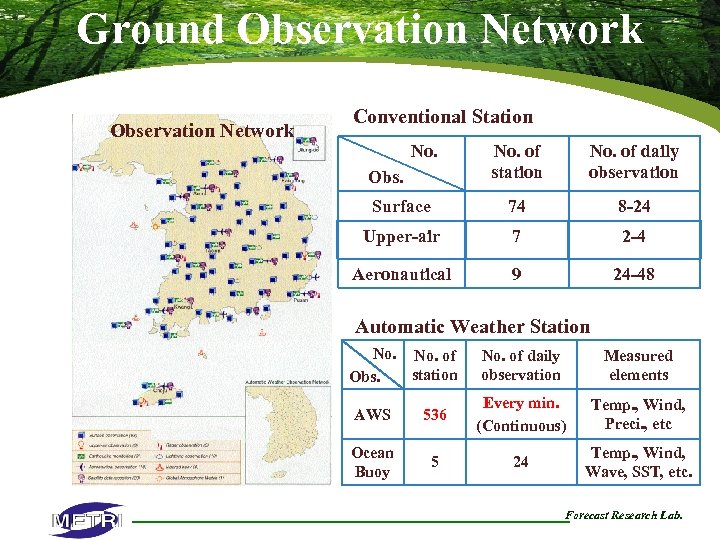 Ground Observation Network Conventional Station No. of station No. of daily observation Surface 74 8 -24 Upper-air 7 2 -4 Aeronautical 9 24 -48 Obs. Automatic Weather Station No. of station Obs. No. of daily observation Measured elements AWS 536 Every min. (Continuous) Temp. , Wind, Preci. , etc Ocean Buoy 5 24 Temp. , Wind, Wave, SST, etc. Forecast Research Lab.
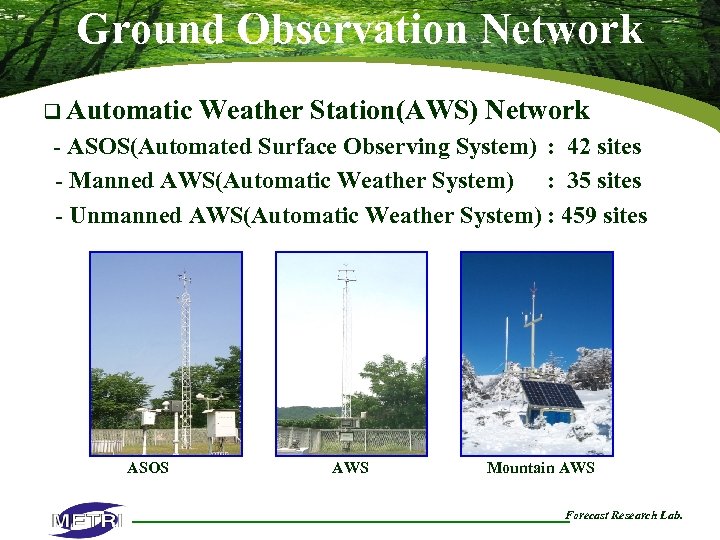 Ground Observation Network q Automatic Weather Station(AWS) Network - ASOS(Automated Surface Observing System) : 42 sites - Manned AWS(Automatic Weather System) : 35 sites - Unmanned AWS(Automatic Weather System) : 459 sites ASOS AWS Mountain AWS Forecast Research Lab.
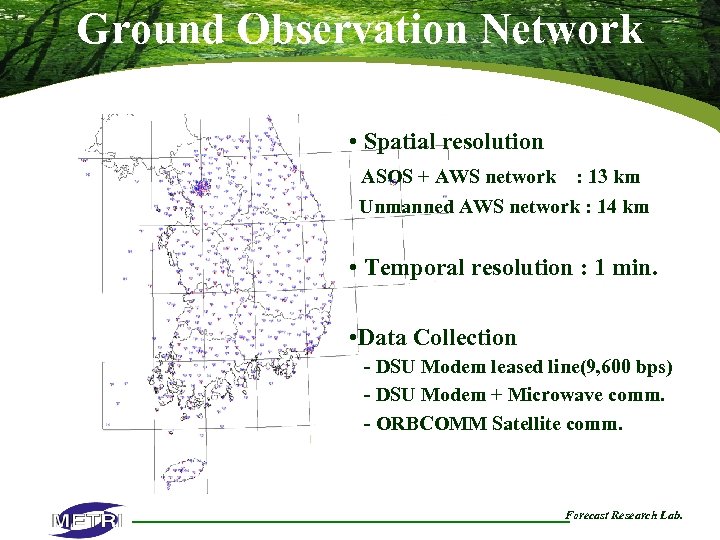 Ground Observation Network • Spatial resolution ASOS + AWS network : 13 km Unmanned AWS network : 14 km • Temporal resolution : 1 min. • Data Collection - DSU Modem leased line(9, 600 bps) - DSU Modem + Microwave comm. - ORBCOMM Satellite comm. Forecast Research Lab.
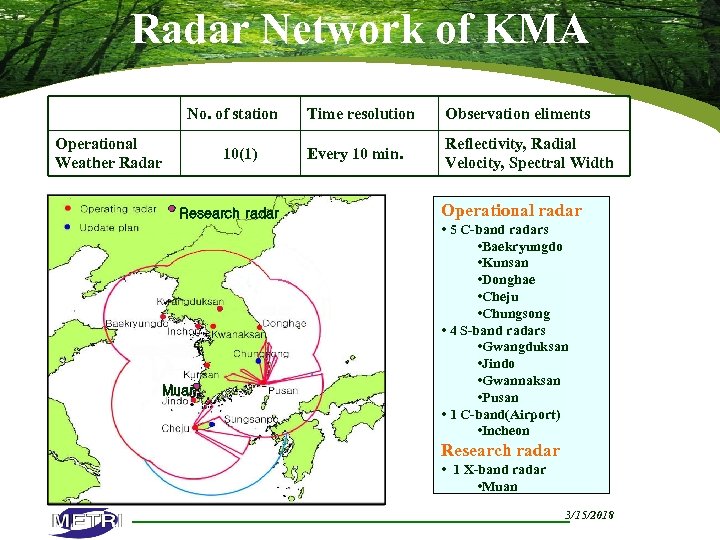 Radar Network of KMA No. of station Operational Weather Radar 10(1) Research radar Muan Time resolution Observation eliments Every 10 min. Reflectivity, Radial Velocity, Spectral Width Operational radar • 5 C-band radars • Baekryungdo • Kunsan • Donghae • Cheju • Chungsong • 4 S-band radars • Gwangduksan • Jindo • Gwannaksan • Pusan • 1 C-band(Airport) • Incheon Research radar • 1 X-band radar • Muan 3/15/2018
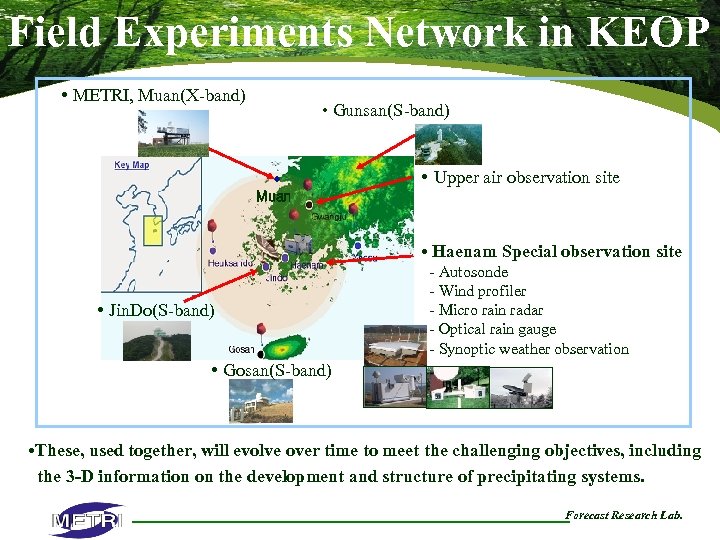 Field Experiments Network in KEOP • METRI, Muan(X-band) • Gunsan(S-band) • Upper air observation site Muan • Haenam Special observation site • Jin. Do(S-band) - Autosonde - Wind profiler - Micro rain radar - Optical rain gauge - Synoptic weather observation • Gosan(S-band) • These, used together, will evolve over time to meet the challenging objectives, including the 3 -D information on the development and structure of precipitating systems. Forecast Research Lab.
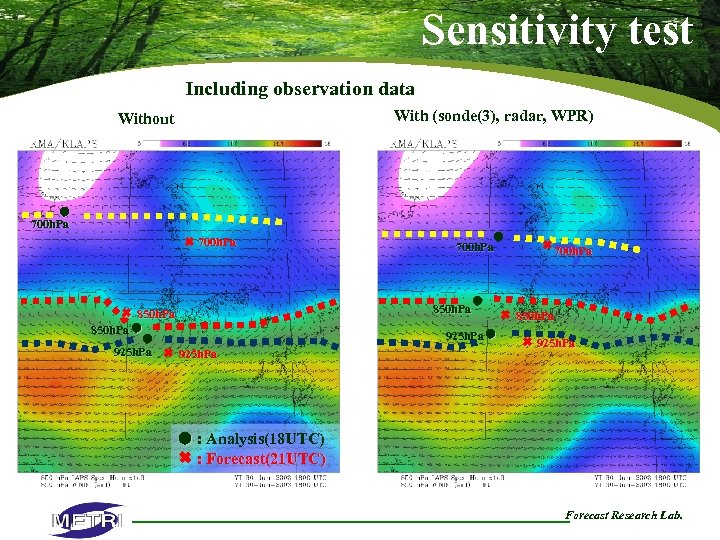 Sensitivity test Including observation data With (sonde(3), radar, WPR) Without 700 h. Pa 850 h. Pa 925 h. Pa 700 h. Pa 850 h. Pa 700 h. Pa 925 h. Pa 850 h. Pa 925 h. Pa : Analysis(18 UTC) : Forecast(21 UTC) Forecast Research Lab.
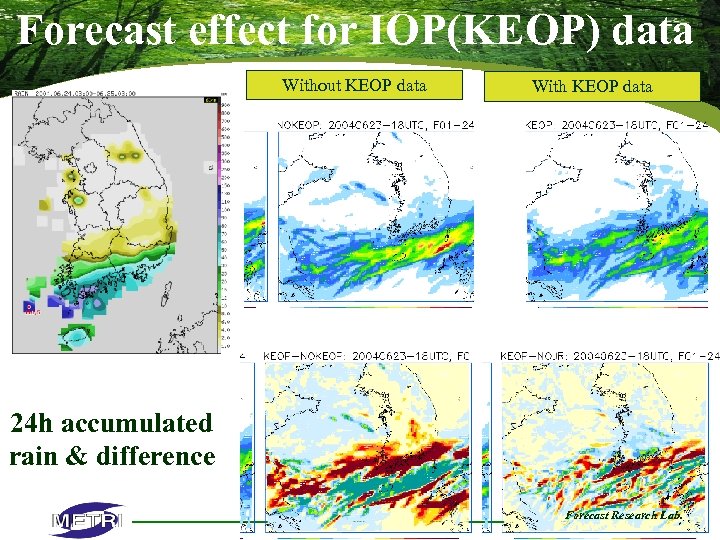 Forecast effect for IOP(KEOP) data Without KEOP data With KEOP data 24 h accumulated rain & difference Forecast Research Lab.
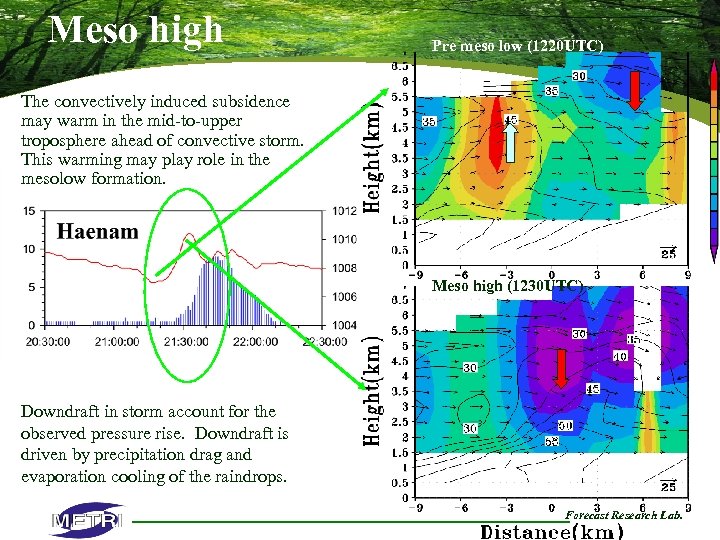 Meso high Pre meso low (1220 UTC) The convectively induced subsidence may warm in the mid-to-upper troposphere ahead of convective storm. This warming may play role in the mesolow formation. Meso high (1230 UTC) Downdraft in storm account for the observed pressure rise. Downdraft is driven by precipitation drag and evaporation cooling of the raindrops. Forecast Research Lab.
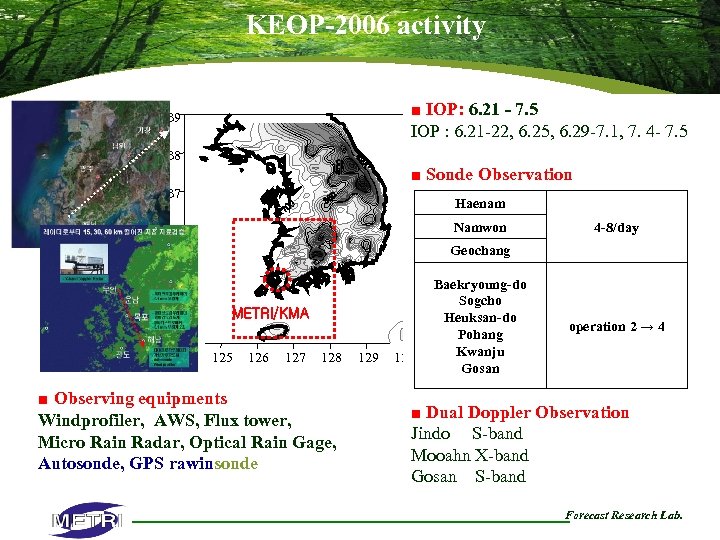 KEOP-2006 activity ■ IOP: 6. 21 - 7. 5 IOP : 6. 21 -22, 6. 25, 6. 29 -7. 1, 7. 4 - 7. 5 39 38 ■ Sonde Observation 37 Haenam Namwon 36 4 -8/day Geochang 35 34 33 124 METRI/KMA 125 126 127 128 ■ Observing equipments Windprofiler, AWS, Flux tower, Micro Rain Radar, Optical Rain Gage, Autosonde, GPS rawinsonde 129 130 Baekryoung-do Sogcho Heuksan-do Pohang 131 Kwanju Gosan operation 2 → 4 ■ Dual Doppler Observation Jindo S-band Mooahn X-band Gosan S-band Forecast Research Lab.
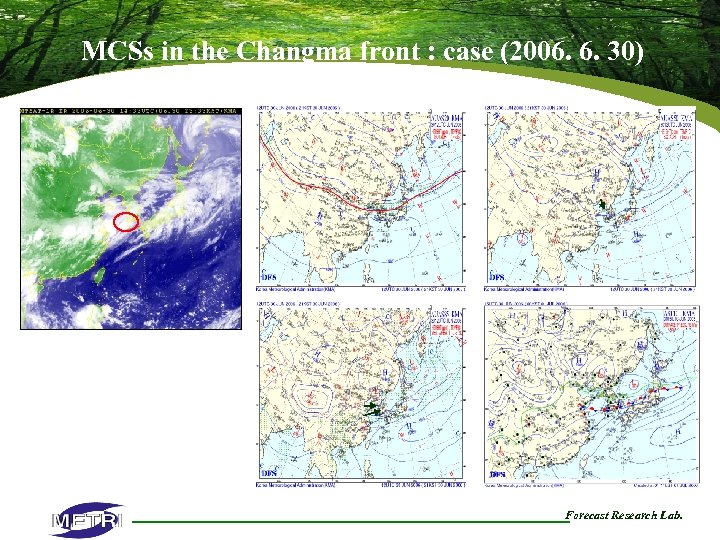 MCSs in the Changma front : case (2006. 6. 30) Forecast Research Lab.
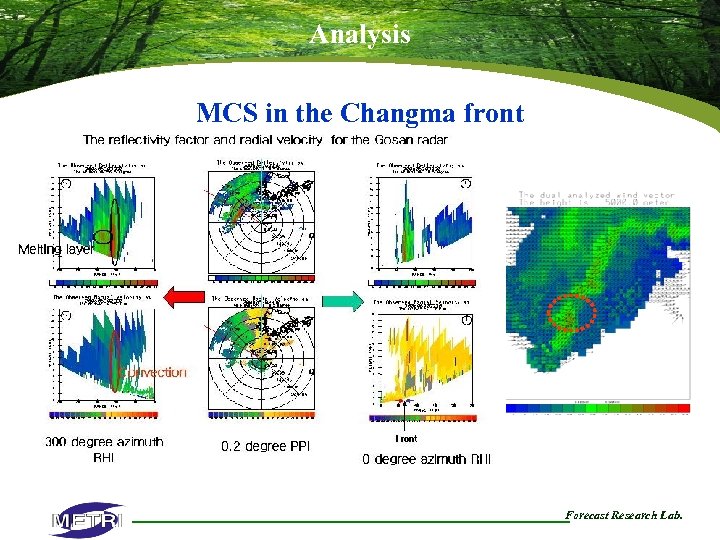 Analysis MCS in the Changma front Forecast Research Lab.
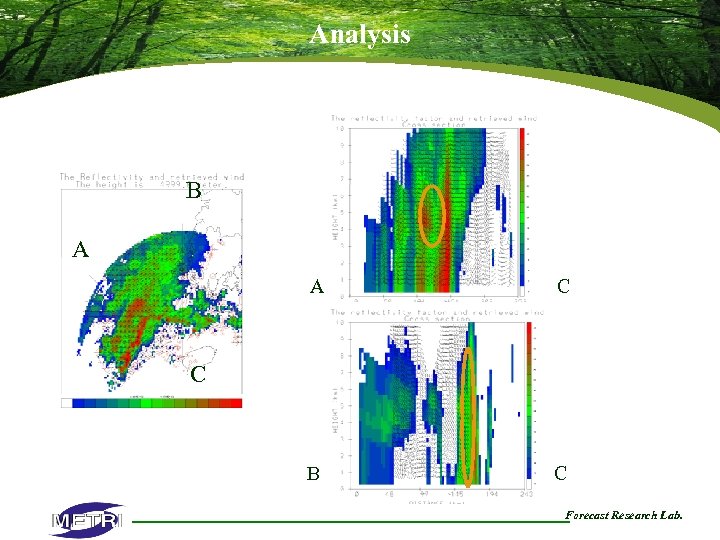 Analysis B A A C B C C Forecast Research Lab.
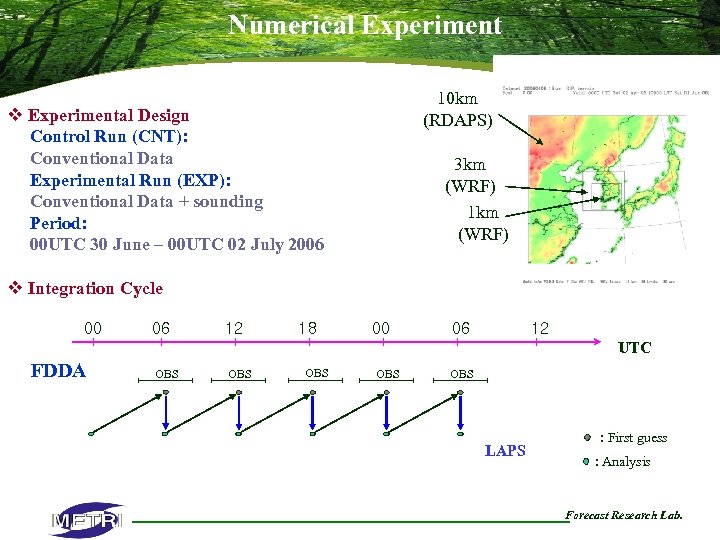 Numerical Experiment 10 km (RDAPS) v Experimental Design Control Run (CNT): Conventional Data Experimental Run (EXP): Conventional Data + sounding Period: 00 UTC 30 June – 00 UTC 02 July 2006 3 km (WRF) 1 km (WRF) v Integration Cycle 00 06 12 18 00 06 12 UTC FDDA OBS OBS OBS LAPS : First guess : Analysis Forecast Research Lab.
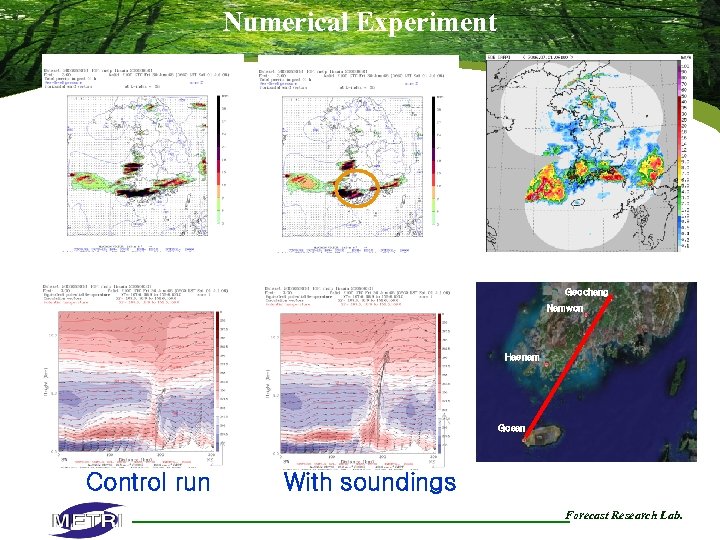 Numerical Experiment Geochang Namwon Haenam Gosan Control run With soundings Forecast Research Lab.
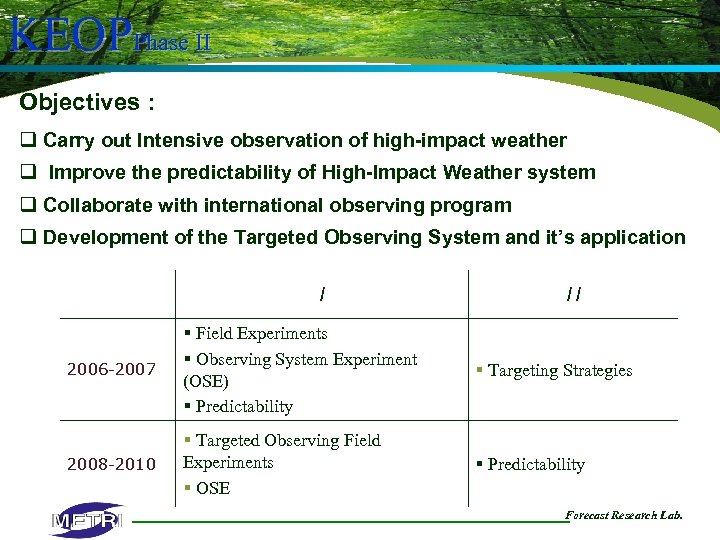 KEOPPhase II Objectives : q Carry out Intensive observation of high-impact weather q Improve the predictability of High-Impact Weather system q Collaborate with international observing program q Development of the Targeted Observing System and it’s application I II 2006 -2007 § Field Experiments § Observing System Experiment (OSE) § Predictability § Targeting Strategies 2008 -2010 § Targeted Observing Field Experiments § OSE § Predictability Forecast Research Lab.
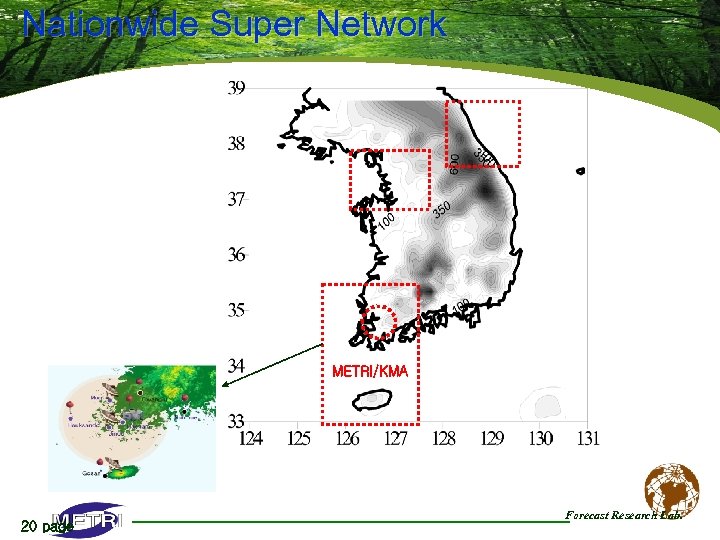 Nationwide Super Network METRI/KMA 20 page Forecast Research Lab.
 Summary q Automatic Weather Station Network (13 km*13 km, one minute) and Weather radar(10 stations) operating by KMA can be used for measuring the high-impact severe weather system. q Produced high resolution temporal and spatial data(KEOP) are used for research and operation of the monitoring, analysis and prediction of severe weather phenomena(typhoon, fronts…) q KEOP has been concentrated on the understanding of dynamical structure and evolution of high-impact weather systems and enhance the understanding of the land-atmosphere interaction and physics of cloud & precipitation. q In order to improve operational forecast through increased model accuracy and reliability, enhancement observing network, development data assimmilation techniques are needed. Forecast Research Lab.
 Thank you for your attention !