


 Скачать презентацию The 50 Market Your Next Great Opportunity International
a382f6fae08d372c37691b6a4b2805d3.ppt
- Количество слайдов: 41
 The 50+ Market: Your Next Great Opportunity International Home Furnishings Center October 24, 2005
 Introduction: You’re 50, so what? n What happens when you wake up and you are 50? ¨ You still have hopes and dreams and plans ¨ You are still working, living, loving ¨ Often caring for children and parents ¨ Probably in your peak earning years, and yet You have dropped off many marketers’ radar screens -- no longer an adult 18 -49 IHFC October 2005 2
 Introduction: You’re 50, what do you want? n What do Americans 50 and older want? ¨ to continue to enjoy their lives to the fullest ¨ to have the homes and lifestyles they’ve always wanted ¨ to be able to live in comfort Not to be marginalized IHFC October 2005 3
 Why You Need To Know About This Market n n n It is enormous in size and wealth, and growing It is complex ¨ 3 distinct generations, not one ¨ they differ by mindset and life stage Its growth is being fueled by Leading Edge Baby Boomers ¨ they have influenced American society, industry and marketing since 1946 and will continue to do so as they age ¨ they are redefining what it means to grow older IHFC October 2005 4
 Myths of the Older Market n n n Older people think and act OLD There aren’t that many of them compared to the under 50 population, and they are dying off They don’t have that much to spend, except on health care products and services They are brand loyal; they won’t switch brands, so why spend money on them They’ve grown comfortable with their home furnishings and don’t want to change They are techno-phobic and computer-illiterate IHFC October 2005 5
 Demographic Destiny n n n Currently, 292 million people in the US 82 million are 50+ -- 28% of the population by 2020, 116 million will be 50+ -- 36% of the population Median age of population is now 36 ¨ in 1980, it was 30 ¨ in 1900, it was 23 When the Boomers begin turning 65 between 2010 -2020 the 65+ population will grow 35%, while the under-65 population will increase just 4% IHFC October 2005 6
 The Healthiest, Wealthiest Cohort n n n More than 90% of those 50+ have no functional limitations due to health Americans 50+ control more than two-thirds of HH wealth ¨ income levels are 35% above the US mean ¨ they represent two-thirds of all stockholders Poverty rate for those 65+ is at an all-time low -- fewer than 10% One in eight (13%) own more than one home They spend $30 billion per year on their grandchildren, including home furnishings Three out of ten refurnished or remodeled their primary residences in the past year (30%), and 17% expect to do so in the next year IHFC October 2005 7
 They Are Savvy, Independent Consumers n n Older people (45+) are no more brand loyal than younger ones They will spend more for quality from a company they know and trust More than 60% of consumers 50 and older have Internet access at home ¨ Even among the oldest segment (80+), one in three has Internet access ¨ Consumers 55+ who buy online spend more online than any other age group They are more diverse in their thinking than younger people since they have a lifetime of experience and knowledge which they use to make decisions IHFC October 2005 8
 Beyond Demographics n n It’s even more important to understand where they are “coming from” Cohort groups are most influenced by events in their formative years -- from 8 -18 Core values are established The pull of the cohort group is redefining age 50 just isn’t what it used to be IHFC October 2005 9
 Three Distinct Segments n GI Generation (Born before 1925) n Silent Generation (1925 -1945) n Leading Edge Baby Boomers (1946 -1955) IHFC October 2005 10
 GI Generation n n n Born into a world without television; most people did not have phones or cars Grew up during the Depression, fought in WW II and were defined by both Believed in “the future” and the American Dream, fueled by the GI bill Created the world we live in today -consumerism, suburbia, discount shopping, fast food, highways First generation to own their own homes in significant numbers First generation to live long enough to enjoy life after work IHFC October 2005 Raising the Flag on Iwo Jima 1945 11
 The Silent Generation n n Came of age during the Cold War, the Mc. Carthy Era, years of conformity Women were encouraged to marry, discouraged from having careers Defined more by what they weren’t than what they were--neither war veterans nor boomers—like the proverbial middle child When the turmoil of the 60 s caught up with them, there was a huge backlash IHFC October 2005 Levittown, NY 1948 12
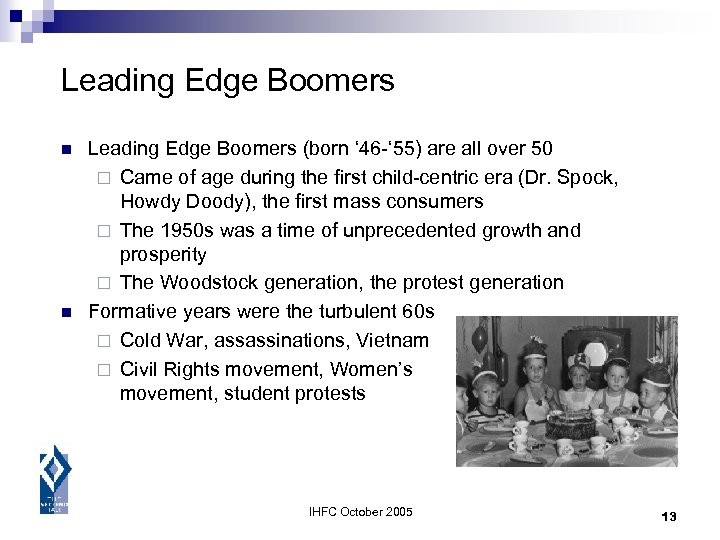 Leading Edge Boomers n n Leading Edge Boomers (born ‘ 46 -‘ 55) are all over 50 ¨ Came of age during the first child-centric era (Dr. Spock, Howdy Doody), the first mass consumers ¨ The 1950 s was a time of unprecedented growth and prosperity ¨ The Woodstock generation, the protest generation Formative years were the turbulent 60 s ¨ Cold War, assassinations, Vietnam ¨ Civil Rights movement, Women’s movement, student protests IHFC October 2005 13
 Leading Edge Boomers n n n Have always embraced the new and unknown, maybe because they felt so safe and secure Their numbers alone would be enough to change the world of aging, but it is their expectation that business and industry should meet their needs that is redefining everything ¨ “ 60 is the new 30” ¨ “age rebelliously” ¨ “the new middle age” They are still trying new things, new places IHFC October 2005 14
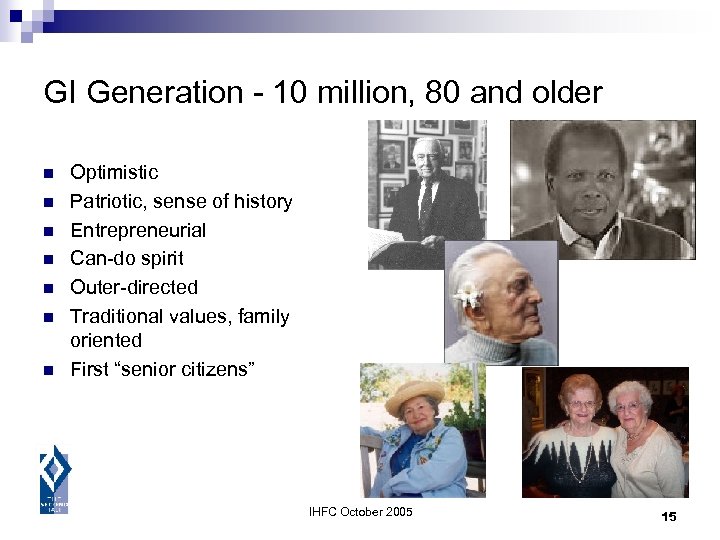 GI Generation - 10 million, 80 and older n n n n Optimistic Patriotic, sense of history Entrepreneurial Can-do spirit Outer-directed Traditional values, family oriented First “senior citizens” IHFC October 2005 15
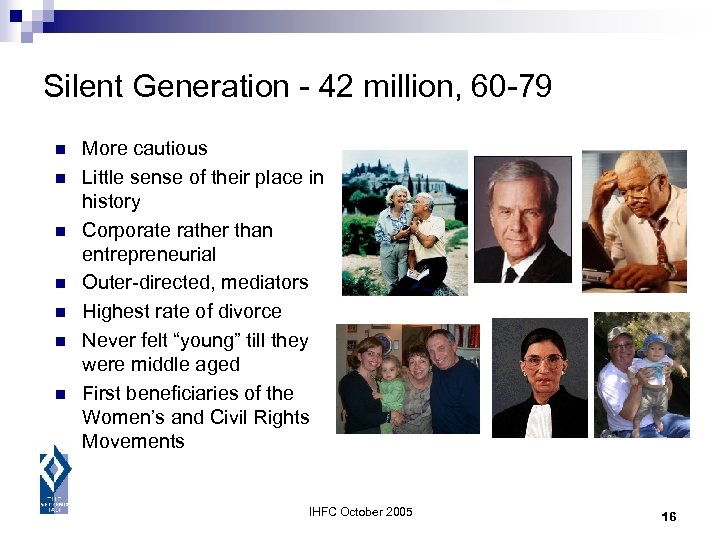 Silent Generation - 42 million, 60 -79 n n n n More cautious Little sense of their place in history Corporate rather than entrepreneurial Outer-directed, mediators Highest rate of divorce Never felt “young” till they were middle aged First beneficiaries of the Women’s and Civil Rights Movements IHFC October 2005 16
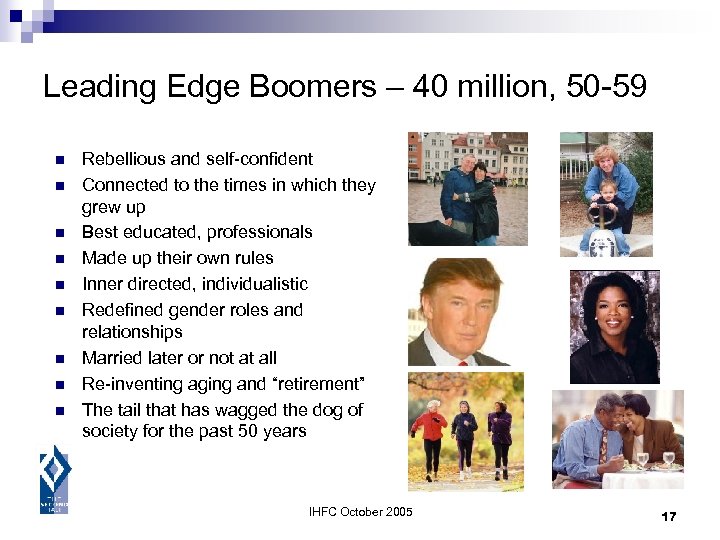 Leading Edge Boomers – 40 million, 50 -59 n n n n n Rebellious and self-confident Connected to the times in which they grew up Best educated, professionals Made up their own rules Inner directed, individualistic Redefined gender roles and relationships Married later or not at all Re-inventing aging and “retirement” The tail that has wagged the dog of society for the past 50 years IHFC October 2005 17
 Generations Defined by Their Wars IHFC October 2005 18
 Communications Implications n n n GI Generation ¨ Watch more television ¨ Patriotic, traditional values ¨ Respond to messages showing them as independent Silent Generation ¨ Still read newspapers regularly ¨ Value opinions of experts ¨ Respond to images of extended families, groups of friends Baby Boomers ¨ Use the Internet for information and shopping ¨ Anti-authority, less likely to respond to testimonials ¨ Respond to nostalgic settings, especially from the sixties IHFC October 2005 19
 Housing Trends n n Three out of four “seniors” live in conventional housing ¨ Most prefer to “age in place” rather than move to health-related facilities More than half of Leading Edge Baby Boomers will modify their homes over the next few years, allowing them to age in place ¨ Levers instead of door knobs ¨ Grab bars, walk-in showers in larger bathrooms ¨ Retractable chandeliers for easier access ¨ Wider doorways ¨ Skid-proof flooring materials ¨ Chairs and sofas that are easy to sit in and get up from ¨ Furniture that is easy to move for cleaning IHFC October 2005 20
 Housing for Older Adults n GI Generation was the first to move to Retirement Communities, starting in the early 1960 s Most were age-restricted communities (55+) Now called “Active Adult Communities, ” to appeal to the younger, more active Silents More recently, Continuing Care Communities have become popular, especially with people in their 70 s and 80 s Nursing home development is slowing down, while Assisted Living and other congregate living facilities are being built ¨ n n n IHFC October 2005 21
 Boomer Trends n Leading Edge Baby Boomers who want to sell the homes where they raised their families are looking for more luxurious housing They can have the homes they always wanted ¨ Separate guest suites (for visiting family) ¨ Dedicated home offices ¨ High-end, well appointed kitchens and baths ¨ Cutting-edge technology built in They won’t be ready for congregate living facilities for another 15 -20 years ¨ n IHFC October 2005 22
 Implications for Home Furnishings n n n Empty Nesters may downsize in space but go upscale in quality and luxury ¨ They can redecorate without worrying about children messing up their new furniture ¨ They can buy the homes they always wanted and furnish them accordingly Second or vacation homes are a growing trend Products should be designed to provide maximum comfort and accessibility IHFC October 2005 23
 More about the 50+ Market and Home Furnishings Opinion 50+ is… n Omnibus study among a projectable sample of 500 people per month, or 6, 000 per year n Quick, cost-effective way to size a market, identify behaviors, test purchase intent, or learn about attitudes n A way to track attitudes, awareness, or behavior over time We studied home furnishings in August IHFC October 2005 24
 Affluence Over 50: Second Home and Pleasure Boat Ownership Source: Opinion 50+, July/August 2005 IHFC October 2005 Base=1002 25
 Home Furnishings Source: Opinion 50+, July 2005 IHFC October 2005 Base=501 26
 It’s time for a change, and I can afford it IHFC October 2005 27
 Boomers’ furnishings more likely to be worn out, while GIs’ want things just for themselves IHFC October 2005 28
 People 50 and over want furnishings that are more comfortable and easier to care for IHFC October 2005 29
 Affordability is most important to the oldest segment, luxury to the middle group n n More than half the GIs responding said affordability was a major criterion (57%), but it’s much less important to Silents (17%) and Boomers (11%) Boomers are more concerned about comfort (49%) than are Silents (33%) or GIs (29%) Luxurious furnishings are more appealing to Silents (29%) than to Boomers (11%) Ease of care is a factor for all segments IHFC October 2005 30
 Bedrooms and living rooms are the most likely to be redecorated in primary residences IHFC October 2005 31
 Bedrooms and living rooms are the most likely to be redecorated in primary residences IHFC October 2005 32
 Flooring and wood or upholstered furniture are the most popular items when redecorating IHFC October 2005 33
 Boomers seem to favor furniture pieces and lighting; Silents are more likely to change flooring when redecorating primary residences IHFC October 2005 34
 On average, people spent more than $4, 800, but one in eight spent more than $10, 000 Mean=$4, 829 Median=$3, 625 IHFC October 2005 35
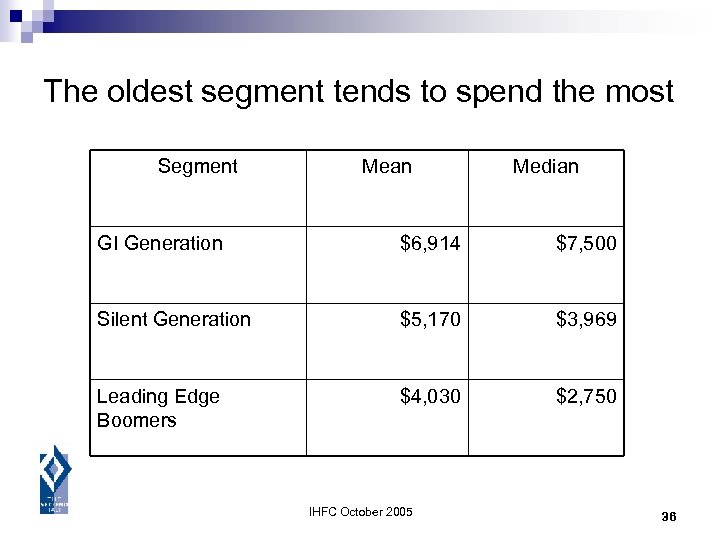 The oldest segment tends to spend the most Segment Mean Median GI Generation $6, 914 $7, 500 Silent Generation $5, 170 $3, 969 Leading Edge Boomers $4, 030 $2, 750 IHFC October 2005 36
 Presence of Children Under 18 Source: Opinion 50+, July 2005 IHFC October 2005 Base=381 37
 Internet Usage Source: Opinion 50+, July 2005 IHFC October 2005 Base=501 38
 Internet Activities Source: Opinion 50+, July 2005 Base=314 IHFC October 2005 39
 Learning more about the 50+ Market n Traditional research ¨ Surveys—phone, central location, online ¨ Focus n groups Seminars and workshops ¨ Product-specific, category-specific ¨ New product development, positioning, communications IHFC October 2005 40
 Main Take-Aways n n n Three segments in the 50+ population ¨ GI Generation (80+) ¨ Silent Generation (60 -79) ¨ Baby Boomers (50 -59) They want home furnishings that are comfortable, informal but high quality, and easy to care for Communications strategies and executions should be tailored to the segments’ “personalities” IHFC October 2005 41