


 Скачать презентацию The 43 rd APEC EWG Associate Meetings
a74e555c678029287461790ff48f65be.ppt
- Количество слайдов: 18
 The 43 rd APEC EWG & Associate Meetings Low Carbon Development for Samui Island, Thailand
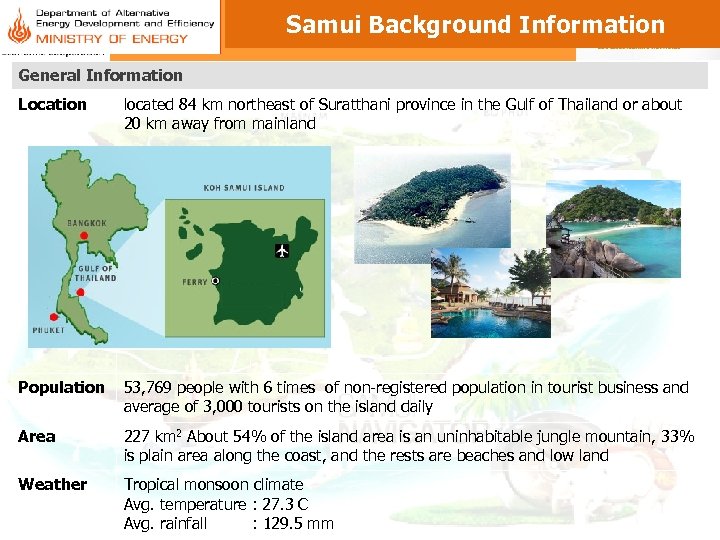 Samui Background Information General Information Location located 84 km northeast of Suratthani province in the Gulf of Thailand or about 20 km away from mainland Population 53, 769 people with 6 times of non-registered population in tourist business and average of 3, 000 tourists on the island daily Area 227 km 2 About 54% of the island area is an uninhabitable jungle mountain, 33% is plain area along the coast, and the rests are beaches and low land Weather Tropical monsoon climate Avg. temperature : 27. 3 C Avg. rainfall : 129. 5 mm
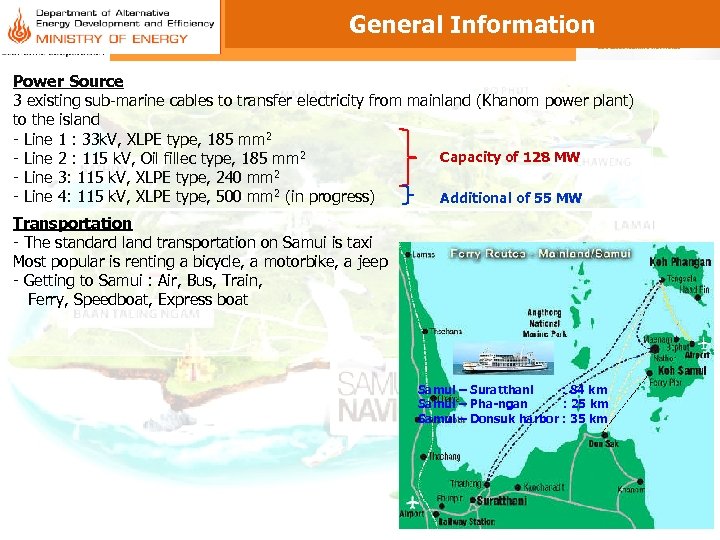 General Information Power Source 3 existing sub-marine cables to transfer electricity from mainland (Khanom power plant) to the island - Line 1 : 33 k. V, XLPE type, 185 mm 2 Capacity of 128 MW - Line 2 : 115 k. V, Oil fillec type, 185 mm 2 - Line 3: 115 k. V, XLPE type, 240 mm 2 - Line 4: 115 k. V, XLPE type, 500 mm 2 (in progress) Additional of 55 MW Transportation - The standard land transportation on Samui is taxi Most popular is renting a bicycle, a motorbike, a jeep - Getting to Samui : Air, Bus, Train, Ferry, Speedboat, Express boat Samui – Suratthani : 84 km Samui – Pha-ngan : 25 km Samui – Donsuk harbor : 35 km
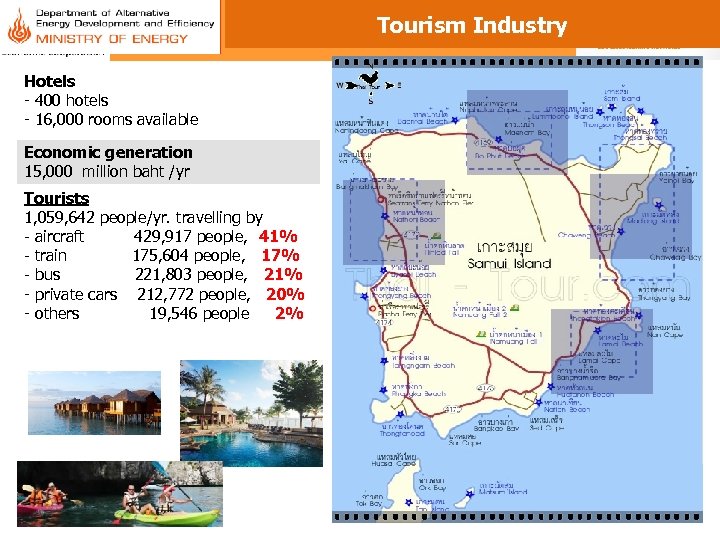 Tourism Industry Hotels - 400 hotels - 16, 000 rooms available Economic generation 15, 000 million baht /yr Tourists 1, 059, 642 people/yr. travelling by - aircraft 429, 917 people, 41% - train 175, 604 people, 17% - bus 221, 803 people, 21% - private cars 212, 772 people, 20% - others 19, 546 people 2%
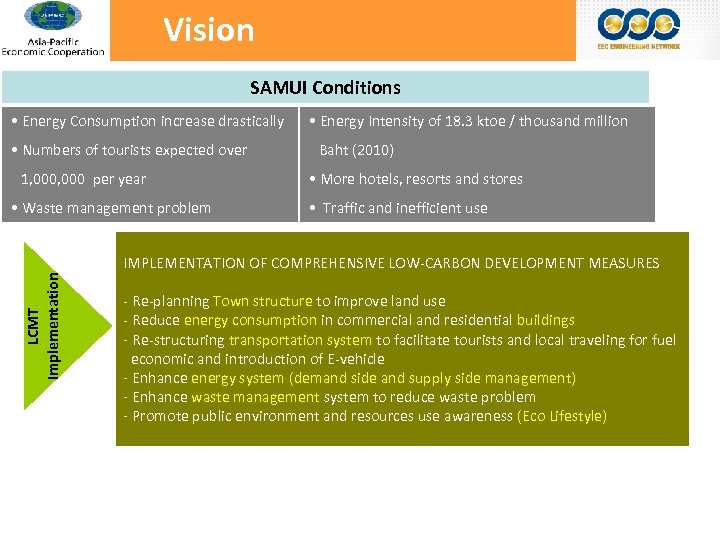 Vision SAMUI Conditions • Energy Consumption increase drastically • Numbers of tourists expected over 1, 000 per year • Waste management problem • Energy Intensity of 18. 3 ktoe / thousand million Baht (2010) • More hotels, resorts and stores • Traffic and inefficient use LCMT Implementation IMPLEMENTATION OF COMPREHENSIVE LOW-CARBON DEVELOPMENT MEASURES - Re-planning Town structure to improve land use - Reduce energy consumption in commercial and residential buildings - Re-structuring transportation system to facilitate tourists and local traveling for fuel economic and introduction of E-vehicle - Enhance energy system (demand side and supply side management) - Enhance waste management system to reduce waste problem - Promote public environment and resources use awareness (Eco Lifestyle)
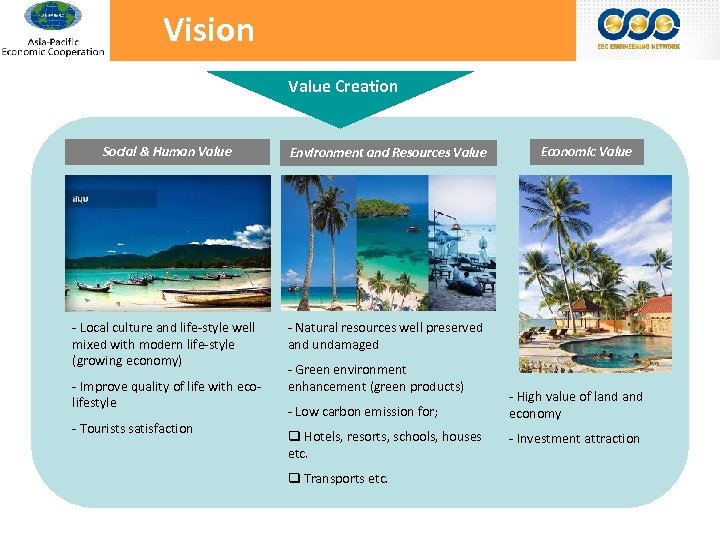 Vision Value Creation Social & Human Value Environment and Resources Value - Local culture and life-style well mixed with modern life-style (growing economy) - Natural resources well preserved and undamaged - Improve quality of life with ecolifestyle - Tourists satisfaction - Green environment enhancement (green products) Economic Value - Low carbon emission for; - High value of land economy q Hotels, resorts, schools, houses etc. - Investment attraction q Transports etc.
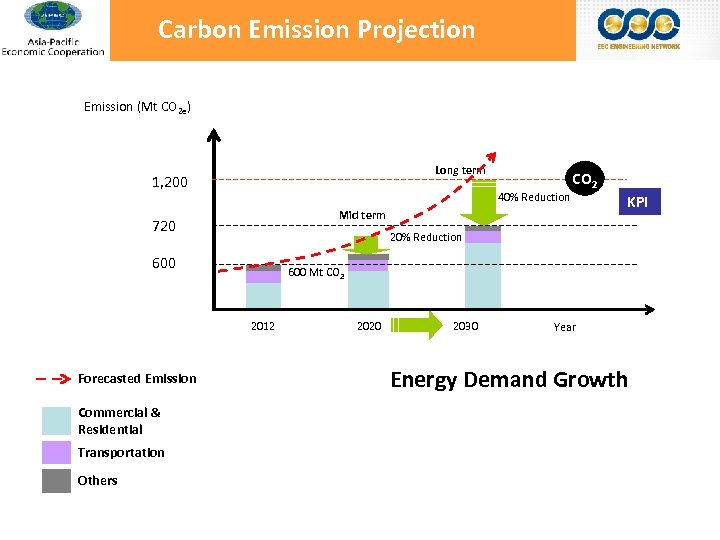 Carbon Emission Projection Emission (Mt CO 2 e) Long term 1, 200 40% Reduction Mid term 720 600 Mt CO 2 2012 Commercial & Residential Transportation Others KPI 20% Reduction 600 Forecasted Emission CO 2 2020 2030 Year Energy Demand Growth
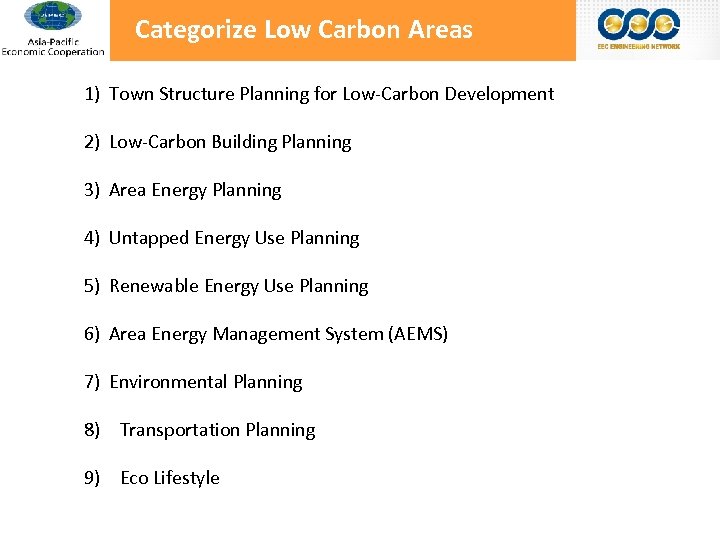 Categorize Low Carbon Areas 1) Town Structure Planning for Low-Carbon Development 2) Low-Carbon Building Planning 3) Area Energy Planning 4) Untapped Energy Use Planning 5) Renewable Energy Use Planning 6) Area Energy Management System (AEMS) 7) Environmental Planning 8) Transportation Planning 9) Eco Lifestyle
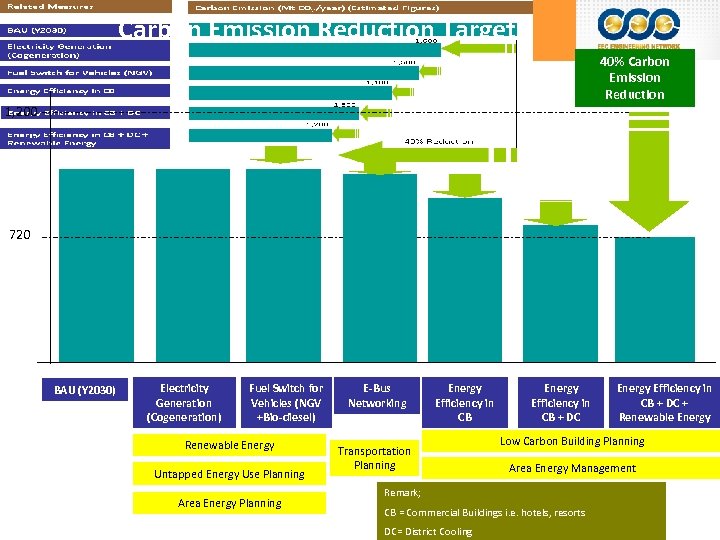 Carbon Emission Reduction Target 40% Carbon Emission Reduction Carbon Emission (Mt CO 2/year) (Estimated Figures) 1, 200 720 BAU (Y 2030) Electricity Generation (Cogeneration) Fuel Switch for Vehicles (NGV +Bio-diesel) Renewable Energy Untapped Energy Use Planning Area Energy Planning E-Bus Networking Energy Efficiency in CB Transportation Planning Energy Efficiency in CB + DC Low Carbon Building Planning Area Energy Management Remark; CB = Commercial Buildings i. e. hotels, resorts DC= District Cooling Energy Efficiency in CB + DC + Renewable Energy
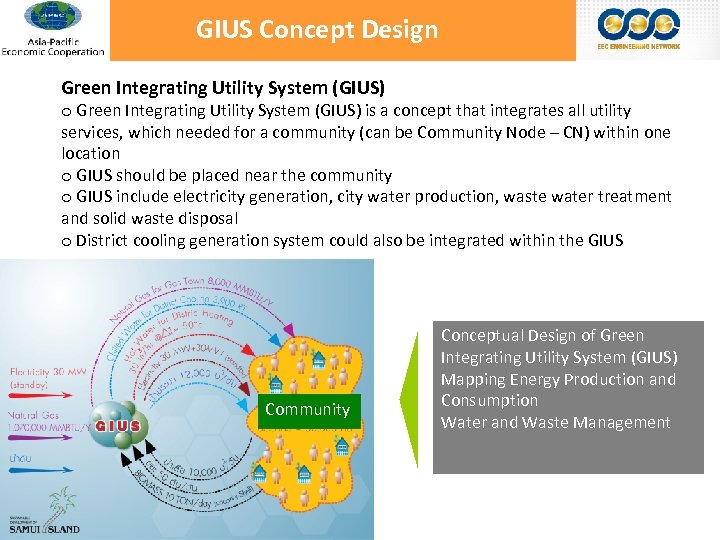 GIUS Concept Design Green Integrating Utility System (GIUS) o Green Integrating Utility System (GIUS) is a concept that integrates all utility services, which needed for a community (can be Community Node – CN) within one location o GIUS should be placed near the community o GIUS include electricity generation, city water production, waste water treatment and solid waste disposal o District cooling generation system could also be integrated within the GIUS Community Conceptual Design of Green Integrating Utility System (GIUS) Mapping Energy Production and Consumption Water and Waste Management
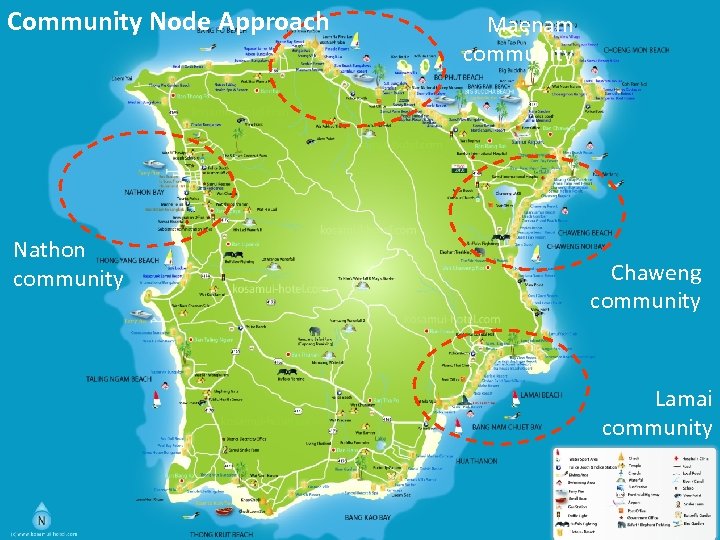 Community Node Approach Nathon community Maenam community Chaweng community Lamai community
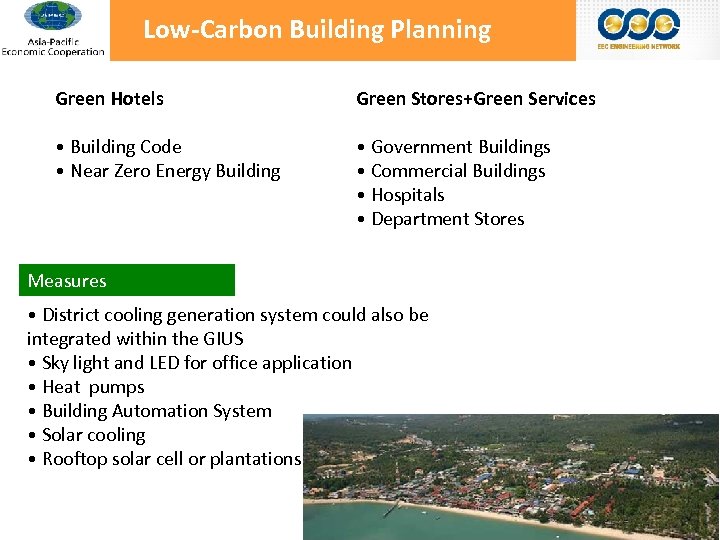 Low-Carbon Building Planning Green Hotels Green Stores+Green Services • Building Code • Near Zero Energy Building • Government Buildings • Commercial Buildings • Hospitals • Department Stores Measures • District cooling generation system could also be integrated within the GIUS • Sky light and LED for office application • Heat pumps • Building Automation System • Solar cooling • Rooftop solar cell or plantations
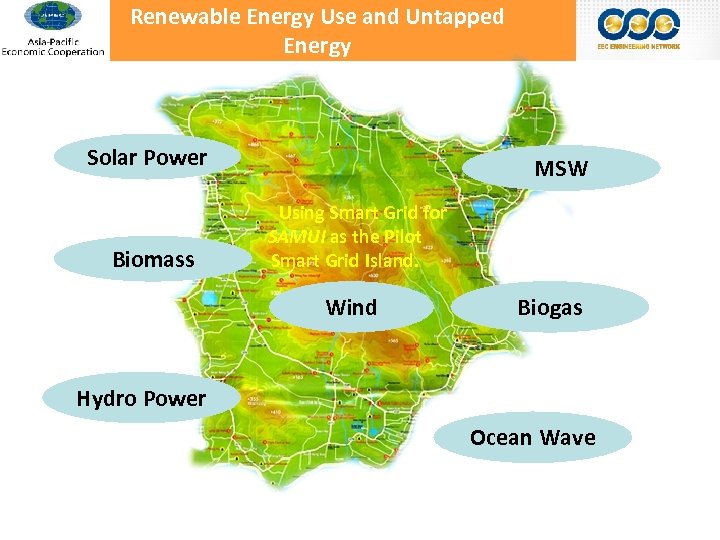 Renewable Energy Use and Untapped Energy Solar Power Biomass MSW Using Smart Grid for SAMUI as the Pilot Smart Grid Island. Wind Biogas Hydro Power Ocean Wave
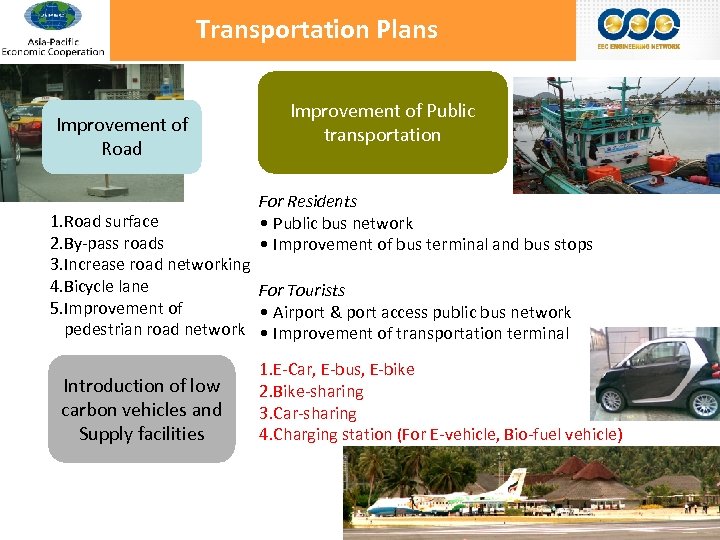 Transportation Plans Improvement of Road Improvement of Public transportation For Residents • Public bus network • Improvement of bus terminal and bus stops 1. Road surface 2. By-pass roads 3. Increase road networking 4. Bicycle lane For Tourists 5. Improvement of • Airport & port access public bus network pedestrian road network • Improvement of transportation terminal • Information system for providing the 1. transportation and tourist attractions E-Car, E-bus, E-bike Introduction of low 2. Bike-sharing carbon vehicles and 3. Car-sharing Supply facilities 4. Charging station (For E-vehicle, Bio-fuel vehicle)
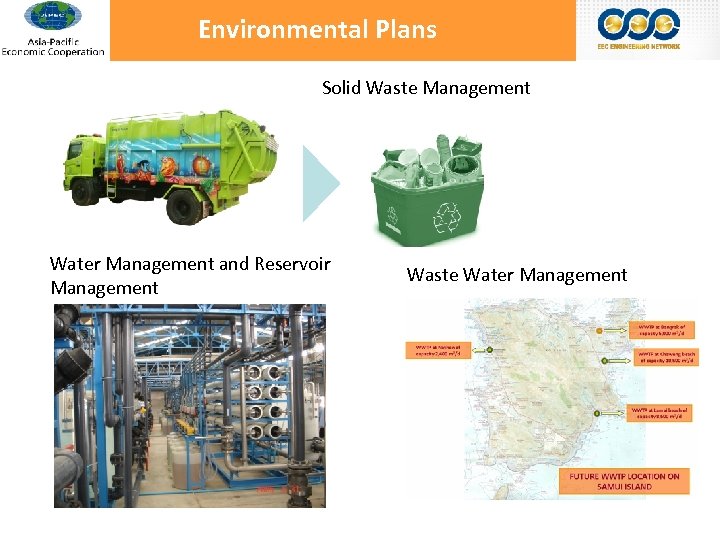 Environmental Plans Solid Waste Management Water Management and Reservoir Management Waste Water Management
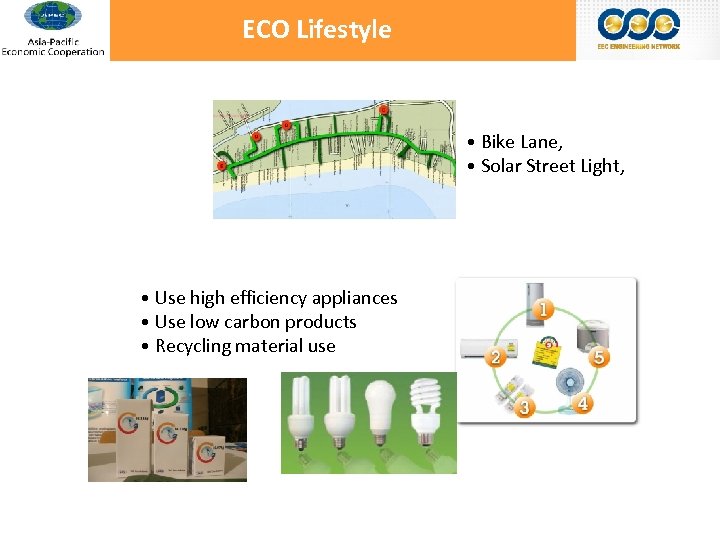 ECO Lifestyle • Bike Lane, • Solar Street Light, • Use high efficiency appliances • Use low carbon products • Recycling material use
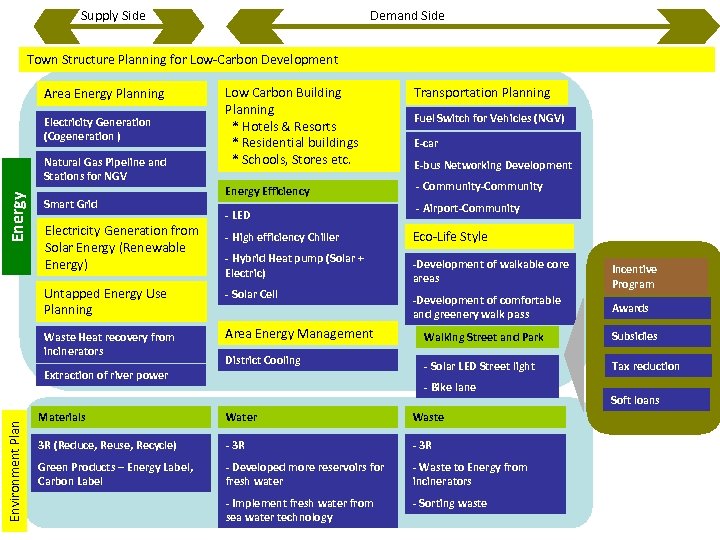 Supply Side Demand Side Town Structure Planning for Low-Carbon Development Area Energy Planning Electricity Generation (Cogeneration ) Energy Natural Gas Pipeline and Stations for NGV Smart Grid Electricity Generation from Solar Energy (Renewable Energy) Low Carbon Building Planning * Hotels & Resorts * Residential buildings * Schools, Stores etc. Transportation Planning Energy Efficiency - Community-Community - LED Fuel Switch for Vehicles (NGV) E-car E-bus Networking Development - Airport-Community - High efficiency Chiller Eco-Life Style - Hybrid Heat pump (Solar + Electric) Untapped Energy Use Planning -Development of walkable core areas - Solar Cell Incentive Program -Development of comfortable and greenery walk pass Awards Waste Heat recovery from incinerators Area Energy Management Walking Street and Park Subsidies District Cooling - Solar LED Street light Tax reduction Environment Plan Extraction of river power - Bike lane Materials Water Waste 3 R (Reduce, Reuse, Recycle) - 3 R Green Products – Energy Label, Carbon Label - Developed more reservoirs for fresh water - Waste to Energy from incinerators - Implement fresh water from sea water technology - Sorting waste Soft loans
 Thank You For Your Attention